


Speaker output power describes how much electrical power a speaker can handle or deliver as acoustic output under defined conditions. It is usually expressed in watts and is one of the most common specifications used when selecting speakers for public address systems, paging systems, conference rooms, classrooms, factories, transportation facilities, commercial buildings, and outdoor notification projects.
Speaker output power is important, but it does not tell the whole story. Real loudness and clarity also depend on sensitivity, distance, room acoustics, amplifier matching, installation height, and background noise.
Basic Meaning of Speaker Output Power
Speaker output power refers to the rated power level associated with a loudspeaker. In practical audio design, it helps engineers understand whether a speaker is suitable for a small room, a large hall, an outdoor area, a noisy industrial zone, or a distributed paging system.
A higher wattage rating usually means the speaker can handle more electrical power, but it does not automatically mean the speaker will sound better or louder in every situation. A highly efficient 10W speaker may sound louder than a low-efficiency 20W speaker at the same distance. That is why output power should always be reviewed together with sensitivity and sound pressure level.
Power Handling and Acoustic Output
Power handling indicates how much electrical power the speaker can accept without overheating, mechanical damage, or serious distortion. Acoustic output describes how effectively the speaker converts that electrical energy into sound.
These two ideas are related but not identical. A speaker with strong power handling may still need good driver design, enclosure tuning, and suitable placement to produce clear and useful sound. In public address and paging systems, intelligibility is often more important than raw loudness.
Why Watts Are Used
Watts are used because speakers receive electrical power from an amplifier or built-in audio module. The watt value helps match speakers, amplifiers, speaker lines, and system zones. It also helps estimate coverage, volume capability, and power budget.
For IP speakers and active speakers, the rated output power may refer to the built-in amplifier power. For passive speakers, the watt rating usually describes how much external amplifier power the speaker can handle safely.
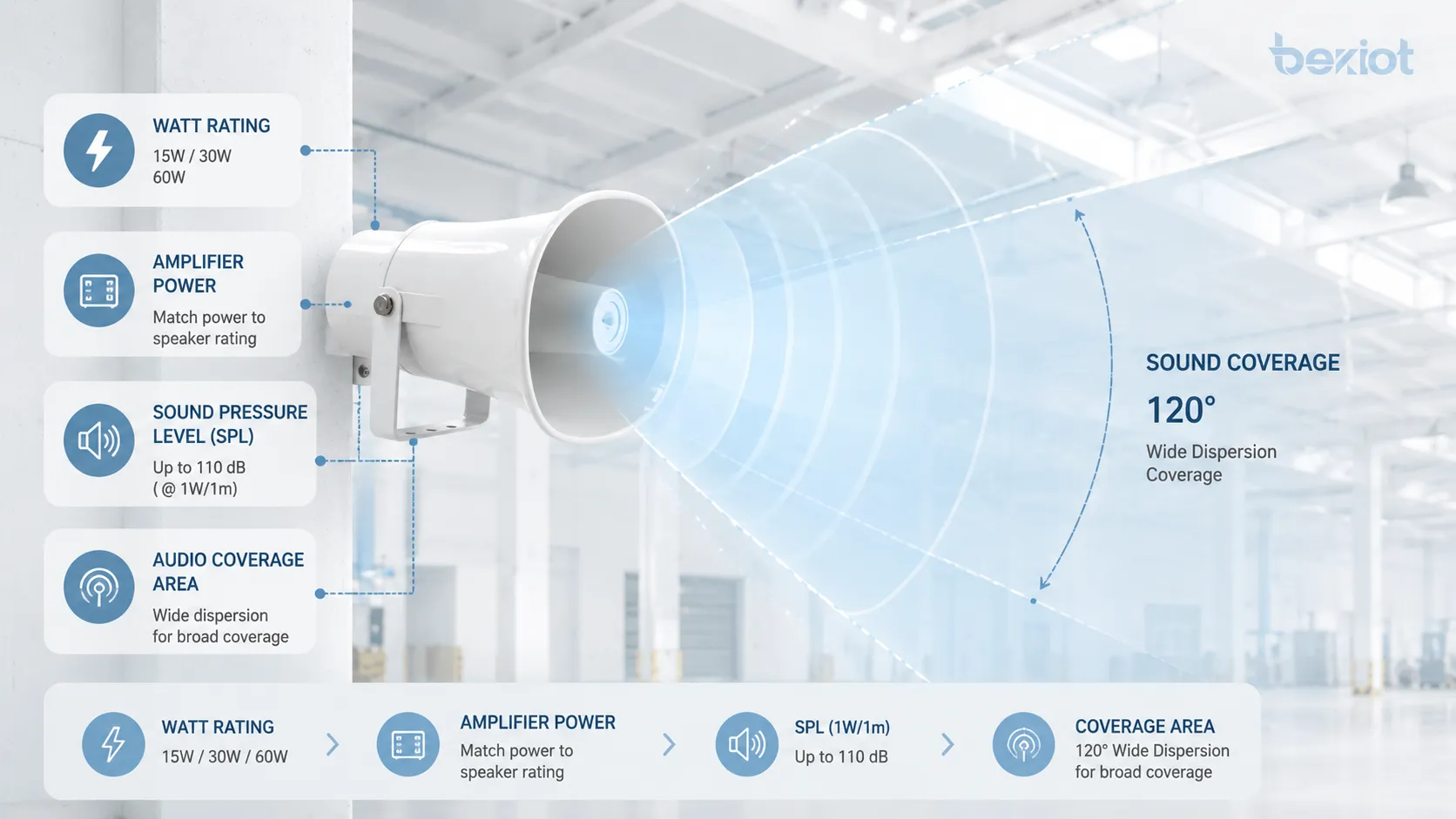
RMS, Program, and Peak Power
One of the most common mistakes in speaker selection is comparing wattage values without checking how they are measured. Speaker power may be listed as RMS power, continuous power, program power, peak power, or maximum power. These ratings do not mean the same thing.
For reliable project design, RMS or continuous power is usually more useful than peak power because it better reflects long-term operating capability. Peak power may show short-term tolerance, but it can be misleading if used as the main selection basis.
RMS or Continuous Power
RMS power, often treated similarly to continuous power in product specifications, indicates the power level a speaker can handle over a longer period under defined test conditions. It is one of the most practical values for system design.
When selecting speakers for background music, paging, emergency announcements, and daily broadcast, continuous power is more meaningful than a short peak number. It helps prevent overheating, distortion, and premature speaker failure.
Program Power
Program power is often higher than continuous power and is intended to represent typical audio program material, where average power is lower than short dynamic peaks. It may be used in professional audio specifications, but the exact meaning can vary by manufacturer.
Because program power is less standardized than continuous power, it should be interpreted carefully. Engineers should check manufacturer documentation and avoid using program power alone for amplifier sizing.
Peak Power
Peak power refers to the highest short-duration power level the speaker may tolerate for brief moments. This number is usually much higher than continuous power, but it does not represent safe long-term operation.
Using peak power as the main design value can lead to amplifier mismatch, distorted sound, and speaker damage. In professional projects, peak power should be seen as a short-term reference, not the normal operating target.
How Output Power Affects Loudness
Speaker output power affects loudness, but the relationship is not linear. Doubling amplifier power does not double perceived loudness. In acoustic terms, doubling power usually increases sound pressure level by about 3 dB, assuming the same speaker and conditions.
To make sound seem roughly twice as loud to human hearing, a much larger increase in power may be needed. This is why speaker sensitivity, placement, and acoustic environment can be just as important as wattage.
Power and Sound Pressure Level
Sound pressure level, or SPL, is normally measured in decibels. A speaker specification may state sensitivity as dB at 1 watt and 1 meter, such as 90 dB SPL at 1W/1m. This means the speaker produces 90 dB at one meter when receiving one watt of input power.
If the same speaker receives more power, SPL increases. However, distance reduces loudness. In open space, sound level usually drops as listeners move farther away from the speaker. This is why coverage planning is necessary for large areas.
Sensitivity Matters
Sensitivity tells how efficiently a speaker converts electrical power into sound. A speaker with higher sensitivity needs less power to reach the same loudness. This can reduce amplifier load and improve system efficiency.
For example, a high-sensitivity speaker rated at 10W may provide enough volume for a paging zone, while a lower-sensitivity speaker may need more power to achieve similar coverage. Comparing wattage without sensitivity can lead to poor selection.
Distortion at High Power
When a speaker is driven close to or beyond its rated power, distortion may increase. The voice coil may heat up, the cone may move beyond its linear range, and the sound may become harsh or unclear.
In voice announcement and emergency notification systems, excessive distortion is a serious problem because it can reduce speech intelligibility. A system should be designed with enough headroom so that speakers do not operate at their limit during normal use.
Technical Features Behind Power Ratings
Speaker power capability depends on several technical factors, including driver size, voice coil design, magnetic structure, enclosure material, cooling, impedance, transformer taps, amplifier design, and protection circuits.
Voice Coil and Heat Dissipation
The voice coil converts electrical current into mechanical movement. When power flows through the coil, heat is generated. If the heat cannot be controlled, the coil may deform, burn, or lose efficiency.
Good speaker design uses suitable coil materials, ventilation, magnetic structure, and enclosure design to manage heat. In high-duty systems, thermal performance can be just as important as rated wattage.
Impedance and Amplifier Matching
Low-impedance speakers commonly use ratings such as 4Ω, 6Ω, or 8Ω. The amplifier must support the speaker impedance and total load. If too many speakers are connected in the wrong way, the amplifier may overheat or enter protection mode.
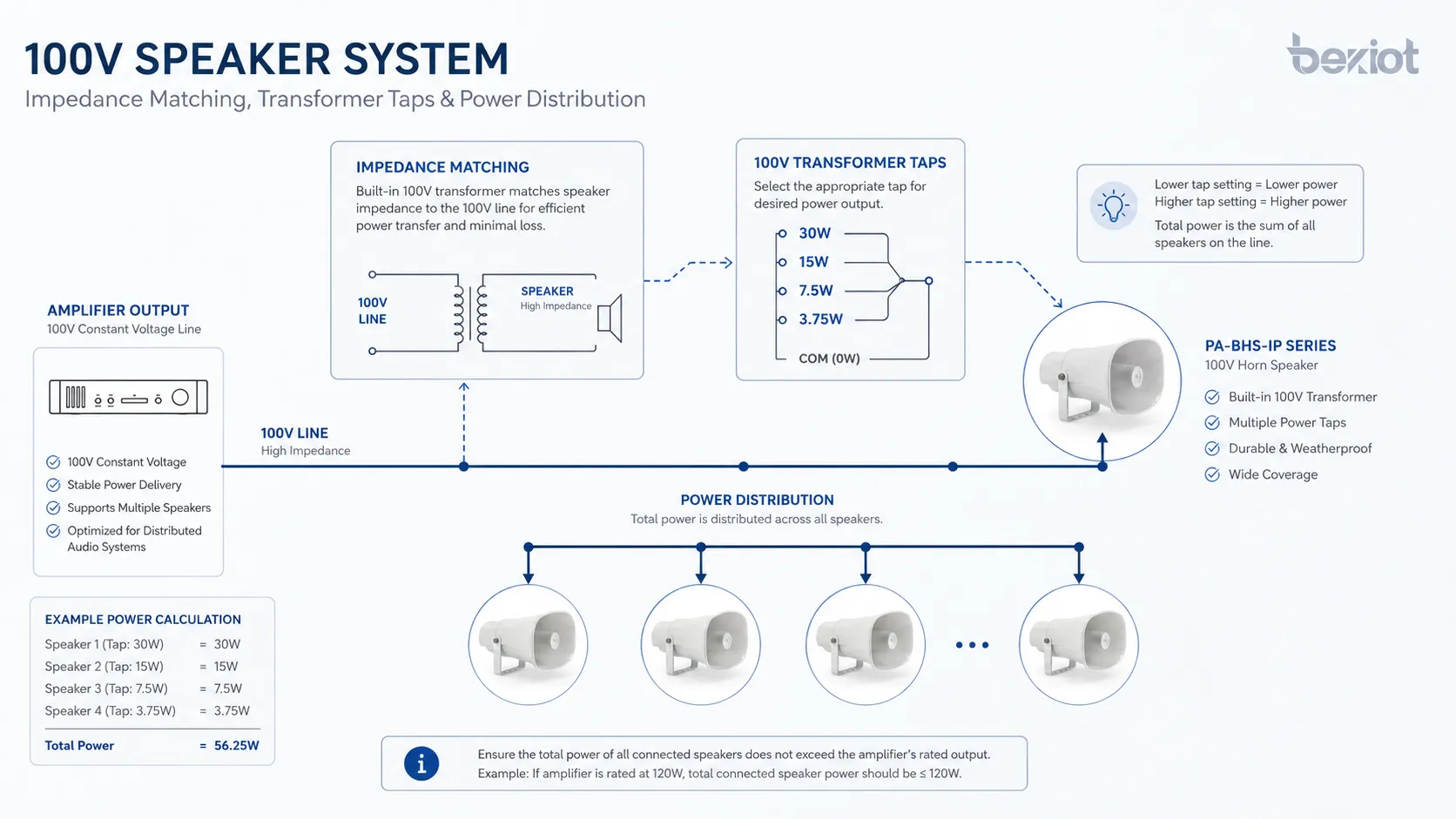
In distributed public address systems, 70V or 100V constant-voltage speaker lines are often used. These systems use transformer taps to assign power levels to each speaker, making it easier to connect multiple speakers over longer distances.
Transformer Tap Settings
Many ceiling speakers, horn speakers, wall speakers, and column speakers for PA systems include selectable transformer taps such as 3W, 6W, 10W, 15W, 30W, or higher. The selected tap determines how much power that speaker draws from the amplifier line.
Correct tap selection helps balance loudness across zones. A quiet office corridor may need a lower tap, while a noisy workshop or outdoor area may need a higher tap. The total tap power of all speakers should remain within the amplifier capacity, with proper headroom.
Audio Benefits of Proper Power Design
Correct speaker output power design improves more than volume. It supports clearer speech, more stable operation, lower distortion, better coverage, and longer equipment life.
Clearer Speech and Announcements
In paging and public address systems, the main goal is often speech intelligibility. The speaker must be loud enough to overcome background noise, but not so loud that it becomes harsh or uncomfortable.
Proper power design helps deliver voice announcements at a usable sound level. This is important in schools, factories, transport stations, warehouses, office buildings, shopping centers, and emergency notification systems.
More Stable Daily Operation
When speakers and amplifiers are correctly matched, the system is less likely to suffer from clipping, overheating, distorted output, or sudden shutdown. This improves reliability for daily broadcast and emergency use.
A stable power design also helps maintenance teams because equipment is not constantly operating near its limit. The result is fewer failures, better user experience, and lower long-term service cost.
Balanced Coverage Across Zones
Different areas may require different sound levels. A lobby, corridor, machinery room, outdoor loading area, and control room cannot be treated the same. Speaker output power helps designers balance each zone according to space size and noise level.
Zone-based design is especially useful in commercial buildings, campuses, hospitals, airports, factories, and public facilities. It helps avoid areas that are too quiet, too loud, or unevenly covered.
Common Applications
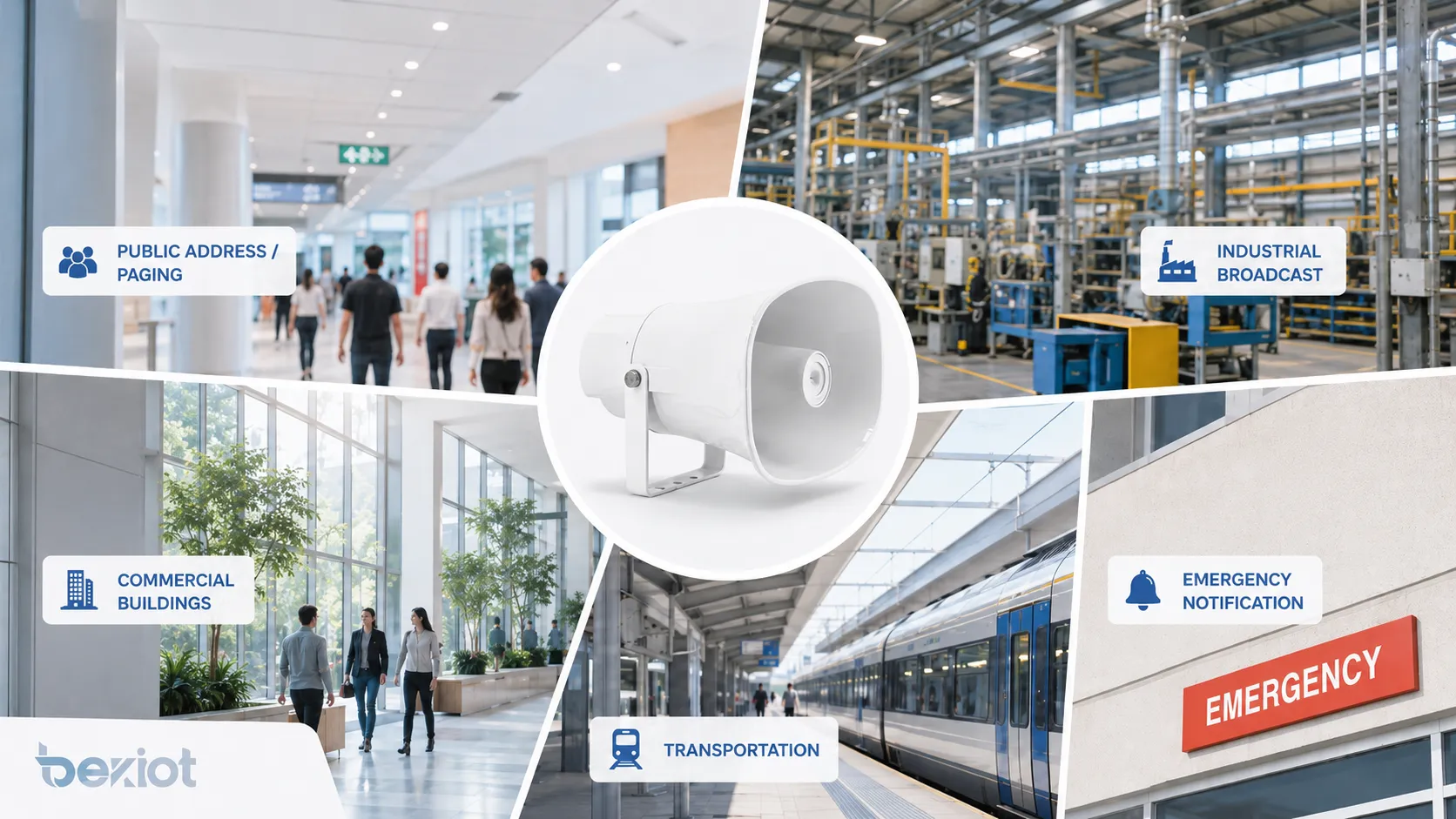
Speaker output power is a key factor in many audio and communication systems. The required power level depends on whether the goal is background music, speech reinforcement, paging, alarm notification, industrial broadcast, or outdoor warning.
Public Address and Paging Systems
Public address systems use speakers to deliver announcements, schedules, safety messages, background music, and emergency instructions. Output power must be high enough to cover the intended area clearly.
For IP-based PA projects, Becke Telcom PA-BHS-IP series speakers can be used as part of a network audio and paging solution where zone broadcast, SIP-based communication, and centralized management are required. The selection should still consider site noise, mounting position, required SPL, and network architecture.
Industrial and Outdoor Broadcast
Industrial sites and outdoor areas often need higher speaker output because of machinery noise, open space, distance, wind, and environmental challenges. Horn speakers and weather-resistant speakers are commonly used in these scenarios.
Power design should consider background noise level, coverage radius, mounting height, directionality, enclosure rating, corrosion resistance, and emergency announcement requirements. In high-noise areas, visual alerts may also be needed to support audio notification.
Conference Rooms and Classrooms
Conference rooms and classrooms usually require moderate output power with high clarity. The speaker should provide even coverage without causing echo, feedback, or listener fatigue.
In these environments, acoustic treatment, microphone placement, DSP processing, and speaker positioning may matter more than very high wattage. A properly placed lower-power speaker system may outperform an overpowered but poorly designed system.
Commercial Buildings and Retail Spaces
Retail stores, hotels, offices, restaurants, and public buildings often use distributed ceiling or wall speakers. Output power is selected to provide comfortable background music and clear announcements without disturbing occupants.
Transformer tap settings are useful in these projects because different zones can be adjusted according to ceiling height, ambient noise, and usage pattern.
Transportation and Emergency Notification
Airports, railway stations, bus terminals, tunnels, parking areas, and emergency evacuation systems require reliable audio coverage. Speaker output power must support clear instructions during both normal and emergency conditions.
Emergency systems should be designed with enough headroom and redundancy. The system must remain intelligible even when background noise increases during abnormal events.
How to Choose the Right Output Power
Choosing speaker output power requires a practical review of the installation environment. A small quiet room may need only a few watts, while a noisy workshop or outdoor zone may need much higher output.
Measure or Estimate Background Noise
The speaker must be louder than the background noise by a suitable margin. For voice announcements, the difference between speech level and ambient noise is important for intelligibility.
In quiet offices, lower output power may be enough. In factories, tunnels, stations, warehouses, and outdoor areas, designers may need higher-power speakers, directional horns, more speaker points, or closer spacing.
Calculate Coverage Distance
Sound level decreases with distance. A speaker that sounds loud at one meter may be much quieter at ten meters. Coverage planning should consider room size, ceiling height, mounting angle, speaker directivity, and listener position.
For large spaces, using multiple speakers at moderate power may provide better coverage than using one very loud speaker. This can improve comfort and reduce uneven sound distribution.
Match Amplifier Capacity
For passive systems, amplifier capacity should match the speaker load. In 100V systems, add the transformer tap values of all speakers in the zone, then choose an amplifier with enough capacity and headroom.
For active IP speakers, check built-in amplifier rating, PoE power class, DC power requirement, maximum SPL, and network management features. The speaker must receive enough power to operate reliably at the required output level.
Allow Headroom
Headroom means extra capacity above normal operating level. A system with no headroom may distort during loud announcements or dynamic peaks. A system with reasonable headroom can operate more cleanly and reliably.
Headroom is especially important in emergency announcements, industrial paging, outdoor broadcast, and high-ceiling spaces. It helps maintain clarity when the system is under stress.
Common Mistakes to Avoid
Speaker output power is easy to misunderstand. Many selection errors come from focusing only on wattage and ignoring acoustic, electrical, and environmental factors.
Choosing by Watts Alone
A higher watt number does not always mean better sound. Sensitivity, SPL, frequency response, dispersion angle, distortion, and installation position can have a major impact on real performance.
When comparing speakers, review the full specification. For paging and announcement systems, intelligibility and coverage are usually more important than the largest watt rating.
Ignoring Amplifier and Line Loss
In long cable runs, line loss can reduce delivered power. Poor cable sizing, wrong impedance, overloaded amplifier channels, or excessive speaker load can reduce volume and reliability.
For distributed systems, calculate total load carefully and use suitable cable. In IP speaker systems, verify PoE budget, switch capacity, network stability, and power redundancy.
Overpowering the Speaker
Sending too much power to a speaker can cause overheating, mechanical damage, distortion, or permanent failure. This may happen when amplifier power is too high, limiter settings are wrong, or users increase volume beyond the design limit.
Protection settings, proper amplifier matching, and user access control can reduce this risk. For installed systems, volume limits should be configured during commissioning.
Maintenance and Testing Tips
Speaker output performance can change over time because of dust, moisture, corrosion, cable aging, amplifier problems, configuration changes, or physical damage. Regular maintenance helps keep the system reliable.
Check Sound Level and Clarity
Periodic listening tests should confirm that announcements are loud and clear in each zone. If possible, sound pressure level measurements can be used to verify coverage against the project design.
Testing should be done under real conditions, not only during quiet hours. A system that sounds clear at night may be difficult to hear during production, traffic, or peak occupancy.
Inspect Wiring and Mounting
Loose terminals, damaged cables, corroded connectors, broken brackets, and water ingress can all affect speaker performance. Outdoor and industrial speakers should be inspected more frequently than indoor office speakers.
Mounting direction should also be checked. A speaker that has shifted angle may no longer cover the intended area.
Review Amplifier and Network Status
Amplifiers should be checked for overload, clipping, abnormal temperature, fault indicators, and channel output. For IP speakers, network registration, power status, firmware, and platform connection should also be monitored.
When system settings change, such as zone routing, volume level, SIP registration, or broadcast priority, the affected speakers should be tested again.
FAQ
What does speaker output power mean?
Speaker output power refers to the watt rating associated with a speaker or its built-in amplifier. It helps indicate how much power the speaker can handle or deliver and supports system planning for loudness, coverage, and amplifier matching.
Does higher speaker wattage mean louder sound?
Not always. Higher wattage can support higher output, but actual loudness also depends on speaker sensitivity, distance, acoustic environment, installation position, amplifier performance, and distortion level.
What is the difference between RMS and peak power?
RMS or continuous power describes a more practical long-term operating level. Peak power describes a short-duration maximum tolerance. For project design, RMS or continuous power is usually more reliable than peak power.
How do I choose speaker output power for a PA system?
Consider background noise, room size, mounting height, coverage distance, speech intelligibility, amplifier capacity, transformer tap settings, and required headroom. For distributed systems, multiple properly placed speakers often work better than one oversized speaker.
Why is speaker sensitivity important?
Sensitivity shows how efficiently a speaker converts power into sound. A higher-sensitivity speaker can produce more sound with the same power, which may reduce amplifier demand and improve system efficiency.
Can IP speakers use output power ratings?
Yes. IP speakers often include built-in amplifiers, so their output power rating helps estimate loudness and coverage. For network PA projects, options such as Becke Telcom PA-BHS-IP series speakers can be evaluated together with SPL, PoE power, SIP compatibility, mounting method, and application environment.







