


A SIP gateway is a communication device that connects a SIP-based IP voice environment with another type of telephony environment, such as analog phones, fax machines, legacy PBX systems, PSTN trunks, FXS or FXO interfaces, or digital voice circuits. In practical terms, it acts as a bridge between two different communication worlds. On one side is the SIP and IP communications domain. On the other side is a legacy, analog, or circuit-based telephony domain that still needs to interoperate with the modern network.
This is why SIP gateways are so important in real communication projects. Most organizations do not replace every legacy voice device, analog line, or PBX interface all at once. They usually migrate in stages. A SIP gateway makes that staged migration possible by translating and connecting different voice environments so they can work together. It can allow analog phones to operate in an IP telephony system, let an IP PBX connect to PSTN trunks, or help older branch systems interoperate with modern SIP services.
SIP gateways appear in many forms, including analog gateways, digital trunk gateways, FXS gateways, FXO gateways, media gateways, and hybrid voice gateways. Some are small devices for branch office or SMB use, while others are large carrier-grade or enterprise-grade systems used for trunking, access migration, and large-scale interconnection. What unifies them is the role they play: making SIP communications interoperable with non-SIP or differently structured telephony resources.
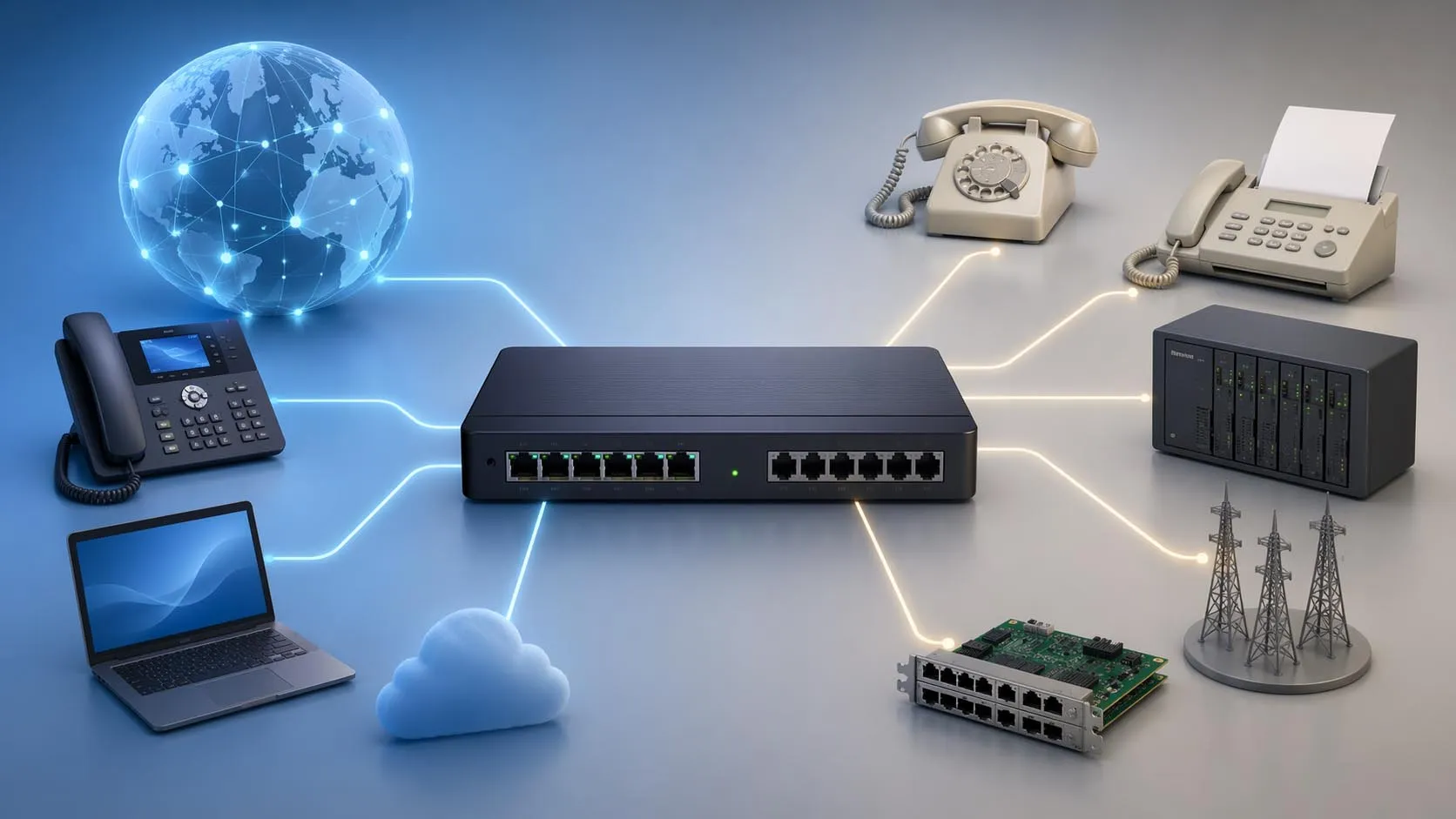
SIP gateways bridge SIP-based voice systems and legacy telephony resources such as analog devices, PBXs, and PSTN access.
What Is a SIP Gateway?
Basic definition
A SIP gateway is a voice gateway that uses SIP signaling on the IP side and provides interworking to another telephony interface or voice environment on the other side. SIP itself is the Session Initiation Protocol, defined as an application-layer signaling protocol used to create, modify, and terminate sessions such as Internet telephony calls. In a SIP gateway, that SIP signaling is used to communicate with IP PBXs, SIP servers, service providers, or hosted voice platforms.
The gateway’s job is not limited to passing packets. It also handles the translation between SIP-based session control and the signaling, media, interface, and line behaviors of the non-SIP side. That is what makes it a gateway rather than just a generic network device.
Why it is called a gateway
The term gateway is important because the device connects two different environments. A SIP gateway is not merely another SIP endpoint like a desk phone. It is an interoperability bridge. AudioCodes, for example, describes its analog and ISDN media gateways as devices for connecting legacy telephones, fax machines, and PBX systems with IP telephony networks and IP-based PBX systems. Ribbon similarly describes media gateways that can act as SIP gateways or VoIP gateways for access and trunking in fixed, mobile, and enterprise environments.
This gateway role is what makes the device valuable in migration, integration, and interconnection projects. It allows one side of the system to continue using established telephony resources while the other side operates in a modern SIP environment.
A SIP gateway is best understood as the bridge between SIP-based IP telephony and legacy, analog, digital, or non-SIP voice infrastructure.
How a SIP Gateway Works
The SIP side of the gateway
On the IP side, the gateway behaves like a SIP-aware voice device. It can register to a SIP platform, interact with a SIP trunk, or exchange SIP signaling with an IP PBX, SIP server, or service provider. Cisco documentation on SIP trunk registration for gateways shows how SIP registration can represent the gateway side of a trunk and support routing for multiple dial peers or endpoints. This reflects the reality that the SIP gateway participates actively in SIP call control rather than acting as a passive converter.
This SIP-side participation is what allows the gateway to integrate into the wider IP voice architecture of the site or service provider environment.
The legacy or non-SIP side of the gateway
On the other side, the gateway interfaces with analog telephones, fax devices, legacy PBXs, FXS or FXO circuits, E1 or T1 trunks, or other telephony interfaces depending on the model. AudioCodes and Ribbon both explicitly describe their gateway portfolios in terms of connecting analog, digital, and legacy telephony resources into IP and SIP environments.
This side of the gateway is where the physical or legacy telephony world is anchored. It is also what determines the practical category of the device, such as analog gateway, digital trunk gateway, or hybrid media gateway.
Signaling and media conversion
Once a call is initiated, the SIP gateway translates signaling and media between the two sides. The SIP side may speak in terms of SIP sessions, codecs, and IP call routing, while the legacy side may involve analog line conditions, TDM trunk behavior, or PBX signaling expectations. The gateway manages this translation so that the call can proceed end to end even though the two sides do not use the same native communication model.
This conversion role is what makes SIP gateways essential in mixed environments. Without that translation layer, many older devices and circuits could not participate directly in modern SIP telephony.
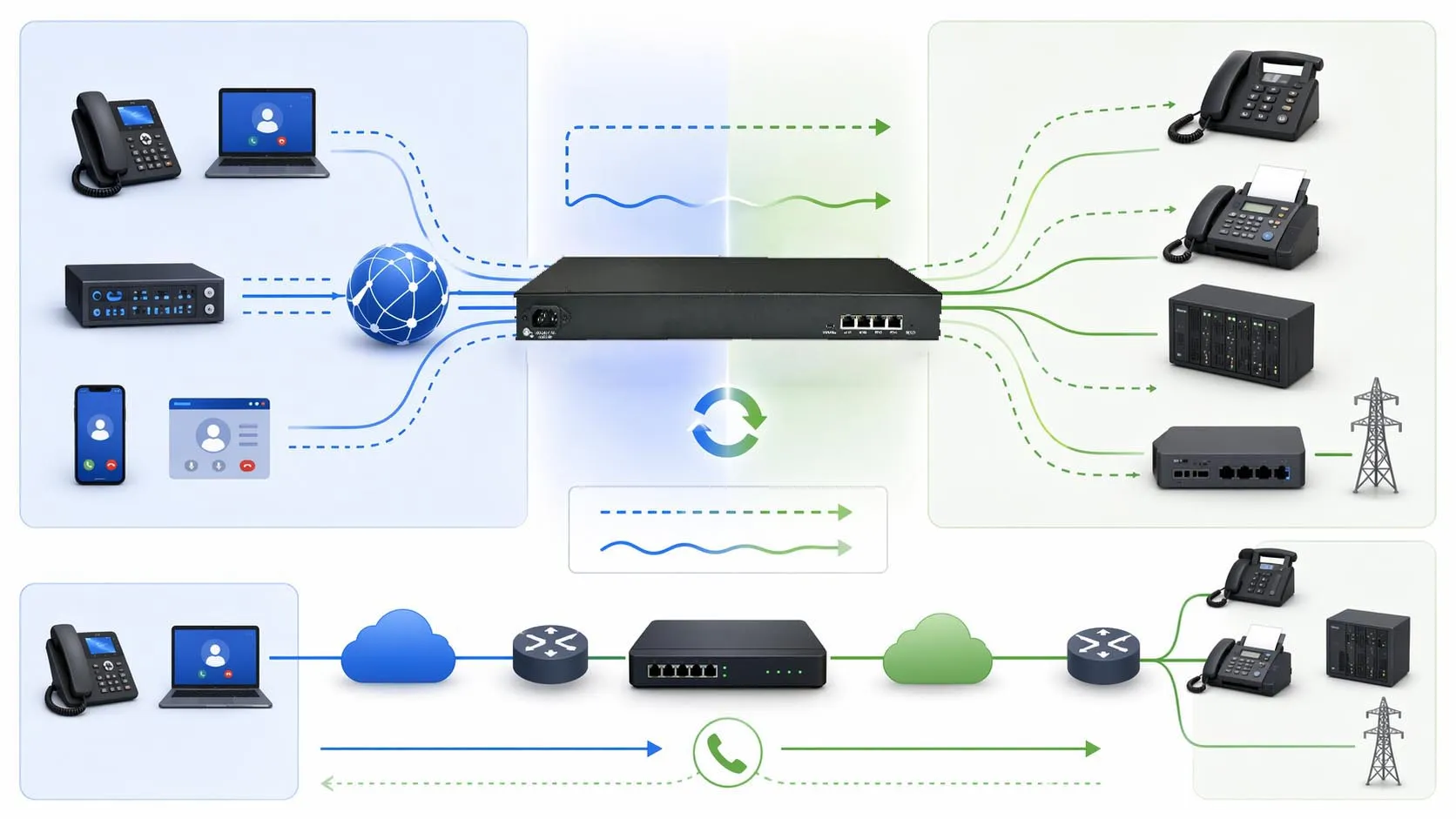
SIP gateways translate between SIP-based voice systems and legacy telephony interfaces so both sides can communicate.
Routing calls between environments
In a real deployment, the gateway often forms part of a larger routing design. Calls from an analog extension or legacy PBX can be sent into the SIP domain, and calls from the SIP side can be delivered toward analog devices, trunk lines, or older systems. Cisco documentation on SIP trunking and AudioCodes product materials both reflect the broader role of gateways in routing calls between modern and legacy call environments.
This means a SIP gateway is not only a format converter. It is also part of the call-routing logic of the overall system.
Main Features of a SIP Gateway
SIP interworking with legacy telephony
The most fundamental feature of a SIP gateway is interworking. It can connect SIP-based systems with analog phones, fax machines, PBXs, PSTN trunks, or digital access circuits. AudioCodes specifically describes this function in its MediaPack and Mediant product lines, and Ribbon likewise frames its media gateways as devices for SIP gateway and VoIP gateway use across access and trunking applications.
This feature is what makes SIP gateway technology so central to migration and interoperability projects.
Support for analog and digital interfaces
Many SIP gateways are available in different interface types. Some provide FXS ports for analog phones or fax machines. Others provide FXO ports for analog line access. Larger gateways may provide E1 or T1 PRI or other digital trunk interfaces. Ribbon’s media gateway portfolio and AudioCodes’ analog and ISDN media gateway portfolio both illustrate how gateway products are designed for different types of voice access and trunking requirements.
This variety is important because different organizations face different migration problems. Some need to keep analog endpoints. Others need to keep trunk access. Others need to keep both.
Compatibility with IP PBX and SIP platforms
A SIP gateway is also valuable because it can work with IP PBXs, SIP trunks, hosted voice environments, and other SIP-capable platforms. AudioCodes explicitly states that its gateways interoperate with leading softswitches and SIP servers, and Cisco gateway materials show how SIP trunk registration and dial-peer models support gateway integration on the SIP side.
This allows the gateway to fit into both enterprise and service-provider-oriented SIP architectures.
Migration without immediate full replacement
Another important feature is gradual migration support. Organizations rarely want to discard all analog devices, fax machines, or legacy PBX interfaces at once. A SIP gateway lets them keep those assets in service while still moving the broader voice environment toward SIP and IP-based telephony.
This is one of the strongest practical reasons for gateway deployment. It reduces the pressure for a disruptive all-at-once migration and makes modernization more manageable.
Scalability across branch and enterprise use cases
SIP gateways exist in both small and large scales. Some devices are designed for branch offices or small deployments with a small number of analog or trunk interfaces. Others are large enterprise or service-provider systems handling high-density access or trunking. Ribbon’s portfolio description makes this especially clear by presenting media gateways across a range of scale and performance requirements.
This gives SIP gateway technology broad relevance, from a small office keeping a few analog devices to a larger carrier or enterprise interconnection design.
The most important feature of a SIP gateway is not just protocol support. It is the ability to preserve interoperability during real-world telephony migration and integration.
SIP Gateway vs VoIP Gateway vs Media Gateway vs SBC
SIP gateway and VoIP gateway
In many market contexts, SIP gateway and VoIP gateway are used very similarly because SIP is one of the dominant signaling methods in VoIP systems. Official vendor materials often reflect this overlap. AudioCodes refers to analog and ISDN VoIP media gateways for connecting legacy telephony with IP telephony networks, and Ribbon explicitly states that its media gateways can act as SIP gateways or VoIP gateways.
In practical terms, SIP gateway is the more protocol-specific phrase, while VoIP gateway is the broader phrase. Many products fall into both categories at the same time.
SIP gateway and media gateway
Media gateway is also a broader category. It refers to gateways that bridge different media or telephony domains, often including analog, TDM, digital, and IP voice systems. A SIP gateway can be one kind of media gateway, especially when SIP is the signaling method used on the IP side. This is why many vendors use both terms in their product families.
So the difference is often one of emphasis rather than an absolute separation. Media gateway emphasizes interworking role and interface breadth. SIP gateway emphasizes the SIP signaling side of that interworking.
SIP gateway and SBC
A SIP gateway is also not the same as an SBC, even though some platforms may combine features. A session border controller is more focused on SIP edge control, demarcation, security, signaling and media interworking, address and port translation, and policy control between networks. Cisco describes CUBE as providing a network-to-network demarcation interface for signaling interworking, media interworking, address and port translation, billing, security, quality of service, call admission control, and bandwidth management. AudioCodes also notes that some hybrid gateway devices deliver SBC functionality, showing that the roles can coexist in one platform without being identical.
In simple terms, a SIP gateway is mainly about connecting SIP to legacy or non-SIP telephony resources. An SBC is mainly about securing, normalizing, and controlling the SIP edge between networks. Some products can do both, but the concepts should not be treated as the same thing.
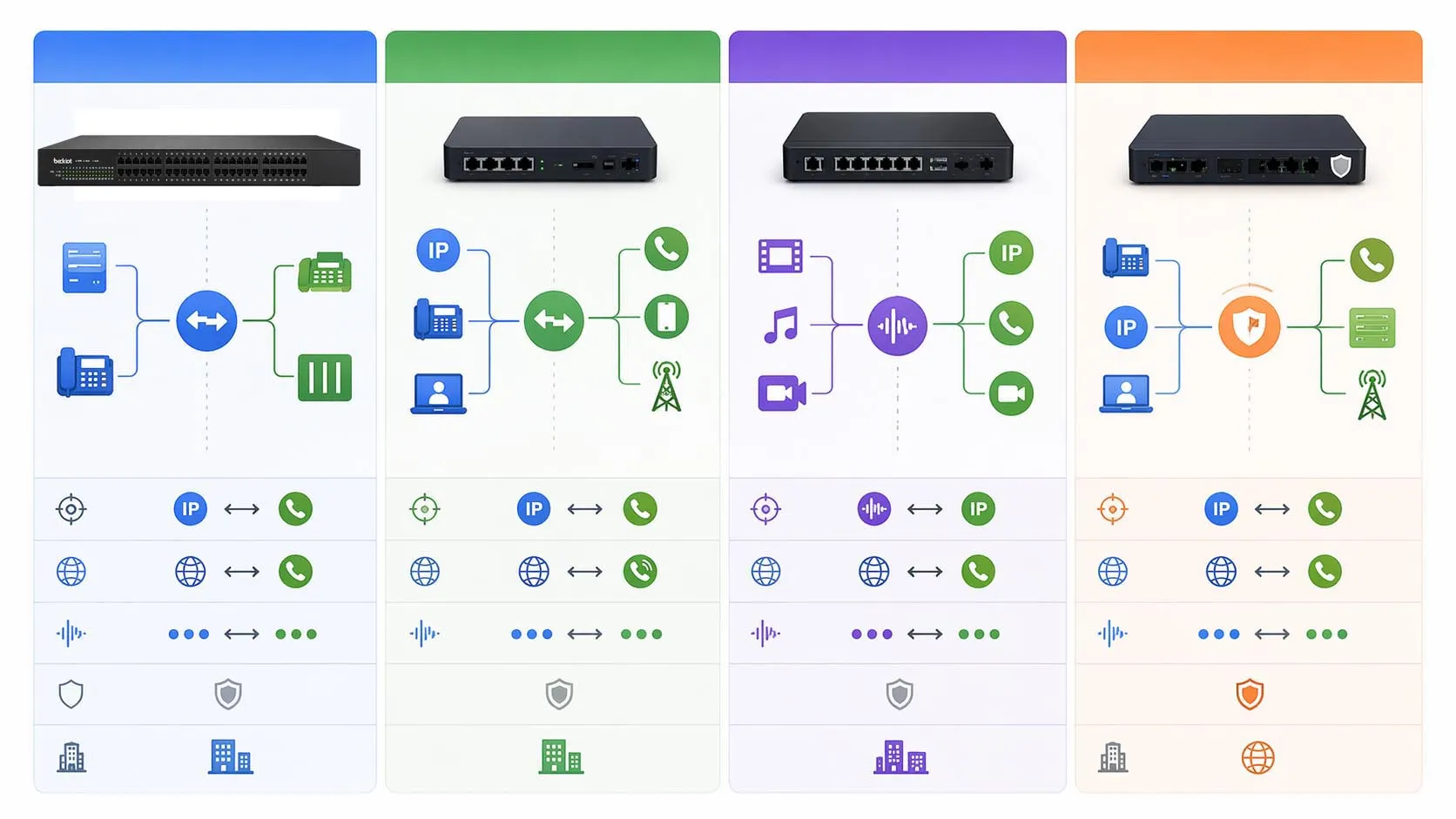
SIP gateways focus on interworking between telephony environments, while SBCs focus on edge control, interoperability, and security between networks.
Typical SIP Gateway Architecture
Endpoint or legacy device layer
At one side of the system are the legacy devices or circuits that still need to be preserved. These may include analog phones, fax machines, analog PBX stations, analog trunk lines, digital trunks, or older enterprise systems. This layer represents the voice resources that cannot or should not be replaced immediately.
The gateway gives this side a path into the modern SIP environment without forcing a full redesign on day one.
Gateway translation layer
The gateway itself sits at the center of the architecture and performs the signaling, media, and interface translation required for interworking. This is the point where the call moves from legacy voice behavior into SIP behavior or the other way around. Depending on the model, the gateway may also provide routing logic, dialing rules, codec handling, and management functions.
This translation layer is the defining architectural role of the SIP gateway.
SIP or IP voice layer
On the SIP side are the IP PBX, softswitch, SIP server, cloud communications platform, SBC, or provider environment that controls modern voice routing. The gateway presents the legacy resources to this side in a way the SIP platform can understand and route.
This is the layer that allows the rest of the organization’s communications environment to remain IP-centric while still accommodating older telephony elements.
External service and PSTN interconnection layer
In some deployments, the SIP side is not just the enterprise PBX but also a SIP trunk provider, hosted platform, or cloud voice environment. Cisco documentation on SIP trunk registration shows that the gateway can represent the trunk side of the interconnection and support routing across dial peers and endpoints. This makes the SIP gateway useful both inside enterprise systems and at the boundary between enterprise and provider voice services.
The exact architecture depends on whether the gateway is preserving endpoints, trunks, or both, but the bridge role remains the same.
Typical Applications of SIP Gateway
Connecting analog phones to an IP PBX
One of the most common uses is connecting analog phones, fax devices, or analog terminals to an IP PBX or SIP server. AudioCodes explicitly describes this use case in its analog gateway lines, which are designed to connect legacy telephones and fax machines with IP telephony networks and IP-PBX systems.
This is especially useful when a site wants to modernize its call control platform but still has analog devices that remain operationally important.
Connecting an IP PBX to PSTN or trunk interfaces
Another major application is connecting an IP PBX or SIP system to PSTN-facing or trunk-facing interfaces. That may mean analog lines, digital PRI, or other traditional telephony connections depending on the gateway type. Cisco and Ribbon materials both reflect this broader interconnection role in enterprise and service provider designs.
This allows the organization to maintain external call access even while the internal voice environment moves toward SIP and IP-based telephony.
Branch office modernization
SIP gateways are often used in branches that still have a small number of analog devices or local telephony resources but are being integrated into a centralized voice architecture. In these cases, the gateway allows the branch to preserve what is still useful while participating in the wider SIP system of the organization.
This is one of the most practical gateway use cases because it supports phased modernization without unnecessary disruption.

Industrial and specialized communication environments
In some industrial, campus, or specialized deployments, SIP gateways are used to keep legacy voice interfaces connected to a broader IP communications backbone. This can include older analog endpoints, service phones, control-room voice interfaces, or special telephony devices that must continue operating in a new networked communications design.
This shows that SIP gateways are not only office migration tools. They are also useful in operational communication environments where replacing every legacy device is not realistic or desirable.
Hybrid cloud and hosted voice migration
Another important application is hybrid migration to hosted or cloud voice services. A business may move much of its call control or external calling to SIP-based platforms but still need a gateway layer for remaining analog or legacy dependencies. In this model, the SIP gateway becomes one of the key bridge technologies that prevents older voice elements from blocking the larger migration strategy.
This application is increasingly relevant as more businesses adopt hosted and hybrid voice architectures.
Main Benefits of SIP Gateway
Protects existing telephony investment
One of the strongest benefits is that a SIP gateway helps organizations keep working telephony assets in service. Analog phones, fax machines, trunk interfaces, and PBX resources do not necessarily need to be discarded immediately. The gateway creates a path for them to continue operating alongside newer SIP-based systems.
This protects existing investment and reduces the cost and disruption of modernization projects.
Supports phased migration
Another major benefit is phased migration. Communication environments rarely change in one step. A SIP gateway allows the organization to move to IP telephony gradually, integrating older and newer systems during the transition. This can reduce operational risk and simplify planning.
In many projects, this migration flexibility is the main reason the gateway is deployed at all.
Improves interoperability
SIP gateways also improve interoperability by allowing dissimilar systems to communicate. This can include analog-to-SIP, digital-to-SIP, PBX-to-SIP, or trunk-to-SIP scenarios. Without a gateway, these different communication domains may remain isolated from one another.
By bridging them, the gateway allows the organization to unify its communications environment more effectively.
Flexible for small and large deployments
Because SIP gateways exist in many sizes and interface combinations, they are useful across a wide range of project scales. A small business may use one to preserve a few analog ports, while a large enterprise or provider may use higher-density gateways for access and trunk interworking. This wide applicability is one reason the category remains important in modern voice design.
It is a mature technology category that continues to solve practical migration and integration problems.
SIP gateways remain relevant because modern voice systems still need to coexist with older telephony resources in the real world.
Things to Consider When Choosing a SIP Gateway
What kind of interfaces need to be preserved
One of the first questions is whether the project needs FXS ports for analog endpoints, FXO ports for analog lines, digital trunk interfaces, or a combination of these. The right SIP gateway depends heavily on which legacy resources need to remain in service.
Choosing the wrong interface mix can make the device unsuitable even if the SIP side is technically strong.
How the gateway fits into the voice architecture
It is also important to decide whether the gateway is mainly connecting endpoints, trunks, branch systems, or cloud migration paths. A gateway used for analog phones has a different role from one used for PRI interworking or hosted voice integration. The system role should be clear before the product is selected.
This makes gateway selection an architectural decision, not just a hardware specification decision.
Interoperability and security requirements
Another consideration is how the gateway will interoperate with the PBX, SIP server, provider, or SBC environment and what security requirements apply at the network edge. In some cases, a separate SBC may still be required even if the gateway handles protocol and interface interworking. In other cases, hybrid devices may combine some gateway and SBC functionality. The design should reflect the real boundary, interoperability, and security needs of the project.
Understanding this distinction helps avoid expecting the gateway to solve problems that belong more naturally to the SBC or edge-control layer.
Conclusion
A SIP gateway is a bridge between SIP-based IP telephony and legacy or non-SIP voice resources. It allows analog devices, digital trunks, older PBXs, and other telephony interfaces to continue working within a modern SIP communications environment. This makes it an essential technology for migration, integration, and interworking in many enterprise, branch, industrial, and provider voice systems.
Its importance lies in practicality. Very few organizations can replace every telephony asset at once, and many still depend on legacy devices or trunk connections. A SIP gateway provides the interoperability layer that allows those resources to coexist with IP PBXs, SIP trunks, hosted voice platforms, and cloud communications environments.
In short, a SIP gateway is not just a protocol converter. It is a strategic bridge that helps organizations move toward modern IP voice architecture without abandoning the telephony resources they still need today.
FAQ
What is a SIP gateway?
A SIP gateway is a voice gateway that connects SIP-based IP telephony with analog, digital, or legacy telephony interfaces so the different systems can interoperate.
How does a SIP gateway work?
It uses SIP signaling on the IP side and translates signaling, media, and interface behavior toward the legacy or non-SIP side, allowing calls to pass between the two environments.
Is a SIP gateway the same as a VoIP gateway?
Often the terms overlap. SIP gateway is more protocol-specific, while VoIP gateway is broader. Many products are accurately described by both terms.
What is the difference between a SIP gateway and an SBC?
A SIP gateway mainly bridges SIP with legacy telephony interfaces, while an SBC mainly provides edge control, security, signaling normalization, and interconnection policy between networks.
Where are SIP gateways commonly used?
They are commonly used for analog phone integration, fax support, PSTN and trunk access, PBX migration, branch office modernization, and hybrid cloud voice deployments.
Why are SIP gateways still important?
Because many organizations still need to preserve legacy telephony devices or interfaces while moving the rest of their communications environment toward SIP and IP-based voice systems.
What should be checked before choosing a SIP gateway?
Important factors include interface type, deployment role, interoperability with the SIP platform, and whether separate SBC or edge-security functions are also needed.







