


Opus is a modern audio codec designed for interactive communication and high-quality media delivery across IP networks. It is widely used in Voice over IP, WebRTC, video conferencing, softphones, collaboration platforms, browsers, streaming workflows, and embedded communication devices. Unlike legacy codecs that were optimized mainly for either narrowband voice or compressed music, Opus was built to handle both speech and full-range audio within one flexible standard.
In practical terms, Opus matters because modern communication systems rarely deal with one fixed network condition. A call may begin on a wired enterprise LAN, move across Wi-Fi, traverse the public internet, and terminate on a mobile device. In those environments, the codec must balance clarity, delay, bandwidth use, packet loss resilience, and interoperability. Opus became popular because it can adapt across those competing demands without forcing designers to choose a separate codec for every scenario.
What Is Opus Codec?
A codec designed for both speech and audio
Opus is an open, royalty-free audio codec standardized by the IETF for interactive speech and general audio transport. It was created to cover a much wider range of use cases than many earlier codecs. Instead of focusing only on narrowband telephony or only on media playback, Opus can encode low-bitrate speech, wideband voice, stereo music, and mixed audio content within a single framework.
This flexibility is one of the reasons Opus is often described as an all-purpose real-time codec. In a business communications environment, the same codec can support desk-to-desk voice calls, mobile softphone sessions, browser-based meetings, intercom endpoints, and conference audio. In media environments, it can also support streaming and web delivery where efficient compression and audio quality both matter.
Because of that range, Opus is not just another “HD voice” label. It is a codec platform that allows systems to shift between speech-optimized and audio-optimized behavior depending on conditions, content type, and application goals.
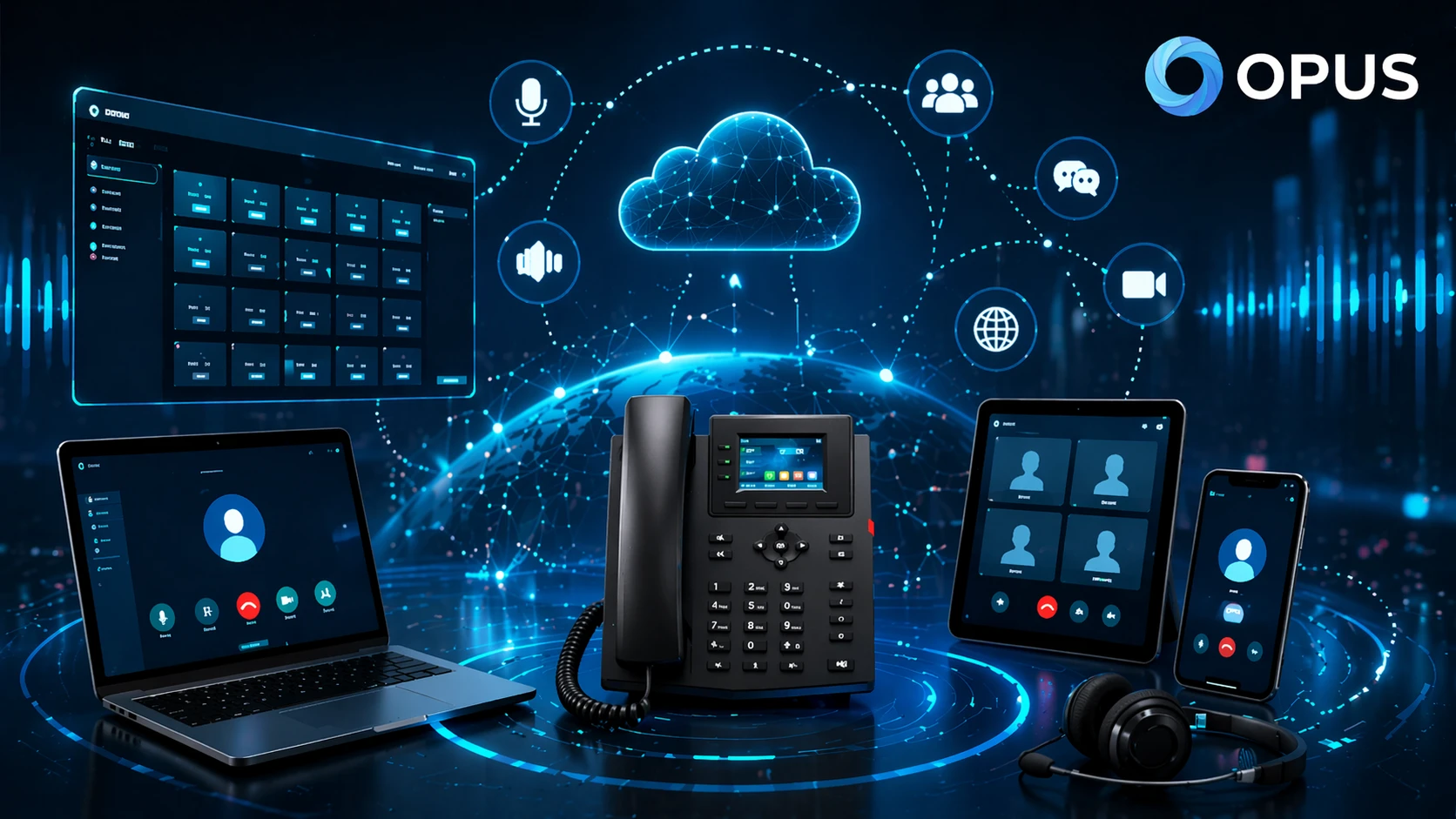
Opus is commonly used across IP phones, soft clients, conferencing systems, and browser-based communications.
Why Opus became so important in modern IP communication
Older voice systems often relied on codecs such as G.711 for compatibility or G.729 for low-bandwidth links. Those codecs still have value, but they reflect earlier network assumptions. Opus arrived in a different era, where communication endpoints needed to work across variable internet paths, mobile access, and multimedia sessions. A codec could no longer be judged only by narrowband voice quality or simple bandwidth savings.
Opus gained importance because it addresses the real conditions of packet-based communication. It can operate at very low bitrates when bandwidth is limited, but it can also scale upward when a session needs more natural, full-range sound. That makes it useful for both human conversation and richer audio experiences, especially in collaboration tools where voice, shared content, and occasional media playback may all appear in one session.
For system designers, the value is equally practical. Supporting one flexible codec can simplify planning across products and reduce the need for multiple parallel audio strategies.
How Opus Works at a High Level
A hybrid approach built from SILK and CELT
One of the defining characteristics of Opus is that it combines two different coding approaches. SILK is used for speech-oriented efficiency, while CELT is designed for low-delay audio coding with higher fidelity. Depending on bitrate, bandwidth target, and audio content, Opus can use one mode, the other mode, or a hybrid approach. This is what allows it to cover both voice-centric and audio-centric scenarios.
That hybrid design is important because speech and music do not stress a codec in the same way. Human voice needs intelligibility, naturalness, and low delay. Music and mixed audio demand better preservation of frequency detail and transient response. Opus can move between those priorities more gracefully than many older codecs that were designed around a narrower purpose.
For users, this means the benefit is not only “better sound.” The more useful interpretation is that Opus can preserve understandable voice under constrained conditions while still scaling to richer audio when the network and application allow it.
Adaptive behavior for real-time networks
Opus is designed to adapt dynamically during a session. Bitrate, frame size, bandwidth, and channel mode can all be adjusted to respond to changing network conditions or application settings. This matters in real deployments because packet loss, jitter, congestion, and endpoint performance are rarely static.
In real-time communications, low delay is often just as important as compression efficiency. A codec that saves bandwidth but adds too much processing delay can make conversation feel unnatural. Opus is widely valued because it offers low-latency operation while still maintaining strong quality across a broad range of bitrates.
When packet loss becomes a factor, systems can also use Opus features such as packet loss concealment, in-band forward error correction, or discontinuous transmission depending on the application design. These features do not eliminate network problems, but they can make communication more usable when networks are imperfect.
Audio Benefits of Opus Codec
Natural voice quality across more network conditions
The most visible benefit of Opus in communication systems is that it can deliver more natural and comfortable voice quality than many legacy narrowband codecs. That improvement often appears as clearer consonants, less muffled speech, better spatial impression in conferencing, and a more realistic sense of presence during conversation.
In office and operational environments, that matters more than it may seem on paper. Better intelligibility reduces repetition. Better naturalness lowers listening fatigue during long meetings or busy coordination sessions. For devices used in dispatch, help point, intercom, or remote collaboration workflows, improved voice quality can directly improve operator efficiency.
It is also useful that Opus can remain serviceable when the network is less than ideal. Instead of treating quality as a fixed promise, it manages quality as an adaptive result, which is usually a better fit for real IP communication.

Opus is valued for combining clear conversational speech with support for richer, more natural audio.
Better fit for mixed-use communication platforms
Many modern platforms are not purely telephony systems. A single platform may carry voice calls, web meetings, browser conferencing, paging announcements, recorded prompts, training audio, and occasional media playback. In those systems, a codec limited to narrowband speech can become a bottleneck.
Opus fits these mixed environments well because it can serve both everyday voice communication and higher-quality audio applications. A user may not describe this benefit in terms of kilobits per second or frame sizes. They simply notice that calls sound clearer, meetings sound fuller, and browser-based sessions perform reliably.
That versatility is one reason Opus appears so often in WebRTC-based products and modern UC environments. It supports the practical expectation that one audio stack should work across many interaction types.
Technical Features That Make Opus Useful
Wide operating range and flexible tuning
Opus supports a broad bitrate range, multiple frame durations, mono or stereo operation, and audio bandwidth options from narrowband to fullband. This wide operating envelope allows product teams to tune the codec for very different goals. A low-bitrate remote voice session, a browser meeting, and a high-quality collaboration endpoint do not need to use the exact same profile.
That flexibility also helps with product segmentation. Entry-level terminals can use conservative settings that prioritize bandwidth efficiency and stability. Higher-end devices or conferencing systems can allocate more bitrate to improve audio richness. The same codec family can therefore scale across different product tiers and deployment types.
From an engineering perspective, the key advantage is not just that Opus has many options. It is that those options can be changed dynamically during operation, which is far more useful than static tuning chosen once at installation time.
Low delay, resilience, and real-time readiness
Opus is designed for low-latency communication, which makes it attractive for interactive applications where conversation timing matters. This includes voice calls, conferencing, gaming voice chat, remote collaboration, and many intercom-style workflows. Delay affects user perception quickly, so a codec built for interactive timing has a real operational advantage.
Resilience is another important feature. Packet loss concealment helps the decoder mask missing audio frames. Forward error correction can improve robustness on lossy networks when configured appropriately. Discontinuous transmission can reduce bitrate during silence periods in some voice-oriented scenarios. Together, these features help Opus cope with the reality of IP networks rather than assuming ideal conditions.
For administrators and integrators, that means fewer compromises when designing for internet-connected users, branch offices, mobile workers, or wireless endpoints.
Strong fit with RTP, SIP, and WebRTC ecosystems
Opus is widely used in real-time media transport, especially in systems built around RTP. In practical communication environments, that means it fits well into SIP calling architectures, browser-based media sessions, UC platforms, softphones, and many media gateways or session border control workflows that support modern codecs.
Its role in WebRTC is especially important because browser-based real-time communication has become a common access model for meetings, customer interaction, and embedded communications. A codec that works well in that ecosystem can connect web clients with IP phones, conferencing systems, mobile apps, and cloud platforms more naturally.
This does not mean Opus automatically replaces every older codec in every system. Compatibility, transcoding paths, and legacy interoperability still matter. But when a platform is designed for modern real-time media, Opus is often one of the most practical choices.
Typical Applications of Opus Codec
VoIP, UC, and browser-based communication
Opus is widely used in VoIP and unified communications environments, especially where softphones, browsers, and conferencing tools need to interoperate. In these deployments, Opus helps improve call quality while still supporting dynamic network adaptation. It is particularly well suited to organizations that mix desk phones, laptop clients, mobile devices, and web-based meeting access.
For IP PBX and communication platform designers, Opus can support a more modern user experience than legacy narrowband-only codecs. Calls sound less constrained, and meetings benefit from a fuller audio range. In systems that integrate WebRTC access, Opus is often one of the central codecs that helps unify browser and SIP-based communication flows.
It also works well in remote and distributed teams where users connect over unpredictable last-mile networks. That is one of the environments where adaptive codecs provide the most visible benefit.

Opus is widely used in VoIP, conferencing, WebRTC, gaming voice, and other modern IP audio applications.
Intercom, embedded terminals, and operational communications
Opus is also relevant in embedded and operational communication products. IP intercom terminals, help points, industrial communication endpoints, dispatch interfaces, and specialized collaboration devices can all benefit from a codec that combines speech clarity with efficient network use. In these environments, background noise, constrained links, and real-time response all matter.
When used carefully within a broader acoustic design that includes echo control, microphone tuning, and network QoS, Opus can help these devices sound more modern and more intelligible than older fixed-bandwidth solutions. The codec alone does not solve all audio problems, but it gives designers a strong foundation.
This is especially valuable in systems that bridge indoor office communication, public-service interaction points, and field communication terminals across one IP architecture.
Streaming, gaming, and interactive media
Outside traditional telephony, Opus is also popular in streaming, gaming voice chat, and interactive online platforms. These use cases value the same qualities that business communication systems value: low delay, broad bitrate flexibility, and consistent subjective quality.
Gaming voice, for example, needs speech clarity with tight conversational timing. Live collaborative media tools need a codec that can handle speech and richer audio. Some internet media workflows value the royalty-free nature of Opus in addition to its technical performance.
This broader adoption reinforces an important point: Opus is not just a telecom codec. It is a modern network audio codec with strong relevance across real-time digital communication.
Deployment Considerations and Practical Trade-Offs
Interoperability still needs planning
Even though Opus is widely supported in modern platforms, deployment still requires interoperability planning. Some older SIP trunks, gateways, legacy desk phones, or recorders may still prefer codecs such as G.711. In mixed environments, this can introduce transcoding, codec negotiation complexity, or design constraints around where Opus is enabled.
That does not make Opus difficult to deploy, but it does mean integrators should not assume universal support across every existing system element. Codec policy, endpoint capability, trunk support, and recording architecture should all be reviewed before large-scale rollout.
In many projects, the most realistic path is selective enablement: use Opus where modern endpoints and applications can benefit from it, while maintaining compatibility paths for older infrastructure.
Codec choice is only one part of audio quality
It is tempting to treat codec selection as the main driver of call quality, but real deployments are shaped by many other factors. Microphone quality, loudspeaker design, acoustic echo cancellation, packet jitter, packet loss, QoS policy, switch configuration, wireless stability, and DSP tuning all influence the final user experience.
Opus can provide an excellent foundation, but it performs best when the surrounding system is also designed well. A poor acoustic path or an unstable network can still produce disappointing results even with a strong codec. By contrast, a well-designed terminal and properly engineered network can make the benefits of Opus much more noticeable.
In other words, Opus should be viewed as a powerful part of the audio chain, not as a magic replacement for end-to-end system design.
FAQ
Is Opus better than G.711?
In many modern IP communication scenarios, Opus offers broader audio range, better adaptability, and stronger performance across variable networks. However, G.711 still remains useful for legacy compatibility, simple SIP interoperability, and some traditional telephony environments.
Is Opus only for WebRTC?
No. Opus is heavily associated with WebRTC, but it is also used in VoIP platforms, conferencing tools, gaming voice, streaming workflows, collaboration applications, and embedded communication devices.
Does Opus require more bandwidth than older codecs?
Not necessarily. Opus can operate across a wide bitrate range, so its bandwidth use depends on configuration and application goals. It can be tuned for low-bitrate speech or for richer, higher-quality audio.
Can Opus be used in SIP systems?
Yes. Many SIP endpoints, media servers, softphones, and communication platforms support Opus over RTP. Actual deployment depends on codec negotiation, endpoint capability, trunk support, and the wider interoperability design.
Why is Opus popular in modern communication products?
Because it combines low delay, good subjective quality, broad adaptability, support for speech and music, and strong relevance to browser-based and IP-native communication environments.
Conclusion
Opus is a highly flexible audio codec built for modern packet-based communication. Its importance comes not only from strong sound quality, but from its ability to adapt across network conditions, application types, and endpoint categories. That makes it useful in VoIP, conferencing, WebRTC, intercom, embedded terminals, and interactive media platforms.
For engineers, integrators, and product teams, the most practical way to think about Opus is simple: it is a codec designed for the realities of modern IP communication. When paired with good acoustic design, sensible codec policy, and stable network engineering, it can provide a noticeably better user experience than many legacy voice-only approaches.







