Effective wireless voice communication is essential for modern business operations. In healthcare, manufacturing, warehousing, hospitality, retail, contact centers, and campus environments, employees often need to stay reachable while moving between rooms, floors, service areas, or work zones. DECT, short for Digital Enhanced Cordless Telecommunications, is a wireless communication technology designed specifically for cordless voice communication and enterprise mobility.
Compared with Wi-Fi or Bluetooth, DECT is not mainly designed as a general-purpose data technology. Its strength lies in stable voice performance, managed coverage, long battery life, simple handset operation, and predictable roaming across planned service areas. For enterprises that need reliable internal voice communication without relying only on smartphones or public cellular networks, DECT remains a practical and mature option.
What Is DECT?
DECT stands for Digital Enhanced Cordless Telecommunications. It is a digital wireless communication standard developed by the European Telecommunications Standards Institute, commonly known as ETSI. The technology was originally created for cordless telephone systems and later evolved into a professional wireless voice platform used in enterprise environments.
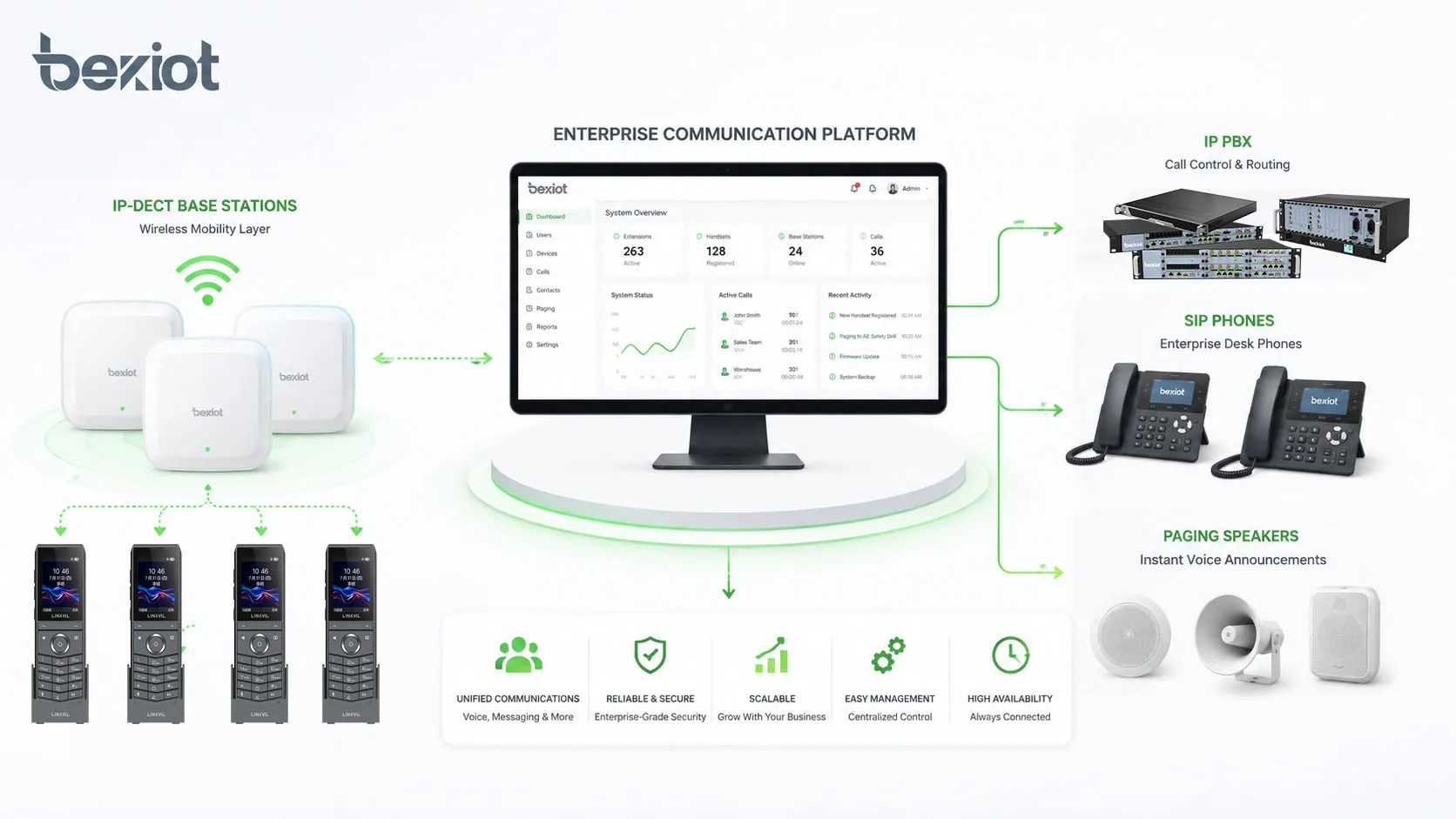
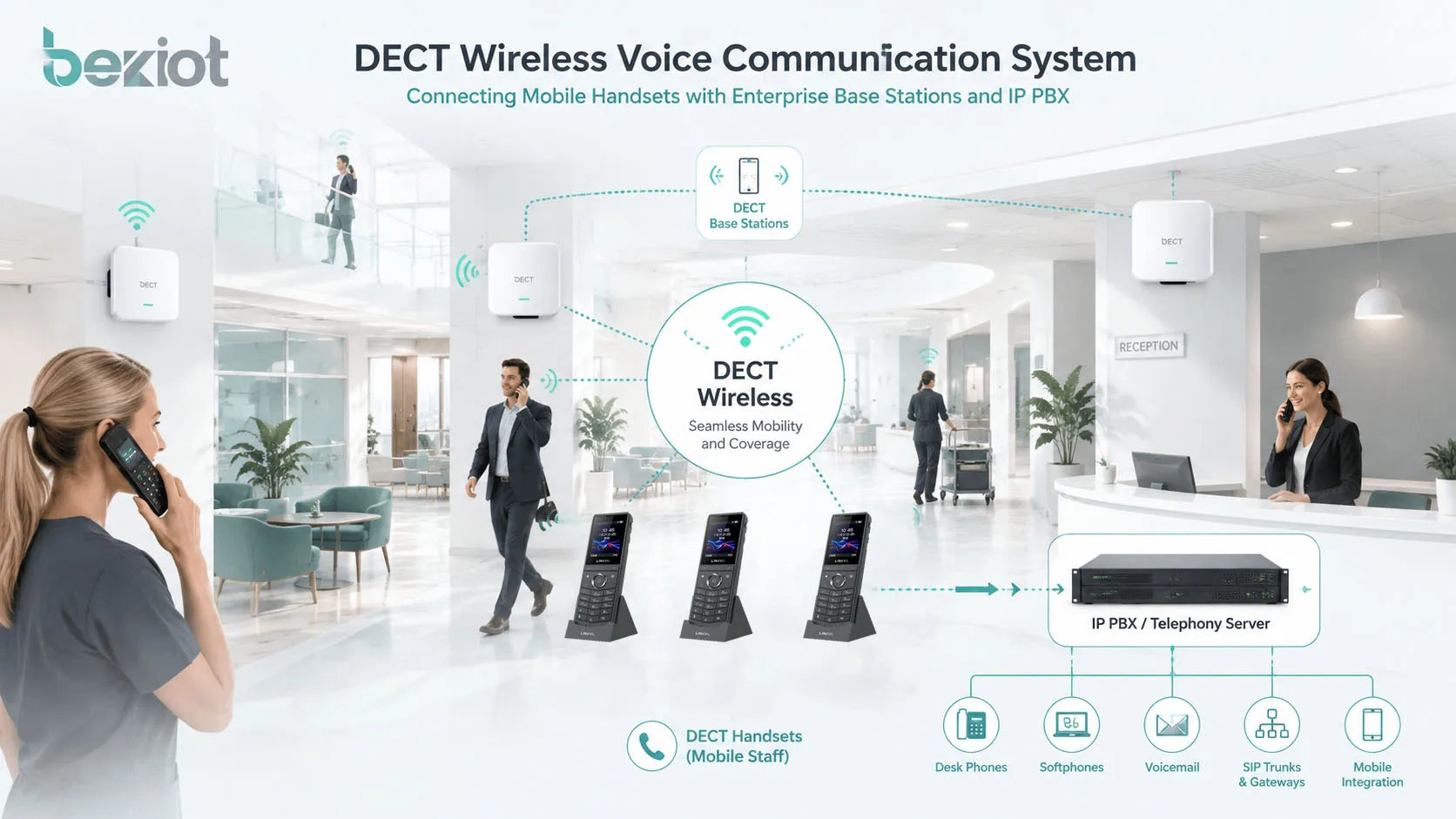
In a typical DECT system, cordless handsets communicate with one or more base stations over a dedicated radio interface. The base stations then connect to a telephone system, IP PBX, SIP platform, or gateway. This structure allows mobile users to make and receive calls as internal extensions while moving freely within the designed coverage area.
The main value of DECT is its voice-first architecture. While Wi-Fi networks carry many types of traffic such as laptops, tablets, cameras, scanners, video meetings, and IoT devices, DECT is normally planned around voice mobility. This makes it easier for organizations to control coverage, capacity, roaming behavior, and call quality.
How DECT Works
At a technical level, DECT uses base stations and cordless endpoints to create a managed wireless voice network. A handset connects to the nearest available base station, and the system manages the radio link, authentication, call setup, and handover. In a multi-cell deployment, users can move from one coverage zone to another while keeping their calls active, provided the system is planned and configured correctly.
DECT commonly operates around the 1.9 GHz range, though exact frequency allocations vary by region. In many European and international markets, DECT uses 1880–1900 MHz. In the United States and Canada, DECT 6.0 uses 1920–1930 MHz. This separation from the common 2.4 GHz and 5 GHz Wi-Fi bands helps reduce competition with general data traffic and many consumer wireless devices.
DECT systems use radio resource management methods such as frequency division, time division, and dynamic channel selection to support multiple simultaneous calls. Dynamic Channel Allocation helps handsets and base stations select cleaner available channels when interference conditions change. For enterprise users, the practical result is more consistent cordless voice communication across planned service areas.
DECT, IP-DECT, and DECT 6.0
Traditional DECT
Traditional DECT systems were commonly connected to PBX equipment through dedicated telephone interfaces. They were widely used for cordless office phones, residential cordless phones, and early business mobility systems. In these deployments, DECT mainly extended voice calling away from the desk.
Although the basic principle remains the same, modern enterprise requirements have expanded beyond simple cordless calling. Organizations now expect centralized management, SIP integration, multi-site deployment, directory services, roaming, monitoring, and compatibility with IP-based voice infrastructure.
IP-DECT
IP-DECT brings DECT mobility into modern VoIP environments. In an IP-DECT system, base stations are connected to the Ethernet network and usually integrate with an IP PBX, SIP server, or unified communication platform. Cordless handsets can then operate as normal enterprise extensions within the same dialing plan as desk phones, SIP intercoms, conference phones, paging gateways, or operator consoles.
This approach is especially useful for companies migrating from legacy PBX systems to IP-based communication. It allows organizations to keep the simplicity of DECT handsets while gaining the flexibility of SIP trunking, centralized configuration, call routing, voicemail, call recording, and multi-site management.
DECT 6.0
DECT 6.0 is the North American naming used for DECT technology operating in the 1920–1930 MHz band. It is not a separate generation like Wi-Fi 6. Instead, it refers to DECT technology adapted to local frequency regulations in the United States and Canada.
For buyers, the key point is to choose equipment that matches the regulatory requirements of the deployment region. Frequency bands, certification rules, and compatibility expectations should be confirmed before purchasing handsets and base stations for international projects.
DECT Compared with Wi-Fi and Bluetooth
DECT, Wi-Fi, and Bluetooth are all wireless technologies, but they serve different communication needs. Wi-Fi is designed for high-speed data access across enterprise networks. Bluetooth is designed for short-range personal device connectivity. DECT is designed primarily for cordless voice communication and managed mobility.
| Comparison Area | DECT | Wi-Fi | Bluetooth |
|---|---|---|---|
| Main Purpose | Voice-centric cordless communication | General data networking | Short-range personal connectivity |
| Typical Use | Enterprise handsets, cordless phones, IP-DECT systems | Laptops, smartphones, tablets, scanners, video, IoT | Headsets, keyboards, speakers, wearables |
| Radio Environment | Dedicated DECT spectrum depending on region | Shared 2.4 GHz, 5 GHz, and newer Wi-Fi bands | Shared 2.4 GHz band |
| Voice Performance | Predictable when coverage and capacity are planned | Depends on Wi-Fi design, roaming, traffic load, and QoS | Good for personal audio but limited for enterprise roaming |
| Range | Often suitable for office, hospital, warehouse, and campus zones with base station planning | Depends heavily on access point density and building conditions | Best for short-range use near a paired device |
| Battery Behavior | Optimized for voice handsets and long shifts | Varies by device and network activity | Efficient for accessories, less suitable for wide-area enterprise voice mobility |
| Enterprise Scalability | Strong for managed cordless voice with multi-cell systems | Strong for data and application access with proper network design | Limited for large-area professional voice networks |
DECT vs Wi-Fi Voice
Wi-Fi voice can work well when the wireless network is carefully designed for roaming, Quality of Service, signal strength, and traffic capacity. However, Wi-Fi is still a shared data environment. Voice calls may be affected by network congestion, access point handover, competing applications, or inconsistent coverage in corners, stairways, warehouses, and service corridors.
DECT separates voice mobility from the enterprise data network. For many organizations, this makes it easier to deliver predictable call behavior for users who mainly need voice communication rather than full mobile computing. It is not a replacement for Wi-Fi, but it can be a better fit for dedicated wireless telephony.
DECT vs Bluetooth
Bluetooth is excellent for personal accessories and short-range audio. It is widely used for headsets, speakers, keyboards, and wearable devices. However, Bluetooth is not designed to provide wide-area building coverage, multi-cell roaming, or large-scale enterprise handset deployment.
DECT is more suitable when users need to move across a facility, receive internal calls, remain reachable during a shift, and connect to a managed telephone system. In practical enterprise environments, DECT and Bluetooth may coexist: DECT provides the wireless voice network, while Bluetooth may still be used for a personal headset connected to a handset or desk phone.
Key Benefits for Enterprise Communication
Reliable Voice Mobility
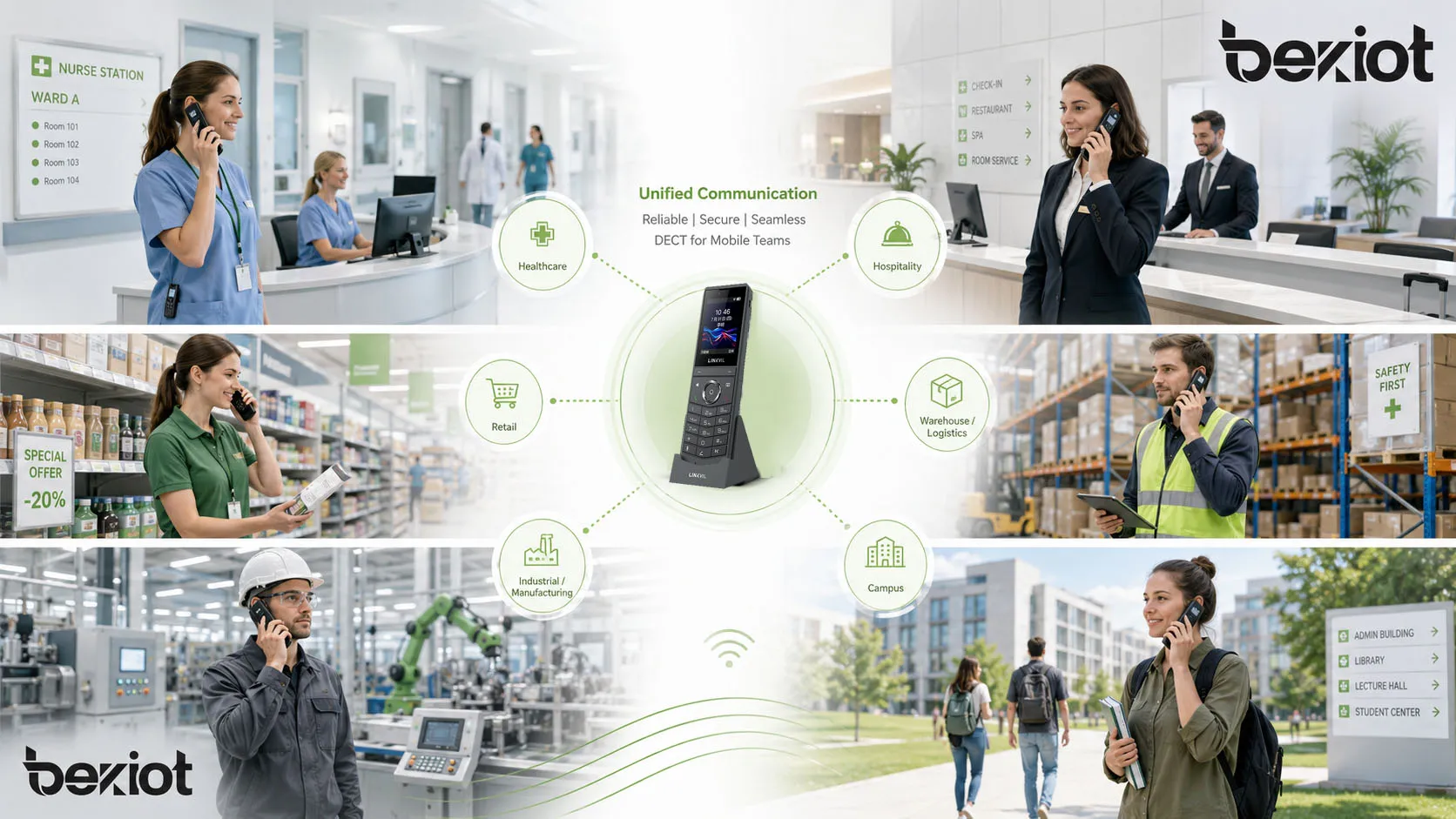
DECT gives employees the ability to answer and place calls while moving through a defined work area. This is valuable for nurses, hotel staff, retail teams, warehouse supervisors, maintenance technicians, security officers, and campus personnel who cannot stay beside a desk phone all day.
When base stations are properly planned, DECT can support roaming between coverage zones and reduce missed calls. In daily operations, this helps teams respond faster to customer requests, service tasks, maintenance issues, and internal coordination needs.
Predictable Audio Quality
Because DECT is designed around voice communication, it can provide consistent audio performance when the deployment is engineered correctly. Modern DECT systems may also support wideband audio through CAT-iq-related capabilities, improving speech clarity compared with older narrowband cordless systems.
Clear audio is not only about comfort. In hospitals, factories, warehouses, and service environments, voice clarity can affect safety, task accuracy, and response speed. A misunderstood instruction or missed call may lead to delays, repeated work, or operational risk.
Reduced Interference with Data Networks
One of the major practical advantages of DECT is that it does not normally compete with Wi-Fi traffic. This matters in buildings where laptops, tablets, cameras, barcode scanners, access control devices, and IoT equipment already consume wireless data capacity.
By separating cordless voice from general data traffic, enterprises can reduce the pressure on their Wi-Fi network and build a more specialized voice mobility layer. This is especially useful in busy hospitals, hotels, retail stores, warehouses, and industrial facilities.
Long Battery Life and Shift-Friendly Operation
DECT handsets are typically designed for voice calling, standby time, and practical mobile use. Many enterprise users value simple keys, lightweight design, loud ringing, belt clips, charging cradles, and reliable operation across long shifts.
For frontline teams, this simplicity can be more useful than a full smartphone. Staff can quickly answer calls, reach internal extensions, transfer calls, and remain available without managing multiple apps or relying on personal mobile phones.
Security and Managed Access
DECT includes authentication and encryption mechanisms that help protect wireless voice communication when implemented correctly. Modern systems may include improved authentication, encryption, handset registration control, and device management features.
For enterprise deployments, security should also include operational rules. Administrators need to manage who can register handsets, how lost devices are removed, how user accounts are assigned, and how emergency numbers or priority contacts are maintained.
Scalable Multi-Cell Deployment
Small businesses may only need one or two base stations. Larger facilities may require a multi-cell DECT system with multiple synchronized base stations across floors, buildings, warehouses, corridors, or campus zones.
With the right system design, DECT can scale from small office coverage to large enterprise mobility. The key is not simply adding more base stations, but planning coverage, capacity, roaming, call density, and management from the beginning.
Enterprise Applications
Healthcare and Hospitals
Healthcare environments require fast, clear, and reliable communication. Nurses, doctors, care assistants, administrative staff, security teams, and maintenance personnel often move between patient rooms, nurse stations, wards, corridors, laboratories, and service areas.
DECT handsets can help clinical and support teams stay reachable without returning to fixed phones. When integrated with nurse call systems, IP PBX platforms, alarms, or dispatch workflows, DECT can support faster response to patient needs and internal service requests.
Manufacturing and Industrial Facilities
Manufacturing plants, workshops, utilities, and industrial sites often include large spaces, metal structures, machinery, noise, and complex movement patterns. DECT can support mobile voice communication for supervisors, maintenance teams, inspection personnel, and shift managers.
Industrial deployments should consider coverage in machine rooms, production lines, storage zones, service corridors, control rooms, and outdoor transition areas. In broader industrial communication projects, DECT may coexist with SIP phones, rugged industrial telephones, PA speakers, alarm buttons, CCTV linkage, and dispatch systems.
For projects that require wired-and-wireless voice integration, Becke Telcom can be considered for SIP-based communication systems, industrial telephones, paging endpoints, emergency phones, and dispatch-related solutions that complement DECT mobility in harsh or mission-critical environments.
Warehousing and Logistics
Warehouses and logistics centers depend on communication between supervisors, pickers, forklift operators, loading dock staff, security guards, inventory teams, and office personnel. DECT can provide a dedicated voice layer for teams moving through aisles, storage racks, packing zones, and dispatch areas.
Coverage design is important because metal shelving, high racks, vehicles, concrete walls, and large open areas may affect radio behavior. A good site survey helps identify where base stations should be placed to avoid weak zones and dropped calls.
Retail and Supermarkets
Retail teams need fast communication between sales floors, checkout counters, customer service desks, stock rooms, security points, and loading areas. DECT handsets allow managers and frontline employees to communicate without leaving their work zones.
In supermarkets, shopping centers, and large retail stores, DECT can support stock checks, price verification, customer assistance, security coordination, and maintenance calls. When combined with paging or announcement systems, it can become part of a wider store communication workflow.
Hotels and Hospitality
Hotels use DECT to connect front desk staff, housekeeping, maintenance, room service, event teams, kitchen teams, and security personnel. Employees can receive calls while moving through guest rooms, service corridors, kitchens, lobbies, and back-office areas.
This helps improve service response and reduces dependence on personal mobile numbers. Calls can remain within the hotel communication system, making service coordination easier to manage and more consistent across shifts.
Contact Centers and Office Mobility
Contact centers and office environments may use DECT phones or DECT headsets where users need stable voice performance and freedom of movement. DECT is especially useful when staff need to step away from the desk while remaining connected to a call.
In dense office environments, the dedicated DECT radio layer can help reduce the interference and congestion concerns sometimes found with general wireless data networks. For agents, reception teams, and internal service desks, this can improve comfort and continuity during long calling periods.
Education and Campus Environments
Universities, schools, corporate campuses, and public institutions often require communication across multiple buildings and large outdoor or semi-outdoor areas. DECT can support administrative staff, maintenance teams, security personnel, residence services, and facility managers.
In campus deployments, DECT should be planned together with desk phones, emergency phones, paging systems, access control, CCTV, and control room workflows. This creates a more complete communication environment for daily operations and incident response.
DECT NR+ and the Future of Wireless Communication
DECT continues to evolve beyond traditional cordless telephony. DECT-2020 NR, also known as DECT NR+, extends the DECT technology family toward non-cellular 5G, private wireless networking, industrial IoT, smart infrastructure, and reliable low-latency communication.
Unlike classic DECT, which is mainly associated with cordless voice, DECT NR+ is designed for broader wireless applications such as industrial sensors, building automation, asset tracking, professional audio, smart metering, and private network use cases. It can support mesh-style networking and flexible device communication models, making it relevant for future industrial and infrastructure environments.
For most enterprise voice projects today, IP-DECT remains the more immediate and practical choice. However, DECT NR+ shows that the DECT ecosystem is not limited to traditional cordless phones. It is moving toward more specialized wireless communication scenarios where reliability, local control, and predictable performance matter.
Planning a DECT Deployment
Coverage Survey
A DECT deployment should start with coverage planning. Building layout, wall materials, floor levels, metal structures, elevators, staircases, basements, outdoor paths, storage areas, and machinery can all affect radio performance.
Enterprises should test real working areas rather than only open office zones. Weak signal areas often appear in service corridors, machine rooms, loading docks, storage corners, underground areas, and transition spaces between buildings.
Capacity and Call Density
Coverage alone is not enough. The system must also support the expected number of simultaneous calls. A hotel floor, hospital ward, warehouse shift, or contact center may place heavier call loads on the system than a small office.
Capacity planning should consider the number of handsets, expected concurrent calls, base station capacity, roaming behavior, and future expansion. This helps avoid bottlenecks during peak usage.
Integration with the Voice Platform
Before deployment, organizations should confirm how DECT will integrate with the existing PBX, IP PBX, SIP server, voicemail system, call recording platform, directory service, emergency workflow, and management tools.
Important functions to test include registration, caller ID, call transfer, hold, hunt groups, codec compatibility, voicemail access, failover behavior, and emergency number routing. For multi-site organizations, centralized configuration and monitoring may also be important.
Handset Selection
Different environments need different handset designs. Office users may prefer compact handsets with directory access and headset support. Healthcare users may need easy cleaning, alert keys, vibration, and reliable shift operation. Industrial users may require rugged housing, loud audio, stronger protection, and emergency alarm functions.
Choosing handsets only by appearance or price can lead to operational problems. The better approach is to match device durability, battery life, audio output, user interface, and accessories to the real working environment.
Security and Device Management
DECT security should be treated as a complete management process. Technical features such as authentication and encryption are important, but administrators also need clear policies for device registration, user assignment, lost handset removal, firmware updates, password handling, and emergency contact management.
For healthcare, finance, government, and industrial safety environments, communication privacy and access control should be reviewed during both procurement and deployment testing.
Limitations to Consider
DECT is strong for managed wireless voice communication, but it is not the best technology for every wireless requirement. It does not replace Wi-Fi data access, smartphone apps, video meetings, mobile business software, or broadband internet connectivity.
DECT also works within planned coverage areas. It is not a public wide-area mobile network. For citywide communication, outdoor field service, vehicle fleets, or cross-region mobility, cellular, PoC, private radio, or RoIP-based systems may be more suitable.
The best result usually comes from choosing the right mix of technologies. In many enterprises, DECT can work alongside Wi-Fi, SIP phones, mobile apps, paging systems, intercoms, emergency phones, and dispatch platforms rather than replacing them all.
How to Choose the Right DECT Solution
When selecting a DECT solution, enterprises should evaluate coverage requirements, building structure, call density, handset durability, battery expectations, SIP compatibility, management tools, security functions, and long-term expansion. A small office may need a simple single-cell system, while a hospital, hotel, warehouse, or campus may require a carefully planned multi-cell IP-DECT deployment.
It is also important to consider how DECT fits into the wider communication ecosystem. The best solution should connect smoothly with the enterprise voice platform, support daily operations, improve staff mobility, and leave room for integration with paging, intercom, alarm, access control, CCTV, and dispatch workflows.
DECT is most valuable when it is planned as a managed enterprise voice mobility system, not simply as a group of cordless handsets.
FAQ
What does DECT stand for?
DECT stands for Digital Enhanced Cordless Telecommunications. It is a wireless communication technology mainly used for cordless voice devices, enterprise handsets, and IP-DECT mobility systems.
Is DECT better than Wi-Fi for voice calls?
DECT is often a better fit for dedicated wireless voice communication because it uses a voice-focused architecture and separate radio environment. However, Wi-Fi voice can also work well when the Wi-Fi network is properly designed for roaming, QoS, coverage, and capacity.
What is the range of DECT?
DECT range depends on the region, device design, building structure, base station placement, and radio conditions. In general, DECT is suitable for indoor enterprise coverage when properly planned, and multi-cell systems can extend coverage across larger facilities or campuses.
What is IP-DECT?
IP-DECT is a DECT system that connects base stations to an IP network and integrates with an IP PBX, SIP server, or unified communication platform. It allows cordless handsets to operate as enterprise extensions within a VoIP environment.
What is DECT 6.0?
DECT 6.0 is the North American name for DECT technology operating in the 1920–1930 MHz frequency band. It is not the same naming logic as Wi-Fi 6; it refers to the regional version of DECT used in the United States and Canada.
Is DECT secure enough for enterprise use?
Modern DECT systems include authentication and encryption mechanisms that support secure enterprise voice communication when properly implemented and managed. Organizations should also apply device registration control, user management, firmware maintenance, and lost-device removal procedures.
Can DECT integrate with Microsoft Teams or unified communication platforms?
Some modern DECT and IP-DECT platforms can integrate with unified communication systems, SIP-based platforms, or collaboration environments depending on vendor support and system architecture. Compatibility should be confirmed during solution selection and testing.
Where is DECT commonly used?
DECT is commonly used in healthcare, hotels, retail stores, supermarkets, warehouses, manufacturing facilities, contact centers, schools, campuses, offices, and other environments where staff need reliable mobile voice communication.
Can DECT replace mobile phones?
DECT can replace mobile phones for internal voice communication within a planned site, but it does not replace public cellular service. It is best suited for controlled enterprise environments where users need stable cordless calling under the company phone system.
Is DECT still relevant for modern enterprises?
Yes. DECT remains relevant for enterprises that need reliable wireless voice, simple handset operation, long battery life, managed coverage, and integration with IP-based voice systems. With IP-DECT and the development of DECT NR+, the technology continues to support both current voice mobility and future specialized wireless communication scenarios.