Choosing between VHF and UHF walkie-talkies is not simply about which radio has a longer advertised range. In real projects, the best frequency band depends on terrain, building density, vegetation, antenna height, obstacles, interference, and the way radio waves travel at different wavelengths. VHF and UHF both belong to professional two-way radio communication, but they are suitable for different operating environments.
For buyers, system integrators, security teams, facility managers, and emergency communication planners, the right question is not “Which one is stronger?” but “Which frequency band fits this site?” A radio system used in open mountain terrain may require a different band from a system used in a hotel, warehouse, shopping mall, parking garage, or urban construction site.
Basic Frequency Ranges and Wavelengths
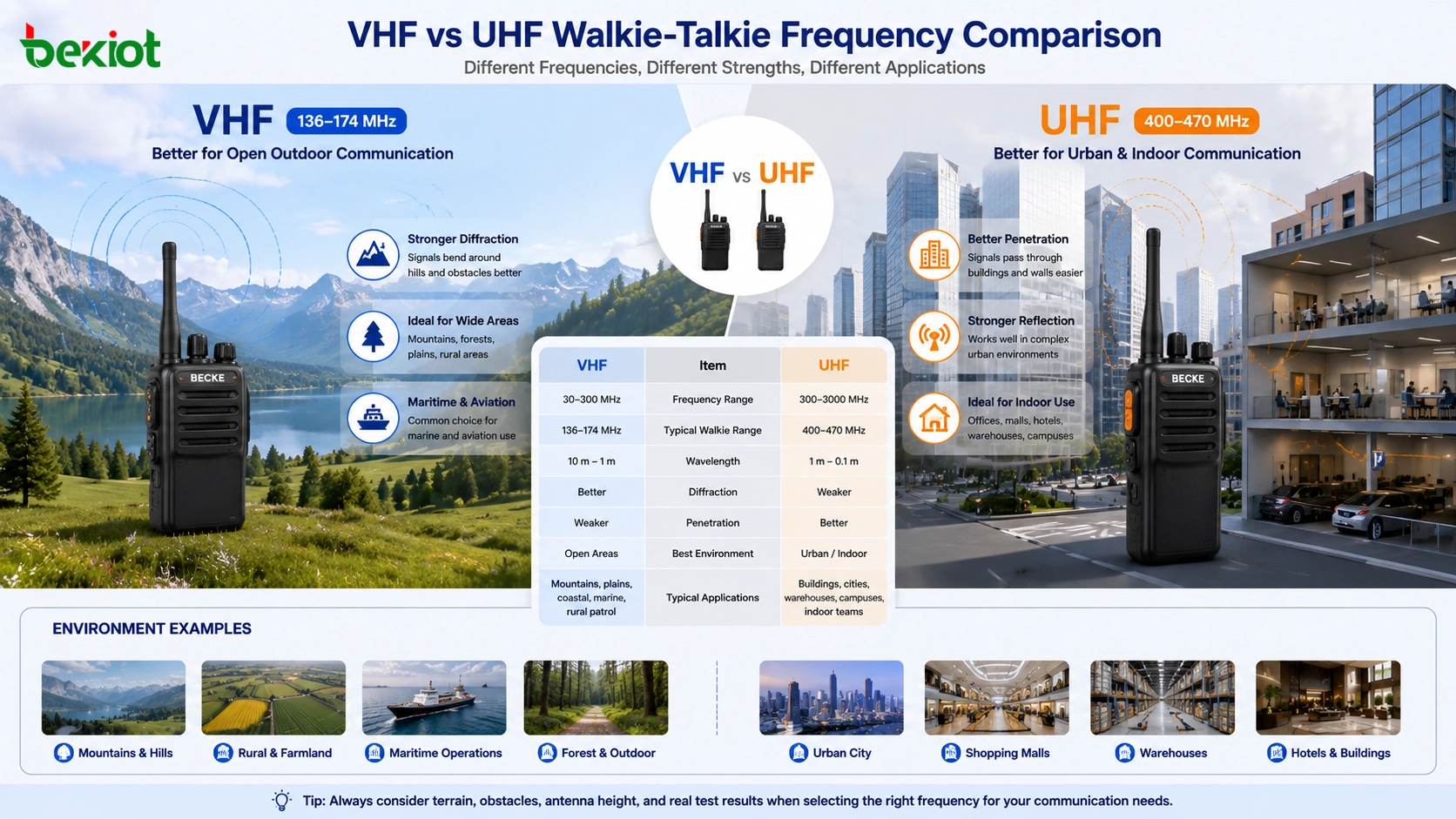
VHF stands for Very High Frequency. Its general frequency range is 30 MHz to 300 MHz, and its wavelength is about 10 meters to 1 meter. Because the wavelength is relatively long, VHF is often called a meter-wave band. In many walkie-talkie applications, VHF radios commonly operate around 136 MHz to 174 MHz.
UHF stands for Ultra High Frequency. Its general frequency range is 300 MHz to 3000 MHz, or 3 GHz, and its wavelength is about 1 meter to 0.1 meter. Because the wavelength is shorter, UHF is often called a decimeter-wave band. In many walkie-talkie applications, UHF radios commonly operate around 400 MHz to 470 MHz.
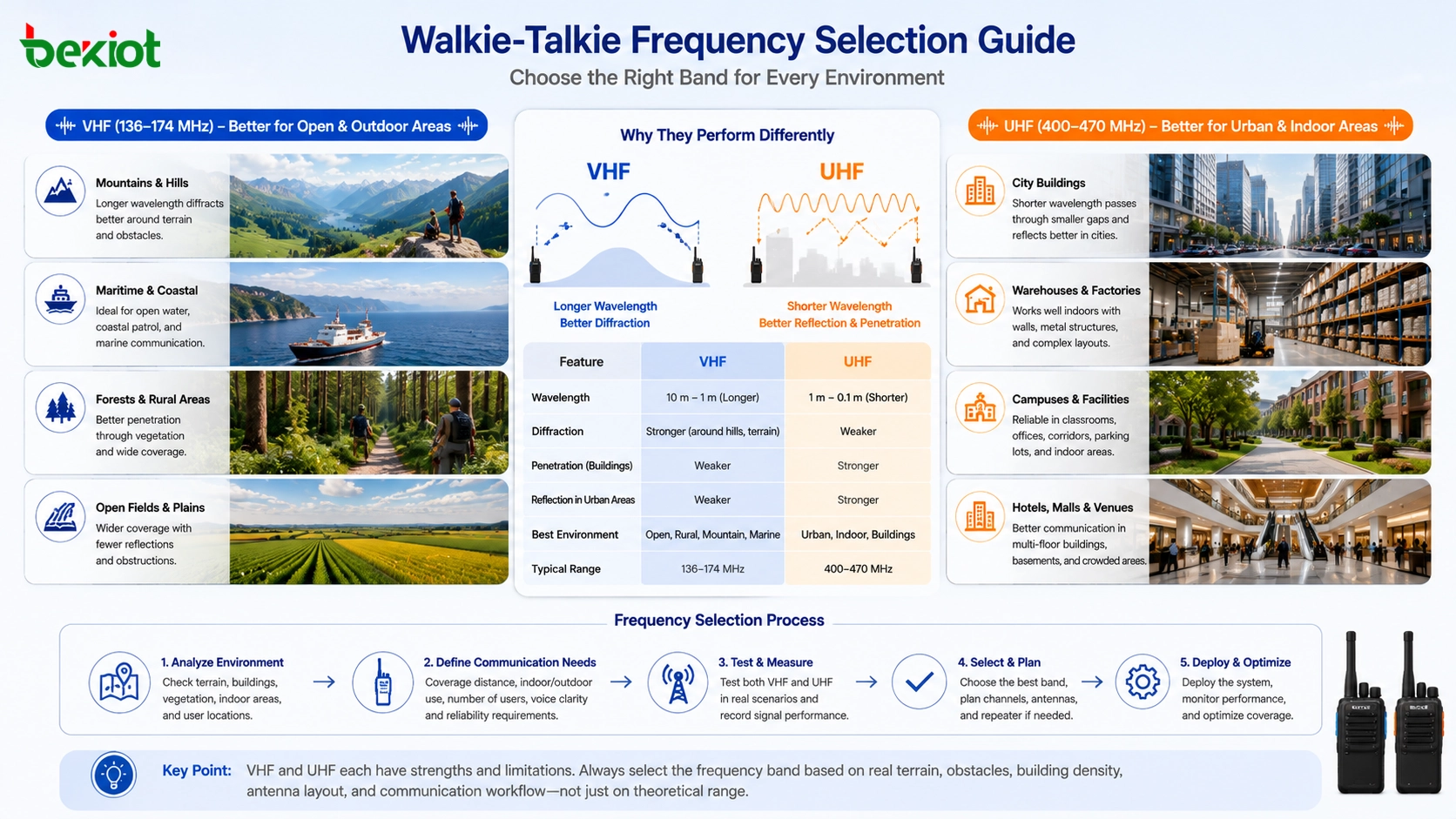
These figures are important because wavelength directly affects communication performance. Longer waves usually diffract better around large obstacles, while shorter waves are often more adaptable to dense urban environments, smaller building gaps, and reflected signal paths.
| Item | VHF | UHF |
|---|---|---|
| Full Name | Very High Frequency | Ultra High Frequency |
| General Frequency Range | 30 MHz to 300 MHz | 300 MHz to 3000 MHz |
| Typical Walkie-Talkie Range | 136 MHz to 174 MHz | 400 MHz to 470 MHz |
| Approximate Wavelength | 10 m to 1 m | 1 m to 0.1 m |
| Main Strength | Outdoor diffraction and open-area coverage | Urban reflection and building adaptability |
| Common Use | Mountains, plains, farms, marine areas, rural patrol | Buildings, cities, warehouses, campuses, hotels, malls |
Diffraction, Penetration, and Reflection
Many people say that VHF has a longer range and UHF has better penetration. This is partly correct, but it is not detailed enough for real system design. To choose the right radio band, it is better to understand three concepts: diffraction, penetration, and reflection.
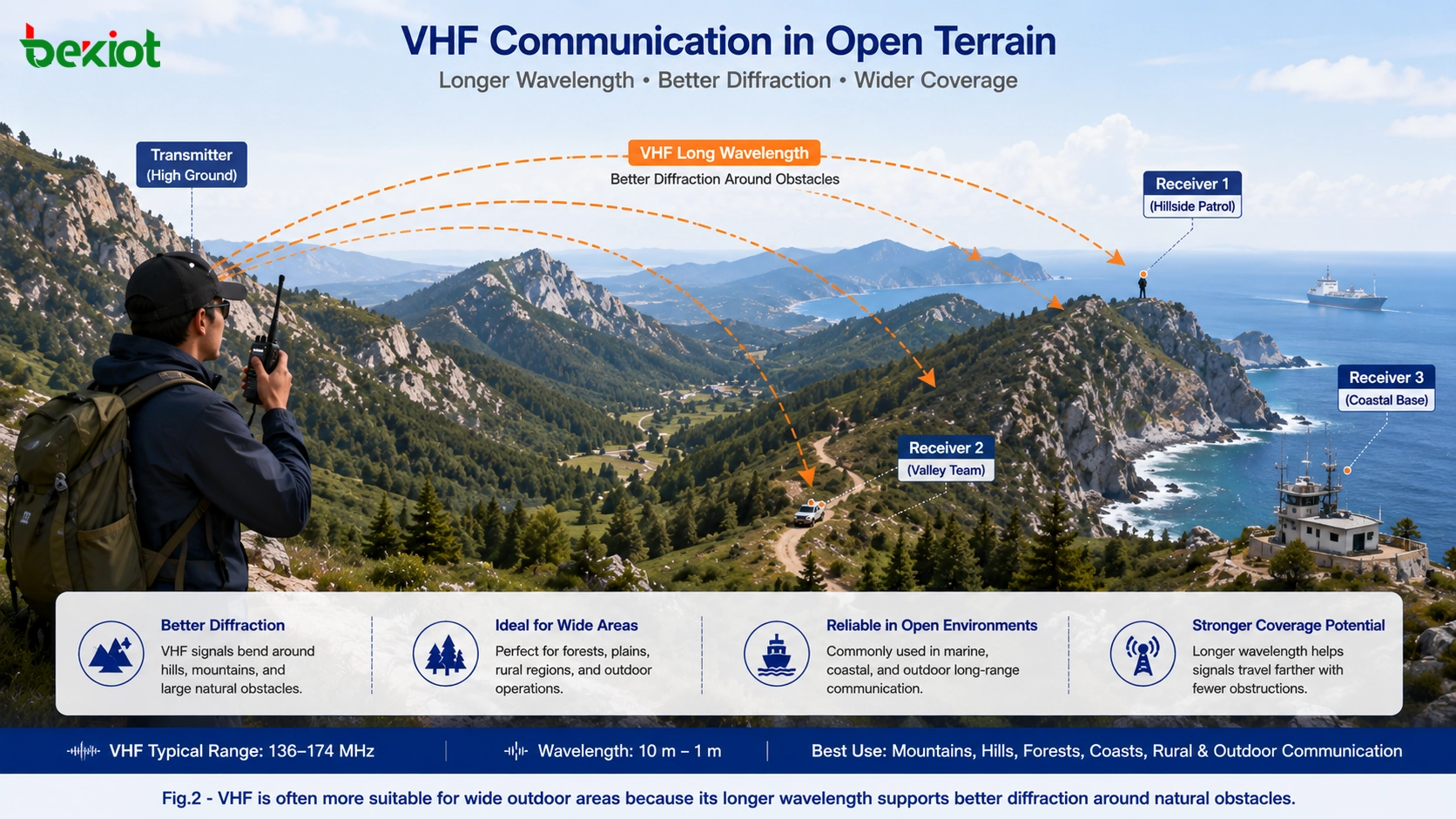
Diffraction means the ability of a radio wave to bend around obstacles. Because VHF has a longer wavelength, it can bend around hills, ridgelines, large trees, and terrain changes more effectively. This is why VHF is often useful in open outdoor areas, mountains, forests, rural zones, coastal areas, and marine communication environments.
Penetration means the ability of a signal to enter or pass through materials, gaps, rooms, corridors, doors, windows, and building structures. UHF often performs better in many indoor and urban environments because its shorter wavelength can pass through smaller openings and interact more effectively with complex building layouts.
Reflection is also important. In cities, radio waves meet concrete walls, glass, steel structures, vehicles, elevators, stairwells, and narrow corridors. UHF signals can reflect from these surfaces and reach users through indirect paths. This is one reason UHF is commonly selected for commercial buildings, hotels, campuses, factories, shopping centers, and parking areas.
Where VHF Usually Works Better
VHF is usually a better choice for open and outdoor communication. In areas with fewer buildings and wider terrain, VHF can deliver stable coverage with good diffraction characteristics. It is often used in open fields, rural patrol, farms, ports, coastal operation, marine communication, mountain rescue, scenic areas, and outdoor security tasks.
In mountain and hill environments, the longer wavelength of VHF helps the signal bend around terrain more effectively than UHF. This does not mean VHF can pass through every mountain, but it often has better tolerance when the communication path is partially blocked by natural obstacles.
VHF also has value in maritime and aviation-style communication environments because these scenarios often involve open space, relatively clear line-of-sight paths, and long-distance communication needs. Over water or open land, VHF may provide reliable performance when antenna height and channel planning are properly designed.
Why UHF Is Common in Cities and Buildings
UHF is widely used in cities because urban communication is rarely a clean line-of-sight path. Users may be inside rooms, behind walls, in stairwells, on different floors, near elevators, inside basements, or between buildings. In these environments, reflection and short-wavelength adaptability often matter more than open-area diffraction.
Because UHF has a shorter wavelength, it can work better through smaller gaps and openings in buildings. It can also reflect from hard surfaces and reach receivers through multiple paths. This makes UHF suitable for hotels, office buildings, shopping malls, warehouses, factories, schools, hospitals, parking lots, construction sites, and property management environments.
UHF is also useful when teams move between indoor and outdoor areas. For example, a security team may need to communicate between a lobby, underground parking area, elevator hall, outdoor gate, and control room. In this type of mixed urban environment, UHF usually provides a more practical balance.
Vegetation, Moisture, and Forest Coverage
Forests and dense vegetation create a special challenge for radio communication. Leaves contain moisture, and water molecules can absorb part of the radio wave energy. This effect can weaken signals, especially when the foliage is dense, wet, or located directly between the transmitting and receiving radios.
UHF signals can be affected more noticeably in dense vegetation because shorter wavelengths are more easily scattered by leaves, branches, and small natural surfaces. Each leaf or branch may reflect or scatter part of the signal, causing energy loss and unstable communication quality.
VHF is often more suitable for forest edges, mountain patrols, and open natural environments because it handles large natural obstacles more effectively. However, real testing is still necessary. Terrain height, antenna location, humidity, season, and tree density can all change the result.
Antenna Height and Site Layout Matter
Frequency selection is only one part of radio planning. Antenna height, antenna quality, user position, repeater placement, and site layout can strongly affect communication performance. A well-positioned UHF repeater may outperform a poorly installed VHF system, and a good VHF antenna installed at a high location may greatly improve outdoor coverage.
For handheld walkie-talkies, the human body can also affect signal transmission. When the radio is held close to the body, placed in a pocket, or used inside a vehicle, the signal may be partially blocked or weakened. This is why practical testing should include real usage posture, actual walking routes, vehicle operation, and expected user behavior.
In large projects, repeaters are often used to extend coverage. A repeater installed at a high point can improve communication between areas that handheld radios cannot reach directly. For buildings, repeaters, distributed antennas, or indoor coverage systems may be needed when basements, tunnels, or reinforced concrete structures block radio signals.
How to Choose for Different Environments
The easiest selection method is to start from the site type. If the site is wide, open, coastal, rural, or mountainous, VHF is usually worth considering first. If the site is dense, urban, indoor, multi-floor, or filled with walls and metal structures, UHF is usually more suitable.
For mixed environments, the answer is less absolute. A logistics park may include warehouses, open yards, offices, loading docks, and vehicle routes. A campus may include classrooms, outdoor playgrounds, underground parking, dormitories, and security gates. In these cases, the best approach is to test both bands and evaluate actual communication coverage.
A reliable test should include the farthest points, blind spots, indoor rooms, stairwells, basements, outdoor boundaries, vehicle routes, high-noise areas, and locations where emergency communication is most important. Testing only in an open area near the office is not enough.
Practical Use Cases by Industry
For agriculture, forestry, coastal operations, rural patrol, outdoor rescue, large scenic areas, and mountain work, VHF is often a practical option because these environments benefit from open-area coverage and diffraction around natural obstacles.
For hotels, commercial buildings, schools, warehouses, hospitals, shopping centers, residential property management, urban security, and construction sites, UHF is often preferred because teams need communication across walls, floors, corridors, parking areas, and complex indoor spaces.
For industrial sites, the decision depends on layout. An open petrochemical zone, power plant yard, or port area may benefit from VHF or a carefully designed repeater system. A factory workshop, underground gallery, utility tunnel, or steel-structure warehouse may be better served by UHF plus indoor coverage planning.
Common Planning Mistakes
One common mistake is selecting radios only by advertised distance. Radio range claims are usually measured under ideal conditions, but real sites include walls, hills, vehicles, machines, trees, electrical interference, and human movement. A radio that claims long range may still perform poorly in a dense building or basement.
Another mistake is treating penetration and diffraction as the same thing. VHF can bend around large natural obstacles better, but it does not automatically perform better inside buildings. UHF can work better in buildings and cities, but it may lose more energy in dense vegetation or long open-area routes.
A third mistake is ignoring local regulations and frequency licensing. Professional radio systems may require legal frequency assignment, channel planning, and compliance with regional radio management rules. Before large-scale purchase or deployment, users should confirm that the selected band and channel plan can be used legally in the target area.
Decision Table for Buyers
| Scenario | Suggested Band | Reason |
|---|---|---|
| Open plain or rural area | VHF | Better diffraction and outdoor coverage potential |
| Mountain and hill environments | VHF | Longer wavelength can bend around natural terrain more effectively |
| Marine and coastal operations | VHF | Suitable for open water, coastal patrol, and line-of-sight style communication |
| Dense city streets | UHF | Better reflection and adaptability in urban structures |
| Indoor commercial buildings | UHF | Shorter wavelength can enter rooms, corridors, and building gaps more effectively |
| Warehouses and factories | Usually UHF | Better for steel structures, indoor movement, and complex layouts |
| Forests and dense vegetation | Usually VHF | UHF may be weakened more by water-rich leaves and scattering |
| Mixed indoor and outdoor sites | Test both | Actual performance depends on layout, antenna height, obstacles, and workflow |
Recommended Selection Process
A professional selection process should begin with a site survey. The survey should identify working areas, blind spots, expected user routes, emergency points, indoor rooms, outdoor boundaries, underground spaces, and high-interference areas. After that, the project team can decide whether VHF, UHF, repeaters, distributed antennas, or a hybrid communication system is required.
Next, test real radios in real positions. A test should not only check whether two radios can hear each other once. It should evaluate voice clarity, signal stability, call success rate, battery performance, antenna type, user movement, and coverage consistency during normal working conditions.
Finally, consider future expansion. If the team may add more users, more areas, repeaters, dispatch consoles, RoIP gateways, or IP-based command platforms, the frequency plan should leave room for growth. Good radio planning is not just about today’s coverage; it should also support tomorrow’s operation.
FAQ
Can VHF and UHF radios communicate with each other?
They cannot communicate directly unless the radio supports the same band, channel frequency, channel spacing, modulation mode, and programming configuration. Cross-band communication usually requires a repeater, gateway, or special system design.
Can a dual-band walkie-talkie solve all frequency selection problems?
A dual-band radio provides flexibility, but it does not remove the need for proper channel planning, legal frequency use, antenna matching, and site testing. The environment still determines which band performs better.
Does higher transmit power always improve coverage?
No. Higher power may improve some links, but it cannot fully solve blocked paths, poor antenna position, strong interference, unsuitable frequency choice, or weak receiver conditions. Proper planning is usually more important than power alone.
How should a company test radio coverage before buying in bulk?
The test should include real working routes, indoor rooms, basements, stairwells, outdoor edges, vehicle areas, machinery zones, and emergency points. Testing should be done during normal work conditions, not only in an empty site.
When should a repeater be added?
A repeater should be considered when direct handheld-to-handheld communication cannot cover the required area, especially in large sites, mountains, tunnels, basements, multi-floor buildings, or wide industrial parks.
What information should be prepared before asking for a radio solution?
Prepare a site map, building layout, number of users, expected coverage area, indoor and outdoor routes, basement or tunnel locations, existing radio equipment, legal frequency requirements, and whether dispatch or recording integration is needed.