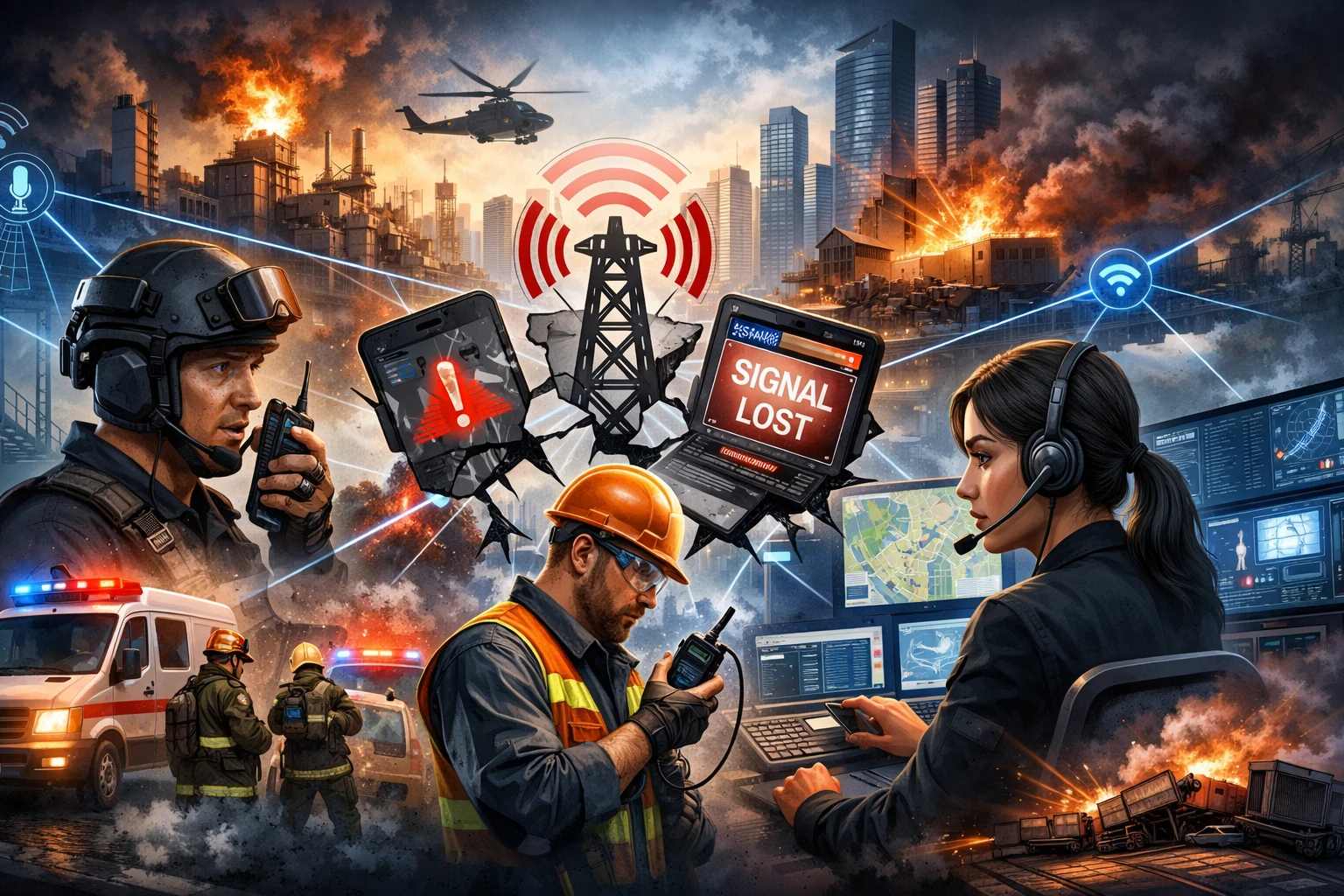
Railway operations run across tunnels, mountains, bridges, valleys and remote construction areas. When an emergency happens in a place with no mobile signal, unstable network coverage or damaged infrastructure, ordinary communication methods may fail at the exact moment when rescue teams need them most.
A practical railway emergency communication solution must do more than provide a phone call. It should support fast deployment, voice communication, video return, field coordination, command center visibility and reliable backup links. For this reason, a field-ready solution often combines satellite communication, wireless relay, RoIP radio dispatch, drone reconnaissance, rugged terminals and an integrated command platform.
Becke Telcom designs railway and industrial emergency communication systems around this principle: daily networks are the main channel, satellite links act as the final backup, wireless relay extends coverage into dead zones, and drones provide the eyes of the command center when people cannot safely enter the danger area.
Why Railway Rescue Communication Is So Difficult
Railway rescue is different from ordinary field communication. The working environment is long, narrow, remote and often blocked by terrain. In a tunnel, signal may disappear after only a short distance. In mountain areas, high slopes, dense forests and poor access roads make mobile coverage unreliable. During landslides, bridge collapse or extreme weather, the existing network may be damaged or completely unavailable.
The first challenge is the tunnel itself. Long railway tunnels can become signal black holes, especially when the rescue point is several kilometers inside the tunnel. The second challenge is mountain coverage. Emergency vehicles may not be able to reach the site quickly, and mobile phones may become useless. The third challenge is situational awareness. A command center cannot rely only on verbal reports; it needs real-time images, video, location and field status to make accurate decisions.
Another key requirement is time. Emergency communication equipment must be powered on, connected and ready within minutes. Rescue teams cannot wait for a temporary network to be slowly rebuilt. Even when video bandwidth is limited, voice communication must remain available, because push-to-talk coordination is the basic lifeline for field rescue.
Solution Concept: Satellite Backup, Wireless Relay and Drone Visibility
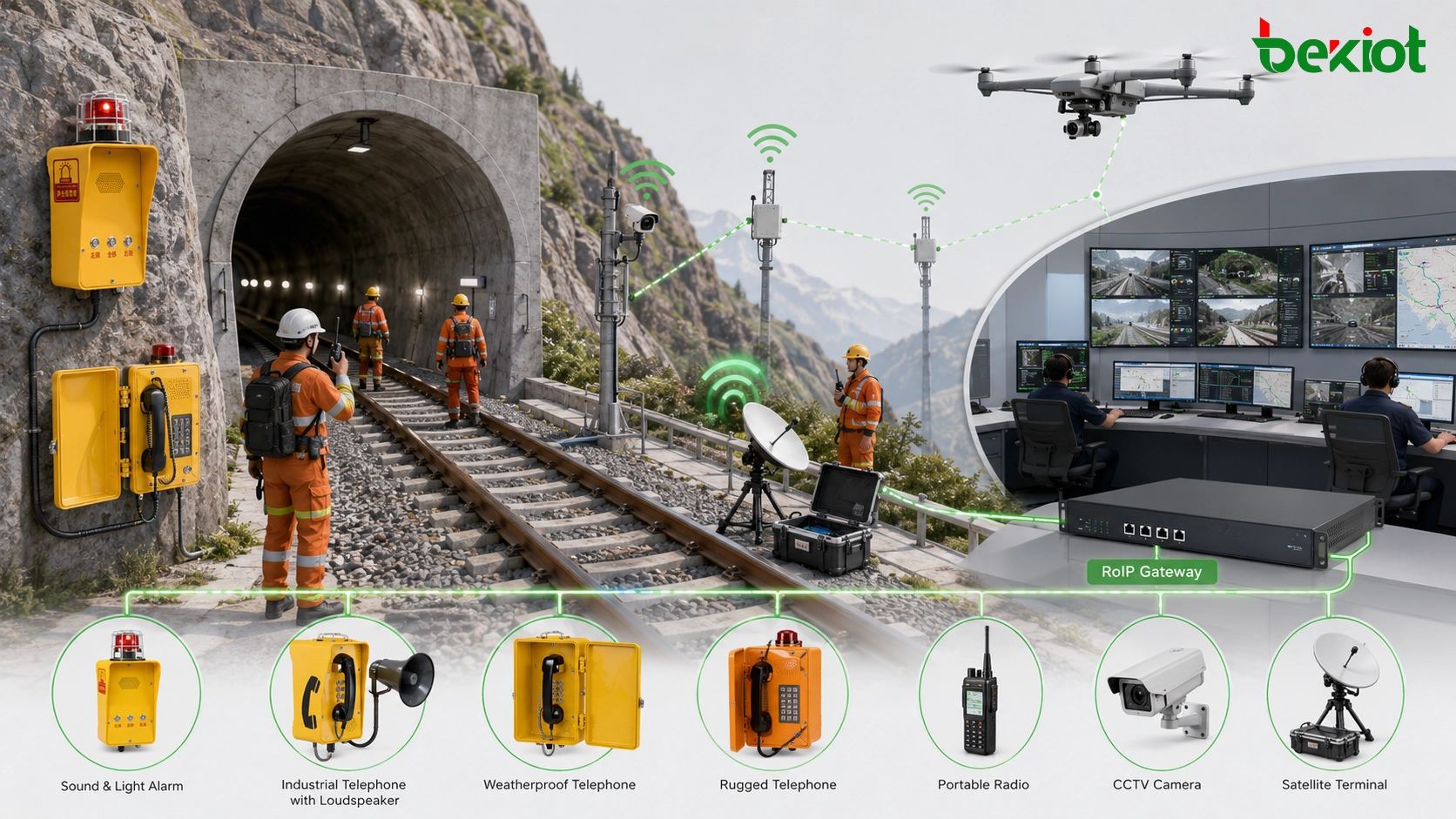
A reliable railway emergency communication solution should not depend on a single transmission method. It should use a layered architecture. Satellite equipment provides the outside connection when terrestrial networks fail. Wireless relay extends local coverage into tunnels, valleys and blocked zones. RoIP gateways connect walkie-talkies and radio users with IP dispatch systems. Drone systems provide aerial video, route inspection and danger-zone reconnaissance.
In a Becke Telcom railway emergency communication deployment, the field team can use rugged SIP phones, industrial telephones, RoIP gateways, portable relay equipment, IP cameras and radio terminals. These devices can connect with an IP PBX, dispatch console, PA/GA broadcast system, CCTV platform and GIS command interface. The result is a practical communication network that supports both daily operation and emergency response.
The purpose is simple: keep the rescue team connected, keep the command center informed, and keep voice communication alive even when normal signal coverage disappears.
Application Scenario 1: Tunnel Rescue with Extended Wireless Coverage
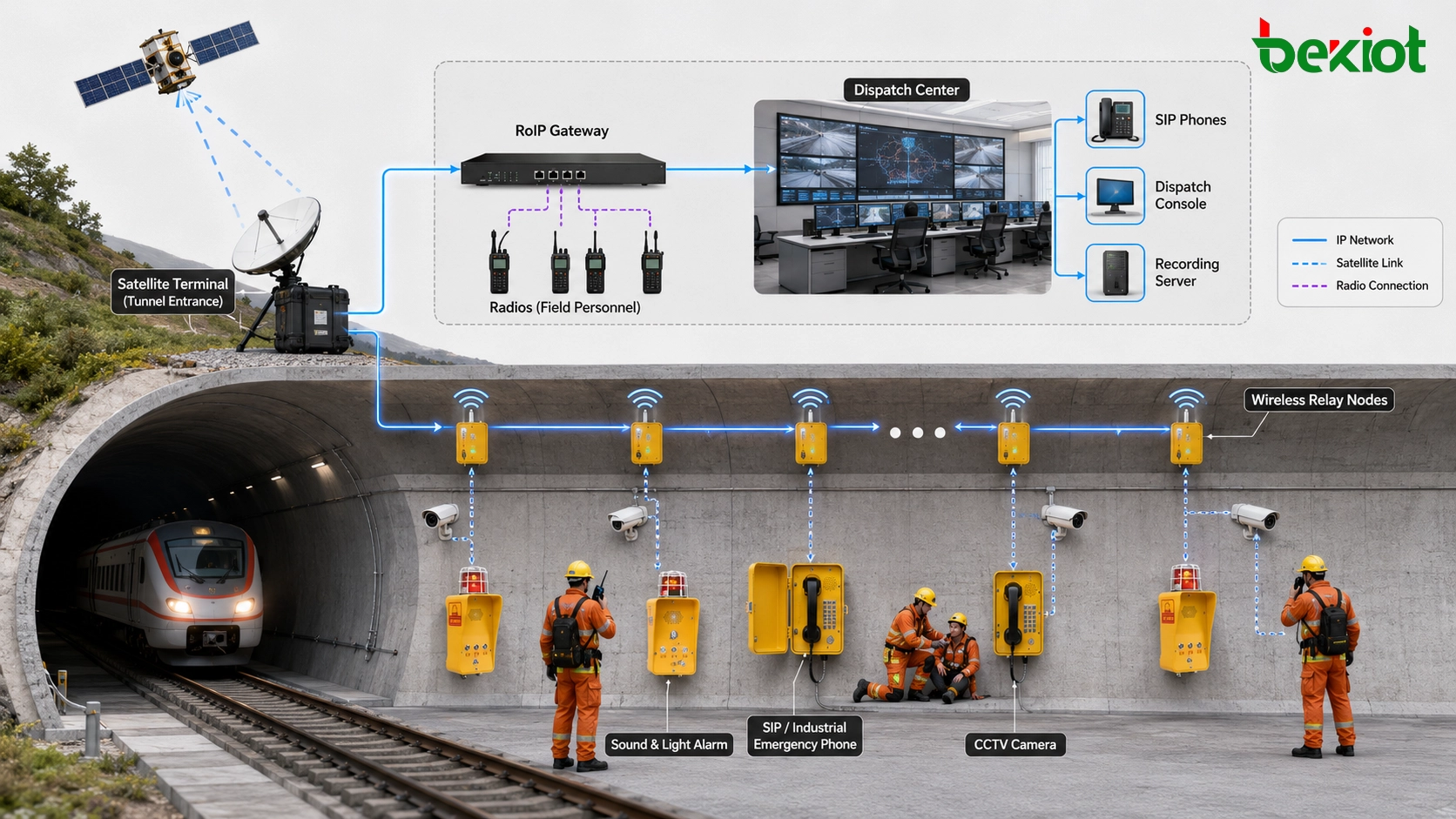
Railway tunnel rescue is one of the most demanding use cases. When an incident happens deep inside a tunnel, mobile signal and ordinary wireless coverage may not reach the rescue point. A portable satellite terminal can be installed near the tunnel entrance to create an external connection. Wireless relay devices can then extend the signal into the tunnel section by section.
This setup allows field cameras, rescue staff terminals and radio communication devices to connect with the command center. Depending on site conditions, wireless relay can help extend communication several kilometers into the tunnel. The command center can receive live video, voice reports and field status without sending additional personnel into unnecessary risk.
For railway tunnels, Becke Telcom can integrate SIP emergency phones, RoIP radio gateways, industrial intercoms and PA broadcast endpoints into a unified dispatch system. This makes it possible to coordinate tunnel teams, broadcast instructions, receive emergency calls and link video surveillance from one command interface.
Application Scenario 2: Mountain Railway Rescue in Signal Blind Areas
Mountain railways often pass through valleys, forests, cuttings and remote areas where public mobile networks are unstable or unavailable. In these situations, emergency teams need a temporary communication network that can be established quickly without relying on local infrastructure.
A satellite terminal can work as a temporary field communication node. Wireless relay equipment can expand local coverage for rescue workers, cameras and radio users. RoIP technology allows traditional walkie-talkies to be connected with an IP dispatch platform, so radio users in the field and operators in the control room can talk through a unified communication system.
This approach is especially useful when emergency vehicles cannot reach the exact incident point. Field personnel can still transmit voice, images and location information. The control room can see where the problem is, assign teams more accurately and coordinate railway, emergency, fire and maintenance departments through a common dispatch workflow.
Application Scenario 3: Landslide, Collapse and Dangerous-Zone Reconnaissance
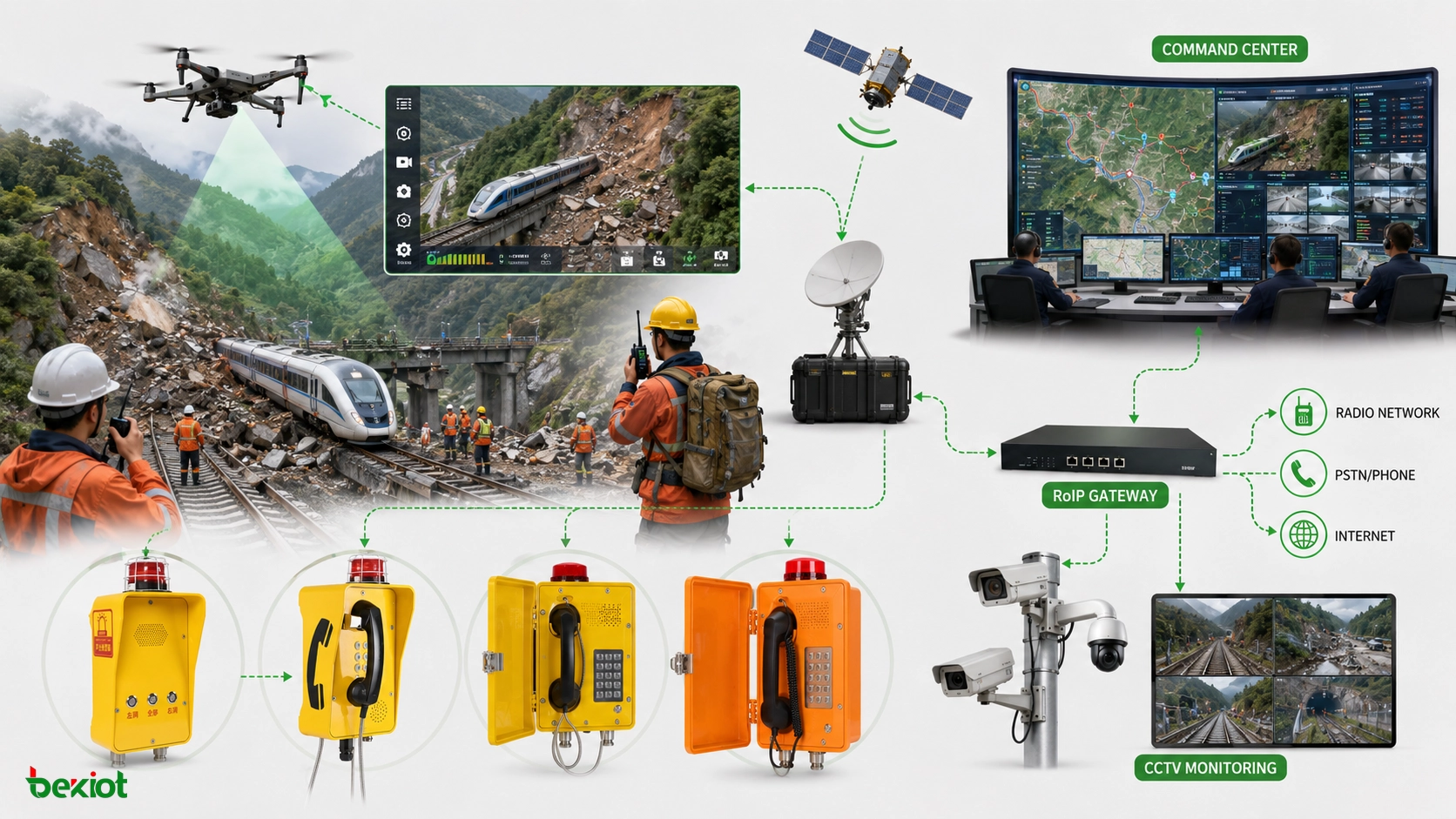
When a bridge is damaged, a slope collapses or a section becomes too dangerous for people to enter, drones can become the first visual access tool. A drone can fly over the affected area, inspect track conditions, capture real-time images and send visual information back to the command center.
When drone video is combined with satellite communication and field wireless relay, the command center can evaluate the scene before sending personnel forward. This helps reduce rescue risk and improves decision-making speed. Ground teams can continue using radios or rugged terminals for voice coordination while the drone provides visual confirmation from above.
For more advanced deployments, Becke Telcom can connect drone video, CCTV, alarm information, GIS maps and emergency calls into a converged command platform. Operators can view the incident location, communicate with field teams, trigger PA announcements and record the response process for later review.
Key System Components
Satellite Communication Equipment
Satellite communication provides the backup link when public networks are unavailable or damaged. It is especially valuable in tunnels, mountain railways, remote construction sections and disaster areas. A portable satellite terminal can help create a temporary communication channel within minutes.
Wireless Relay Network
Wireless relay devices extend field coverage into areas where direct signal cannot reach. In tunnel rescue, relay nodes can be placed step by step to carry communication deeper into the tunnel. In mountain areas, relay points can help cover valleys, slopes and blocked sections.
RoIP Gateway and Radio Dispatch
RoIP technology connects traditional walkie-talkie systems with IP networks. This allows radio users, dispatch operators, SIP phones and command platforms to communicate together. For railway rescue, RoIP is important because handheld radios are still one of the most reliable tools for field coordination.
Rugged SIP Phones and Industrial Emergency Terminals
Railway sites require durable communication terminals. Industrial telephones, SIP emergency phones, waterproof call stations and vandal-resistant terminals can be installed in tunnels, stations, maintenance areas, bridges and outdoor railway sections. These terminals support daily communication as well as emergency calling.
Video, CCTV and Drone Integration
Voice is the foundation, but visual information improves command accuracy. CCTV cameras, portable cameras and drones can send real-time images to the command center. This helps operators understand the situation, confirm risk zones and support rescue planning.
Dispatch Platform and PA/GA Broadcast
A converged dispatch platform connects voice, radio, video, GIS, alarms and public address functions. In an emergency, the command center can talk to field teams, view video, locate resources, trigger broadcasts and coordinate multiple departments from one interface.
Recommended Architecture for Railway Emergency Communication
A practical architecture can be divided into four layers. The field layer includes rescue personnel, radios, SIP phones, emergency call points, cameras and drones. The access layer includes satellite terminals, wireless relay devices, RoIP gateways and network switches. The platform layer includes IP PBX, dispatch server, recording system, video management and GIS map services. The command layer includes dispatch consoles, large-screen visualization, PA/GA control and emergency coordination workflows.
This layered structure helps railway operators build a system that is not limited to one device or one network. If the public network is available, the system can use it. If the public network fails, satellite and wireless relay can take over. If people cannot enter the danger zone, drones and cameras provide visual information. If video bandwidth becomes unstable, radio and voice communication remain the priority.
Technical Value for Railway Operators
The main value of this solution is communication continuity. Railway rescue cannot rely only on mobile phones or a single network. By combining satellite backup, wireless relay, RoIP dispatch and rugged endpoints, the system keeps field teams connected even in extreme environments.
The second value is faster decision-making. Real-time video, drone images, GIS maps and radio communication give the command center a more complete view of the incident. Operators can assign teams, avoid dangerous routes and coordinate multiple departments more efficiently.
The third value is system integration. Becke Telcom solutions can connect SIP communication, industrial phones, radio systems, PA broadcast, CCTV, alarms and dispatch workflows. This reduces system isolation and helps railway operators build a unified emergency communication platform instead of several separate tools.
Deployment Considerations
Before deploying a railway emergency communication system, operators should evaluate tunnel length, terrain conditions, public network coverage, radio frequency planning, power supply, access roads, command center requirements and the need for video return. The equipment should be easy to transport, fast to start and stable under harsh environmental conditions.
For fixed railway infrastructure, emergency phones, SIP intercoms, PA speakers and CCTV can be installed along tunnels, stations and maintenance sections. For mobile rescue teams, portable satellite equipment, wireless relay kits, RoIP gateways and rugged terminals can be prepared as emergency response packages.
Testing is also essential. A solution should be tested in real tunnel sections, mountain blind areas and simulated disaster scenarios. The test should confirm startup time, coverage distance, voice quality, video stability, battery endurance and command center integration.
Becke Telcom Railway Emergency Communication Solution
Becke Telcom provides industrial communication products and integrated dispatch solutions for railway, tunnel, energy, emergency, transportation and public safety environments. The solution can combine SIP phones, industrial waterproof telephones, emergency call stations, RoIP gateways, IP PBX, PA broadcast, CCTV linkage, GIS dispatch and command center communication.
For railway emergency scenarios, Becke Telcom focuses on three practical goals: rapid field deployment, reliable voice communication and clear command visibility. Whether the incident happens inside a tunnel, in a mountain blind spot or in a dangerous collapse area, the system is designed to help operators build a temporary but dependable communication network.
When railway communication must continue under no-signal conditions, a layered emergency communication solution is not optional. It is the foundation for safe rescue, fast coordination and informed command decisions.
FAQ
What is a railway emergency communication solution?
It is a communication system designed for railway rescue and incident response. It connects field teams, command centers, radios, phones, cameras, drones, PA systems and dispatch platforms, especially in areas where normal networks may fail.
Why is satellite communication important for railway rescue?
Satellite communication provides a backup link when public mobile networks, fiber links or local infrastructure are unavailable. It is especially useful in tunnels, mountain areas and disaster zones.
How does wireless relay help in railway tunnels?
Wireless relay extends communication coverage into areas where direct signal cannot reach. In long tunnels, relay nodes can help carry voice, video and data communication deeper into the rescue area.
What role does RoIP play in railway emergency dispatch?
RoIP connects walkie-talkie radio systems with IP communication platforms. This allows radio users in the field to communicate with SIP phones, dispatch consoles and command center operators.
Can drones be integrated into railway emergency communication?
Yes. Drones can provide real-time visual information from dangerous or inaccessible areas. When connected with satellite communication, wireless relay and dispatch platforms, drone video can support faster and safer decision-making.
What should railway operators consider before deployment?
They should evaluate tunnel length, terrain, signal blind areas, radio coverage, power supply, command center workflow, video requirements, equipment portability and emergency startup time.