


Queue priority is a call management mechanism that decides which waiting call should be answered first when multiple callers are in a queue. Instead of treating every call strictly by arrival time, the system evaluates business rules, caller type, urgency, service level, customer value, language, skill requirement, callback status, and escalation condition to determine the best handling order.
In contact centers, help desks, emergency hotlines, customer service teams, technical support groups, healthcare appointment desks, utility service centers, and enterprise call platforms, queue priority helps reduce unnecessary waiting for important calls while improving agent utilization. Its purpose is not to ignore ordinary callers, but to match response speed with operational importance.
From First-Come-First-Served to Intelligent Waiting
A simple queue answers calls in the order they arrive. This is easy to understand, but it does not always reflect business reality. A VIP customer, emergency caller, service outage report, returning caller, or high-risk support case may require faster handling than a routine inquiry.
Priority-based handling adds decision logic to the waiting process. The system can promote certain calls, reserve agents for special queues, route urgent calls to skilled staff, or move callers between queues when conditions change.
This makes the call flow more flexible. The system is no longer only asking, “Who arrived first?” It also asks, “Which call should be handled next to protect service quality, customer experience, and operational risk?”
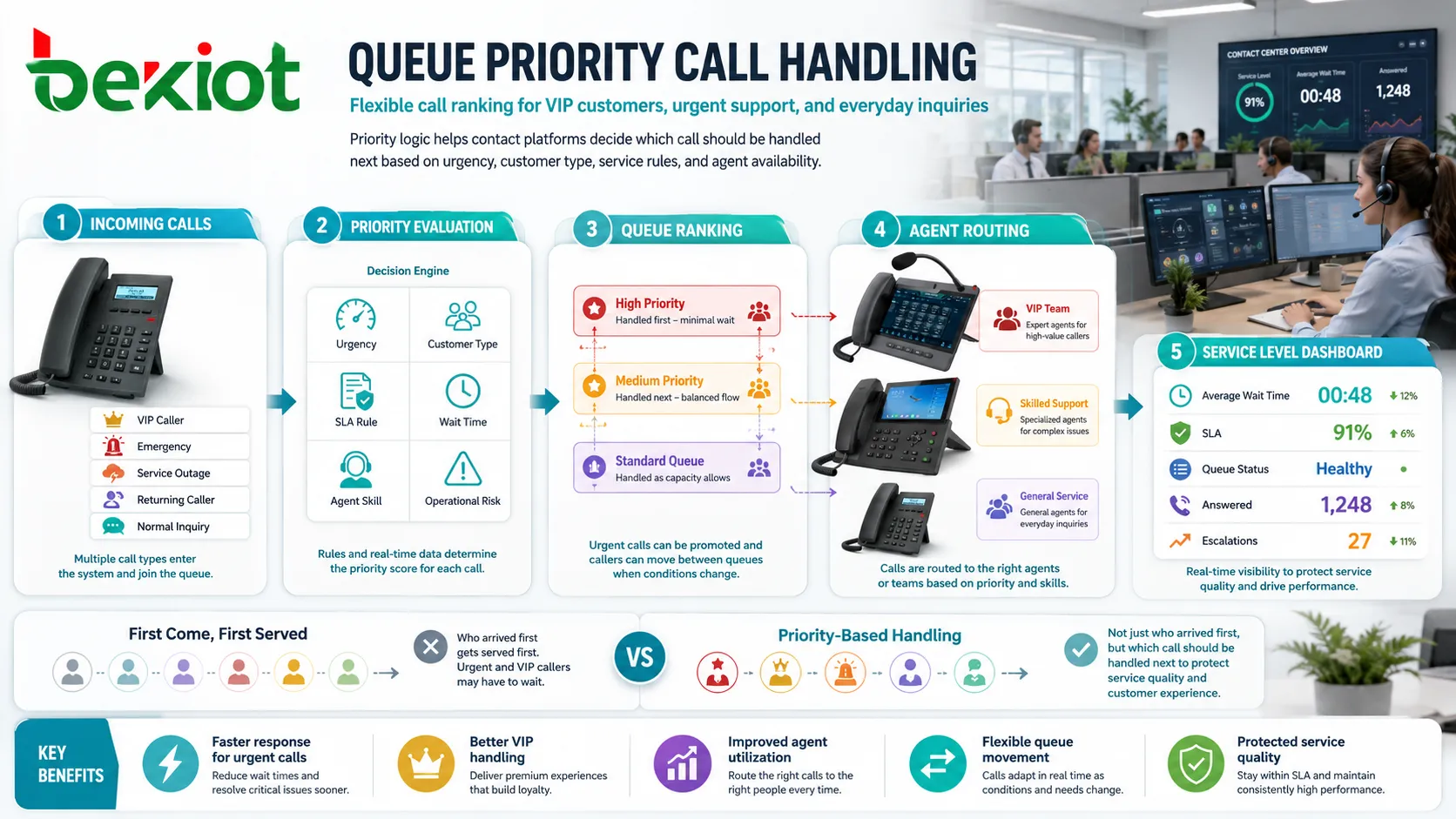
How the Decision Logic Works
Caller Identification
The system first identifies the caller where possible. This may come from caller ID, account number, IVR input, CRM record, ticket number, registered phone number, or customer authentication. Identification allows the platform to understand who is calling and what level of handling may be needed.
If the caller cannot be identified, the system may still apply rules based on the number dialed, selected IVR option, language choice, time of day, region, or service category.
Intent and Urgency Detection
Priority may depend on why the person is calling. A password reset, billing question, product inquiry, emergency repair, outage report, medical appointment change, or service cancellation may each require different handling.
Intent can be detected through IVR menus, speech recognition, keypad selection, previous ticket status, CRM flags, or agent-defined escalation rules from earlier interactions.
Rule-Based Ranking
After the caller and reason are known, the system applies ranking rules. These rules may assign higher priority to premium accounts, emergency lines, repeat callers, service-level breaches, high-value opportunities, or unresolved complaints.
Ranking can be fixed or dynamic. A call may start as normal priority but become higher priority if the caller waits too long or if the service-level target is close to being missed.
Agent Matching
A high-priority call still needs the right agent. The system may check agent skill, language, department, availability, certification, customer ownership, or current workload before connecting the call.
This prevents a priority call from being answered quickly by the wrong person, which would only create another transfer and waste time.
Key Techniques Behind Faster Response
Priority Weighting
Priority weighting assigns scores to calls based on multiple factors. For example, a premium customer may receive additional weight, an urgent category may receive more weight, and a long waiting time may increase the score gradually.
This approach is more flexible than using only one rule. It allows the platform to compare different types of calls fairly and decide which one should move forward.
Dynamic Reordering
Queue order can change while callers are waiting. If an ordinary call has waited too long, the system may lift its priority to prevent excessive delay. If an emergency call enters the queue, it may move ahead immediately.
Dynamic reordering helps balance urgency and fairness. It reduces the risk that low-priority callers are forgotten while still protecting important calls.
Skill-Based Routing
Skill-based routing connects callers to agents who can solve the issue efficiently. A technical problem should not always go to a general service agent, and a billing dispute may not belong to a product specialist.
When priority and skill routing work together, call handling becomes faster not only because calls are answered sooner, but because they are answered by better-matched agents.
Service-Level Monitoring
Service-level targets define how quickly certain calls should be answered. The system can monitor waiting time and adjust call priority before the target is missed.
This is useful for business contracts, premium support, emergency support, public service hotlines, and regulated service environments.
| Priority Input | Example Rule | Efficiency Impact |
|---|---|---|
| Customer Value | Premium accounts move ahead within the same service category. | Protects high-value relationships and reduces account escalation risk. |
| Urgency | Emergency, outage, or safety-related calls receive immediate promotion. | Improves response to time-sensitive events. |
| Waiting Time | Priority increases after a defined threshold. | Prevents long delays for callers initially ranked lower. |
| Agent Skill | Calls wait for a qualified agent instead of any available agent. | Reduces repeat transfers and improves first-contact resolution. |
Where Efficiency Gains Come From
The first efficiency gain comes from reduced mismatch. If calls reach the right team earlier, agents spend less time transferring, explaining internal notes, or recovering from routing mistakes.
The second gain comes from better service-level protection. Calls that are close to missing target response time can be promoted before they become complaints. This helps supervisors manage queues proactively instead of reacting after performance has already declined.
The third gain comes from workload control. Priority rules can distribute calls according to agent capacity, skill, and queue pressure. A busy technical queue may be supported by backup agents only when demand exceeds a threshold.
The fourth gain comes from improved caller behavior. When urgent callers are handled faster and routine callers receive clear wait information or callback options, abandonment rates may decrease and the overall experience becomes more predictable.
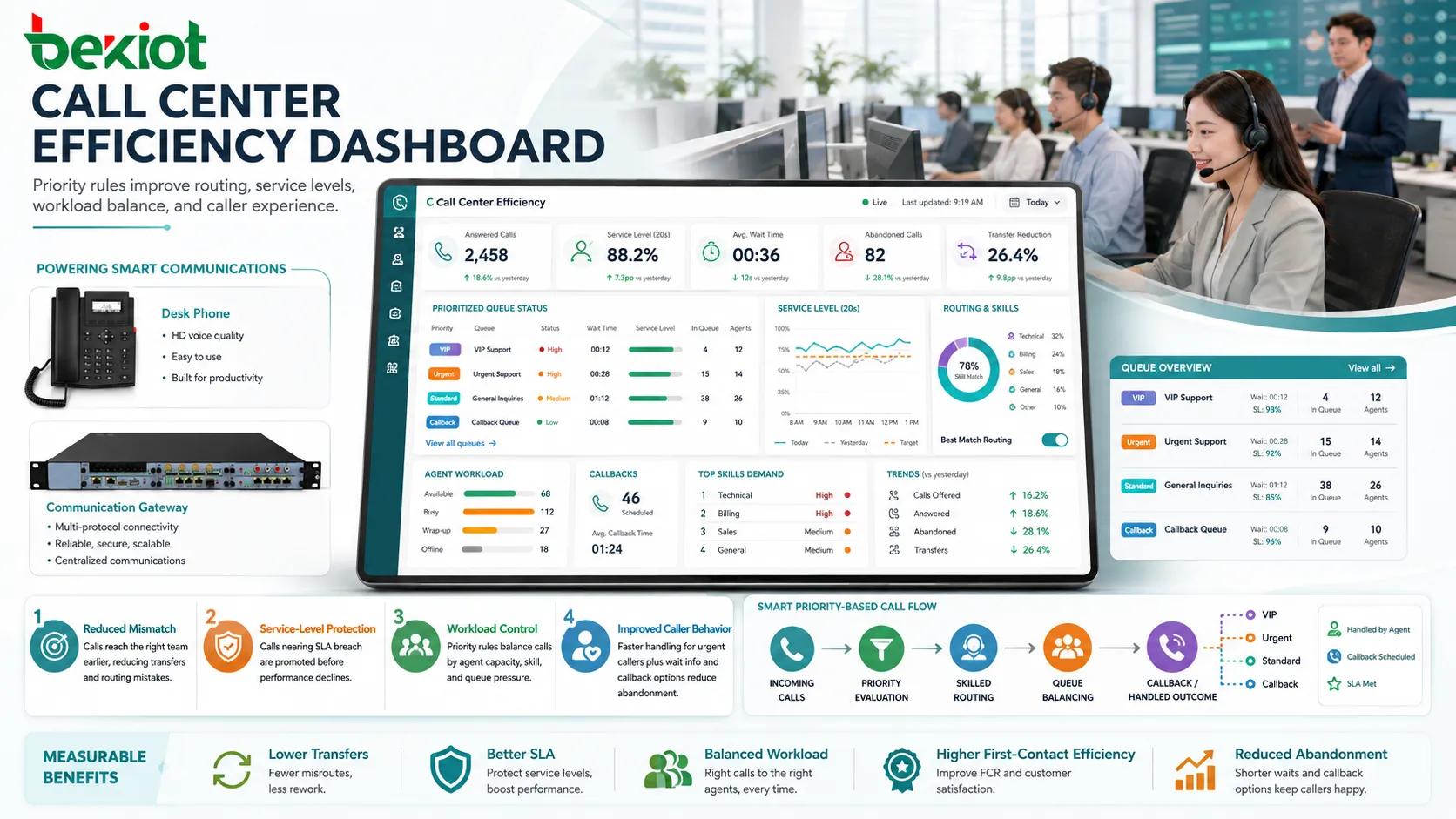
Applications in Different Call Environments
Customer Service Centers
Customer service teams use priority rules to separate urgent issues from routine requests. A service outage, complaint escalation, subscription cancellation, or high-value account call may receive faster handling than a general information inquiry.
This does not mean ordinary callers are ignored. Good design sets limits so lower-priority calls still progress through the queue within acceptable waiting time.
Technical Support Desks
Technical support often deals with different severity levels. A full system outage, security incident, payment failure, or production-impacting problem should not wait behind simple password questions.
Priority logic can combine ticket severity, customer contract level, device status, and previous case history to decide routing order.
Healthcare and Appointment Lines
Healthcare call centers may need to distinguish appointment scheduling, prescription questions, urgent symptoms, department callbacks, insurance issues, and internal clinical calls.
Priority handling should be designed carefully in this field because call urgency may affect patient experience and operational safety. Clear escalation paths and human review are important.
Utilities and Public Service Hotlines
Utility providers, municipal services, transport hotlines, and public service centers may receive calls about outages, leaks, safety hazards, billing, complaints, and general information. Calls related to danger or widespread service interruption may need higher priority.
Priority rules can also be linked to geographic area, incident type, outage status, and existing work orders.
Sales and Revenue Teams
Sales teams may prioritize calls from active opportunities, high-value leads, returning buyers, campaign responses, or customers near renewal. The goal is to reduce missed revenue opportunities and connect prospects while intent is fresh.
However, sales priority should be balanced with service commitments so support callers are not unfairly delayed.
Designing Rules Without Creating Unfair Queues
Priority design must balance speed and fairness. If too many callers receive high priority, the system loses meaning. If priority rules are too strict, lower-ranked callers may wait too long and abandon the call.
A good design usually includes aging rules. This means a caller’s priority gradually increases as waiting time grows. Aging prevents routine calls from remaining at the bottom indefinitely.
Supervisors should also define maximum wait thresholds, overflow rules, callback options, and manual override procedures. These controls help the system remain fair during peak traffic.
Relationship with IVR and Self-Service
IVR menus help collect information before the call reaches an agent. Caller choices can influence priority, department selection, language routing, and skill requirements.
Self-service can reduce queue pressure by handling simple requests such as balance checks, order status, appointment confirmation, password reset, or payment reminders. This leaves agents more available for complex or urgent calls.
Priority logic should not depend only on IVR selection because callers may choose the wrong option to get faster service. Systems should validate intent using account data, ticket history, and agent feedback when possible.
Metrics That Show Improvement
Average Speed of Answer by Category
Overall average speed of answer can hide important differences. Teams should measure response time by call type, customer tier, service severity, and queue category.
This shows whether priority rules are actually helping the calls that matter most.
Abandonment Rate
If callers wait too long, they may hang up. A well-designed system should reduce abandonment for urgent and high-value calls while keeping routine abandonment under control.
First-Contact Resolution
Priority routing should not only answer faster. It should also route callers to agents who can solve the issue. First-contact resolution helps measure this quality.
Transfer Rate
High transfer rates may indicate poor skill matching or unclear IVR design. Lower transfer rates usually mean calls are reaching the correct agents earlier.
Service-Level Compliance
Service-level reports show whether defined targets are met. Priority rules can help protect targets for critical queues, premium support, and regulated response lines.
Common Configuration Mistakes
Making Too Many Calls High Priority
If every queue or caller type receives top priority, the system becomes ineffective. Priority must represent real operational importance.
Ignoring Long-Waiting Normal Calls
Lower-priority callers still need protection. Without aging rules or maximum wait thresholds, routine callers may experience poor service.
Routing Urgent Calls to Unqualified Agents
Fast answer time is not useful if the agent cannot resolve the issue. Priority should work together with skill and knowledge routing.
Using Static Rules Forever
Customer behavior, call volume, service contracts, and business priorities change. Rules should be reviewed regularly using real call data.
Not Explaining Queue Behavior to Agents
Agents and supervisors should understand why certain calls arrive first. Otherwise, they may misinterpret queue order or manually override the system incorrectly.
Implementation Steps
Start by classifying call types. Identify which calls are urgent, high-value, compliance-related, complex, routine, or suitable for self-service.
Next, define measurable rules. Use customer tier, IVR choice, ticket severity, service-level target, language, location, account status, and waiting time as structured inputs.
Then test with historical call data. Simulate how the rules would have changed queue order, wait time, abandonment, and agent workload.
After deployment, monitor results daily during the early stage. Adjust thresholds if too many callers are promoted or if certain groups wait too long.
Finally, document the policy. Supervisors, agents, workforce planners, and administrators should know how the system ranks calls and when manual override is allowed.
Queue priority improves call handling when it connects urgency, caller value, waiting time, agent skill, and service targets into one controlled routing decision.
FAQ
Can priority rules make some callers wait too long?
Yes, if the rules are poorly designed. Aging rules, maximum wait thresholds, overflow routing, and callback options help protect lower-priority callers.
Should VIP callers always go first?
Not always. A safety-related or service outage call may be more urgent than a routine VIP inquiry. Priority should reflect both value and urgency.
How often should queue rules be reviewed?
They should be reviewed whenever call volume changes, service targets shift, new products launch, staffing changes, or reports show unfair waiting patterns.
Can callers abuse priority menus?
Yes. Some callers may choose urgent options to shorten waiting time. Validation through account data, ticket status, agent tagging, and analytics can reduce abuse.
What is the safest way to start using priority routing?
Start with a small number of clear categories, monitor the effect on all caller groups, and adjust gradually before applying complex scoring rules across every queue.







