


Least-Cost Routing, often abbreviated as LCR, is a call routing strategy used in PBX, IP PBX, VoIP, SIP trunks, softswitches, telecommunications carriers, and enterprise communication systems. Its goal is to select the most cost‑effective route for outbound calls while maintaining call quality, reliability, compliance, and service availability.
When a communication system has multiple trunks, carriers, gateways, or service providers, the same destination may be reachable via different routes with different costs. LCR compares these routes according to predefined rules, then sends each call over the route that matches the organisation‘s cost and policy requirements.
LCR does not mean simply picking the cheapest trunk. A good strategy balances price, quality, availability, destination rules, emergency requirements, and operational risks.
The Basic Meaning of Least-Cost Routing
LCR is a routing logic that analyses the dialled number and selects the preferred outgoing route according to cost and policy. It may take into account the destination prefix, country code, area code, mobile or fixed number type, carrier tariff, time of day, trunk status, route priority, and failover options.
For example, a company might use a SIP trunk for local calls, a different carrier for international calls, a GSM gateway for certain mobile destinations, and a PSTN gateway as a backup when other routes fail. LCR helps the system determine the appropriate route for each call instead of leaving the choice to users manually.
Cost‑based Call Routing
The core idea is cost‑based routing. The system examines the dialled number against call patterns and price rules. If several routes are able to complete the call, the PBX or softswitch selects the lowest‑cost eligible route.
However, cost is usually not the only condition. A very cheap route may suffer from poor voice quality, low answer rates, limited capacity, or instability. Therefore a practical LCR must include quality rules and failover so that saving money does not come at the expense of call reliability.
Where LCR Is Used
LCR is used in enterprise PBX systems, contact centres, hosted VoIP platforms, telecommunications carriers, multi‑site companies, hotel phone systems, international calling services, and organisations with high volumes of outbound calls.
Its value becomes especially clear when call costs vary by destination. International calls, mobile calls, premium‑rate destinations, remote areas, and inter‑carrier routes may have different prices depending on the provider and time period.
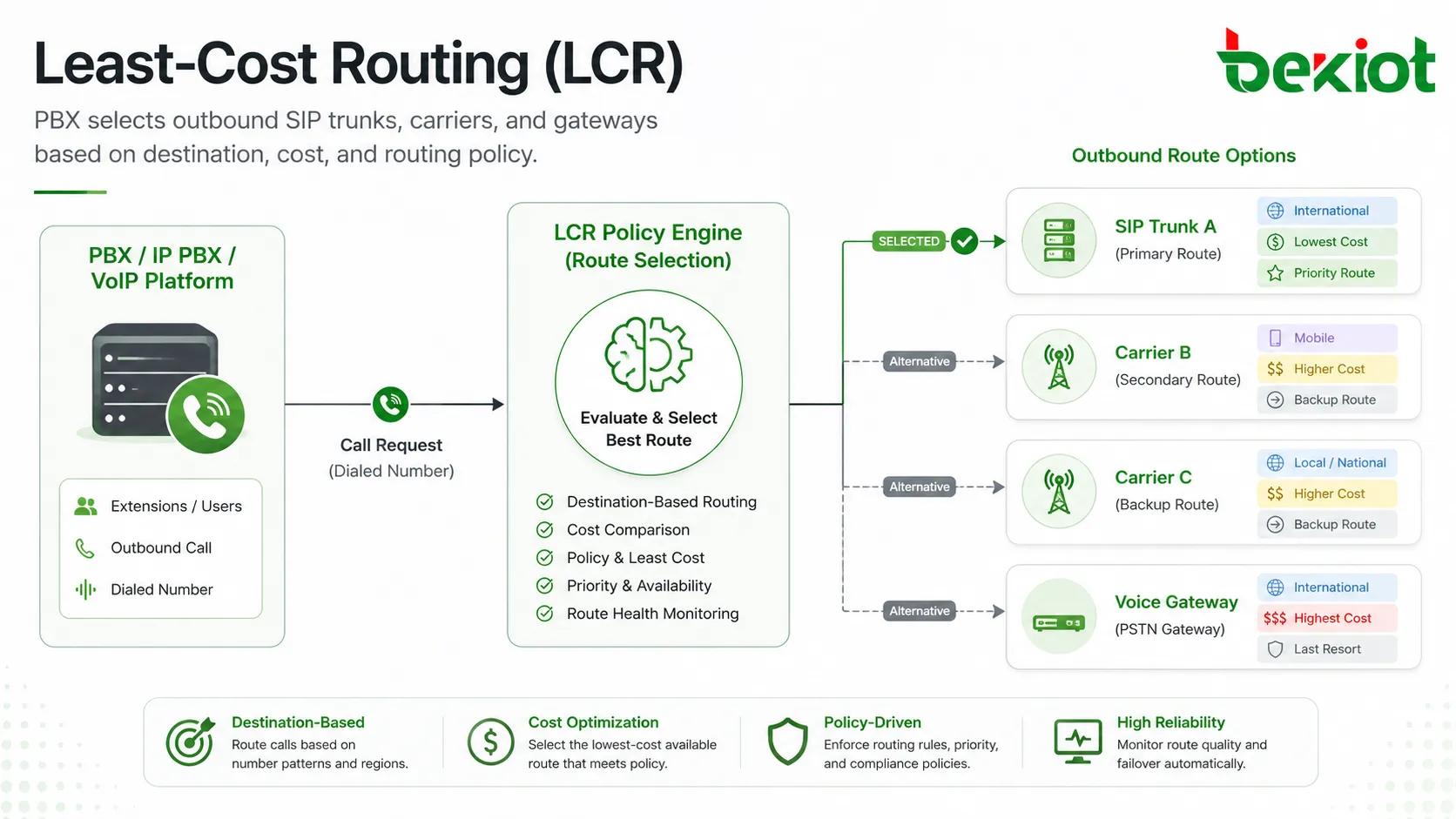
How LCR Works in a PBX or SIP System
The LCR process starts when a user dials an external number. The PBX or SIP platform normalises the number format, matches it against call patterns, examines available routes, compares cost rules, applies eligibility policies, and then sends the call to the selected trunk or gateway.
If the preferred route is unavailable, congested, or rejected, the system can try the next route on the list. This failover behaviour is important because the cheapest route is not always available at the moment the call is placed.
Number Normalisation
Number normalisation converts different dialling formats into a consistent pattern before routing. A user may dial a local number, a national number, an international prefix, or a number in E.164 format. The system must understand the destination before comparing costs.
For example, the formats “00442071234567”, “+442071234567”, and “02071234567” may need to be interpreted correctly based on the caller‘s location and routing policy. Poor normalisation can lead to wrong route selection or call failure.
Prefix Matching
LCR often relies on prefix matching. The system compares the leading digits of the dialled number with routing tables. Longer, more specific prefixes usually have higher priority than shorter, more general prefixes.
A rule for “+44” may cover the whole United Kingdom, while a more specific rule like “+447” covers UK mobile numbers. If mobile and fixed rates differ, the more specific prefix must be matched first.
Route Selection
After the destination is identified, the system examines which routes can carry the call. It may compare trunk price, priority, capacity, schedule, user eligibility, caller location, and route health.
The selected route must meet both cost and service requirements. If the lowest‑cost route fails, the system should try the next eligible route rather than dropping the call immediately.
Call Completion and Logging
After the call is routed, the system logs the route used, call time, destination, duration, trunk, result, and sometimes an estimated cost. These logs help administrators review savings, detect routing problems, and adjust LCR rules later.
Call Detail Records are important for verifying that the LCR strategy is working as intended. Without reports, administrators may not know whether calls are actually following the intended routes.
Core Principles Behind LCR
A reliable LCR design should follow several principles: minimise cost, maintain quality, avoid routing errors, support failover, and remain easy to maintain. Excessive complexity may save a small amount of money but create significant operational problems.
Cheapest Eligible Route
The system should select the cheapest route that is eligible for the specific call. Eligibility may depend on destination, user group, time, trunk availability, capacity, carrier restrictions, and regulatory requirements.
Therefore the cheapest route in a tariff table is not always the correct one. A route may be excluded because it is unavailable, blocked for a certain user, not allowed for emergency calls, or does not meet the required quality level.
Quality Before Aggressive Cost Reduction
Call quality must remain a key factor. A low‑price route with high latency, poor answer rates, bad voice, frequent drops, or caller ID problems may harm business communication.
Minimum quality thresholds should be defined before applying aggressive cost rules. For important calls, a slightly more expensive route may be better if it provides stable service and a predictable experience for the caller.
Specific Rules Before General Rules
Specific call patterns should be evaluated before general patterns. This prevents broad rules from capturing calls that should follow a more precise routing logic.
A general international rule might match all numbers starting with “00”, but a specific country or mobile network prefix may have a better route. Therefore rule order and priorities must be set carefully.
Failover and Redundancy
LCR should include backup routes. If the primary route fails, the system tries a secondary route and then another route if needed. This protects call continuity when carriers, trunks, or gateways experience problems.
The failover design must balance cost and reliability. A backup route may be more expensive, but it prevents call failures while a trunk is down or a carrier is congested.
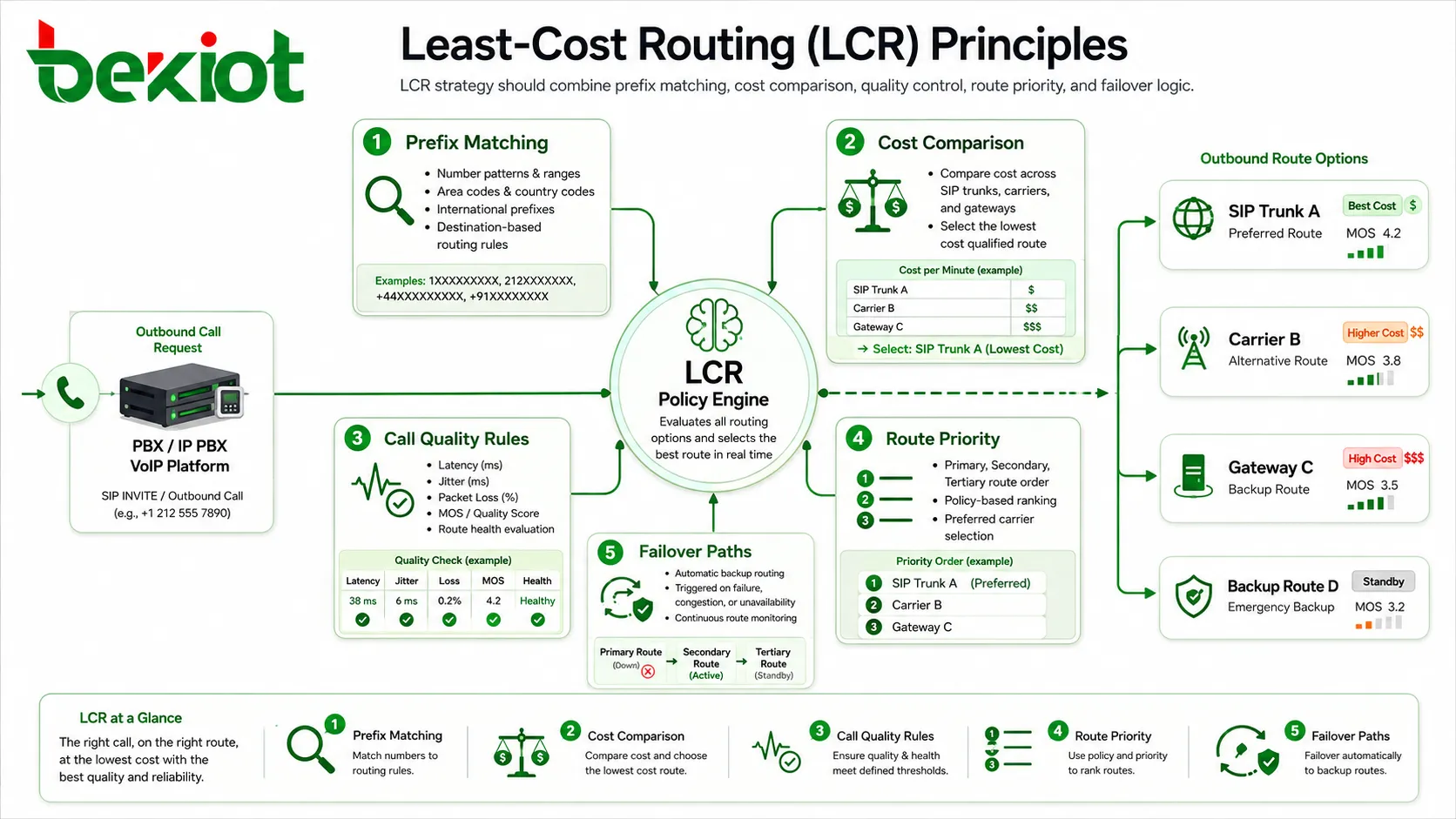
Main Components of an LCR System
An LCR system typically consists of call patterns, price tables, route groups, trunk groups, number normalisation rules, permission classes, failover rules, and reporting tools. Each component affects the final call route.
Call Patterns
Call patterns define which numbers match routing rules. They may be based on country codes, area codes, mobile prefixes, local numbers, service numbers, international access codes, or organisation‑specific dialling formats.
Pattern accuracy is fundamental to LCR. If a pattern is wrong, the system may send calls to a more expensive route, reject valid calls, or select a carrier that cannot complete the destination.
Price Tables
Price tables store call costs by destination and carrier. They may include per‑minute rates, call setup fees, billing increments, peak/off‑peak rates, mobile/fixed rates, and special‑destination prices.
These tables must be updated regularly. Carrier prices change, and stale tables may cause the system to select routes that are no longer the cheapest or most suitable.
Trunk and Carrier Groups
Trunk groups define available outgoing routes such as SIP trunks, PRI lines, analogue gateways, GSM gateways, inter‑office trunks, or carrier paths. Each group has capacity, cost, caller ID rules, and quality characteristics.
Grouping trunks simplifies routing management. Instead of configuring each individual route, administrators can define route groups and apply policies to them.
Permission Classes
Permission classes determine which users are allowed to use specific routes. Not every extension should be allowed to make international calls, premium‑rate calls, or expensive routes.
Permission settings help prevent misuse and toll fraud, and also allow different policies for departments, contact centres, managers, reception, and public phones.
Configuration Strategy
LCR configuration should start from business requirements and call traffic analysis. Before building rules, understand the call destinations, the most expensive destinations, the available carriers, and calls that need special handling.
Step 1: Analyse Call Traffic
Begin by reviewing call logs and identifying the most frequent destinations, the most expensive routes, the volume of international and mobile calls, peak periods, and calls that frequently fail.
This analysis prevents unnecessary complexity. If most calls are local, the design can be simple. Extensive international calling requires more detailed prefix and rate rules.
Step 2: Normalise Number Formats
Before applying LCR, decide on a number normalisation scheme: whether the system will use E.164, national format, local format, or a mix with conversion rules.
Consistent formatting improves routing accuracy and simplifies reporting. It also helps with SIP trunk compatibility, caller ID presentation, emergency routing, and CRM integration.
Step 3: Build Destination Groups
Destination groups help organise routing logic. Common groups include local fixed, national fixed, mobile, international, premium‑rate numbers, emergency numbers, service numbers, and private network routes.
Grouping destinations makes the routing table easier to maintain, because administrators can manage similar destinations together instead of many scattered rules.
Step 4: Assign Route Priorities
For each destination group, assign a primary, secondary, and tertiary route. The primary route should be the lowest‑cost route that meets quality requirements, while backup routes ensure continuity when the primary fails.
Priority should not be based on price alone. Consider capacity, reliability, caller ID support, emergency compliance, carrier reputation, and support quality.
Step 5: Define User Permissions
User permissions prevent unauthorised access to routes. General employees may be allowed only local and national calls, while international calling may require supervisor approval or an authorisation code.
This step is important because LCR can use many trunks. Without permission controls, users or attackers may abuse expensive routes.
Step 6: Test Before Going Live
Testing should include local, national, mobile, international calls, blocked destinations, failover paths, caller ID presentation, registration behaviour, and CDR records.
Test calls must verify both route selection and call quality together. A route that connects but provides poor voice or incorrect caller ID needs adjustment.
| Configuration Area | Primary Purpose | Check Point |
|---|---|---|
| Number Normalisation | Normalise numbers before routing | Verify local, national, international and E.164 formats |
| Prefix Matching | Determine destination class | Use specific rules before general rules |
| Price Table | Compare route costs | Keep carrier prices updated and validated |
| Route Priority | Select primary and backup trunks | Balance price, quality, capacity, and availability |
| User Permissions | Control who can use routes | Restrict international, premium, and high‑risk destinations |
| Reporting | Verify savings and detect problems | Review CDRs, route usage, failures, and cost trends |
Benefits of Least-Cost Routing
LCR provides value by reducing call expenses, improving route control, supporting carrier diversity, and giving administrators a structured way to manage outbound traffic.
Lower Call Costs
The most obvious benefit is cost reduction. By selecting the cheapest eligible routes for different destinations, organisations can lower their spending on outbound calls, especially international, mobile, and high‑volume calls.
Savings can be significant in contact centres, multi‑site organisations, hotels, telecom resellers, and enterprises with frequent outbound calling.
Better Carrier Utilisation
LCR allows intelligent use of multiple carriers. One provider may be good for local calls, another for mobile destinations, and a third for international regions.
This prevents over‑reliance on a single carrier and allows the organisation to benefit from different pricing structures and service strengths.
Improved Failover Capability
A well‑designed LCR policy includes alternative routes. If the preferred route is unavailable, the system can automatically try another route.
This enhances call resilience; even if one carrier‘s trunk fails, users can still complete calls through backup routes.
More Granular Call Policy
LCR gives administrators more control over how calls exit the system. Calls can be routed by department, destination, cost, time, caller ID, or permission level.
This helps align telephone system behaviour with business policy, and also supports security and prevents unnecessary use of expensive routes.
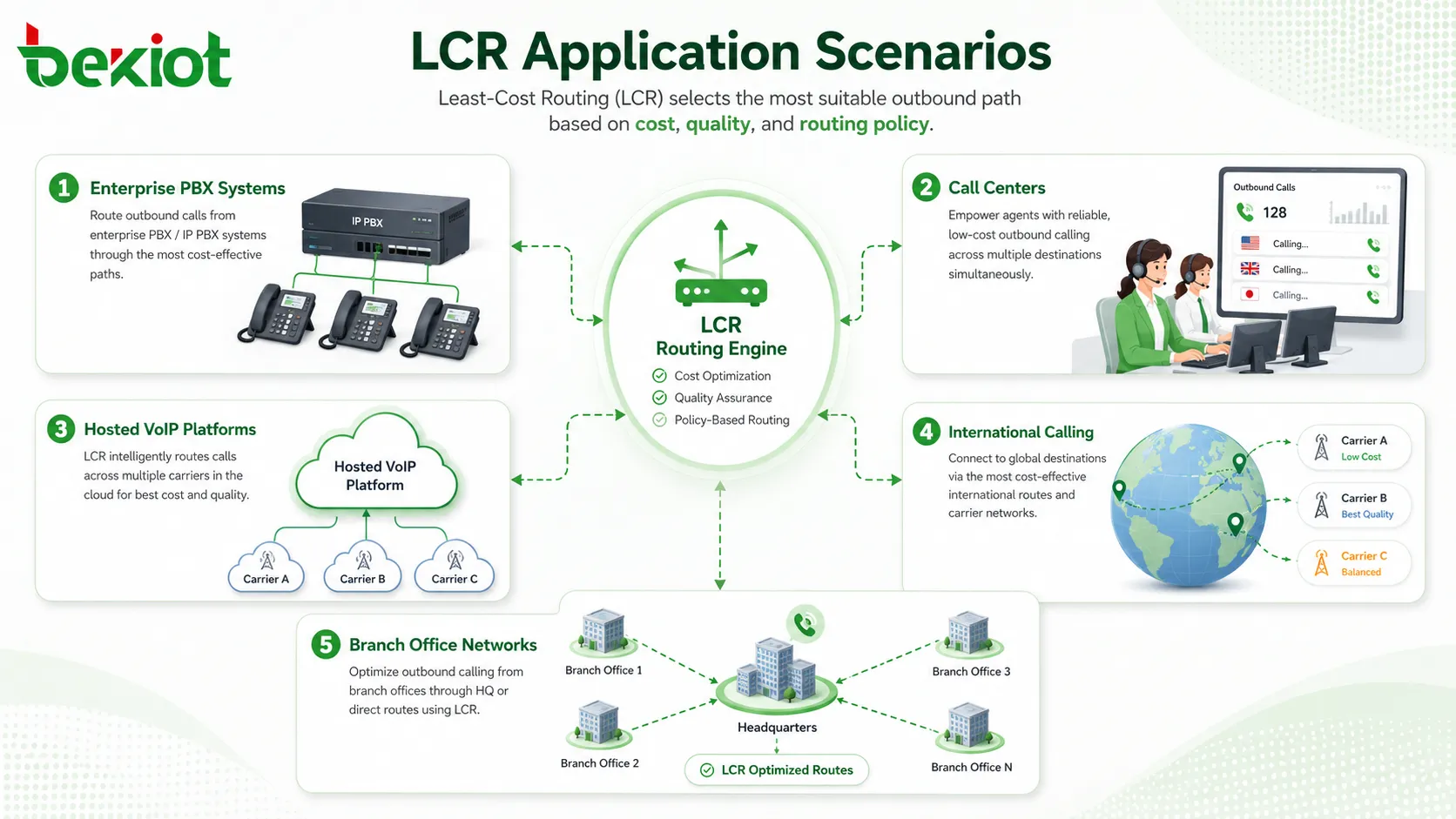
Applications in Communication Systems
LCR is useful in many environments where controlling outbound call cost and routes is important. It can be applied to small PBX systems or large carrier‑grade platforms.
Enterprise PBX Systems
Enterprises use LCR to manage outbound calls across SIP trunks, branch gateways, and carrier services. Headquarters may route local calls through local trunks, while international calls use a low‑cost carrier.
In multi‑site companies, LCR can route calls through the branch that is closest to the destination when policy allows, reducing cost and improving caller ID localisation.
Contact Centres
Contact centres generate a high volume of outbound calls. LCR helps route calls through carriers that offer better rates for specific destination categories while maintaining quality requirements.
Answer rates, call quality, and caller ID reputation should be monitored. The cheapest route may not be effective if calls are blocked, flagged as spam, or rejected by recipients.
Hosted VoIP Platforms
Hosted VoIP providers use LCR to manage customer traffic across multiple upstream carriers. The platform may select routes based on destination, wholesale price, quality score, and carrier availability.
For providers, LCR affects both profitability and service quality. Poor routing leads to customer complaints, while good routing reduces cost without harming user experience.
International Calling Services
International call rates vary widely between carriers. Therefore LCR is highly valuable when routing calls to multiple countries, regions, mobile networks, and special destinations.
International LCR requires frequent price updates and careful prefix management, because some countries have complex numbering plans and incorrect matching can lead to unexpected charges.
Branches and Hybrid Networks
Organisations with branch offices may route calls through local trunks, central SIP trunks, or inter‑office links. LCR determines the best route based on destination and availability.
This supports hybrid environments where legacy gateways, SIP trunks, cloud PBX, and private network routes coexist during migration or long‑term operation.
Quality and Security Considerations
LCR can save money, but poor configuration can cause quality problems, security risks, and compliance issues. Therefore it should be designed as part of a complete call routing policy, not as a standalone cost‑cutting feature.
Call Quality Monitoring
Route performance should be monitored continuously. Useful indicators include post‑dial answer ratio, average call duration, post‑dial delay, packet loss, jitter, latency, failure rate, and user complaints.
If a low‑cost route performs poorly, its priority should be lowered or it should be removed. Savings are worthless if calls fail or customers cannot hear clearly.
Protection Against Toll Fraud
LCR often opens access to multiple outbound routes, including international carriers. This increases exposure to toll fraud if permissions are weak.
Controls include strong SIP passwords, route permissions, international call restrictions, account lockout policies, fraud monitoring, rate limits, and alerts for unusual behaviour.
Emergency Call Handling
Emergency calls must not be routed by cost alone. They must follow legal, location, and service requirements. Emergency routes should be clearly separated from ordinary LCR rules.
For emergency numbers, priority should be given to accuracy, caller location, reliable carrier routing, and regulatory compliance, not cost reduction.
Caller ID and Compliance
Some routes may not support correct caller ID, local number presentation, or regulatory requirements. Incorrect caller ID can cause calls to be rejected, loss of trust, or non‑compliance.
Before selecting a route, confirm the caller ID rules and destination regulations, especially for sales, healthcare, finance, and customer service calls.
Common Configuration Mistakes
LCR errors can lead to hidden cost increases or obvious call failures. Problems often come from stale prices, wrong prefixes, missing failover, or excessive focus on the cheapest route.
Stale Price Tables
Carrier prices change over time. If tables are not updated, the system may select a route that is no longer the cheapest and may miss opportunities for cheaper or better‑quality routes.
Price table maintenance should be scheduled. Automated imports or provider price feeds can help, but data always requires verification.
Incorrect Prefix Matching
Wrong or incomplete prefixes can send calls to the wrong route, especially with international numbering plans, mobile prefixes, special service numbers, and areas with overlapping dialling formats.
Prefix rules should be tested with real sample numbers, giving priority to longer, more specific matches where needed.
Missing Failover Routes
If the cheapest route is the only route, calls may fail when the trunk is unavailable. LCR must include backup routes to protect call completion.
Backup routes may be more expensive, but they provide continuity during outages, congestion, or carrier rejection.
Ignoring User Permissions
If every user can access every route, the organisation may face unexpected costs and security risks. International and premium routes must be controlled.
Permission classes, authorisation codes, and fraud alerts help reduce misuse and manage call policy.
Maintenance and Optimisation
LCR is not a set‑and‑forget configuration. Prices, traffic patterns, carrier performance, business needs, and security risks change, so regular review is required to keep the strategy effective.
Review Route Usage
Administrators should review which routes are actually being used and whether they match the intended policy. If most calls use backup routes, the primary route may be failing or misconfigured.
Usage reports also reveal new patterns. If international traffic to certain destinations increases, a specialised route optimisation may be worthwhile.
Compare Cost and Quality Together
Cost reports should be reviewed alongside quality reports. A route that saves money but causes call failures is not a good route.
Quality‑adjusted routing is often better than pure cost routing, because it selects routes that meet a minimum quality threshold while controlling expenses.
Test After Every Major Change
After price updates, adding carriers, changing dial plans, modifying prefixes, or changing permissions, test representative scenarios including local, mobile, international, blocked, and failover cases.
Testing helps catch errors before they affect users or customers, and also confirms that reports and CDRs accurately reflect the selected route.
FAQ
Does LCR work with both SIP trunks and legacy gateways?
Yes. Many PBX and softswitch platforms can include SIP trunks, PRI gateways, analogue gateways, GSM gateways, and private network routes in a single LCR strategy, as long as the system can match patterns and select route groups.
How often should LCR price tables be updated?
It depends on how often carrier prices change and the volume of calls. High‑volume or internationally‑focused environments may need frequent updates, while smaller systems may review prices monthly or quarterly.
What are the risks of always choosing the cheapest route?
The cheapest route may suffer from poor voice quality, low answer rates, high post‑dial delay, caller ID problems, or unreliable completion. A quality threshold should be used so that low price does not harm performance.
Can LCR reduce toll fraud?
LCR by itself is not a fraud prevention feature, but it works together with permission rules and route restrictions. To reduce fraud, restrict expensive destinations, monitor unusual traffic, and secure SIP accounts.
Why do some international calls fail after changing LCR?
Common causes include wrong prefix matching, unsupported number format, carrier rejection, missing caller ID, destination blocking, trunk credit exhaustion, or poor route quality. Test calls and SIP tracing help identify the cause.
Should emergency calls be included in LCR rules?
Emergency calls should have dedicated routing rules and must not be optimised for cost. They must follow local requirements for call completion, caller location, trunk reliability, and access to emergency services.







