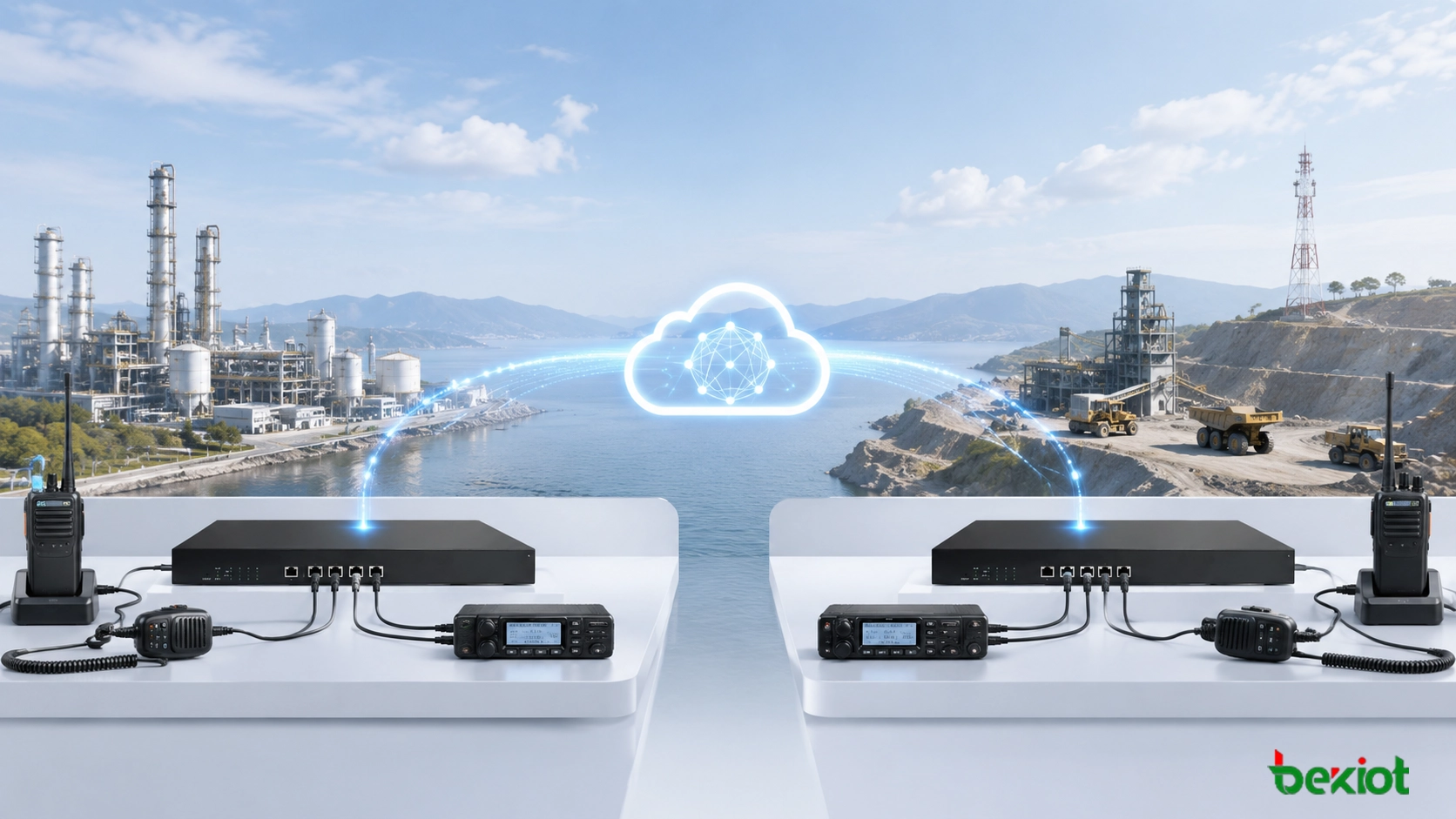
In many radio communication projects, teams in different regions need to talk to each other even though their walkie-talkies are limited by radio coverage distance. When two work areas are far apart, direct radio communication may not be possible. Traditional methods often require complex repeater deployment, private network construction, or deep system integration.
A more practical approach is to use a ROIP gateway to convert radio voice into IP-based voice transmission. With this architecture, radio channels in different locations can be mapped and interconnected over an existing IP network, allowing users in Site A and Site B to communicate as if they were operating under the same radio system.
Why Long-Distance Radio Communication Needs a Different Approach
Walkie-talkies are efficient for local group communication, but their coverage is limited by transmission power, terrain, antenna height, building obstruction, and repeater availability. When two teams are located far away from each other, for example in two industrial sites, two towns, two tunnel sections, or two regional operation centers, ordinary radio communication cannot always cover the distance.
In this situation, there are usually several technical options. One method is to build a multi-repeater system. Another method is to connect two complete radio systems through an IP-based communication platform. Both options can work, but they may require engineering design, network planning, equipment compatibility checks, and higher deployment cost.
For projects with a small number of fixed channels, a ROIP gateway can offer a simpler path. It does not require replacing existing radios, changing user habits, or rebuilding the entire communication system. Instead, it connects selected radio channels from different locations and forwards voice through IP links.
Solution Scenario: Two Sites, Four Channels, 100 km Apart
Consider a typical project. Site A and Site B each have an existing radio system. Each site uses four radio channels for different teams, such as security, maintenance, operations, and emergency response. The two sites are about 100 km apart, but there is an available network connection between them.
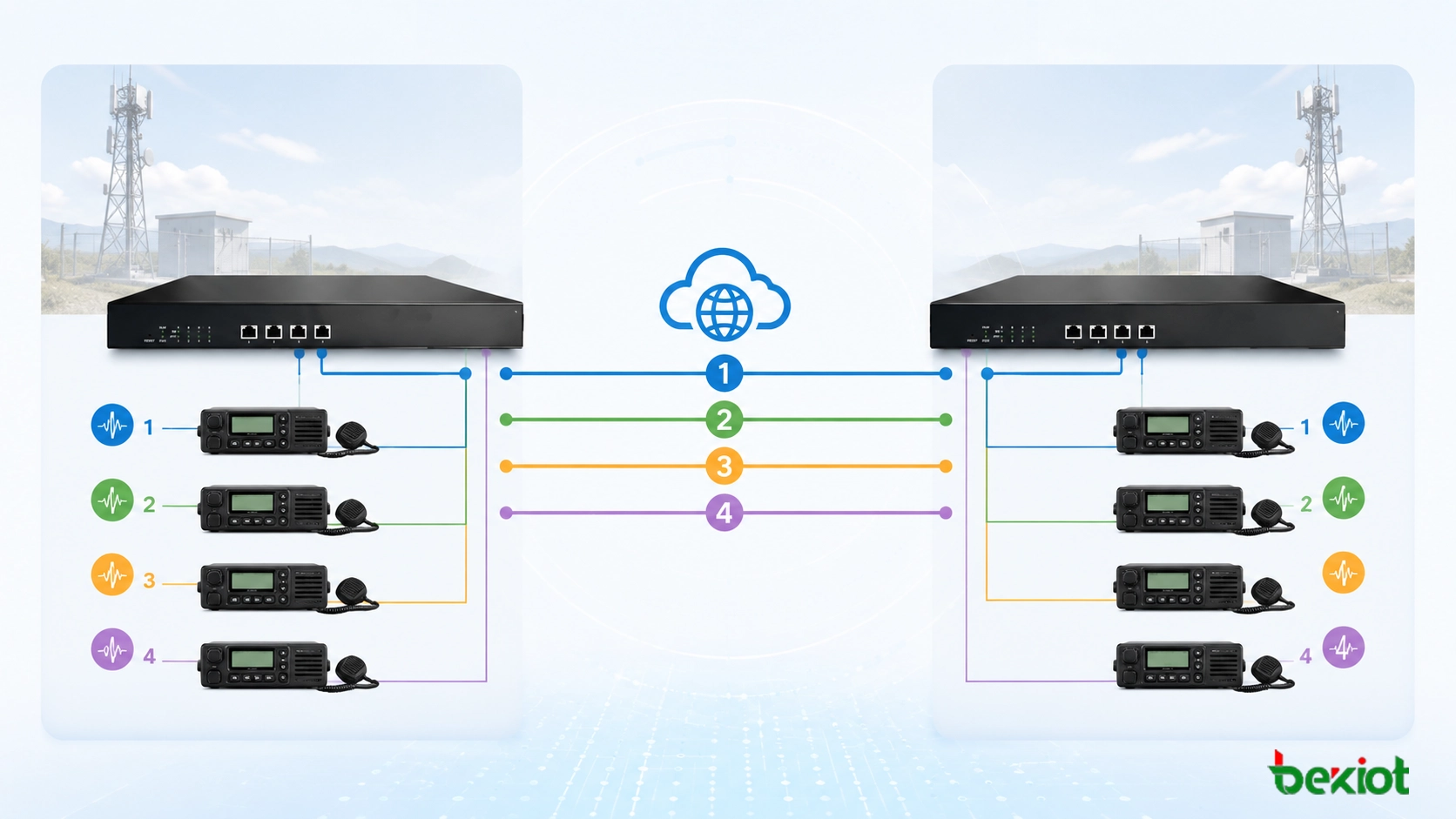
The project goal is straightforward: users on Channel 1 at Site A should be able to talk with users on Channel 1 at Site B. Channel 2 should connect to Channel 2, Channel 3 to Channel 3, and Channel 4 to Channel 4. Field users should continue using their existing walkie-talkies and mobile radios without changing their daily operation.
To achieve this, one 4-port ROIP gateway can be deployed at Site A and another 4-port ROIP gateway can be deployed at Site B. Each gateway connects to four mobile radios or base radios through customized cables. These radios act as the radio-side access points for the four local channels.
How the Architecture Works
The ROIP gateway connects to radio terminals through customized audio and control cables. It receives voice from the radio, converts the audio into IP-based voice transmission, and sends it to the gateway at the other site. On the receiving side, the remote gateway outputs the audio to the corresponding radio terminal, which then broadcasts the voice into the local radio channel.
When a user speaks on Channel 1 at Site A, the Site A radio receives the voice, the ROIP gateway converts and forwards it through the IP network, and the Site B gateway sends the voice to the Channel 1 radio at Site B. Users listening on Channel 1 at Site B can hear the message. The same logic works in reverse, so communication is bidirectional.
This channel-to-channel mapping creates a predictable communication structure. Operators do not need to manage complicated routing rules during daily use. Each radio group keeps its original channel identity, while the ROIP gateway handles the cross-region transport in the background.
Carrier Detection Improves Response Speed
One important technical detail is the triggering method. Some radio interconnection solutions rely on VOX or VAD, meaning the system detects voice activity and then activates transmission. This method is convenient, but it may introduce delay, clipped first syllables, or false triggering in noisy environments.
A more responsive method is to use carrier detection or a related radio signaling input from the connected mobile radio. When the radio receives a valid carrier signal, the gateway can immediately activate the remote transmission path. This helps reduce delay and provides a more stable push-to-talk experience.
For cross-region radio communication, low latency matters. Field users expect radio communication to feel direct and natural. Carrier-based triggering can make the interconnection more suitable for dispatch, security, emergency coordination, and industrial operations where fast response is important.
Where Becke Telcom Fits into This Type of Project
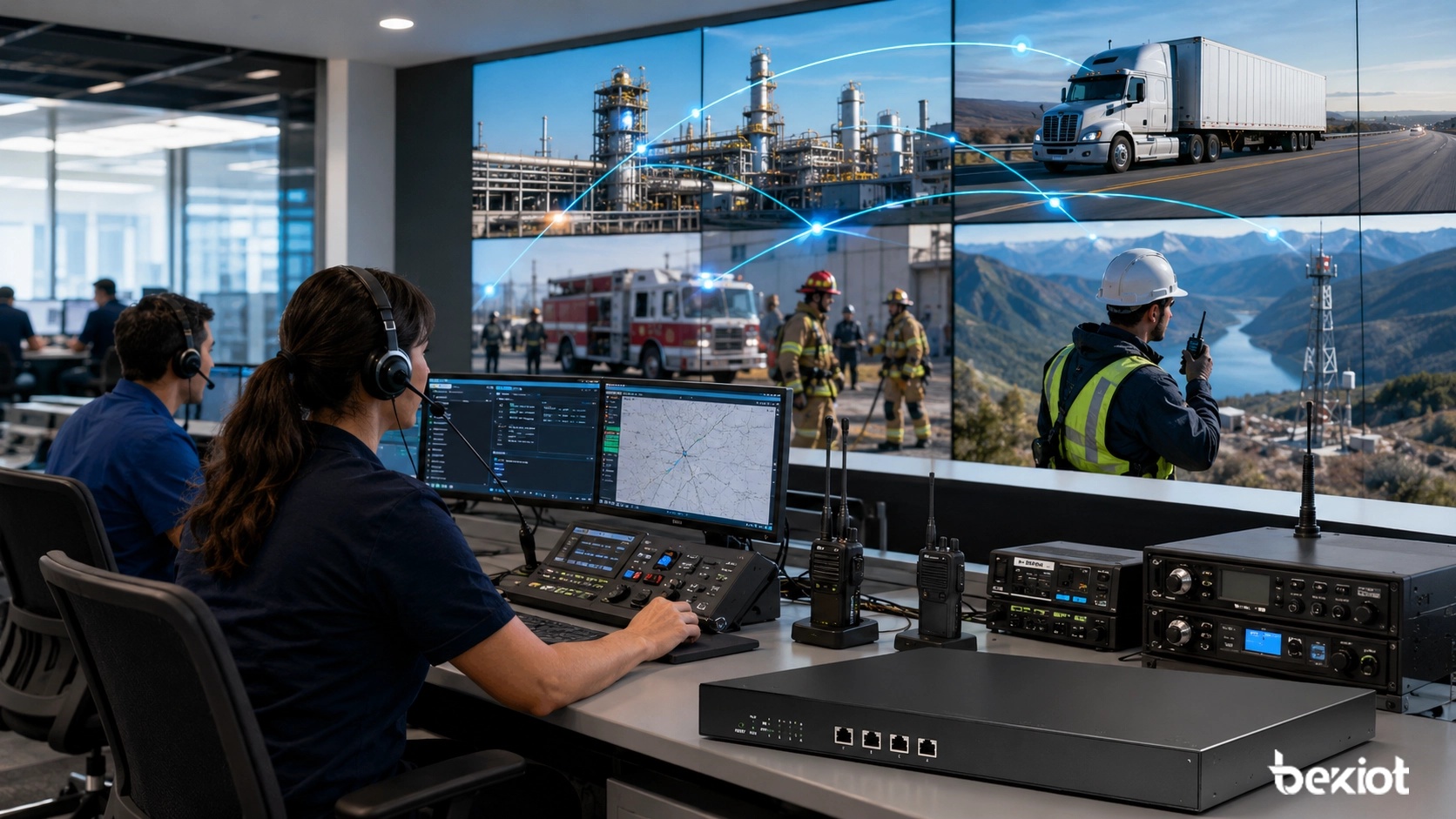
Becke Telcom can be considered when customers need a practical radio-to-IP interconnection solution for industrial sites, transportation networks, emergency response teams, logistics yards, energy facilities, or regional dispatch systems. A Becke Telcom ROIP gateway can help connect existing radio resources with IP communication, dispatch platforms, or command center workflows.
In projects with several fixed channels, a model such as the BK-ROIP4 ROIP Gateway can be used as part of a simple and scalable interconnection layer. The final configuration should be selected based on the number of radio channels, cable interface requirements, PTT control method, network condition, redundancy needs, and dispatch integration requirements.
A good cross-region radio solution should protect existing radio investment while improving communication reach, response speed, and operational coordination.
Practical Benefits for System Integrators
This ROIP gateway approach is attractive for system integrators because it reduces the need for heavy software customization. The deployment focuses on radio-side docking, IP connectivity, channel mapping, and voice quality testing. For projects with clear and fixed channel requirements, the engineering workload is easier to control.
It also helps avoid unnecessary platform replacement. Many customers already have radios, channels, teams, and operating procedures in place. A ROIP gateway allows the existing system to remain active while adding cross-region communication capability.
For phased projects, this architecture is flexible. The first stage may connect only two locations and four channels. Later, the system can expand to more locations, more channels, dispatch console access, recording, monitoring, emergency call priority, or unified communication platform integration.
Recommended Deployment Workflow
Check Existing Radio Channels
Engineers should confirm how many radio channels need to be interconnected, what radios are used at each site, whether the channels are fixed, and whether each channel requires one-to-one mapping or shared group communication.
Confirm Radio Interface and Cable Requirements
Customized cables are often required to connect the ROIP gateway with mobile radios or base radios. The project team should verify audio input, audio output, PTT control, carrier detection, grounding, connector type, and radio-side configuration before installation.
Build the IP Connection Between Sites
The two sites need a stable IP network connection. This may be a private network, VPN, enterprise WAN, fiber link, 4G/5G router, or other available transmission path. Network delay, packet loss, security, and firewall rules should be checked before formal use.
Map Channels and Test Bidirectional Calls
After installation, each channel should be mapped clearly. Channel 1 at Site A should correspond to Channel 1 at Site B, and so on. Engineers should test bidirectional voice, delay, audio level, PTT behavior, carrier triggering, busy status, and long-term stability.
Typical Application Scenarios
Cross-region ROIP gateway solutions are suitable for industrial parks, mines, ports, logistics centers, power plants, railway maintenance sections, highway operations, tunnel management, water treatment facilities, petrochemical sites, and emergency response teams. These environments often need radio users in different regions to communicate without changing existing terminals.
The solution is especially useful when the channel number is limited and the communication relationship is stable. For example, two remote sites may only need to interconnect several fixed working groups. In this case, a gateway-based design is easier to deploy than a complex multi-platform integration project.
Engineering Notes Before Project Delivery
A successful deployment should pay attention to audio level matching, microphone gain, speaker output level, PTT timing, carrier detection stability, radio squelch settings, network bandwidth, power supply, lightning protection, grounding, and maintenance access.
The project team should also define what happens when one link fails. For mission-critical environments, backup network links, spare radios, redundant power, and clear operating procedures are recommended. If the solution is connected to a dispatch platform, user permissions, recording policy, and access control should also be planned.
Before acceptance, the system should be tested under real operating conditions. Short laboratory testing is not enough for radio projects. Field testing should include long-duration communication, repeated PTT operation, noisy environments, different radio positions, and network fluctuation scenarios.
Conclusion
Cross-region walkie-talkie interconnection can be achieved without replacing the entire radio system. By deploying ROIP gateways at two locations, connecting them to existing mobile radios or base radios, and mapping channels through an IP network, organizations can extend radio communication over long distances.
This approach is practical for projects with fewer fixed channels, stable business workflows, and clear site-to-site communication requirements. It provides a simpler deployment path, lower engineering complexity, faster delivery, and better protection of existing radio investment. For industrial and emergency communication projects, Becke Telcom can provide suitable ROIP gateway and dispatch integration options according to the actual network and radio environment.
FAQ
What is a ROIP gateway used for in cross-region radio communication?
A ROIP gateway is used to convert radio voice into IP-based voice transmission. It allows radio systems in different regions to communicate through an IP network while users continue operating their existing walkie-talkies or mobile radios.
Does this solution require replacing existing radios?
No. In most projects, existing radios can remain in use. The ROIP gateway connects to mobile radios or base radios through suitable audio, PTT, and control interfaces, so users do not need to change their normal radio operation habits.
How many radio channels can be connected between two sites?
The number of connected channels depends on the gateway model and project design. For example, a four-port ROIP gateway can support four radio channels, making it suitable for one-to-one channel mapping between two remote sites.
What should be checked before deploying a ROIP gateway solution?
Engineers should check radio interfaces, customized cable requirements, PTT control, carrier detection, audio levels, IP network stability, firewall settings, power supply, grounding, and field communication quality before formal deployment.