Emergency command vehicles are widely used in disaster response, rescue coordination, public safety operations, major event support, temporary field command and communication assurance missions. In these scenarios, the vehicle must do more than transport personnel and equipment. It needs to function as a mobile communication hub that connects field teams, rear command centers, external telephone users, radio groups, conference participants and on-site decision-makers.
In many traditional deployments, public-network PTT, digital radio, analog telephone lines, IP phones and onboard conference audio are installed as separate systems. Each system may work well on its own, but the lack of interconnection creates operational friction. Dispatchers may need to switch between several devices, repeat instructions manually and coordinate different user groups through separate voice channels. During urgent incidents, this can slow down decision-making and increase the risk of missed information.
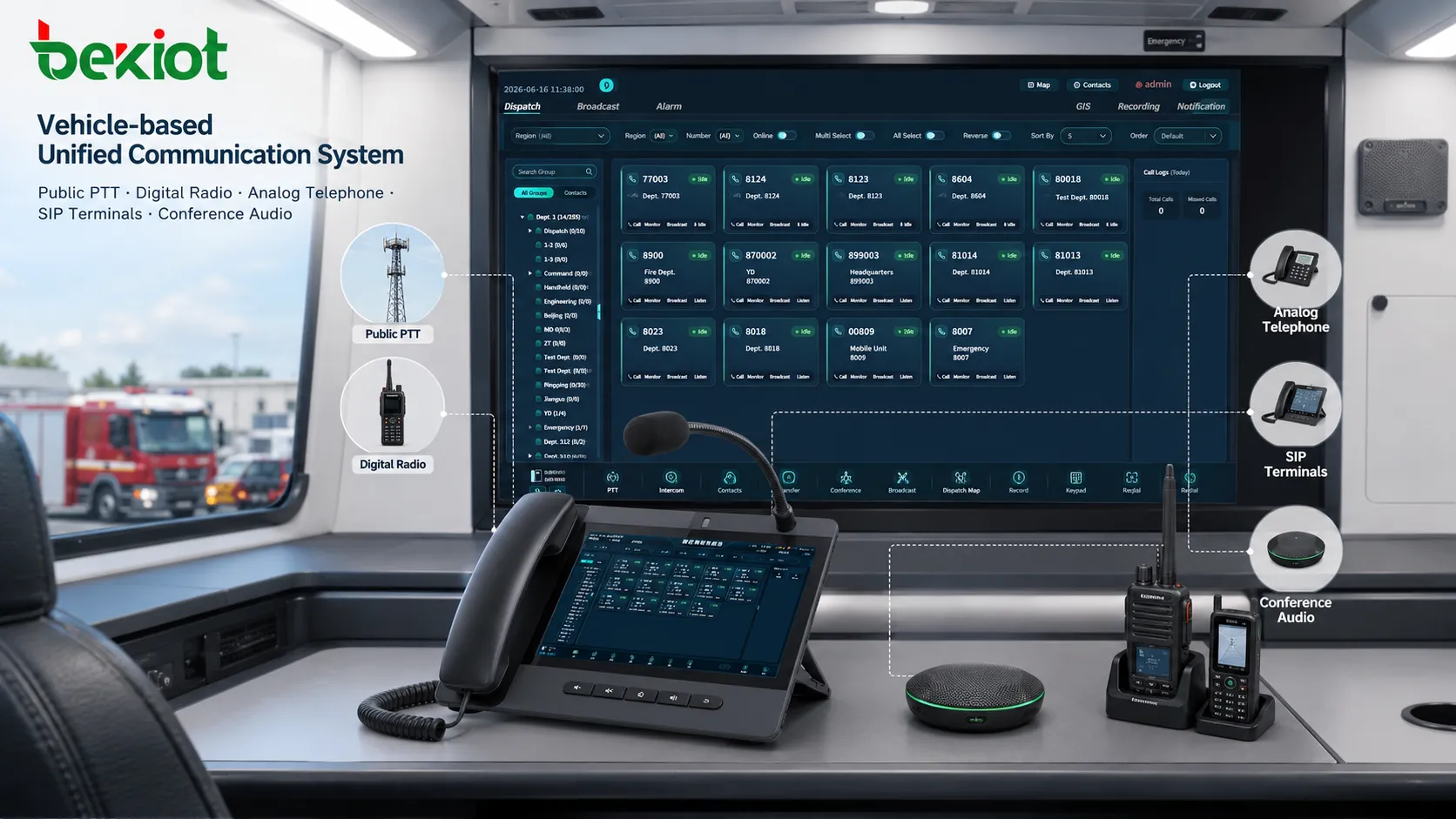
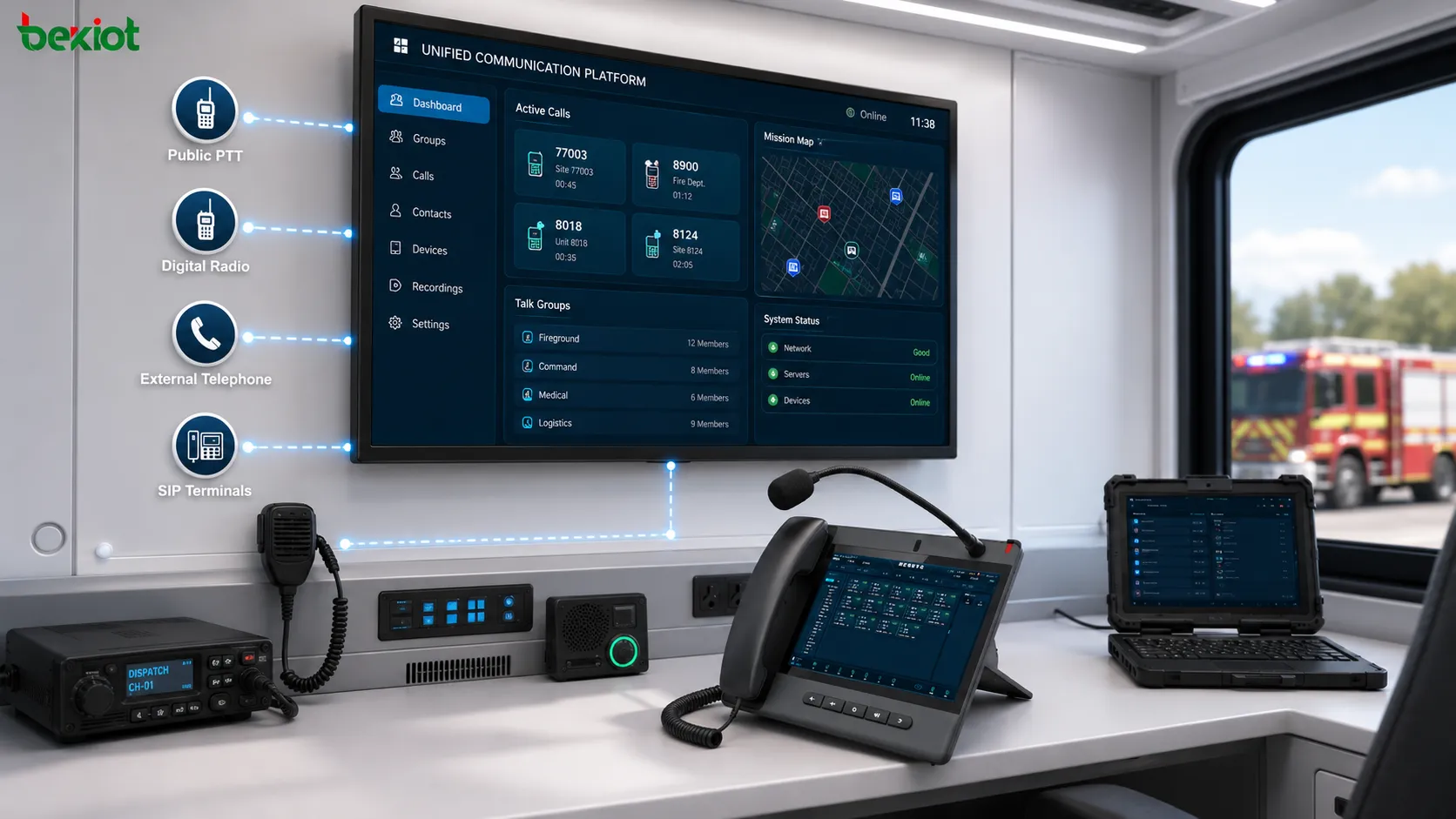
A vehicle-based unified communication system solves this problem by connecting multiple voice resources into one dispatch environment. The solution allows public PTT users, digital radio users, telephone users, SIP terminal users and vehicle meeting-room participants to communicate across system boundaries. It creates a practical “one platform, one view, unified dispatch” communication architecture for mobile command centers.
Communication Challenges in Field Command Operations
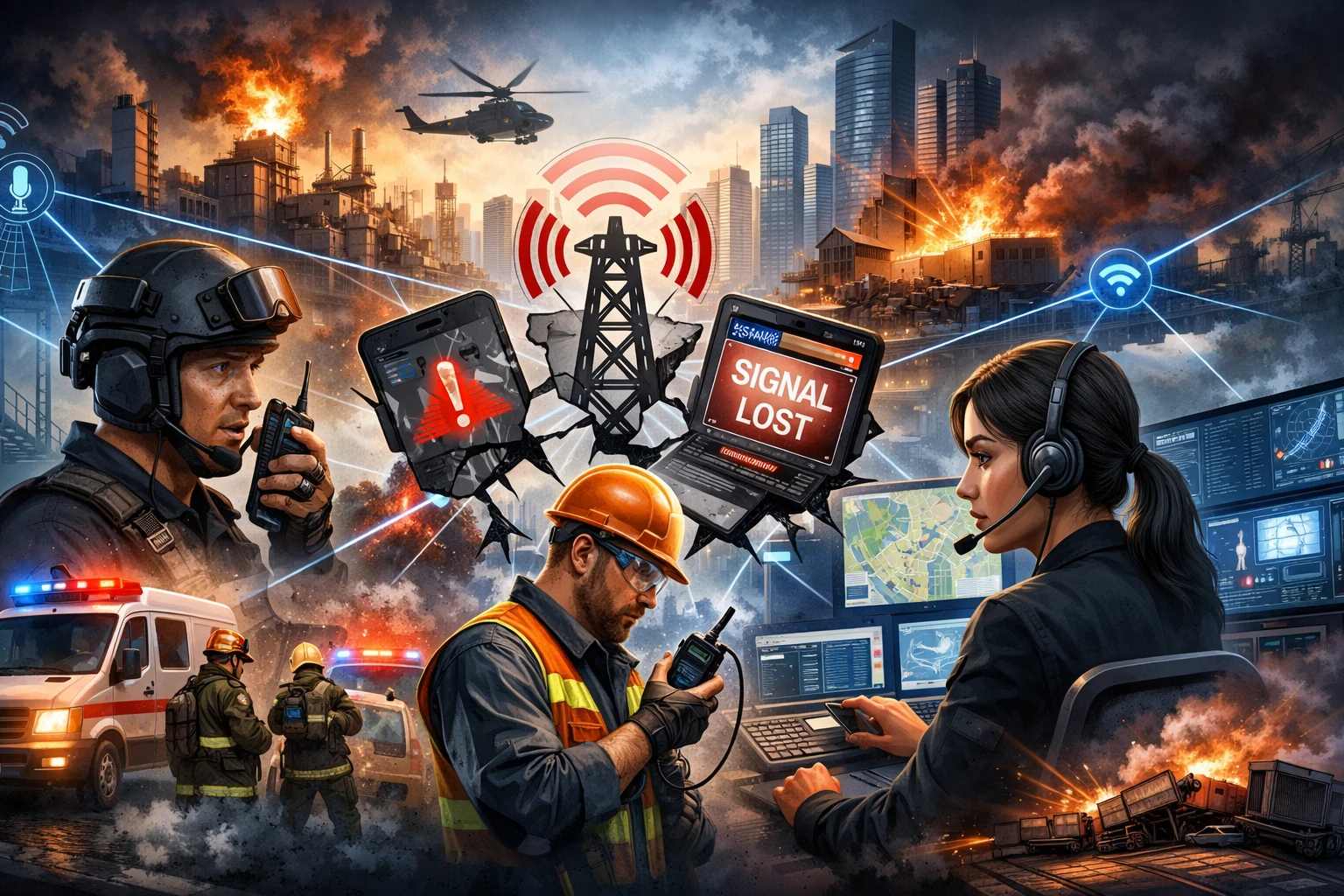
Emergency scenes usually involve different departments, different networks and different terminal types. Rescue personnel may use digital radios, mobile teams may use public-network PTT, rear command centers may call through fixed or mobile phones, and command staff inside the vehicle may rely on a local conference microphone and loudspeaker system. These resources are often deployed by different teams and may not share the same protocol, frequency, network or operating interface.
When communication resources are isolated, voice information cannot flow smoothly. A radio user cannot directly speak with a telephone user. A public PTT group may not be heard in the vehicle conference room. A rear command center call may need to be repeated manually to field teams. This creates delays and places extra pressure on the operator.
For emergency command vehicles, the main goal is not simply to install more communication devices. The goal is to make all available communication resources usable from a unified command workflow. The platform should reduce device switching, simplify voice routing and allow operators to coordinate multiple teams quickly under high-pressure conditions.
Integrated Resources Inside the Mobile Platform
The system can integrate the main communication resources commonly required in an emergency command vehicle. A typical configuration includes two public-network PTT channels, two digital radio systems, two analog telephone lines, IP phones and the vehicle-mounted conference loudspeaker and microphone system.
These resources are connected through audio access, SIP access, IP PBX interconnection, voice gateway conversion or dispatch platform integration. After integration, each resource becomes part of the same communication environment rather than a standalone device.
| Resource Type | Typical Function | Integration Value |
|---|---|---|
| Two public-network PTT channels | Connects wide-area mobile users and carrier-based PTT groups | Allows mobile field teams to join unified dispatch communication |
| Two digital radio systems | Supports professional radio groups for rescue, security or field operation | Enables radio users to communicate with SIP, phone and conference users |
| Two analog telephone lines | Provides external calling to fixed-line and mobile phone users | Connects the vehicle with rear command centers and external organizations |
| IP phones and SIP terminals | Provides internal calling, shortcut keys and lightweight dispatch operation | Turns vehicle workstations into practical communication access points |
| Onboard conference audio | Serves vehicle meeting areas with microphones and loudspeakers | Allows command staff to listen, speak and join field communication directly |
This structure is especially useful for mobile command vehicles, communication support vehicles, rescue coordination vehicles and temporary command cabins where space is limited but communication demand is high.
How the System Architecture Works
The architecture is built around unified access and centralized dispatch. Public PTT channels and digital radio systems are brought into the platform through suitable audio or gateway interfaces. Analog telephone lines are connected through an IP PBX or voice gateway and then interconnected with the dispatch system through SIP. IP phones and SIP consoles register to the communication platform as internal endpoints.
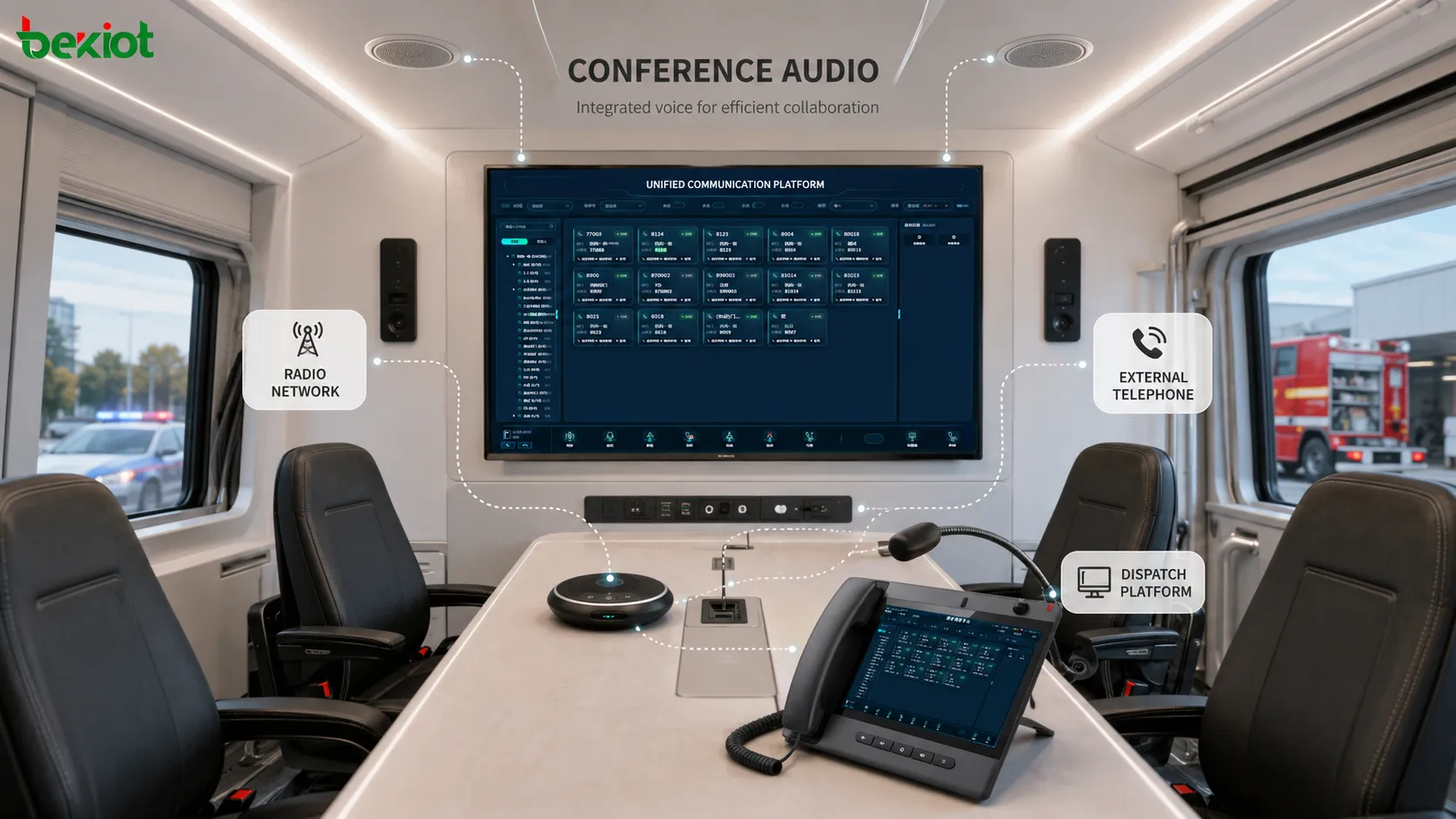
The vehicle conference loudspeaker and microphone system can also be integrated as an audio resource. This allows the meeting area inside the command vehicle to participate in external calls, radio communication or dispatch conferences. The conference room is no longer only a local discussion space; it becomes part of the wider command communication network.
Once these resources are connected, the platform can manage calling, grouping, bridging, monitoring and voice routing from one operating layer. Operators can initiate calls to radio groups, connect telephone users, bridge multiple channels and route field audio into the vehicle meeting area when needed.
Cross-Network Voice Interoperability
The most important value of the solution is cross-network interoperability. Public-network PTT, digital radio, analog telephone, SIP terminals and conference audio can be connected into one communication domain. This allows users from different networks to speak with each other without changing their original terminal habits.
For example, a dispatcher can connect a digital radio group with a public-network PTT channel, then add an external telephone call from a rear command center. If command staff inside the vehicle need to participate, the conversation can be routed into the onboard conference audio system. This eliminates repeated verbal relay and improves the speed of field coordination.
This capability is valuable when multiple departments are involved in the same incident. Public safety, emergency rescue, medical support, traffic control, utility repair, construction teams and government command centers may use different communication tools. A unified vehicle platform helps these teams coordinate through a shared voice workflow.
A Clearer Dispatch Workflow for Operators
In emergency operations, the operator’s workload must be reduced as much as possible. If the operator must manage multiple handheld radios, telephone handsets, audio mixers and software panels at the same time, communication efficiency will drop. The unified platform creates a clearer dispatch workflow by concentrating communication resources into one interface.
Typical operations may include single call, group call, emergency call, cross-channel conference, external dialing, telephone-to-radio bridging, radio-to-conference audio routing and communication status monitoring. The dispatcher can select the target resource, initiate the call and manage the conversation without moving between multiple devices.
This improves both speed and accuracy. Instead of manually repeating instructions across separate systems, the dispatcher can build a voice connection between the required users. This is especially important when commands must be delivered quickly, such as evacuation coordination, rescue team deployment, road control, medical transfer or emergency repair dispatch.
IP Phones as Practical Dispatch Terminals
IP phones inside the vehicle are not limited to ordinary extension calling. With preset keys and SIP-based configuration, they can become lightweight dispatch terminals. Operators can use shortcut keys to call public PTT channels, digital radio groups, internal extensions, external telephone lines or conference audio resources.
This approach is practical for vehicle environments where space is limited. A full-size dispatch workstation may not be required at every operator position. A SIP phone or SIP paging console can provide fast access to common communication tasks, while the central dispatch platform handles more advanced operations.
For duty officers, technicians or meeting participants inside the vehicle, IP terminals provide an easy way to communicate with the wider command network. They can make calls, receive dispatch communication and participate in cross-system voice coordination without learning multiple independent systems.
Related Product: becke GP320i SIP Paging Microphone Console
The GP320i SIP Paging Microphone Console can be introduced as a compact SIP-based voice access and paging console for emergency command vehicles, mobile command rooms and communication support posts. It is suitable for command desks, vehicle meeting tables and duty positions where quick paging, SIP calling and dispatch access are required.
Telephone Line Access for Rear Command Connectivity
Analog telephone line integration extends the communication boundary of the command vehicle. With two external telephone lines connected through an IP PBX or voice gateway, the vehicle can communicate with fixed-line users, mobile phone users, emergency operation centers, hospitals, government offices, utility companies and external support organizations.
This is important because not every participant in an emergency operation has access to the same radio or PTT system. Some decision-makers may only be reachable by phone. Some organizations may not be part of the dedicated radio network. Telephone integration allows the vehicle platform to connect these external users into the command workflow.
Through telephone-to-radio or telephone-to-conference bridging, a rear command center can speak directly with field teams or vehicle command staff. This improves information sharing and reduces the need for manual relay between field and rear command levels.
Conference Audio as Part of the Command Network
Many emergency command vehicles include a small meeting area with microphones, loudspeakers and an audio system. In a traditional setup, this audio system is only used for local discussion. It may not be connected to radios, telephones or dispatch resources.
After integration, the onboard conference audio system becomes an active communication resource. Field radio calls can be played through the vehicle loudspeakers. Command staff can speak through the conference microphone and communicate with external teams. Telephone calls from the rear command center can be routed into the meeting area for group discussion.
This design supports collective decision-making. During a complex incident, commanders, technical experts and liaison officers can listen to live field communication together, discuss response measures and issue instructions without relying on a single handheld terminal.
Unified Management for Daily Readiness
Emergency communication systems must be ready before an incident occurs. A unified platform makes daily inspection and readiness management easier. Operators can check whether SIP terminals, telephone lines, radio access paths and audio channels are available. This helps reduce hidden faults before deployment.
Centralized management also supports clearer resource naming and operational organization. Channels can be named by function, department, incident role or communication group. For example, public PTT channels, digital radio groups, external phone lines and conference audio zones can be displayed in a way that matches real command workflows.
For organizations that operate multiple command vehicles, a standardized communication architecture also helps with training, maintenance and future expansion. Operators can use similar workflows across different vehicles, reducing the learning curve during joint missions.
Deployment Points That Affect Reliability
Resource mapping and interface planning
Before deployment, the project team should confirm how each communication resource will be connected. This includes the number of public PTT channels, digital radio systems, telephone lines, SIP terminals, audio input/output paths and conference zones. Clear mapping avoids confusion during commissioning and later maintenance.
Audio quality and gain control
Cross-system voice communication depends heavily on audio quality. Radio audio, phone audio and conference audio may have different levels, noise conditions and delay characteristics. The system should be adjusted to maintain clear speech, avoid echo, reduce distortion and provide stable volume across different communication paths.
Network and SIP stability
SIP phones, IP PBX connections and dispatch platform services require reliable IP networking inside the vehicle. Network switches, power supply, addressing, VLAN planning, QoS, firewall rules and backup links should be considered according to the vehicle’s operating environment.
Power supply and field durability
Command vehicles may work in temporary locations and unstable field conditions. Power distribution, backup power, equipment fixing, cable routing, grounding and heat dissipation should be planned carefully. Communication equipment should remain stable during vehicle movement, field parking and long-duration operation.
Operator training and emergency procedures
Even a well-designed platform must match the habits of dispatchers and commanders. Preset keys, channel names, call groups, emergency procedures and fallback methods should be tested and documented. Operators should know how to switch between normal communication, cross-network bridging and backup communication modes.
Application Scenarios
Emergency rescue command
In disaster response, rescue teams, command centers, medical teams and logistics teams may use different networks. The vehicle platform can connect them into a shared voice environment, helping commanders coordinate rescue routes, personnel deployment and emergency support.
Major event security
For sports events, public gatherings, exhibitions and government activities, communication must connect field security, traffic control, emergency medical support and rear command. The unified system helps dispatchers coordinate multiple teams from one vehicle-based command point.
Temporary field command posts
When an incident site does not have fixed communication infrastructure, the vehicle can quickly become a mobile command post. By integrating radio, telephone, SIP and conference audio, the team can establish a usable communication network without waiting for a full fixed-site deployment.
Communication support vehicles
For communication assurance missions, the vehicle may need to provide temporary access between different departments and communication systems. The unified platform helps convert and bridge voice resources, making it easier to support multi-agency operations.
Key Benefits of the Solution
The solution turns independent communication devices into an interconnected vehicle communication platform. It supports public PTT, digital radio, analog telephone, SIP terminals and conference audio under one dispatch framework.
It improves command efficiency by reducing device switching and manual message relay. Operators can initiate calls, bridge channels and manage communication resources through a unified workflow. Field teams and rear command users can communicate more directly, even when they use different terminal types.
It also improves scalability. Additional SIP phones, paging consoles, radio interfaces, audio zones or telephone resources can be added according to project needs. This makes the architecture suitable for compact emergency vehicles as well as larger mobile command centers.
Most importantly, the system strengthens field communication reliability. In emergency response, communication is not only a technical function; it directly affects command speed, team coordination and incident handling quality. A unified vehicle-based communication system provides the foundation for faster, clearer and more coordinated field operations.
FAQ
Can this system connect existing radio equipment?
Yes. Existing public-network PTT and digital radio resources can usually be integrated through suitable audio interfaces, gateway conversion or platform interconnection. The exact method depends on the current equipment interface and project requirements.
Does the vehicle still need independent radios after integration?
In many projects, independent radio terminals are still kept for backup or direct operation. The unified platform does not have to replace every terminal. Its main purpose is to connect and manage different communication resources more efficiently.
Can telephone users join radio or PTT communication?
Yes. After telephone lines are connected through an IP PBX or voice gateway, telephone users can be bridged with radio groups, SIP terminals or conference audio resources when the dispatch workflow requires it.
Is the solution suitable for small command vehicles?
Yes. The architecture can be adapted to compact vehicles by reducing the number of channels, terminals or audio zones. A smaller system can still provide unified access, SIP calling and cross-network communication.
What should be tested before field deployment?
Important tests include call routing, cross-network bridging, audio clarity, external telephone access, SIP registration, conference audio routing, power stability, emergency procedures and operator workflow. Testing should be completed before the vehicle is used in real missions.