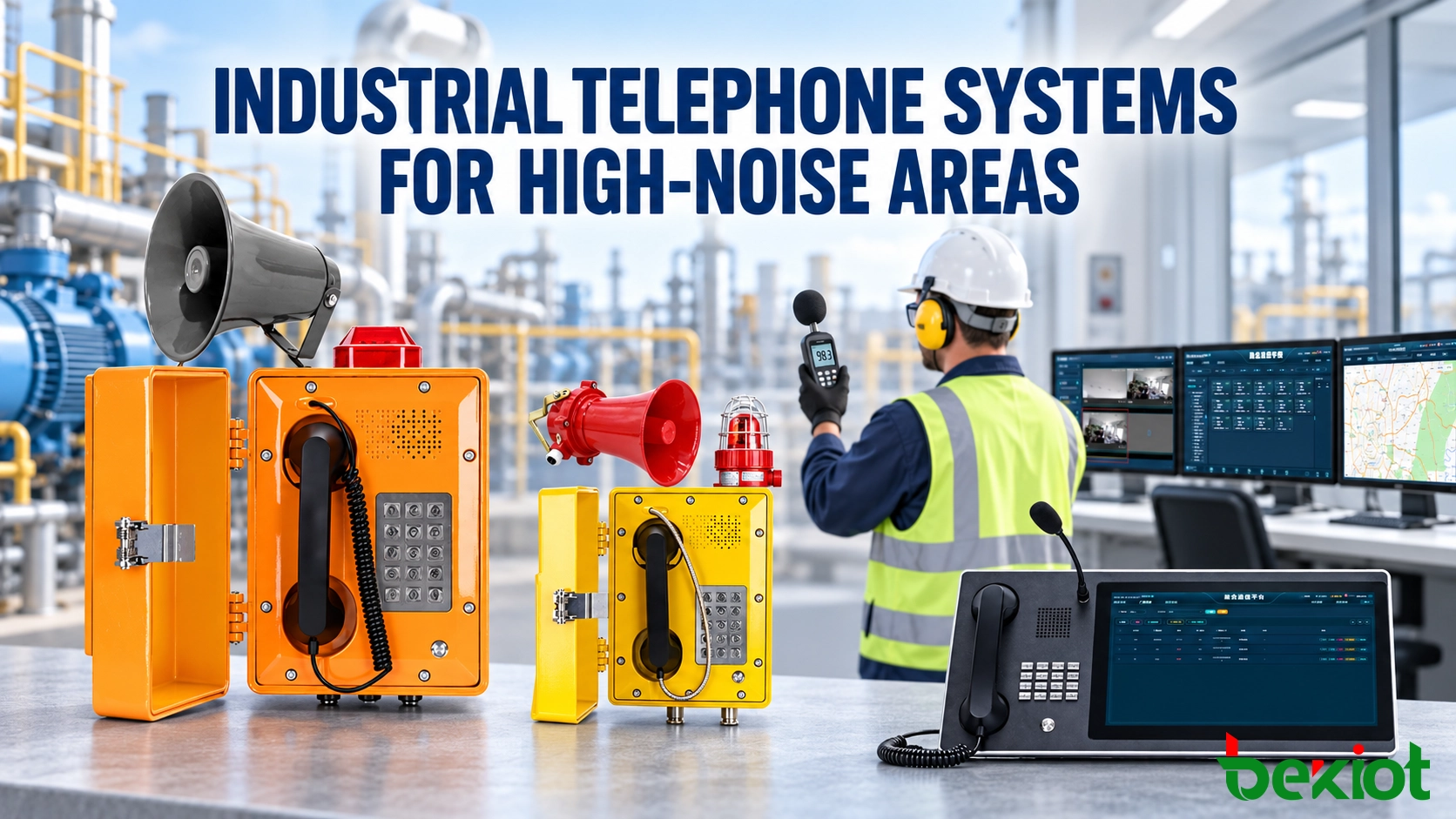
Reliable voice communication becomes difficult when workers are surrounded by production machinery, ventilation systems, vehicle movements, compressors or material-handling equipment. In these conditions, installing a louder telephone is rarely enough. The complete communication path—from the microphone and handset to the IP network, dispatch server and control-room operator—must be designed around the actual acoustic and operational environment.
An effective industrial telephone system should allow personnel to notice an incoming call, understand spoken instructions, report an incident without delay and remain connected during abnormal operating conditions. This requires a coordinated design covering acoustic performance, environmental protection, call routing, network availability, power continuity and maintainability.
Begin with an Acoustic and Operational Survey
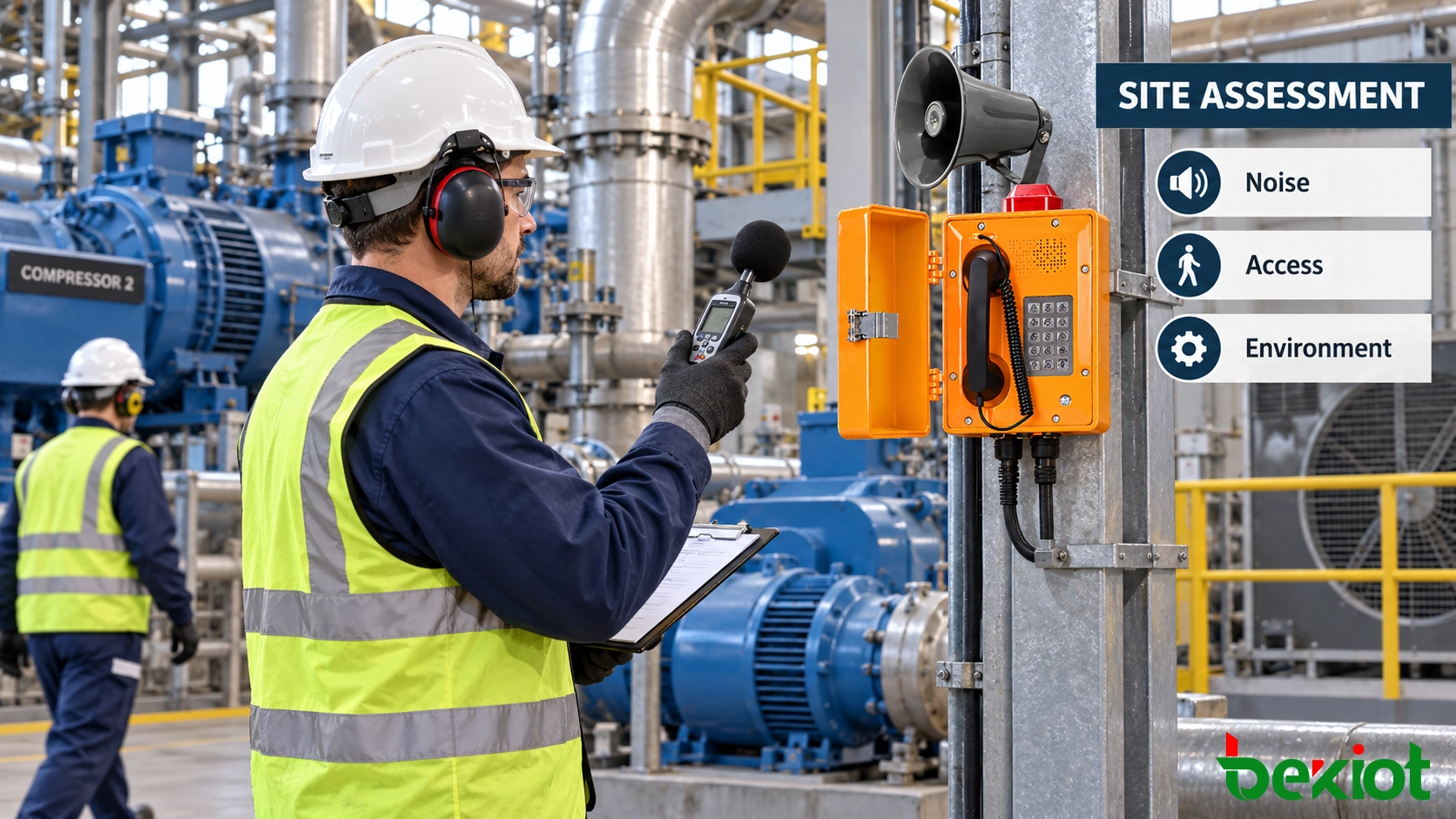
System design should begin at the installation site rather than with a product catalogue. Noise levels, worker movement, protective equipment and emergency procedures all influence the type and location of each communication terminal.
Ambient noise should be measured during representative operating conditions. A reading taken while equipment is idle may not reflect the environment during production, loading, ventilation startup or maintenance. Measurements should therefore cover normal operation, peak activity and any temporary process that significantly changes the acoustic environment.
The survey should also identify the nature of the noise. Continuous low-frequency machinery noise affects communication differently from intermittent impact noise, warning sirens or passing vehicles. Average sound pressure level alone may not explain whether speech will remain understandable.
Engineers should record the following information for every proposed call point:
Typical and peak ambient noise levels during real operation.
Whether noise is continuous, intermittent or highly variable.
The distance between the user and the telephone.
Whether workers use helmets, gloves, hearing protection or respirators.
The time required to reach the nearest communication point.
Local exposure to dust, water, chemicals, vibration, heat or electromagnetic interference.
Whether the point is intended for routine calls, operational dispatch or emergency assistance.
The operating workflow is equally important. A maintenance technician may need to dial several extensions, while a worker at an emergency call point may only need to lift the handset or press one button to reach the control room. A terminal should not include more operational steps than the situation allows.
Translate Site Conditions into Terminal Requirements
Once the survey is complete, each area can be assigned a suitable terminal specification. The required enclosure, acoustic interface and calling method may differ substantially between a control room, production workshop, tunnel, loading area and outdoor equipment zone.
Handset or Hands-Free Operation
A handset is often preferable in sustained high-noise areas because the receiver is positioned close to the user’s ear and the microphone remains close to the mouth. This physical arrangement can improve speech pickup and reduce the amount of surrounding noise entering the call.
Hands-free terminals are useful when workers cannot hold a handset or when several people must hear the same conversation. However, their performance depends heavily on mounting position, microphone directivity, loudspeaker output and acoustic reflections. In very noisy spaces, a hands-free terminal may require an acoustic hood or a more sheltered installation position.
Incoming Call Notification
A communication point is ineffective if workers cannot detect an incoming call. Audible ringing should be evaluated against the measured background noise at the user position, not only against the rated output measured close to the device.
Increasing volume indefinitely can introduce distortion, create additional noise exposure and interfere with nearby alarms. Where audible notification is unreliable, the design should combine sound with a visible strobe, beacon or local display. Visual notification is particularly valuable where hearing protection is mandatory.
Speech Pickup and Output
The microphone should favor speech close to the user while reducing surrounding machinery noise. A noise-reducing handset, suitable microphone sensitivity and controlled input gain usually provide better results than simply applying maximum amplification.
Output volume must also remain adjustable. A level suitable for peak production may be uncomfortable during shutdown or maintenance periods. Separate adjustment for the handset, loudspeaker and external speaker can help the system accommodate changing operating conditions.
Protection Against the Environment
The enclosure rating must match the actual exposure. Dust resistance, water protection, corrosion resistance, impact resistance and operating temperature should be evaluated separately. A telephone installed outdoors may need protection from rain and ultraviolet exposure, while a terminal in a wash-down area may face pressurized water and cleaning chemicals.
Impact protection is also important in areas with tools, carts, vehicles or frequent public access. Cable entries, mounting hardware, handset cords and hook switches should receive the same attention as the main enclosure because these components are common mechanical failure points.
Hazardous areas require an additional assessment. A weatherproof telephone is not automatically suitable for an atmosphere containing flammable gas or combustible dust. Where hazardous-area certification is required, the terminal, accessories, cabling and installation method must all comply with the applicable site classification.
A Practical Waterproof Endpoint Option
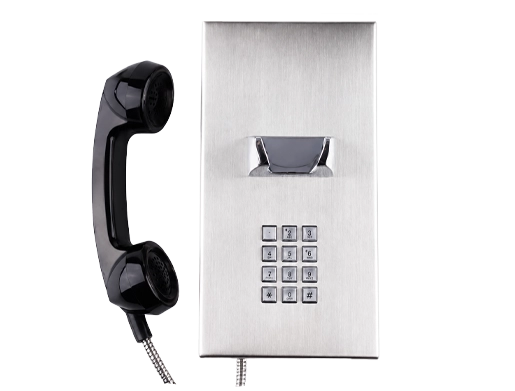
For wet, dusty or exposed communication points, the EX-BT27 industrial waterproof telephone can be considered as one endpoint within the wider system. It supports SIP 2.0, an IP66 enclosure, IK10 impact protection, PoE, configurable hotline dialing, automatic answering and adjustable audio levels. Its stated operating range is -40°C to +60°C.
These characteristics make it relevant to tunnels, utility corridors, production workshops, power facilities, ports and other locations where an ordinary office phone would not provide adequate environmental protection. Final suitability should still be confirmed against the project’s acoustic measurements, hazardous-area classification and network design.
Related Product: EX-BT27 Industrial Waterproof Telephone
Build the System Around a Resilient SIP Architecture
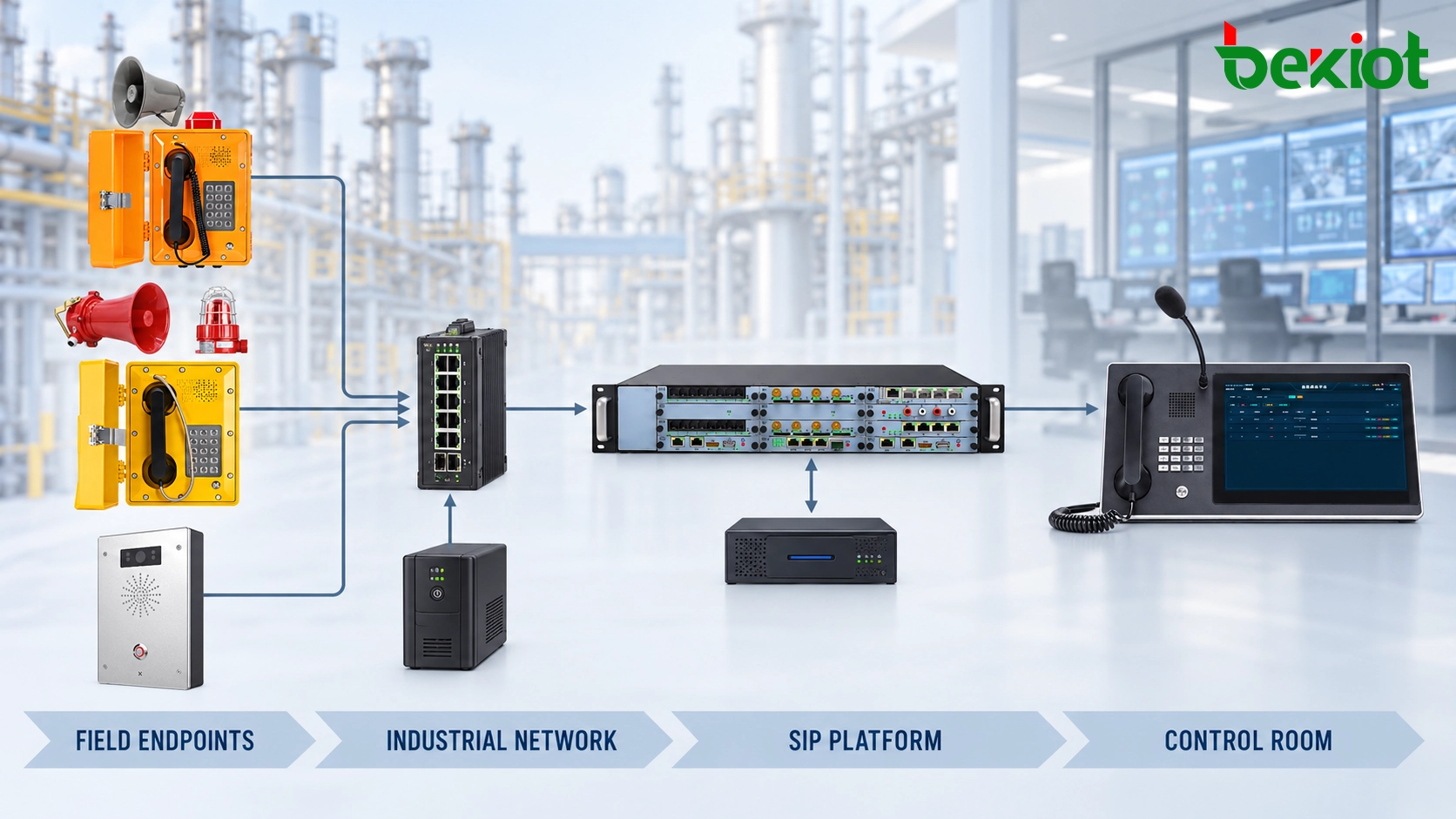
Industrial telephones should be treated as part of an operational communication system rather than as isolated endpoints. A typical architecture includes field telephones, access switches, a SIP server or IP PBX, operator consoles, recording services and interfaces to paging or dispatch platforms.
When a field user lifts the handset, the telephone can present a dial tone, call a predefined extension or automatically connect to an emergency position. The SIP platform applies the call-routing rules and sends the call to the appropriate control-room operator, duty group or backup destination.
Standard SIP architecture makes it possible to use the same network for several communication functions:
Point-to-point calls between field personnel and the control room.
Hotline calls initiated by lifting a handset.
Priority calls to emergency or maintenance teams.
Group paging to selected operational zones.
Automatic answering for remote announcements.
Call transfer, escalation and duty-group routing.
Recording and event correlation for incident review.
Separate Signaling from the Media Path
Successful SIP registration does not confirm that voice communication will work correctly. SIP signaling establishes and controls the call, while RTP normally carries the audio. Firewalls, routing policies and network address translation can therefore allow registration but block or misroute the media stream.
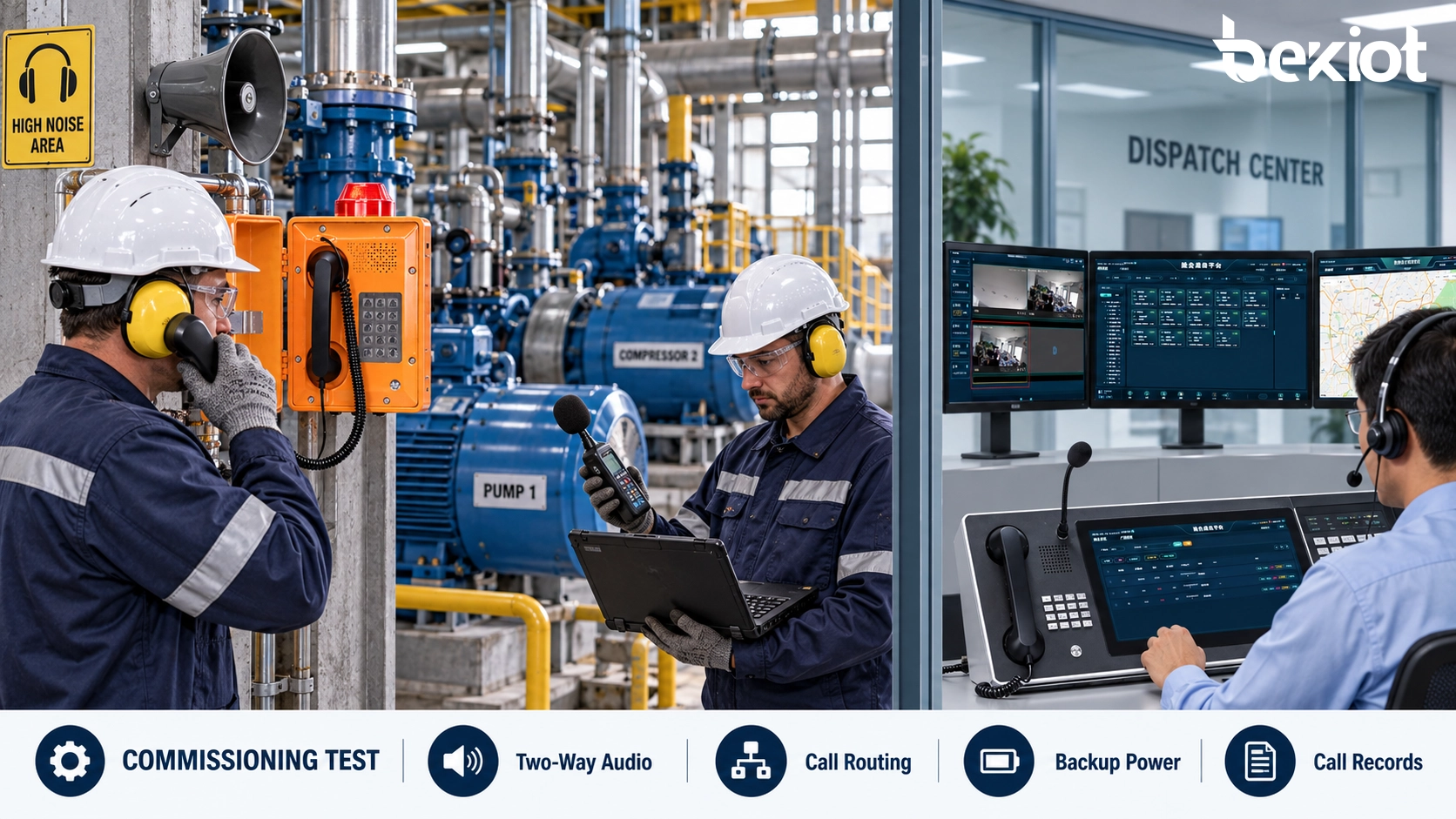
Commissioning should verify two-way audio across every required network path. This includes calls within one subnet, between operational zones and through any wide-area or redundant connection.
Control Delay, Jitter and Packet Loss
Industrial voice traffic uses relatively little bandwidth, but it is sensitive to network impairment. Excessive delay makes conversations difficult, variable delay produces broken speech, and packet loss can remove critical words from an emergency report.
Voice traffic should be assigned appropriate quality-of-service policies across the complete path. Configuration at the telephone alone is insufficient if switches, routers or WAN services ignore the traffic classification. Network utilization should also be tested during busy periods rather than only when the network is lightly loaded.
Provide Independent Power Paths
PoE can simplify field installation by carrying power and data through one Ethernet cable. The upstream switch and communication server must then be connected to a suitable uninterruptible power supply. Otherwise, a local telephone with PoE support will still stop operating when the network cabinet loses power.
Critical designs may use redundant switches, diverse fiber routes, backup server instances and secondary control-room positions. The required redundancy should be determined through a failure-mode analysis rather than by duplicating every component without a defined recovery strategy.
Position Call Points Around Real Workflows
Terminal quantity should not be calculated only from floor area. Installation planning should consider travel time, physical barriers, worker routes, risk zones and the expected response process.
A worker should not need to cross moving machinery, traffic lanes or restricted areas to reach a telephone. In tunnels, corridors and long process areas, communication points are normally distributed along the travel route. Additional terminals may be needed near entrances, maintenance platforms, refuge points, emergency exits and equipment with a high fault-reporting frequency.
Each call point should be visible and identifiable. Signage, lighting and consistent mounting positions help workers locate a telephone quickly, especially during smoke, power interruption or an unfamiliar emergency.
Avoid Poor Acoustic Positions
A telephone mounted directly beside a motor, fan outlet or metal processing machine may be difficult to use regardless of its rated volume. Moving it a short distance, adding a partial acoustic barrier or installing it inside a communication booth can deliver a greater improvement than increasing amplifier power.
Highly reflective spaces also require attention. Metal walls, concrete tunnels and enclosed process rooms can produce strong reverberation. Reflected sound reduces intelligibility because earlier and later parts of speech overlap. Acoustic hoods and controlled speaker direction can limit this effect at individual call points.
Design Simple Call Behavior
Routine operational telephones may require a keypad, directory and multiple destination choices. Emergency points should generally use a simpler interaction, such as lift-to-call or one-button dialing.
The call route should identify the location automatically where the platform supports this function. The operator should be able to see a meaningful name such as “Conveyor Line 2 East” or “Tunnel Cross Passage 08” instead of an unexplained extension number.
If the primary operator does not answer within a defined period, the platform can route the call to another console, a duty group or a supervised fallback number. Escalation rules should be agreed with the operations team and tested as part of the emergency procedure.
Define Measurable Acceptance Criteria
Factory specifications are useful for selecting equipment, but system acceptance must be based on performance after installation. Cabling, network behavior, mounting position, environmental noise and operator configuration can all affect the final result.
A practical site acceptance test should include the following checks:
| Test Area | Required Verification |
|---|---|
| Call initiation | Confirm keypad, speed-dial, hotline and emergency-call behavior as applicable. |
| Speech quality | Verify intelligibility in both directions while nearby equipment is operating. |
| Incoming notification | Confirm that workers can detect ringing or visual alerts from their normal work positions. |
| Call routing | Test primary destinations, unanswered-call escalation, busy conditions and operator transfer. |
| Network behavior | Verify two-way RTP audio, acceptable delay and stable calls during representative network load. |
| Power continuity | Confirm operation through the specified backup period and observe recovery after power restoration. |
| Failure response | Disconnect selected links or servers and confirm that the documented fallback behavior occurs. |
| Environmental sealing | Inspect cable glands, mounting points, handset seals and unused entries after installation. |
| System records | Confirm that time stamps, call logs, alarms and recordings can be retrieved by authorized users. |
Speech testing should use complete operational phrases rather than a simple test tone. A tone can confirm that an audio path exists, but it does not show whether a worker can accurately understand a location, equipment number or emergency instruction.
Testing should also include users wearing their normal personal protective equipment. Gloves may affect keypad operation, while hearing protection, helmets and respirators can change the way a handset is positioned and used.
Plan for Long-Term Availability
Reliability depends on maintenance as well as initial design. Industrial telephones may remain unused for long periods and then become essential during an incident. A device that appears physically intact may still have a damaged handset cord, blocked microphone opening, failed visual indicator or outdated network configuration.
The maintenance plan should define inspection frequency according to environmental exposure and operational importance. Wet, corrosive and vibration-prone areas normally require more frequent inspection than clean indoor locations.
Routine checks should cover enclosure condition, mounting security, cable glands, handset operation, keypad response, loudspeaker output, microphone pickup, network registration and the complete call route. Test calls should reach the real destination or a supervised test position rather than stopping at a local dial tone.
Configuration records should include extension numbers, SIP accounts, IP addresses, VLAN assignments, switch ports, call-routing rules and firmware versions. Backups should be updated after approved changes so that failed equipment can be replaced without reconstructing its configuration manually.
A well-designed industrial telephone system is therefore not defined by one rugged device. It is a coordinated communication path that remains accessible, intelligible and manageable under the operating conditions of the site. Acoustic measurement, appropriate endpoint selection, resilient network design, practical placement and realistic acceptance testing must work together.
FAQ
Can industrial telephone calls be recorded?
Yes. When the telephone is connected to a compatible SIP server, dispatch platform or recording system, calls can be recorded according to project policy. Access permissions, retention periods and local privacy requirements should be defined before recording is enabled.
Can several plants use one central communication platform?
Yes. Multiple sites can register their industrial telephones with a centralized or distributed SIP architecture. Extension plans, site naming, bandwidth, cybersecurity and WAN failure behavior should be designed so that an operator can immediately identify where each call originated.
Should industrial telephones share a network with office computers?
They can use common physical infrastructure, but voice endpoints should normally be separated through managed VLANs, access-control policies and appropriate quality-of-service settings. This improves traffic control, fault isolation and security management.
Is an explosion-proof telephone required in every factory?
No. Explosion-proof equipment is required only where the formal hazardous-area assessment and applicable regulations demand it. Dust, moisture or outdoor exposure may require a weatherproof telephone without requiring an explosion-protected design.
What spare parts should be kept on site?
The spare-parts plan should reflect the installed terminal type and replacement time. Common items include handsets, reinforced cords, hook switches, key modules, cable glands, mounting hardware and at least one preconfigured replacement terminal for critical sites.