


A converged communication system is built to connect different communication resources into one platform, allowing users to manage voice, video, dispatch, intercom, paging, emergency notification, and multi-system coordination from a unified interface. It is widely used in emergency command, public safety dispatch, industrial operation centers, transportation control rooms, smart parks, energy sites, campuses, and other environments where cross-system communication is required.
However, many integration problems do not appear during product demonstrations. They appear during deployment, acceptance testing, and daily operation. Video cannot be played on dispatch software. Smart terminals cannot decode surveillance streams. Radio systems can talk, but location, messaging, or private-call signaling cannot be synchronized. SMS gateway functions are requested, but SIM card policies and carrier restrictions create delivery and after-sales risks. These are common traps in converged communication projects, and they must be considered during the early solution design stage.
Start with What Must Be Connected
The first mistake in many projects is treating a converged communication platform as a simple software interface. In reality, the platform must often connect many independent systems, each with its own protocol, media format, control logic, and operational boundary. A complete project may include video surveillance systems, SIP phones, emergency call stations, public address terminals, radio networks, dispatch consoles, mobile clients, external telephone lines, alarm systems, and third-party business platforms.
A successful solution must therefore begin with a system inventory. Engineers should confirm what needs to be integrated, how each system communicates, which protocols are open, which functions must be retained, and which functions can only be realized through gateway conversion. Without this step, the project may look feasible in a proposal but become difficult during implementation.
The core principle is simple: converged communication is not only about connecting devices. It is about ensuring that voice, video, signaling, control commands, alarms, and dispatch workflows can actually work together in a stable and maintainable architecture.
Video May Fail Even When the Camera Is Online
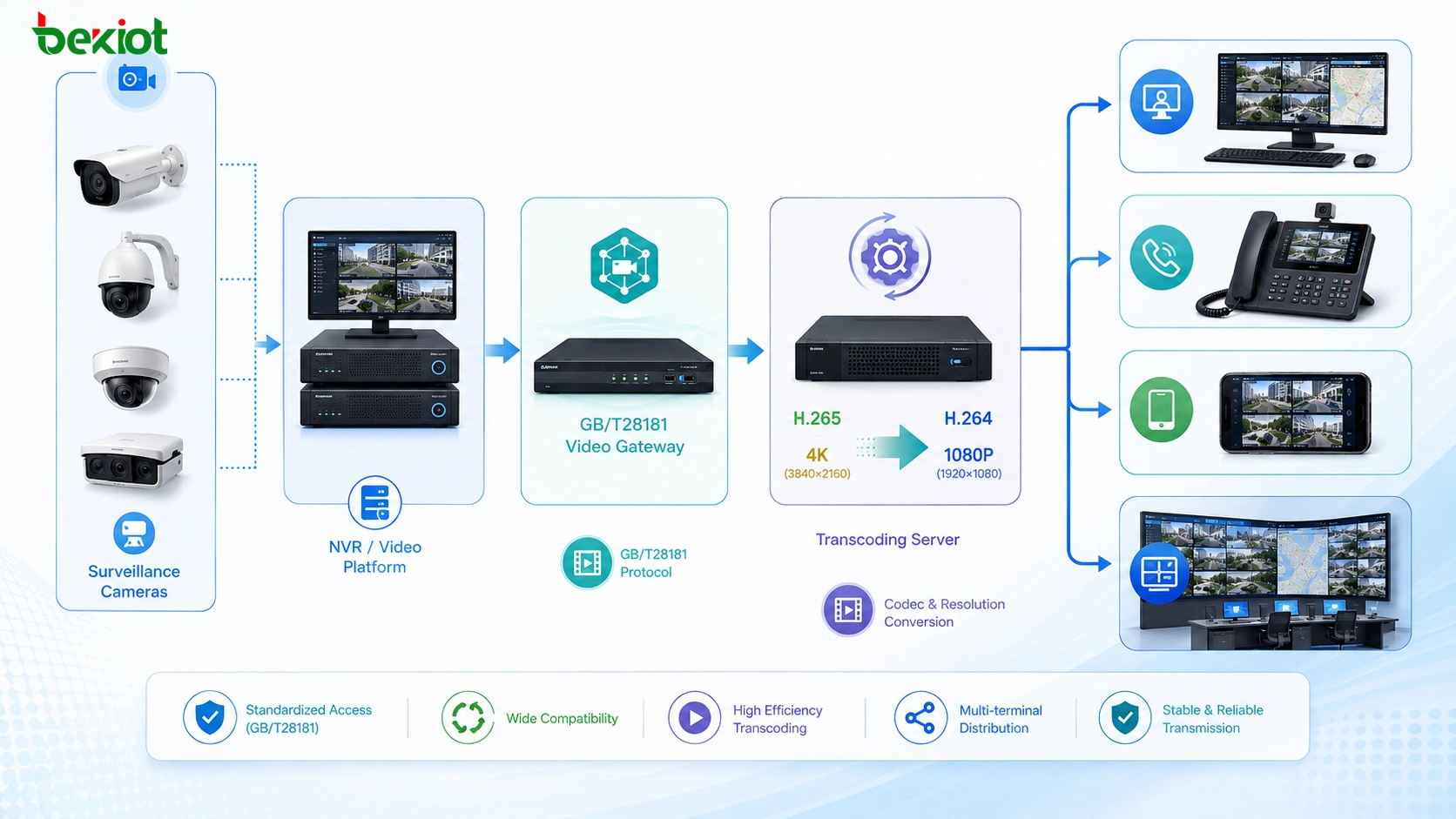
Video surveillance integration has become a standard requirement in many converged communication projects. In many deployments, video access is implemented through a video gateway using GB/T28181 to connect cameras, NVRs, video platforms, and surveillance systems. After the video sources are connected, the converged communication platform can call, preview, distribute, and link video with dispatch events.
The hidden risk is that access protocol compatibility does not guarantee playback compatibility. A camera may be successfully connected through a video gateway, but the video stream may still fail to play on the dispatch platform, video phone, smart terminal, web client, or mobile application. This often happens because the video codec and resolution are not supported by the target terminal.
In current surveillance projects, many cameras use H.265 encoding and may provide 4K video resolution. However, many converged communication terminals and dispatch clients still mainly support H.264 decoding, and many devices are optimized for 1080P video. If this difference is not considered in advance, the project may face black screens, playback failure, freezing, high CPU load, temporary equipment replacement, delayed acceptance, or additional unexpected costs.
Put Transcoding into the Design Early
A practical way to avoid video compatibility risk is to include a video transcoding server in the solution design. The transcoding server receives the original video stream and converts it into a format that the target platform or terminal can decode. For many projects, this means converting H.265 streams into H.264, reducing 4K video to 1080P, or adjusting bitrate and frame rate for smoother playback.
The transcoding server can work together with an existing video gateway, or it can be used as an independent media-processing layer. In a well-designed system, it can support GB/T28181 upper-level and lower-level cascading, SIP-based networking, H.264/H.265 conversion, resolution adaptation, frame rate control, and bitrate adjustment. This makes video easier to distribute to dispatch software, video phones, mobile clients, web terminals, and command center displays.
This design also reduces project risk. Instead of discovering playback problems during acceptance testing, the project team can verify codec compatibility, stream profiles, latency, video quality, and terminal decoding performance during the planning and testing stage.
Radio Interconnection Is More Than Audio
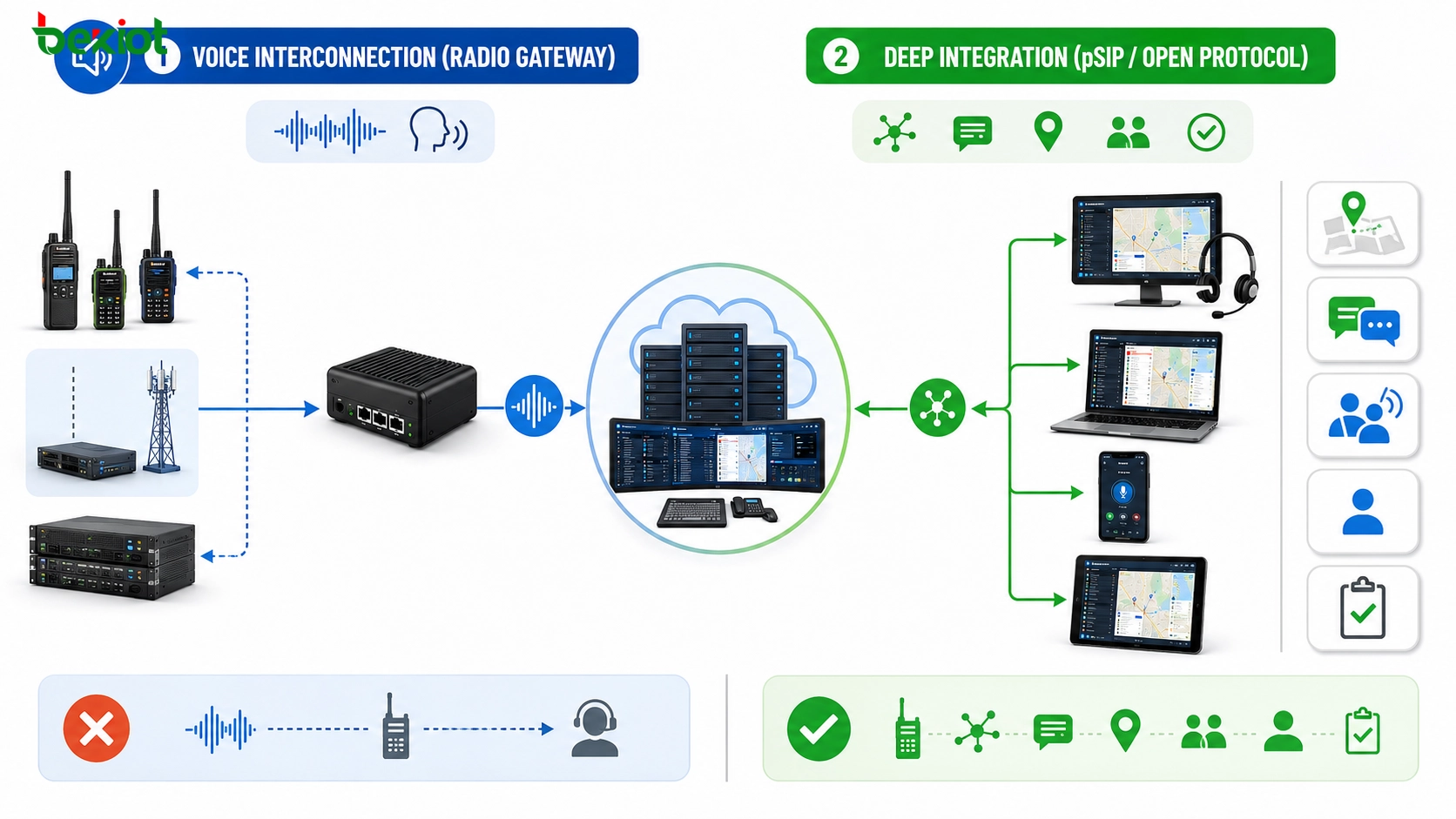
Another common pitfall appears when connecting trunked radio or walkie-talkie systems to a converged communication platform. A common method is to use a radio gateway or trunking intercom gateway. The gateway connects to mobile radios, base stations, handheld radios, or vehicle-mounted radios through customized cables, then converts radio audio into standard SIP voice so that the dispatch platform can communicate with radio users.
This method is useful and widely used. It allows IP dispatch consoles, SIP phones, command center microphones, and other communication terminals to talk with radio users. It is especially valuable when the project only needs voice interconnection between the radio network and the IP communication system.
However, this method normally connects audio only. It usually cannot exchange full signaling with the original trunked radio platform. This means that functions such as radio positioning, short messages, private calls, user status, group control, or native trunking system signaling may not be available through a simple audio gateway. If the customer expects these functions, the project team must explain the limitation clearly before the solution is finalized.
Protocol Access Needs Real Project Evaluation
Some projects require deeper protocol-level integration instead of simple audio gateway access. In these cases, pSIP or other open protocol methods may be discussed. From a technical perspective, protocol connection may not be extremely difficult if interface documents, test environments, and vendor support are available. The real challenge is project feasibility.
Before promising protocol-level integration, the project team should confirm several key points. Does the existing trunking system actually support open pSIP access? Can the original vendor provide interface documentation, test accounts, and technical support? Are there extra license fees or integration service fees? Can the integrator perform debugging with the customer’s existing radio platform? Are advanced functions such as location, messaging, private call, group call, and status reporting truly available through the interface?
If these questions cannot be clearly answered, a safer option is to use a radio gateway for voice interconnection. This approach may not provide all native trunking functions, but it is more predictable for cross-system voice communication. For industrial sites that need SIP dispatch, RoIP gateway access, emergency intercom, paging, and field communication integration, Becke Telcom can be considered as part of the endpoint and system integration architecture.
SMS and SIM-Based Calling Can Create Hidden Risk
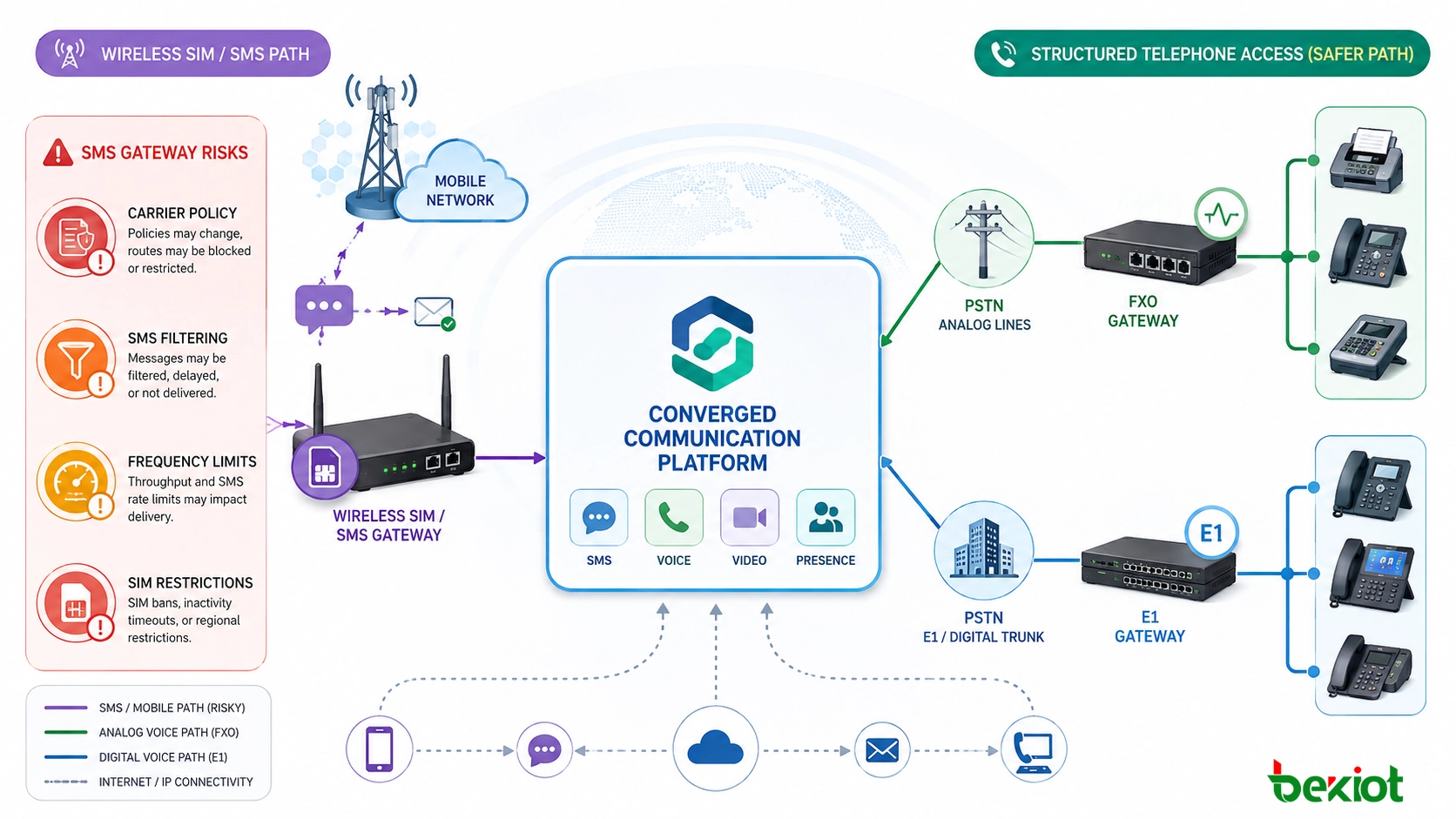
Some users ask for two functions in converged communication projects: sending SMS messages and making calls through mobile SIM cards. In practice, these requirements usually involve SMS gateways, wireless telephone gateways, or SIM-based gateway devices. In some cases, the same device can support both SMS sending and mobile-network calling through built-in SIM cards.
This looks simple, but the operational risk is high. In many markets, carrier management of SIM cards has become much stricter. SIM cards that can make voice calls and send SMS messages often require personal real-name registration. Enterprise users may be able to apply for IoT SIM cards, but these cards may not support normal voice calling or SMS sending. This creates a delivery question: who provides the SIM card, who owns it, and who is responsible when it is restricted?
SMS sending is also often monitored by operators or service providers. If messages are sent too frequently, too quickly, or with repeated content, the number or service account may be blocked. Even if a third-party SMS platform is used, the message content may be reviewed, filtered, delayed, or rejected. Therefore, SMS requirements should be handled as a service-risk item, not simply as a hardware function.
Choose Safer Paths for Telephone and Message Access
For projects that require external phone calling, it is often safer to use standard telephone access methods such as FXO or E1 rather than relying mainly on SIM-based wireless gateways. FXO can connect traditional analog telephone lines for small-capacity access, while E1 can provide higher-concurrency trunk access for larger communication systems.
For SMS notification requirements, a professional SMS platform may be more manageable than a local SIM gateway, but it still requires clear responsibility boundaries. The project contract should define who provides the SMS service, who reviews message templates, who handles account suspension, how delivery failure is reported, and whether SMS is a guaranteed service or only a notification channel.
This point is important for after-sales responsibility. If the system integrator promises SMS or SIM-based calling without clarifying carrier policy risk, later service restrictions may become a dispute even though the gateway hardware itself is functioning normally.
Build the Solution Around Acceptance Testing
A good converged communication solution should be designed backward from acceptance testing. The project team should ask what must be demonstrated at the end of the project. Can dispatch software open the required video streams? Can video phones and mobile clients decode them? Can radio users talk with SIP users? Does the system need only radio voice, or does it need positioning and messaging? Are SMS and SIM-based calling legally and operationally feasible? Are external calls routed through stable and compliant telephone access?
If the answers are not clear during the proposal stage, the project should include a proof-of-concept test. This is especially important for video transcoding, GB/T28181 access, H.265/H.264 compatibility, pSIP integration, radio gateway cable adaptation, and SMS service behavior. Testing early is far less expensive than correcting the architecture after installation.
Recommended Planning Framework
Check the Media Format Before Device Selection
Before choosing terminals, video gateways, or dispatch clients, confirm the actual video format generated by the surveillance system. Identify whether the cameras use H.264 or H.265, whether streams are 1080P or 4K, and whether the target terminals can decode them smoothly. If not, include transcoding in the initial design.
Separate Voice Interconnection from Signaling Integration
When connecting radio systems, clearly separate “voice interconnection” from “full protocol integration.” A radio gateway can solve voice communication, but it may not deliver location, messaging, private call, or native dispatch signaling. If those functions are required, evaluate pSIP or protocol access carefully.
Clarify Responsibility for Carrier-Dependent Functions
SMS and SIM-based calling depend on carrier policies, service accounts, real-name rules, content review, sending frequency, and regional restrictions. These factors should be written into the project scope and after-sales responsibility document before delivery.
Common Mistakes to Avoid
One common mistake is assuming that video access equals video playback. A video gateway may connect cameras successfully, but codec mismatch can still prevent playback on dispatch software, video phones, or smart terminals.
Another mistake is promising full radio system integration when only an audio gateway is included. If the project needs positioning, messaging, single call, group control, or status synchronization, the team must evaluate protocol access instead of relying only on audio conversion.
A third mistake is treating SIM gateways as a simple replacement for formal telephone access. SIM card policies, SMS monitoring, account blocking, and real-name requirements can create serious project delivery and after-sales risks.
Conclusion
Converged communication projects are valuable because they bring multiple communication systems into one coordinated platform. But the more systems a project connects, the more hidden compatibility and operational risks it may face. Video codec mismatch, radio signaling limitations, pSIP integration uncertainty, SIM card restrictions, SMS service blocking, and unclear responsibility boundaries can all affect delivery quality.
The best way to avoid these problems is to plan the solution in detail before implementation. Confirm video codecs and resolutions. Add transcoding when H.265 or 4K streams must be used by H.264 or 1080P terminals. Choose radio gateways when voice interconnection is enough, and evaluate protocol access only when advanced trunking functions are truly required. Treat SMS and SIM-based calling as carrier-dependent services with clear responsibility terms.
A reliable converged communication solution is not only about combining many devices. It is about understanding the limits of each subsystem, choosing the right gateway or server, testing before acceptance, and building an architecture that can operate smoothly after the project is delivered.
FAQ
Why does video fail in some converged communication projects?
Video often fails because the access protocol and the video codec are treated as the same issue. A camera may be connected through GB/T28181, but the dispatch terminal may not support the camera’s H.265 codec or 4K resolution. In this case, a video transcoding server may be required.
What can a video transcoding server do?
A video transcoding server can convert H.265 to H.264, adjust 4K streams to 1080P, reduce bitrate, control frame rate, and make surveillance streams playable on dispatch software, video phones, mobile clients, and command center terminals.
Can a radio gateway support all trunking radio functions?
Usually not. A radio gateway can often convert radio audio into SIP voice for interconnection, but it may not support full signaling functions such as location, short messages, private calls, group control, or user status. These functions may require protocol-level integration.
Is pSIP integration always recommended?
pSIP integration should be used only after feasibility is confirmed. The project team must verify interface openness, vendor support, test conditions, licensing costs, and whether the required functions are actually available through the protocol.
Why are SIM-based SMS and calling functions risky?
SIM-based gateways depend on carrier policies, real-name registration, SMS content review, sending frequency limits, and account monitoring. Numbers may be blocked if messages are sent too frequently or content is repeated. Responsibility should be clearly defined before project delivery.







