A converged communication system is designed to bring voice, dispatch, intercom, paging, video linkage, emergency notification, and business communication into one coordinated platform. In many projects, however, the system cannot operate as an isolated IP network. It often needs to connect with the public telephone network, legacy PBX lines, carrier voice services, or existing enterprise telephone resources. This is where external telephone line access becomes a key part of system planning.
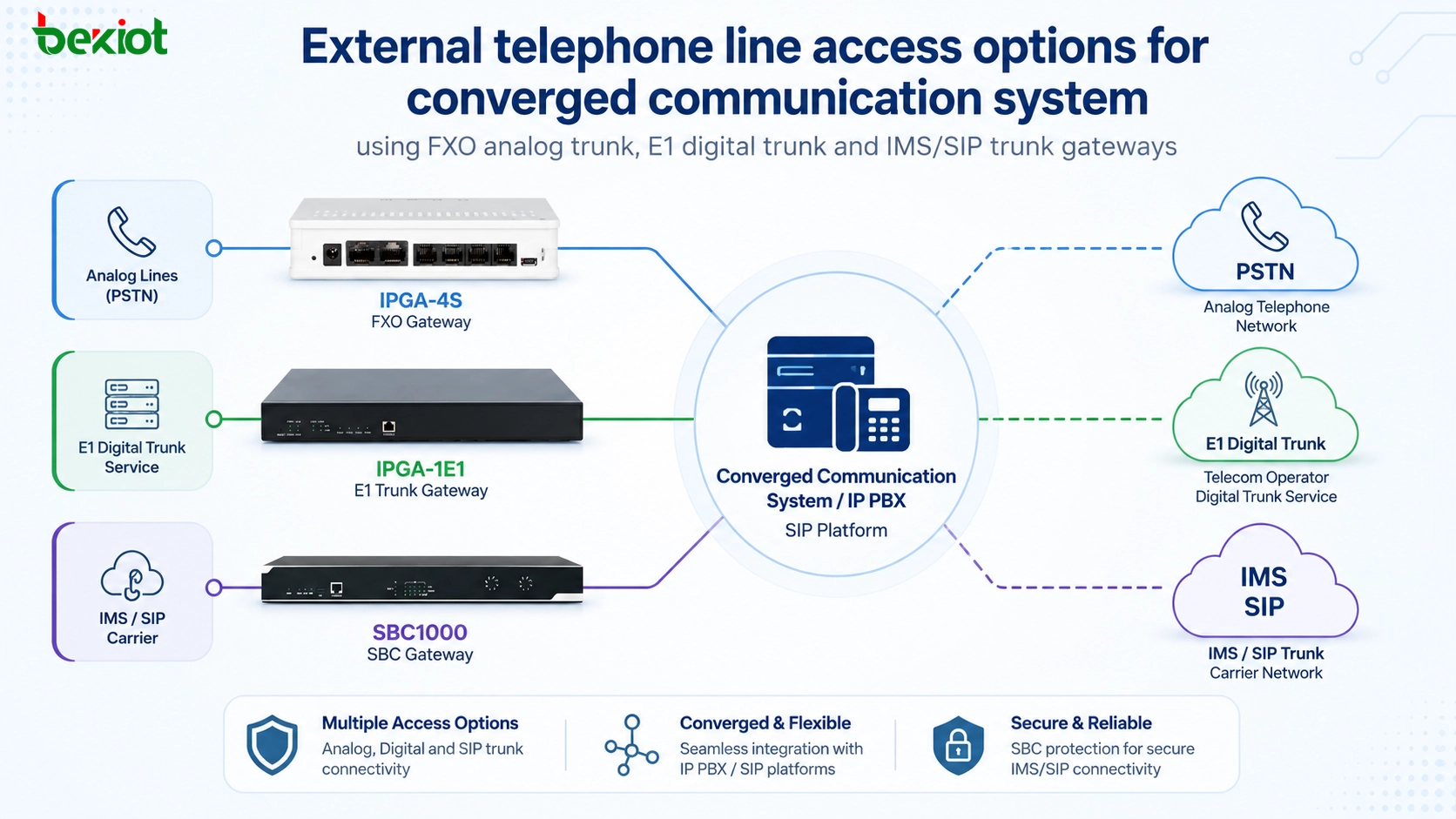
In practical deployments, there are three mainstream ways to connect a converged communication system with telephone services: FXO analog trunk access, E1 digital trunk access, and IMS/SIP trunk access. Each method has its own network structure, cost model, capacity range, gateway requirement, and best-fit application scenario. Choosing the right access method affects not only call quality and concurrency, but also numbering, routing, security, scalability, maintenance, and long-term operating cost.
Why External Voice Access Still Matters
Modern communication platforms are increasingly IP-based. SIP servers, IP PBX systems, softswitch platforms, dispatch consoles, SIP phones, industrial telephones, emergency call stations, and IP speakers can all communicate through Ethernet or private IP networks. For internal communication, this architecture is efficient and flexible. Users can dial extensions, trigger broadcasts, join dispatch groups, and connect multiple sites over IP.
But many organizations still need to make and receive calls through the public telephone network. A control room may need to call external maintenance teams. A factory may need public voice lines for suppliers, customers, and emergency services. A campus may want internal SIP extensions to receive public calls. A transportation hub may need dispatch operators to call mobile phones or landlines. In these scenarios, the converged communication platform must have a reliable external line access design.
The external access method should be selected according to call volume, existing carrier resources, deployment budget, numbering requirements, and future expansion. A small site with only a few external calls may use analog lines. A large organization with high concurrent call demand may choose E1 digital trunking or IMS/SIP trunking. A distributed enterprise may prefer an IP-based solution with SBC protection and centralized routing.
Three Main Access Paths
The three common access paths are not simply different cables. They represent different generations of telephony access. FXO analog access connects traditional telephone lines. E1 digital trunking aggregates many voice channels over a digital transmission interface. IMS/SIP trunking connects voice services over IP broadband networks and is more aligned with modern carrier architecture.
A good design does not treat one method as universally better than the others. Instead, it maps each method to the project requirement. FXO is simple and suitable for small-capacity access. E1 provides higher concurrency and unified external numbering. IMS/SIP offers IP-based access, flexible service capabilities, and stronger alignment with modern converged platforms, but it usually requires careful security and interoperability design.
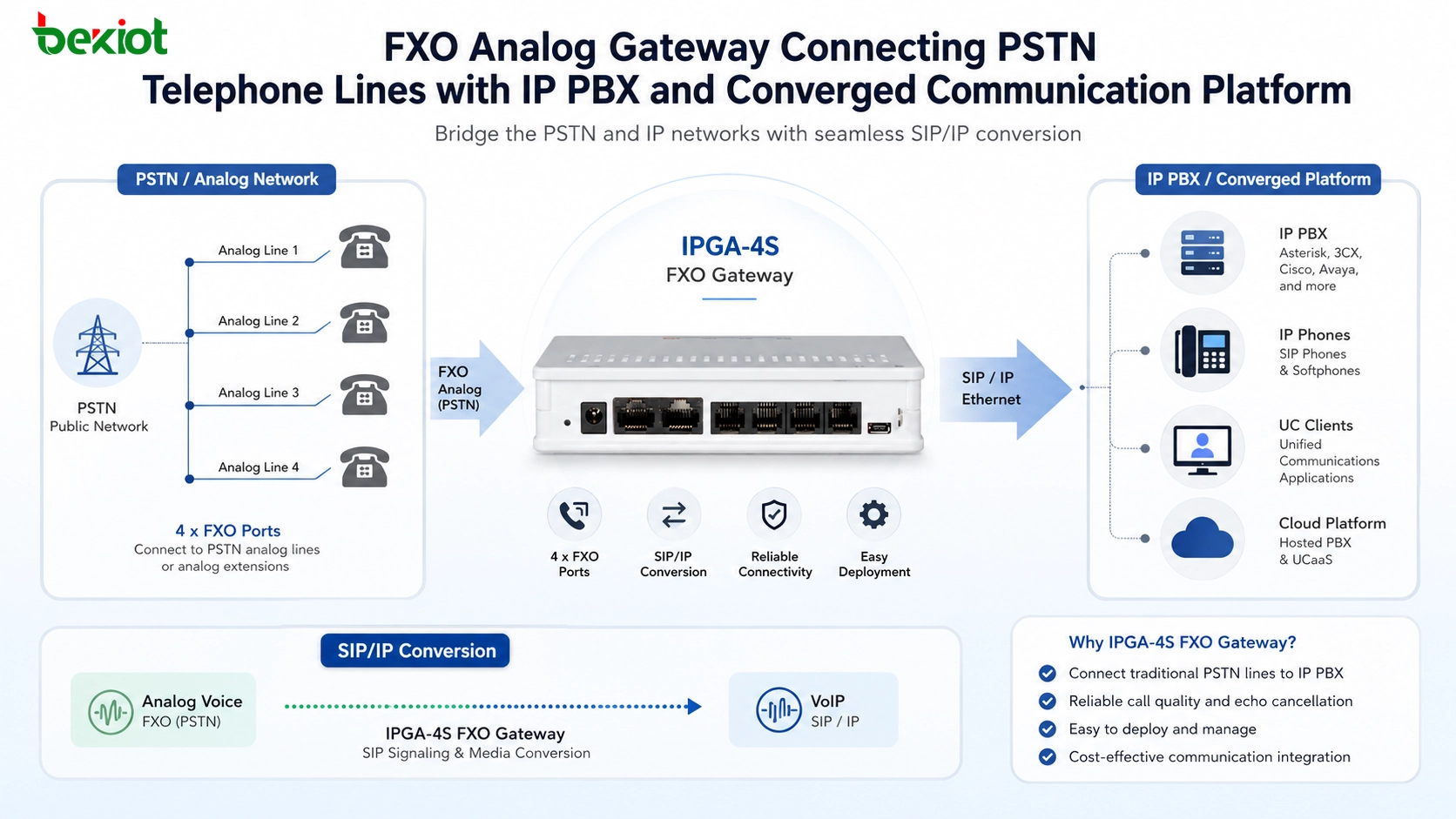
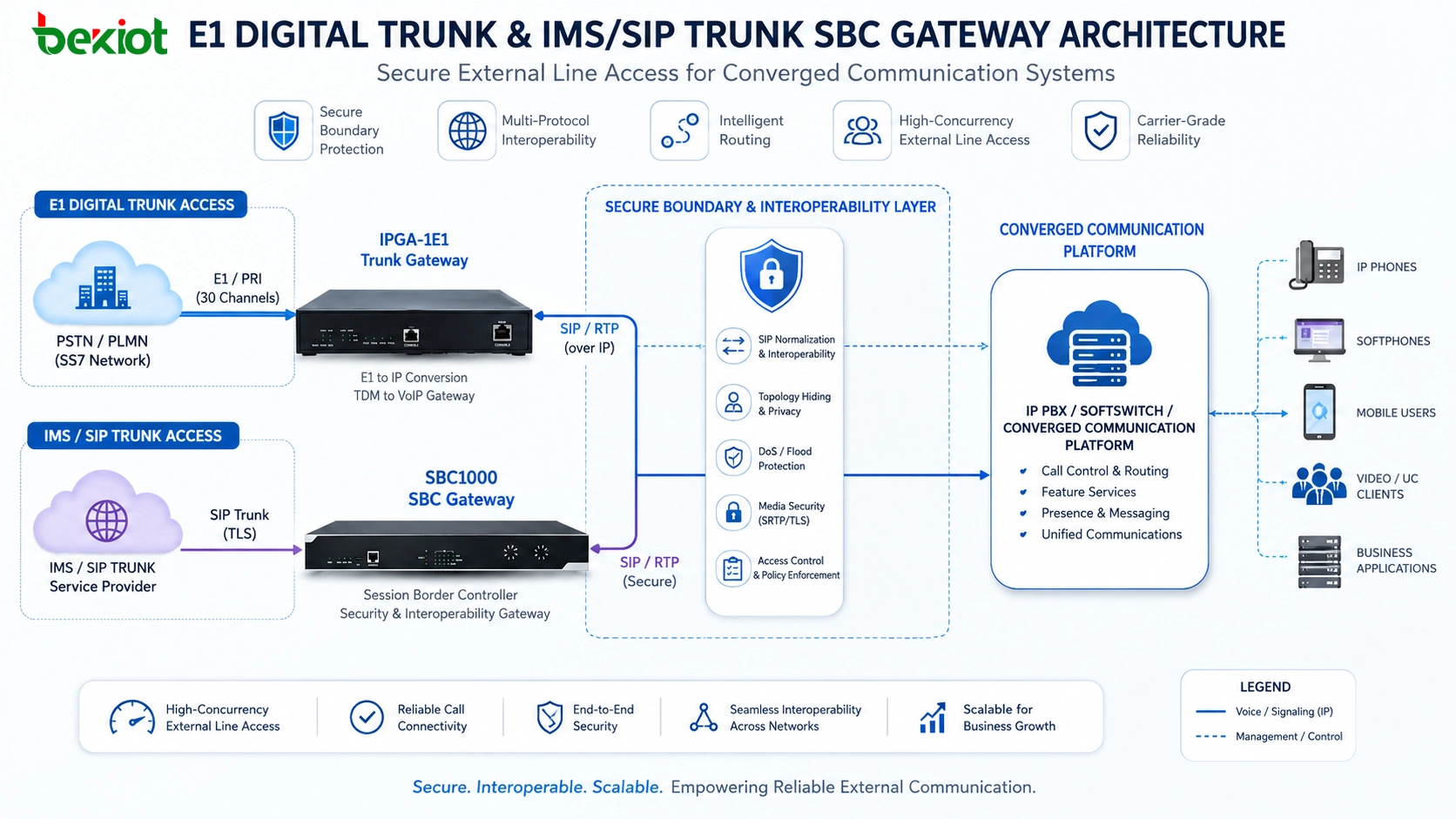
In gateway selection, Becke Telcom can be lightly matched to these access types through the IPGA-4S FXO Gateway for analog line access, the IPGA-1E1 Trunk Gateway for E1 digital trunk access, and the SBC1000 Gateway for IMS/SIP trunk security and interoperability.
Using Analog Lines for Small-Capacity Access
FXO analog trunk access is the traditional telephone-line method. In simple terms, it is the same kind of telephone line used by many legacy landline services. When a converged communication system needs to connect to a telecom operator through analog lines, an FXO gateway is used to convert the analog telephone line into SIP or IP-based voice access for the communication platform.
The main advantage of this method is simplicity. If a site only needs a few external lines, analog access is easy to understand, easy to deploy, and suitable for small offices, small factories, branch sites, security rooms, property management offices, and locations with limited external calling requirements.
However, FXO analog access has a clear limitation: each telephone number is normally associated with one physical telephone line. If a project needs dozens or hundreds of external call channels, pulling many separate analog lines into the equipment room becomes inefficient and unrealistic. Cable management, installation cost, port count, maintenance work, and operator service coordination all become more complicated.
Another operational issue is numbering. When each line has a separate telephone number, external service management becomes less convenient. Operators may provide line hunting or bind multiple analog lines to one public number, but this service may require additional configuration and cost. Therefore, FXO is usually better for low-concurrency external calling rather than large-scale telephone access.
How an FXO Gateway Fits into the System
An FXO gateway sits between the analog telephone line and the IP communication platform. On one side, it connects to the carrier’s analog telephone line. On the other side, it registers to or connects with the SIP server, IP PBX, softswitch, or converged communication system. The gateway converts analog voice and signaling into SIP/RTP traffic so that internal IP extensions can make and receive external calls.
When planning FXO access, the project team should count the number of required external lines and choose a gateway with matching port capacity. A four-port FXO gateway, for example, can connect four analog telephone lines. For smaller sites, this may be enough. For larger deployments, FXO can become difficult to scale, and E1 or IMS/SIP access should be considered.
FXO planning should also include caller ID support, line polarity, busy tone detection, impedance matching, dial plan routing, emergency call rules, and failover behavior. These details affect whether calls are released correctly, whether inbound numbers are displayed properly, and whether the gateway works smoothly with the carrier’s analog line characteristics.
Scaling External Calls with Digital Trunks
E1 digital trunk access solves the problem of needing many separate analog telephone lines for high-concurrency voice service. Instead of assigning one physical analog line to each call path, E1 uses digital time-division transmission. A single E1 interface contains 32 time slots, and in typical voice trunk applications it can provide 30 concurrent voice channels, with the remaining time slots used for synchronization and signaling depending on the implementation.
This is a major advantage for medium and large projects. With E1 access, an organization can support many simultaneous calls using far fewer physical circuits than analog line access. When combined with carrier-side fiber or digital transmission, E1 can deliver stable, centralized telephone access to the customer side while keeping equipment-room cabling more manageable.
E1 digital trunking is suitable for sites that require higher call concurrency, unified external telephone numbers, centralized inbound and outbound routing, and stable voice access. Examples include enterprise headquarters, large factories, dispatch centers, hospitals, campuses, hotels, transportation facilities, and organizations that receive or place many public telephone calls at the same time.
Planning E1 Signaling and Capacity
An E1 trunk gateway connects the carrier’s E1 digital trunk to the converged communication system. The gateway converts E1 voice channels and signaling into SIP voice channels for the IP platform. In many real deployments, E1 trunks may use signaling methods such as ISDN-PRI or SS7, depending on the carrier and regional network design.
When selecting an E1 gateway, engineers should confirm three key points. The first is port quantity. One E1 port typically supports up to 30 voice channels, so the number of E1 ports should match the expected call concurrency. The second is signaling mode. The gateway must support the signaling type provided by the telecom operator. The third is numbering and routing design. The system should support inbound number mapping, outbound route selection, caller ID handling, and emergency call routing.
E1 access provides strong concurrency, but its overall cost may be higher than small analog access. The line service, gateway equipment, carrier coordination, and signaling configuration require more professional planning. Therefore, E1 is most suitable when the project has enough call volume to justify a digital trunk.
Moving Voice Access onto IP Networks
IMS/SIP trunk access reflects the broader shift from dedicated voice circuits to IP-based carrier services. Traditional FXO lines and E1 trunks usually require dedicated physical lines. This can increase deployment cost, especially when organizations are moving toward IP-based infrastructure and broadband networks.
IMS uses SIP as the session control protocol. Because many converged communication systems are already SIP-based, IMS/SIP trunking can connect carrier voice services with an IP PBX, softswitch, or communication platform more naturally than legacy line-based access. It can support high concurrency, centralized routing, flexible number management, and richer service capabilities.
As broadband access improves year by year, IP networks can carry more real-time voice and video traffic. For organizations that need scalable external voice access, IMS/SIP trunking can reduce dependency on dedicated analog or E1 physical circuits and make voice service easier to integrate into modern IP communication architecture.
Why an SBC Is Usually Needed
Although IMS/SIP trunking is more aligned with IP communication, direct connection is not always recommended. In many projects, a Session Border Controller, or SBC, is deployed between the IMS/SIP trunk and the converged communication system. The SBC acts as a security, interoperability, routing, and media-control boundary.
The SBC protects the internal communication system from external SIP exposure. It can help with NAT traversal, SIP normalization, topology hiding, access control, codec negotiation, media anchoring, call admission control, and failover routing. It also improves compatibility when the carrier IMS network and the enterprise communication platform use different SIP behaviors, codec policies, or transport settings.
In practical terms, the SBC makes IMS/SIP trunk access safer and easier to control. It provides a professional edge between the carrier network and the enterprise communication network, helping the system maintain stable call behavior while reducing security and interoperability risks.
Choosing the Right Method for the Project
The right access method depends on the scale and purpose of the project. FXO analog access is suitable for a small number of telephone lines and low external call concurrency. It is easy to deploy and cost-effective when the system only needs a few public telephone paths.
E1 digital trunk access is suitable for projects with higher concurrent call demand. It can provide up to 30 voice channels per E1 interface and can support unified external number access. It is better for organizations that need centralized public telephone service and stable multi-channel inbound and outbound calling.
IMS/SIP trunk access is suitable for IP-oriented organizations, large-concurrency calling, richer service capability, and modern carrier integration. It is especially useful when the project wants to reduce dependence on separate physical voice lines and build external voice access directly over broadband or carrier IP networks. In most professional designs, IMS/SIP access should be paired with an SBC for security and compatibility.
About Wireless Gateway Access
In addition to FXO, E1, and IMS/SIP trunking, some systems may use a wireless gateway with mobile SIM cards to connect to the telephone network. This method can be useful in special temporary scenarios, remote locations, emergency backup situations, or places where fixed telephone lines are unavailable.
However, this is not usually the mainstream method for enterprise external line access. Mobile SIM card management is often subject to stricter policies and operational restrictions. Large-scale or long-term use may create compliance, stability, and management challenges. For this reason, wireless gateway access is generally reserved for special cases rather than normal converged communication deployment.
Designing the Call Routing Architecture
After selecting the external access method, the next step is call routing design. A converged communication system should define how internal extensions use external lines, which departments can make outbound calls, how inbound calls are distributed, whether calls go to an IVR, ring group, dispatcher, recording server, or emergency console, and how failover should work.
For FXO access, routing is usually based on available analog ports and line groups. For E1 access, routing can be based on trunk groups, DID numbers, caller ID rules, and department policies. For IMS/SIP access, routing can be even more flexible, especially when the SBC supports multiple trunks, carrier failover, number rewriting, and codec control.
In mission-critical environments, emergency calling must be carefully planned. The system should define which trunk is used for emergency outbound calls, how caller identity is presented, and what happens if the primary trunk fails. External line access is not only a cost or capacity decision; it is also part of safety and business continuity planning.
Security and Reliability Considerations
External telephone access introduces risk because the communication system becomes connected to outside networks. For analog and E1 access, risks are mainly related to line stability, physical connection, fraud prevention, and call routing control. For IMS/SIP access, cybersecurity becomes more important because SIP traffic crosses IP networks.
Security planning should include strong SIP authentication, IP allowlists, transport security where supported, SBC topology hiding, anti-scanning policies, call rate limits, toll fraud prevention, and clear routing permissions. Recording, logging, alarm reporting, and call detail records can also help administrators monitor abnormal behavior.
Reliability planning should include gateway redundancy, backup trunks, power protection, network monitoring, carrier SLA review, and failover routing. In large projects, external voice access should not depend on a single path. A mixed design may use IMS/SIP as the primary trunk and E1 or FXO as backup, depending on local carrier resources and budget.
Recommended Deployment Framework
A practical deployment should begin with a requirements survey. The project team should confirm the number of users, expected concurrent external calls, inbound call volume, outbound call volume, public number requirements, existing carrier resources, emergency call requirements, and future expansion plans.
The second step is gateway selection. Small sites can use FXO gateways for analog line access. Medium and large sites can use E1 trunk gateways when the carrier provides digital trunk resources. IP-oriented projects can use IMS/SIP trunk access with SBC protection to improve security, compatibility, and routing control.
The third step is integration testing. Before formal operation, engineers should test inbound calls, outbound calls, caller ID, busy tone release, codec compatibility, DTMF transmission, call transfer, call recording, routing failover, emergency call behavior, and long-duration call stability.
The final step is operation and maintenance planning. Administrators should monitor gateway status, trunk availability, SIP registration, call failure rate, concurrent channel usage, packet loss, jitter, and abnormal outbound call behavior. This helps maintain stable communication and reduces downtime.
Conclusion
There are three mainstream ways for a converged communication system to access external telephone services: FXO analog trunking, E1 digital trunking, and IMS/SIP trunking. FXO is suitable for a small number of external lines and low concurrency. E1 is suitable for high-concurrency telephone access and unified numbering. IMS/SIP is suitable for modern IP-based carrier access, large-scale service integration, and richer communication capabilities.
The best choice depends on the actual project. A small office or branch site may only need a few analog lines. A large enterprise, campus, or command center may require E1 digital trunking. A modern IP-based communication system may prefer IMS/SIP trunking with an SBC deployed at the network edge.
A successful external line access design should balance cost, capacity, security, compatibility, carrier resources, and future scalability. With the right gateway architecture, a converged communication platform can connect internal SIP users, dispatch consoles, emergency terminals, and public telephone networks into one stable and manageable communication system.
FAQ
What are the main external telephone access methods for converged communication systems?
The three main methods are FXO analog trunk access, E1 digital trunk access, and IMS/SIP trunk access. FXO is suitable for small-capacity analog lines, E1 is suitable for high-concurrency digital trunking, and IMS/SIP is suitable for IP-based carrier voice access.
When should FXO analog access be used?
FXO analog access is suitable when the system only needs a small number of external telephone lines. It is easy to deploy and cost-effective for low-concurrency scenarios, but it is not ideal for dozens or hundreds of external call channels.
How many calls can one E1 trunk support?
A typical E1 trunk has 32 time slots and can usually support 30 concurrent voice calls in common telephony applications. Engineers should also confirm whether the carrier uses ISDN-PRI, SS7, or another signaling method before selecting the E1 trunk gateway.
Why is an SBC important for IMS/SIP trunking?
An SBC protects the internal communication system when connecting to external IMS/SIP trunk services. It can support SIP security, NAT traversal, codec negotiation, SIP normalization, routing control, topology hiding, and compatibility between the carrier network and the enterprise platform.
Can wireless SIM gateways be used as external lines?
Wireless SIM gateways can be used in special cases such as temporary access, emergency backup, or remote sites without fixed lines. However, due to stricter SIM card management and operational limitations, they are usually not the primary method for enterprise external telephone access.