


Zone 22 is a hazardous area classification used for places where an explosive atmosphere in the form of a cloud of combustible dust in air is not likely to occur in normal operation, but if it does occur, it will persist only for a short period. In simple terms, Zone 22 represents the lower-frequency end of combustible dust area classification. It is still a hazardous location, but it is less severe than Zone 20 and Zone 21 because the expected presence of an explosive dust cloud is rarer and shorter in duration.
This definition is important because many industrial sites handle powders, granules, fibers, and fine particulate materials that can create dust clouds under certain conditions. Even when dust release is infrequent, the risk does not disappear. Minor leakage, disturbed dust deposits, short-duration release during transfer, imperfect sealing, or temporary process upset can still create an ignitable dust cloud. As a result, Zone 22 classification remains highly relevant in food processing, feed production, woodworking, pharmaceuticals, chemicals, recycling, materials handling, and other bulk solids industries.
Zone 22 is often misunderstood because it sounds like a “light-risk” area. In reality, it is a controlled hazardous classification that still requires proper equipment selection, correct installation practices, and a clear understanding of the actual dust present. A dusty environment is not automatically Zone 22, and a Zone 22 area is not automatically safe for ordinary industrial equipment. The classification must be tied to release frequency, dust properties, layer build-up, ventilation, and ignition risk.
What Is a Zone 22 Dust Hazardous Area?
A Zone 22 dust hazardous area is a place where a combustible dust cloud is not likely to occur in normal operation and, if it does occur, will exist only for a short time. This wording is precise and should be read carefully. The dust must be combustible. It must be capable of becoming airborne. The release scenario must be credible. And the likely duration of the explosive atmosphere must be brief rather than continuous or occasional as part of ordinary operation.
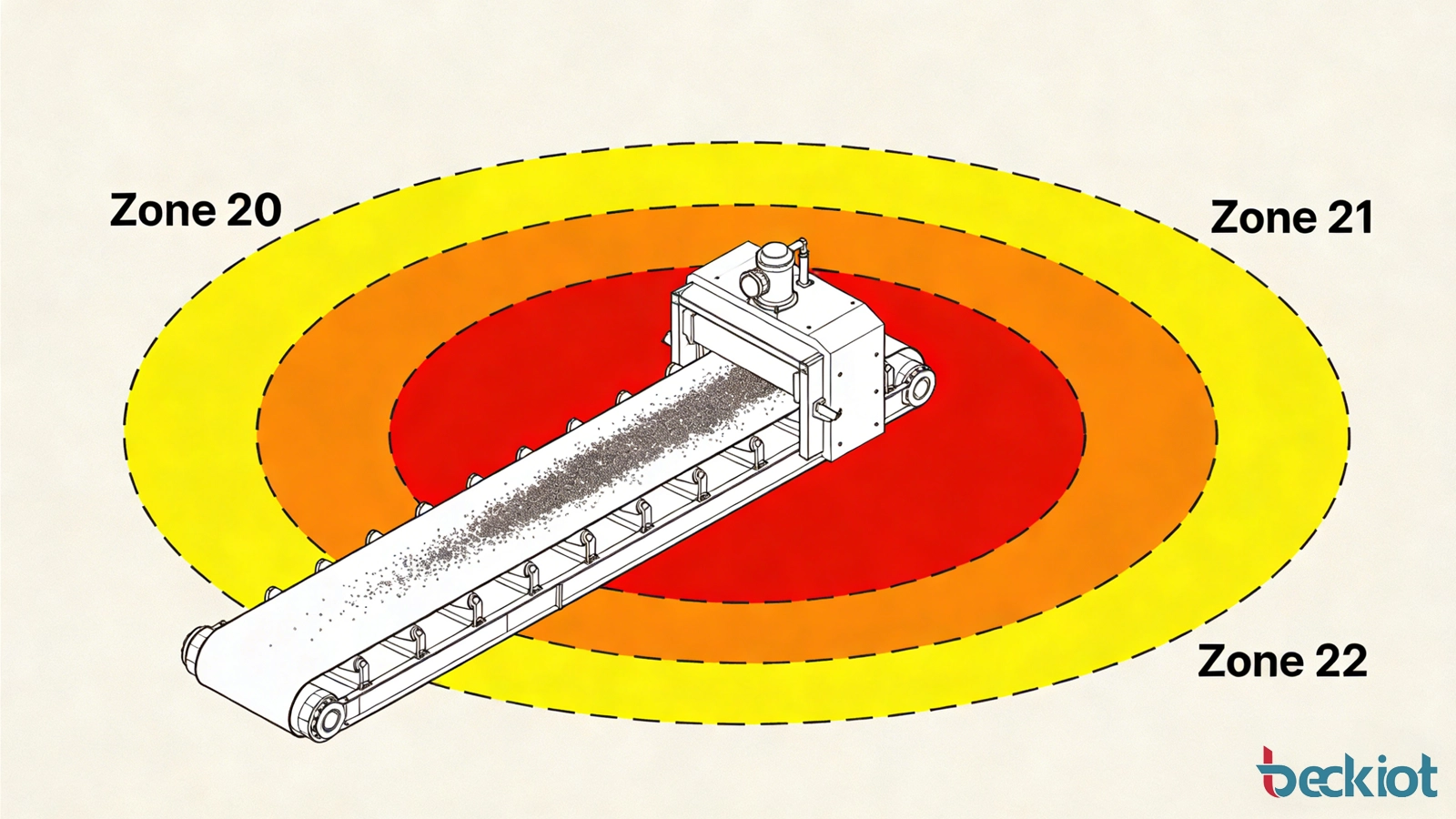
That means Zone 22 often applies to areas outside primary dust release points rather than directly at them. For example, the main discharge point of a powder conveyor may be Zone 21, while the surrounding area further away, where dust is not expected but may appear briefly because of leakage or disturbance, may be Zone 22. In the same way, the interior of a dust collector may be Zone 20, nearby equipment interfaces may be Zone 21, and the outer working area with good extraction and housekeeping may be Zone 22.
Zone 22 therefore plays an important role in practical plant design. It allows engineers to define the lower-risk boundary of a combustible dust hazard while still requiring appropriate protection. It is not a label for “dirty areas” in general. Instead, it is a classification for places where a short-lived explosive dust cloud is possible, even though it is not expected during normal running conditions.
How Zone 22 Differs from Zone 20 and Zone 21
The easiest way to understand Zone 22 is to compare it with the other dust zones. Zone 20 applies where an explosive dust atmosphere is present continuously, for long periods, or frequently. Zone 21 applies where it is likely to occur occasionally in normal operation. Zone 22 applies where it is not likely in normal operation but, if it occurs, it should persist only briefly.
This is why the same facility can contain all three dust zones at the same time. Inside silos, filters, and enclosed process vessels, the risk may justify Zone 20. At filling stations, transfer points, and equipment openings where release is expected during ordinary operation, the risk may justify Zone 21. In surrounding spaces where release is abnormal, limited, or quickly dispersed, classification may fall to Zone 22.
The practical consequence is that equipment requirements often differ from one zone to another. However, the lower likelihood in Zone 22 does not mean protection can be ignored. Dust layers, electrostatic effects, overheated surfaces, poor maintenance, or temporary release conditions can still create a real ignition scenario.
Which Standards Define Zone 22?
The international framework for dust hazardous area classification is built around the IEC 60079 series. IEC 60079-10-2 addresses area classification for explosive dust atmospheres and is the primary reference used to determine whether a location should be classified as Zone 20, Zone 21, or Zone 22. IEC 60079-0 provides the general requirements for Ex equipment, including marking and fundamental construction principles, while IEC 60079-31 addresses equipment dust ignition protection by enclosure “t” for explosive dust atmospheres. For installation design and equipment selection, IEC 60079-14 is a key document, and inspection and maintenance are covered by IEC 60079-17.
In Europe, the ATEX framework is equally important. Directive 1999/92/EC provides the workplace classification definitions for hazardous places and formally defines Zone 22 as a place in which an explosive atmosphere in the form of a cloud of combustible dust in air is not likely to occur in normal operation but, if it does occur, will persist for a short period only. The same directive also notes that layers, deposits, and heaps of combustible dust must be considered as sources that can form an explosive atmosphere. Directive 2014/34/EU addresses equipment and protective systems intended for use in potentially explosive atmospheres and supports the conformity framework for products placed on the EU market.
These standards and directives should not be treated as isolated references. Area classification, equipment certification, installation design, and ongoing inspection all interact. A correct Zone 22 project depends on all of them working together.
How Zone 22 Is Evaluated in Real Facilities
In practice, Zone 22 classification comes from an area classification study rather than guesswork. Engineers review the combustible dust properties, process layout, quantity of material handled, dust release sources, release frequency, release duration, airflow patterns, extraction effectiveness, and housekeeping conditions. They also assess whether dust deposits can accumulate and later become airborne because of vibration, cleaning, mechanical action, or incidental airflow.
Ventilation and containment are especially important in Zone 22 evaluation. A well-enclosed transfer system with effective local extraction may limit the hazardous extent to a smaller surrounding zone. Likewise, a plant with strong housekeeping and dust control may prevent widespread accumulation and reduce the credible size of a hazardous dust cloud. Even so, classification cannot rely on optimism. Engineers must consider realistic operating behavior, not only ideal design intent.
This is one reason Zone 22 is common in peripheral process areas. The release may be infrequent, and the cloud may only last briefly, but if the event can realistically happen and the dust is combustible, a hazardous classification may still be required.
Protection Ratings and Ex Markings for Zone 22
When selecting equipment for Zone 22, the most common mistake is focusing only on whether a product is “dustproof.” Zone 22 selection requires more than a general ingress protection claim. The product must be suitable for a combustible dust explosive atmosphere, which means engineers need to look at the full Ex marking, equipment protection level, dust group, maximum surface temperature, certification basis, and installation conditions.
1. Equipment protection level and ATEX category
Zone 22 commonly aligns with Equipment Protection Level Dc in the IEC approach and is often associated in practice with Category 3D equipment in ATEX applications. Higher-protection equipment may also be used where appropriate, but the key point is that the selected product must be suitable for the actual zone and dust hazard identified in the classification study.
2. Protection by enclosure “t”
For many electrical products in dust atmospheres, the most familiar protection concept is Ex t, with Zone 22 equipment frequently marked Ex tc. This method is addressed by IEC 60079-31 and is based on enclosure integrity together with surface temperature limitation so that combustible dust outside the equipment is not ignited. It is widely used for industrial telephones, loudspeakers, beacons, junction boxes, lighting, control stations, camera housings, and similar products intended for combustible dust locations.
3. Dust groups IIIA, IIIB, and IIIC
Dust atmosphere equipment is also assigned to Group III categories. IIIA refers to combustible flyings, IIIB to non-conductive dust, and IIIC to conductive dust. This distinction matters because conductive dust places greater demands on enclosure design and protection integrity. Equipment certified for Group IIIC is generally suitable for the less demanding IIIA and IIIB dust groups, provided the rest of the marking and temperature limits are appropriate.
4. Maximum surface temperature
For combustible dust hazards, surface temperature control is critical. Zone 22 equipment markings may specify a maximum surface temperature such as T85°C, T100°C, or T120°C. The selected temperature limit must remain below the ignition characteristics of the actual dust present, with engineering margin that considers both airborne dust clouds and dust layers on the enclosure surface.
5. IP rating and enclosure integrity
IP ratings still matter in Zone 22, because enclosure resistance to dust ingress is part of maintaining protection integrity. IEC 60529 defines the IP Code system for enclosure protection against the ingress of solids and water. However, the IP code is only one part of the evaluation. A high IP rating does not automatically prove that equipment is suitable for explosive dust atmospheres. Zone 22 compliance requires the relevant Ex protection concept and certification basis in addition to suitable environmental sealing.
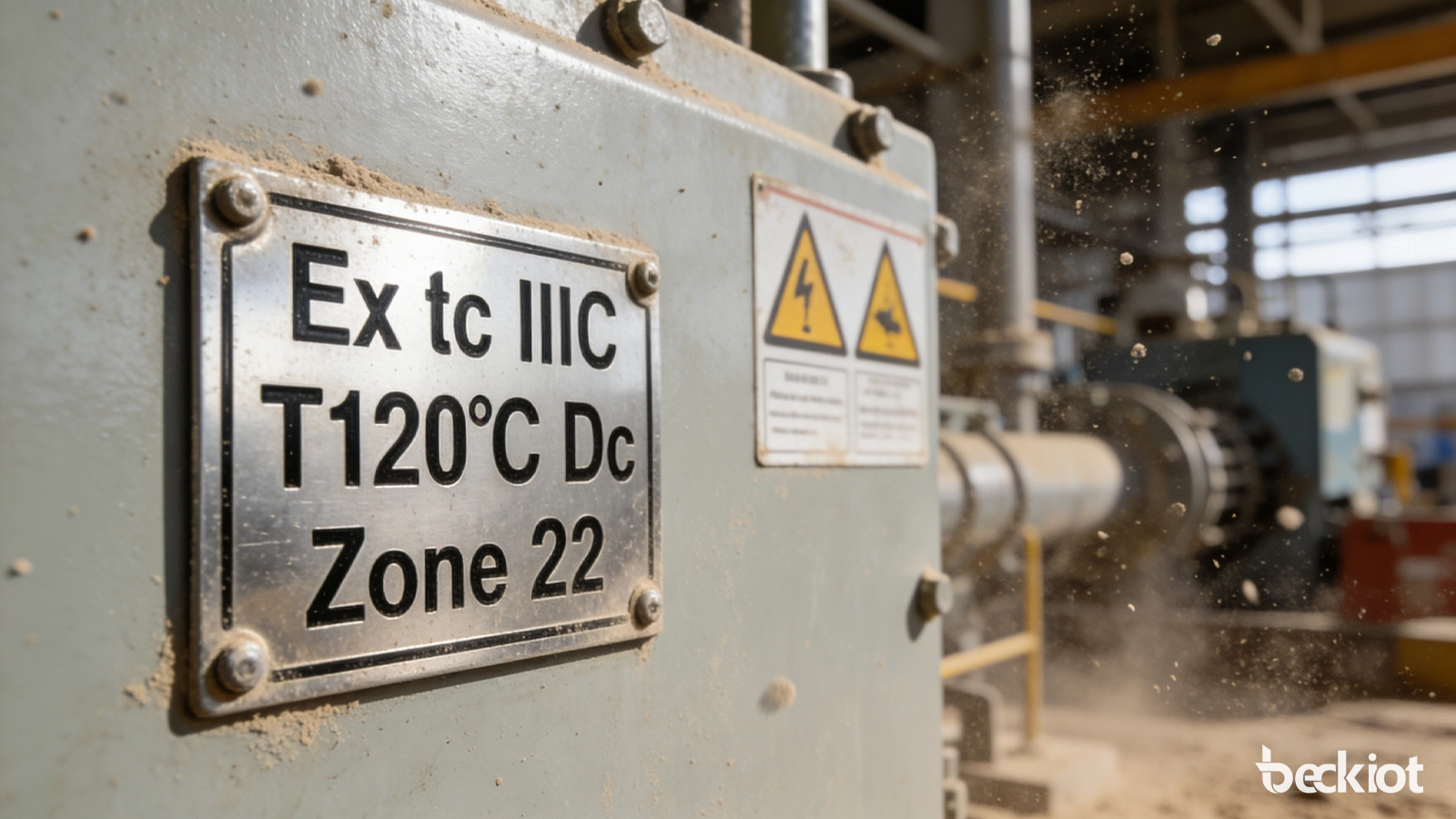
A typical marking for a Zone 22 dust application may appear as:
Ex tc IIIC T120°C Dc
Ex identifies explosion-protected equipment.
tc indicates the enclosure-based dust protection concept for Zone 22 use.
IIIC identifies suitability for conductive dust, the most demanding Group III dust category.
T120°C states the maximum permitted surface temperature.
Dc identifies the equipment protection level commonly associated with Zone 22.
Why IP Rating Does Not Equal Ex Rating
One of the most common purchasing errors is assuming that an IP65 or IP66 product is automatically suitable for Zone 22. This is not correct. The IP code mainly indicates the degree of protection against ingress of solid particles and water under standardized test conditions. It says nothing by itself about ignition control in a combustible dust atmosphere.
Ex protection addresses a different question: whether the equipment can operate without becoming an effective ignition source in a potentially explosive atmosphere. That requires consideration of thermal behavior, enclosure design, material selection, fault tolerance, dust ingress performance, marking, testing, and certification. In other words, IP rating supports environmental protection, while Ex rating addresses explosion safety. A Zone 22 product often needs both, but one does not replace the other.
Typical Applications of Zone 22 Equipment
Zone 22 equipment is widely used in areas surrounding combustible dust processes where the likelihood of a dust cloud is limited but still credible. Typical applications include:
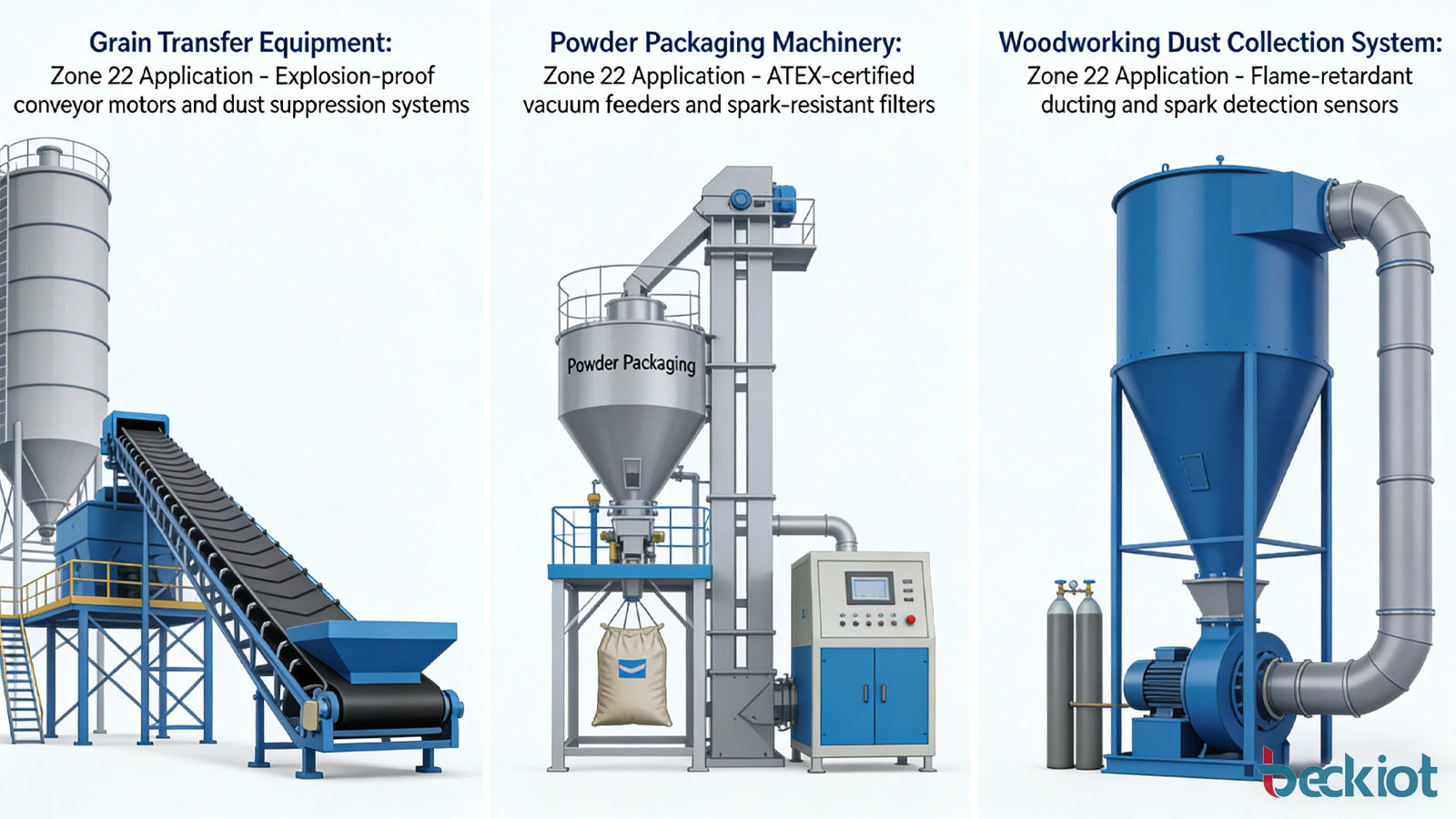
Food and grain plants: peripheral spaces around flour handling, sugar transfer, feed production, cereal dosing, and powder packaging lines.
Woodworking and panel plants: surrounding areas near sanding lines, sawdust conveying equipment, extraction interfaces, and pellet handling systems.
Chemical and pharmaceutical production: external process zones around powder transfer points, mixers, filling equipment, and packaging cells with controlled dust release.
Bulk materials and recycling: peripheral areas near separators, bins, dosing equipment, and enclosed conveyors handling fine combustible solids.
Utilities and plant services: local alarm devices, intercoms, call stations, loudspeakers, and field control products installed near dust-classified process spaces.
In these locations, the product category can include industrial telephones, intercom stations, horn speakers, warning beacons, operator stations, junction boxes, camera enclosures, luminaires, local panels, and cable accessories, as long as they are correctly rated for the classified dust atmosphere.
Common Zone 22 Locations in Plant Layouts
Zone 22 often appears in the outer or surrounding zones of process equipment rather than inside the equipment itself. Examples may include the space around a bagging machine with effective dust extraction, the area near a screw conveyor inspection point, the floor area near a silo discharge interface, or the surrounding corridor outside a generally enclosed powder process line. It can also appear near dust collector outlets, transfer chutes, or access doors that are normally closed but may allow short-duration dust escape.
In many facilities, Zone 22 classification also depends heavily on housekeeping quality. Dust deposits on floors, beams, cable trays, and equipment tops are not only a cleanliness issue. They can become a hazard source if disturbed and dispersed into the air. This is why area classification cannot be separated from maintenance discipline.
Selection and Installation Considerations for Zone 22
Even when the area is only Zone 22, installation quality remains important. The protection concept of certified equipment can be undermined by unsuitable cable glands, missing seals, incorrect entries, damaged enclosures, improper mounting, or unauthorized modifications. Accessories and field wiring should match the product certification and the actual conditions of use. Outdoor or washdown environments may impose additional demands related to corrosion, weather exposure, and water ingress, but those environmental requirements should not compromise explosion protection.
Engineers should also confirm the actual combustible dust properties of the process material. Conductive dust, low ignition temperature dust, or heavy dust layer formation can change the suitability of a product that might otherwise appear acceptable. Nameplate markings and certificates should always be checked against the area classification study rather than selected on appearance or past habit.
Common Mistakes in Zone 22 Projects
Assuming Zone 22 is too low-risk to require hazardous area equipment.
Choosing by IP rating alone without checking Ex marking and certification.
Ignoring dust layers and focusing only on visible airborne dust.
Failing to verify the correct dust group, especially where conductive dust may be present.
Using certified equipment but pairing it with incompatible cable entries or accessories.
Neglecting housekeeping, which can turn settled dust into a secondary hazard source.
Treating area classification as a document exercise instead of an engineering judgment tied to the actual process.
FAQ
Is Zone 22 the same as an ordinary dusty area?
No. A dusty area is not automatically a hazardous area. Zone 22 specifically means a place where an explosive atmosphere in the form of a combustible dust cloud is not likely to occur in normal operation but, if it does occur, will only exist for a short time.
Is Zone 22 less severe than Zone 21?
Yes. Zone 21 applies where an explosive dust cloud is likely to occur occasionally in normal operation. Zone 22 applies where it is not likely in normal operation and, if it occurs, it should persist only briefly.
Can ordinary IP-rated equipment be used in Zone 22?
Not automatically. A high IP rating may help with environmental sealing, but it does not by itself demonstrate suitability for a combustible dust explosive atmosphere. The equipment must have the correct Ex protection concept and certification.
What marking is commonly seen on Zone 22 products?
One common example is Ex tc IIIC T120°C Dc, although the exact marking depends on the protection method, dust group, temperature requirement, and product design.
Can higher-rated equipment be installed in Zone 22?
Yes. Higher-protection equipment may be used where appropriate. In practice, products suitable for more demanding dust zones are often used in Zone 22 when standardization or site requirements support that approach.
Why are dust layers important if Zone 22 is about dust clouds?
Because settled dust can later become airborne and form a cloud, and it can also insulate hot surfaces and affect ignition risk. Dust layers, deposits, and heaps therefore remain important in the assessment of dust hazardous areas.
Conclusion
Zone 22 is the hazardous area classification for places where an explosive atmosphere in the form of a combustible dust cloud is not likely during normal operation, but may occur briefly under credible release conditions. It is governed by recognized frameworks such as IEC 60079 and ATEX and should be evaluated through proper area classification rather than assumption. Correct equipment selection depends on more than a generic dustproof enclosure. Engineers must consider the full Ex marking, dust group, temperature limit, equipment protection level, IP performance, installation quality, and the actual process conditions at the site. When these factors are handled together, Zone 22 protection becomes a clear and manageable engineering task.







