


5G is the fifth generation of mobile network technology. It is designed to deliver higher data capacity, lower latency, stronger mobility performance, and support for many more connected devices than earlier generations. In everyday use, 5G is often associated with faster mobile internet, but in engineering terms it is much more than a speed upgrade. It is a full system architecture that combines a new radio interface, a more flexible core network, and a service model designed for consumer broadband, industrial automation, critical communications, and large-scale machine connectivity.
Compared with 4G LTE, 5G expands what a cellular network can do. It supports enhanced mobile broadband for high-throughput applications, ultra-reliable low-latency communications for time-sensitive services, and massive machine-type communications for dense IoT deployments. This combination is why 5G is discussed not only in telecom but also in manufacturing, transportation, healthcare, utilities, ports, mining, and smart city development. It is both a public mobile network platform and a foundation for private wireless networks in enterprise environments.
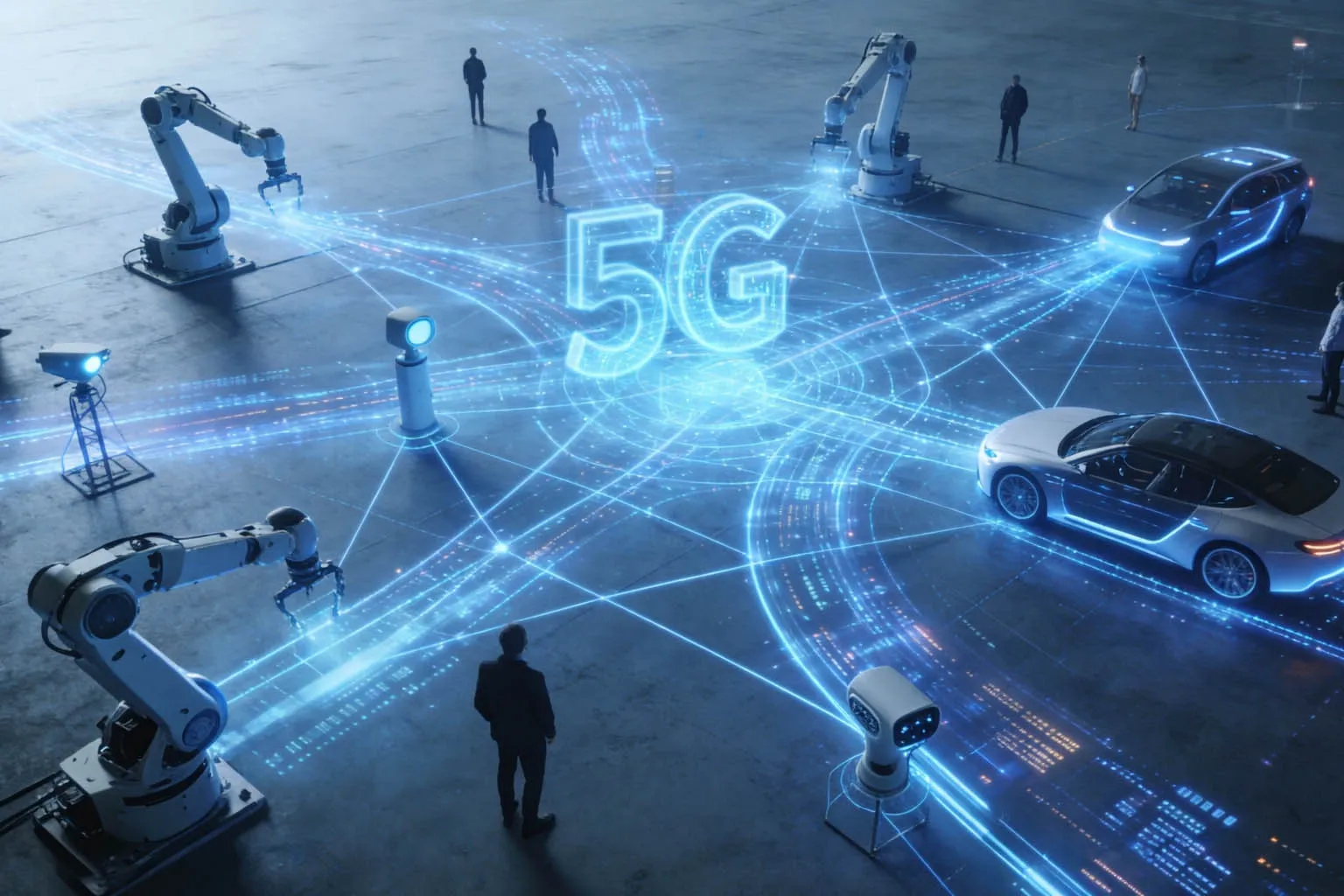
What Is a 5G Network?
A 5G network is the mobile communications system standardized for the fifth generation of cellular technology. In the 3GPP framework, 5G includes the 5G radio interface known as NR, or New Radio, together with the 5G Core, often abbreviated as 5GC. This is important because 5G should not be understood as radio access alone. A true 5G system combines the user device, the radio access network, transport connectivity, and a new core network architecture that manages mobility, sessions, policies, security, and service exposure.
From a standards perspective, 5G was introduced by 3GPP in Release 15 as the first phase of the 5G system, and the platform has continued to evolve through later releases. That evolution has added more capabilities for industrial connectivity, network automation, slicing, edge integration, positioning, security, and sector-specific services. In other words, 5G is not a single fixed product. It is a growing standards-based ecosystem built to support both public mobile operators and enterprise-grade network use cases.
Why 5G matters
Earlier generations were primarily optimized for voice and then mobile broadband. 5G is broader in scope. It is built to support very different performance profiles on the same overall platform. A smartphone user streaming video, a factory robot requiring deterministic wireless behavior, a utility network connecting thousands of sensors, and a logistics platform tracking moving assets can all operate over 5G-oriented infrastructure, provided the network is designed and configured for those service needs.
This broader scope makes 5G strategically important. It is not only about higher peak rates. It is about enabling flexible connectivity models for digital transformation, especially where wired access is costly, mobility is essential, or service requirements vary widely across users and applications.
Core Features of 5G Networks
The main features of 5G are usually explained through three service families: enhanced mobile broadband, ultra-reliable low-latency communications, and massive machine-type communications. These categories do not cover every deployment in a rigid way, but they provide a useful framework for understanding what 5G is designed to achieve.
Enhanced Mobile Broadband (eMBB)
eMBB focuses on high-capacity data services. This includes faster downlink and uplink speeds, better user experience in dense areas, and improved support for data-heavy applications such as ultra-high-definition video, cloud gaming, AR and VR services, remote collaboration, and broadband replacement scenarios. For most consumers, eMBB is the most visible part of 5G because it directly affects mobile internet performance.
In practical deployment terms, eMBB also helps operators serve crowded environments more efficiently. Stadiums, airports, transport hubs, commercial districts, campuses, and city centers all benefit from improved spectrum use, beamforming, wider channels in higher bands, and more advanced radio scheduling.
Ultra-Reliable Low-Latency Communications (URLLC)
URLLC addresses services where delay and reliability matter as much as bandwidth. The target is not just faster browsing but dependable communication for industrial control, machine coordination, remote operation, autonomous systems, and selected mission-critical services. In these scenarios, a network must reduce delay variation, protect service continuity, and support prioritized traffic behavior under demanding conditions.
Not every commercial 5G deployment immediately delivers full URLLC-grade performance. Real-world results depend on spectrum, radio conditions, transport design, core placement, edge computing, and application architecture. Even so, URLLC is one of the defining reasons 5G is attractive for advanced industrial and operational environments.
Massive Machine-Type Communications (mMTC)
mMTC is the service category for very large numbers of connected devices. Typical examples include sensors, meters, trackers, environmental monitors, asset tags, and distributed industrial or municipal IoT nodes. The network objective here is not maximum per-device throughput. It is efficient support for enormous connection density, scalable signaling, wide coverage, and practical energy behavior for battery-powered endpoints.
This capability makes 5G relevant to smart grids, agriculture, pipelines, logistics yards, warehouses, ports, smart buildings, and city infrastructure where thousands or even hundreds of thousands of devices may need secure and manageable wireless access.
Other defining capabilities
Higher peak throughput: 5G is designed for far higher peak data rates than previous generations.
Lower latency: The architecture is built to reduce transport and service delay for sensitive applications.
Massive connection density: 5G supports very large device populations within a limited area.
Flexible service delivery: Different services can be optimized using policy control, QoS handling, and slicing models.
Cloud-oriented architecture: The 5G core is designed around modular network functions and service-based interaction.
Edge integration: Applications can be placed closer to users and machines to improve responsiveness.
How 5G Performance Is Commonly Measured
When people talk about 5G, they often focus only on speed tests. That is too narrow. 5G performance is usually discussed using a wider set of indicators such as peak data rate, user-experienced data rate, latency, reliability, mobility, area traffic capacity, and connection density. These metrics help explain why 5G can support such different applications across consumer, enterprise, and industrial domains.
Under the IMT-2020 framework, target values commonly referenced for 5G include peak downlink rates of 20 Gbit/s, peak uplink rates of 10 Gbit/s, user-plane latency targets of 4 ms for eMBB and 1 ms for URLLC, user-experienced data rates of 100 Mbit/s downlink and 50 Mbit/s uplink, area traffic capacity of 10 Mbit/s per square meter, and connection density of 1 million devices per square kilometer. These are framework-level targets rather than guarantees for every commercial cell or every device in the field.
That distinction matters. Real performance depends on spectrum width, frequency band, terminal capability, cell loading, coverage conditions, backhaul quality, deployment mode, and whether the network is using a 4G-assisted architecture or a full 5G standalone core. A properly designed private 5G network in an industrial site may outperform a crowded public macro cell in consistency, even if the headline speed looks lower.
5G Network Architecture Explained
A 5G network is usually described through three major domains: the user equipment, the radio access network, and the core network. Together, these elements create the end-to-end path for signaling, policy enforcement, authentication, data sessions, and user traffic delivery.
User Equipment (UE)
The UE is the endpoint that connects to the network. This can be a smartphone, tablet, fixed wireless router, vehicle terminal, industrial gateway, camera, robot controller, handheld terminal, sensor concentrator, or other 5G-capable device. The UE contains the radio components and subscriber identity functions needed to register with the network and establish data sessions.
NG-RAN and the gNB
The radio access side of 5G is called NG-RAN, or Next Generation Radio Access Network. Its main node is the gNB, the 5G base station. The gNB provides the NR radio link to the user device and handles radio resource management, scheduling, mobility-related procedures, and connectivity toward the core network. In many deployments, the gNB can be split into a Central Unit and one or more Distributed Units, which helps operators and enterprises design more flexible architectures across sites and transport domains.
The radio interface itself is known as NR, or New Radio. 5G NR supports operation across multiple frequency ranges so networks can balance coverage and capacity. Lower frequencies generally provide wider coverage and better penetration, while higher frequencies provide wider bandwidth and higher data capacity but require denser deployment.
5G Core (5GC)
The 5G Core is one of the biggest architectural changes introduced with 5G. Instead of relying on a more monolithic legacy model, the 5G Core uses a service-based architecture. In this approach, network functions expose services to one another through standardized interfaces, which improves modularity, flexibility, and deployment scalability.
Common 5G Core functions include the AMF for access and mobility management, the SMF for session management, and the UPF for user-plane forwarding. Other important functions may include the UDM for subscriber data handling, the AUSF for authentication support, the PCF for policy control, the NRF for service discovery among network functions, the NSSF for slice selection, and the AF for application-related interaction with the network.
Service-Based Architecture (SBA)
In a service-based 5G Core, network functions do not have to behave like tightly bound legacy nodes. They can interact through common service interfaces, which supports cloud-native implementation models, more dynamic scaling, and better integration with modern orchestration and automation frameworks. This is one reason 5G is often discussed together with virtualization, containerization, and telecom cloud strategies.
For enterprises and operators, the practical value of SBA is that network logic becomes more flexible. Services can be deployed closer to the edge, functions can scale according to load, and different network slices or service policies can be introduced without redesigning the whole platform from scratch.
NSA vs SA: Two Main 5G Deployment Models
5G is commonly deployed in two ways: Non-Standalone and Standalone. Understanding the difference is essential because the user experience and service capability of a 5G network can depend heavily on which model is in use.
Non-Standalone (NSA)
NSA uses 5G NR radio access together with existing LTE and EPC infrastructure. It was widely adopted as an early deployment path because it allowed operators to introduce 5G radio capacity without replacing the entire core network immediately. In this model, the 4G side still anchors key control functions, while 5G contributes additional radio capability and throughput.
NSA is practical for faster rollout, but it does not unlock the full set of 5G-native capabilities in the same way a full 5G Core can. That is why NSA is often seen as a transitional architecture rather than the final target state for advanced 5G services.
Standalone (SA)
SA connects 5G NR directly to the 5G Core. This is the architecture most closely associated with full 5G service capability. It supports the native 5G core framework, broader slicing possibilities, improved policy handling, and stronger support for services that depend on low latency, edge integration, and flexible traffic control.
For industrial private networks, campus networks, and advanced operator services, SA is usually the more strategic model because it provides cleaner end-to-end 5G behavior. In discussions about private 5G, edge computing, deterministic wireless design, and differentiated enterprise services, SA is often the preferred architecture.
5G Frequency Ranges and Coverage Logic
5G works across multiple frequency ranges rather than a single universal band. This multi-band strategy is one of the reasons 5G can support both wide-area coverage and high-capacity hotspot service. Lower bands provide stronger propagation and larger coverage footprints, which are helpful in rural or broad-area environments. Mid-band spectrum is often considered the balance point between coverage and capacity, making it highly valuable for mainstream public 5G deployment. Higher bands can deliver much wider bandwidth and very high throughput, but they require denser site design because radio propagation is more limited.
This is why one 5G network can look very different from another. A nationwide public operator may emphasize low-band and mid-band coverage, while a dense stadium, transport hub, or industrial campus may use additional high-band layers where the business case supports higher local capacity. From a design perspective, 5G is not just a new standard. It is a toolkit for building different coverage and capacity profiles on top of a common architecture.
Advanced 5G Capabilities Beyond Speed
Network slicing
Network slicing is one of the most discussed 5G features. It allows the network to support different logical service environments on shared infrastructure. A slice can be tailored for different requirements such as latency, device profile, security posture, throughput, or service area expectations. This is especially useful when a public operator or enterprise wants to support different business services on the same 5G platform without treating every user and every application identically.
Virtualization and cloud-native functions
Because the 5G Core is based on network functions and service interfaces, it aligns well with network function virtualization and cloud-style deployment models. This helps operators and enterprise providers scale workloads more flexibly, automate service lifecycle management, and introduce new features more efficiently than with older fixed-purpose architectures.
Edge computing integration
5G is often combined with edge computing so application logic can be placed closer to devices and users. This reduces transport delay and can improve response time for industrial control, machine vision, AR assistance, robotics, and local video analytics. In many enterprise cases, the combination of private 5G and edge computing is more important than raw peak speed because it supports more predictable operational performance.
Common Applications of 5G Networks
5G applications are not limited to consumer mobile phones. The technology is increasingly used as a platform for broadband mobility, industrial transformation, and large-scale connected operations.
Mobile broadband and fixed wireless access
For consumers and commercial users, 5G improves smartphone broadband, hotspot performance, and fixed wireless access. In areas where fiber or cable deployment is slow or expensive, 5G can also be used to deliver last-mile broadband alternatives for homes, offices, temporary facilities, and remote sites.
Industrial automation and private 5G
Factories, ports, warehouses, mines, utilities, and energy sites are exploring or deploying private 5G networks for machine connectivity, automated guided vehicles, industrial video, predictive maintenance, worker terminals, environmental monitoring, and wireless control scenarios. The appeal is especially strong where Wi-Fi coverage is not enough, mobility is critical, or deterministic operational behavior matters.
Transport and logistics
5G supports fleet tracking, yard coordination, port automation, connected vehicles, rail communications support, smart intersections, and real-time logistics visibility. In large outdoor sites, the ability to connect moving equipment, cameras, sensors, and handheld terminals over one controlled wireless fabric can improve operational efficiency.
Healthcare and public services
Hospitals, emergency response systems, public safety agencies, and municipal platforms can use 5G for mobile access, connected medical equipment, field video, telepresence support, situational awareness, and integrated IoT services. These use cases depend heavily on network design, security controls, and local service priorities rather than on radio speed alone.
Smart cities and utilities
Smart lighting, metering, environmental sensing, traffic monitoring, infrastructure diagnostics, and grid-related IoT are all potential 5G-enabled service domains. In these scenarios, the key value is often scalable device connectivity and centralized management rather than peak per-device throughput.
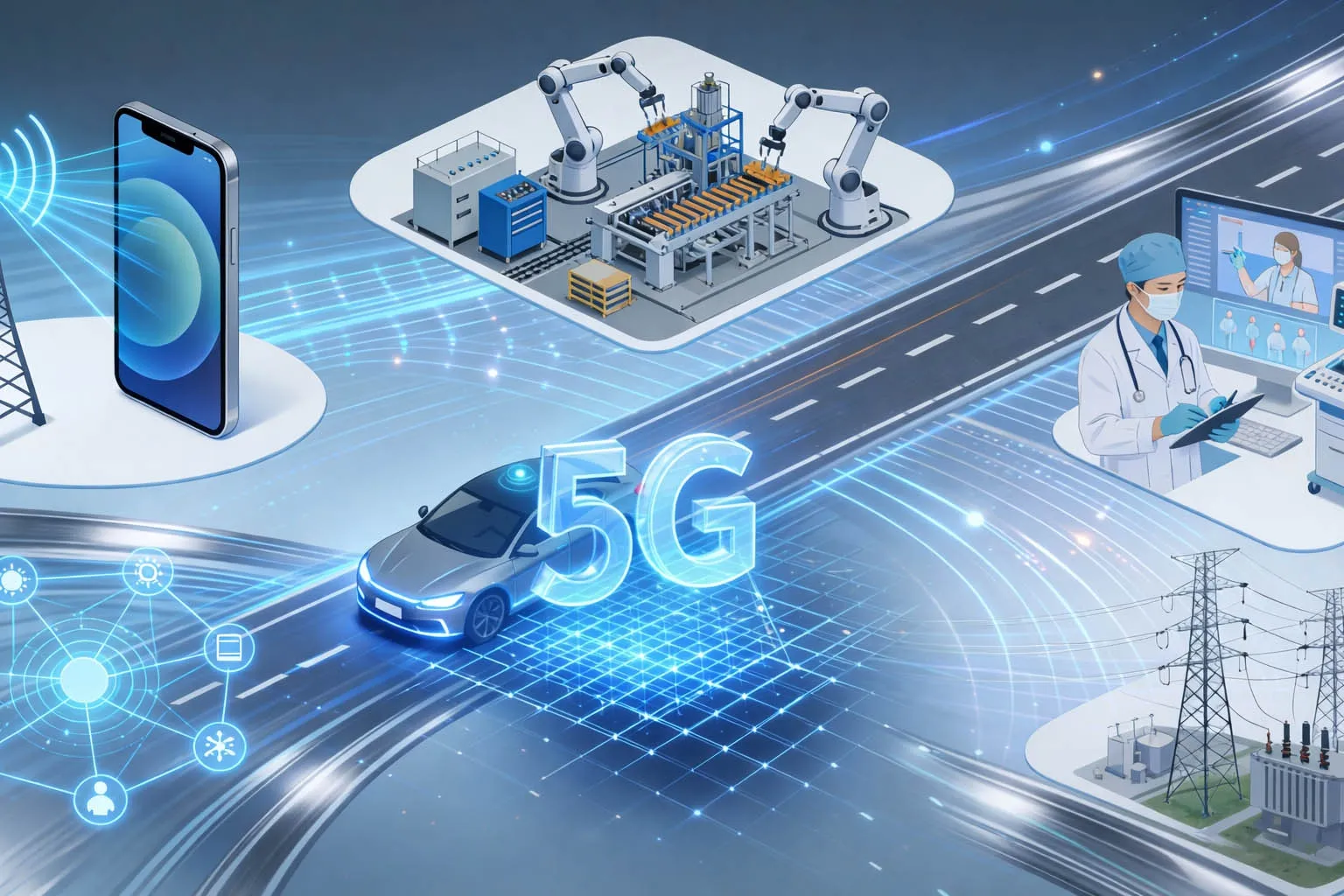
How 5G Differs From 4G
5G is often described as the successor to 4G LTE, but the difference is not only faster data. 4G was primarily optimized around mobile broadband and IP-based packet services. 5G broadens the design goal to include differentiated service types, deeper software modularity, stronger support for cloud deployment, and more native handling of use cases that require very low latency or massive device density.
Another important difference is architectural. A full 5G standalone system uses a 5G Core with service-based functions, whereas many 4G-era systems were built on more static node relationships. This makes 5G better suited to automation, slicing, flexible policy control, and edge-driven application models. In short, 5G is not only a radio evolution. It is a systems evolution.
Common Misunderstandings About 5G
5G is not just faster 4G. It includes a new radio system and a new core architecture designed for broader service types.
Not every 5G icon means full 5G capability. NSA deployments can still rely heavily on 4G core functions.
Higher speed is only one part of the story. Latency, reliability, slicing, policy control, and massive connectivity are equally important.
5G performance is not identical everywhere. Spectrum, coverage design, band choice, core architecture, and network load all affect the result.
Private 5G and public 5G are not the same business model. They may use similar standards, but ownership, control, security, and application priorities can differ significantly.
FAQ
What does 5G stand for?
5G stands for fifth generation mobile network technology. It follows earlier generations such as 4G LTE and is designed to support higher capacity, lower latency, and broader service flexibility.
Is 5G only for smartphones?
No. Smartphones are only one part of the 5G ecosystem. The technology is also used for industrial equipment, routers, vehicles, sensors, cameras, gateways, private enterprise networks, and IoT deployments.
What is the difference between NSA and SA 5G?
NSA combines 5G radio with existing 4G core infrastructure, while SA uses 5G radio together with a 5G Core. SA is generally considered the fuller 5G architecture because it supports more native 5G capabilities.
Does 5G always mean very low latency?
Not automatically. Low latency depends on the end-to-end network design, including spectrum, radio conditions, transport, core placement, edge computing, and application architecture. The standard supports low-latency service models, but real-world performance varies.
Can 5G be used in industrial sites?
Yes. Private and enterprise-oriented 5G is increasingly used in factories, ports, logistics parks, mines, utilities, and energy sites for automation, monitoring, mobile terminals, industrial video, and connected machinery.
Is 5G still evolving?
Yes. 5G continues to evolve through later 3GPP releases. Release 18 is widely recognized as the starting point of 5G-Advanced, which extends the platform with additional enhancements in areas such as automation, performance, service support, and security.
Conclusion
5G is a full mobile network system rather than a simple speed upgrade. It combines New Radio access, a service-based 5G Core, flexible deployment models, and support for broadband, low-latency, and large-scale device connectivity. That is why it has become relevant far beyond the smartphone market.
For consumers, 5G improves mobile broadband and wireless access experience. For enterprises and industrial operators, it opens the door to private wireless networks, edge-aware applications, differentiated service delivery, and more scalable machine connectivity. Understanding 5G therefore means understanding both its radio layer and its architecture. Once those pieces are clear, the technology is easier to evaluate for real business and engineering applications.







