ATEX explosion-proof certification is the European conformity framework used for equipment and protective systems intended for use in potentially explosive atmospheres. In practical industry language, people often say that a product is “ATEX certified” when it has been designed, assessed, marked, and documented for lawful use in hazardous gas, vapor, mist, or combustible dust environments within the European regulatory system. However, ATEX is not a single protection method by itself. It is a legal and technical compliance framework that works together with hazardous area classification rules and harmonized standards for design, testing, installation, inspection, and maintenance.
This distinction matters. A flameproof enclosure, an intrinsically safe circuit, a pressurized cabinet, and a dust-protected enclosure can all fall under ATEX, but they do so through different tpes of protection and different equipment markings. In other words, ATEX does not simply mean “metal box that will not explode.” It covers a broader set of safety concepts for preventing ignition in explosive atmospheres and for matching equipment to the correct risk zone.
ATEX is especially important in industries where flammable gases or combustible dusts may be present. Oil and gas terminals, petrochemical plants, paint and solvent lines, grain and feed facilities, pharmaceutical powder processing, battery material manufacturing, wastewater treatment sites, fuel depots, chemical storage areas, and hydrogen-related installations all rely on hazardous area equipment selection. In these environments, certification is not only a paperwork exercise. It is part of risk control, engineering compliance, operational safety, and legal market access.
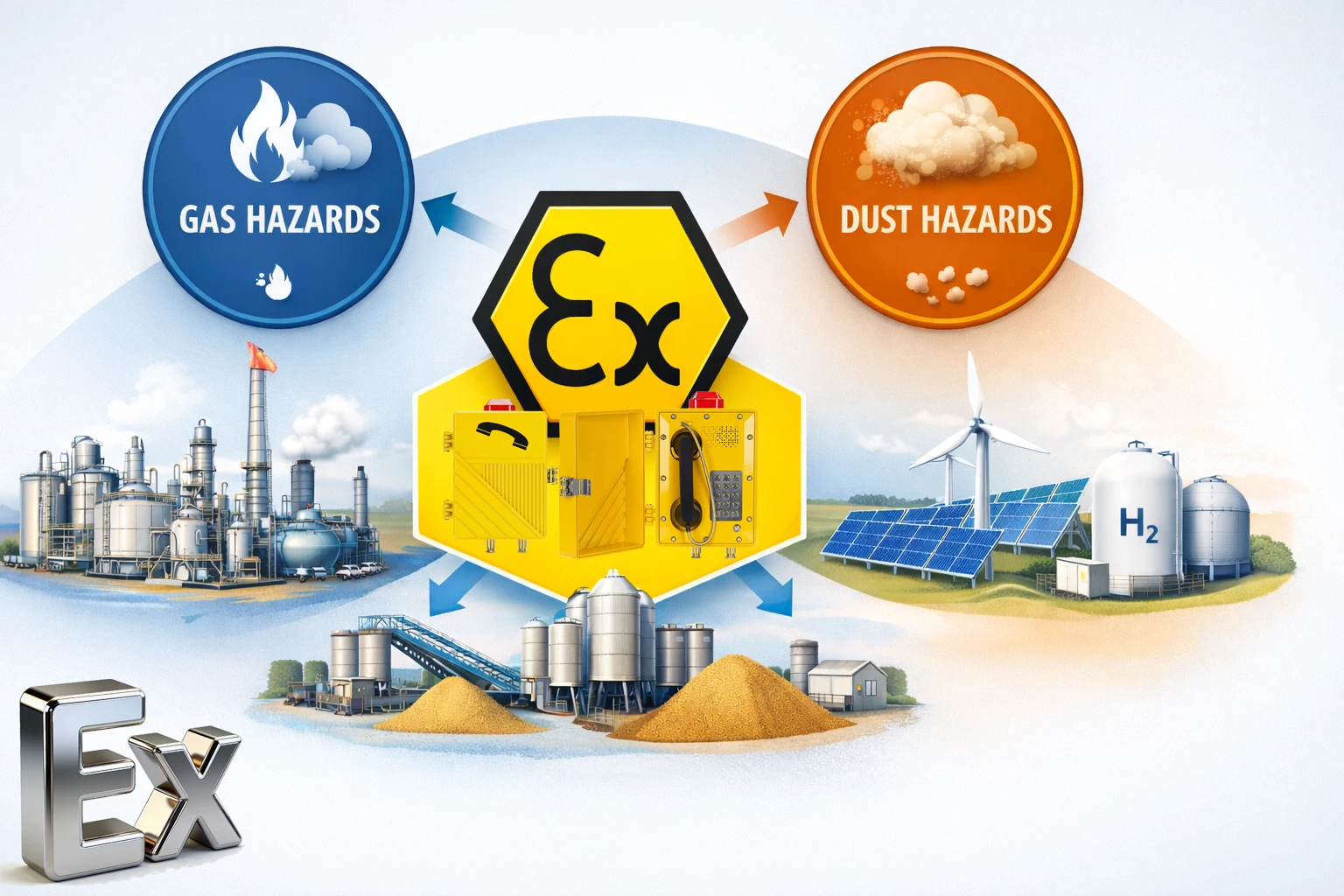
ATEX certification links hazardous area classification, equipment design, marking, conformity assessment, and field use in potentially explosive atmospheres.
What Does ATEX Mean?
ATEX comes from the French expression Atmosphères Explosibles, which refers to explosive atmospheres. In common engineering use, the term covers two related but different European directives. The first is Directive 2014/34/EU, often called the ATEX Equipment Directive, which applies to equipment and protective systems intended for use in potentially explosive atmospheres. The second is Directive 1999/92/EC, often called the ATEX Workplace Directive, which applies to the minimum requirements for improving the safety and health protection of workers potentially at risk from explosive atmospheres.
That means ATEX has both a product side and a workplace side. The equipment directive deals with what can be placed on the market and put into service. The workplace directive deals with how employers classify hazardous places, assess explosion risk, mark dangerous areas, and select suitable equipment for those areas. A complete hazardous area project therefore depends on both sides working together.
When people ask, “Does this product have ATEX certification?” they are usually asking about compliance under 2014/34/EU. But in real plant engineering, certification alone is not enough. The product must also be suitable for the zone classification, gas group or dust group, temperature requirement, ambient conditions, cable entry system, installation practice, and maintenance plan of the actual site.
Is ATEX the Same as Explosion-Proof?
Not exactly. In everyday English, “explosion-proof” is often used as a broad commercial phrase for equipment intended for hazardous areas. But in strict technical language, ATEX covers multiple methods of preventing ignition, and not all of them are the same as the traditional flameproof enclosure concept. For example, a product may comply through intrinsic safety, increased safety, pressurization, encapsulation, protection by enclosure for dust, or other recognized methods, depending on the design and the hazard involved.
This is why it is better to think of ATEX as a compliance umbrella rather than a single enclosure style. A Zone 1 gas phone marked Ex db eb IIC T6 Gb and a Zone 21 dust junction box marked Ex tb IIIC T85°C Db may both be ATEX-compliant, but they are not protected in the same way. They use different design principles and are intended for different hazard scenarios.
So while “ATEX explosion-proof certification” is a common market phrase and can be understood by buyers, engineers should read the exact product marking instead of relying on the phrase alone. The marking is where the real technical meaning is found.
The Two Core ATEX Directives
1. ATEX 2014/34/EU: equipment and protective systems
Directive 2014/34/EU sets the rules for equipment and protective systems intended for use in potentially explosive atmospheres. It covers the essential health and safety requirements, conformity assessment procedures, technical documentation, CE marking, and ATEX-specific marking used to place products on the EU market. It applies to electrical equipment and also to relevant non-electrical equipment and protective systems.
Under this directive, manufacturers must determine the intended use of the product, identify the applicable category and marking, apply the relevant harmonized standards where appropriate, carry out the required conformity assessment route, compile technical documentation, issue the EU declaration of conformity, and affix the required markings. Depending on the equipment category and product type, a notified body may be involved in the assessment process.
2. ATEX 1999/92/EC: workplace risk and area classification
Directive 1999/92/EC focuses on the employer’s side of explosion protection. It requires the assessment of explosion risks, classification of hazardous places into zones, coordination of safety measures, prevention of ignition sources, and use of appropriate equipment in each classified area. It also introduces the familiar area categories such as Zone 0, Zone 1, Zone 2 for gases and Zone 20, Zone 21, Zone 22 for combustible dusts.
This workplace directive is why an ATEX-certified product cannot simply be installed anywhere without engineering judgment. The employer or plant operator must know whether the location is Zone 1, Zone 2, Zone 21, or Zone 22, what substance is present, how often the explosive atmosphere is expected, and whether the selected equipment category matches that area.
How ATEX Relates to IEC and EN Standards
ATEX is a legal framework, but legal compliance in practice depends heavily on technical standards. In Europe, products are commonly designed and assessed against harmonized EN standards that are aligned with the IEC 60079 series and related documents. These standards provide the detailed rules for construction, testing, marking, installation, and maintenance of Ex equipment.
Some of the most important standards in the ATEX ecosystem include:
EN IEC 60079-0 for general requirements for Ex equipment and components.
EN IEC 60079-1 for flameproof enclosures “d”.
EN IEC 60079-7 for increased safety “e”.
EN IEC 60079-11 for intrinsic safety “i”.
EN IEC 60079-14 for design, selection, and installation of electrical equipment in explosive atmospheres.
EN IEC 60079-17 for inspection and maintenance of electrical installations in hazardous areas.
EN IEC 60079-31 for protection by enclosure “t” in explosive dust atmospheres.
EN ISO 80079-36 and EN ISO 80079-37 for non-electrical Ex equipment.
IEC 60529 for enclosure ingress protection, often used together with Ex requirements when dust or water ingress is a practical design concern.
Using these standards does not eliminate the need to understand the directive. Instead, it provides a structured technical route to demonstrate conformity. Manufacturers, system integrators, inspectors, and end users should all treat the standards as working tools rather than as abstract references.
Equipment Groups and Categories Under ATEX
One of the most important parts of ATEX certification is the equipment classification system. The directive distinguishes equipment groups and categories so that products can be matched to the severity of the hazardous area.
Equipment groups
Group I equipment is intended for mines susceptible to firedamp. Group II equipment is intended for places with explosive atmospheres other than mines. Group III equipment is intended for explosive dust atmospheres other than mines. In many industrial communication, instrumentation, lighting, junction box, and control applications, Group II and Group III are the categories most often encountered.
Equipment categories
ATEX equipment categories indicate the required level of protection for the intended hazard area:
Category 1G / 1D: very high level of protection for areas where explosive atmospheres are present continuously, for long periods, or frequently.
Category 2G / 2D: high level of protection for areas where explosive atmospheres are likely to occur occasionally.
Category 3G / 3D: normal level of protection for areas where explosive atmospheres are unlikely in normal operation, or if they occur, exist only infrequently and for a short time.
In practical terms, this usually corresponds as follows:
Zone 0 → Category 1G
Zone 1 → Category 2G or 1G depending on the design approach
Zone 2 → Category 3G, 2G, or 1G as appropriate
Zone 20 → Category 1D
Zone 21 → Category 2D or 1D
Zone 22 → Category 3D, 2D, or 1D as appropriate
Higher-category equipment can often be used in lower-risk zones, but the reverse is not acceptable. A Category 3G device may be suitable for Zone 2, but it should not be selected for Zone 1.
Equipment Protection Levels and Their Role
Modern Ex engineering also uses the concept of Equipment Protection Level, or EPL. EPL is widely used in IEC-based documentation and helps relate the protection integrity of equipment to the zone in which it may be installed. Common EPL markings include Ga, Gb, and Gc for gases, and Da, Db, and Dc for dusts.
In simple terms:
Ga corresponds to the highest protection for gas atmospheres and is typically used for Zone 0.
Gb is typically used for Zone 1.
Gc is typically used for Zone 2.
Da is typically used for Zone 20.
Db is typically used for Zone 21.
Dc is typically used for Zone 22.
ATEX category language and EPL language are related but not identical. Many product datasheets and nameplates show both systems through the detailed marking. Engineers should be comfortable reading both.
How to Read ATEX and Ex Markings
A complete hazardous area marking carries much more information than a simple ATEX logo. Consider a typical gas-area marking such as:
II 2G Ex db eb IIC T6 Gb
Each part has meaning:
II = Equipment Group II, for places other than mines.
2G = Category 2 for gas atmospheres, suitable for areas like Zone 1.
Ex = The equipment is built according to recognized explosion protection principles.
db eb = The types of protection applied, such as flameproof enclosure and increased safety.
IIC = Gas group, covering the more severe gas subgroup range.
T6 = Temperature class, indicating the maximum surface temperature limit.
Gb = Equipment Protection Level for gas, typically associated with Zone 1.
A dust-area example could look like:
II 2D Ex tb IIIC T85°C Db
Here, the marking shows Group II/III-type industrial use, Category 2D for dust, protection by enclosure tb, the dust group IIIC, a maximum surface temperature of 85°C, and EPL Db for dust.
The ability to read these markings is essential for procurement and engineering. A device may look physically rugged, but if the gas group, temperature class, dust group, EPL, or ambient range is wrong, it can still be unsuitable for the application.
Common Protection Types Used in ATEX Equipment
ATEX-certified products use one or more recognized methods of protection depending on the intended zone, function, and product architecture. Some of the most common types are listed below.
Ex d: flameproof enclosure
Flameproof enclosure allows an internal explosion to occur within a specially designed housing while preventing flame propagation to the surrounding atmosphere. This is one of the most widely recognized forms of hazardous area protection, especially for robust field devices, operator stations, and industrial communication equipment in gas zones.
Ex e: increased safety
Increased safety reduces the likelihood of arcs, sparks, or excessive temperatures by using design measures that improve safety margins. It is commonly used for terminal boxes, motors, and connection systems in appropriate gas-area applications.
Ex i: intrinsic safety
Intrinsic safety limits the electrical and thermal energy available in the circuit so that ignition cannot occur under specified fault conditions. This method is common for instrumentation loops, sensors, transmitters, handheld devices, and systems where low-energy design is feasible and desirable.
Ex p: pressurization
Pressurization keeps a protective gas within an enclosure at a pressure high enough to prevent entry of the external explosive atmosphere. This is often used for larger panels, analyzers, cabinets, and control systems.
Ex m: encapsulation
Encapsulation protects ignition-capable components by embedding them within a compound so that the explosive atmosphere cannot interact with the source of ignition under intended conditions.
Ex t: protection by enclosure for dust
For combustible dust atmospheres, protection by enclosure is especially important. The enclosure is designed to prevent dust ingress to a controlled degree and to limit surface temperature so that deposited or airborne dust is not ignited.
Real products may combine multiple types of protection in one design. That is why the full marking must be read as a system rather than as a single letter code.
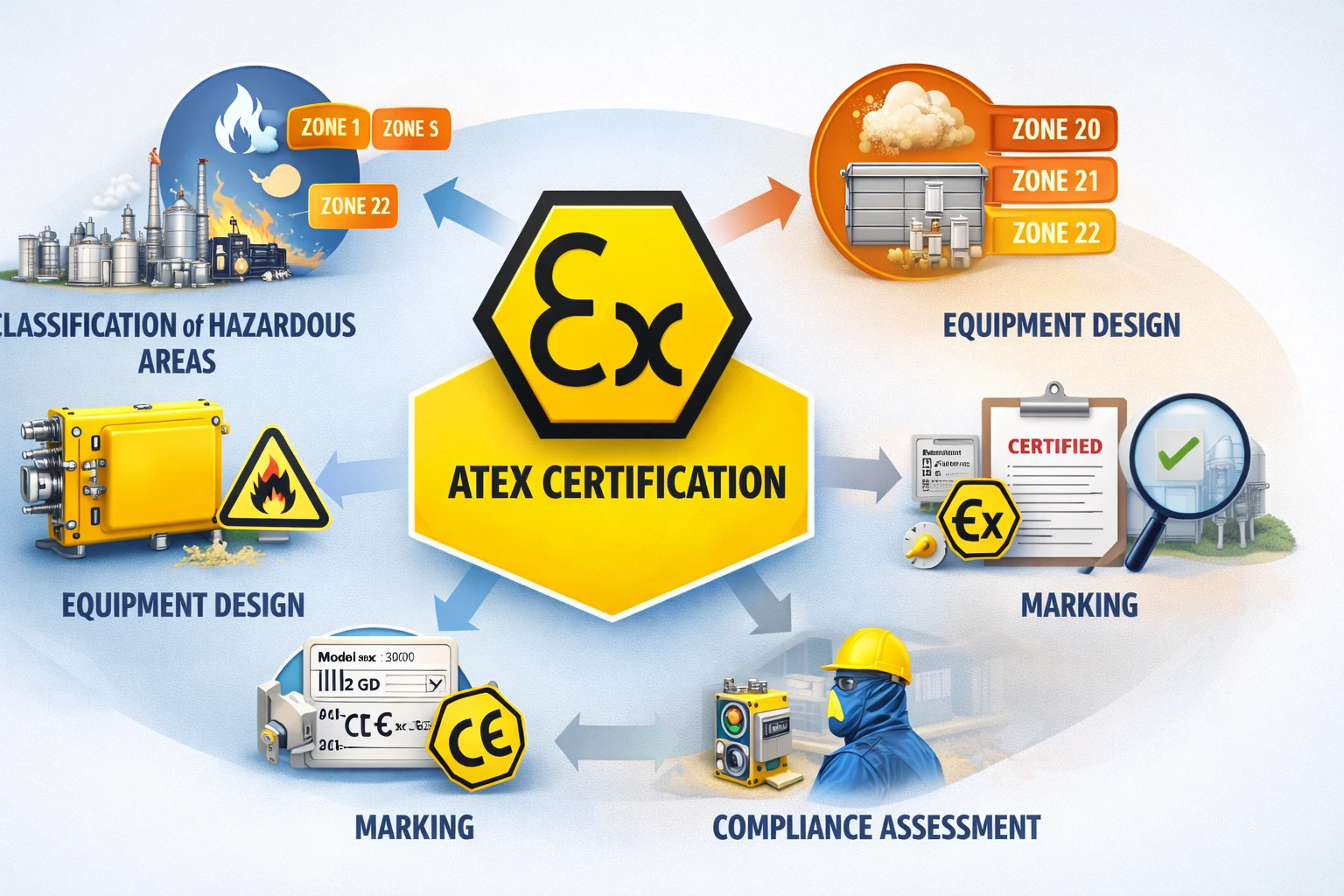
ATEX-certified equipment is used across both gas-hazard and dust-hazard industries, from petrochemicals to bulk solids processing and emerging energy sectors.
Temperature Classes, Surface Temperature, and Gas/Dust Groups
Protection ratings in hazardous areas are not limited to zone suitability. The ignition characteristics of the substance present must also be considered. For gas atmospheres, the product marking may include a gas group such as IIA, IIB, or IIC, along with a temperature class such as T1 through T6. The higher the T-number, the lower the maximum permitted equipment surface temperature.
For dust atmospheres, the marking often uses dust groups such as IIIA, IIIB, and IIIC, together with an explicit maximum surface temperature like T85°C or T120°C. Dust selection also requires attention to deposited layers, because a hot surface that is safe in clean air may still ignite a dust layer under unfavorable conditions.
This is one reason why engineers should avoid oversimplified statements such as “ATEX means it can go anywhere hazardous.” A Zone 1 product for IIA gases and a mild temperature class is not automatically suitable for all Zone 1 applications. Gas group and ignition temperature still matter.
What Role Does IP Rating Play?
Ingress Protection, or IP rating, is often discussed alongside ATEX, especially for outdoor devices and dust-area products. IP rating describes how well an enclosure resists solid particle ingress and water ingress under the IEC 60529 system. Typical examples include IP66, IP67, and IP68.
IP rating is important, but it is not a substitute for ATEX suitability. A high IP rating by itself does not make a product hazardous-area compliant. However, in many real applications, IP performance supports the overall safety and durability of the equipment by helping prevent dust accumulation inside the enclosure, limiting water ingress, and protecting the product against environmental contamination.
For dust-certified products in particular, enclosure integrity becomes a practical and safety-critical issue. Engineers therefore often review both the Ex marking and the IP rating together, especially in harsh industrial environments such as offshore decks, washdown food plants, mining transfer points, fertilizer handling, and chemical outdoor pipe racks.
How ATEX Certification Is Typically Obtained
The exact conformity route depends on the product category, protection concept, and directive requirements, but a typical ATEX certification process often includes the following steps:
Define intended use by specifying the target zone, gas or dust type, temperature limitations, and installation environment.
Choose the protection concept such as Ex d, Ex e, Ex i, Ex p, Ex m, or Ex t based on the product function and risk profile.
Design to the applicable standards and prepare drawings, bills of materials, thermal analysis, ignition hazard assessment, and test plans.
Perform testing and assessment through the required conformity route, including notified body involvement where applicable.
Compile technical documentation and quality records.
Issue the EU declaration of conformity and affix the required CE and ATEX markings.
Provide instructions for safe use covering installation, cable entry, maintenance limits, ambient conditions, and any special conditions of use.
From a buyer’s perspective, certification should never be checked only by asking for a logo on a brochure. The user should verify the complete product marking, certificate details, documentation, and match to the site classification.
Typical Applications of ATEX-Certified Equipment
ATEX-certified equipment is used anywhere explosive atmospheres may arise because of flammable gas, vapor, mist, or combustible dust. The exact product types vary widely, but the application logic is consistent: equipment must not become an effective ignition source under the conditions for which it is certified.
Oil and gas
Drilling areas, production modules, storage terminals, compressor stations, loading systems, and refinery process units frequently require ATEX-certified communication devices, lighting, instrumentation, motors, junction boxes, control stations, sensors, analyzers, and network enclosures.
Chemical and petrochemical plants
Solvents, vapors, mists, and process gases create hazardous gas areas around reactors, tank farms, transfer pumps, blending systems, and packaging lines. ATEX-certified field devices and control equipment are commonly required.
Pharmaceutical and specialty powder production
Many powders used in pharmaceutical manufacturing, additives, and intermediates can create combustible dust hazards. Equipment in filling, transfer, sieving, drying, and blending zones may require dust-certified designs.
Grain, feed, sugar, and food processing
Combustible organic dusts are a major hazard in silos, conveyors, mills, bucket elevators, filters, mixers, and packaging systems. ATEX-certified motors, sensors, communication stations, and dust-area enclosures help reduce ignition risk.
Paint, coating, and solvent handling
Spray booths, mixing rooms, solvent storage, and transfer lines often involve hazardous gas or vapor zones where suitable Ex equipment is essential.
Energy transition sectors
Hydrogen handling, biogas upgrading, battery materials processing, and advanced chemical energy chains are increasingly relevant applications. These sectors often combine demanding process safety requirements with modern digital control and communication needs, making correct hazardous-area certification even more important.
How to Select ATEX Equipment Correctly
Good ATEX equipment selection is not based on rugged appearance or marketing language. It starts with the hazardous area study and then checks the actual marking, installation conditions, and documentation against the site requirements.
At a minimum, the selection process should answer these questions:
What is the classified zone: 0, 1, 2, 20, 21, or 22?
Is the hazard gas, vapor, mist, or combustible dust?
What gas group or dust group applies?
What ignition temperature or maximum permissible surface temperature must be respected?
What ambient temperature range applies at the actual site?
Will the equipment be exposed to corrosion, washdown, UV, salt spray, vibration, or mechanical impact?
Do cable glands, stopping plugs, mounting accessories, and conduit systems also need matching certification?
Are there special conditions of use listed on the certificate or instructions?
These questions are what separate a truly suitable ATEX installation from a superficially compliant purchase. The equipment nameplate, certificate, installation guide, and area classification dossier should all be reviewed together.
Common Misunderstandings About ATEX
“ATEX is only for electrical products”
No. ATEX can also apply to relevant non-electrical equipment and protective systems. Mechanical ignition sources must be considered where applicable.
“If it has a CE mark, it is automatically ATEX”
No. CE marking alone does not prove suitability for explosive atmospheres. The product must specifically comply with the ATEX directive and carry the correct Ex and category markings.
“High IP means hazardous-area compliant”
No. IP rating supports enclosure performance, but it does not replace Ex certification or correct zone matching.
“Any ATEX-certified device can be used in any hazardous zone”
No. Zone, category, EPL, gas group, dust group, and temperature limitations all still apply.
“ATEX and IECEx are identical”
They are related but not identical. IECEx is an international certification system based on IEC standards, while ATEX is the EU legal conformity framework. Many manufacturers design products so that both systems align technically, but the regulatory pathways are different.
FAQ
What is ATEX certification in simple terms?
ATEX certification is the European conformity framework for equipment intended for use in potentially explosive atmospheres. It helps show that a product has been assessed and marked for hazardous gas or dust environments under the relevant EU rules.
What is the difference between ATEX 2014/34/EU and 1999/92/EC?
2014/34/EU applies to equipment and protective systems placed on the market. 1999/92/EC applies to workplaces, risk assessment, zone classification, and the protection of workers in explosive atmospheres.
Does ATEX mean the same as IECEx?
No. IECEx is an international certification system based on IEC standards, while ATEX is a European legal framework. They often use closely related technical standards, but the regulatory schemes are not the same.
Is a flameproof enclosure the same as ATEX?
No. Flameproof enclosure is one type of protection, usually marked Ex d. ATEX is the broader framework that can include many protection concepts such as Ex d, Ex e, Ex i, Ex p, Ex m, and Ex t.
Why does temperature class matter in ATEX equipment?
Because hazardous substances can ignite if the equipment surface becomes too hot. The temperature class or maximum surface temperature helps ensure that the product remains below the ignition threshold of the gas or dust environment.
Can I use ordinary industrial equipment in Zone 2 or Zone 22 if the risk is low?
Low frequency of occurrence does not eliminate the hazardous classification. Equipment used in classified areas still needs to match the relevant zone requirements and installation rules.
Conclusion
ATEX explosion-proof certification is best understood as a complete European hazardous-area compliance framework rather than a single product feature. It brings together legal requirements, zone classification logic, technical standards, product marking, conformity assessment, and field selection rules. For engineers and buyers, the key task is not simply to ask whether a product is “ATEX.” It is to confirm that the exact equipment category, EPL, gas or dust group, temperature rating, IP performance, installation method, and documentation fit the actual hazardous location.
When handled correctly, ATEX-certified equipment supports safer operation across gas and dust hazard industries, from petrochemical facilities and tank farms to grain plants, powder processing lines, and advanced energy infrastructure. The certification only delivers value when it is matched to the right zone and used according to its technical and regulatory limits.