


The RJ11 connector is one of the most familiar interfaces in traditional voice communication systems. It is widely associated with telephones, fax machines, DSL equipment, and other low-bandwidth communication devices that rely on analog or narrowband signal transmission. Although newer IP-based systems now dominate many modern networks, RJ11 still remains relevant in telephony, building infrastructure, industrial voice interfaces, and legacy communication upgrades.
In practical terms, RJ11 is valued because it is simple, compact, low cost, and easy to deploy. It has been used for decades in residential, commercial, and institutional environments where reliable line-level voice connectivity is needed. Even in modern projects, installers, system integrators, and facility managers still encounter RJ11 ports when working with analog phones, PSTN lines, gateways, PBX extensions, alarm dialers, and some intercom devices.
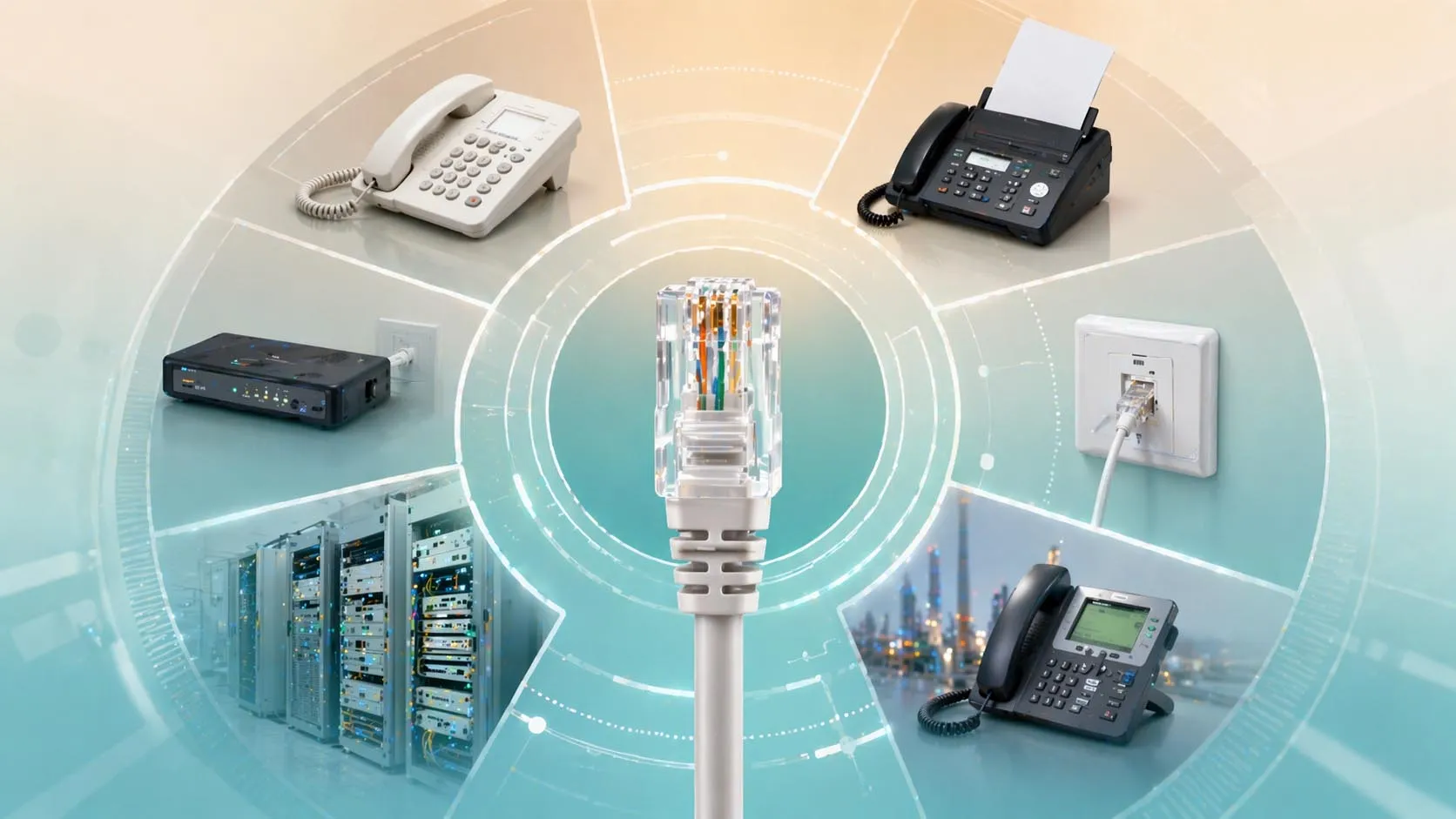
RJ11 connectors are commonly used for analog telephone lines and related communication interfaces.
What Is an RJ11 Connector?
An RJ11 connector is a small modular connector commonly used for telephone wiring. It is typically designed to carry one telephone line, using a compact plug and jack format that is easy to insert, remove, and terminate. In many everyday situations, RJ11 is the connector people associate with landline telephones and wall telephone sockets.
The term “RJ” comes from “Registered Jack,” a standardized interface format historically used in telecommunications. RJ11 refers to a specific modular connection style used for voice-grade circuits. While people often use the term loosely, RJ11 usually describes a 6-position connector body with a smaller number of actual metal contacts installed inside it, most commonly for one analog line.
Because it is physically smaller than network connectors such as RJ45, RJ11 is well suited to voice terminals and compact communication devices. It is designed for simple connection rather than high-speed data transport, which is why it continues to appear in traditional telephony rather than Ethernet networking.
RJ11 is best understood as a compact modular connector built primarily for analog telephone line connections, not for modern Ethernet data networking.
Basic Structure of an RJ11 Connector
Compact modular design
An RJ11 connector usually uses a 6-position body. In practice, this means the plastic connector can accommodate up to six positions, but not all positions must be populated with metal contacts. The most common telephone version uses the center pair, which is enough for a single voice line.
This modular design made installation faster and more standardized across homes, offices, hotels, schools, and communication rooms. Instead of hardwiring every telephone directly, technicians could use plug-and-play patching methods for endpoints and line interfaces.
Common contact arrangement
In standard single-line telephone applications, the center two contacts are the most important. These carry the primary analog voice line. Some related modular variants use additional contacts for extra lines or auxiliary functions, but basic RJ11 use is centered on the middle pair.
That simple arrangement is one reason RJ11 remained popular for so long. It supports the core requirement of voice communication without the complexity of larger connector formats intended for data or multi-pair structured cabling.
Locking tab and easy installation
Like other modular plugs, RJ11 uses a plastic locking tab that clicks into the matching jack. This creates a secure mechanical connection while still allowing easy replacement. For installers and maintenance teams, that means failed handsets, cords, or line jumpers can often be swapped quickly without major rewiring.
This convenience is especially useful in environments with many voice endpoints, such as front desks, guest rooms, security desks, dispatch points, medical stations, and legacy PBX deployments.
Main Features of RJ11 Connector
Small size and simple interface
One of the most obvious features of RJ11 is its compact form factor. It takes up very little space on a device, which is why it has long been used on telephones, modems, dialers, and wall outlets. For equipment manufacturers, this helps keep terminal layouts clean and practical.
The simplicity of the interface also reduces confusion in voice-only installations. A technician can quickly identify the port type and understand that it is intended for a telephone line rather than an Ethernet uplink.
Suitable for analog voice circuits
RJ11 is optimized for traditional telephony and other low-frequency signaling applications. It is commonly used for analog voice communication, ring signal delivery, and line-level telephone functions. In many systems, it connects end devices to the public switched telephone network, PBX analog extensions, or voice gateways.
That makes RJ11 especially common wherever analog endpoints still need to coexist with newer infrastructure. For example, a VoIP gateway may present FXS or FXO interfaces through RJ11 ports so legacy phones or line trunks can be integrated into an IP-based communication platform.
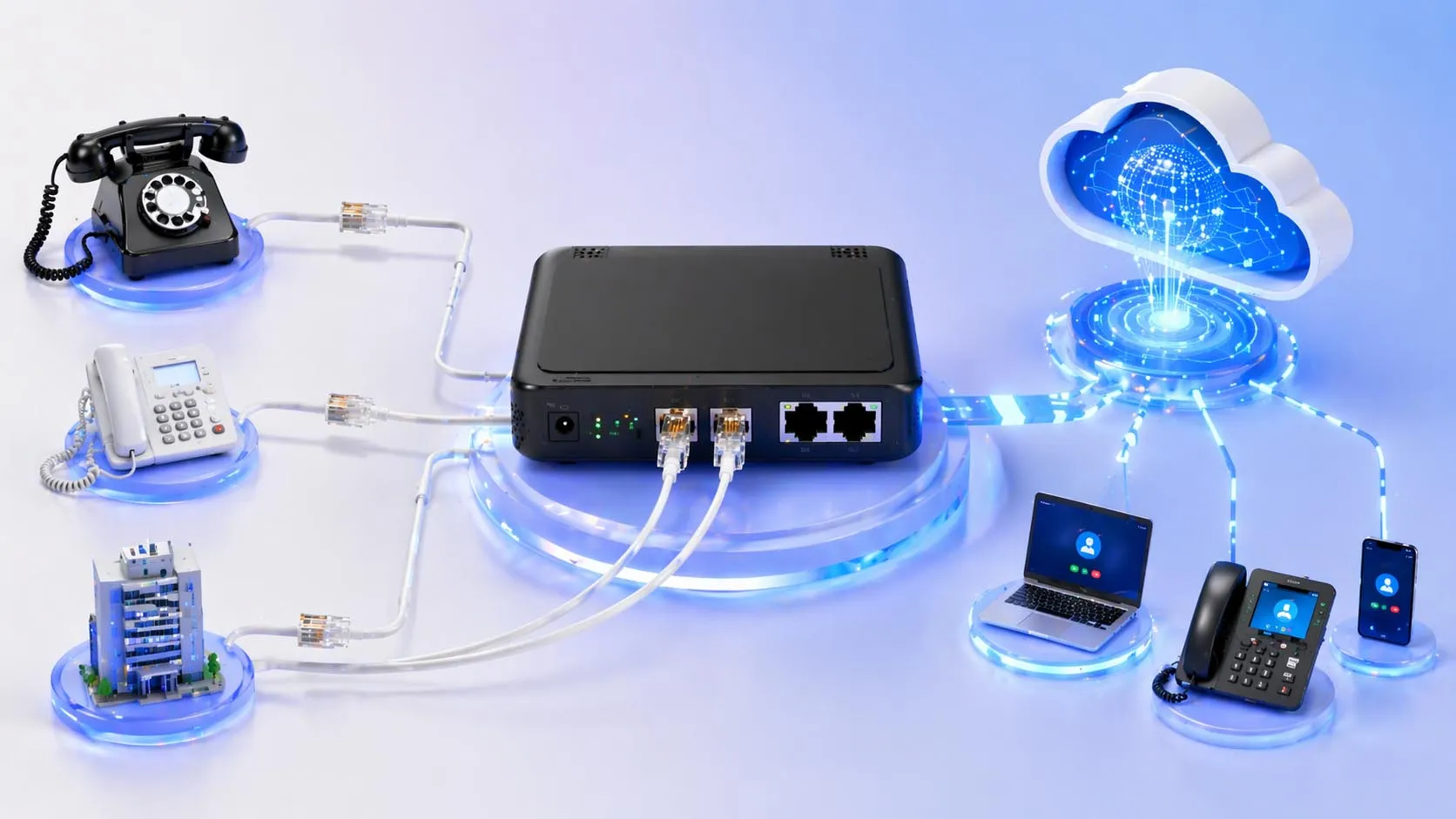
RJ11 remains widely used where analog voice devices must connect reliably and simply.
Low cost and broad availability
RJ11 connectors, cords, and termination tools are inexpensive and widely available in global markets. This makes them practical for large-scale replacement, routine maintenance, and legacy expansion. In projects where analog lines are still required, RJ11 helps keep material and service costs manageable.
Because the format has been used for many years, it is also easy to source compatible cables, handsets, splitters, couplers, wall jacks, and interface accessories.
Fast field replacement
Another practical feature is easy servicing. If a telephone cord is damaged or an endpoint is moved, maintenance teams can often replace or reroute the RJ11 connection within minutes. This supports quick recovery in service desks, public counters, dormitories, and facility offices where voice communication is still operationally important.
In mixed old-and-new environments, this ease of handling makes RJ11 a useful bridge between legacy wiring habits and current communication upgrades.
How RJ11 Wiring Is Commonly Used
Single-line telephone connection
The most common use of RJ11 is a single analog telephone line. In this arrangement, the center pair carries the active line. This is enough for standard voice calls and remains the classic deployment for desk phones, wall phones, and many simple voice terminals.
Because the wiring requirement is minimal, this arrangement is straightforward to terminate and troubleshoot. If line voltage, tone, or ringing is present on the center pair, the endpoint can usually operate without additional complexity.
Support for related modular variants
In real-world usage, people sometimes refer broadly to several similar telephone-style modular connectors as RJ11, even when the exact contact count differs. That is one reason the term can occasionally cause confusion. However, in most equipment discussions, “RJ11 port” still clearly signals a telephone-style analog interface rather than a data network port.
When reviewing specifications, it is always helpful to verify the exact number of contacts and the intended signal type, especially when dealing with gateways, PBX equipment, access devices, or alarm communication hardware.
Not intended for Ethernet networking
Although RJ11 and RJ45 may appear visually similar to non-specialists, they are designed for different purposes. RJ11 is typically used for telephone lines, while RJ45 is the standard modular connector format associated with Ethernet networking. Plugging the wrong cable into the wrong interface can cause installation errors or equipment mismatch.
In communication projects, clear labeling is important, especially where analog telephony, IP telephony, access control, alarm systems, and structured cabling exist side by side.
RJ11 vs RJ45: What Is the Difference?
RJ11 and RJ45 are both modular connectors, but they belong to different application categories. RJ11 is primarily linked to telephony and analog circuits, while RJ45 is associated with Ethernet data networking. The difference is not only functional but also physical, because RJ45 is wider and supports more conductors.
For technicians and buyers, understanding this distinction helps prevent confusion during procurement, equipment installation, and cable planning. A communication system may contain both RJ11 and RJ45 interfaces, but each serves a different role in the overall topology.
| Item | RJ11 | RJ45 |
|---|---|---|
| Main use | Telephone and analog voice line connection | Ethernet data networking |
| Typical application | Phones, modems, fax, analog gateway ports | Switches, routers, IP phones, PCs, cameras |
| Physical size | Smaller modular connector | Larger modular connector |
| Common function | Low-bandwidth voice and line signaling | Packet-based network data transmission |
| Typical environment | Legacy telephony or analog interfaces | Modern LAN and IP infrastructure |
RJ11 is associated with analog voice connectivity, while RJ45 is associated with IP data networking. They may look related, but they are not interchangeable in system design.
Common Applications of RJ11 Connector
Landline telephones and desk phones
The most classic application of RJ11 is the telephone handset or line cord used with landline phones. Homes, offices, hotel rooms, reception desks, and public service counters have long depended on RJ11-based telephone wiring for daily communication.
Even in locations that are moving toward all-IP infrastructure, analog telephones may still remain in use for backup lines, security stations, elevator emergency phones, or dedicated utility circuits.
PBX and analog extension systems
Many PBX systems and analog extension frameworks use RJ11 interfaces to connect telephone sets or line distribution points. In legacy business environments, these interfaces remain common in branch offices, service buildings, dormitories, warehouses, and administrative facilities.
During communication upgrades, RJ11 often continues to play a role because analog phones and existing cabling may still be operational and cost-effective. In that case, adapters, gateways, or hybrid PBX systems help extend system life without a full immediate replacement.
VoIP gateways and telephony conversion
In many modern integration scenarios, RJ11 appears on FXS and FXO ports of voice gateways. These ports allow analog devices or PSTN lines to connect into an IP-based communication environment. This is especially useful when an organization wants to preserve legacy phones, analog trunks, or specialty devices while introducing SIP or IP PBX platforms.
For example, analog phones in older rooms or operational areas may connect through RJ11 to an FXS gateway, while the gateway itself links to the IP network through Ethernet. This approach provides a practical migration path instead of forcing immediate endpoint replacement everywhere.

RJ11 often appears on analog gateway interfaces that connect legacy telephony to modern IP systems.
Fax machines, dial-up devices, and DSL equipment
RJ11 has also been widely used with fax machines, dial-up modems, DSL splitters, and related telecom devices. Although some of these applications are now less common than before, they still exist in many institutions, administrative offices, service counters, and infrastructure systems.
In some regions and industries, these devices remain part of operational workflows, compliance processes, or backup communication procedures, which is why RJ11 support still matters.
Alarm panels, emergency phones, and specialty terminals
Certain alarm panels, elevator telephones, building communication points, and specialty reporting devices also use RJ11 interfaces. In these environments, the focus is not high-speed networking but stable, direct line access for simple voice or signaling functions.
This is one reason RJ11 remains relevant in facility management and industrial retrofits. Even when the main backbone becomes IP-based, some critical edge devices continue to depend on analog interfaces for compatibility or regulatory reasons.
Advantages of Using RJ11
Easy to understand and deploy
RJ11 is familiar to installers and users alike. The connector format is intuitive, the wiring concept is straightforward, and the hardware ecosystem is mature. That reduces the learning curve for maintenance personnel and helps simplify field deployment.
In smaller facilities or voice-only circuits, this simplicity can be a real operational advantage.
Useful for legacy system continuity
Many organizations cannot replace every analog device at once. RJ11 helps preserve continuity for installed telephones, fax lines, alarm dialers, and analog control interfaces. This can reduce upgrade pressure and allow communication modernization to proceed in stages.
For system designers, that staged transition is often more practical than a full and immediate infrastructure replacement.
Reliable for narrow-purpose line connections
When the requirement is basic telephone connectivity, RJ11 remains an effective and proven option. It is not trying to serve every communication need. Its strength lies in doing a narrow task well: providing a simple physical interface for analog voice and related telecom circuits.
That focus is one reason it has remained in service for so many years across such a wide range of environments.
Limitations of RJ11
Not suitable for high-speed network data
RJ11 should not be treated as a substitute for Ethernet connectivity. It is not designed for the structured data transmission requirements of modern LAN environments. Devices such as IP phones, computers, wireless access points, and cameras generally rely on RJ45-based network connections, not RJ11 line interfaces.
Using the correct connector type is essential for both performance and system compatibility.
Limited role in all-IP environments
As communication systems continue to migrate toward SIP, VoIP, and unified IP platforms, the role of RJ11 becomes more specialized. It is still useful, but often at the edge of the system rather than at the core. Its presence is strongest in hybrid deployments, legacy retention, and analog-specific interfaces.
That means RJ11 is no longer the universal communication connector it once was, but it still has meaningful value where analog line support remains necessary.
Conclusion
The RJ11 connector is a compact modular interface primarily used for telephone and analog communication lines. Its long history, simple structure, low cost, and broad compatibility have made it a standard component in telephony for decades. Even as modern communication shifts toward IP networks, RJ11 remains important in desk phones, PBX extensions, fax lines, gateways, emergency phones, and many hybrid system designs.
For anyone working with voice infrastructure, building retrofits, analog devices, or gateway integration, understanding RJ11 is still useful. It helps distinguish telephony interfaces from Ethernet ports, supports smoother installation planning, and makes it easier to connect legacy equipment into modern communication environments.
In short, RJ11 is a small connector with a very specific role: dependable analog line connectivity where simple, practical, and proven telephone interfaces are still needed.
FAQ
Is RJ11 the same as a telephone connector?
In everyday usage, yes. RJ11 is the connector most people mean when they refer to a traditional telephone plug or telephone line connector.
Can RJ11 be used for Ethernet?
No. RJ11 is generally intended for telephone and analog line applications, while Ethernet networking uses RJ45-style connectors and structured network cabling.
What devices commonly use RJ11?
Common examples include landline telephones, fax machines, modems, PBX analog extensions, DSL equipment, alarm dialers, and FXS or FXO gateway ports.
What is the main advantage of RJ11?
Its main advantage is simplicity. RJ11 is compact, easy to install, inexpensive, and well suited to analog voice line connections.
Is RJ11 still used today?
Yes. While it is less central in fully IP-based environments, RJ11 is still widely used in legacy telephony, analog interfaces, hybrid communication systems, and specialty voice devices.
How is RJ11 different from RJ45?
RJ11 is mainly for analog telephone lines, while RJ45 is mainly for Ethernet networking. RJ45 is larger and supports data networking applications that RJ11 is not designed for.







