A GOIP gateway is a device that bridges a mobile network and an IP voice network. In practical terms, it lets a business use SIM-based mobile channels as telephony resources inside a SIP environment such as an IP PBX, softswitch, contact center platform, or VoIP service. Instead of treating the mobile network and the VoIP network as two separate worlds, the gateway sits between them and translates signaling, routing logic, and media handling so calls can move in both directions.
Related Products:GW2000-VF-16-Channel Gateway
In industry usage, the term GOIP is commonly used to describe a GSM or LTE VoIP gateway. Some vendors use it as a product family name, while others use terms such as GSM VoIP gateway, LTE VoIP gateway, or mobile-to-SIP gateway. The core idea is the same: connect mobile voice and messaging services to an IP-based communications platform.
That makes the device useful in a wide range of situations. A company might use it to place outbound calls over mobile SIMs, receive calls from mobile numbers into a PBX, provide a fallback route when fixed lines fail, extend communications to locations without reliable landline access, or build SMS-enabled workflows for alerts and verification. The category is easy to misunderstand because it looks simple from the outside, but in practice a good GOIP gateway is not just a converter. It is a routing and interconnection tool that affects call cost, continuity, user experience, and deployment flexibility.
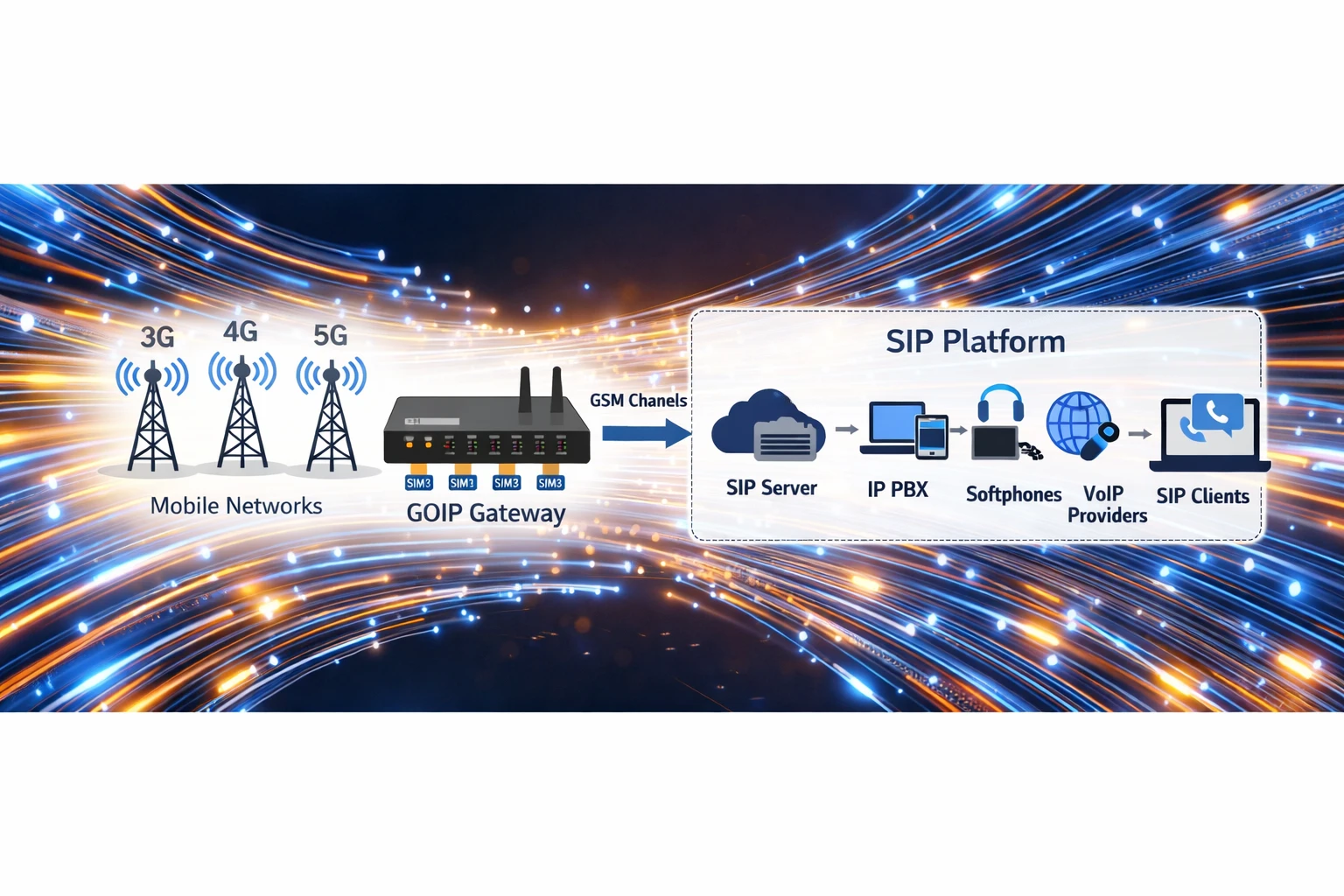
A GOIP gateway sits between a SIP platform and one or more mobile network channels, allowing two-way voice interconnection and, in many models, SMS handling.
What Is a GOIP Gateway?
A GOIP gateway is best understood as a mobile-network voice gateway for SIP systems. On one side, it works with SIM cards and cellular modules that access GSM, WCDMA, or LTE voice services, depending on the model and the operator network. On the other side, it behaves like a SIP endpoint or SIP trunk that can register to an IP PBX or communicate with a softswitch in peer mode. Once both sides are configured, the gateway can route traffic between them.
In small deployments, a GOIP gateway may be used simply to add one or several mobile trunks to a business phone system. In larger deployments, it can become part of a broader routing design that includes multiple SIMs, channel groups, outbound rules, caller ID logic, and even messaging applications. That is why the same class of equipment appears in very different environments: small offices, temporary sites, branch offices, distributed operations, telecom integration projects, and specialized vertical use cases that need mobile network access inside a VoIP workflow.
It also helps to separate a GOIP gateway from neighboring product categories. It is not an FXS gateway for analog phones. It is not an FXO gateway for PSTN line ports. It is not the PBX itself. And it is not merely a SIM bank or SIM management box, although some higher-density solutions may work alongside remote SIM systems. Its main role is to make mobile voice resources available to IP communications platforms in a controlled, routable way.
How Does a GOIP Gateway Work?
At a high level, a GOIP gateway handles two jobs at the same time: network interconnection and call control. It interacts with the mobile network through built-in radio modules and SIM cards, and it interacts with the VoIP side through SIP signaling over an IP connection. When a call is made or received, the gateway decides which side is the source, sets up the signaling relationship, and then carries the media stream between the two environments.
From Mobile Network to VoIP
When a call comes in through a SIM channel, the gateway detects the incoming mobile call and matches it against its routing rules. It can then send the call to a SIP account, a SIP trunk, a PBX extension range, or a trunk group. In a business deployment, this often means an incoming mobile-network call is delivered to the PBX so an internal user, ring group, IVR, or call queue can answer it.
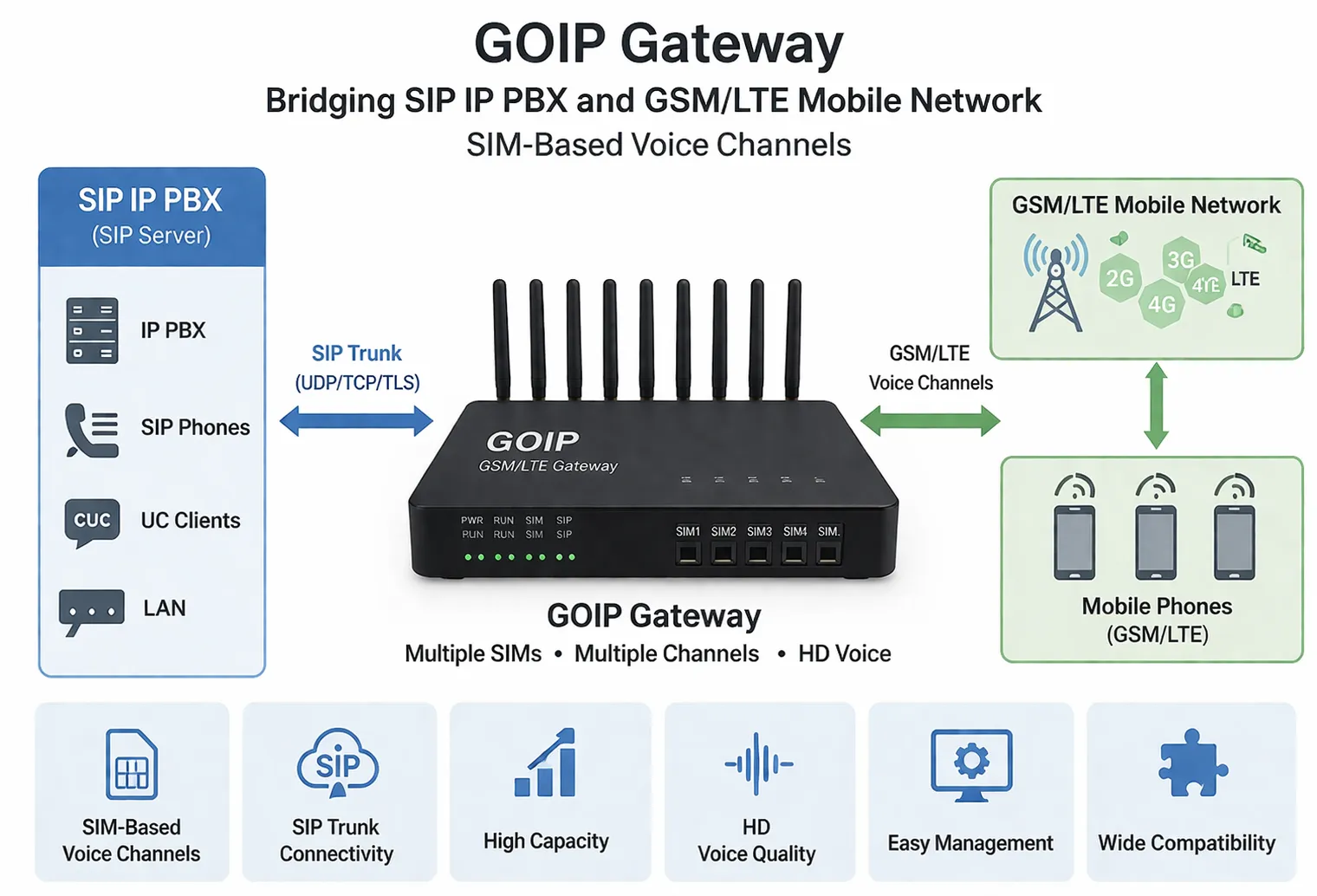
This direction is often described as Mobile-to-IP or GSM-to-VoIP. It is useful when a company wants mobile numbers to behave like part of the main phone system rather than as standalone handsets.
From VoIP to Mobile Network
When a user on the PBX places a call, the PBX can choose the GOIP gateway as the outbound path. The gateway receives the SIP call, selects an available SIM channel, and dials the destination over the mobile network. This is the IP-to-Mobile or VoIP-to-GSM direction. It is commonly used when organizations want to reach mobile users through local SIM-based routes, maintain service in sites where fixed trunks are unavailable, or add a backup call path outside the fixed telecom infrastructure.
The quality of this process depends on more than registration status. Correct SIP trunk settings, codec negotiation, numbering rules, DTMF handling, NAT behavior, caller ID expectations, and mobile network conditions all matter. A gateway can be technically online and still produce poor user experience if routing and interworking details are not tuned properly.
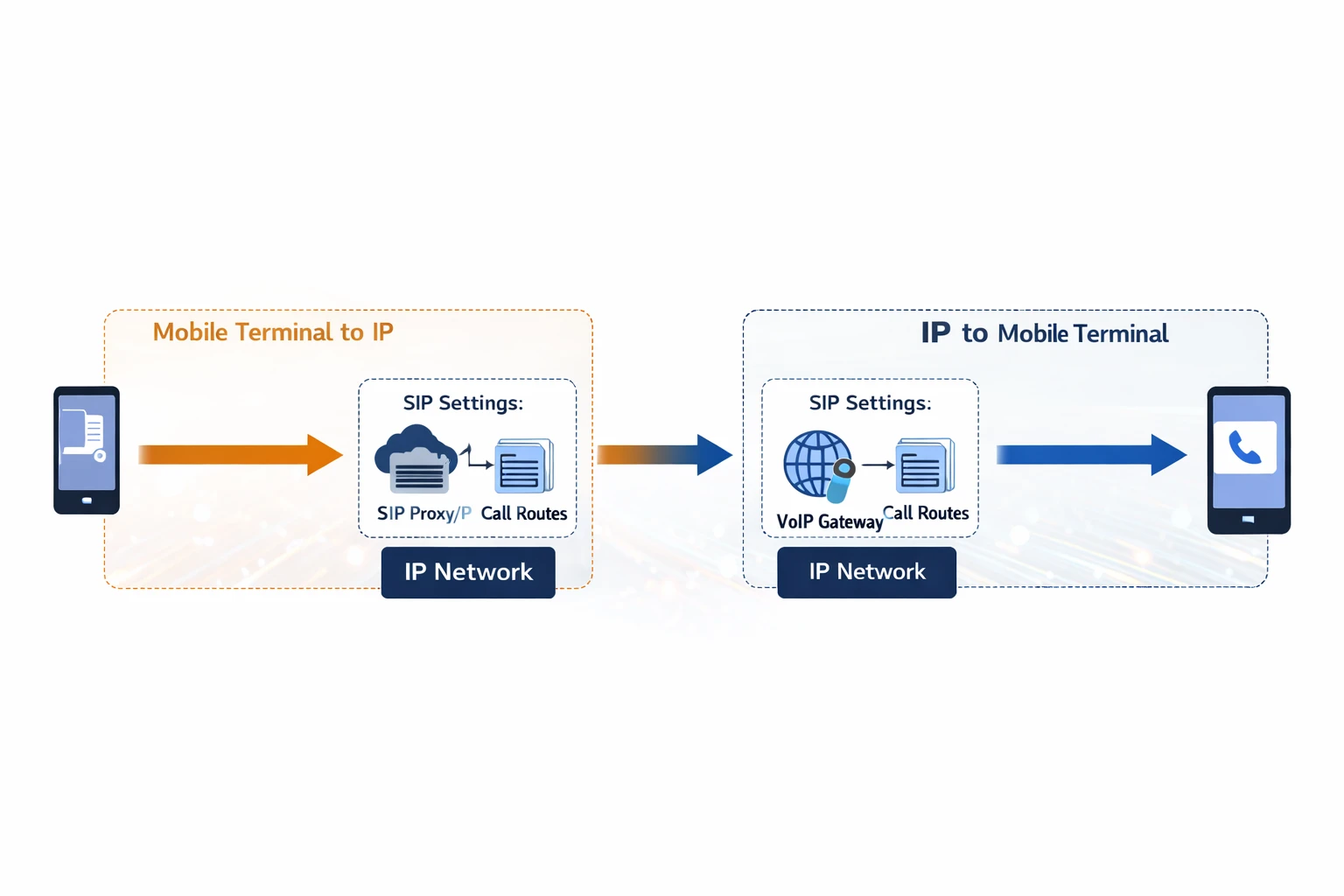
The two core traffic directions are Mobile-to-IP and IP-to-Mobile, both of which are controlled by SIP settings, route logic, and channel availability.
Media, Signaling, and Session Handling
Most modern deployments use SIP on the IP side. SIP handles session setup, modification, and release, while RTP carries the actual voice media. On the mobile side, the gateway works with the operator's voice service through the radio module and SIM profile supported by the hardware. Some devices also support different registration modes, peer trunk modes, separate SIP ports per channel, or grouped SIP behavior depending on the system design.
In practical engineering terms, this means the gateway is not just passing audio blindly. It is participating in session control, codec choice, route selection, and, in some models, security or keepalive settings such as NAT handling and SRTP support. The result is a device that behaves more like a specialized telecom edge gateway than a simple adapter.
Key Features of a GOIP Gateway
The exact feature set depends on the vendor and model, but several capabilities appear again and again across serious GOIP platforms.
1. SIP Integration with IP PBX and Softswitch Platforms
A GOIP gateway is typically deployed as a SIP-connected device. It may register as an account, connect as a trunk, or interwork in peer mode with an IP PBX or SIP server. This flexibility matters because not every PBX is designed the same way. Some environments prefer extension-style registration, while others use trunk-based routing or static peer relationships.
For installers, this is one of the most important strengths of the category. A gateway that offers flexible SIP interconnection can fit more cleanly into existing numbering plans, inbound and outbound routing rules, failover logic, and multi-site deployments.
2. Multi-Channel Mobile Access
Unlike a single mobile handset, a GOIP gateway can expose multiple concurrent mobile channels to the VoIP system. Depending on the model, that could mean one channel for a very small site or many channels for more demanding traffic. This makes the device suitable for branch office calling, local mobile breakout, project sites, and service continuity planning.
Higher-density models are not just about call volume. They also allow better traffic segmentation, route assignment by business unit, and channel reservation for specific services.
3. SMS and USSD Support
One of the most valuable differences between a GOIP gateway and a simpler voice-only interconnect is messaging support. Many platforms can send and receive SMS, process inbox and outbox events, work with USSD, and even connect messaging workflows to external applications. In practice, this opens the door to alerting, service notifications, verification processes, and operator account management tasks such as balance checks, depending on the market and carrier behavior.
This is why GOIP equipment is often used in projects that need more than voice. Once messaging is added, the gateway becomes part of an operational workflow rather than just a telephony bridge.
4. Routing Control
Good GOIP gateways offer route logic in both directions. Administrators can decide which mobile channels can deliver calls into which SIP destinations, which VoIP sources are allowed to use which mobile trunks, and what number rules should be applied. Some systems also support blocklists, digit manipulation, trunk groups, channel limits, and per-route policies.
This routing control is where much of the business value comes from. Two devices with similar hardware can produce very different outcomes depending on how much control the administrator has over policy and traffic handling.
5. Codec and Interworking Options
VoIP interoperability often depends on codec choices and signaling details. Many GOIP gateways support common voice codecs such as G.711, and some models or platforms add options such as G.729 or other profiles through licensing or model-specific support. The right choice depends on bandwidth conditions, PBX compatibility, and desired voice quality.
This is also the point where deployment discipline matters. If the gateway, PBX, and remote trunk provider do not agree cleanly on codec behavior, DTMF transport, caller ID presentation, or keepalive settings, the system may register but still behave poorly in real traffic.
6. Security and Remote Management
In modern IP communications, security cannot be treated as a bonus feature. Depending on the model, a GOIP gateway may support items such as SRTP, authentication controls, web management, logging, and remote diagnostics. Some platforms also expose APIs or command-line tools for integration and troubleshooting.
For enterprise use, these administrative capabilities are important because the gateway often sits at the edge between two very different networks. If it cannot be monitored and maintained properly, it becomes a blind spot in the voice infrastructure.
What Makes a GOIP Gateway Useful in Real Deployments?
From a buyer's point of view, the appeal of a GOIP gateway is not just that it connects two networks. Its real value is that it makes mobile access manageable inside a VoIP architecture. That can improve resilience, simplify user operations, and create more flexible call routing options than a collection of standalone mobile phones ever could.
For example, a business can keep using its PBX features such as IVR, ring groups, recording policies, and extension dialing while still reaching the outside world through mobile channels. A remote site can remain operational even when fixed telecom lines are limited. A temporary project location can be brought online quickly without waiting for traditional trunks. An organization with specific SMS workflows can centralize those workflows instead of scattering them across unrelated devices.
In short, a GOIP gateway is useful when mobile connectivity needs to become part of a structured communications system rather than stay trapped inside individual handsets.
Typical Applications of GOIP Gateways
IP PBX Mobile Trunking
This is the most common use case. The gateway adds SIM-based mobile trunks to an IP PBX so the PBX can send and receive calls through the mobile network. It is often used where fixed trunks are unavailable, expensive, slow to provision, or needed only as one part of a mixed routing design.
Backup Calling for Business Continuity
Many organizations want a second outbound path in case their primary voice route fails. A GOIP gateway can provide an independent path through the mobile network, which makes it useful for continuity planning in small offices, branch locations, field facilities, and temporary operating sites.
Remote and Infrastructure-Limited Locations
In locations where wired telecom services are difficult to obtain or unstable, a GOIP gateway can help connect a SIP phone system to available mobile coverage. This is especially practical when an organization still wants PBX-style call control instead of relying on ad hoc mobile usage.
SMS Notification and Service Workflows
Where supported by the gateway and local operator environment, the device can be used for SMS alerts, operational messaging, reminder workflows, verification steps, and application-triggered text delivery. In these cases, the gateway acts as both a telecom bridge and an automation endpoint.
Industry-Specific Voice Access
Some sectors use GOIP gateways to integrate mobile access into dispatch, service, support, or operational communications. The exact scenario varies widely, but the recurring requirement is the same: use cellular channels as manageable resources inside a broader communications system rather than as isolated consumer devices.
GOIP Gateway vs. FXO Gateway vs. FXS Gateway
These three products are often mentioned together, but they solve different interconnection problems.
An FXO gateway connects a VoIP system to analog PSTN or PBX line ports. It is built for fixed-line analog telephony. An FXS gateway provides analog station interfaces for devices such as telephones, fax machines, or speakerphones. It is used to bring analog endpoints into an IP environment.
A GOIP gateway, by contrast, connects a VoIP system to a mobile voice network through SIM-based cellular channels. So even though all three are called gateways, their network edges are completely different. In design work, choosing the wrong one is not a minor detail. It changes the entire deployment model.
Deployment Considerations Before You Choose a GOIP Gateway
Check the Supported Mobile Technologies
Do not assume every gateway handles every operator network the same way. Some models are focused on GSM, while others support WCDMA, LTE, or VoLTE-related capabilities. The correct choice depends on what your local carriers still support and what type of voice service is actually available in the target area.
Confirm PBX Interoperability
Before deployment, verify SIP registration mode, trunk method, codec support, NAT behavior, DTMF transport, caller ID expectations, and route design. A gateway that is theoretically standards-based can still require practical tuning to work well with a specific PBX, softswitch, or hosted platform.
Evaluate Messaging Requirements
If SMS or USSD is part of the project, confirm those functions in advance instead of treating them as optional extras. Voice-only selection criteria are not enough for workflows that need message routing, application integration, or operator balance handling.
Review Carrier Policy and Regulatory Compliance
Telecom rules, SIM usage terms, numbering policy, and anti-fraud enforcement vary by country and operator. A technically capable deployment can still be unacceptable if it conflicts with carrier policy or local regulation. That question should be answered before rollout, not after the gateway is online.
Plan Antenna, Signal, and Site Conditions
Because the mobile side depends on radio conditions, placement matters. Poor signal strength, antenna mistakes, interference, or unsuitable installation environments can undermine call quality and stability even when the IP side is configured correctly.
FAQ
Is a GOIP gateway the same as a GSM gateway?
In many practical discussions, yes. GOIP is commonly used as shorthand for a GSM or mobile VoIP gateway, although exact naming varies by vendor and product generation.
Can a GOIP gateway work with an IP PBX?
Yes. That is one of its main purposes. Many gateways can connect to an IP PBX through SIP account mode, register trunk mode, or peer trunk mode, depending on the product and PBX design.
Can a GOIP gateway send SMS as well as carry voice calls?
Many models can. Messaging support is one of the strongest reasons to choose this category when the project needs more than basic voice interconnection.
Is a GOIP gateway better than an FXO gateway?
They are different, not better or worse in the abstract. Use an FXO gateway when you need analog fixed-line interconnection. Use a GOIP gateway when you need mobile-network interconnection through SIM-based channels.
Do all GOIP gateways support LTE or VoLTE?
No. Support depends on the hardware, radio module, firmware, and carrier environment. You should always verify supported bands and voice technologies before buying.
What is the biggest mistake in GOIP deployment?
The most common mistake is treating it like a plug-and-play converter instead of a telecom gateway. Successful deployment depends on routing logic, PBX interoperability, mobile network support, policy compliance, and site signal conditions.
Conclusion
A GOIP gateway is a practical bridge between the mobile network and the SIP world. It gives IP PBX and VoIP platforms access to SIM-based voice channels, and in many cases to SMS or USSD functions as well. That makes it useful for mobile trunking, backup calling, remote deployment, and application-driven communications workflows.
The best way to evaluate a GOIP gateway is not to ask whether it can make calls. Most of them can. The more useful question is whether it can fit cleanly into your routing design, your PBX logic, your carrier environment, and your operational workflow. When those pieces align, a GOIP gateway becomes far more than a converter. It becomes a flexible telecom edge device that extends what an IP communications platform can do.