


G.729 is one of the classic narrowband voice codecs in IP telephony. It became well known because it offered a very practical promise: understandable voice quality at a much lower bit rate than traditional G.711. In the early growth of VoIP, that promise mattered a great deal. WAN links were tighter, branch bandwidth was more limited, and engineers had to fit more calls into less network capacity.
That history still explains why G.729 remains an important codec to understand. Even when newer codecs are available, G.729 continues to appear in PBX systems, SIP gateways, older carrier interconnects, and mixed enterprise voice environments. It is not the codec people choose when they want the most natural or most spacious call sound. It is the codec people recognize when bandwidth efficiency, compatibility, and predictable voice behavior matter more than full-band speech quality.
This article explains what G.729 is, how it works, what audio benefits it really offers, which technical features matter in deployment, and where it is still used in practice.
What Is G.729 Codec?
G.729 is an ITU-T speech codec designed to compress narrowband voice for packet and digital voice networks. In its basic mode, it encodes speech at 8 kb/s using a coding method known as CS-ACELP, short for conjugate-structure algebraic-code-excited linear prediction. In simple terms, it is a low-bit-rate speech codec built to make voice transmission more bandwidth-efficient than PCM-based telephony.
The easiest way to place G.729 in context is to compare it with G.711. G.711 is simple, widely supported, and still the default choice in many IP telephony deployments, but it consumes 64 kb/s at the codec layer. G.729 reduces that codec bit rate to 8 kb/s. That reduction is the reason it became so popular in WAN-based VoIP, remote branch connectivity, and situations where multiple simultaneous calls had to cross limited network links.
At the same time, G.729 is not a wideband HD voice codec. It is a narrowband speech codec. That means its job is not to make speech sound especially rich or open. Its real job is to make speech reasonably clear while keeping bandwidth use under control.
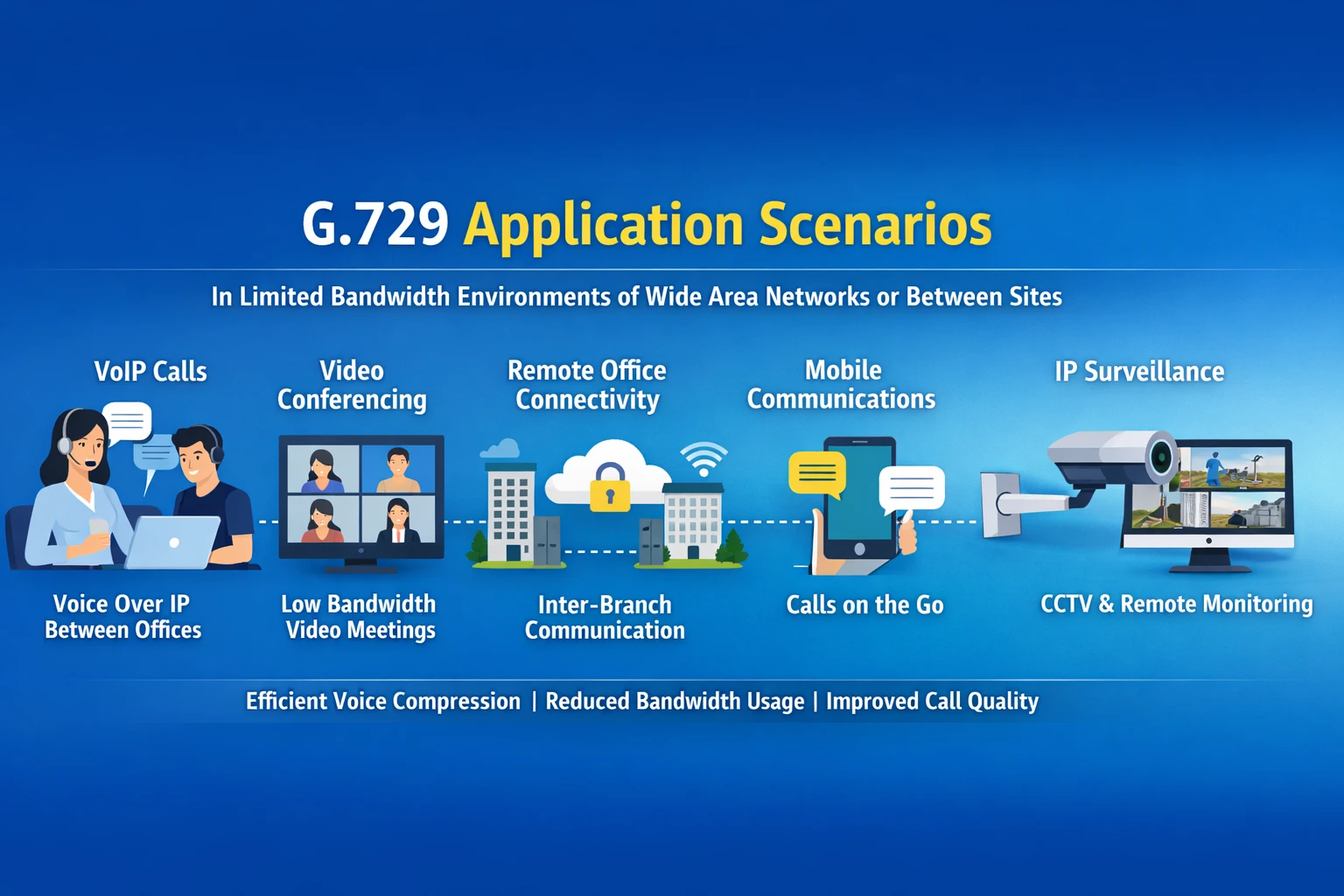
G.729 became widely associated with VoIP deployments where voice capacity had to be preserved across limited WAN or inter-site bandwidth.
How Does G.729 Work?
Technically, G.729 works by modeling speech rather than transmitting a higher-bit-rate audio waveform in a more direct way. The codec analyzes the incoming voice signal and encodes a compact mathematical representation of it. That is why it can deliver intelligible speech at a much lower bit rate than codecs such as G.711.
In its basic form, G.729 uses 10 ms speech frames. A single encoded voice frame occupies 10 octets, and the default packetization interval commonly used in RTP is 20 ms, which means two frames are packed into one payload. This is one of the practical reasons G.729 became attractive in packet voice networks: it compresses each call strongly enough to reduce bandwidth consumption, but it still fits cleanly into standard RTP-based transport.
There are also important annexes associated with G.729. Annex A introduced a reduced-complexity version at the same 8 kb/s rate. Annex B added voice activity detection and comfort noise behavior for source-controlled rate operation. Later annexes extended the family with different rates and functions. In real engineering work, this is why codec names like G.729, G.729A, and G.729B often appear together in SIP trunks, gateways, and DSP configuration discussions.
From a signaling perspective, G.729 is also well defined in RTP. The RTP clock rate is 8,000 Hz, and the RTP/AVP profile assigns static payload type 18 to G729. That predictability helped it become a familiar codec in SIP and H.323 environments, especially in earlier enterprise and carrier voice networks.
Audio Benefits of G.729
The word benefits can be slightly misleading with G.729 if people expect it to outperform every other codec on pure listening quality. Its benefits are more practical than glamorous. G.729 is valuable because it offers a useful balance between speech intelligibility and network efficiency.
The first major benefit is obvious: lower codec bandwidth. In environments where available capacity is tight, reducing per-call codec rate can make a meaningful operational difference. That can help branch offices support more concurrent calls, reduce pressure on lower-capacity links, or simplify voice rollout in networks where bandwidth is not abundant.
The second benefit is consistency. G.729 has been part of enterprise and service-provider voice networks for a long time. Because of that, many older gateways, SBCs, PBX platforms, and SIP devices understand it well. In mixed networks, mature interoperability is often worth more than theoretical codec elegance.
The third benefit is that G.729 can still sound perfectly acceptable for many business voice conversations when the rest of the call path is healthy. If packet loss, jitter, echo, and acoustic problems are controlled, G.729 can deliver speech that is stable enough for ordinary calls, call routing, dispatch conversations, branch telephony, and many routine office interactions.
Bandwidth efficiency: It dramatically lowers codec bit rate compared with G.711.
Good practical voice intelligibility: It keeps speech understandable for normal telephony when the network is stable.
Mature interoperability: It is familiar in many older VoIP ecosystems, gateways, and SIP environments.
Predictable narrowband behavior: Engineers often know exactly what kind of trade-off they are getting.
Of course, G.729 also has limits. Because it is a compressed narrowband codec, it does not usually sound as natural as wideband codecs such as G.722, nor as transparent as G.711 on a good LAN. That is why modern network design often treats G.729 as a tool for constrained conditions, not as the universal best choice for every voice conversation.
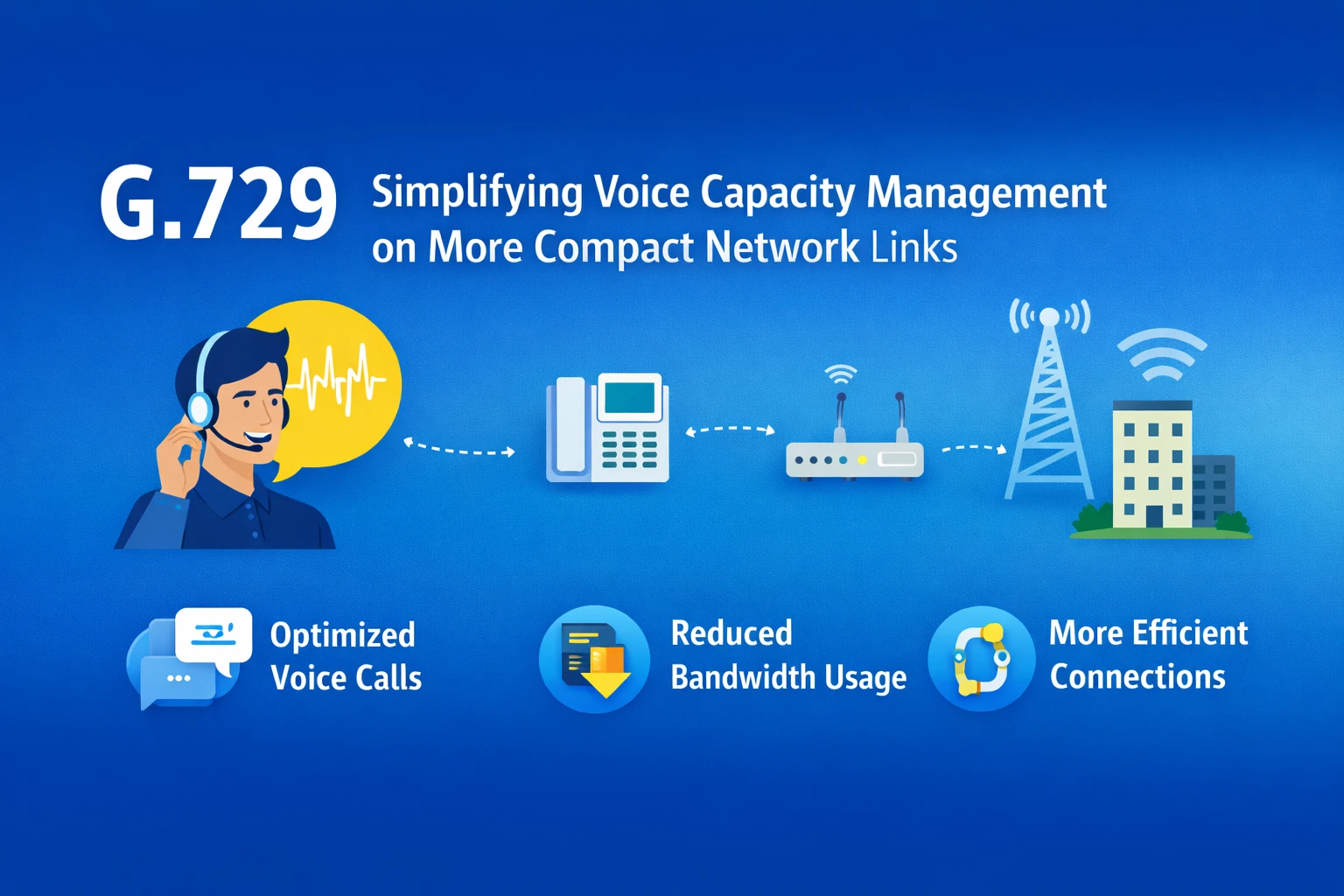
In real deployments, G.729 is appreciated less for premium audio and more for making voice capacity easier to manage on tighter network links.
Core Technical Features of G.729
When engineers talk about G.729, a few technical details matter much more than the rest. These are the characteristics that affect codec negotiation, network planning, interoperability, and user experience.
1. 8 kb/s narrowband speech coding
The base G.729 codec runs at 8 kb/s. That is its defining characteristic. It is built for narrowband speech compression rather than high-fidelity or wideband audio reproduction. This keeps call bandwidth lower, but it also means voice sounds more processed than on higher-bandwidth or wideband codecs.
2. 10 ms codec sample interval
G.729 typically operates on 10 ms codec samples. In practical packet voice deployments, two of those samples are often combined into a 20 ms RTP payload. That default behavior produces a 20-byte payload and 50 packets per second. It is a small detail, but it directly affects bandwidth calculations, packet rates, and voice delay planning.
3. Default 20 ms packetization in many VoIP deployments
Although 10 ms packets are possible, 20 ms packetization is common because it offers a familiar trade-off between delay and bandwidth efficiency. Larger packetization intervals can further reduce packet overhead, but they also add delay and can increase the impact of packet loss on perceived call quality.
4. Annex A and Annex B deployment relevance
Annex A reduced implementation complexity while staying interoperable with the main G.729 payload format. Annex B introduced VAD and comfort-noise behavior. In real systems, this is why engineers must pay attention to whether endpoints, trunks, or SBCs expect plain G.729, G.729A, or versions with Annex B behavior enabled or restricted.
5. Well-established RTP mapping
Because G.729 is clearly defined for RTP, it became easy to negotiate and transport in many voice systems. Static payload type 18 and the 8,000 Hz RTP clock rate are part of that long-standing interoperability story.
6. Lower Ethernet bandwidth than G.711 in common packetization settings
Codec rate alone is not the whole story because IP, UDP, RTP, and link-layer overhead all matter. Even so, the practical savings are real. With common 20 ms packetization, Cisco’s bandwidth table shows about 31.2 kb/s per call for G.729 over Ethernet versus about 87.2 kb/s for G.711. That difference explains why G.729 became so attractive in bandwidth-sensitive voice networks.
G.729 vs G.711 and G.722
It is easier to understand G.729 when it is placed beside the codecs people most often compare it with.
G.729 vs G.711
G.711 is usually the simpler and less compressed choice. It tends to preserve speech more directly and is often favored on local networks, in SIP trunking, and in environments where bandwidth is not a major concern. G.729, by contrast, is the codec people turn to when conserving bandwidth matters more than preserving the most open call sound.
If a network has enough capacity and the goal is uncomplicated voice quality, G.711 is often the more comfortable option. If the network is tighter and call density matters, G.729 starts to look much more attractive.
G.729 vs G.722
G.722 is a wideband codec associated with HD voice. It is chosen to improve how speech sounds. G.729 is chosen to reduce how much bandwidth speech consumes. Those are very different priorities. A user listening to both will usually hear G.722 as fuller and clearer, while G.729 will sound narrower and more compressed. But on a limited link, G.729 may still be the more practical engineering decision.
Where G.729 Works Well in Practice
G.729 is most useful where network economy still matters. That includes branch connectivity, older WAN topologies, remote sites, multi-site PBX networking, and certain SIP interconnection scenarios where endpoints or gateways already support it and bandwidth remains a design constraint.
It is also a codec that often appears in legacy or long-lived enterprise deployments. Voice infrastructure tends to stay in service longer than many other IT systems. As a result, engineers regularly encounter G.729 in installed systems even if newer endpoints also support newer codecs.
Branch office VoIP: Useful when multiple calls share a modest WAN or VPN path.
SIP gateway interconnection: Common where gateways and PBX systems need a compact, well-known voice codec.
IP PBX multi-site networking: Helpful when call traffic crosses inter-office links with limited available capacity.
Legacy enterprise voice environments: Frequently seen in mature systems where codec support must align with older handsets, gateways, or DSP resources.
Carrier or service-provider interop: Sometimes used when interconnection policies, existing trunk profiles, or equipment capabilities already include it.
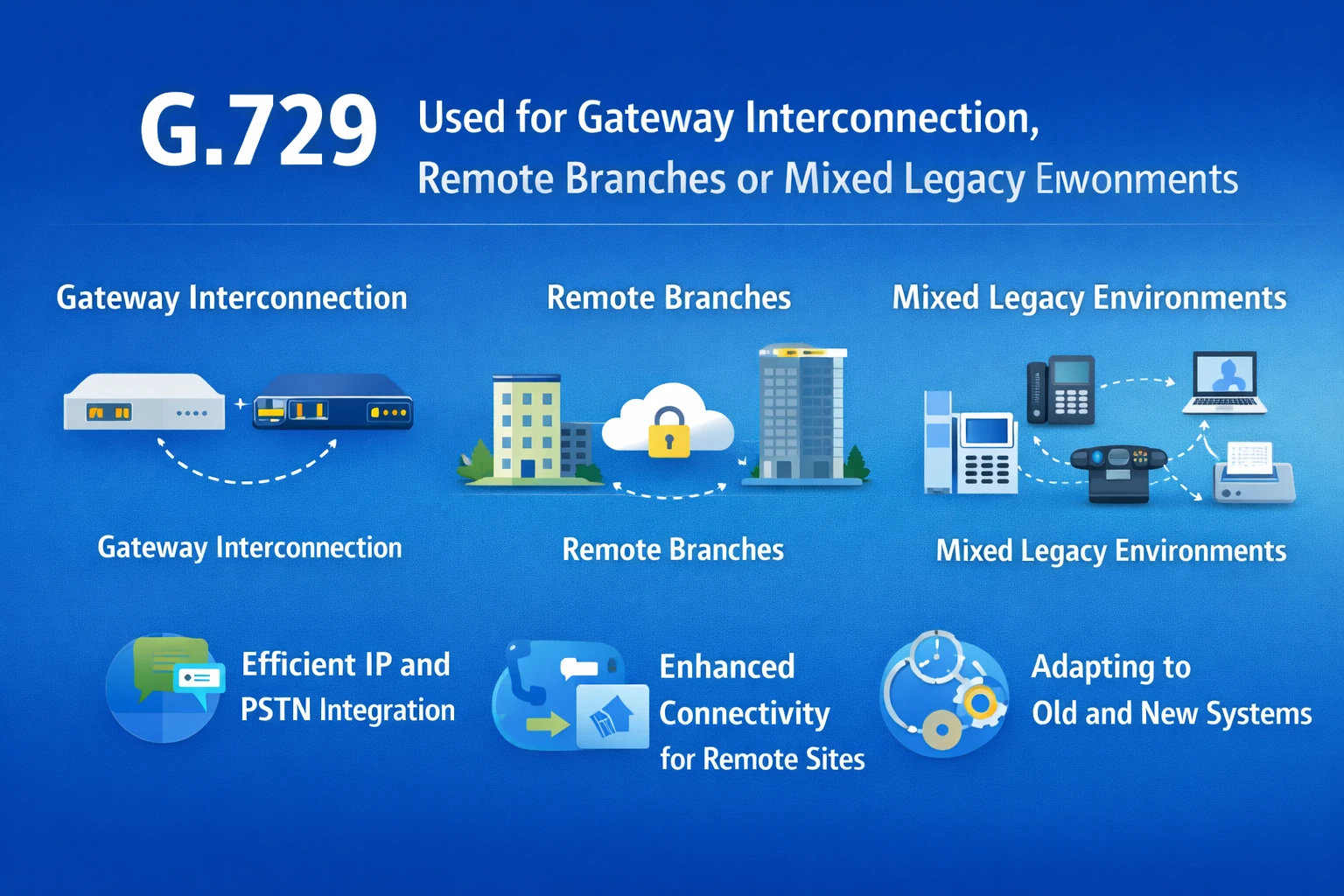
G.729 remains relevant wherever voice systems need a familiar compressed codec for gateway interconnection, remote branches, or mixed legacy environments.
Deployment Considerations and Common Limitations
G.729 is efficient, but it is not universally ideal. Because it is a compressed speech codec, it can be less forgiving in some scenarios than G.711. If a network suffers from packet loss, poor jitter handling, or acoustic issues at the endpoint, the resulting speech can sound more synthetic or more fragile than users expect.
It is also important to remember that voice quality depends on the whole call path, not just the codec. A poorly tuned WAN, weak QoS policy, bad microphone, or echo problem will not be rescued by choosing G.729. In fact, heavy compression can make some impairments feel more noticeable.
Fax and modem scenarios are another area where engineers need care. In Cisco voice guidance, fax passthrough uses G.711 because it introduces less distortion to analog fax signals, and T.38 fax relay is treated separately from ordinary voice codec selection. So while G.729 is fine for many speech calls, it is not normally the first codec engineers choose for reliable fax transport.
Is G.729 Still Relevant Today?
Yes, but its role is more selective than before. In well-provisioned LAN and enterprise collaboration environments, administrators often prefer codecs that preserve more voice detail. However, relevance is not the same thing as dominance. G.729 still matters because real networks are mixed, real deployments inherit legacy infrastructure, and real engineers still need a compact codec that many systems understand.
That is the best way to think about G.729 today. It is not the codec that tries to impress people with the richest audio. It is the codec that keeps showing up because it solves a practical network problem efficiently.
FAQ
Is G.729 better than G.711?
Not in every sense. G.729 is better when bandwidth efficiency is the priority. G.711 is often better when the network can support higher bandwidth and the goal is simpler, less compressed voice quality.
Is G.729 an HD voice codec?
No. G.729 is a narrowband speech codec. It is designed for efficient voice compression, not for wideband or HD voice reproduction.
What is the main advantage of G.729?
Its main advantage is reduced codec bit rate. That makes it useful in bandwidth-sensitive VoIP, SIP trunk, and branch office scenarios.
What is the difference between G.729 and G.729A?
G.729A refers to the reduced-complexity version defined in Annex A. In RTP payload terms, G.729 and G.729A are treated as interoperable, which is why many systems do not distinguish them at the basic payload level.
Does G.729 support silence suppression?
Yes, that behavior is associated with Annex B, which defines voice activity detection and comfort-noise operation. Whether it is used depends on endpoint support, negotiation, and system policy.
Is G.729 suitable for fax?
It is usually not the preferred choice for fax transport. In many practical VoIP designs, fax passthrough relies on G.711, while T.38 is used when dedicated fax relay is required.
Conclusion
G.729 is a classic example of an engineering codec rather than a showcase codec. It was built to solve the problem of carrying more speech across less bandwidth, and it did that job well enough to become deeply embedded in the history of VoIP. Its audio is narrower than G.722 and more compressed than G.711, but that trade-off is exactly why it earned its place.
For modern voice engineers, system integrators, and telecom teams, G.729 is still worth understanding. Even when it is no longer the default first choice, it remains a practical option in bandwidth-aware networks, gateway interconnection, legacy enterprise systems, and voice environments where efficiency still matters.







