An AC contactor is an electrically controlled switching device used to connect and disconnect power to loads such as motors, pumps, compressors, heaters, lighting banks, and industrial equipment. In practical control panels, the contactor separates the power circuit from the control circuit. The main contacts carry load current, while the coil and auxiliary contacts allow push buttons, relays, PLC outputs, or protection devices to start and stop the load safely and predictably.
An AC contactor wiring diagram shows how these elements are connected. A typical diagram identifies the incoming line terminals, outgoing load terminals, coil terminals, overload relay, start and stop devices, and optional auxiliary contacts used for interlocking or seal-in control. Understanding this structure is important for installation, maintenance, fault tracing, and safe panel design.
At the same time, contactor wiring is not only a matter of connecting wires to labeled terminals. Correct wiring also depends on the coil voltage, the load type, the control voltage source, short-circuit protection, overload protection, and the manufacturer’s exact schematic. For this reason, any practical installation should always follow the device datasheet and the project drawing in addition to general wiring principles.
General diagrams are useful for understanding the logic of a contactor circuit, but the final installation must follow the exact terminal layout, coil rating, and protection requirements of the specific device being used.
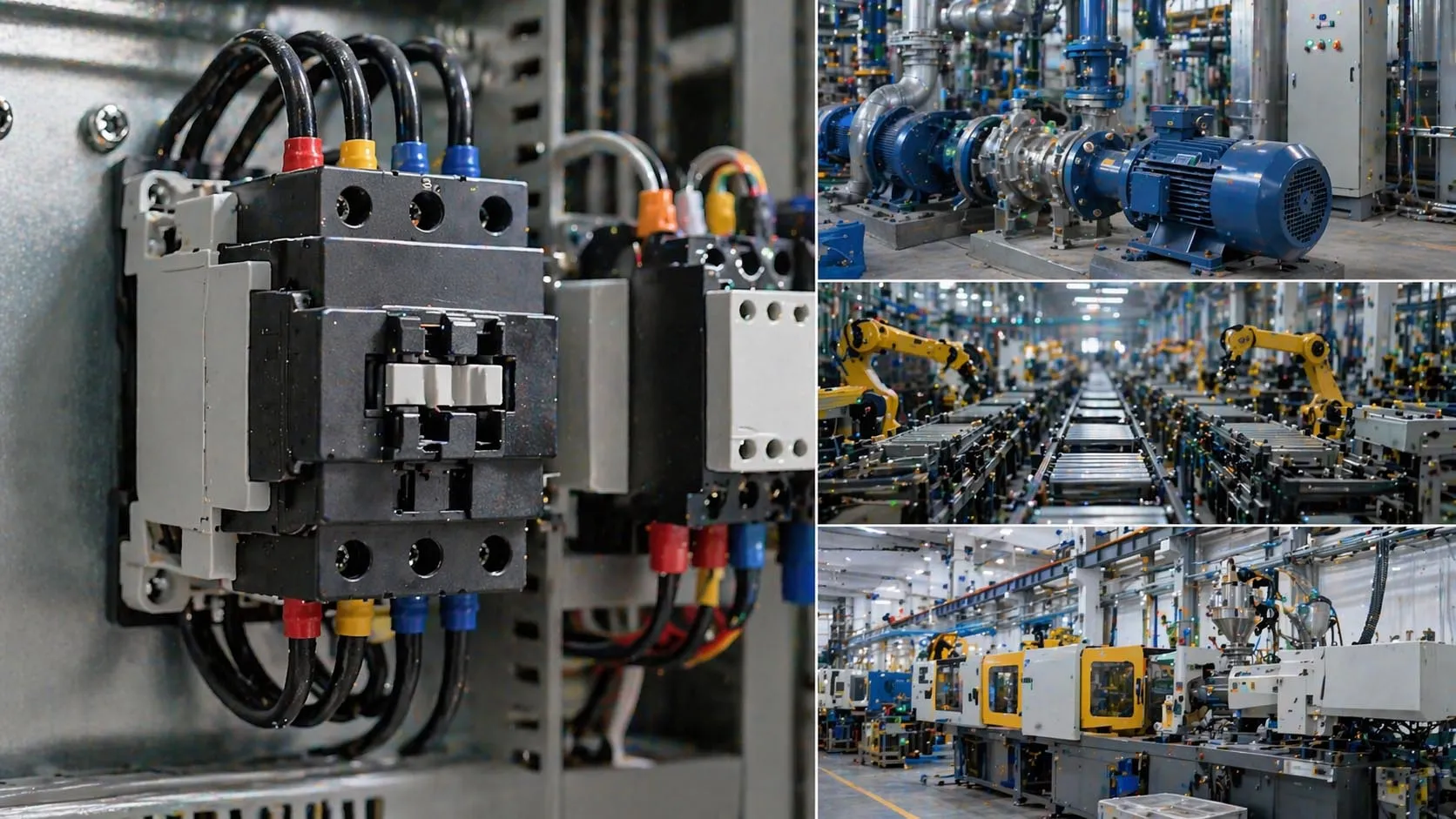
A basic AC contactor installation combines a power path for the load and a lower-power control path for the coil and operating logic.
What an AC Contactor Wiring Diagram Shows
Power Terminals and Load Terminals
The first part of a wiring diagram shows the main power path. In many IEC-style contactors, the incoming supply is marked on the line side with terminal designations such as 1L1, 3L2, and 5L3, while the outgoing side is marked 2T1, 4T2, and 6T3. When the contactor coil is energized, the main contacts close and connect the line side to the load side. When the coil is de-energized, those main contacts open and disconnect the load.
In three-phase motor control, these power poles typically feed the overload relay and then the motor. In smaller or single-phase applications, the contactor may use fewer poles, but the logic remains the same: line power enters on the source side and exits on the load side only when the contactor is pulled in.
This is why the power circuit should always be read separately from the control circuit. The heavy-current path tells you how the load is switched, while the control path tells you what makes the contactor open or close.
Coil Terminals and Auxiliary Contacts
The second part of the diagram shows the control circuit. On many contactors, the coil terminals are marked A1 and A2. Applying the correct control voltage across these two terminals energizes the coil and changes the state of the contactor. On some DC-coil models, polarity may also be marked, but for AC coils the main concern is matching the coil to the correct rated control voltage.
Many contactors also provide auxiliary contacts. A common example is one normally open auxiliary contact marked 13/14 and one normally closed auxiliary contact marked 21/22. These contacts do not carry the main motor or heater current. Instead, they are used in the control circuit for feedback, interlocking, indication, or hold-in logic.
In a typical three-wire start/stop circuit, the normally open auxiliary contact is wired in parallel with the start push button to create a seal-in or holding path. Once the coil energizes and the auxiliary contact closes, the contactor stays energized after the start button is released, until a stop button or protection contact opens the circuit.
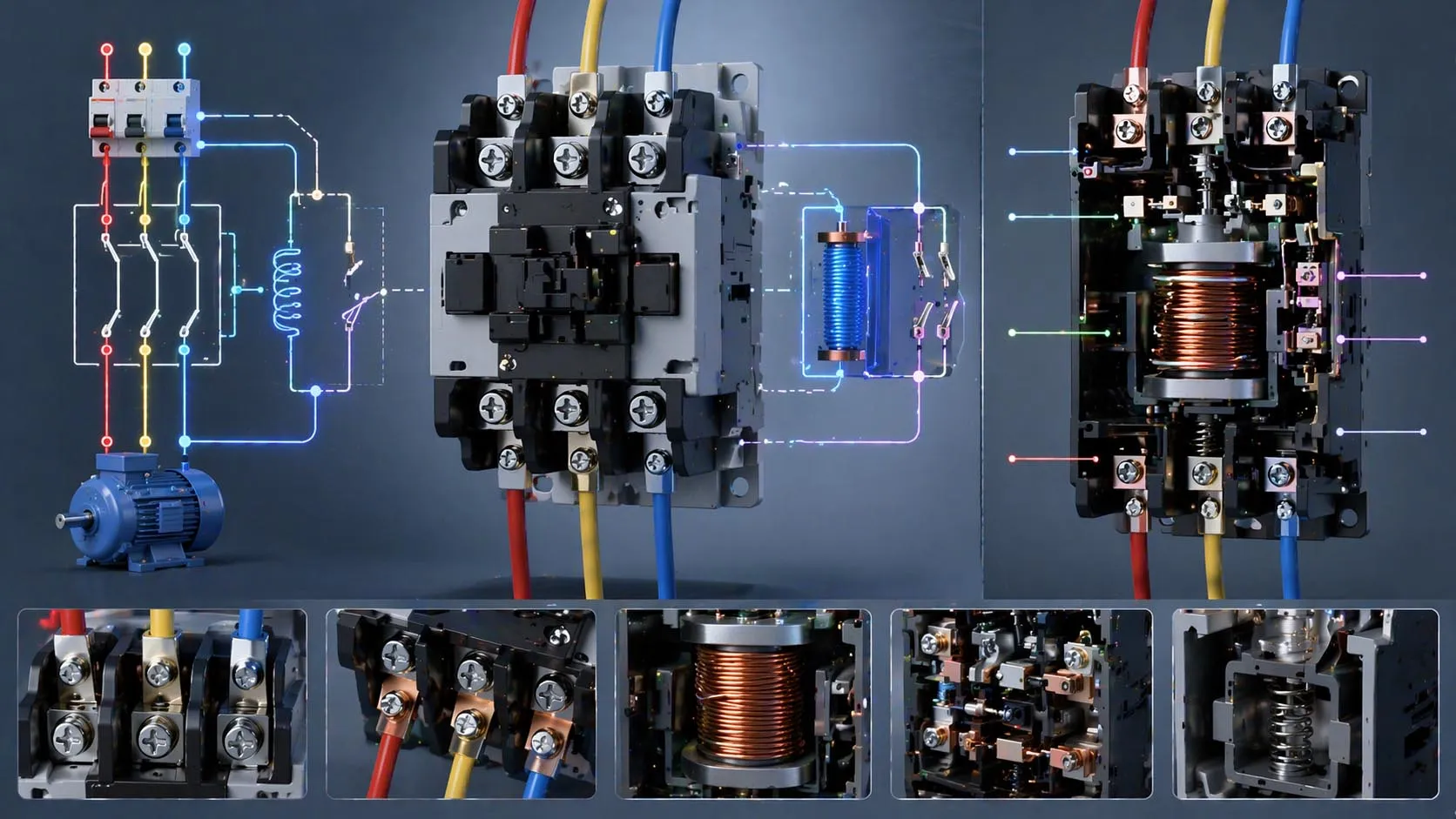
Most wiring diagrams begin with terminal identification so the installer can distinguish coil, power, and auxiliary functions correctly.
Basic Working Principle of an AC Contactor Circuit
How the Coil Operates the Main Contacts
The operating principle of an AC contactor is straightforward. When the control circuit sends the correct voltage to A1 and A2, the electromagnetic coil pulls in the moving contact assembly. This closes the main contacts and, depending on the design, changes the state of the auxiliary contacts at the same time. When coil power is removed, spring force returns the contactor to its normal state.
This arrangement allows a low-power control signal to switch a much higher-power load. It also makes it possible to control motors and other equipment from push-button stations, thermostats, PLC outputs, timer relays, safety relays, float switches, and remote control devices without sending full load current through those control components.
Because the coil is the operating element, the control circuit must be wired with the same care as the power circuit. If the coil voltage is wrong, the contactor may chatter, overheat, fail to pull in, or be damaged.
How a Standard Start/Stop Circuit Is Built
A common contactor wiring method uses a normally closed stop button, a normally open start button, the normally closed overload relay auxiliary contact, and a normally open auxiliary holding contact. In basic logic, control power flows through the stop contact and the overload contact, then through the start button to A1. A2 returns to the other side of the control supply.
When the start button is pressed, the coil energizes. At the same time, the auxiliary holding contact closes and creates a parallel path around the start button. That means the contactor remains energized after the button is released. Pressing the stop button, or tripping the overload relay, opens the control path and drops out the contactor.
This control method is widely used because it is simple, reliable, and easy to troubleshoot. It also separates operator control, overload protection, and load switching into clearly defined parts of the circuit.
A contactor does not protect the motor by itself. In most motor circuits, short-circuit protection and overload protection must be added separately and coordinated with the contactor rating.
Typical AC Contactor Wiring Steps
Step 1: Confirm the Device Rating and Coil Voltage
Before wiring begins, the installer should confirm the contactor type, coil voltage, pole arrangement, current rating, utilization category, and any accessory modules such as auxiliary blocks or mechanical interlocks. The coil voltage is especially important because control circuits may use 24 V AC, 24 V DC, 110 V AC, 120 V AC, 220–240 V AC, or other values depending on the panel design.
This is also the stage where the installer checks whether an overload relay will mount directly to the contactor and whether additional control components such as a control transformer, PLC relay output, selector switch, timer, or interlock contact are included in the design.
Step 2: Mount the Contactor and Related Devices
The contactor should be mounted according to the manufacturer’s instructions, usually on DIN rail or a panel backplate. At the same time, the overload relay, terminal blocks, push buttons, protection devices, and wire ducts should be arranged so that line wiring, load wiring, and control wiring remain clear and serviceable.
Good panel layout is part of good wiring practice. Clear physical separation between power conductors and control conductors improves maintenance, reduces wiring errors, and makes future troubleshooting easier. It also supports better heat management and cleaner cable routing inside the enclosure.
Step 3: Wire the Main Power Circuit
After safe isolation and verification, the main supply conductors are connected to the incoming line terminals of the contactor, and the outgoing conductors are connected from the contactor or overload relay to the load. In many motor starter arrangements, the line enters the contactor first, the load side of the contactor feeds the overload relay, and the overload relay then feeds the motor terminals.
At this stage, conductor size, terminal torque, protection coordination, and phase sequence must all follow the equipment documentation and local electrical code. The goal is not merely to complete the path, but to complete it in a way that matches the rated application of the starter assembly.
Step 4: Wire the Control Circuit
Next, the control circuit is wired. A simple example starts from the control supply, passes through the normally closed stop button, then through the normally closed overload relay auxiliary contact, then through the normally open start button, and finally to the A1 coil terminal. The A2 terminal returns to the opposite leg of the control supply.
If a three-wire control method is used, the contactor’s normally open auxiliary contact is connected in parallel with the start button to form the holding circuit. If indicator lamps, interlocks, timer contacts, or PLC permissives are part of the design, they are inserted according to the required control sequence shown on the schematic.
This is the point where wiring discipline matters most. One misplaced auxiliary contact or one incorrect control-voltage return can make the circuit fail to start, fail to hold, or fail to stop properly.
Step 5: Inspect, Test, and Commission
Before energizing, all terminations should be checked against the drawing, and all terminals should be tightened to the specified torque. The installer should verify wire identification, insulation condition, grounding, phase continuity, overload settings, and the mechanical freedom of the contactor and overload assembly.
Commissioning should begin with control-circuit checks and no-load or controlled-load testing where appropriate. The installer confirms that the stop function drops out the contactor, the start function latches correctly if a holding circuit is used, and the overload trip path opens the control circuit as intended. Final testing should also check for chatter, abnormal noise, overheating, or incorrect rotation in motor applications.
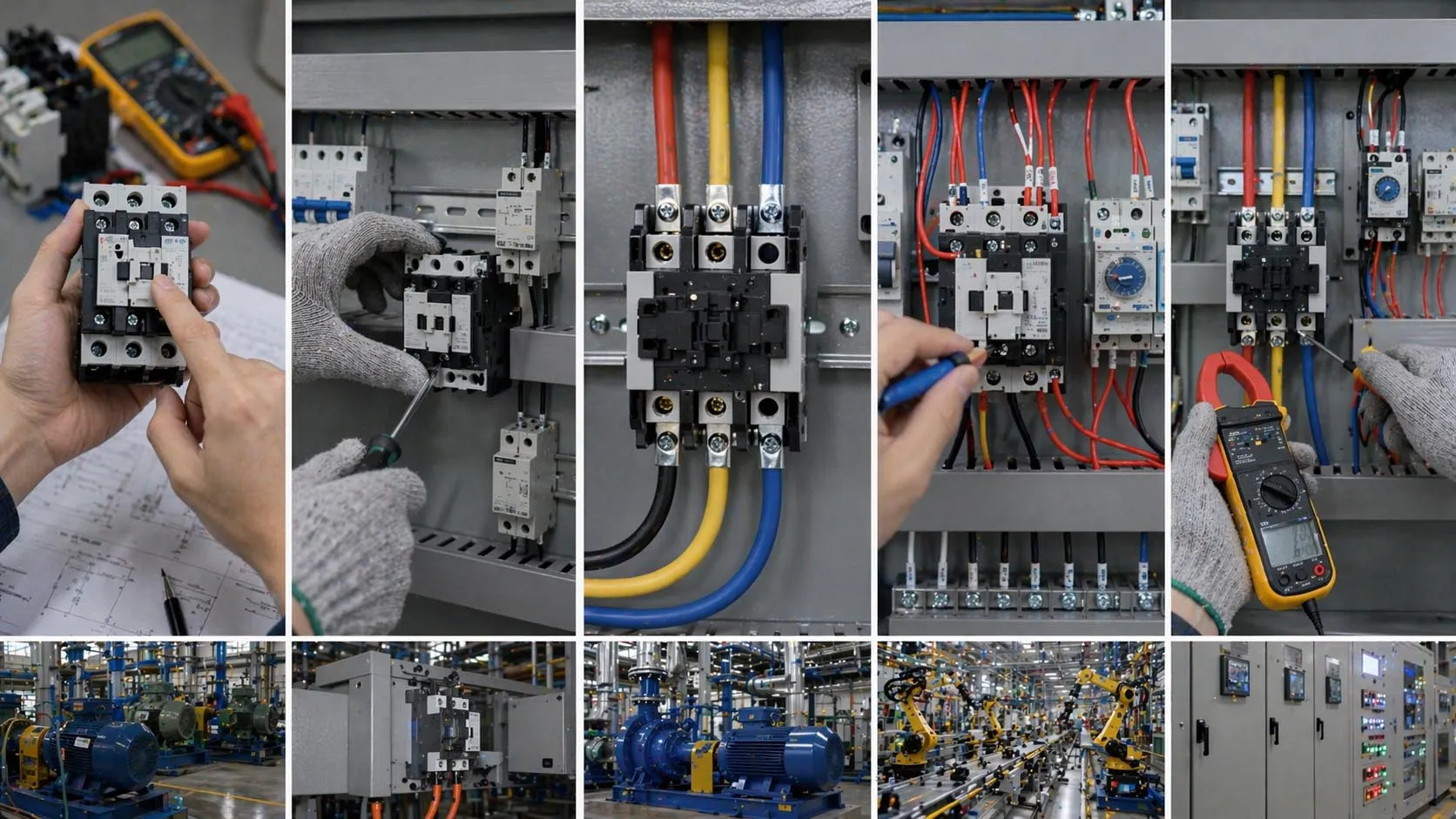
Successful installation depends on more than terminal connection; it also requires rating checks, layout discipline, inspection, and controlled commissioning.
Common Wiring Methods
Direct On-Line Motor Starter Wiring
One of the most common contactor applications is a direct on-line motor starter. In this method, the contactor switches full line voltage to the motor when the coil energizes. The overload relay is paired with the contactor to protect the motor from sustained overcurrent conditions, while separate short-circuit protection is provided upstream by the appropriate device.
This arrangement is widely used because it is simple and effective for many pumps, fans, conveyors, compressors, and general industrial motors. The wiring diagram is usually easy to read because the power circuit and control circuit can be separated clearly.
Reversing Contactor Wiring
Another common method is reversing control, which uses two contactors and a mechanical and electrical interlock arrangement to reverse motor rotation by swapping two motor phases. In this design, the diagrams are more complex because both contactors must never close at the same time. Auxiliary interlock contacts are therefore added in the control circuit to block simultaneous energization.
Reversing circuits are effective, but they should never be improvised without the correct interlock design and manufacturer guidance. This type of contactor wiring requires more attention than a basic non-reversing starter.
Contactor Control from PLCs or Relays
In modern panels, contactors are often controlled by PLC outputs, control relays, timer relays, or building automation signals rather than only by manual push buttons. The principle stays the same: the external control device either provides or removes coil power, while permissives and protection contacts remain in series with the coil circuit.
This makes contactors easy to integrate into automated systems, but it also means the diagram must show both field wiring and control logic clearly so maintenance staff can identify whether a fault is in the power circuit, the control hardware, or the automation sequence.
Installation Tips and Maintenance Checks
Keep Power and Control Wiring Organized
Good contactor installations are easier to maintain because they are wired clearly. Line conductors, motor conductors, and small control wires should be routed cleanly and labeled consistently. Auxiliary contacts, overload contacts, and coil leads should be identifiable without guesswork. This reduces troubleshooting time and lowers the chance of future wiring errors during service work.
Where possible, follow a consistent panel standard for terminal numbering, wire ferrules, conductor color, and component labeling. Good documentation often prevents more downtime than any single hardware upgrade.
Verify the Overload Relay Settings
If an overload relay is used, it should be set according to the motor full-load current and the protection design, not by guesswork. The overload relay’s normally closed auxiliary contact is commonly placed in the coil circuit so that an overload trip removes coil power and opens the contactor. If that setting is wrong, the motor may nuisance-trip or, worse, may not be protected adequately.
After commissioning, it is also good practice to verify that the overload trip path behaves as intended and that reset procedures are clear to the maintenance team.
Inspect for Heat, Chatter, and Contact Wear
During maintenance, technicians should look for loose terminals, discoloration, overheating, abnormal coil noise, contact wear, and contamination. Chattering contactors often point to low control voltage, weak coil supply, loose control wiring, or incorrect coil selection. Heat damage near the terminals may indicate loose torque, overloaded conductors, or poor device sizing.
Because contactors are electromechanical devices, regular inspection matters. Many failures can be prevented if worn auxiliary blocks, damaged coils, or poor terminations are identified before they cause a hard stop in production.
Most contactor problems are not caused by the diagram itself, but by mismatched coil voltage, loose terminations, incorrect protection settings, or control-circuit details that were overlooked during installation.
Applications of AC Contactor Wiring
Motor Control Panels
AC contactors are used extensively in motor starter panels for pumps, fans, blowers, conveyors, compressors, and machine tools. In these applications, the wiring diagram provides a practical map for starting logic, overload protection, control interlocks, and maintenance access.
HVAC and Building Systems
In HVAC systems, contactors are used for compressors, condenser fans, air handlers, electric heaters, and packaged equipment. The diagrams often include thermostats, pressure switches, time delays, and safety cutouts in the control circuit.
Industrial Automation and Process Equipment
In industrial automation, contactors remain common wherever robust discrete load switching is required. They are used in control panels, utility distribution sections, machine power branches, heating systems, water treatment systems, and process equipment where the control signal must switch a larger AC load safely.
Lighting and Power Switching
Contactors are also widely used to switch lighting banks, electric heating groups, capacitor banks, and other repetitive AC loads. In these applications, the wiring diagram helps coordinate switching logic, control voltage, timing, and auxiliary status feedback.
FAQ
What is the difference between an AC contactor and a relay?
A contactor is generally designed for switching higher-power loads such as motors, heaters, and large AC circuits, while a relay is often used for lower-power control functions. Contactors also commonly support add-on overload relays and auxiliary blocks in motor-control assemblies.
What do A1 and A2 mean on a contactor?
A1 and A2 are the coil terminals. Applying the correct rated control voltage across these terminals energizes the contactor and changes the state of its main and auxiliary contacts.
How are the main terminals usually marked?
On many IEC-style devices, the incoming side is marked 1L1, 3L2, and 5L3, while the outgoing side is marked 2T1, 4T2, and 6T3. Always confirm the exact markings on the product you are installing.
Why is an overload relay wired with the contactor?
The overload relay protects the motor from sustained overcurrent. Its normally closed auxiliary contact is commonly wired in the contactor coil circuit so that an overload trip de-energizes the coil and stops the motor.
Can I wire a contactor without the manufacturer’s diagram?
No. General diagrams are useful for understanding the circuit, but the actual installation should always follow the manufacturer’s schematic, device ratings, and applicable electrical code requirements.