A Zone 1 hazardous area is a location where an explosive atmosphere made up of flammable gas, vapour, or mist is likely to occur in normal operation occasionally. In practical terms, this means the area cannot be treated as continuously dangerous like Zone 0, but it also cannot be considered only an abnormal-risk area like Zone 2. Because an ignitable mixture may reasonably appear during expected process conditions, equipment installed in Zone 1 must be designed, selected, and maintained with a higher level of explosion protection.
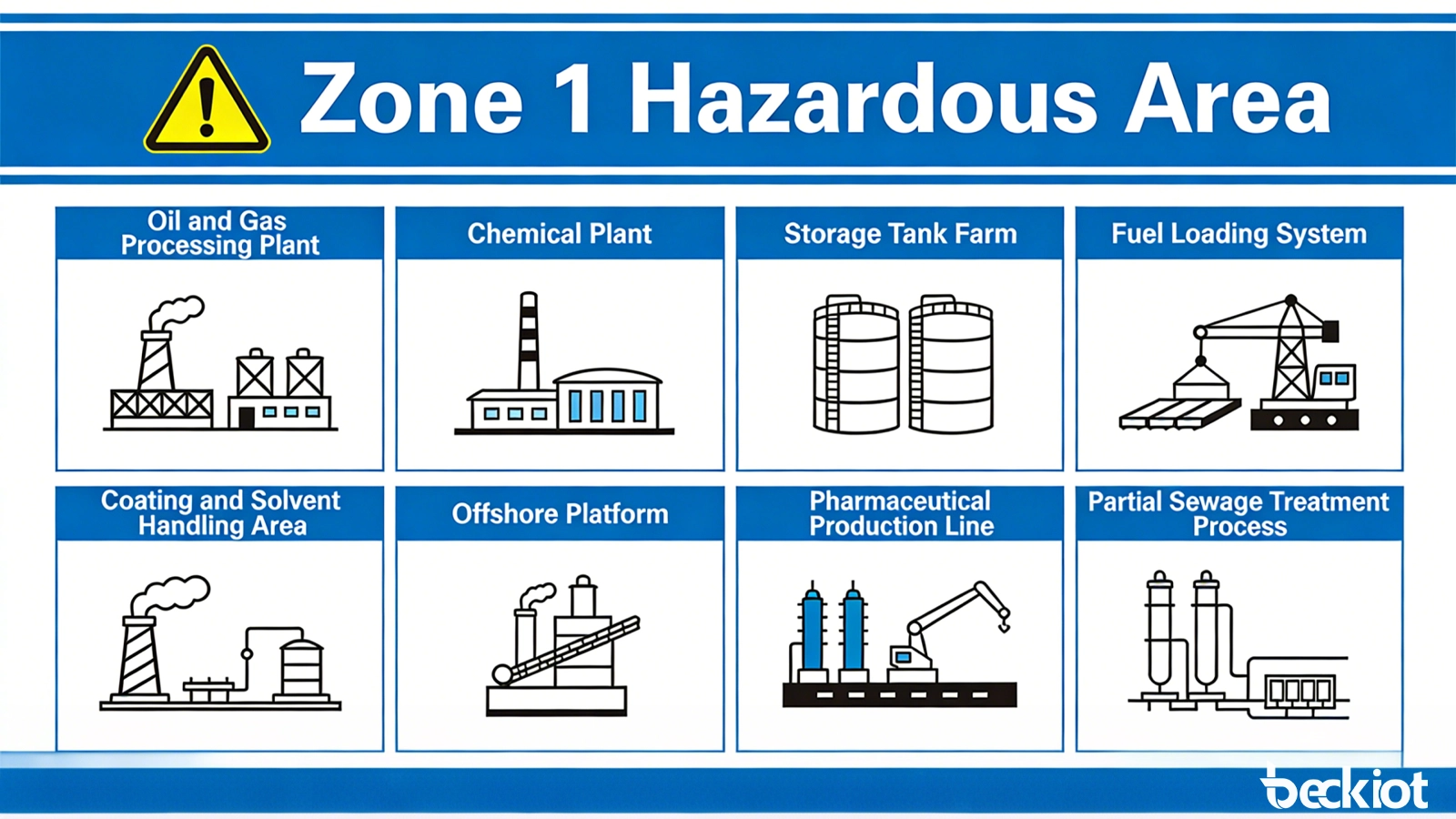
Zone 1 classification is common in oil and gas processing plants, chemical facilities, tank farms, fuel loading systems, paint and solvent handling areas, offshore platforms, pharmaceutical production lines, and some wastewater treatment processes. These environments may release flammable gas or vapour during normal operating cycles such as filling, venting, mixing, sampling, draining, or connection and disconnection of process lines. The role of classification is to reduce ignition risk by matching the right equipment and installation method to the real exposure level of the site.
This article explains what Zone 1 means, how it is determined, which standards are commonly used, what protection ratings and markings matter, and where Zone 1 equipment is typically applied in industry.
What Is a Zone 1 Hazardous Area?
Under the zone-based hazardous area classification system used in IEC, IECEx, ATEX, and many international projects, gas atmospheres are usually divided into Zone 0, Zone 1, and Zone 2. Zone 1 sits in the middle of that risk model. It describes an area where a flammable gas atmosphere is likely to occur in normal operation occasionally, but not continuously or for long periods.
The phrase normal operation is important. It does not refer only to fault conditions, accidents, or major equipment failures. Instead, it covers expected operating situations such as breathing from tanks, pump seal emissions, routine valve operation, vapour release near filling points, or other process-related emissions that can happen during regular plant activity. If a flammable atmosphere is expected only under rare abnormal conditions, the area may fall into Zone 2 instead. If it is present continuously, frequently, or for long periods, the area is more likely to be Zone 0.
| Gas Zone | Basic Meaning | Typical Risk Level | Typical Equipment Requirement |
|---|---|---|---|
| Zone 0 | Explosive gas atmosphere is present continuously, frequently, or for long periods | Highest ongoing exposure | Very high protection level |
| Zone 1 | Explosive gas atmosphere is likely to occur in normal operation occasionally | High but not continuous exposure | High protection level for regular process risk |
| Zone 2 | Explosive gas atmosphere is not likely in normal operation, and if it occurs it exists only for a short time | Lower exposure probability | Enhanced protection for infrequent risk |
Zone 1 is not simply a “dangerous area” label. It is a formal engineering classification used to decide what type of equipment, wiring method, enclosure, inspection routine, and maintenance practice can be accepted in that location.
How Is Zone 1 Classification Determined?
Zone classification is based on risk assessment, not guesswork. Engineers evaluate the substance involved, how it may be released, how often it may be released, the rate of release, the ventilation conditions, the physical layout, and the likely persistence of a flammable atmosphere. In many projects, this is carried out as part of a hazardous area classification study during front-end engineering, detailed design, or plant modification.
1. Source of Release
The first step is to identify where flammable gas or vapour can escape. Typical sources include pump seals, compressor seals, flange connections, vents, sample points, loading arms, storage tank openings, relief devices, and process drains. Some sources release only during maintenance or upset conditions, while others may release intermittently during normal production. A source that is expected to emit flammable gas during ordinary plant operation is a strong indicator that the nearby area may require Zone 1 classification.
2. Ventilation
Ventilation has a major influence on classification. Strong and reliable natural or forced ventilation can dilute a release quickly and may reduce the size or severity of the hazardous area. Poor ventilation, enclosed spaces, pits, trenches, and equipment rooms can allow vapour to accumulate, making Zone 1 classification more likely or increasing the extent of the zone. This is why the same process connection may be assessed differently outdoors and indoors.
3. Release Frequency and Duration
Engineers also consider whether the flammable atmosphere appears continuously, occasionally, or only rarely. Zone 1 is associated with occasional occurrence during normal operation. The classification is therefore closely related to how the plant actually behaves in service, not just how it looks on a drawing.
4. Substance Properties
Not all gases behave the same way. Density, flash point, auto-ignition temperature, vapour pressure, and explosive limits all influence classification. Hydrogen, acetylene, hydrocarbons, solvents, alcohols, and other flammable materials may require different design assumptions. The gas group and temperature class of the final equipment must also match the substance present at the site.
5. Layout and Ignition Exposure
The final extent of Zone 1 is influenced by process arrangement, elevation changes, drainage paths, cable routes, nearby hot surfaces, and the presence of potential ignition sources. Classification drawings often define not only the zone category but also the three-dimensional boundary around equipment, walkways, skids, tanks, and access points.
Zone 1 Is About the Area, Not Just the Product
A common misunderstanding is to treat Zone 1 as a product feature. In fact, Zone 1 is first an environmental classification. The location is classified because of the likelihood of a flammable atmosphere. Only after the area is classified do engineers choose suitably rated equipment for it.
That means a Zone 1 telephone, camera, beacon, junction box, pushbutton station, loudspeaker, network switch, or motor is not “safe everywhere” by default. It is suitable only when its certification, type of protection, gas group, temperature class, ambient temperature range, ingress protection, and installation conditions all match the site requirements.
Correct hazardous area protection depends on the whole chain: area classification, equipment selection, cable entry, grounding, sealing, installation practice, inspection, and maintenance.
Main Standards and Regulatory Frameworks
Zone 1 projects are usually governed by a combination of technical standards, certification schemes, and local regulations. The exact framework depends on where the system will be installed, but several references appear repeatedly in international practice.
IEC 60079 Series
The IEC 60079 family is the core technical reference for many hazardous-area electrical projects. Different parts cover different stages of the lifecycle:
IEC 60079-10-1: classification of areas with explosive gas atmospheres
IEC 60079-14: design, selection, and installation of electrical equipment
IEC 60079-17: inspection and maintenance of installations
IEC 60079-0: general requirements for Ex equipment
IEC 60079-1, -7, -11, -18, and others: detailed requirements for specific protection concepts such as flameproof, increased safety, intrinsic safety, and encapsulation
Together, these standards help define how a site is classified, which Ex protection concepts are acceptable, how equipment must be marked, and how the installation should be verified and maintained over time.
IECEx
IECEx is an international conformity assessment system based on IEC standards for equipment used in explosive atmospheres. It is widely recognized in global projects because it provides a structured certification framework linked to the IEC 60079 standards. IECEx is especially valuable for multinational engineering, procurement, and operating environments where a consistent technical basis is needed across countries.
ATEX
Within the European Economic Area, the ATEX product framework is central to placing equipment on the market for explosive atmospheres. In practice, engineers often refer to ATEX equipment categories, zone suitability, and Ex marking together. For Zone 1 gas applications, equipment is commonly associated with Category 2G or an equivalent high level of protection suitable for that zone.
OSHA, NEC, and North American Practice
In the United States and some related projects, hazardous locations may be handled through Class/Division or Zone-based approaches, depending on the code path chosen. Class I, Zone 1 relates to flammable gases, vapours, and mists, and overlaps in practical intent with international Zone 1 gas classification. However, terminology, marking, and approval details can differ, so equipment should never be substituted across jurisdictions without checking the local code and certification basis.
Protection Ratings and Equipment Marking for Zone 1
When people discuss “Zone 1 ratings,” they may actually mean several different things at once: the zone suitability, the type of Ex protection, the gas group, the temperature class, the ingress protection rating, and the certification scheme. These items must be read together.
1. Equipment Protection Level and Category
For gas atmospheres, Zone 1 equipment is typically selected with a high protection level, commonly shown as Gb in IEC-style marking. In ATEX-based project language, this usually corresponds to Category 2G equipment. The basic idea is that the device should not become an ignition source in normal operation and should continue to provide a high level of safety under expected faults or disturbances addressed by the applicable protection concept.
2. Common Ex Protection Concepts for Zone 1
Several protection methods are widely used for Zone 1 equipment:
Ex d or Ex db (flameproof enclosure): contains an internal explosion and prevents flame transmission to the surrounding atmosphere
Ex e or Ex eb (increased safety): reduces the likelihood of arcs, sparks, or excessive temperatures in normal service
Ex i or Ex ib (intrinsic safety): limits electrical and thermal energy so ignition cannot occur under the defined fault conditions
Ex m or Ex mb (encapsulation): encloses ignition-capable parts in resin or similar material
Ex p systems (pressurization): keeps the hazardous atmosphere away from ignition-capable parts by maintaining protective gas pressure
The most suitable concept depends on the equipment type and the operating environment. A field telephone, beacon, camera, loudspeaker, paging station, sensor, control station, or network enclosure may all be protected differently even within the same Zone 1 plant.
3. Gas Group
Zone 1 equipment must also be compatible with the gas group present. In many industrial gas applications, markings may reference groups such as IIA, IIB, or IIC. A product approved for IIC is typically suitable for the more demanding gas conditions within that grouping hierarchy, while equipment approved only for IIA may not be acceptable where more easily ignited gases are present. Hydrogen and acetylene-related environments often drive more stringent group requirements.
4. Temperature Class
Every Ex device also has a maximum surface temperature classification, often expressed as T1 through T6 in gas environments. The selected temperature class must be below the auto-ignition temperature of the hazardous substance present. For example, a device marked T6 has a lower maximum surface temperature than one marked T3, which can be critical in solvent, gas, and chemical process areas.
5. Ingress Protection Rating
Ingress protection, shown as IP ratings such as IP66 or IP67, is not the same as explosion protection, but it still matters greatly in Zone 1 applications. A poor enclosure seal can allow water, dust, or corrosive contamination to damage a certified device, compromise long-term reliability, or invalidate safe installation assumptions. Outdoor process areas, offshore decks, tunnels, utility corridors, washdown facilities, and corrosive chemical units often require both Ex certification and high enclosure protection.
| Marking Element | What It Tells You | Why It Matters in Zone 1 |
|---|---|---|
| Gb / 2G | Protection level or category for gas atmosphere use | Shows suitability for Zone 1 gas applications |
| Ex db / eb / ib / mb / p... | Protection concept used by the equipment | Determines how ignition risk is controlled |
| IIA / IIB / IIC | Gas group compatibility | Must match the flammable substance at site |
| T1-T6 | Maximum surface temperature classification | Must remain below gas ignition temperature |
| IP66 / IP67 / IP68... | Resistance to dust and water ingress | Supports durability in harsh industrial conditions |
| Ambient temperature range | Approved operating temperature window | Important for desert, offshore, arctic, or high-heat process sites |
Typical Equipment Used in Zone 1 Areas
Zone 1 areas may contain much more than lights and junction boxes. Modern industrial plants often deploy a wide range of certified electrical and communication equipment, including:
Explosion-protected industrial telephones and SIP phones
PA and GA loudspeakers for public address and emergency alarms
Manual call points, beacons, horns, and alarm stations
Cameras and monitoring devices
Field instrumentation, transmitters, sensors, and analyzers
Local operator stations, pushbuttons, and control panels
Motors, luminaires, junction boxes, and cable glands
Network devices or pressurized cabinets used for industrial communication and control
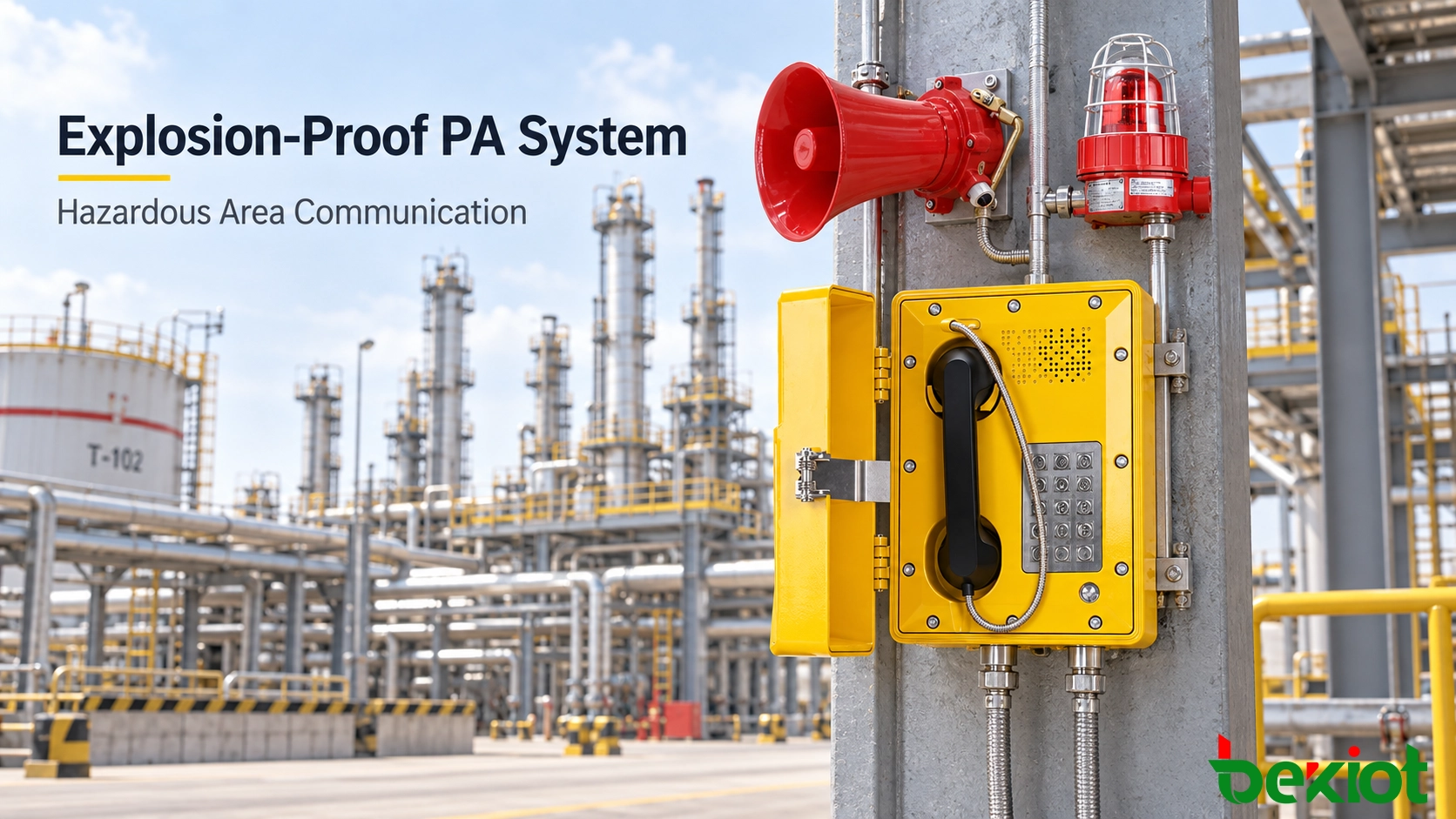
In communication systems, for example, a Zone 1 deployment may include Ex telephones for emergency call points, Ex loudspeakers for plant-wide alerts, Ex beacons for visual warning, and safe-area servers or dispatch platforms connected through appropriate barriers, interfaces, or certified network architecture. The hazardous area device is only one part of the whole compliance picture.
Where Are Zone 1 Areas Commonly Found?
Oil and Gas Facilities
Hydrocarbon processing units, wellhead areas, compressor stations, loading skids, tank manifolds, and refinery process zones frequently contain Zone 1 sections. Vapour releases may occur during normal transfer, venting, or process operation, which makes flameproof, intrinsically safe, or other appropriately certified equipment essential.
Chemical and Petrochemical Plants
Reactors, solvent handling lines, blending stations, filling points, pump areas, and sample cabinets may all create occasional explosive gas atmospheres in routine service. Zone 1 equipment is commonly selected for process communication, alarm notification, instrumentation, and local control functions.
Offshore Platforms and Marine Energy Assets
Offshore topsides, drilling areas, process modules, utility skids, and enclosed technical rooms often involve combustible gas exposure together with salt spray, vibration, and severe weather. In these settings, high IP ratings, corrosion resistance, broad ambient temperature tolerance, and dependable Ex certification are all important.
Pharmaceutical and Fine Chemical Production
Where alcohols, solvents, and volatile compounds are handled during mixing, extraction, drying, or packaging, localized Zone 1 classifications may be required. The chosen equipment often needs to balance safety, washdown resistance, cleanability, and process continuity.
Fuel Handling and Storage
Tank farms, loading arms, fuel pump rooms, loading bays, and transfer points may create occasional flammable vapour clouds during regular operation. Communication, alarms, and local emergency controls in these areas often rely on certified devices suitable for Zone 1.
Wastewater and Biogas Applications
Digesters, sludge treatment areas, gas handling sections, and some enclosed treatment spaces can contain methane-rich atmospheres. Zone 1 classification may apply near release sources or in inadequately ventilated sections where gas is likely to occur during normal plant operation.
Zone 1 vs Zone 2: Why the Difference Matters
The distinction between Zone 1 and Zone 2 has major cost, engineering, and operational consequences. Zone 1 generally demands a higher protection level, more restrictive equipment selection, and stricter installation controls. Using Zone 2 equipment in a Zone 1 area can create a serious safety and compliance failure. On the other hand, over-classifying everything as Zone 1 can increase capital cost, reduce equipment choice, and complicate maintenance unnecessarily.
That is why hazardous area classification should be based on a documented engineering assessment rather than conservative guessing alone. The right answer is not always the most restrictive one; it is the one supported by process reality, ventilation conditions, and the applicable code framework.
Installation Considerations for Zone 1 Equipment
Certified equipment alone is not enough. Improper installation can defeat the protection method. In Zone 1 projects, special attention is usually given to cable entries, stopping plugs, earthing and bonding, sealing arrangements, conduit or cable system type, segregation of intrinsically safe and non-intrinsically safe circuits, enclosure integrity, and inspection records.
Use matching accessories. Cable glands, blanking elements, and stopping plugs must be compatible with the equipment certification and environmental rating.
Check temperature limits. Ambient temperature, solar gain, nearby hot pipework, and enclosure loading can affect surface temperature compliance.
Protect the enclosure. Corrosion, UV exposure, vibration, and chemical attack can shorten service life even if the original Ex certification is valid.
Verify maintenance access. Some Ex concepts require very specific procedures during opening, servicing, or replacement.
Document inspections. Initial inspection and periodic inspection are central to long-term compliance.
In communication systems, designers should also consider power supply routing, surge protection, network topology, redundancy, and integration between hazardous-area devices and safe-area control systems. The best design is not only compliant on paper but also serviceable in the field.
How to Select Equipment for a Zone 1 Application
When choosing equipment for Zone 1, a structured checklist helps prevent costly errors:
Confirm the area is truly classified as Zone 1 for gas, vapour, or mist
Identify the substance, gas group, and required temperature class
Check whether the project requires IECEx, ATEX, local approval, or multiple certifications
Verify the protection concept is suitable for the equipment function
Confirm the equipment protection level or category matches Zone 1 requirements
Review the approved ambient temperature range
Check ingress protection and corrosion resistance for the site environment
Make sure associated accessories are equally compliant
Review installation, inspection, and maintenance instructions before procurement
For example, a Zone 1 industrial telephone for offshore use may need not only gas-area certification but also IP66 or higher enclosure protection, corrosion-resistant materials, glove-friendly controls, clear audio output in high-noise conditions, and compatibility with SIP or dispatch systems located in the safe area.
Common Misunderstandings About Zone 1
“IP66 means it is explosion-proof.” Incorrect. IP ratings address ingress of dust and water, not ignition protection.
“Any ATEX label is enough.” Incorrect. The category, marking, gas group, temperature class, and documentation must all fit the application.
“Zone 1 and Class I, Division 1 are always interchangeable.” Not automatically. They are broadly related concepts, but approval paths and markings differ by jurisdiction.
“The certified product alone guarantees safety.” Incorrect. Installation and maintenance are equally important.
“Zone 1 means the whole plant is the same.” No. Hazardous areas are often localized and depend on actual release sources and ventilation.
Conclusion
Zone 1 hazardous areas are locations where explosive gas atmospheres are likely to occur during normal operation occasionally. They demand more than general industrial equipment and more than simple weatherproofing. Proper protection depends on sound area classification, the right Ex protection concept, suitable gas group and temperature class, appropriate IP performance for the environment, and disciplined installation and inspection practice.
Whether the application involves industrial telephones, alarm devices, instrumentation, control stations, or plant-wide communication systems, the principle remains the same: the equipment must be selected to match the actual hazardous area, not just the purchase specification headline. Understanding Zone 1 correctly is therefore essential for both safety and long-term system reliability in hazardous industrial environments.
FAQ
Is Zone 1 the same as explosion-proof?
No. Zone 1 is an area classification. Explosion-proof or flameproof is one possible protection concept used by some equipment installed in that area, but it is not the only one.
What kind of atmosphere does Zone 1 refer to?
Zone 1 refers to explosive atmospheres formed by flammable gas, vapour, or mist mixed with air. Dust zones use a different classification system, such as Zone 20, 21, and 22.
Can Zone 2 equipment be used in Zone 1?
Normally no. Zone 2 equipment is intended for a lower-probability exposure environment. Zone 1 generally requires a higher level of protection and matching certification.
What marking should I look for on Zone 1 equipment?
You should review the full marking, including the Ex protection concept, gas group, temperature class, equipment protection level or category, ingress protection where relevant, ambient temperature range, and the applicable certification scheme such as IECEx or ATEX.
Does IP66 mean the device is suitable for Zone 1?
No. IP66 only describes enclosure resistance to dust and water ingress. Zone 1 suitability depends on Ex certification and matching hazardous-area marking.
Which industries most often use Zone 1 equipment?
Oil and gas, petrochemical, chemical processing, offshore energy, pharmaceutical production, fuel handling, and some wastewater and biogas facilities are among the most common examples.