


G.711 is one of the most established voice codecs in telephony. Long before cloud calling, SIP trunks, and IP PBX platforms became common, G.711 was already the baseline format for digital voice transport in traditional phone networks. That history still matters today. In many modern VoIP deployments, G.711 remains the default or preferred codec when the goal is stable interoperability, familiar voice quality, and minimal processing delay.
At first glance, G.711 can look simple compared with newer codecs. It does not promise ultra-low bit rates, adaptive wideband audio, or sophisticated compression. What it does offer is something network engineers and telephony integrators still value: predictable behavior. When an IP phone talks to a SIP server, a media gateway, or a carrier trunk, G.711 is often the format that causes the fewest surprises.
This article explains what G.711 is, how it works, what audio benefits it provides, where its technical limits are, and why it still appears so often in business telephony, contact center, gateway, and industrial communication systems.
What Is G.711 Codec?
G.711 is an ITU-T audio codec used for voice communication. In practical terms, it converts analog speech into a digital stream and converts that digital stream back into audio at the far end of a call. It is most closely associated with narrowband telephony and has been widely used in both legacy circuit-switched networks and IP-based voice systems.
In day-to-day engineering language, G.711 is often treated as the “standard phone call codec.” That description is not technically perfect, but it captures why the codec remains so important. A huge amount of telephony equipment already understands it: IP phones, media gateways, softswitches, SBCs, SIP trunks, PBX platforms, analog telephone adapters, and many WebRTC or browser-connected voice services.
G.711 has two common variants:
G.711 μ-law (u-law / PCMU), commonly used in North America and Japan.
G.711 A-law (a-law / PCMA), commonly used in many other international telephony environments.
Both variants are built on the same basic idea. They digitize speech at the same nominal bit rate, but they use different companding laws. In real deployments, choosing the correct variant is usually more about regional interoperability than about dramatic differences in audio quality.
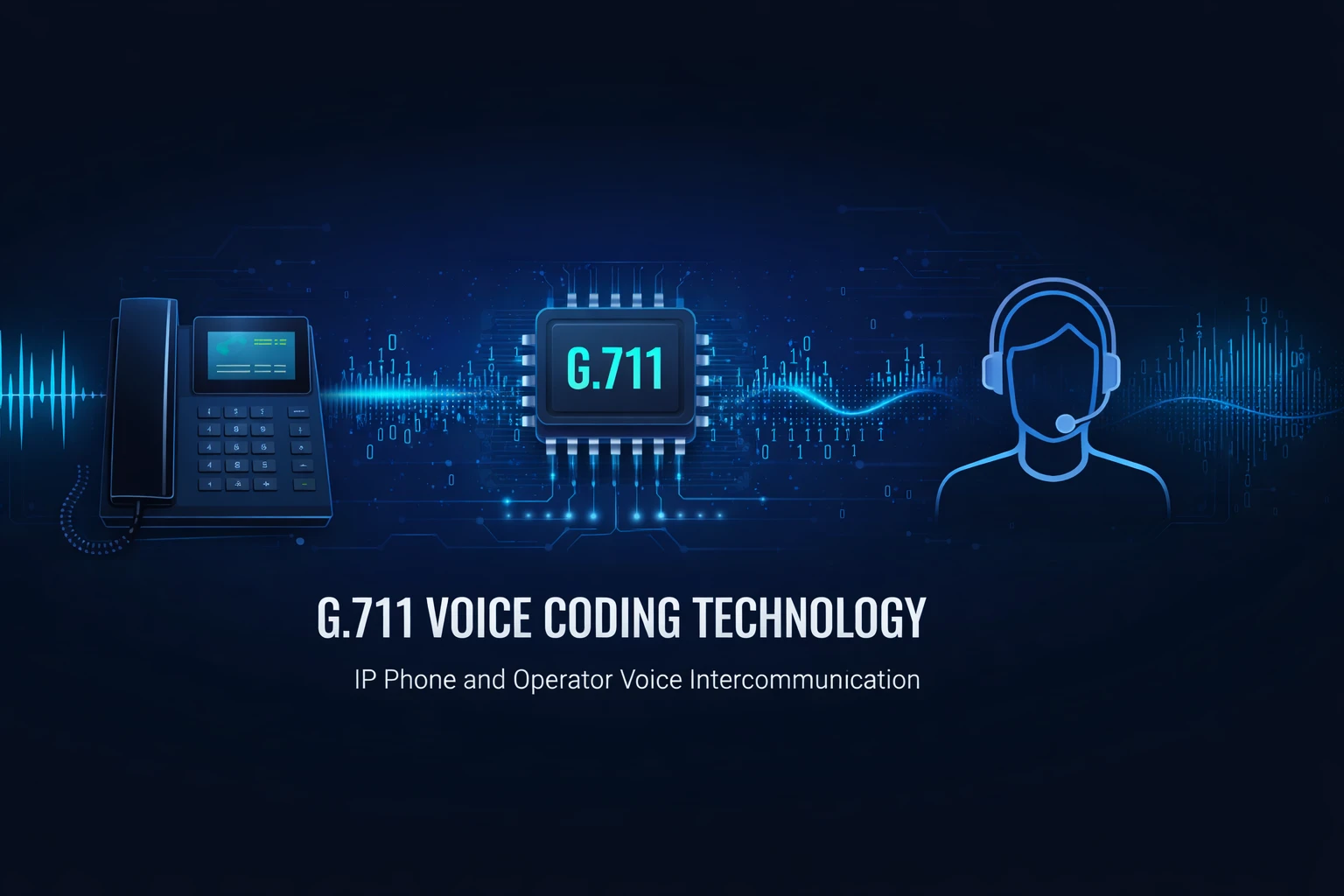
G.711 often acts as the common voice format across IP phones, PBX platforms, gateways, and carrier connections.
How Does G.711 Work?
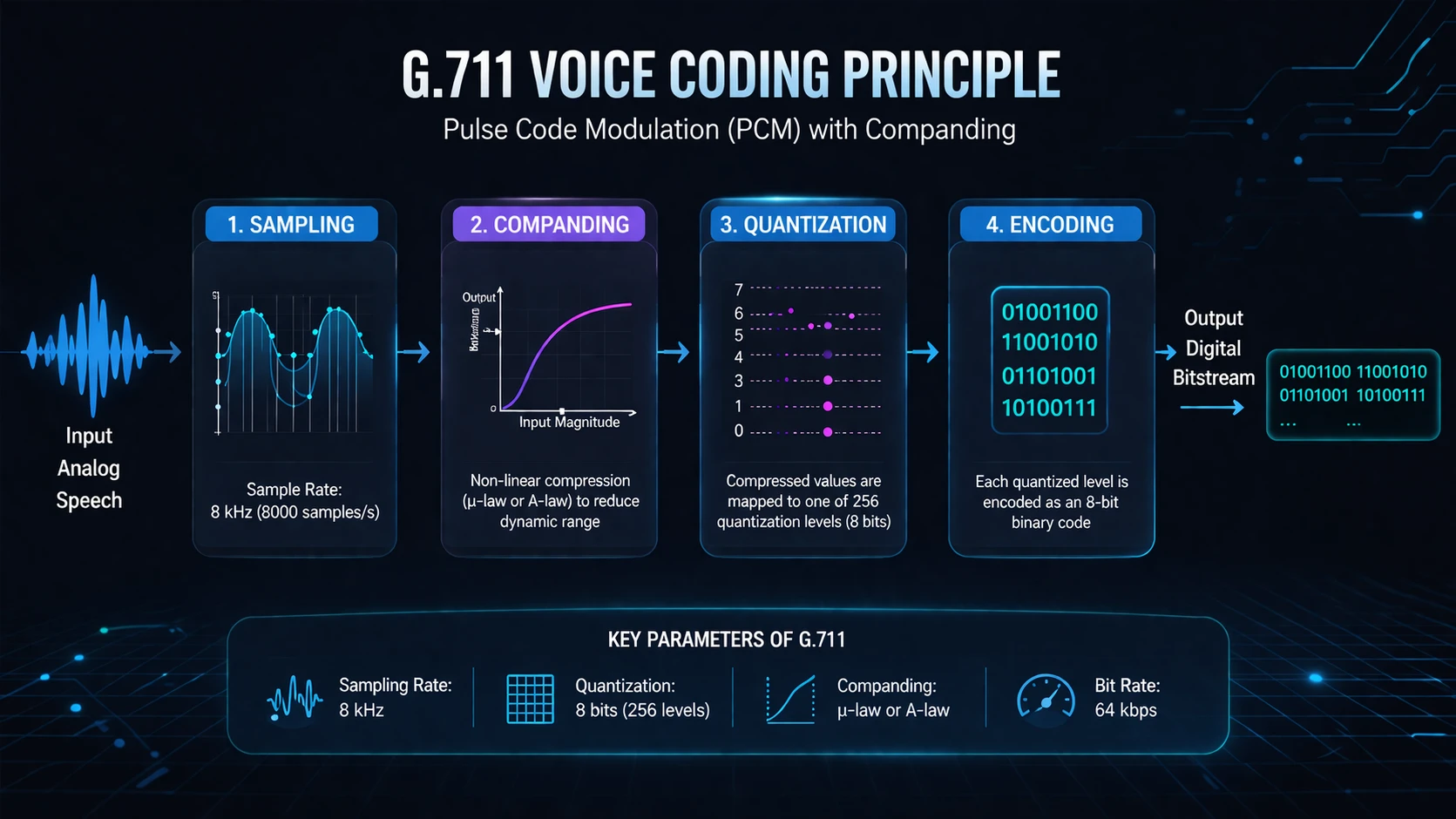
G.711 uses pulse code modulation, usually shortened to PCM. The basic process is straightforward. Speech is sampled, converted into digital values, then represented as 8-bit words. Instead of keeping the signal in a purely linear form, G.711 applies companding. That means quieter sounds and louder sounds are mapped in a way that improves practical speech representation within a limited number of bits.
This is where A-law and μ-law enter the picture. They are two logarithmic companding methods used to encode speech efficiently within the G.711 framework. The codec therefore stays relatively simple while still delivering voice quality that has long been considered acceptable for standard telephony.
In VoIP systems, G.711 audio is usually packetized into RTP streams. A common packetization interval is 20 ms, although other packet sizes may also be used depending on device settings and network design. Once packetized, the media stream can be transported across LAN, WAN, VPN, internet, or carrier IP infrastructure.
One reason G.711 remains popular is that it does not ask much from the processor. The codec logic is light compared with heavily compressed codecs. That makes encoding and decoding straightforward, which helps reduce algorithmic delay and keeps interoperability predictable in mixed environments.
G.711 survives not because it is fashionable, but because it is dependable. In voice networks, dependable often beats elegant.
Audio Benefits of G.711
1. Natural-sounding narrowband speech
For ordinary phone conversations, G.711 provides voice quality that most users recognize as familiar and stable. It does not deliver wideband “HD audio” in the same way as codecs like G.722 or Opus in wideband mode, but for classic business calling it is often described as toll-quality speech. That matters in office telephony, customer service, dispatch, and operator workflows where intelligibility is usually more important than extended frequency response.
2. Very low codec delay
One of G.711’s strongest practical advantages is low delay introduced by the codec itself. Because it uses minimal compression complexity, it avoids much of the processing burden seen in lower-bit-rate codecs. In real deployments, this helps conversations feel more immediate, especially when the network itself is well managed.
3. Reduced transcoding pain
Voice quality often gets worse when media is repeatedly transcoded between different codecs. G.711 helps avoid that problem because so many endpoints and platforms already support it natively. If both sides of a call can stay on G.711 end to end, call paths are simpler and troubleshooting tends to be easier.
4. Good fit for enterprise telephony basics
Features such as call transfer, IVR access, voicemail prompts, ring groups, conferencing, queue announcements, paging audio, and extension-to-extension calling generally work very comfortably with G.711. It is not the only codec that can handle these functions, but it is one of the least troublesome when compatibility is the priority.
Technical Features of G.711
G.711 looks simple on the surface, but there are several technical details that matter in real projects.
64 kb/s codec bit rate
The nominal codec rate is 64 kb/s. This is one of the first figures engineers remember about G.711, and it is also the first reason people compare it with more compressed codecs such as G.729. The trade-off is clear: G.711 usually gives better simplicity and lower codec delay, but it consumes more bandwidth.
8 kHz clocking and 8-bit sample representation
In RTP environments, G.711 is associated with an 8,000 Hz clock rate. Its PCMA and PCMU forms encode audio as 8-bit samples after logarithmic scaling. That makes the codec narrowband rather than wideband, which is why it sounds like traditional telephony rather than modern full-band audio.
A-law and μ-law variants
A-law and μ-law are not optional cosmetic labels. They must match the expectations of the far end or be converted correctly by the network element handling the call. A mismatch here can lead to failed negotiation, unnecessary transcoding, or poor interoperability with carrier trunks and gateways.
Static RTP payload mapping
In classic RTP use, PCMU is mapped to payload type 0 and PCMA to payload type 8. This small detail matters in SIP and RTP troubleshooting because it appears directly in SDP offers and packet captures. For engineers working with SIP trunks, SBCs, and PBX interconnection, knowing these values can speed up diagnosis when media negotiation goes wrong.
Common 20 ms packetization
Many systems use 20 ms packetization by default. For G.711, that usually means 160 bytes of voice payload per packet. It is a practical balance used widely in IP telephony because it keeps packet overhead, jitter-buffer behavior, and latency within a familiar range for most business deployments.
Actual network bandwidth is higher than 64 kb/s
The codec itself runs at 64 kb/s, but real IP transport consumes more than that because RTP, UDP, IP, and Layer 2 headers are added on top of the voice payload. This is one of the most common misunderstandings in VoIP planning. G.711 is not just “64 kb/s per call” once real packet overhead is included in the design.
In VoIP, G.711 is commonly carried as RTP media after PCM sampling and A-law or μ-law companding.
G.711 vs More Compressed Codecs
G.711 is often compared with codecs such as G.729, Opus, or other modern alternatives. The right choice depends less on theory and more on the actual network and business objective.
Choose G.711 when you want broad compatibility, low codec delay, straightforward troubleshooting, and enough bandwidth to carry calls comfortably.
Choose a more compressed codec when bandwidth is limited, mobile or WAN conditions are more difficult, or the platform supports more advanced optimization without sacrificing interoperability.
In many enterprise environments, G.711 still wins simply because the LAN is strong, the SIP devices already support it, and call quality problems are more likely to come from packet loss or jitter than from the codec itself. In other words, if bandwidth is not the bottleneck, using a simple and widely supported codec often makes operational sense.
That said, G.711 is not always the best answer. If a deployment depends heavily on constrained uplinks, large-scale branch traffic over limited WAN paths, or internet conditions where every kilobit matters, a lower-bit-rate codec may be more practical. Codec selection is always a system decision, not just a quality decision.
Where Is G.711 Commonly Used?
IP PBX and SIP telephony
G.711 is widely used in enterprise IP telephony, including desk phones, softphones, SIP servers, hosted PBX platforms, and on-premises IP PBX systems. It is often the codec people leave enabled when they want the system to “just work” with the broadest range of SIP endpoints.
SIP trunk and carrier interconnection
Many SIP trunk environments support or prefer G.711, especially PCMU in certain regions. This makes it a common baseline codec for interconnection between enterprise phone systems and service provider networks.
Gateways between analog, TDM, and IP worlds
Media gateways frequently use G.711 when bridging legacy telephony equipment and IP voice platforms. This includes analog adapters, FXS/FXO gateways, PRI gateways, and hybrid PSTN-VoIP migration projects. Because G.711 aligns well with traditional telephony behavior, it is often the safest media choice in mixed networks.
Fax pass-through scenarios
Although T.38 is the dedicated standard for many fax-over-IP deployments, G.711 still appears in fax pass-through scenarios. In practice, some installations use G.711 pass-through when T.38 is unavailable, not supported end to end, or not stable across all network segments.
Browser and WebRTC interoperability
G.711 also remains relevant because PCMA and PCMU are part of the baseline codec set required for WebRTC interoperability. That makes the codec useful in voice systems that connect browsers, softphones, and legacy SIP infrastructure.
Industrial and operational communications
In industrial telephony, emergency intercom, paging, help points, dispatch consoles, and gateway-based voice systems, G.711 is still a practical choice when the network is managed and stable. Its main appeal in these projects is not novelty; it is predictability across multiple vendors and device types.
Deployment Considerations
Choosing G.711 is easy. Designing well around it is where the real work begins.
Bandwidth planning matters
Because G.711 is not a low-bit-rate codec, WAN sizing and concurrent call planning must be done carefully. On a healthy LAN this may not feel important, but on branch links, VPN tunnels, or multi-site voice networks it becomes very important very quickly.
QoS still matters
Even a simple codec cannot rescue a bad network. If jitter, latency, packet loss, or queue congestion are present, G.711 calls will still sound bad. Engineers sometimes blame the codec when the real issue is weak QoS policy, poor routing, or insufficient upstream bandwidth.
A-law and μ-law selection should be intentional
Codec negotiation problems are often less about G.711 itself and more about using the wrong regional variant or forcing avoidable transcoding. For international SIP trunking and multi-country deployments, being explicit about PCMA versus PCMU helps keep media behavior consistent.
Avoid unnecessary transcoding
If the call path already starts and ends on G.711-capable devices, keeping the media in G.711 is often the cleanest design. Unnecessary transcoding adds complexity, consumes DSP or CPU resources, and can make troubleshooting harder than it needs to be.
When G.711 Is the Right Choice
G.711 is usually the right choice when the network has enough capacity, the deployment values compatibility, and low processing delay matters more than bandwidth savings. That is why it continues to appear in office telephony, SIP trunks, gateways, browser interconnection, operator systems, and many industrial voice projects.
It is less ideal when bandwidth is scarce or when the business expects wideband or premium audio performance across the entire path. In those cases, another codec may serve the application better. But when voice networks need a dependable common denominator, G.711 is still one of the strongest answers available.
FAQ
Is G.711 compressed or uncompressed?
It is often described as uncompressed in practical telephony discussions because it does not use aggressive low-bit-rate compression like G.729. Technically, it uses logarithmic companding, so it is simpler to say that it is a classic PCM-based telephony codec with very light processing complexity.
What is the difference between G.711 A-law and μ-law?
They use different companding laws. μ-law is common in North America and Japan, while A-law is common in many other countries. The choice is usually driven by interoperability requirements rather than by a dramatic user-facing quality gap.
Is G.711 good for VoIP?
Yes, especially when bandwidth is available and interoperability is important. It is one of the most widely supported codecs in SIP phones, PBX systems, gateways, and carrier interconnection.
Does G.711 support HD voice?
Not in the way wideband codecs do. G.711 is typically associated with traditional narrowband telephony. If the goal is a wider audio range, codecs such as G.722 or Opus are usually better choices.
Why is G.711 still used if newer codecs exist?
Because it is simple, widely supported, low in codec delay, and easy to interoperate across mixed telephony systems. In many business networks, those advantages still outweigh the benefit of heavier compression.
Is G.711 still relevant in browser-based calling?
Yes. PCMA and PCMU continue to matter in interoperability scenarios, especially where browser-based calling must connect cleanly to older SIP and telephony infrastructure.
Conclusion
G.711 is not a glamorous codec, and that is part of its strength. It has remained relevant because it solves a basic problem well: carrying speech between different kinds of telephony equipment with predictable quality and minimal drama. In a world full of new codecs and new transport methods, that kind of reliability is still valuable.
If your network has sufficient bandwidth and your project depends on broad compatibility across PBX systems, SIP trunks, gateways, or mixed voice endpoints, G.711 is still a solid and practical choice. It may not be the most bandwidth-efficient codec in the room, but it is often the one that keeps the room talking.







