Differentiated Services Code Point, usually called DSCP, is a traffic classification value used in IP networks to mark packets so routers, switches, and other network devices can handle them according to different priority or service policies. In simple terms, DSCP helps the network understand which traffic should be treated as more delay-sensitive, more important, or more suitable for standard forwarding. This is especially valuable when multiple kinds of traffic, such as voice, video, business applications, monitoring streams, and ordinary data transfers, share the same network resources.
DSCP is widely associated with Quality of Service, or QoS, because it gives network equipment a practical way to classify packets and place them into different forwarding behaviors. Instead of treating all traffic exactly the same, a DSCP-aware network can reserve better handling for services that are more sensitive to delay, jitter, packet loss, or congestion. This makes DSCP an important concept in enterprise networking, service provider environments, VoIP systems, video collaboration, industrial communications, and many other IP-based deployments.
Understanding What DSCP Means
Definition and Core Purpose
DSCP is a value stored in the IP header that identifies how a packet should be treated as it travels through a network. It does not guarantee bandwidth by itself, and it does not create priority automatically unless network equipment is configured to act on it. What it does provide is a standard marking mechanism that devices can read and use when applying QoS policies.
The core purpose of DSCP is to support traffic differentiation. Some traffic types are more sensitive to delay than others. A voice call, for example, usually suffers quickly if packets are delayed or dropped, while a large file download can often tolerate slower delivery more easily. DSCP gives the network a way to recognize that difference and process packets accordingly.
In practice, DSCP helps administrators design a more intentional network. Instead of hoping all traffic behaves well under load, they can define policies that favor critical services during congestion or heavy usage periods.
DSCP does not change what the traffic is. It changes how the network is instructed to treat that traffic.
Why Traffic Marking Matters
In a lightly loaded network, all traffic may seem to perform well even without QoS marking. But when bandwidth is limited, links are shared, or delay-sensitive applications are running alongside large data transfers, packet treatment becomes more important. Without prioritization, real-time services such as VoIP, SIP signaling, streaming audio, or video conferencing may compete with less time-sensitive traffic in the same queues.
Traffic marking matters because it helps preserve service quality where timing is important. A few hundred milliseconds of extra delay may not matter much for email or document downloads, but it can significantly affect interactive voice and video performance. DSCP gives the network a structured way to distinguish between those use cases.
This is one reason DSCP is often discussed in the same context as business telephony, IP paging, industrial voice systems, and operational command networks. In those environments, predictable packet handling is often more important than raw bandwidth alone.
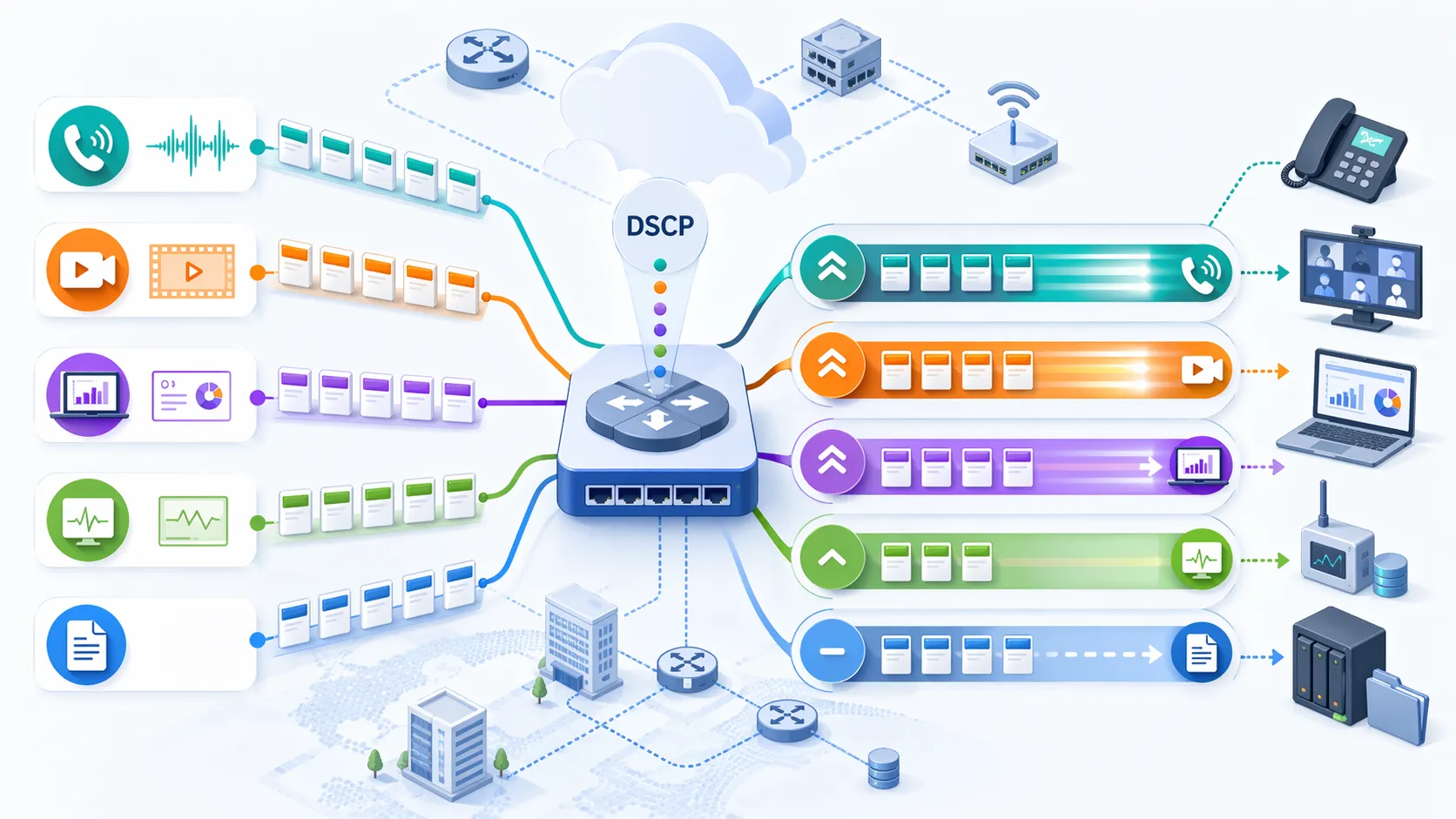
DSCP helps a network distinguish between packet types so voice, video, and data can be handled according to different QoS policies.
How DSCP Works
The DSCP Field in the IP Header
DSCP is carried within the Differentiated Services field of the IP header. In IPv4, this field evolved from the older Type of Service concept, while in IPv6 it appears within the traffic class structure. The DSCP portion uses six bits, which allows a range of marking values that can represent different forwarding classes or service intentions.
When a packet is marked with a DSCP value, network devices that are configured for QoS can inspect that value and place the packet into an appropriate queue, forwarding class, or scheduling behavior. This may influence how the packet is buffered, transmitted, dropped under congestion, or prioritized relative to other traffic classes.
The DSCP mark itself is only one part of the overall QoS design. The network still needs policies that define what each marking means in practice. In other words, the marking is the label, while the configured QoS behavior is the action taken because of that label.
Classification, Queuing, and Forwarding Behavior
The operational flow usually begins with traffic classification. A device such as an IP phone, gateway, SIP server, router, or firewall identifies a packet type and applies a DSCP mark according to policy. For example, real-time voice media may be marked differently from signaling traffic or best-effort web browsing traffic.
Once marked, the packet enters the network. Intermediate devices can then use that DSCP value to determine which queue or class should handle the packet. Delay-sensitive traffic may be sent through expedited queues, while ordinary traffic may enter standard best-effort forwarding paths. Under congestion, devices may also drop lower-priority packets first, helping protect the experience of more critical services.
This process is what makes DSCP useful. It allows packet treatment to reflect application needs instead of assuming all traffic has the same service requirement. In well-designed networks, this leads to more predictable behavior during busy periods.
DSCP becomes meaningful only when packet marking and network policy are aligned from end to end.
Common DSCP Classes and Meanings
Best Effort, Expedited Forwarding, and Assured Forwarding
Several DSCP values are commonly associated with broad service classes. Best Effort traffic usually represents ordinary traffic with no special priority treatment. Expedited Forwarding, often linked with delay-sensitive applications such as voice media, is intended for traffic that benefits from low delay, low loss, and reduced jitter. Assured Forwarding classes provide multiple service levels and drop precedences for traffic that should receive more structured treatment than ordinary best-effort forwarding.
These classes do not magically enforce universal behavior across every network. Their meaning depends on how the organization or provider maps them into actual queues and policies. Even so, they provide a widely recognized framework for expressing packet treatment priorities.
In practical terms, this lets engineers separate applications into more suitable categories instead of leaving everything in one undifferentiated queue. That structured approach becomes very important when the network carries mixed workloads.
Voice, Video, Signaling, and Business Data
In many enterprise networks, real-time voice media is marked with a high-priority DSCP value because it is extremely sensitive to delay and jitter. Signaling traffic, such as SIP call setup messages, may also receive elevated treatment, though usually not always at the exact same level as the voice payload itself. Video traffic may be marked differently depending on whether it is interactive video conferencing, streaming media, or surveillance transport.
Business applications, transactional services, control traffic, and critical industrial data may also be assigned DSCP markings that reflect operational importance. Meanwhile, routine internet browsing, file synchronization, backups, and bulk transfers often remain in lower-priority or best-effort classes.
The result is a more application-aware network. Instead of relying only on link speed, the network can make more intelligent forwarding decisions based on service needs.
Benefits of Using DSCP
Better Performance for Delay-Sensitive Services
One of the main benefits of DSCP is improved handling for delay-sensitive services. Voice calls, video meetings, paging audio, remote operator communications, and other real-time traffic types can experience noticeable service degradation if packet delivery becomes inconsistent. By placing these packets in more favorable queues, DSCP-based QoS can help preserve intelligibility, reduce jitter, and lower the chance of service disruption under congestion.
This does not mean DSCP removes all network problems. If the link is severely undersized or the network is poorly designed, marking alone cannot create capacity that does not exist. But in a properly engineered environment, DSCP can significantly improve how limited resources are allocated when traffic competes for transmission time.
This is particularly valuable in converged networks where voice, video, and ordinary data all share the same switching and routing infrastructure.
More Predictable QoS Policy Across the Network
DSCP also helps make QoS policy more consistent and scalable. When traffic is marked correctly at the edge, intermediate devices can rely on the same marking framework instead of trying to rediscover the nature of each flow independently. That reduces ambiguity and makes policy enforcement more systematic across routers, switches, WAN devices, and provider handoff points.
This consistency becomes more important as networks grow larger or more distributed. A branch office, headquarters link, industrial site, remote operations room, and cloud interconnection may all handle the same traffic types differently unless a shared marking approach exists. DSCP provides that common language for packet treatment.
In this sense, DSCP is not only a technical marking tool. It is also part of a broader network design discipline that supports predictable service behavior.
Uses of DSCP in Modern Networks
Enterprise Voice, Video, and Collaboration Networks
DSCP is widely used in enterprise networks that carry IP telephony, unified communications, video conferencing, soft clients, collaboration tools, and cloud-connected business applications. These environments often include mixed traffic with very different timing needs. DSCP helps protect user experience by ensuring that critical interactive traffic is less affected by bursts of ordinary data activity.
For example, a company may use DSCP to prioritize RTP voice streams above email synchronization or large file transfers. It may also separate voice signaling, interactive video, and default office data into different service classes so the network can respond more intelligently when links become busy.
This makes DSCP highly relevant in any business network where communication quality directly affects day-to-day operations.
Industrial Communication, Paging, and Operational Systems
DSCP is also useful in industrial and operational communication systems, especially where IP-based voice, paging, intercom, dispatch, monitoring, and control services share the same infrastructure. In these settings, some traffic may be operationally important even if total bandwidth usage is not extremely high. The real concern is often predictable delivery rather than raw volume.
A plant network, transport control environment, tunnel communications platform, or campus safety system may use DSCP to make sure voice pages, SIP sessions, dispatch traffic, or alarm-related media are treated more carefully than background data. This can support better service stability when multiple applications converge on one network.
In projects involving Becke Telcom IP phones, SIP gateways, intercoms, or IP paging systems, DSCP can be part of the wider QoS strategy that helps voice and broadcast traffic perform more reliably across business and industrial communication deployments.
Applications of DSCP Across Industries
Business Offices, Campuses, Healthcare, and Hospitality
In office and campus environments, DSCP is often applied to business voice, collaboration traffic, and essential application flows. Schools and universities may use it to support classroom communications, administrative VoIP, paging, and video services across shared network infrastructure. In healthcare, packet prioritization can help support voice mobility, communication systems, and other operational traffic with tighter delivery needs.
Hospitality environments may also benefit, especially where VoIP, guest services, property systems, and business applications share network resources. In these sectors, the value of DSCP lies in improving service differentiation without requiring physically separate networks for every function.
The more a network carries mixed application types, the more useful DSCP-based classification can become.
Transportation, Utilities, Manufacturing, and Security Networks
Transportation hubs, utility systems, manufacturing sites, and security-focused networks often operate with converged IP infrastructure that supports voice, alarms, operator stations, surveillance, control traffic, and general administration. DSCP helps these environments distinguish between operationally important traffic and routine background traffic, especially on constrained uplinks or heavily shared segments.
In manufacturing or utility operations, voice coordination and event-driven communication may need more careful handling than routine file movement. In security networks, interactive operator traffic may need different treatment from bulk recording flows. DSCP gives the network a structured way to reflect those differences in forwarding behavior.
This is why DSCP is frequently included in network design guidelines for environments where timing, coordination, and service continuity matter.
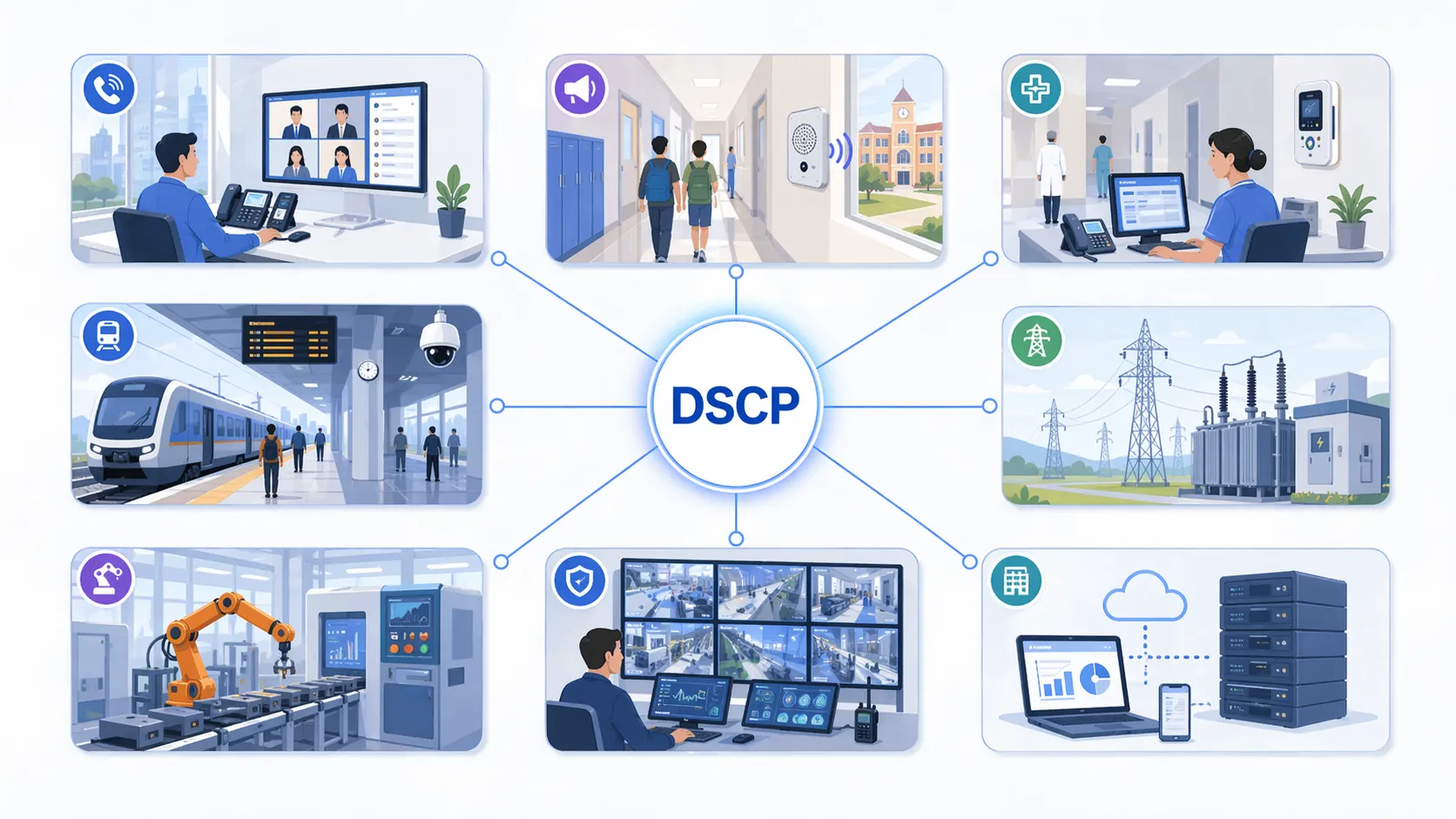
In industrial and operational networks, DSCP can help voice, paging, and control-related traffic receive more predictable forwarding treatment.
DSCP and Quality of Service Design
Why DSCP Alone Is Not Enough
Although DSCP is important, it is only one part of QoS design. A marked packet still depends on actual device configuration, queue allocation, bandwidth planning, congestion management, and trust boundaries. If the network ignores markings, rewrites them incorrectly, or lacks usable scheduling policies, the DSCP value will have little practical effect.
QoS design therefore requires consistency. Endpoints, switches, routers, WAN devices, and provider edges must either preserve or intentionally map DSCP values in a coordinated way. Otherwise, the packet may lose its intended treatment as it moves through the network.
This is why experienced engineers treat DSCP as a classification framework within a broader performance strategy rather than as a stand-alone feature.
Trust Boundaries, Mapping, and Policy Enforcement
A trust boundary defines where the network begins accepting or remarking incoming DSCP values. For example, a switch connected to managed IP phones may trust the phone's markings while still controlling how connected PCs are treated. Upstream devices may then map those markings into specific queues and bandwidth behaviors.
Policy enforcement is important because not all packets should be allowed to claim high priority. If every device could mark its traffic as urgent without restriction, the value of QoS would collapse. Good design therefore combines DSCP marking with access control, remarking policy, and realistic class planning.
This protects critical services while keeping the network fair and manageable. In other words, DSCP works best when the network is selective, not when everything is treated as top priority.
If every packet is marked important, then no packet is truly prioritized.
DSCP Versus CoS and Other Traffic Priority Methods
Layer 3 Marking Versus Layer 2 Priority
DSCP operates at Layer 3 because it is carried in the IP header. Class of Service, often called CoS in Ethernet switching contexts, operates at Layer 2 and is associated with VLAN-tagged frame priority. These two mechanisms are related but not identical. CoS is useful within local switched environments, while DSCP is more suitable for end-to-end IP-based forwarding policy across routed networks.
In many practical designs, networks use both. Traffic may be classified at the access layer, mapped into a CoS value for local switching behavior, and also marked with DSCP for routed transport. The mapping between them depends on organizational QoS standards and device capabilities.
Understanding this difference helps avoid confusion. DSCP is not the only priority method in networking, but it is one of the most important for IP traffic classification across modern infrastructures.
Why DSCP Remains Widely Used
DSCP remains widely used because it is standardized, flexible, and well suited to IP-based service differentiation. It works across many kinds of networks and can support a range of traffic classes without requiring an entirely separate physical infrastructure for critical services.
As organizations continue to converge voice, video, control, and data onto shared IP platforms, the need for structured traffic treatment remains strong. DSCP offers a practical way to express packet priority in that shared environment.
For this reason, it continues to be a central concept in enterprise QoS, WAN policy, UC design, and industrial IP communications.
Conclusion
Differentiated Services Code Point is a packet-marking method used to classify IP traffic so networks can apply different forwarding behaviors to different service types. It is a key part of QoS design because it helps distinguish delay-sensitive, operationally important, and best-effort traffic on shared infrastructure.
DSCP does not guarantee performance by itself, but it provides the labeling framework that routers, switches, and policy engines use to make better forwarding decisions. In enterprise, carrier, and industrial environments, this can improve the experience of voice, video, paging, signaling, and other critical applications during periods of congestion or heavy use.
As more organizations rely on converged IP networks for communication and operations, DSCP remains highly relevant. It helps networks move beyond one-size-fits-all forwarding and toward more predictable treatment of the traffic that matters most.
FAQ
What is DSCP used for?
DSCP is used to mark IP packets so network devices can classify and handle them according to QoS policy. This helps the network prioritize or differentiate traffic such as voice, video, signaling, and ordinary data.
Its purpose is not to add bandwidth directly, but to improve how existing network resources are allocated when different traffic types compete.
Is DSCP the same as QoS?
No. DSCP is one part of QoS, not the whole thing. DSCP provides the packet marking, while QoS includes the wider policy framework such as classification, queuing, scheduling, congestion management, and trust boundaries.
In other words, DSCP is a mechanism used inside a broader QoS strategy.
Why is DSCP important for VoIP and SIP systems?
DSCP is important for VoIP and SIP systems because voice and signaling traffic are often sensitive to delay, jitter, and packet loss. Proper marking can help those packets receive more favorable treatment across a shared network.
This can improve call quality, paging intelligibility, and the overall stability of real-time communication services in business and industrial deployments.