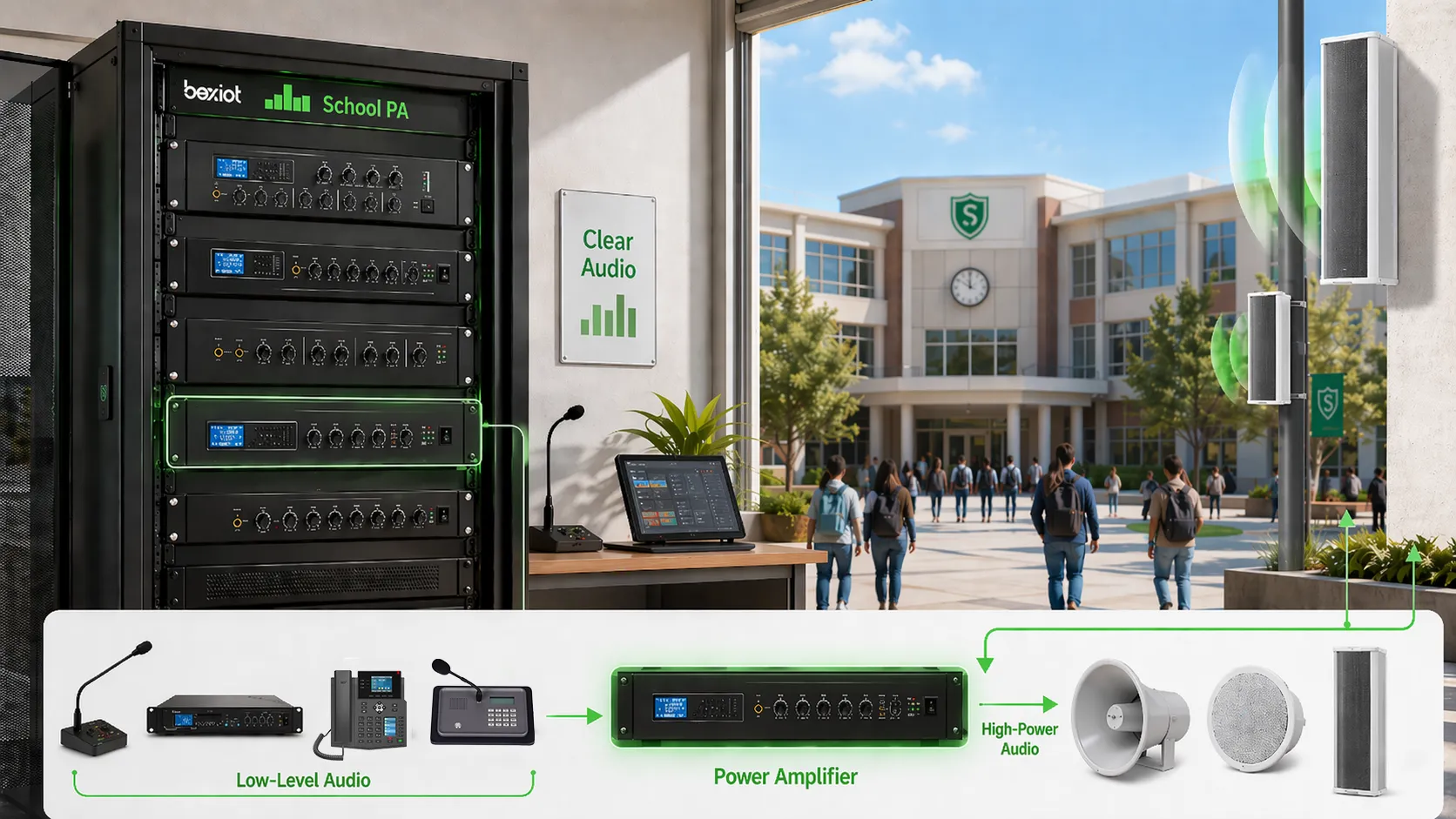
A power amplifier is a device that takes a low-level audio signal and increases its power so that loudspeakers can reproduce sound at a practical listening level. In simple terms, it is the stage that gives an audio system the strength needed to move from signal transmission to real acoustic output. Without power amplification, microphones, media players, paging controllers, SIP endpoints, and mixing equipment may send audio instructions, but the connected speakers would not deliver the volume, coverage, and clarity required in real-world environments.
Power amplifiers are widely used in public address systems, commercial sound systems, industrial communication platforms, transportation facilities, schools, stadiums, factories, and emergency broadcasting networks. In modern IP-based deployments, they are also increasingly tied to network audio and SIP communication platforms, making them an important part of both traditional analog audio chains and newer integrated paging architectures.
Understanding What a Power Amplifier Does
Definition and Core Role
The basic role of a power amplifier is to receive an incoming audio signal and raise its power level so it can drive one or more speakers. The input signal may come from a microphone preamp, mixer, media source, intercom controller, paging console, IP gateway, or SIP server-linked endpoint. The amplifier does not create the content of the audio. Instead, it provides the electrical energy required to reproduce that content at an audible and useful level.
This function makes the power amplifier a bridge between signal processing and sound reproduction. In many systems, source devices manage call control, routing, tone generation, announcements, and audio scheduling, while the amplifier handles the heavy work of delivering enough output power for the loudspeaker line. That is why power amplifiers are essential in any audio design where sound must travel across large areas or remain intelligible in noisy conditions.
In practical engineering terms, the amplifier helps convert communication intent into acoustic presence. Whether the goal is background music, routine paging, alarm tones, or emergency voice instructions, the amplifier is what enables the message to reach people clearly through connected speakers.
In a complete audio system, the power amplifier is the stage that turns a usable signal into usable sound.
Signal Level Versus Power Level
It is important to distinguish between a signal and the power needed to reproduce that signal. A line-level signal can carry the full content of speech or music, but it usually does not have enough electrical energy to move a loudspeaker cone effectively. The amplifier keeps the original signal information while increasing the available output power so that the speaker can reproduce the sound at the required volume.
This is why a system can appear to be functioning at the control side while still failing at the acoustic side. For example, a paging controller may show that a live announcement is active, but without proper amplification, the connected loudspeakers may sound weak, distorted, or silent. In other words, signal transport alone is not enough. Power delivery is equally important.
The relationship between signal level and amplifier capacity also affects sound quality. When an amplifier is undersized, it may be forced to operate near its limit too often, which increases distortion and reduces intelligibility. A properly matched amplifier offers more stable performance, better headroom, and a more reliable listening result.
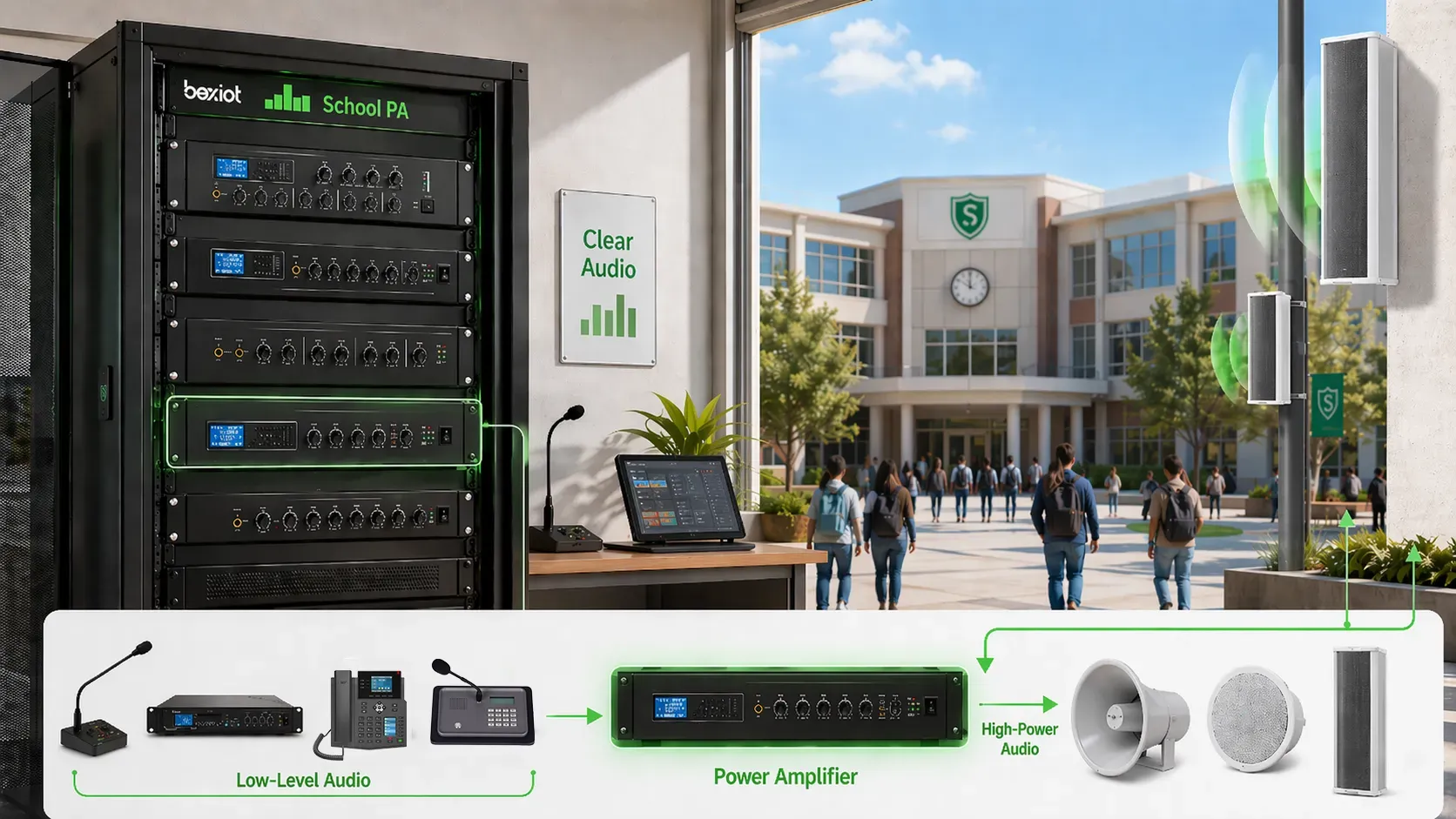
Rack-mounted power amplifiers are commonly deployed in control rooms, equipment cabinets, and centralized paging systems.
How a Power Amplifier Works
From Input Signal to Speaker Output
A power amplifier begins by receiving an audio input signal from an upstream device. That signal is analyzed and reproduced at the output stage with greater voltage and current capability. The amplifier uses its internal power supply and output circuitry to deliver the energy needed by the speaker load while preserving the waveform of the source signal as accurately as possible.
In audio terms, this means the amplifier should make the signal stronger without changing its essential content. A well-designed amplifier raises output power while keeping noise, distortion, and coloration under control. This becomes especially important for speech communication, because intelligibility depends not only on loudness but also on the clean reproduction of consonants, transients, and tonal balance.
Once the amplified signal reaches the speaker, the speaker converts electrical energy into mechanical motion and then into sound waves. The listener hears the final result, but behind that result is a chain that depends heavily on stable and correctly sized amplification.
Impedance, Wattage, and Headroom
Three common ideas appear in power amplifier selection: impedance, wattage, and headroom. Impedance describes the electrical load presented by the speaker or speaker line. Wattage refers to the power the amplifier can deliver. Headroom describes the extra capacity available above normal operating level, which helps the system handle peaks without clipping.
In low-impedance speaker systems, such as 4-ohm or 8-ohm designs, amplifier matching must be handled carefully to avoid overload or instability. In commercial and industrial paging systems, 70V or 100V constant-voltage distribution is often used because it simplifies speaker-line design across many zones and long cable runs. In those environments, the amplifier must support the correct distribution method as well as the total speaker load.
Headroom matters because audio is dynamic. Speech peaks, alarm tones, and sudden program material can all demand more power than the average signal level suggests. An amplifier with comfortable operating margin is more likely to sound clean, remain stable, and avoid clipping during demanding moments.
Good amplifier design is not only about maximum loudness. It is also about controlled output, clear speech, and consistent performance under load.
Main Types of Power Amplifiers in Communication and Audio Systems
Audio Power Amplifiers for Paging and Public Address
In paging and public address environments, power amplifiers are used to distribute voice announcements, background music, alarm tones, and scheduled broadcasts to wall speakers, horn speakers, ceiling speakers, column speakers, and industrial loudspeakers. These amplifiers are typically installed in equipment racks or cabinets and may support one zone or many zones depending on overall system architecture.
Their design priorities usually focus on continuous operation, thermal stability, line matching, and compatibility with centralized control equipment. Unlike consumer audio amplifiers, paging amplifiers are often selected for intelligibility, system uptime, and practical integration rather than purely entertainment-oriented sound character.
In transportation hubs, campuses, factories, and public facilities, this kind of amplifier plays a direct role in making sure operational messages are heard over distance and background noise. When combined with microphones, intercoms, or control software, it becomes part of a much larger communication workflow rather than a stand-alone audio device.
Network and SIP-Enabled Power Amplifiers in Modern Systems
As communication systems move toward IP architecture, power amplifiers are no longer always isolated hardware blocks. Many modern designs connect amplification with network audio transport, SIP paging logic, multicast distribution, web-based management, or centralized server control. This makes the amplifier part of a smart communications platform rather than only an output device.
In Becke Telcom and similar industrial communication deployments, SIP-enabled amplification can be used to support IP paging, remote broadcasting, scheduled announcements, and integrated emergency notification. Products in this category are often selected not only for output wattage, but also for their ability to work with SIP servers, dispatch platforms, and wider IP PA systems. In practical project design, this helps reduce system fragmentation and improves operational control.
For example, Becke Telcom’s SIP amplifier direction, including models such as the BK-PA060A, BK-PA120A, and BK-PA800A in relevant deployment discussions, reflects how amplification can be combined with network communication, centralized configuration, and modern paging workflows. This is especially valuable for organizations that want one system to support both routine announcements and higher-priority voice broadcasting.
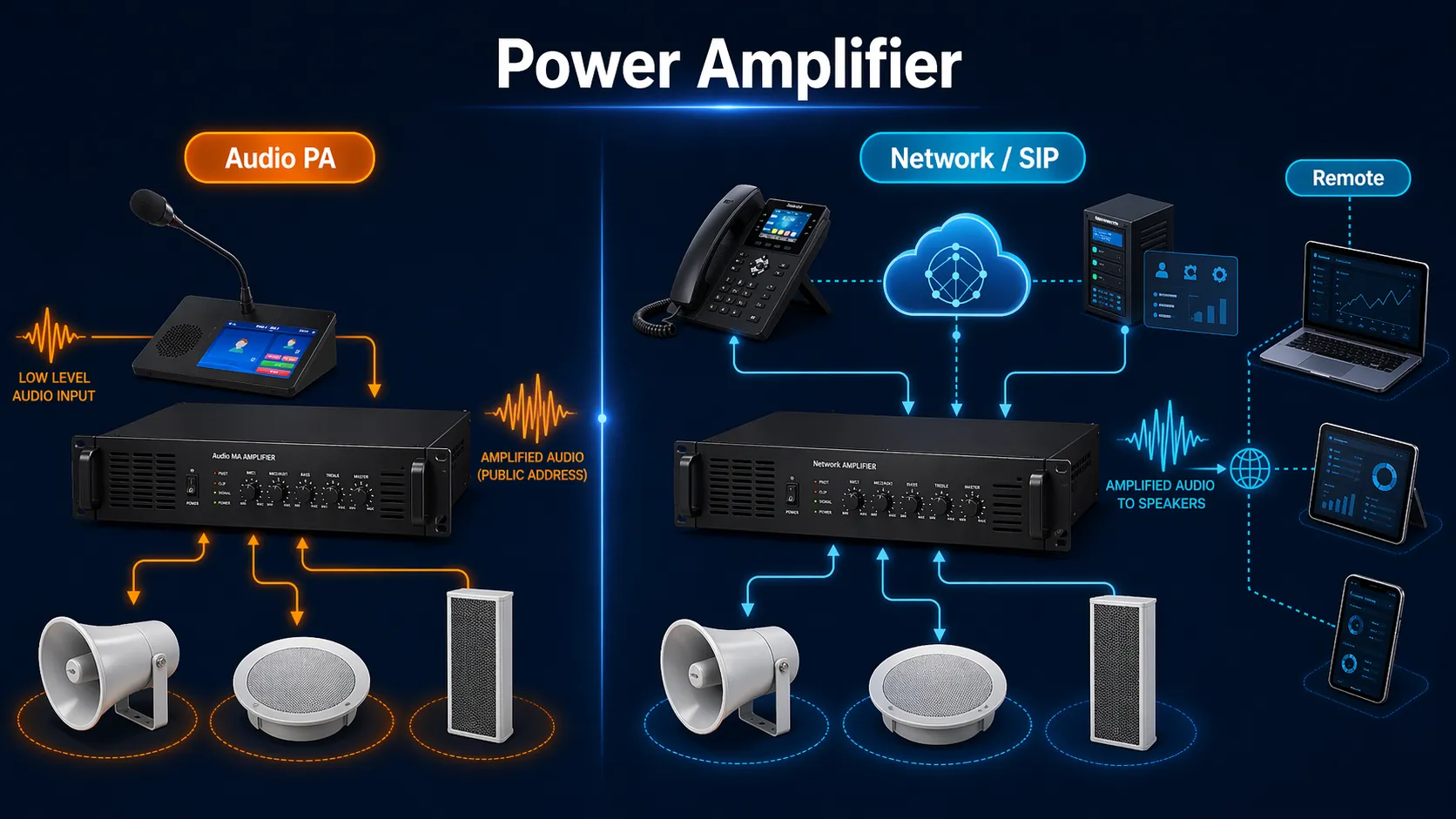
In IP-based audio architecture, power amplifiers can be integrated with SIP paging, server control, and remote management workflows.
Benefits of Using a Power Amplifier
Stronger Coverage and Better Speech Clarity
One of the clearest benefits of a power amplifier is that it enables wider and more effective sound coverage. A source device alone cannot deliver the energy needed for large spaces, outdoor areas, or multi-speaker zones. The amplifier provides that energy, helping the system maintain useful listening levels across offices, corridors, factories, platforms, campuses, and public venues.
This benefit becomes even more important for speech. In many business and safety-related environments, the goal is not simply to make sound louder. The goal is to make instructions understandable. A properly matched amplifier helps preserve speech clarity, reduce weak output problems, and support more consistent intelligibility across the coverage area.
In environments with ambient noise, such as workshops, transportation infrastructure, and industrial plants, amplification quality can directly influence whether a spoken message is actually understood. That is why amplifier selection should be treated as a communication decision, not just an electrical specification.
Scalability, Centralization, and System Flexibility
Another major advantage is scalability. Power amplifiers make it possible to expand an audio system from a small local installation into a multi-zone or site-wide platform. As more speakers, areas, or functional zones are added, amplification capacity can be planned accordingly. This supports structured growth instead of forcing a complete redesign every time the system expands.
Amplifiers also support centralized management. In a modern paging or IP PA design, audio sources, routing logic, priorities, schedules, and user permissions may all be controlled from a server or dispatch layer, while amplifiers deliver the final output across the field. This separation improves maintenance and makes system architecture more organized.
For organizations moving toward integrated communication, amplification can also sit alongside SIP intercoms, IP phones, alarm inputs, video linkage, and emergency workflows. That broader compatibility is one reason power amplifiers remain relevant even as audio and communication networks become more software-driven.
Common Applications of Power Amplifiers
Commercial Buildings, Schools, and Transportation Facilities
In commercial buildings and campuses, power amplifiers are used for routine paging, public announcements, scheduled tones, background music, and emergency messaging. They are often part of a centralized public address system that serves lobbies, hallways, offices, classrooms, parking areas, or outdoor gathering spaces.
In schools, amplification supports bell scheduling, zone paging, and campus-wide alerts. In rail stations, airports, and terminals, it helps ensure that instructions, service updates, and emergency notices can be delivered across large and often noisy spaces. The amplifier is one of the key components that allows these messages to remain audible over physical distance and ambient activity.
Because these settings often require zone control and predictable coverage, amplifiers used here are typically selected with long-run stability, speaker-line compatibility, and centralized control integration in mind.
Industrial Plants, Tunnels, and Emergency Communication Sites
In industrial environments, power amplifiers are frequently paired with horn speakers, rugged loudspeakers, PAGA systems, control room platforms, and emergency communication equipment. These sites may include oil and gas facilities, manufacturing plants, utility tunnels, mining areas, offshore platforms, and process industries where announcements must remain clear under harsh acoustic conditions.
Amplification in these applications is not only about sound pressure. It is also about dependability. If a site depends on voice instructions during alarms, evacuation, maintenance coordination, or operational dispatch, the amplifier becomes part of the site’s communication resilience strategy. Protection features, continuous-duty performance, and system integration therefore matter a great deal.
This is also where suppliers such as Becke Telcom can be relevant in project planning, especially when amplification is not a stand-alone requirement but part of a broader industrial SIP paging, emergency broadcasting, or integrated communication solution.
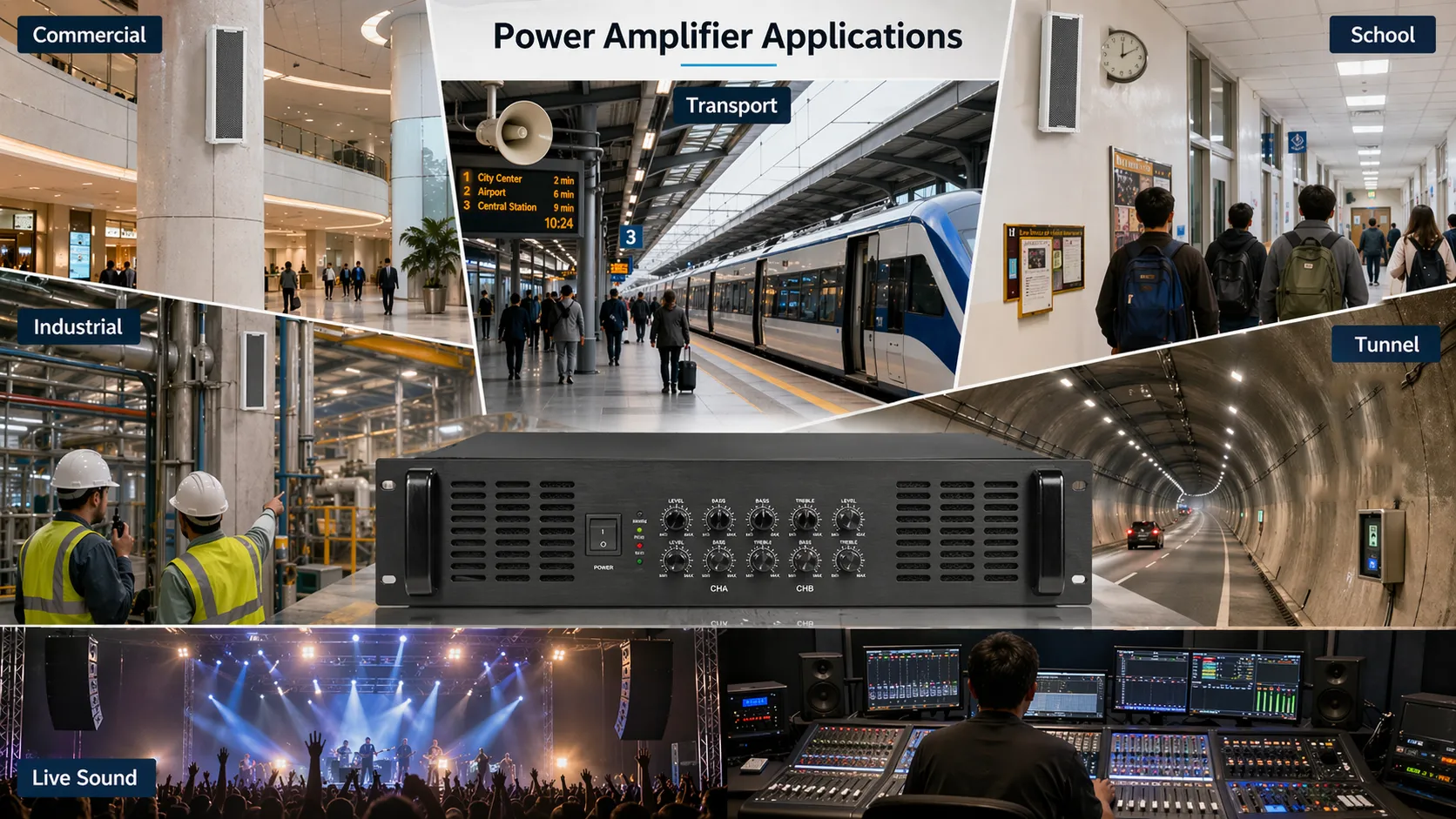
In industrial and mission-critical sites, power amplifiers help drive paging speakers for operational coordination and emergency communication.
Broadcasting, Live Sound, and Specialist Audio Projects
Power amplifiers are also widely used in live sound, performance venues, houses of worship, conference facilities, and specialist audio installations. In these settings, they may support music reinforcement, speech systems, event audio, and distributed loudspeaker networks. The technical priorities may vary, but the core principle remains the same: the amplifier provides the output power required by the speaker system.
Compared with industrial or paging-focused systems, these projects may place more emphasis on musical dynamics, low-frequency performance, and audience experience. Even so, amplifier sizing, speaker matching, and thermal reliability are still central engineering concerns.
This broader range of applications shows why the power amplifier remains one of the most foundational devices in audio infrastructure. Its role extends across commercial communication, life-safety messaging, and high-performance sound reproduction.
How to Choose the Right Power Amplifier
Power Capacity, Load Matching, and Installation Conditions
Choosing the right power amplifier starts with the speaker design and the actual use case. You need to know whether the system is low-impedance or constant-voltage, how many speakers will be connected, what the total load will be, and what sound pressure or intelligibility target is expected in the space. Selecting only by a headline wattage figure can lead to poor system balance.
Installation conditions also matter. A quiet office ceiling-audio system has very different requirements from an outdoor paging network or a factory-wide emergency voice platform. Temperature, ventilation, enclosure type, dust exposure, uptime expectations, and rack-space limitations should all influence amplifier selection.
In networked projects, interface requirements matter just as much as output power. The amplifier may need SIP compatibility, web configuration, remote control, scheduled playback support, or interoperability with an IP paging server. In those cases, the right model is the one that fits both the acoustic design and the system architecture.
Reliability, Protection, and Future Expansion
Reliability should never be treated as a secondary issue. A good amplifier should include practical protection features such as overload protection, overheating control, short-circuit protection, and stable continuous-duty behavior. These protections help preserve both the amplifier itself and the wider system it supports.
Future expansion is another key consideration. Many organizations begin with one building, one plant area, or one paging zone, but later extend the system to more locations. Choosing an amplifier platform that can scale, integrate, and remain manageable over time reduces future upgrade pressure.
If the project involves SIP paging, industrial broadcasting, or a converged communication environment, it can be useful to evaluate vendors that understand both amplification and system-level voice architecture. In that context, a light Becke Telcom approach may make sense for buyers who want power amplification tied more closely to IP communication and operational paging workflows rather than treated as isolated audio hardware.
Conclusion
A power amplifier is a critical device that increases audio signal power so speakers can deliver sound with practical volume, coverage, and clarity. It sits at the point where signal handling becomes real acoustic output, making it essential in public address, paging, industrial communication, broadcasting, and commercial sound systems.
Its value goes beyond loudness. A well-chosen power amplifier supports speech intelligibility, system stability, scalable design, and dependable long-term operation. As audio systems move toward IP integration, the amplifier also becomes part of a broader communication architecture that may include SIP control, centralized management, remote broadcasting, and emergency notification.
For organizations building modern paging or industrial voice systems, this is where solution-oriented suppliers become relevant. Becke Telcom, for example, can be considered when a project requires not only amplification, but also coordination with SIP paging, IP PA infrastructure, and broader communication integration.
FAQ
Is a power amplifier the same as an audio amplifier?
A power amplifier is a type of audio amplifier, but the term usually refers specifically to the stage that provides enough output power to drive speakers. Some devices combine preamplifier functions, source control, and power amplification in one unit, while others separate those functions across different hardware blocks.
In system design, the distinction matters because not every audio device that handles sound is able to drive a speaker line directly. Mixers, intercom controllers, and media players may process or route audio, but they often still rely on a dedicated power amplifier for final speaker output.
Why is amplifier headroom important?
Headroom is important because real audio signals are dynamic. Speech peaks, alarm tones, and musical transients can rise above the average signal level, and the amplifier needs enough reserve capacity to reproduce those peaks cleanly.
When headroom is insufficient, clipping becomes more likely. That can reduce speech intelligibility, increase distortion, and in severe cases place extra stress on the speaker system. Adequate headroom helps the system sound cleaner and operate more reliably.
Where are power amplifiers commonly used in business and industrial systems?
They are commonly used in schools, offices, malls, transportation hubs, factories, tunnels, utility sites, campuses, warehouses, and emergency communication networks. Any environment that needs controlled audio distribution to multiple speakers is likely to require amplification.
In modern business and industrial projects, power amplifiers are often used together with SIP paging, IP public address systems, dispatch platforms, and alarm-linked broadcast workflows. This makes them part of a wider operational communication system rather than a stand-alone sound component.