A T1 digital trunk is a dedicated telecommunications circuit widely used to carry voice and data between customer equipment and a carrier network. In traditional enterprise telephony, it became one of the most important building blocks for connecting a private branch exchange, or PBX, to the public network. In broader communications infrastructure, it also served as a stable digital access method for point-to-point connectivity, channelized services, and business-grade WAN transport.
Even though many organizations have moved toward SIP trunking, fiber access, and all-IP voice networks, T1 digital trunks still appear in legacy enterprise systems, critical facilities, rural deployments, industrial environments, and migration projects where older equipment remains in service. Understanding how a T1 digital trunk works is useful not only for maintaining installed systems, but also for planning upgrades, interworking legacy infrastructure, and making informed decisions about replacement strategies.
Understanding T1 Digital Trunk
What a T1 Digital Trunk Means
A T1 digital trunk is a digital transmission service based on the T-carrier system, most commonly delivered at a line rate of 1.544 Mbps. In North American telecommunication networks, a single T1 circuit is structured as 24 individual 64 kbps channels, often called DS0 channels. These channels can be used for voice, data, or a mix of both, depending on how the service is provisioned and how the connected equipment is configured.
When people refer to a T1 digital trunk in voice applications, they usually mean a carrier-provided digital connection between a business phone system and the public switched telephone network. Instead of using multiple analog lines, the organization uses one digital circuit to support multiple simultaneous calls. This improves line efficiency, simplifies trunk management, and provides a more structured interface for enterprise telephony equipment.
T1 as a Business Access Technology
The importance of T1 was not limited to telephony. For many years, T1 circuits were also used for leased-line data connectivity, branch office links, dedicated internet access, and access to carrier services. Because the bandwidth was fixed and the circuit was dedicated, T1 developed a reputation for predictable performance and operational stability compared with best-effort shared access services.
In voice deployments, the T1 format allowed carriers and enterprises to consolidate channels in a clean digital form. In data deployments, the same transport model supported routers, CSU/DSUs, and private WAN connections. This dual role is one reason T1 remained common for such a long time: it fit both legacy voice architecture and early digital networking with a single well-understood service model.
Although it is now considered a legacy access method in many markets, T1 still matters in practical engineering discussions because so many older PBXs, alarm systems, branch routers, and carrier handoff designs were built around it. In those environments, a working knowledge of T1 is still necessary for troubleshooting, replacement planning, and network documentation.
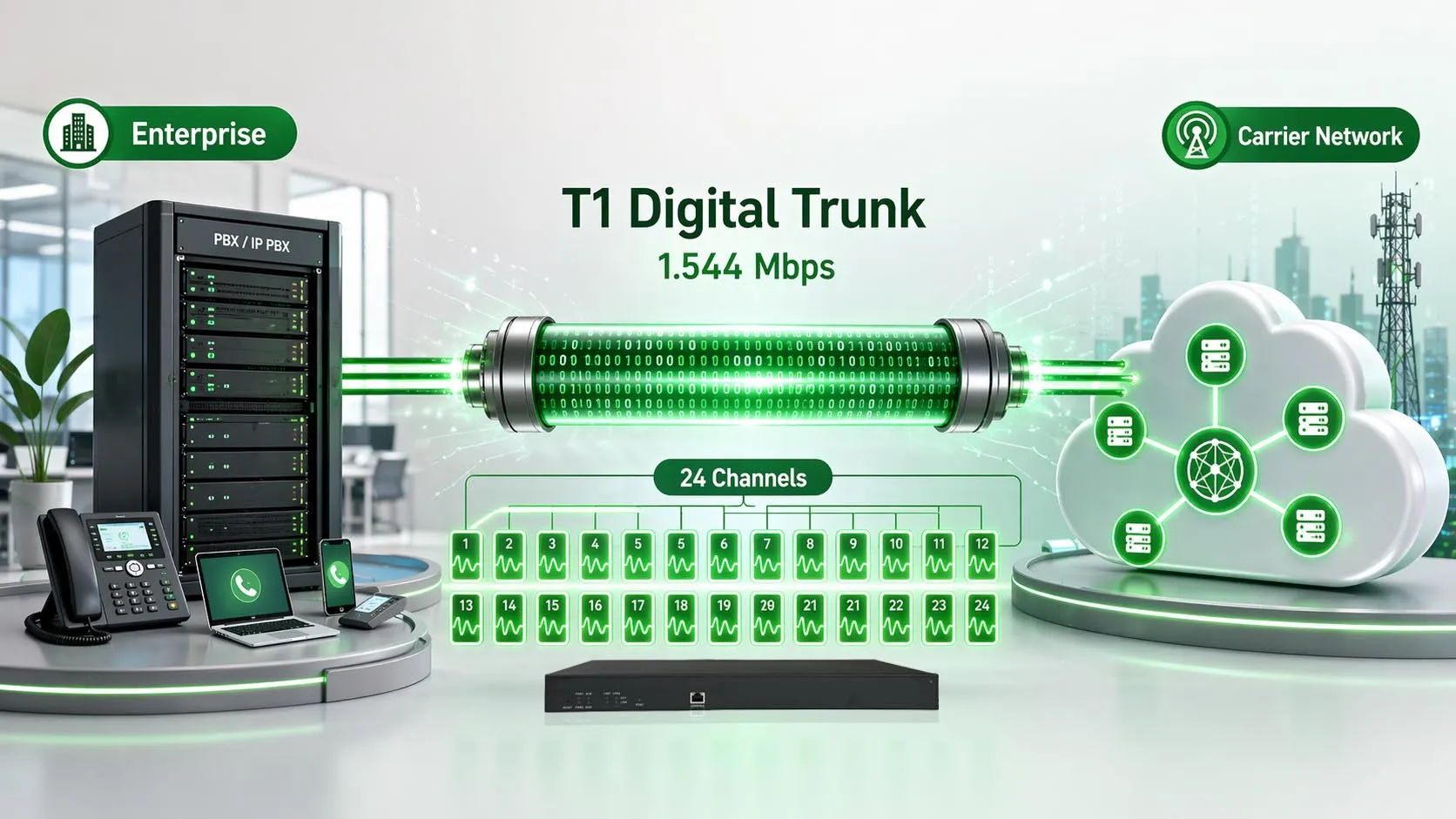
A T1 digital trunk provides a structured digital connection between enterprise equipment and the carrier network for multiple simultaneous channels.
Key Features of T1 Digital Trunk
24-Channel Structure and Predictable Capacity
One of the defining features of a T1 digital trunk is its 24-channel architecture. Each channel represents a DS0 time slot, which makes the circuit highly structured and easy to map in voice and data environments. In a conventional telephony deployment, that structure allows a business to carry many concurrent calls over a single digital trunk rather than managing a large bundle of separate analog lines.
This fixed channel model also makes capacity planning straightforward. Network and telephony teams can determine how many simultaneous call paths are available, how many channels are reserved for signaling or special functions, and whether the circuit is adequate for current traffic. In legacy environments where deterministic resource allocation matters more than burst capacity, that predictability is a real operational advantage.
Dedicated Circuit Behavior and Stable Performance
A T1 digital trunk is typically provisioned as a dedicated carrier circuit rather than a shared broadband service. Because the bandwidth is reserved and the service characteristics are well defined, T1 is associated with steady latency behavior, consistent channel performance, and better control over service expectations. This made it attractive for business telephony, especially in periods when packet voice quality over shared IP access was less mature than it is today.
For organizations that prioritized voice continuity, consistent call behavior, and carrier-managed service levels, T1 was often preferred over loosely managed alternatives. The circuit provided a stable physical and logical interface that could be monitored, tested, and maintained using established telecom methods. In many cases, this reduced operational uncertainty for both carriers and enterprise administrators.
That stability also contributed to T1's use in backup and resilience designs. Even where newer connectivity methods were deployed, some organizations retained T1 for specific fallback functions, legacy trunk groups, or controlled service paths that needed consistent behavior under defined operating conditions.
Compatibility with PBXs and Legacy Equipment
T1 digital trunks became deeply integrated into PBX and enterprise voice infrastructure. Many business phone systems, channel banks, access gateways, and telecom interfaces were designed specifically to connect to T1-based carrier services. As a result, T1 achieved broad compatibility across generations of enterprise telephony hardware.
This long service life is still one of the reasons T1 remains relevant. A facility may continue using a T1 digital trunk not because it is the newest option, but because it fits existing equipment, preserves known workflows, and avoids immediate replacement of an otherwise functional telephony environment. In maintenance-heavy sectors and phased migration projects, that compatibility continues to carry practical value.
T1 digital trunking became important not simply because it was digital, but because it gave enterprise voice systems a disciplined, carrier-grade way to scale beyond analog lines while keeping call paths structured and manageable.
Network Architecture of a T1 Digital Trunk
Basic T1 Network Topology
In a typical architecture, the customer side includes a PBX, router, voice gateway, or channelized access device. That equipment connects to a CSU/DSU or an integrated T1 interface, which prepares the signal for transmission over the local loop. The local loop extends from the customer premises to the carrier access network, which then connects into a central office, digital cross-connect system, or broader transport infrastructure.
On the carrier side, the T1 may terminate into switching systems, tandem networks, channel banks, or aggregation platforms depending on whether the service is used for voice trunking, leased-line data, or special access. In a voice scenario, the trunk connects enterprise call traffic into the public switched telephone network or into a carrier's digital voice platform. In a data scenario, it may connect to another customer site, a managed network, or an upstream service node.
This architecture is important because it separates customer equipment, access handoff, and carrier transport into defined layers. That separation makes fault isolation easier. Teams can identify whether an issue is inside the PBX, at the interface level, on the local loop, or deeper in the carrier network rather than treating the whole circuit as one undefined connection.
Customer Premises Equipment and Interface Roles
The equipment at the customer site often determines how the T1 digital trunk is used. A PBX may use the T1 to handle inbound and outbound voice calls. A router paired with a CSU/DSU may use it for WAN data transport. A media gateway may convert legacy T1 channels into SIP sessions for migration between old telephony infrastructure and modern IP communication platforms.
In older deployments, the CSU/DSU is a key architectural element because it provides signal conditioning, framing, loopback testing, and line interface functions. In some devices, these features are integrated directly into the access router or PBX interface card. Regardless of form factor, the role remains the same: establish a standards-compliant digital handoff between enterprise equipment and the carrier circuit.
From an operations perspective, this layer is also where administrators often perform line testing, alarm checking, and status verification. Understanding the handoff point is essential when diagnosing slips, framing errors, loss of signal, or call path issues on a T1 service.
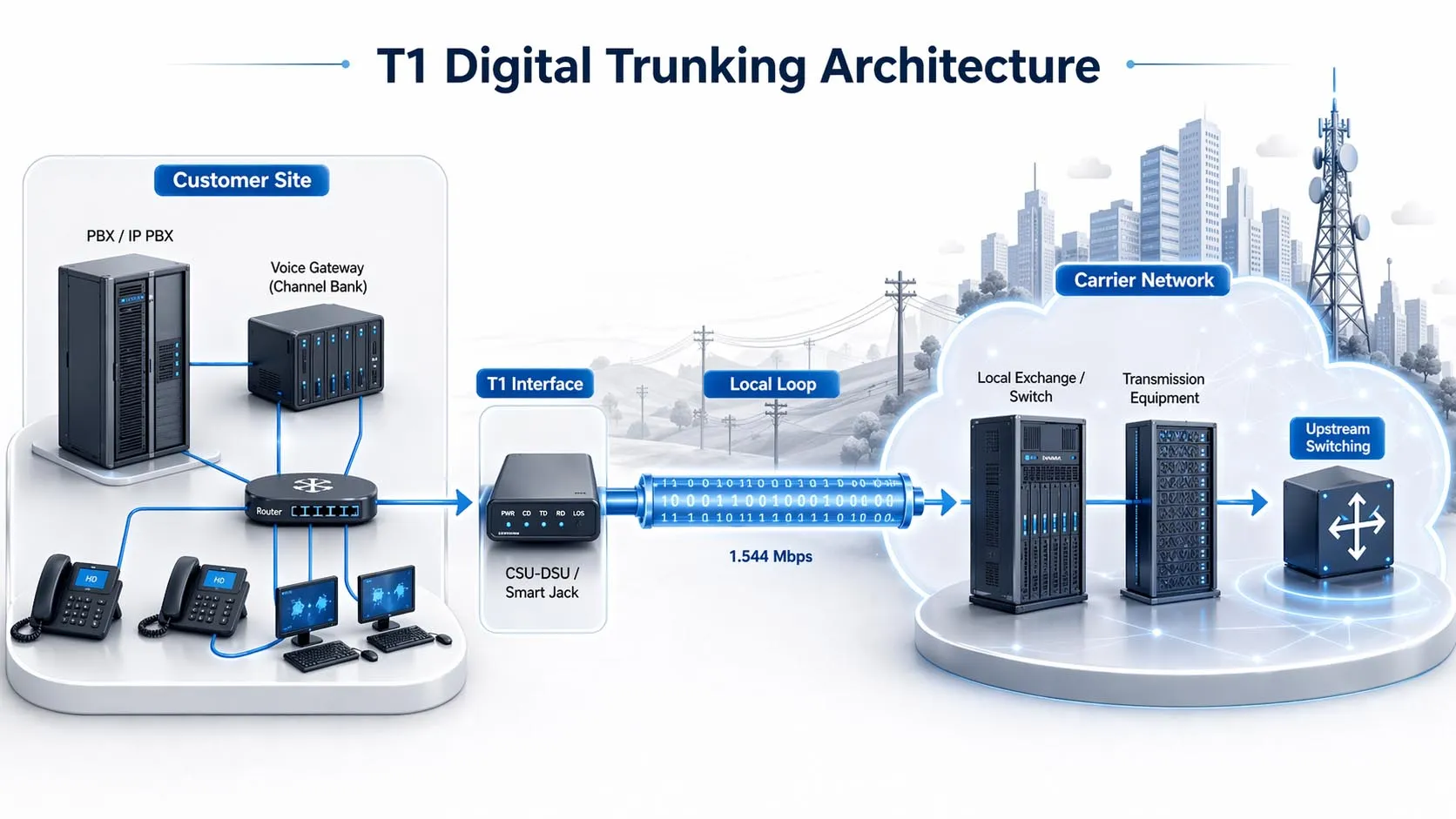
The T1 network architecture typically includes customer equipment, a T1 handoff interface, the carrier local loop, and upstream switching or transport infrastructure.
How T1 Digital Trunk Carries Voice Traffic
Channelization, Framing, and Signaling
A T1 digital trunk carries traffic in a time-division multiplexed format. The 24 DS0 channels are interleaved into frames and transmitted at the fixed T1 line rate. In voice networks, each DS0 can represent a single call path, which makes the service suitable for multi-line business telephony. The carrier and customer equipment must agree on framing and line coding so that the signal is interpreted correctly at both ends.
In legacy voice deployments, T1 digital trunks may use channel-associated signaling, sometimes called robbed-bit signaling, where signaling information is carried within the voice channel structure. In other cases, the service may be delivered as ISDN PRI over T1, where 23 bearer channels are used for voice or data and one channel is reserved for signaling. Both models are related to T1 transport, but they differ in how call control is organized.
This distinction matters in real deployments. A general T1 digital trunk refers to the transport medium and digital trunk format, while PRI describes a specific signaling method carried on a T1 in many enterprise PBX environments. Engineers maintaining legacy systems often need to know which signaling model is in use before modifying the circuit or replacing the connected equipment.
Call Routing Between PBX and Carrier
When a user places a call through a PBX connected to a T1 digital trunk, the PBX selects an available channel and sends the call toward the carrier. The carrier network then routes the call into the public network or to the intended destination. For inbound traffic, the opposite process occurs: the carrier presents the call on the trunk, and the PBX directs it to the correct extension, hunt group, or service application.
This method allows an organization to centralize voice connectivity. Instead of assigning a dedicated analog line to every user or function, the enterprise concentrates many call paths through a smaller number of digital trunks. That is one reason T1 digital trunking played such a major role in the development of scalable business telephony.
In voice architecture, the real strength of T1 is not raw speed. It is the structured delivery of multiple reliable call channels between enterprise systems and the carrier network.
Operational Advantages and Practical Limitations
Why T1 Was So Widely Adopted
T1 digital trunking offered a strong combination of channel efficiency, service predictability, and telecom-grade manageability. It reduced the physical clutter of large analog trunk groups, provided clearer carrier demarcation, and gave enterprises a consistent platform for PBX expansion. For data services, it offered a dedicated point-to-point digital connection that was easier to characterize than many early shared-access alternatives.
Another operational strength was the maturity of the ecosystem around it. Carriers, enterprise telecom teams, and support vendors all had established procedures for provisioning, testing, and maintaining T1 services. That maturity lowered the learning curve and made the technology dependable in environments where change control was conservative and service continuity mattered more than adopting the newest interface.
Where T1 Shows Its Age Today
In modern networks, the biggest limitation of T1 is bandwidth. A line rate of 1.544 Mbps is modest by contemporary standards, and even its structured 24-channel design can be restrictive compared with SIP trunking over scalable IP access. T1 services can also be more expensive per unit of capacity than newer transport methods, especially where fiber and Ethernet access are widely available.
There are also lifecycle considerations. Carriers in many regions have reduced investment in legacy TDM infrastructure, and organizations with aging PBXs may face challenges related to spare parts, interface cards, and support expertise. This does not make T1 unusable, but it does mean long-term planning is important. Many enterprises now treat T1 as a maintained legacy service or as a temporary bridge during migration to IP-based communications.
Even so, the retirement path is rarely only technical. Regulatory constraints, field device dependencies, branch availability, or the need to preserve stable voice service during phased upgrades can all keep T1 in operation longer than expected.
Typical Applications of T1 Digital Trunk
PBX Voice Trunking in Enterprises
The most familiar application of a T1 digital trunk is PBX voice connectivity. Businesses use the trunk to support multiple simultaneous inbound and outbound calls without installing a large number of analog trunks. This was especially important for offices, contact centers, campuses, hotels, hospitals, and institutions that needed more calling capacity and more professional call handling than simple line-by-line analog service could provide.
Because the channels are grouped in a digital interface, T1 also supports structured numbering, call distribution, DID services, and cleaner expansion of enterprise telephony. In many legacy office environments, this is still the core reason a T1 trunk exists today.
Branch Connectivity and Legacy Data Links
Before modern broadband and carrier Ethernet became common, T1 circuits were widely used for branch office data connectivity and private WAN links. A business could connect remote offices to a headquarters site or to a managed network using dedicated digital access with defined service characteristics. While these data applications are less common today, they still appear in older network designs and in special environments where existing infrastructure remains active.
In some migration scenarios, a T1 data circuit is also retained as a backup path, out-of-band management link, or fallback service for equipment that was never redesigned for modern access methods. This is especially relevant where operational reliability, certification boundaries, or site constraints slow down infrastructure changes.
Industrial, Utility, and Critical Facility Environments
T1 digital trunking can also be found in utility networks, transport systems, industrial facilities, and other critical sites that adopted digital telecom services early and maintained them over long lifecycle periods. In these settings, the T1 may connect PBXs, alarm reporting systems, SCADA-related communications interfaces, or specialized voice services that still depend on TDM transport.
These applications highlight an important point: T1 is not always kept because it is technically superior to newer IP options. It is often kept because it remains integrated into a broader operational system where change must be carefully managed. In critical environments, a working legacy service with known behavior can remain in place until every dependency is fully understood and migration risk is acceptable.
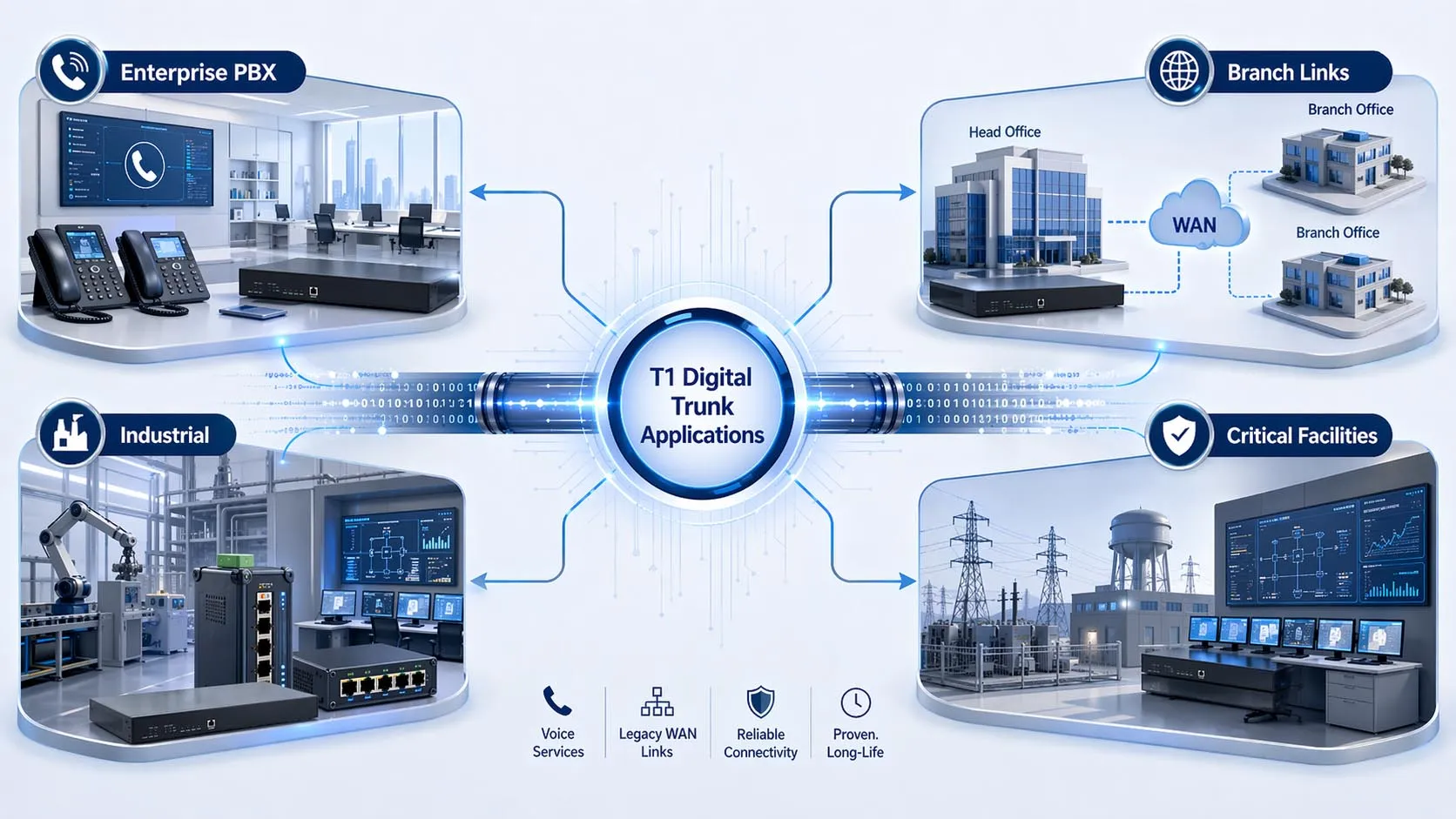
T1 digital trunks have been used in enterprise voice systems, legacy WAN connectivity, and long-lifecycle industrial and critical facility communications.
T1 Digital Trunk Compared with Other Trunking Options
T1 Digital Trunk vs. Analog Trunks
Compared with analog trunks, T1 offers greater channel density, cleaner integration with digital PBXs, and better structural visibility into the trunk resource. Instead of managing many separate analog pairs, the enterprise can manage one digital facility carrying multiple channels. This simplifies scaling and often improves the professionalism of the overall telephony design.
Analog trunks may still be useful in small or highly specific applications, but they are less efficient for organizations that need a larger number of concurrent call paths. T1 became the preferred upgrade path in many classic enterprise voice environments precisely because it solved that scaling problem in a standardized way.
T1 Digital Trunk vs. SIP Trunking
Compared with SIP trunking, T1 is less flexible and far less bandwidth-efficient, but it can still be attractive in legacy systems that were built around TDM interfaces. SIP trunking rides over IP access and can scale more elastically, integrate more easily with modern unified communications, and often reduce the dependency on specialized legacy telecom hardware. For new deployments, SIP is usually the more future-oriented choice.
However, migration is not always immediate. A T1-connected PBX may require interface gateways, signaling conversion, dial plan adjustments, and operational testing before SIP can fully replace the existing service. That is why T1 remains part of many transition architectures: it serves as the legacy baseline from which modernization is staged.
Conclusion
Why T1 Digital Trunk Still Matters
A T1 digital trunk is a dedicated digital communications circuit built around a 24-channel T-carrier structure. It has played a major role in enterprise telephony, PBX trunking, leased-line data, and long-service-life business connectivity. Its main strengths include structured channel capacity, predictable performance, broad compatibility with legacy equipment, and a well-understood operational model.
While newer IP-based services now dominate most fresh deployments, T1 still matters wherever legacy PBXs, critical infrastructure, or phased migration strategies remain in place. For engineers, system integrators, and operations teams, understanding T1 is still valuable because many real-world networks continue to depend on it, support it, or evolve away from it gradually rather than all at once.
FAQ
How many voice channels does a T1 digital trunk support?
A standard T1 provides 24 DS0 channels. In many traditional voice applications, this means up to 24 simultaneous voice paths when channel-associated signaling is used. In PRI configurations carried over T1, one channel is typically used for signaling and 23 channels remain available for bearer traffic.
The exact usable call count depends on the signaling model and how the service is provisioned. That is why administrators should verify whether the circuit is configured as a standard channelized T1, a PRI service, or a specialized carrier offering before making design assumptions.
Is a T1 digital trunk the same as ISDN PRI?
Not exactly. T1 refers to the underlying digital transport format and line structure, while PRI is a specific signaling and service model that can run over a T1 circuit. In other words, PRI often uses T1 transport, but not every T1 digital trunk is necessarily provisioned as PRI.
This difference is important when replacing equipment or troubleshooting call control. Two services may both be described informally as “T1,” yet use different signaling methods and interface expectations.
What equipment is commonly connected to a T1 digital trunk?
Common connected equipment includes PBXs, access routers, CSU/DSUs, media gateways, channel banks, and carrier demarcation devices. In voice environments, the T1 often terminates on a PBX or gateway. In data environments, it may terminate on a router or other WAN access platform.
In migration projects, a media gateway is especially common because it can bridge T1-based legacy voice channels to SIP or other IP communication platforms without requiring an immediate full replacement of the existing system.
Is T1 digital trunking still used today?
Yes, but mostly in legacy, transitional, or specialized environments. Many new deployments prefer SIP trunking, carrier Ethernet, or fiber-based services because they offer greater flexibility and more capacity. Even so, T1 remains in service in older PBX systems, rural sites, critical facilities, and networks where equipment dependencies make rapid migration impractical.
Its continued use is usually driven by operational reality rather than by modern bandwidth requirements. A stable legacy circuit can remain valuable when uptime, compatibility, and controlled migration are more important than adopting the latest access technology immediately.