In many business and field communication scenarios, teams need to use a mobile SIM number like a fixed office phone line. A company may publish a mobile number for customer service but want staff to answer it from desk phones. A temporary project site, outdoor event, emergency command post, rural office, or mobile service point may not have a wired telephone line, but still needs stable phone access through a PBX, IP phone, or dispatch platform.
This requirement is usually solved with a telephone gateway or a cellular telephone converter. Although both can make a mobile SIM number work with fixed telephones or phone systems, their technical routes are very different. One converts mobile voice into SIP/VoIP communication, while the other converts a SIM card into an analog telephone line for a traditional desk phone or PBX interface.
The Real Requirement Behind SIM-to-Phone Conversion
When people say they want to “convert a mobile number into a fixed telephone,” they usually do not mean changing the legal number type from mobile to PSTN. In most projects, the real requirement is to let a mobile SIM card be used through fixed communication equipment, such as a desk phone, analog phone, IP phone, PBX extension, softswitch, or dispatch system.
This distinction matters because the solution is not only about hardware. It also involves call routing, SIM card management, operator policy, legal compliance, billing control, call recording, caller ID presentation, security, and whether the system will be used locally or remotely.
A correct design should answer several questions first: Will the SIM number be used only by one desk phone? Will several agents answer calls through a PBX? Does the project need outbound calling, inbound calling, recording, call queueing, IVR, or remote extension access? Will the device be installed in the same location as the users, or will users in another city or country control the SIM-based calls through IP phones?
Two Common Device Types
There are two mainstream equipment types for this type of application. The first is a 4G LTE telephone gateway, also known as a GSM/4G VoIP gateway or SIM-to-SIP gateway. The second is a 4G wireless telephone converter, sometimes called a cellular-to-analog adapter, wireless fixed terminal, or SIM-to-FXS telephone converter.
They may look similar in product descriptions because both use SIM cards and both allow calls through desk phones or phone systems. However, their internal logic, integration method, risk level, and applicable scenarios are not the same.
| Device Type | Core Function | Output Interface | Best Fit | Main Concern |
|---|---|---|---|---|
| 4G LTE VoIP Gateway | Converts mobile SIM voice into SIP/VoIP communication | Ethernet / SIP trunk / SIP account | IP PBX, softswitch, call center, dispatch system, multi-extension answering | Regulatory control, anti-fraud compliance, remote call risk |
| Wireless Telephone Converter | Converts a SIM card into an analog phone line | Analog FXS telephone port | Single analog phone, PBX FXO port, simple office or temporary site | Limited VoIP capability unless connected to another gateway |
4G LTE VoIP Gateway for SIP-Based Systems
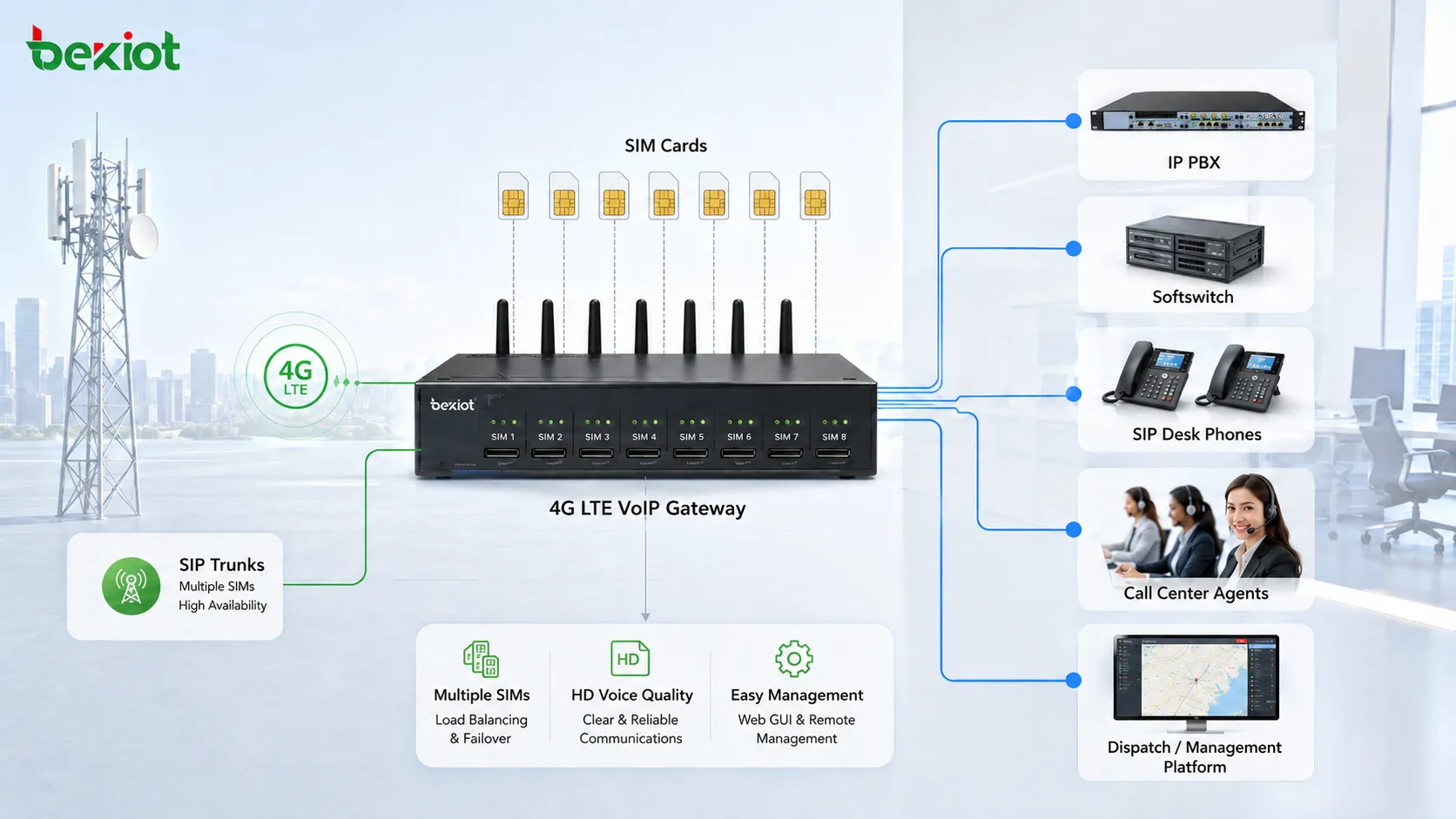
A 4G LTE VoIP gateway is a standard telephony gateway device. Its working principle is to convert mobile network voice into SIP-based VoIP communication. After inserting one or more SIM cards into the gateway, the system can use those mobile numbers for inbound and outbound calls through SIP trunks, SIP accounts, IP PBX systems, softswitch platforms, or unified communication systems.
In a simple deployment, the SIM card receives a mobile call, the gateway converts the call into a SIP session, and the call is sent to an IP PBX or call platform. The PBX can then route the call to an IP phone, softphone, operator seat, IVR menu, ring group, call queue, or dispatch console. For outbound calls, the process works in the opposite direction: an IP phone or system user places a call through the PBX, and the gateway sends the call out through the SIM card.
This type of gateway is powerful because it gives a mobile SIM number IP networking capability. It can connect mobile networks with enterprise telephony, call centers, VoIP platforms, and dispatch communication systems. Some rack-mounted gateways support multiple SIM cards, and the referenced example uses a model that can insert up to 32 SIM cards. This allows many mobile numbers to be centrally managed through one gateway device.
How It Connects to a Phone System
The 4G LTE gateway usually connects to the network through Ethernet. On the IP side, it communicates with SIP servers, IP PBX systems, or VoIP platforms. On the mobile side, it communicates with the operator network through SIM cards and cellular modules.
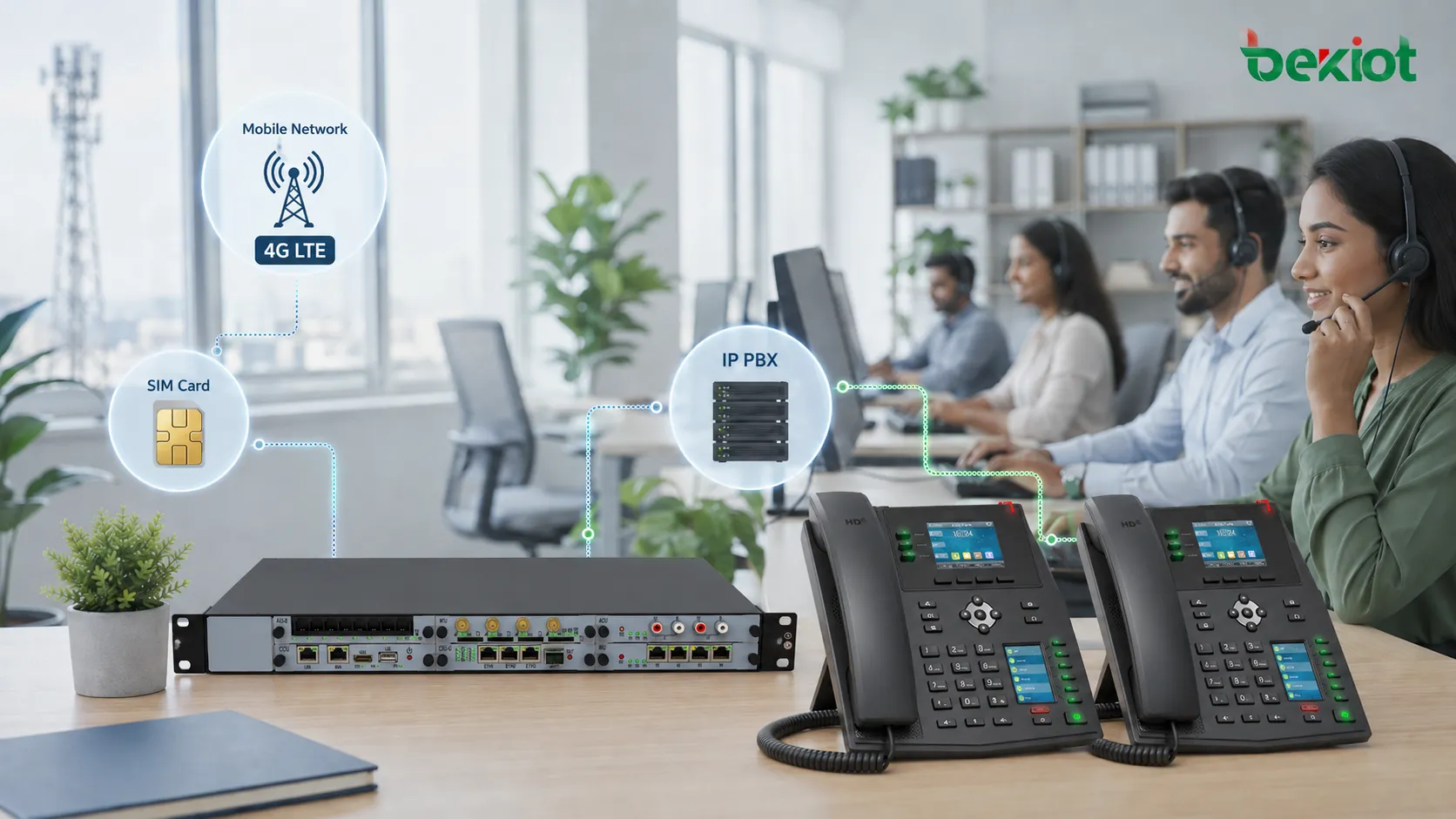
The typical architecture includes SIM cards, the LTE gateway, a SIP server or IP PBX, and phone endpoints. These endpoints may include IP desk phones, call center seats, softphones, SIP intercoms, dispatch consoles, or other SIP-compatible devices. Once the gateway is registered or trunked to the PBX, the SIM number can be used as an external line.
This architecture is useful when a company needs centralized call routing, multi-agent answering, call recording, extension management, customer service workflows, or integration with a larger communication platform.
Why It Can Be Sensitive
The same capability that makes a 4G LTE VoIP gateway useful also makes it sensitive. Because the gateway can be deployed in one location while users control calls through IP networks from another location, it may be abused for unauthorized call operations, telecom fraud, grey-market traffic, or SIM box activities.
Many countries and regions strictly regulate GSM/4G VoIP gateways. Operators and regulators may restrict bulk SIM gateway usage, cross-border call routing, automated calling, caller identity misuse, or unlicensed telecom resale. For legitimate projects, buyers should confirm local telecom rules, operator approval, SIM usage policy, and call behavior requirements before deployment.
A SIM-to-SIP gateway should be used for legitimate enterprise, emergency, temporary-site, or service communication needs only. The project should include access control, call logs, permission management, usage limits, and compliance checks from the beginning.
Wireless Telephone Converter for Analog Phones
A wireless telephone converter is a more traditional device. It evolved from early wireless fixed phones. Before smartphones became common, many places used wireless desk phones to provide voice service without pulling a physical telephone line. The device looked like a fixed telephone, but inside it worked through a mobile SIM card.
A modern wireless telephone converter does not always include a built-in phone body. Some models simply provide a SIM card slot and an analog telephone port. After inserting a SIM card, the device outputs a standard analog phone line. A normal desk phone can be plugged into this line, allowing users to make and receive calls through the mobile SIM number.
This solution is simple and practical when the requirement is only to make one mobile number behave like a local analog phone line. It is often used in temporary offices, small shops, rural locations, outdoor service points, guard rooms, mobile cabins, and sites where wired telephone lines are unavailable or inconvenient to install.
Connecting the Converter to a PBX or Gateway
Although a wireless telephone converter does not provide native VoIP functions, its analog output can be connected to other telephony equipment. For example, the analog line from the converter can be connected to the FXO port of a traditional PBX. It can also be connected to the FXO port of a VoIP gateway, allowing the SIM-based analog line to be further integrated into an IP phone system.
In this architecture, the converter acts as the mobile-to-analog layer, while the PBX or VoIP gateway handles extension routing, IP communication, or SIP integration. This can be useful when a project wants a simpler or more compliant device at the SIM side, but still needs to connect the call to internal phones.
The trade-off is that the system may need more devices. Instead of using one 4G LTE VoIP gateway to convert SIM directly to SIP, the project may use a wireless converter plus an FXO gateway or PBX. This adds hardware, but it may be easier to purchase, easier to approve, or more suitable for simple installations.
Which Route Is Better for Your Project?
The best choice depends on the scale and integration depth of the project. If the requirement is one SIM card connected to one desk phone, a wireless telephone converter is usually simpler. It provides a familiar analog telephone experience and does not require SIP configuration.
If the requirement is to connect multiple SIM numbers to an IP PBX, call center, dispatch system, or unified communication platform, a 4G LTE VoIP gateway is more efficient. It can convert SIM cards into SIP trunks or SIP lines, allowing calls to be routed, recorded, queued, transferred, and managed through enterprise telephony software.
If the project must be deployed across regions, the compliance risk becomes higher. A SIM-to-SIP gateway can technically allow users in another location to control a mobile SIM number remotely. This may be useful for legitimate distributed offices or emergency operations, but it can also trigger regulatory concern. The design should be reviewed carefully before deployment.
| Requirement | Recommended Device | Reason |
|---|---|---|
| One SIM number used by one desk phone | Wireless telephone converter | Simple analog output, easy to operate, no PBX required |
| SIM number connected to an analog PBX | Wireless converter + PBX FXO port | Turns mobile service into a PBX external line |
| SIM cards connected to IP PBX | 4G LTE VoIP gateway | Direct SIP integration and centralized call routing |
| Call center or customer service seat answering | 4G LTE VoIP gateway | Supports queues, recording, routing, and multiple extensions through PBX |
| Temporary site with limited technical staff | Wireless telephone converter | Lower configuration complexity |
| Multi-SIM centralized management | 4G LTE VoIP gateway | Some models support many SIM cards and trunk management |
| Strict compliance environment | Confirm with operator first | SIM gateway use may be regulated or restricted |
Practical Use Cases
In customer service scenarios, a company may already have a mobile number known by customers. Instead of asking employees to answer calls from one mobile phone, the number can be connected to a PBX or call center. Calls can then be distributed to several agents, recorded for quality control, and managed during business hours.
In temporary project offices, mobile SIM access can replace the need for wired telephone installation. A construction site, event venue, emergency tent, mobile command vehicle, or remote service station can use a SIM-based solution to quickly provide voice communication.
In rural or outdoor environments, wired telephone lines may be unavailable or expensive to install. A cellular-to-analog converter can give users a familiar desk phone experience, while a 4G VoIP gateway can connect the site to a broader IP communication system.
In emergency or dispatch scenarios, SIM-based external lines can act as backup communication paths. If wired PSTN lines or SIP trunks are unavailable, a mobile network path may provide an additional way to reach external users. However, this backup role should be planned with clear call permissions and usage monitoring.
Important Compliance and Security Checks
Before deploying any SIM-to-phone solution, the project team should check whether the device type is allowed under local telecom regulations. This is especially important for 4G LTE VoIP gateways, multi-SIM gateways, and any system that enables remote users to place calls through SIM cards.
Access control is also essential. The gateway or PBX should restrict who can use the SIM line, which numbers can be dialed, when outbound calls are allowed, and whether international calls are permitted. Without permission control, a gateway can create billing risk, security risk, and compliance risk.
Call records should be retained according to business and legal requirements. Logs help administrators review usage, detect abnormal traffic, troubleshoot call failures, and prove that the system is being used for legitimate purposes.
For business deployments, SIM cards should not be treated like casual consumer phones. They should be managed as communication resources with inventory records, operator contracts, usage policies, billing alerts, and replacement plans.
Deployment Architecture for Business Phone Systems
A standard deployment can be divided into the mobile access layer, gateway conversion layer, phone system layer, and user endpoint layer. The mobile access layer includes SIM cards and cellular service. The gateway conversion layer includes the 4G VoIP gateway or wireless telephone converter. The phone system layer may include IP PBX, softswitch, analog PBX, call center platform, or dispatch system. The endpoint layer includes desk phones, SIP phones, softphones, operator seats, and mobile users.
For analog conversion, the path is usually SIM card to wireless converter, then analog phone or PBX FXO port. For SIP conversion, the path is SIM card to LTE gateway, then SIP trunk to IP PBX, then extension routing to users. For more advanced systems, call recording, IVR, ring groups, queueing, CRM integration, and dispatch integration can be added at the PBX or platform layer.
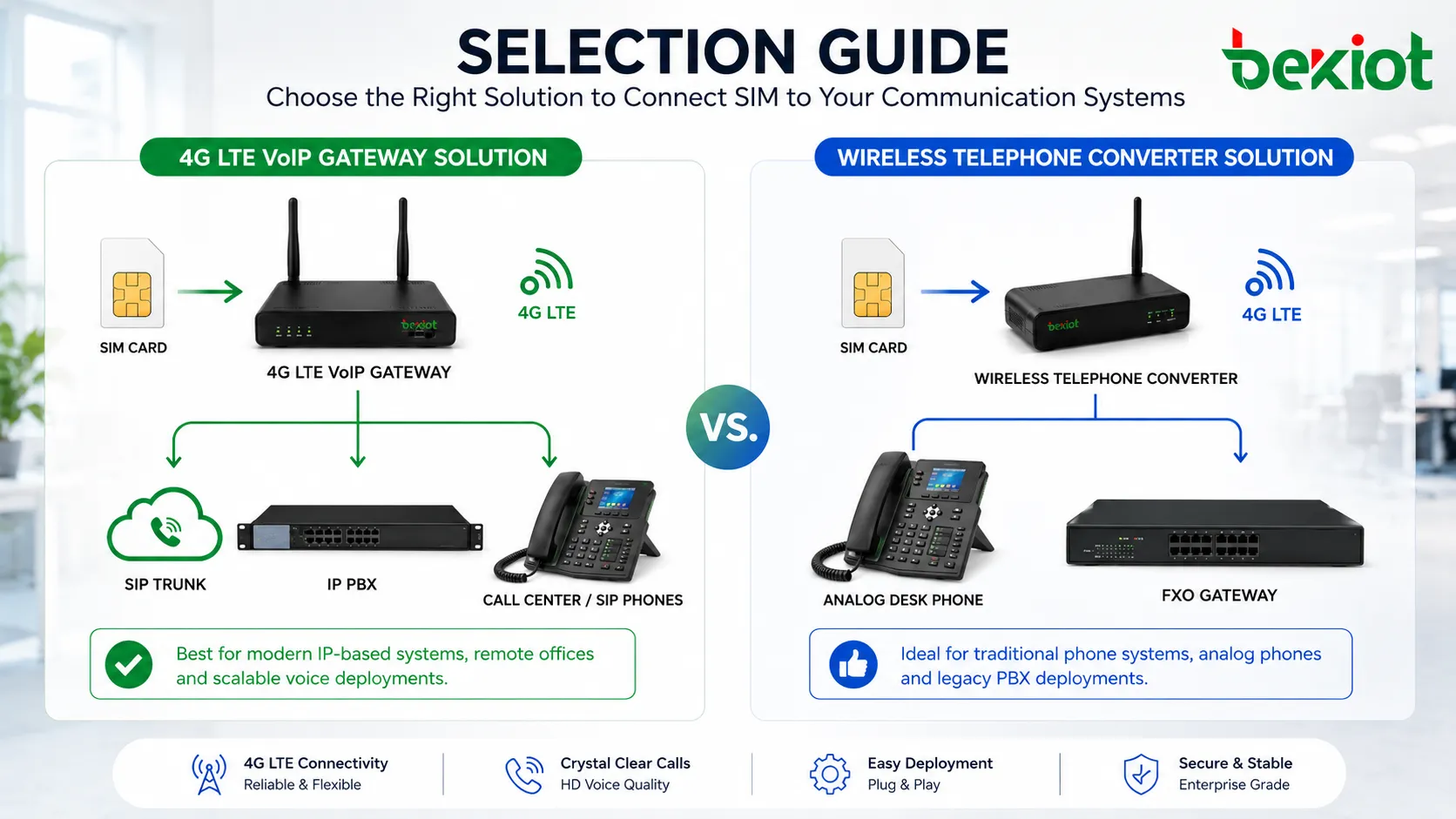
Selection Checklist for Buyers
Buyers should first confirm whether the system requires analog output or SIP output. If the receiving equipment is a normal desk phone, an analog converter may be enough. If the receiving system is an IP PBX, SIP server, or softswitch, a 4G LTE VoIP gateway is usually the more direct option.
The second step is to check the number of SIM cards and simultaneous calls required. A single-SIM converter normally handles one call at a time. A multi-SIM gateway can support more lines, but each SIM channel still needs to be managed carefully.
The third step is to confirm network and operator conditions. The system should support the required mobile bands, SIM type, VoLTE or circuit-switched voice behavior, signal strength, antenna placement, and backup power. Poor cellular signal can cause call drops, audio delay, or unstable registration.
Finally, evaluate security and compliance. A low-cost gateway may work technically, but if it lacks access control, call limits, logs, blacklist/whitelist rules, and management security, it may not be suitable for business deployment.
FAQ
Can a mobile number become a real fixed telephone number?
Usually no. The mobile number remains a mobile number assigned by the operator. The equipment only allows that SIM number to be used through fixed telephone devices, PBX systems, or IP phones.
How many calls can one SIM card handle at the same time?
In most normal voice scenarios, one SIM card handles one active call at a time. If multiple simultaneous calls are required, the project usually needs multiple SIM cards, multiple channels, or another trunking method.
Can the system receive SMS messages?
Some 4G gateways support SMS management, but not all telephone converters do. If SMS verification, notification, or logging is required, this should be confirmed before purchase.
What happens if cellular signal is weak?
Weak signal can cause poor audio quality, call drops, delayed dialing, or failed registration. External antennas, better installation positions, operator comparison, and signal testing should be completed before final deployment.
Is it safe to allow remote users to call through a SIM gateway?
It can be safe only with proper access control, user authentication, call permission rules, dialing limits, logs, and compliance review. Uncontrolled remote access can create serious billing and legal risks.
What information should be prepared before choosing the device?
Prepare the number of SIM cards, expected call volume, inbound and outbound call requirements, whether a PBX is used, analog or SIP interface requirements, operator network conditions, legal compliance needs, and call recording or management requirements.