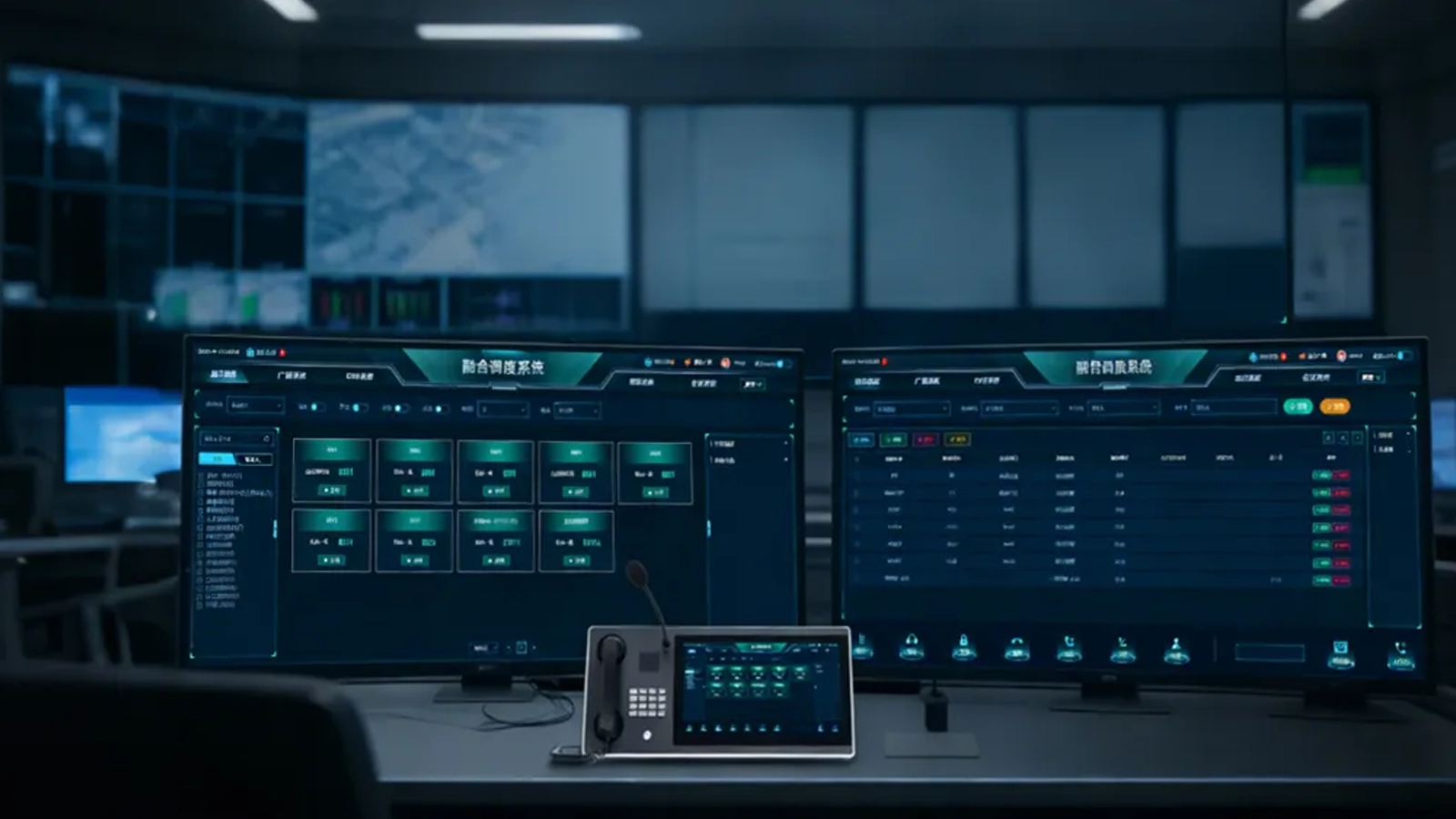
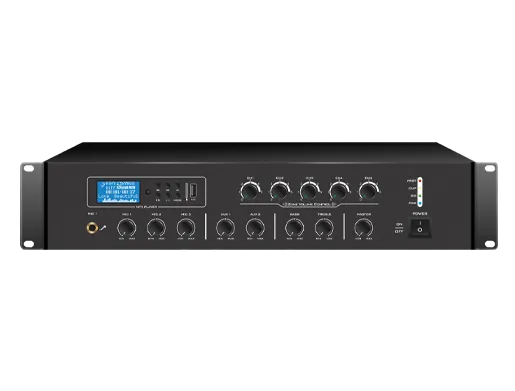

The Becke PA-W120W is a SIP network multi-source five-zone Paging amplifier built for projects that need more flexible control than a standard network amplifier can offer. It combines SIP networking, multi-source audio playback, five-zone speaker control, local and remote operation, and dependable amplifier performance in one integrated platform, making it a practical solution for schools, factories, transport sites, campuses, commercial buildings, and community broadcast systems.
What makes the PA-W120W especially useful is not just its network capability, but its ability to handle different operating habits and installation scenarios. It can work with broadcast servers, network dispatch consoles, intercom phones, and mobile apps, while also supporting built-in MP3 playback, FM radio, and Bluetooth audio. That gives users a more flexible broadcasting tool for both daily operation and emergency communication.
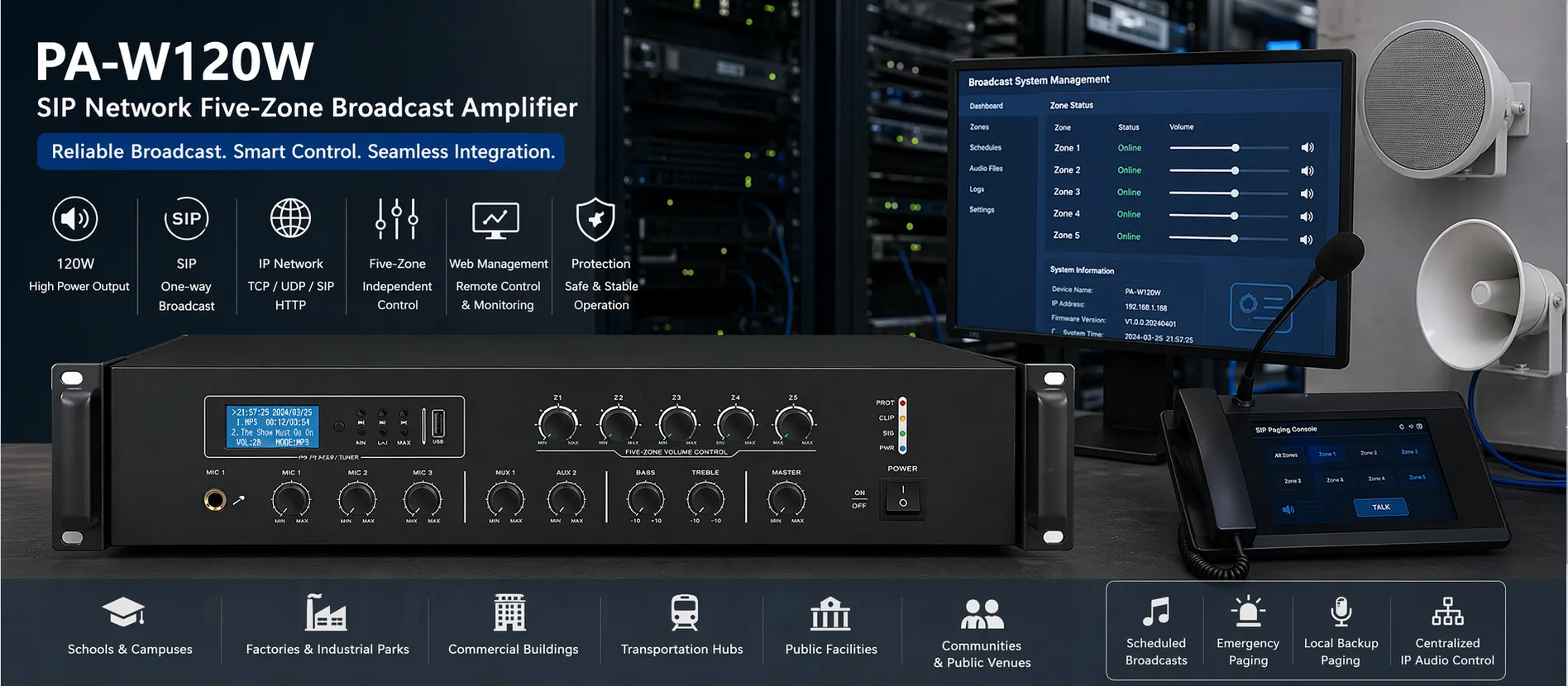
The core advantage of the PA-W120W is its five-zone independent volume control and five-zone 100V constant-voltage speaker output. Each zone can be adjusted separately and switched on or off as needed. This makes the amplifier highly practical for sites where different areas require different paging schedules, audio levels, or operating priorities.
Instead of sending the same audio at the same level everywhere, users can manage coverage more precisely. In real projects, this is valuable for separating classrooms from corridors, offices from workshops, public areas from back-of-house zones, or indoor sections from outdoor perimeter areas. It gives users more control without adding unnecessary system complexity.
The PA-W120W is built for multi-source broadcasting. It supports coordinated operation through a broadcast server, network dispatch console, intercom phone, and mobile app, allowing users to manage background music, scheduled playback, TTS voice synthesis, emergency paging, radio live streaming, and alarm broadcasting from a unified audio platform.
At the same time, it includes built-in MP3 playback, FM tuner, and Bluetooth functionality. This means users can access more audio sources directly from the device without relying entirely on external equipment. For many everyday installations, this reduces system complexity while improving usability for local staff.
The PA-W120W supports TCP/IP, UDP, SIP, and HTTP protocols through its integrated network audio codec module. This makes it easy to deploy within modern SIP paging and IP broadcast architectures where centralized scheduling, remote management, and distributed voice communication are required.
Because it supports 16-bit stereo CD-quality audio transmission and MP3/WAV compatibility, the amplifier can deliver both clear speech broadcasting and stable daily audio playback. That is particularly useful for systems where announcements must remain intelligible while still supporting more routine audio applications.
The PA-W120W is designed to support both routine and urgent communication tasks without requiring separate hardware paths. It can handle timed announcements, background music, TTS messages, emergency paging, radio programs, and alarm broadcasts through one integrated amplifier platform.
This makes it a strong fit for sites that need a practical balance between operational convenience and emergency readiness. A school can use it for bells and notices during the day and for urgent voice instructions when needed. A factory can use it for shift reminders, production notices, and emergency alerts. A commercial site can manage both ambient audio and rapid broadcast response from the same system layer.
The amplifier provides two AUX inputs and three MIC inputs, with independent volume as well as bass and treble adjustment controls. More importantly, it supports local paging during network interruption. That gives the PA-W120W an important layer of practical resilience because basic paging does not stop just because the normal IP path becomes unavailable.
For many users, this local fallback capability is a major operational benefit. It helps preserve continuity and makes the amplifier more dependable in real installations where communication must continue even during temporary network issues.
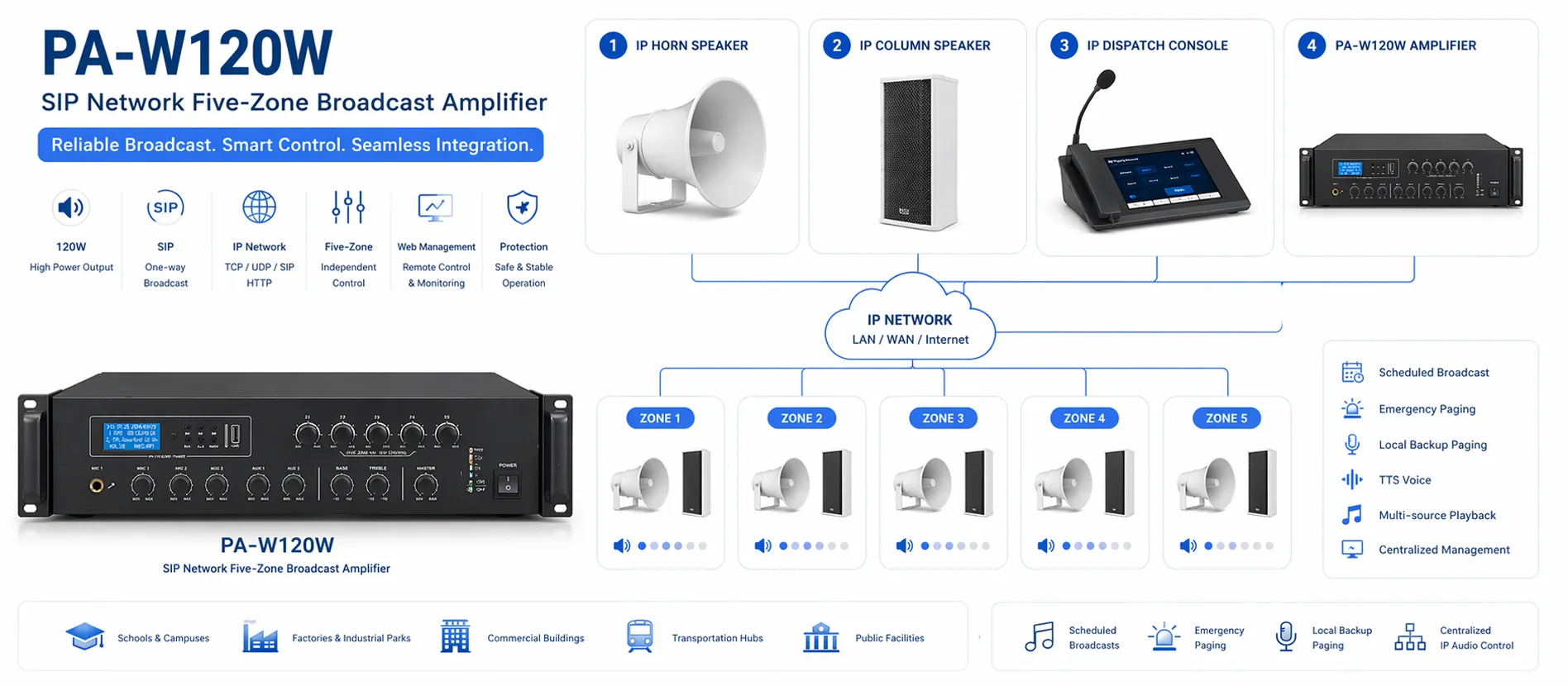
The PA-W120W provides a full web-based remote management interface, allowing users to access the device through a browser by IP address. Through the management page, operators can configure network parameters, manage SIP accounts, adjust volume, perform online packet capture, and execute online firmware upgrades.
In addition to web access, it also supports configuration through a dedicated client. This dual-path setup is useful for engineering teams and maintenance personnel because it provides more convenient commissioning and troubleshooting options. The amplifier also supports DHCP and static addressing, along with cross-subnet search and configuration, which helps simplify deployment across larger networks.
The PA-W120W includes an integrated MP3 playback module with USB and SD card interfaces, providing strong media reading capability and support for both MP3 and WMA decoding. Users can select different playback modes such as random playback, single-track repeat, folder repeat, and full repeat, depending on the operational need.
It also supports five EQ sound effects, which helps adapt playback style to different listening environments and user preferences. Priority playback is built in as well, making it easier to ensure more important audio takes precedence when needed.
The integrated FM tuner supports practical radio reception with storage for approximately 15 to 40 stations, while the Bluetooth module allows connection with phones, tablets, and computers for direct wireless playback. Bluetooth range can reach up to 20 meters, giving local users additional convenience in smaller on-site applications.
The amplifier uses a 128 × 64 graphic dot-matrix display, giving users a clearer interface for status viewing and function selection. The display makes local operation more intuitive, which is important for installers and end users who need straightforward daily access to device functions without depending entirely on a remote platform.
This kind of usability matters in real projects. Not every broadcast task is planned from a control room, and not every operator is a trained engineer. A clearer front-panel experience makes the device easier to integrate into daily operational routines.
The PA-W120W uses Class-D power amplifier technology together with a full-loop feedback network to reduce distortion and maintain stronger sound integrity during higher-output operation. This helps the amplifier deliver more stable paging and broadcast performance, particularly when it is working across multiple zones or supporting more frequent announcements.
For end users, the benefit is simple: clearer delivery, smoother operation, and more consistent broadcast performance in practical environments.
The amplifier uses dual PFC switch-mode power supply technology to improve overall efficiency and reduce unnecessary power current consumption. It supports a wide voltage input range from AC90V to AC265V, which makes it more adaptable to different regional power conditions and helps simplify deployment across a wider range of sites.
This wide-voltage design is especially useful in distributed projects where power conditions may vary between locations. It supports a more dependable and more flexible installation strategy.
An intelligent temperature-based cooling system automatically adjusts heat dissipation according to operating conditions. The internal fan is designed for efficient cooling with relatively low noise, helping the amplifier stay stable without adding unnecessary disturbance to the environment.
The PA-W120W also includes intelligent energy-saving behavior. When no signal is detected, it can automatically enter standby mode, with standby power consumption controlled at 10W or below. For projects with many amplifiers deployed across different zones, this helps reduce long-term energy waste.
The PA-W120W includes multiple intelligent protection functions covering soft start, DC protection, short circuit, overheat, overload, and limiter protection. These features improve system safety and help reduce the risk of amplifier damage during abnormal operating conditions.
Status indicators including level, protection, and standby indicators make routine inspection easier for technicians. The amplifier also includes 4KV lightning surge protection, adding practical value in field installations where electrical disturbance must be taken seriously.
The device provides two auxiliary audio outputs for expansion with external power amplifiers through standard RCA interfaces. This makes wiring convenient and gives system designers more room to scale the installation when more output power or wider area coverage is required later.
Because the PA-W120W is fully digital in design and works across many network structures, it is easy to expand without being limited by location. Existing network infrastructure can often be reused, helping reduce both deployment cost and long-term maintenance effort.
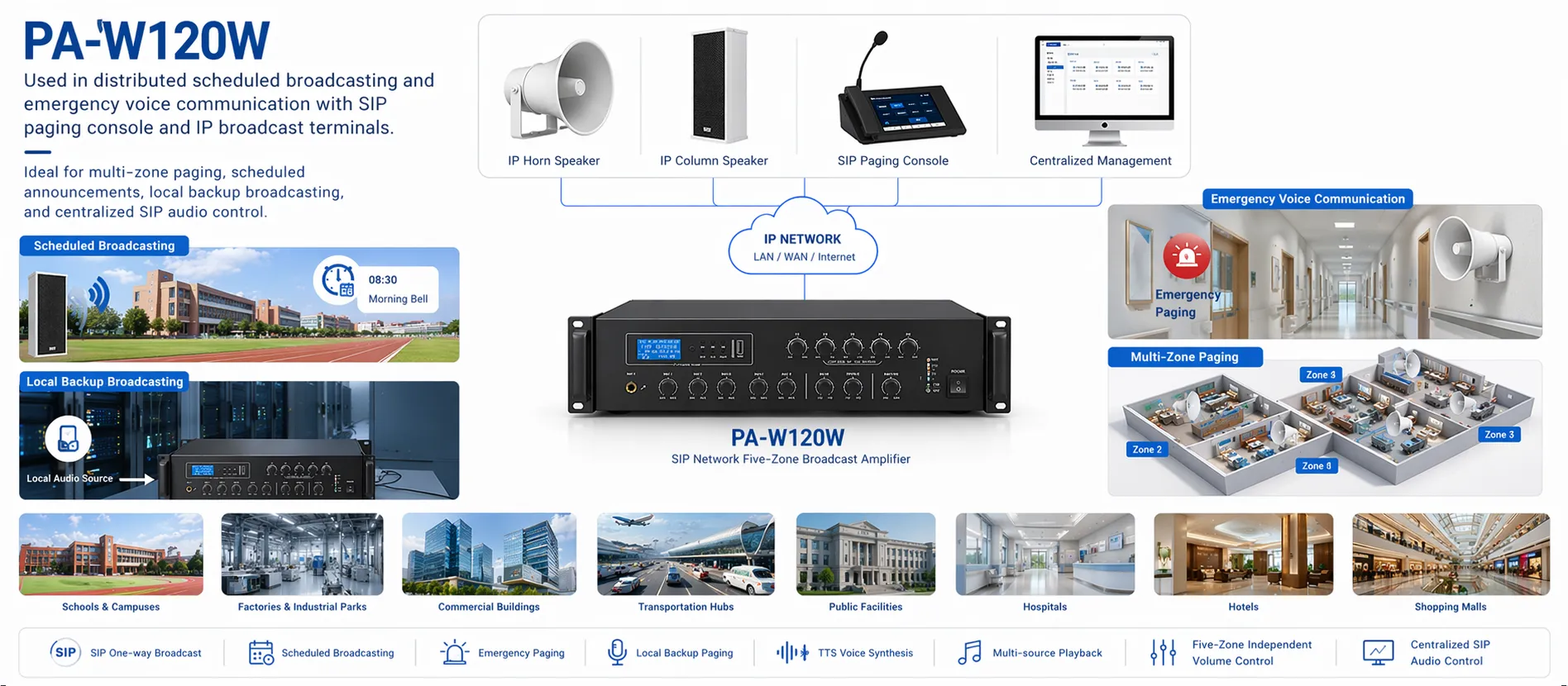
The PA-W120W is very well suited to education environments where different buildings or areas need separate control. The five-zone design is useful for classrooms, sports grounds, corridors, dormitories, libraries, and outdoor spaces, while the amplifier’s scheduling and local input capability supports both routine and urgent campus communication.
In industrial environments, the amplifier can support production notices, work shift reminders, safety announcements, area-based paging, and emergency response messaging. The combination of zone control, local paging backup, and network integration makes it a practical fit for plant-wide communication tasks.
The PA-W120W is also suitable for shopping centers, office buildings, residential communities, and mixed-use properties where different zones require different audio levels or independent control. It can support both daily background broadcasting and emergency message delivery in a more structured way.
For stations, terminals, parks, hospitals, and other public facilities, the amplifier provides a useful mix of centralized IP control and flexible local functionality. It can be integrated into broader service communication systems while still remaining practical for everyday on-site broadcasting.
The PA-W120W is a practical choice for users who need more than simple network amplification. It brings together SIP compatibility, five-zone output control, multi-source playback, web management, client configuration, local paging fallback, and built-in MP3/FM/Bluetooth support in one device. That combination makes it especially attractive for projects that want both engineering flexibility and day-to-day usability.
For integrators and end users alike, the PA-W120W offers a more adaptable Paging amplifier platform for modern IP audio systems. It supports structured daily operation, easier maintenance, clearer zone control, and better readiness for emergency communication without making the overall system harder to deploy.
The PA-W120W adds five-zone independent speaker control, built-in MP3/FM/Bluetooth playback, local paging during network interruption, and multiple remote and local configuration methods. It is designed for more flexible real-world broadcasting rather than simple one-path audio output.
Yes. It supports SIP along with TCP/IP, UDP, and HTTP, making it suitable for SIP paging, IP broadcast, and broader integrated voice communication architectures.
It can work with broadcast servers, dispatch consoles, intercom phones, mobile apps, USB media, SD cards, FM radio, Bluetooth devices, local microphones, and auxiliary audio inputs, giving users a broad range of control and playback options.
It is well suited to schools, campuses, factories, industrial parks, commercial buildings, communities, hospitals, transport sites, and other multi-zone facilities that need scheduled broadcasting, emergency paging, and centralized IP audio control.
| Item | Specification |
|---|---|
| Model | PA-W120W |
| Audio Formats | MP3, WAV |
| Audio Mode | 16-bit stereo, CD-quality sound |
| Sampling Rate | 8 kHz ~ 16 kHz |
| Tone Control | Bass: ±10 dB at 100 Hz; Treble: ±10 dB at 10 kHz |
| Input Sensitivity & Impedance |
MIC 1/2/3: 5 mV / 600 Ω, unbalanced TRS input |
| Output Sensitivity & Impedance | MIX OUT: 1000 mV / 470 Ω, unbalanced RCA output |
| Overload Source EMF |
MIC 1/2/3: > 12 dB, unbalanced TRS input |
| Input Interfaces | 2 x AUX (line) inputs + 3 x MIC (microphone) inputs |
| Rated Power | 120 W |
| Standby Power Consumption | < 10 W |
| Frequency Response | 80 Hz ~ 16 kHz (+1 / -3 dB) |
| Signal-to-Noise Ratio | MIC 1/2/3: 66 dB; AUX 1/2: 80 dB |
| Total Harmonic Distortion (THD) | 0.5% at 1 kHz, 1/3 rated output power |
| Channel Crosstalk Attenuation | ≤ 50 dB |
| Output Mode | 100 V constant-voltage output (amplitude limit: 135 V) |
| Display | 128*64 dot matrix graphic display |
| Cooling | Front-to-rear forced air cooling; built-in fan starts at heatsink temperature 55 °C |
| Protection Circuits | Soft start, DC, short-circuit, overheat, overload, amplitude limit intelligent protection system |
| Lightning Protection | 4 kV lightning surge protection |
| Power Supply | AC 220 V / 50 Hz |
| Operating Temperature | 5 °C ~ 40 °C |
| Operating Humidity | 20% ~ 80% relative humidity, non-condensing |
| Material | Black aluminum panel, SPCC cold-rolled steel chassis |
| Dimensions | 484 × 210 × 88 mm |
| Weight | 4.60 kg |