
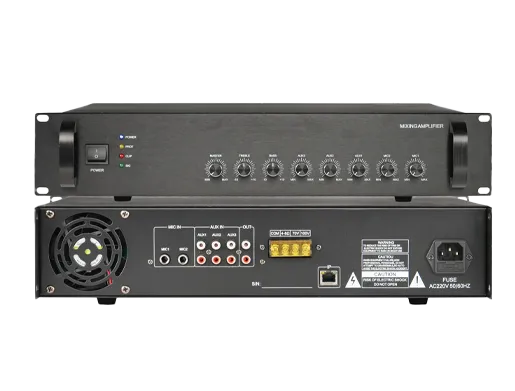

Becke BK-PA120A SIP Amplifier is designed for larger paging and public address projects that require stronger output power, practical network audio control, and flexible on-site audio integration in a single rackmount platform. With a standard 19-inch 2U chassis and brushed aluminum alloy front panel, it is well suited to control rooms, equipment racks, campus broadcast cabinets, factory communication rooms, and commercial building audio systems that need a professional installation standard.
Built around a 120W high-fidelity amplifier module and a hardware-based network audio decoding design, BK-PA120A is positioned for sites that need clear voice announcements, scheduled playback, routine paging, and network-driven audio distribution with dependable daily operation. It combines SIP-based audio access, local microphone and line inputs, WEB management, text-to-speech capability, and multiple speaker output options, making it a strong fit for structured IP broadcast projects where both system flexibility and installation efficiency matter.
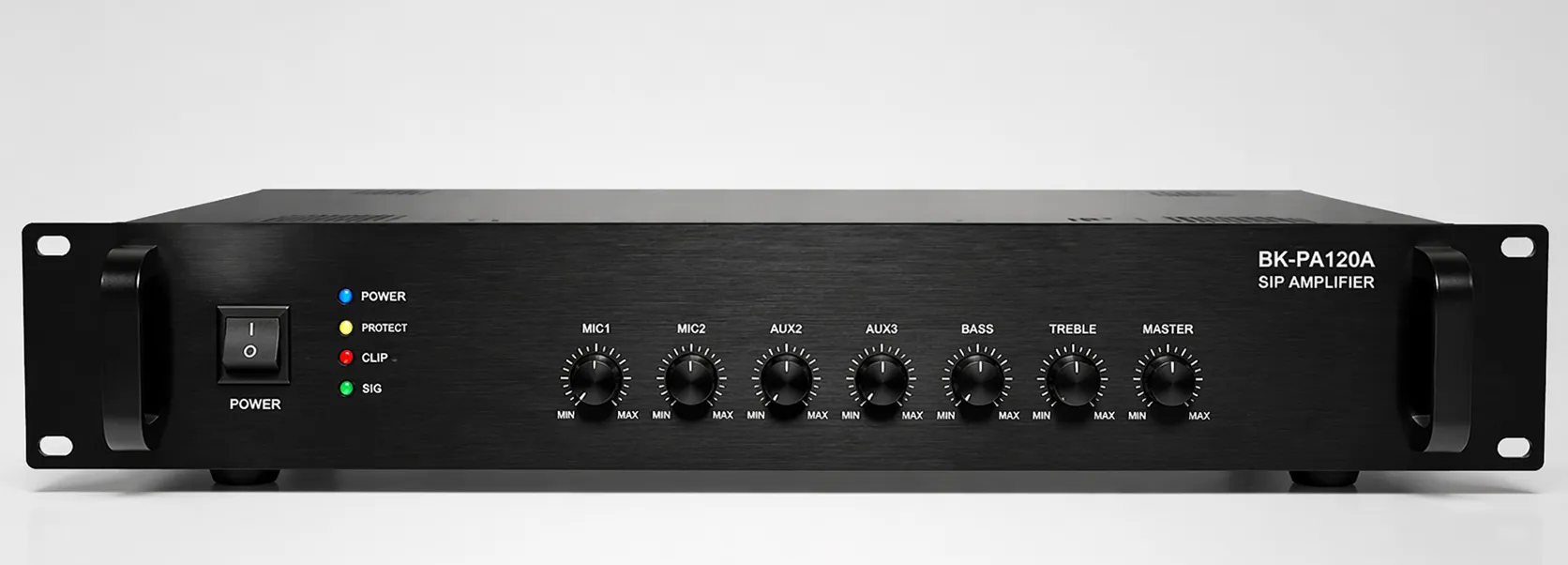
BK-PA120A is designed for projects that need more output headroom than lower-power network amplifiers can provide. Its built-in 120W high-fidelity power amplifier module gives system designers a stronger platform for driving speaker lines in wider corridors, larger halls, bigger classroom groups, factory workshops, warehouse zones, and commercial areas where voice clarity and sufficient coverage are both essential.
This stronger output positioning makes the unit especially suitable for projects that need a balance between centralized network control and practical field-level amplification. Rather than treating the amplifier as just a signal endpoint, BK-PA120A functions as a core execution device in the paging chain, delivering the power needed for routine announcements and operational voice communication across more demanding coverage areas.
BK-PA120A integrates one hardware-based network audio decoding module with its amplifier stage, simplifying system architecture for installers and integrators. It supports SIP, TCP/IP, UDP, and IGMP multicast protocols, enabling 16-bit stereo CD-quality audio transmission over IP networks and reducing the need for separate decoding and amplification hardware in many projects.
This integrated design helps streamline rack planning, cabling, and maintenance. In practical deployments, it can reduce device count, simplify troubleshooting logic, and support a cleaner project layout in schools, commercial buildings, industrial facilities, and public-service environments where multiple audio zones must be managed in a structured way.
For larger paging projects, the real advantage is not only higher wattage, but a stronger combination of network audio access, input flexibility, and stable amplification in one engineering-friendly platform.
The standard 19-inch 2U rackmount structure makes BK-PA120A easy to deploy in broadcast racks, communication cabinets, and integrated control systems. Its brushed aluminum alloy front panel adds a more professional equipment-room appearance while supporting better consistency across installations that include multiple audio, network, or control devices.
This layout is valuable in projects where neat integration matters as much as function. Education campuses, factories, office towers, hotels, transport facilities, and municipal buildings often require standardized cabinet deployment, and BK-PA120A is well aligned with that type of engineering workflow.
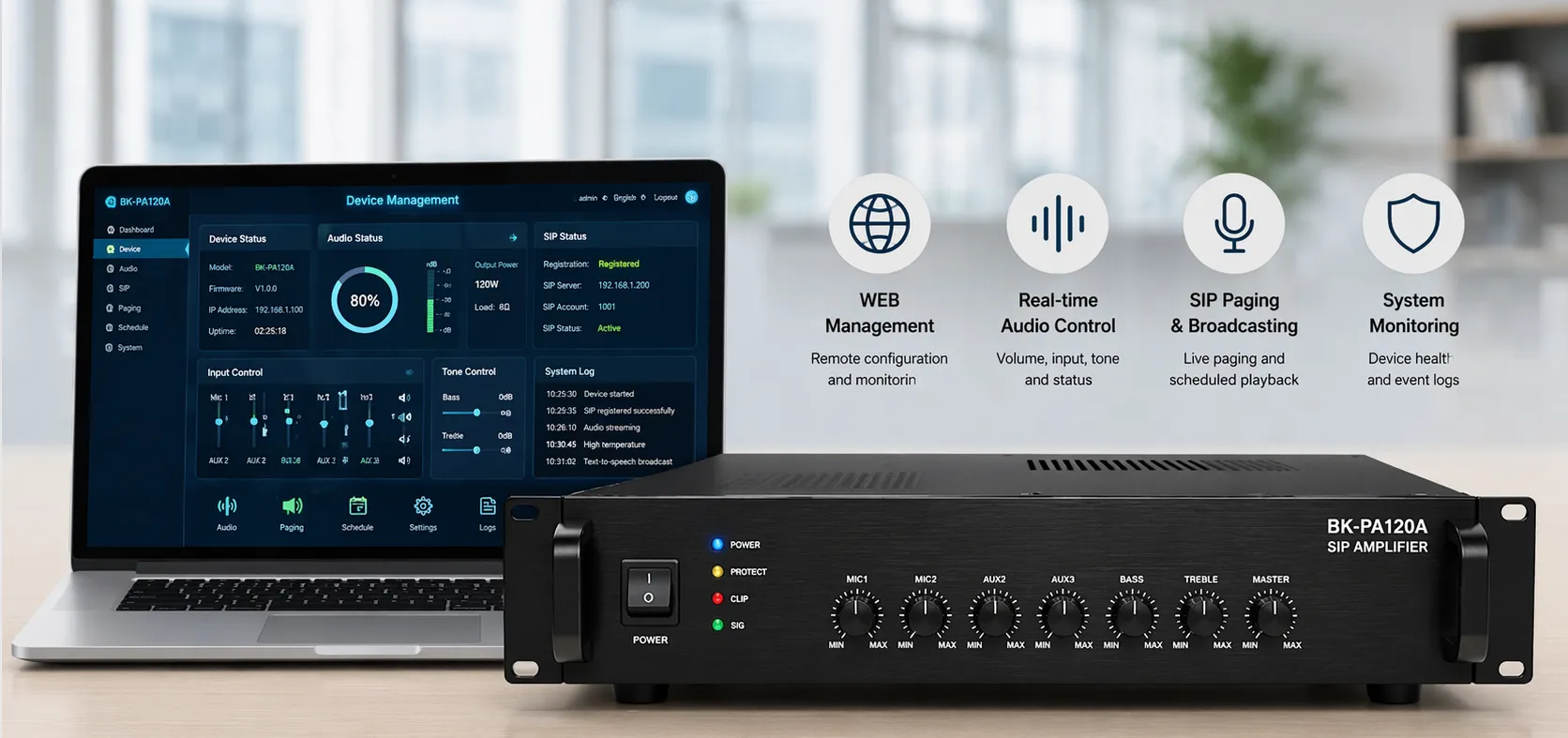
BK-PA120A supports two RCA mixed outputs, two 6.3 mm microphone inputs, and three RCA line inputs, giving the device practical value in installations where more than one audio source must be handled at the same time. This allows it to work with local microphones, control-room voice input, playback devices, and auxiliary audio sources in a way that better matches real site operation.
Microphone 1 supports forced priority override, which is useful when urgent live announcements need to interrupt background playback or lower-priority audio. Each input supports independent volume adjustment, helping operators and installers tune the amplifier for daily broadcast use without making the system unnecessarily complicated.
Different sites have different acoustic conditions. BK-PA120A includes bass and treble adjustment through potentiometer control, allowing more precise audio tuning according to speaker layout, room size, installation conditions, and the type of content being delivered. This is particularly helpful when one project includes classrooms, open corridors, production areas, and office sections with different acoustic behavior.
Instead of relying on fixed output characteristics, the unit gives installers a more useful tuning range for optimizing intelligibility and playback balance. For daily voice announcements, tone adjustment can improve speech presence, while for routine background audio it can help create a more controlled listening result.
BK-PA120A supports 100V and 70V constant-voltage output as well as 4Ω to 8Ω constant-resistance output, making it easier to match the amplifier to different speaker line designs. This allows the same model to fit distributed public address lines, long-distance speaker circuits, and more localized speaker arrangements depending on the structure of the project.
That flexibility is important in mixed-use environments. A campus may use long speaker lines in corridors and building-wide broadcast areas, while a factory may combine horn speakers in production zones with other speaker types in offices or support spaces. BK-PA120A is positioned to handle these variations more easily in one deployment framework.
Powered by a high-performance ARM architecture processor, BK-PA120A supports WEB login for parameter modification. This gives administrators and installers a more convenient way to configure and manage the device during setup, inspection, and maintenance. In projects where multiple network audio endpoints are deployed, browser-based configuration can save time and reduce onsite adjustment pressure.
The amplifier also supports text-to-speech broadcasting, extending its usefulness for scheduled notices, routine reminders, service announcements, and repeatable operational messaging. This is especially valuable in facilities where live paging is not always necessary and automation can improve consistency and response speed.
BK-PA120A includes output protection against short circuit, overcurrent, and overload conditions, with LED warning indicators for clearer fault awareness. These mechanisms help protect the amplifier and connected speaker circuits in abnormal conditions and give maintenance personnel more direct visual status feedback during inspection and troubleshooting.
It also includes built-in protection against self-excitation, overheating, and power-on or power-off impact, again supported by LED warning indication. This protection-oriented design improves daily operational confidence and makes the amplifier better suited to continuous-use broadcast environments where stability is a basic requirement rather than an optional feature.
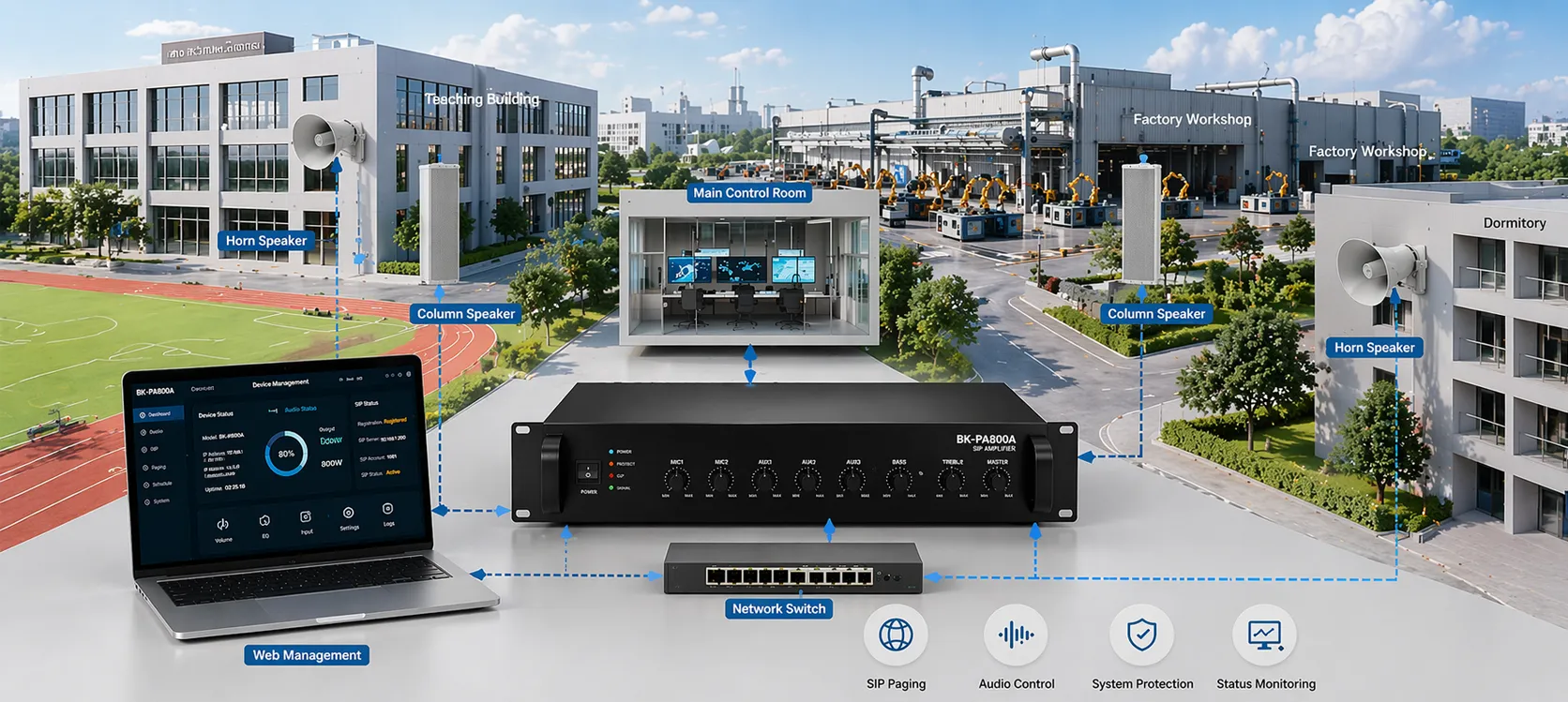
Schools, training centers, colleges, and dormitory buildings often require broader announcement coverage than small audio amplifiers can provide. BK-PA120A fits these projects well by combining higher output power with network audio reception, microphone access, and flexible speaker connectivity. It supports scheduled notices, class change signals, administrative paging, and routine building-wide announcements from a more centralized network audio architecture.
Its rackmount design and WEB configuration also make it suitable for standardized equipment-room deployment in education environments that prefer structured maintenance and long-term expandability. For larger campus blocks or multi-building audio planning, the model offers a practical balance between power and manageability.
Industrial facilities often need stronger voice reinforcement for shift notices, production reminders, safety instructions, area paging, and incident communication. BK-PA120A is well positioned for these environments because its 120W output gives more usable margin for larger or noisier areas, while its network protocol support allows integration into modern IP-based paging and operational communication systems.
With local microphone inputs and forced priority control, it can support both routine centralized broadcasting and urgent local intervention. That makes it useful in factories, logistics zones, assembly workshops, warehouses, and utility facilities where communication needs can shift quickly between normal operation and immediate response.
Office buildings, hotels, retail properties, hospitals, and service complexes often require networked public address devices that can support both daily announcements and more organized voice distribution across different areas. BK-PA120A can serve as a practical SIP amplifier node in these projects, especially where larger coverage or stronger speaker drive is needed.
Its support for different speaker output methods helps it adapt to long corridor lines, lobby areas, floor-level voice coverage, and mixed interior spaces. This makes it a strong choice for integrators seeking a higher-power model that still remains straightforward to configure and maintain.
Public buildings, transport facilities, service halls, and infrastructure sites often need structured network audio equipment that can deliver routine notices, service prompts, and live announcements through a dependable amplification platform. BK-PA120A supports these requirements with SIP connectivity, multicast compatibility, text-to-speech support, and practical cabinet integration.
For these projects, the value lies in its ability to combine higher output capacity with cleaner installation logic. Instead of scattering separate devices across the system, planners can use BK-PA120A as a focused network audio amplification point that supports easier management and a more disciplined engineering layout.
BK-PA120A stands out because it is built for projects that need more than basic network audio playback. Its 120W amplifier stage, integrated network decoding, flexible mixed input design, tone adjustment, WEB management, text-to-speech capability, and multiple protection mechanisms make it a stronger and more deployment-oriented solution for medium-to-larger paging systems.
Compared with lower-power models, it is better positioned for installations that need broader coverage, stronger speaker driving capability, or more operational margin in demanding environments. For system integrators, project contractors, and facility managers, BK-PA120A offers a practical combination of audio performance, network compatibility, and installation convenience.
Its built-in 120W high-fidelity amplifier module provides more output power for larger coverage areas, longer speaker lines, and sites that need stronger voice delivery than smaller SIP amplifiers can typically provide.
Yes. It supports two 6.3 mm microphone inputs, three RCA line inputs, and two RCA mixed outputs, making it suitable for systems that combine live paging, playback devices, and auxiliary audio integration.
Yes. It supports 100V and 70V constant-voltage output as well as 4Ω to 8Ω constant-resistance output, allowing it to adapt to a range of speaker layouts and project structures.
Its WEB-based parameter configuration, ARM-based processing platform, text-to-speech broadcasting support, independent volume control, tone adjustment, and LED-assisted protection functions all help improve setup efficiency and daily maintenance.
| Item | Specification |
|---|---|
| Product Model | BK-PA120A |
| Power Output | Built-in high-fidelity amplifier module with 120W rated output power |
| Mechanical Design | Standard 19-inch 2U rack-mounted design with brushed aluminum alloy panel |
| Audio Decoding | Built-in 1-channel network hardware audio decoding module; supports SIP, TCP/IP, UDP, IGMP (Multicast) protocols for networked transmission of 16-bit stereo CD-quality audio signals |
| Audio I/O |
2×RCA mixed output 2×6.3mm microphone inputs 3×RCA line inputs MIC1 with priority break-in function, independent volume control |
| Tone Adjustment | Supports independent treble and bass adjustment via potentiometer |
| Audio Output | 100V / 70V constant voltage output & 4Ω–8Ω constant resistance output |
| Output Protection | Short-circuit, over-current, overload protection with LED alarm indication |
| System Protection | Built-in self-excitation, overheating, power on/off impact protection with LED alarm indication |
| Main Processor | High-performance ARM architecture chip; supports WEB configuration for parameter modification |
| Broadcast Function | Supports text-to-speech (TTS) broadcast |
| Network Interface | 1×standard RJ45 (10/100Mbps) Ethernet interface; supports LAN and WAN access |
| Frequency Response | 80Hz ~ 16KHz |
| Signal-to-Noise Ratio | SNR > 65dB |