Emergency communication systems are designed to maintain command, coordination, and information flow when conventional communication networks become unavailable, unstable, or overloaded. In disaster response, industrial incidents, public safety operations, and remote-area missions, communication is often the first capability that must be restored. Without it, rescue teams cannot coordinate efficiently, command centers cannot make timely decisions, and field personnel may be left without reliable support.
From the perspective of practical deployment, emergency communication is not built around a single device. It depends on a layered combination of satellite links, wireless mesh or ad hoc networking, reinforced public network infrastructure, and wired communication systems for fixed or high-reliability locations. A complete solution must also consider anti-interference capability, information security, rapid deployment, and compatibility between different technologies and user groups.
At Beck Telcom, emergency communication planning is typically viewed as a system-level task rather than a simple equipment procurement exercise. The right architecture combines terminal devices, network access methods, command platforms, and backup mechanisms to ensure that communication remains available when the environment becomes most demanding.
Why Emergency Communication Equipment Matters
In many emergencies, normal communication networks are the first systems to fail. Power outages, damaged base stations, overloaded mobile networks, disrupted fiber routes, and harsh environmental conditions can all interrupt routine voice and data services. When that happens, emergency communication equipment becomes the operational backbone for coordination, dispatching, reporting, and safety notification.
The value of emergency communication equipment lies not only in restoring contact, but also in enabling structured response. Teams need to transmit alarms, issue evacuation messages, exchange field status updates, share images and video, and maintain contact between the incident scene and the command center. This means the communication system must support more than simple calling. It should also deliver resilience, coverage flexibility, and integration across multiple network types.
In emergency response, communication is not a supporting function on the edge of operations. It is the framework that allows every other response action to work in a coordinated way.
Main Categories of Emergency Communication Equipment
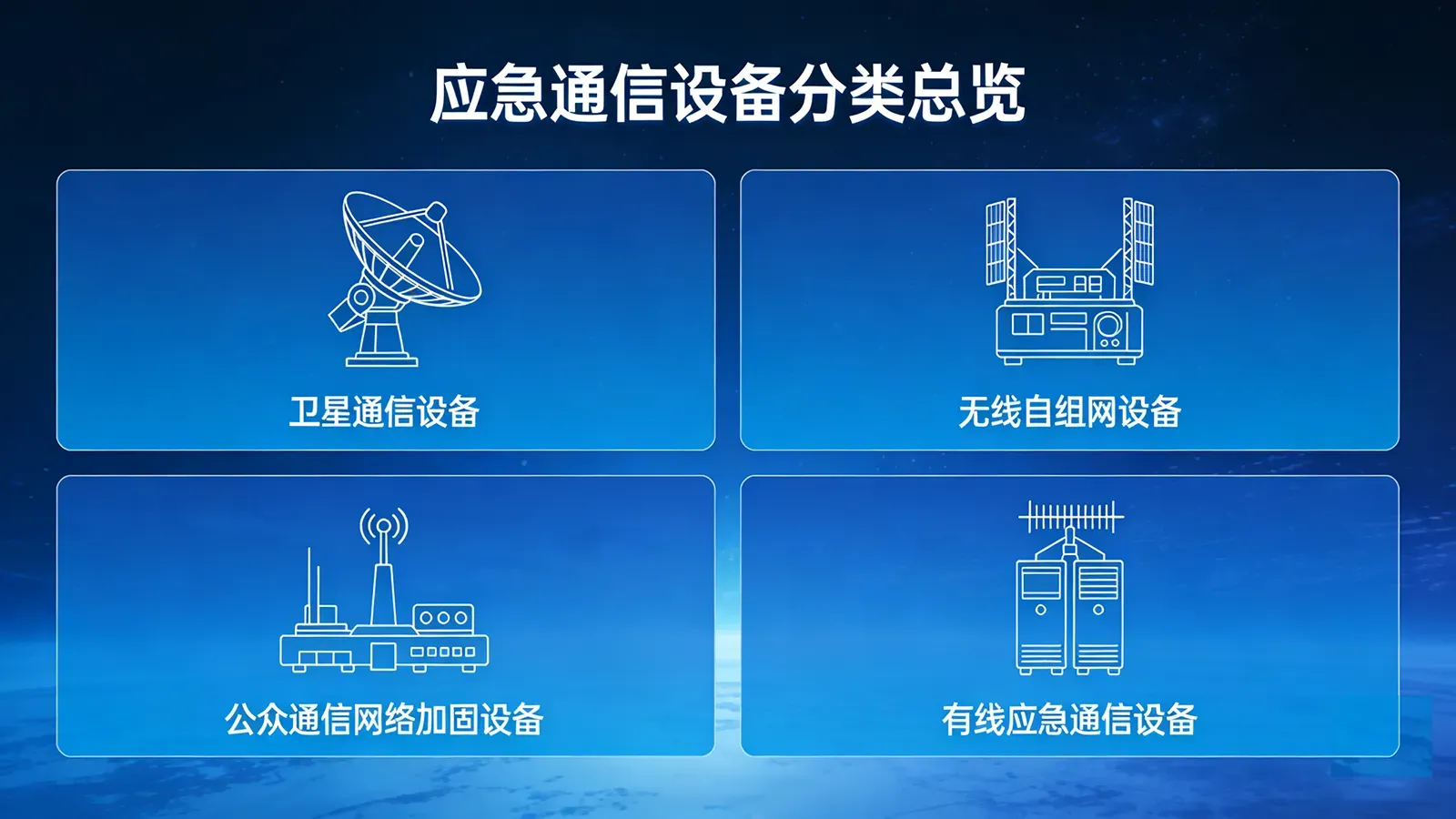
Satellite Communication Equipment
Satellite communication equipment is one of the most important categories in emergency response because it does not rely on damaged terrestrial infrastructure. When public mobile networks, fiber links, or local radio systems are disrupted, satellite-based communication can still provide a dependable path for voice and data transmission. This makes it especially valuable in earthquakes, floods, typhoons, offshore operations, mountain rescue, desert deployment, and other scenarios where coverage is weak or infrastructure is destroyed.
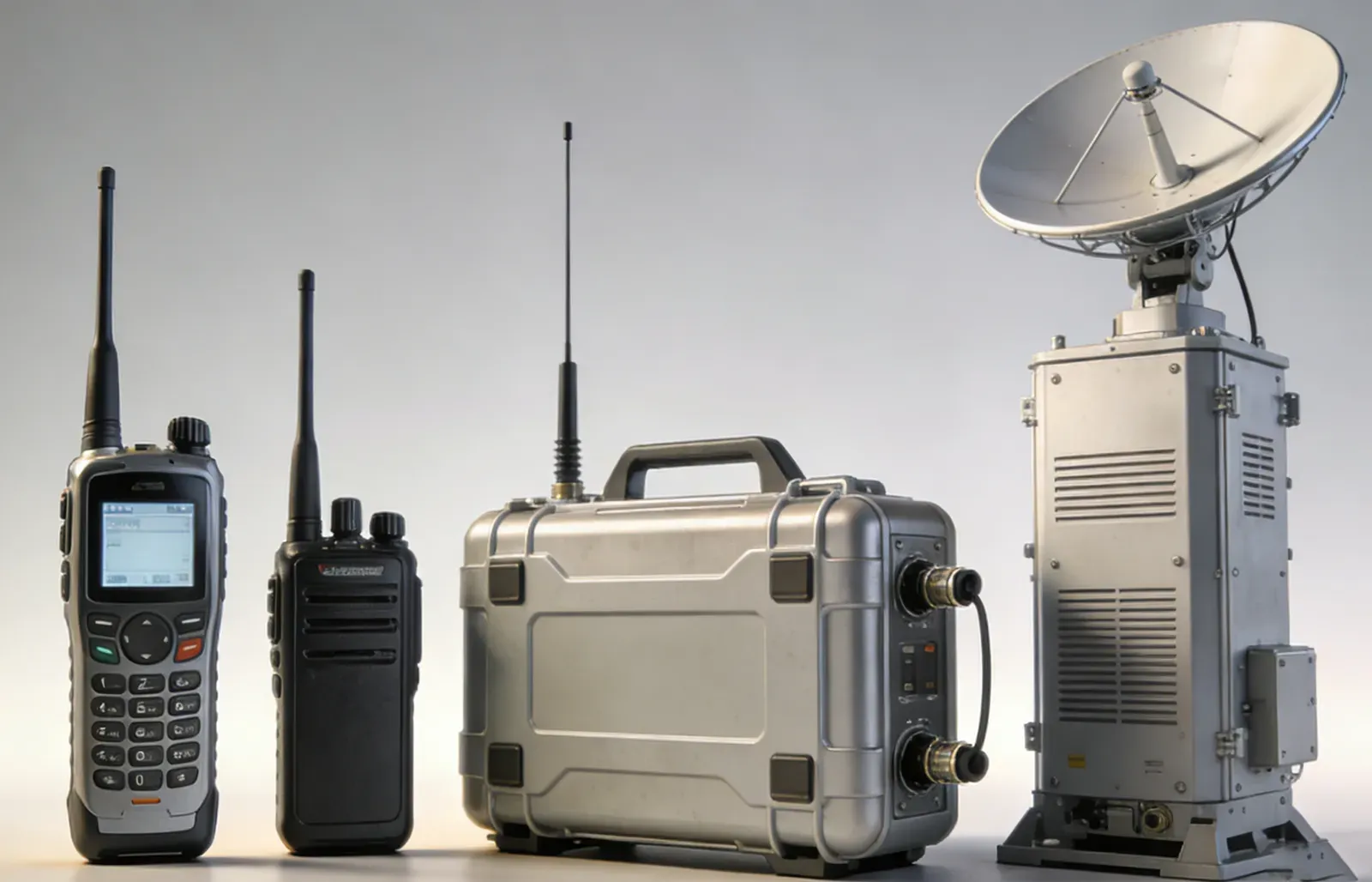
Satellite phones are the most familiar form of satellite communication equipment. They provide direct voice communication through satellite networks and are widely used by rescue leaders, field coordinators, and remote operations personnel. Their biggest strength is independence from local network conditions. Even in isolated or devastated areas, they can create a communication path for urgent reporting and command coordination.
Satellite data terminals expand this capability by supporting text, image, and video transmission. In practical operations, that means field teams can send situational updates, damaged-site images, inspection photos, and live video back to command centers. Some larger deployments also use transportable satellite base stations or mobile satellite systems to create temporary coverage zones for broader team communication. These systems are particularly useful when a response requires multi-user connectivity rather than one-to-one calling.
Wireless Ad Hoc and Mesh Network Equipment
Wireless ad hoc communication equipment is designed to build temporary networks without depending on fixed infrastructure. Instead of requiring a traditional base station layout, these devices discover and connect with nearby nodes automatically, forming a dynamic communication network that can adapt as teams move or conditions change. This makes them highly suitable for disaster zones, search-and-rescue operations, temporary command areas, and major public security deployments.
Ad hoc routers and mesh nodes are the core of this category. They can be installed in vehicles, carried by teams, placed at temporary control points, or mounted at elevated positions to extend coverage. When deployed correctly, they provide flexible local-area communication for voice, data, and sometimes video. Compared with satellite systems, they are especially useful for short- to medium-range connectivity among multiple responders working within the same operational area.
Handheld nodes, wearable terminals, and vehicle-mounted terminals are also common in this category. These devices give field personnel mobility while remaining part of the same temporary network. In complex urban operations or rugged outdoor environments, this flexibility is often essential. If one path becomes blocked, the network may automatically reroute traffic through another node, improving survivability and operational continuity.
Because these networks are built quickly and adjusted in real time, they are often used to bridge the gap between individual responders and higher-level command systems. In practical solution design, they are frequently paired with satellite backhaul, command vehicles, or portable dispatch systems to create a more complete emergency communication architecture.
Public Network Reinforcement Equipment
Not every emergency requires a complete replacement of public communication infrastructure. In many cases, the more effective strategy is to reinforce existing networks so they can continue operating under stress. Public network reinforcement equipment is used for that purpose. It strengthens communication nodes, increases resilience, and reduces the risk of service failure during severe weather, large gatherings, accidents, or localized outages.
Base station reinforcement solutions may include hardened enclosures, environmental protection upgrades, anti-corrosion design, improved grounding, surge protection, and backup power systems. In coastal areas, for example, infrastructure may need additional resistance to salt spray, strong winds, and moisture. In disaster-prone inland regions, the focus may be on power continuity, structural robustness, and redundant connectivity.
Line protection and infrastructure monitoring also play an important role. Fiber routes, outdoor cables, transmission cabinets, and access points can be protected through environmental shielding, lightning protection, and fault monitoring systems. By detecting line interruptions or degraded conditions early, operators can reduce downtime and improve recovery speed. This category is especially important for municipalities, transport operators, utilities, and organizations that need to preserve public-facing communication services during emergencies.
Wired Emergency Communication Equipment
Although wireless technologies are central to modern emergency response, wired emergency communication equipment still has an important role in many critical environments. Wired systems offer strong transmission stability, predictable performance, and high resistance to radio interference. In fixed industrial sites, tunnels, underground facilities, plants, control rooms, and safety-critical operational zones, they remain a dependable communication method.
Wired intercom systems are widely used in locations where structures, shielding, or hazardous conditions can weaken wireless performance. In mines, process plants, utility tunnels, and industrial corridors, wired communication often provides a more consistent path for real-time voice coordination. These systems may also support call recording, selective calling, emergency priority functions, and integration with alarms or public address systems.
Wired emergency command systems extend this principle by linking command rooms, local control points, field boxes, and fixed emergency stations. In many industrial communication architectures, a wired backbone is used as the stable layer of the system, while wireless and satellite technologies are added for mobility and resilience. This hybrid approach allows operators to maintain high-quality communication at critical nodes while still supporting flexible field deployment.
From a system-planning perspective, wired equipment is especially valuable when communication must remain stable over long operating periods, when environmental shielding is required, or when the site already has structured cabling and fixed operating positions.
Core Principles for Emergency Communication Deployment
Flexibility and Scalability
No two emergencies develop in exactly the same way. A system that performs well in a flood response may not be suitable for a chemical plant incident, a tunnel accident, or a major public event. For that reason, emergency communication planning must begin with flexibility. The solution should allow equipment combinations to be adjusted according to terrain, user numbers, communication range, service priority, and the changing stages of the response process.
Scalability is equally important. Initial communication demand may begin with simple voice contact between a few teams, but later expand into site-wide coordination, multimedia reporting, command conferencing, or multi-agency interoperability. The deployment design must allow more terminals, more access points, more bandwidth, and more service functions to be added without forcing a complete redesign of the network.
In practical engineering terms, scalability also affects procurement and maintenance. Organizations benefit when systems are modular, standards-based, and able to grow with operational needs. This is one reason why many emergency communication projects use layered architectures rather than single-function devices.
Support different emergency scenarios with the same core platform
Add terminals, routers, gateways, or dispatch resources as demand grows
Allow phased deployment instead of one-time rigid construction
Maintain compatibility between legacy systems and new IP-based components
Rapid Deployment Capability
In an emergency, the value of a communication system depends heavily on how fast it can be made operational. A technically advanced solution that takes hours to configure may be less useful than a simpler system that can be activated in minutes. Rapid deployment therefore becomes one of the most practical design requirements in emergency communication planning.
This principle affects equipment form factor, interface design, setup process, and training requirements. Portable devices should be easy to carry, intuitive to operate, and simple to power. Portable base units and routers should use standardized connectors and support quick startup. Equipment cases, predefined wiring kits, and prepared network templates can all reduce deployment time in real incidents.
Rapid deployment also depends on preparation before the emergency occurs. Predefined plans, regular drills, and role-based equipment assignment help response teams know what to deploy, where to deploy it, and how to interconnect it. In many well-designed systems, the difference between slow activation and fast activation is not just the equipment itself, but the discipline of planning and rehearsal behind it.
Fast deployment is rarely the result of improvisation. It is the result of simple equipment design, clear procedures, and repeated operational practice.
Anti-Interference and Security
Emergency communication systems often operate in noisy electromagnetic environments. Severe weather, damaged industrial equipment, overlapping radio devices, dense urban infrastructure, and temporary high-load activity can all introduce interference. If anti-interference capability is not considered during design, communication quality may degrade at the exact moment the system is needed most.
This is why equipment selection must consider modulation methods, error correction, shielding design, grounding, spectrum management, and fallback routing options. Wireless systems may need channel agility, frequency diversity, or mesh rerouting. Wired systems may need shielded cables and grounding protection. Satellite systems may require optimized terminal placement and robust signal recovery methods.
Security is just as important as stability. Emergency communication may carry evacuation orders, incident reports, location details, or operational decisions. Unauthorized access or message tampering can create operational confusion and serious safety consequences. Encryption, role-based access control, identity authentication, and secure network segmentation help protect the integrity and confidentiality of emergency communication traffic.
Key Technologies That Improve Emergency Communication Systems
Multi-Network Convergence
One of the most important trends in emergency communication is multi-network convergence. Rather than relying on a single communication path, modern systems combine satellite, wireless, public network, and wired resources into a coordinated architecture. This improves resilience because communication can continue even if one layer becomes unavailable.
For example, a field team may use a wireless mesh network for local coordination while a command vehicle uses satellite backhaul to reach the central command center. At the same time, fixed control rooms may remain connected through wired communication systems, and parts of the public network may still be available with reinforced infrastructure support. When these layers are integrated properly, the overall system becomes more adaptable and more dependable.
Multi-network convergence also improves user experience and operational efficiency. Instead of forcing teams to switch manually between unrelated systems, a converged architecture can route traffic through the most appropriate available path. This reduces communication gaps and helps command personnel maintain situational awareness across multiple teams and operating zones.
Encryption and Access Management
Data protection is no longer optional in emergency communication design. Modern response environments involve more digital traffic, more connected terminals, and more shared operational information than ever before. That means communication systems must protect both the content of transmissions and the identity of the users accessing them.
Encryption mechanisms are used to protect voice, text, images, and video as they move across the network. In addition, access management policies determine who is allowed to enter the system, what resources they can use, and what information they can view. This is particularly important in large-scale or multi-agency operations where different teams may have different operational roles and permission levels.
Secure system design also includes device management, event logging, certificate-based authentication, and segmentation between public-facing and internal communication domains. Together, these controls help ensure that emergency communication remains both usable and trustworthy during sensitive operations.

Preconfigured Deployment Planning
Technology alone does not guarantee operational success. A major reason some emergency communication systems perform well in real incidents is that they are backed by preconfigured deployment planning. This means organizations prepare not only the equipment, but also the logic of how that equipment will be used.
Preconfigured planning includes standard deployment kits, scenario-based topology templates, role assignments, equipment checklists, priority service definitions, and fallback workflows. For example, one deployment plan may define how to establish a local wireless network for an urban incident, while another may specify a satellite-first model for remote terrain or offshore use.
When this planning is combined with regular training and testing, teams can move from transport to activation much faster. It also reduces setup errors, improves coordination between technical and operational personnel, and makes the overall system more predictable under pressure.
Define the likely emergency scenarios
Match communication resources to each scenario
Prepare device kits and connection templates in advance
Assign user roles and communication priorities
Validate the plan through regular drills and network testing
How to Build an Effective Emergency Communication Solution
Start with Scenario and User Analysis
The first step in designing an effective emergency communication solution is understanding the actual operating environment. The communication requirements of a wildfire response are not the same as those of an industrial explosion, a tunnel evacuation, or a city security event. Coverage range, mobility, number of users, required services, and environmental risks all influence the system design.
User analysis is equally important. Field responders, command operators, maintenance technicians, security personnel, and external support teams may all need different forms of communication access. Some users require portable voice terminals, while others need multimedia reporting tools or dispatch consoles. A successful solution begins by identifying these needs clearly rather than assuming one device type will fit all users.
This stage also clarifies service priorities. Some traffic, such as emergency voice calls or evacuation announcements, may need higher priority than routine reporting traffic. These priorities should be reflected in both equipment selection and network design.
Select the Right Combination of Equipment
Once the scenario and user needs are clear, the next task is to choose the right equipment mix. This is rarely a matter of selecting a single technology. Most robust emergency communication systems use a layered structure that combines multiple categories of equipment according to the site and the operational objective.
For example, satellite devices may provide wide-area resilience, wireless mesh equipment may handle local team coordination, wired systems may protect communication in fixed control positions, and public network reinforcement may preserve part of the existing infrastructure. The goal is not to maximize complexity, but to create a balanced architecture where each layer supports a specific operational purpose.
Compatibility should also be considered early. Equipment should support open interfaces or well-established standards whenever possible. This reduces integration risk and improves long-term maintainability, especially when systems need to expand later.
Choose satellite communication for remote or infrastructure-loss scenarios
Use wireless ad hoc networking for flexible local-area coordination
Deploy wired systems where stable fixed communication is essential
Strengthen public networks when continuity of existing services matters
Test, Optimize, and Maintain Readiness
No emergency communication system should be considered ready until it has been tested in realistic conditions. Functional testing confirms whether voice, data, video, alarm, and dispatch features work as intended. Performance testing evaluates range, interference resistance, capacity, and handover behavior. Reliability testing examines how the system behaves during power disruption, device failure, or network interruption.
Testing should not be viewed as a one-time acceptance task. Emergency communication systems require periodic review, especially when equipment inventory changes, deployment areas expand, or network integration becomes more complex. What worked well during the last exercise may require adjustment before the next real event.
Long-term readiness also depends on maintenance discipline. Batteries must be checked, firmware updated, interfaces verified, cables inspected, and deployment kits kept complete. In many cases, organizations discover during exercises that the main challenge is not the communication theory, but the practical readiness of the equipment and procedures.
The most reliable emergency communication system is the one that has already been tested, adjusted, and practiced before the emergency begins.
Conclusion
Emergency communication equipment includes a broad range of technologies, from satellite communication devices and wireless ad hoc systems to reinforced public infrastructure and wired emergency communication networks. Each category serves a different purpose, and the most effective solutions are those that combine them in a layered, practical, and operationally realistic way.
A strong emergency communication plan must balance flexibility, scalability, anti-interference performance, security, and rapid deployment. It should also be built around actual scenarios, clear user roles, and verified workflows rather than abstract technical assumptions. When these elements are aligned, emergency communication becomes a dependable operational capability rather than a last-minute temporary tool.
For organizations that need resilient communication in disaster response, industrial safety, transport operations, or public emergency management, a carefully designed system architecture can make a measurable difference in response speed, coordination efficiency, and overall safety performance.
FAQ
What is the most important type of emergency communication equipment?
There is no single most important type for every situation. Satellite equipment is critical when public infrastructure fails, wireless ad hoc networks are useful for flexible local deployment, and wired systems remain valuable in fixed or high-interference environments. The right choice depends on the scenario and operating conditions.
Why is multi-network convergence important in emergency communication?
Multi-network convergence improves resilience by allowing different communication layers to support each other. If one network becomes unavailable, another can continue carrying critical traffic. This helps maintain communication continuity during unstable or changing emergency conditions.
How can emergency communication systems be deployed faster?
Faster deployment depends on portable equipment, standardized interfaces, prepared deployment kits, clear operating procedures, and regular drills. Preconfigured plans often reduce setup time more effectively than adding complexity to the equipment itself.
Are wired communication systems still useful in modern emergency solutions?
Yes. Wired systems remain highly useful in mines, tunnels, plants, control rooms, and other locations where communication stability and resistance to wireless interference are essential. They are often used as part of a hybrid emergency communication architecture.
What should organizations evaluate before selecting emergency communication equipment?
They should evaluate application scenarios, coverage requirements, user groups, service priorities, environmental risks, integration needs, deployment speed, and long-term maintenance capacity. Equipment should be selected as part of a complete solution, not in isolation.