Grandstream Built-In IP PBX: Features, Benefits, and Business Applications
Learn what Grandstream built-in IP PBX is, how its core features support voice, video, meetings, and remote work, and where it fits in modern business communication environments.
Becke Telcom
Grandstream built-in IP PBX is designed for businesses that want more than a basic phone system. Instead of treating voice calls, internal extensions, meetings, remote access, and endpoint management as separate tools, it brings them together into one communications platform. For many organizations, that makes daily communication easier to manage, easier to scale, and more consistent across office staff, front-desk teams, branch locations, and remote employees.
As businesses move away from isolated telephony systems and toward more connected communications environments, built-in IP PBX solutions have become more attractive. They help reduce platform sprawl, improve internal responsiveness, and create a more unified user experience across desk phones, soft clients, mobile devices, and meeting endpoints. In the Grandstream context, this approach is often associated with organizations that want on-premise control while still supporting hybrid work and distributed communications.
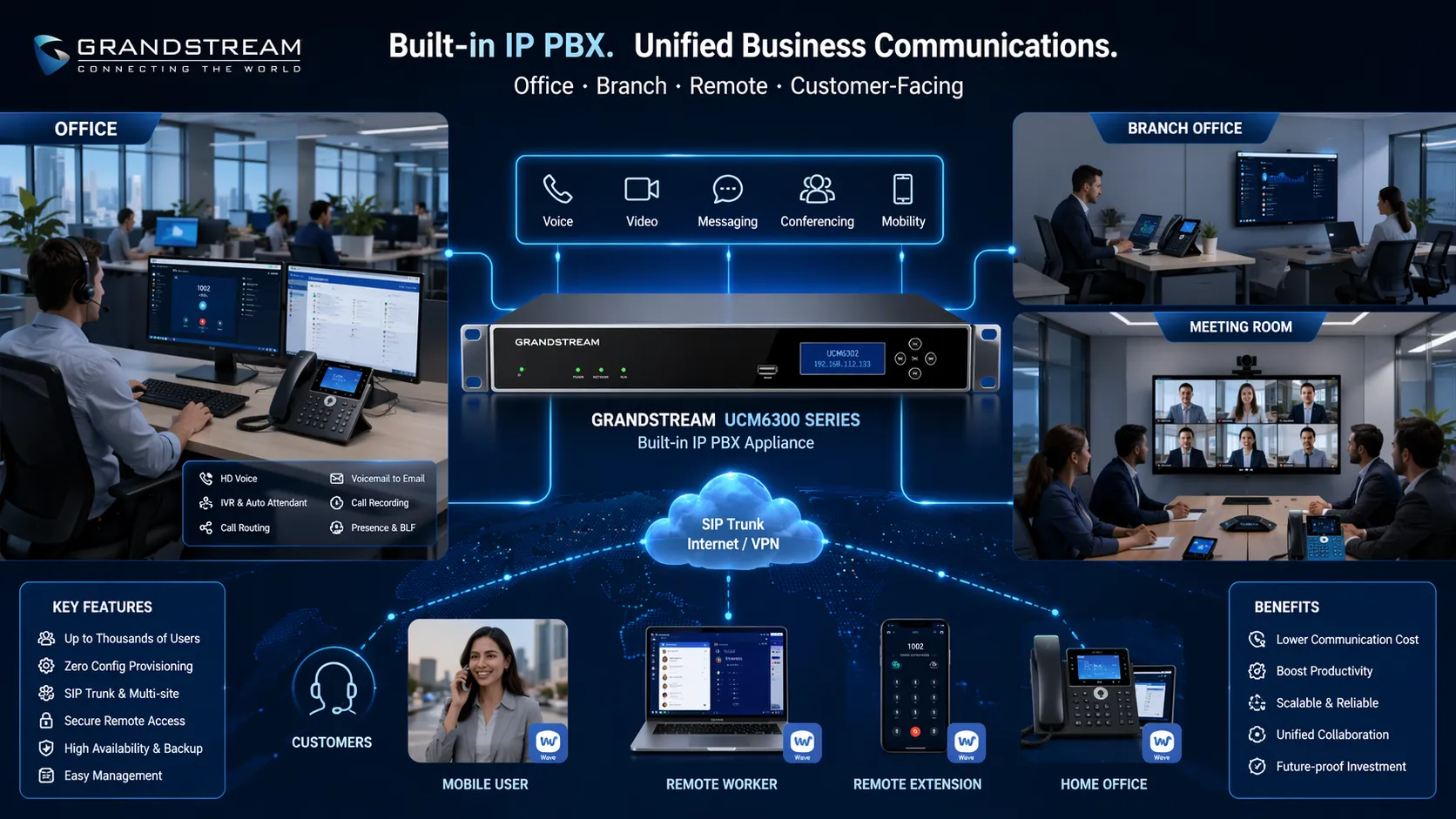
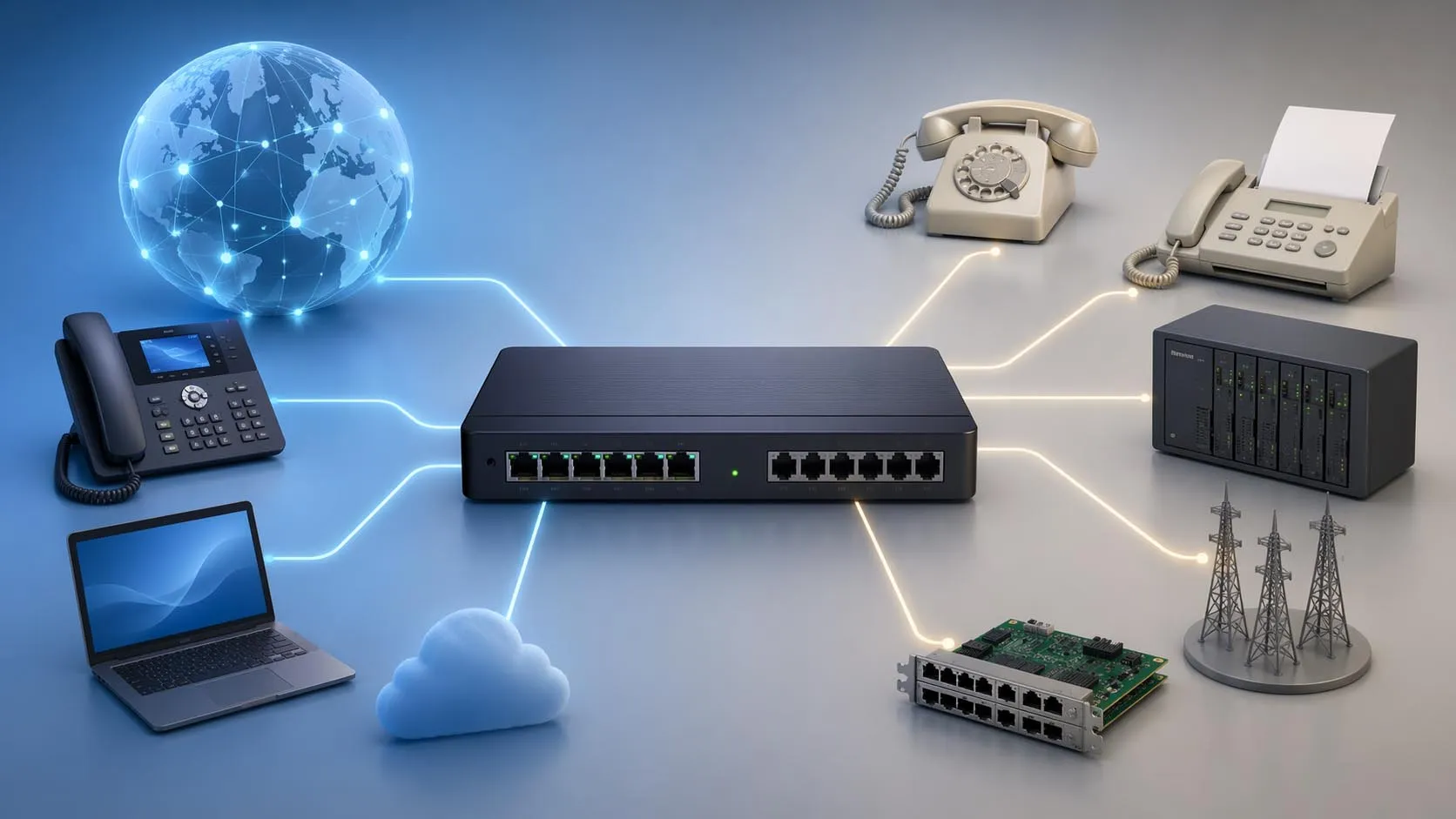
Grandstream built-in IP PBX can unify office calling, meetings, remote users, and endpoint connectivity in one platform.
What Is Grandstream Built-In IP PBX?
An all-in-one communications platform
A built-in IP PBX is a business communication system that combines core PBX functions with broader unified communications capabilities. Instead of only providing extension management and call routing, it can also support internal collaboration, conferencing, mobile access, endpoint registration, and centralized administration from a single platform.
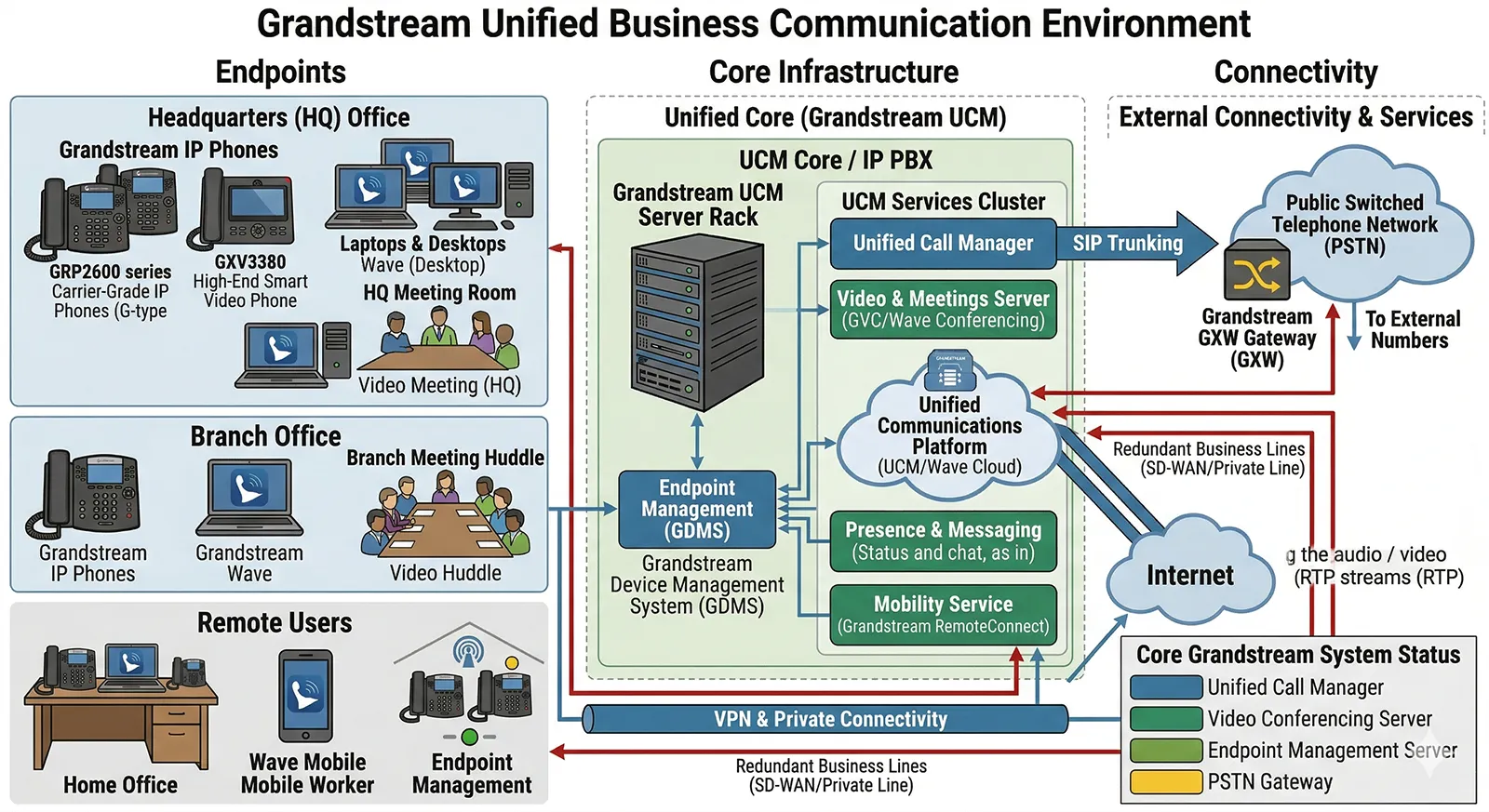
In practical terms, Grandstream built-in IP PBX is often used as the central communication hub for an organization. It can sit at the center of voice calling, video communication, meetings, internal dialing, remote connectivity, and SIP endpoint management, making it suitable for businesses that want a single control point rather than multiple disconnected systems.
Why businesses still choose built-in IP PBX
Cloud communications are popular, but many businesses still prefer a built-in IP PBX model because it offers more local control over system configuration, calling logic, extension structure, and internal policies. For organizations with specific network, privacy, cost, or deployment requirements, this can be a major advantage.
Another reason is flexibility. A built-in IP PBX can serve a single office, a headquarters with branch offices, or a hybrid team spread across multiple locations. When properly deployed, it gives companies the structure of a centralized communications system without forcing them into a one-size-fits-all service model.
Key Features of Grandstream Built-In IP PBX
Voice, video, meetings, and collaboration in one system
One of the most important features is convergence. Grandstream built-in IP PBX is not just about making and receiving calls. It is designed to support business voice communication alongside video calling, conferencing, web-based collaboration, and communication between different types of endpoints.
This matters because modern business conversations do not stay inside one channel. A front-desk inquiry may become an internal transfer, a mobile call, a scheduled meeting, or a follow-up collaboration session. A platform that supports these workflows in one environment is far more useful than a phone system that only handles extension-to-extension calls.
Support for remote work and distributed teams
Many businesses now operate across headquarters, branch sites, home offices, and mobile staff. A strong built-in IP PBX should therefore support users beyond the physical office. Grandstream’s positioning in this space makes the platform relevant to companies that need remote extensions, mobile collaboration, browser-based access, and easier communication across sites.
This is especially useful for organizations that want the stability of an on-premise PBX model while still enabling remote access. It creates a middle ground between traditional office telephony and fully cloud-dependent communication systems, which can be attractive to businesses with hybrid operations.
Centralized provisioning, management, and system integration
Another important feature is easier administration. As the number of endpoints grows, manual setup becomes inefficient. A built-in IP PBX becomes much more valuable when it can simplify endpoint onboarding, reduce deployment time, and make ongoing management less labor-intensive for IT teams.
Integration also matters. Businesses often need the communication platform to connect with CRM workflows, hospitality systems, internal contacts, or service processes. A system that supports external integration can move beyond basic telephony and become part of the company’s broader operating workflow.
Key value comes from unifying call control, collaboration, endpoint administration, and remote access.
Main Benefits for Businesses
Lower complexity across communication workflows
One of the clearest benefits is simplification. When calling, meetings, internal extensions, and user access are managed inside one environment, businesses spend less time switching between systems and troubleshooting fragmented workflows. That can improve both user adoption and administrative efficiency.
This does not mean every business needs the most complex UC deployment possible. It means many businesses benefit from reducing unnecessary communication silos. A built-in IP PBX can help create a cleaner operational model where staff know where to place calls, answer calls, join meetings, and manage communication tasks.
Better control over the business communication environment
Control is another major benefit. Companies that want direct oversight of extension planning, user permissions, internal routing, department structures, and deployment timing often prefer a built-in model over a fully outsourced one. This is particularly relevant for businesses that want predictable internal behavior and direct visibility into how the system is configured.
For some organizations, this also supports operational consistency. Front desks, customer-facing staff, internal departments, and leadership teams can all work from a more uniform calling and collaboration environment, which reduces confusion and helps standardize internal communication practices.
Stronger fit for growth without unnecessary fragmentation
As organizations grow, communication challenges usually grow with them. More users, more locations, more call flows, more internal groups, and more devices can quickly turn a simple phone setup into something difficult to manage. A built-in IP PBX helps by giving that growth a structured platform instead of forcing teams to keep adding isolated tools.
That makes it easier to expand communications in a controlled way. Businesses can add users, connect locations, introduce mobile access, or improve internal collaboration without rebuilding the entire communication environment from scratch every time requirements change.
A good built-in IP PBX is not just a replacement for old telephony. It becomes the communications core that ties together calling, collaboration, user management, and business responsiveness.
Business Applications of Grandstream Built-In IP PBX
Office communications and front-desk call handling
For standard business offices, Grandstream built-in IP PBX can serve as the foundation for daily voice communications. It can support reception, extension dialing, internal transfers, department routing, management communication, and user availability across a structured extension environment.
This makes it useful for companies that want a more professional internal and external calling experience without relying on disconnected consumer-grade tools. It is especially relevant when the front desk, operations team, leadership team, and internal staff all need to work from one coordinated system.
Branch offices and hybrid work environments
Businesses with multiple sites often need a communication model that feels centralized even when operations are distributed. A built-in IP PBX can support that by giving offices and remote users a common internal communication framework. Staff in different locations can work as part of one business phone environment instead of separate local systems.
This application becomes even more relevant in hybrid work settings. Employees may move between the office, home, and travel environments, but the business still wants one communication identity, one extension logic, and one collaborative framework. That is where a unified IP PBX approach becomes strategically useful.
Hospitality, service, and customer-facing environments
Customer-facing businesses often need more than simple internal calling. They may require structured call handling, staff coordination, service responsiveness, integration with operational systems, and the ability to support different communication touchpoints across the property or organization.
That makes Grandstream built-in IP PBX suitable for use cases such as hospitality, managed services, professional offices, clinics, education-related operations, and similar environments where voice communication is closely tied to daily service workflows. In these scenarios, the PBX is not just a phone platform; it supports business operations and customer experience.
Typical business applications include offices, multi-site operations, hybrid teams, and service-oriented environments.
Is Grandstream Built-In IP PBX the Right Choice?
When it is a strong fit
Grandstream built-in IP PBX is a strong fit for businesses that want centralized communications, flexible deployment, SIP endpoint support, and a unified platform for calling and collaboration. It is especially relevant when a company wants to avoid fragmented tools and prefers a more controlled communication architecture.
It also works well for businesses that want to balance traditional PBX structure with modern collaboration requirements. If the goal is to support desk phones, video endpoints, remote users, meetings, and internal communication from one business-grade platform, this approach makes practical sense.
When another model may be better
Not every business needs a built-in IP PBX. Some very small teams may prefer a lightweight cloud-only service with minimal setup. Others may have complex enterprise requirements that push them toward larger UC ecosystems, broader compliance frameworks, or deeper contact center specialization.
The best choice depends on business size, IT capability, security expectations, deployment preference, and communication workflows. A built-in IP PBX is usually most valuable when the business wants more structure and control than entry-level cloud calling provides, but does not want communication to become operationally fragmented.
Conclusion
Grandstream built-in IP PBX can be understood as a practical business communications platform rather than just a replacement for legacy telephony. Its value comes from combining calling, collaboration, user access, and centralized management into a single operational framework. That gives businesses a more connected and manageable communication environment.
For companies evaluating modern voice and unified communications systems, the key question is not only whether the platform can place calls. The more important question is whether it can support how the business actually works across teams, locations, devices, and service workflows. In that context, Grandstream built-in IP PBX is best viewed as a flexible, business-oriented communications foundation.
FAQ
What does Grandstream built-in IP PBX mean?
It generally refers to a Grandstream business communication platform that combines PBX calling functions with broader unified communications features such as conferencing, collaboration, remote access, and centralized endpoint management.
Is Grandstream built-in IP PBX only for voice calls?
No. The broader value of this type of platform is that it can support voice, meetings, internal collaboration, remote user access, and communication across multiple device types instead of acting as a voice-only phone switch.
Who should consider Grandstream built-in IP PBX?
It is suitable for businesses that want a structured communication system for offices, branches, hybrid teams, front-desk operations, and service-oriented environments where internal coordination and professional call handling both matter.
What is the main benefit of a built-in IP PBX over a basic phone system?
The main benefit is consolidation. A built-in IP PBX can reduce communication silos by bringing call control, collaboration, user management, and endpoint connectivity into one platform.
Can Grandstream built-in IP PBX support remote and hybrid work?
Yes. This is one of the reasons the platform is often discussed in modern business deployment scenarios. It is relevant to organizations that need local control while also supporting remote users and distributed communication workflows.
We use cookie to improve your online experience. By continuing to browse this website, you agree to our use of cookie.
Cookies
This Cookie Policy explains how we use cookies and similar technologies when you access or use our website and related services. Please read this Policy together with our Terms and Conditions and Privacy Policy so that you understand how we collect, use, and protect information.
By continuing to access or use our Services, you acknowledge that cookies and similar technologies may be used as described in this Policy, subject to applicable law and your available choices.
Updates to This Cookie Policy
We may revise this Cookie Policy from time to time to reflect changes in legal requirements, technology, or our business practices. When we make updates, the revised version will be posted on this page and will become effective from the date of publication unless otherwise required by law.
Where required, we will provide additional notice or request your consent before applying material changes that affect your rights or choices.
What Are Cookies?
Cookies are small text files placed on your device when you visit a website or interact with certain online content. They help websites recognize your browser or device, remember your preferences, support essential functionality, and improve the overall user experience.
In this Cookie Policy, the term “cookies” also includes similar technologies such as pixels, tags, web beacons, and other tracking tools that perform comparable functions.
Why We Use Cookies
We use cookies to help our website function properly, remember user preferences, enhance website performance, understand how visitors interact with our pages, and support security, analytics, and marketing activities where permitted by law.
We use cookies to keep our website functional, secure, efficient, and more relevant to your browsing experience.
Categories of Cookies We Use
Strictly Necessary Cookies
These cookies are essential for the operation of the website and cannot be disabled in our systems where they are required to provide the service you request. They are typically set in response to actions such as setting privacy preferences, signing in, or submitting forms.
Without these cookies, certain parts of the website may not function correctly.
Functional Cookies
Functional cookies enable enhanced features and personalization, such as remembering your preferences, language settings, or previously selected options. These cookies may be set by us or by third-party providers whose services are integrated into our website.
If you disable these cookies, some services or features may not work as intended.
Performance and Analytics Cookies
These cookies help us understand how visitors use our website by collecting information such as traffic sources, page visits, navigation behavior, and general interaction patterns. In many cases, this information is aggregated and does not directly identify individual users.
We use this information to improve website performance, usability, and content relevance.
Targeting and Advertising Cookies
These cookies may be placed by our advertising or marketing partners to help deliver more relevant ads and measure the effectiveness of campaigns. They may use information about your browsing activity across different websites and services to build a profile of your interests.
These cookies generally do not store directly identifying personal information, but they may identify your browser or device.
First-Party and Third-Party Cookies
Some cookies are set directly by our website and are referred to as first-party cookies. Other cookies are set by third-party services, such as analytics providers, embedded content providers, or advertising partners, and are referred to as third-party cookies.
Third-party providers may use their own cookies in accordance with their own privacy and cookie policies.
Information Collected Through Cookies
Depending on the type of cookie used, the information collected may include browser type, device type, IP address, referring website, pages viewed, time spent on pages, clickstream behavior, and general usage patterns.
This information helps us maintain the website, improve performance, enhance security, and provide a better user experience.
Your Cookie Choices
You can control or disable cookies through your browser settings and, where available, through our cookie consent or preference management tools. Depending on your location, you may also have the right to accept or reject certain categories of cookies, especially those used for analytics, personalization, or advertising purposes.
Please note that blocking or deleting certain cookies may affect the availability, functionality, or performance of some parts of the website.
Restricting cookies may limit certain features and reduce the quality of your experience on the website.
Cookies in Mobile Applications
Where our mobile applications use cookie-like technologies, they are generally limited to those required for core functionality, security, and service delivery. Disabling these essential technologies may affect the normal operation of the application.
We do not use essential mobile application cookies to store unnecessary personal information.
How to Manage Cookies
Most web browsers allow you to manage cookies through browser settings. You can usually choose to block, delete, or receive alerts before cookies are stored. Because browser controls vary, please refer to your browser provider’s support documentation for details on how to manage cookie settings.
Contact Us
If you have any questions about this Cookie Policy or our use of cookies and similar technologies, please contact us at support@becke.cc .