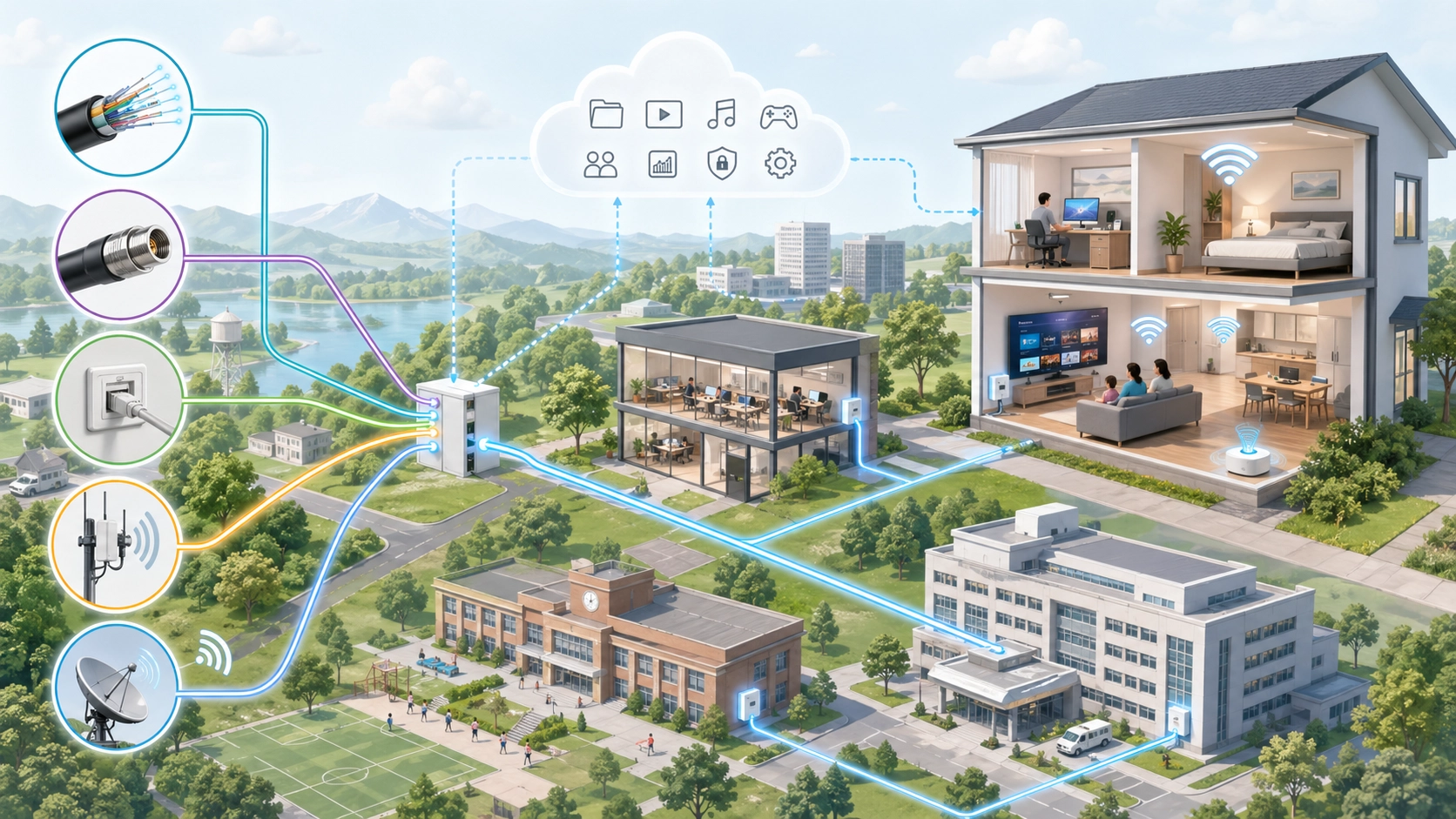
Fixed broadband is the foundation of modern home, business, education, cloud, entertainment, and digital service connectivity. It refers to internet access delivered to a fixed location through technologies such as fiber-to-the-home, cable broadband, DSL, fixed wireless access, or satellite. Unlike mobile broadband, which moves with the user, fixed broadband is designed to provide a stable connection to a home, office, campus, building, or facility.
The question of which fixed broadband providers are faster is not as simple as naming one global winner. Broadband performance depends heavily on local infrastructure, access technology, service plan, in-home Wi-Fi quality, network congestion, routing, latency, and how speed is measured. A provider that leads in one country or city may not be the fastest in another. A provider that delivers very high download speeds may not lead in upload performance, consistency, or latency.
Even so, the direction of the market is becoming clearer. Fiber networks are gaining share, cable operators are upgrading toward DOCSIS 4.0, Wi-Fi 7 is becoming part of premium home networking, and fixed wireless access is expanding where fiber is costly or slow to deploy. The future of fixed broadband will not be judged by headline download speed alone. It will be shaped by symmetrical performance, reliability, latency, coverage, affordability, and the ability to support many connected devices at the same time.
What Fixed Broadband Means
Definition and Core Meaning
Fixed broadband is a high-speed internet service provided to a specific physical location. It normally uses a modem, optical network terminal, router, gateway, or customer premises equipment installed at the user site. The connection may enter the building through fiber, coaxial cable, copper line, wireless receiver, or satellite terminal depending on the network design.
The core value of fixed broadband is stable high-capacity access. It is used for streaming, video meetings, cloud work, online gaming, smart home devices, security cameras, remote learning, business applications, VoIP, backup, monitoring, and many daily digital services. For companies and institutions, fixed broadband also supports branches, offices, payment systems, public Wi-Fi, cloud platforms, and remote operations.
In practical terms, fixed broadband is no longer just a consumer internet product. It is a basic digital infrastructure layer that supports both household life and business continuity.
Fixed broadband performance is not only about how fast a file downloads. It is about how reliably a location can participate in digital life and digital operations.
Why Speed Rankings Need Context
Speed rankings can be useful, but they must be interpreted carefully. A speed test result reflects the connection used by the tester, the plan purchased, the device used, the local Wi-Fi environment, the test server, network load, and the provider’s infrastructure. This means measured results are not always the same as theoretical plan speed.
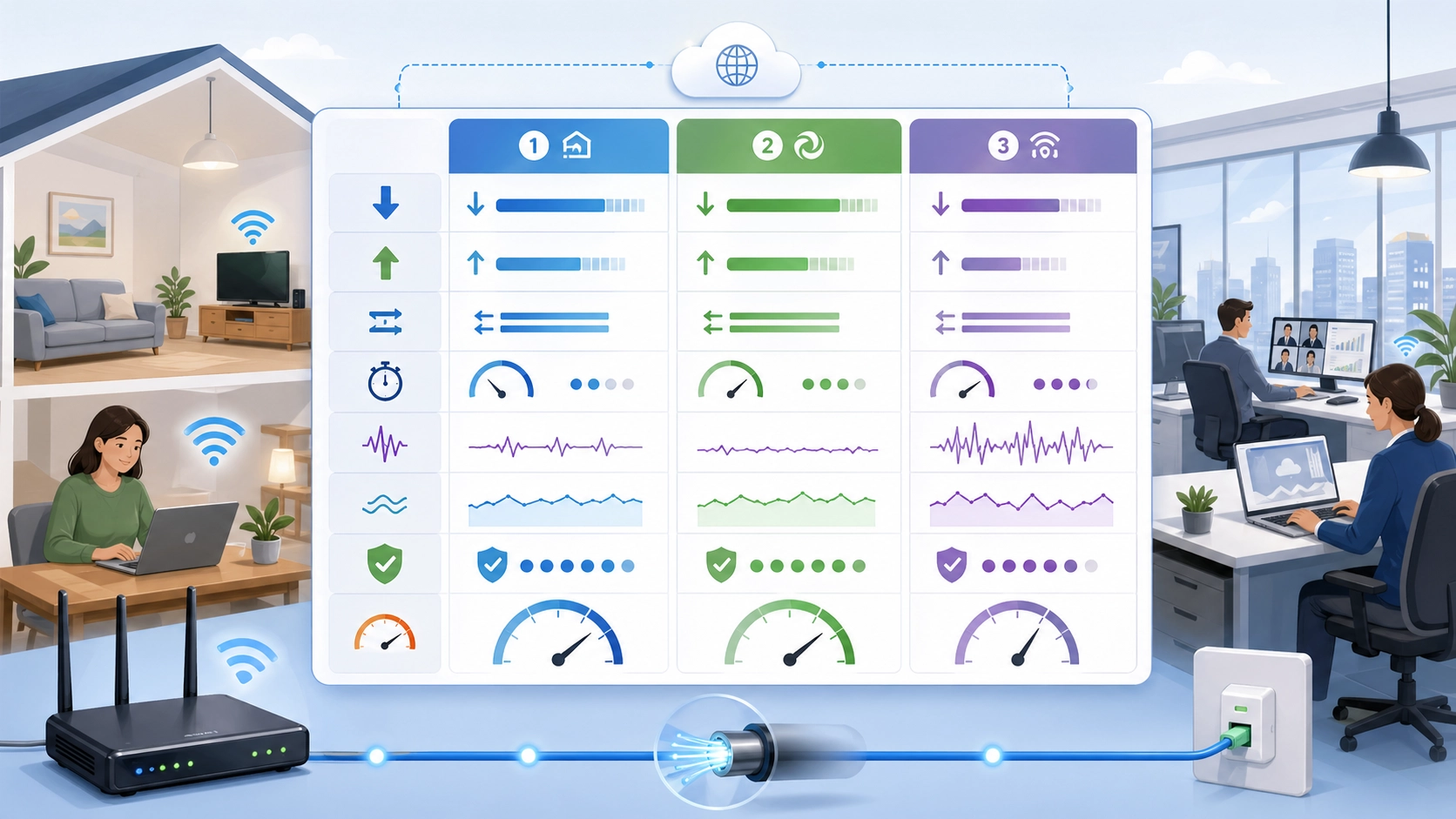
It is also important to distinguish between download speed, upload speed, latency, consistency, reliability, and peak-time performance. A provider may advertise multi-gigabit download plans, but users may still experience weak performance if uploads are limited, latency is unstable, or in-home Wi-Fi becomes the bottleneck. For real users, the fastest provider is often the one that delivers consistently good performance where they actually live or work.
Therefore, provider comparison should combine market data with local availability and user requirements. A national ranking is helpful, but the best choice still depends on the specific address, plan, and use case.
Which Fixed Broadband Providers Are Faster?
Why There Is No Single Global Answer
There is no single fixed broadband provider that can be called the fastest everywhere because providers operate in different markets with different networks. A strong fiber provider in one country may not serve another country at all. A regional fiber company may outperform national brands in one city, while a cable operator may lead in another area because its network is newer or less congested.
The fastest providers are usually those with strong fiber coverage, modern access networks, enough backhaul capacity, and good home-network equipment. In some markets, fiber-first providers lead because they offer symmetrical upload and download performance. In other markets, upgraded cable operators remain highly competitive on download speed, especially where DOCSIS upgrades have been deployed.
The most practical way to answer the question is to look at provider performance by country, region, and access technology rather than expecting one universal ranking.
Recent Market Examples
In the United States, recent Ookla-based reporting for the first half of 2025 identified AT&T Fiber as the fastest fixed internet service provider at the national level, while separate fixed broadband experience analysis has highlighted the strength of AT&T on upload performance and the competitive performance of large cable operators such as Xfinity and Spectrum in several experience categories. This shows why “fastest” can vary depending on whether the focus is download, upload, video, reliability, or consistency.
In Australia, Superloop has been recognized in 2025 Ookla-related reporting as a leading fixed broadband performer, helped by high-speed plans delivered over fiber-to-the-premises and hybrid fiber-coaxial access where available. In Indonesia, MyRepublic Indonesia was recognized in Ookla Speedtest Awards reporting for fast fixed network performance in 2025. In Thailand, AIS has reported strong fixed broadband award performance in the second half of 2025.
These examples point to a wider market pattern: faster providers are usually not faster by accident. They tend to invest in fiber, modern access equipment, national or regional backbone capacity, better customer premises hardware, and cleaner traffic engineering.
How to Compare Fixed Broadband Providers
Download Speed, Upload Speed, and Symmetry
Download speed remains the most visible metric because it affects streaming, file downloads, browsing, app updates, and content consumption. Many marketing claims focus on download speed because it is easy to understand and easy to advertise. However, download speed alone is not enough to judge a provider.
Upload speed is increasingly important because homes and businesses now send more data than before. Video meetings, cloud backup, remote work, security cameras, content creation, telemedicine, and business applications all depend on upload performance. Fiber providers often perform well here because many fiber plans are symmetrical or near-symmetrical, while some older cable and DSL systems may offer much lower upload speeds than downloads.
A provider with strong upload performance may feel better for modern work and interactive services even if its advertised download speed is similar to a competitor.
Latency, Jitter, and Consistency
Latency measures how long data takes to travel between the user and the service. Jitter measures variation in that delay. Both are important for gaming, VoIP, video conferencing, cloud desktops, remote control, and interactive applications. A fast download number does not always guarantee good latency.
Consistency is also critical. Users do not only care about the best result at 3 a.m. They care about whether the service remains usable during evening peak hours, office hours, bad weather, or heavy household device usage. A provider with slightly lower maximum speed but stronger consistency may deliver a better real experience.
This is why the best provider comparison should include speed, latency, packet loss, peak-time stability, and service reliability together.
The fastest broadband provider on paper is not always the best provider in practice. The better question is which provider delivers usable speed consistently at the address where the service is needed.
Network Architecture Behind Faster Providers
Fiber-to-the-Home and Fiber-to-the-Premises
Fiber-to-the-home and fiber-to-the-premises are among the strongest fixed broadband architectures because optical fiber provides high capacity, low signal loss, and strong upgrade potential. Fiber networks can support symmetrical service, higher uploads, low latency, and future upgrades through improved optical equipment.
Many leading broadband markets have moved aggressively toward fiber because it provides a long-term platform for multi-gigabit service. Technologies such as GPON, XGS-PON, and future higher-capacity PON systems allow operators to increase speed without rebuilding the entire physical network from scratch.
Fiber also supports other digital infrastructure. Mobile networks, business services, smart city systems, data centers, and public service networks all benefit from fiber backhaul and dense fiber access.
Cable Broadband and DOCSIS Upgrades
Cable broadband remains important in many countries because existing coaxial networks already reach large numbers of homes. With DOCSIS upgrades, cable operators can deliver high downstream speeds and improve capacity without immediately replacing every access line with fiber.
DOCSIS 4.0 is especially important because it is designed to support higher capacity and better upstream performance than older cable architectures. However, cable performance still depends on network segmentation, upstream spectrum, node upgrades, customer equipment, and congestion management.
In markets where cable operators upgrade aggressively, they can remain competitive with fiber for many users, especially on download-heavy services. The key challenge is matching fiber-like upload, latency, and long-term scalability expectations.
Where the Fixed Broadband Market Is Headed
Fiber Share Will Continue to Grow
The long-term direction of fixed broadband is toward more fiber. Fiber supports high speed, low latency, strong reliability, and symmetrical bandwidth more naturally than many legacy access technologies. It also provides a more future-ready platform for households and enterprises that continue adding connected devices and cloud-dependent services.
Growth does not mean every copper or cable network disappears immediately. Many markets will remain mixed for years, with fiber, cable, fixed wireless, DSL, and satellite serving different locations and budgets. However, the strategic direction is clear: wherever dense demand and investment conditions support it, fiber is becoming the preferred fixed broadband foundation.
This trend is also changing competition. Smaller regional fiber providers can challenge national brands in local markets, while large telecom operators are expanding fiber footprints to protect long-term market share.
DOCSIS 4.0, Wi-Fi 7, and Home Networking Will Matter More
The broadband market is also moving beyond the access line itself. DOCSIS 4.0 upgrades can help cable operators remain competitive. Wi-Fi 7 routers and mesh systems can improve in-home performance, especially as users adopt multi-gigabit plans. A fast fiber or cable connection can still feel slow if the home Wi-Fi system is weak, congested, or poorly placed.
This means future provider competition will include customer premises equipment, smart Wi-Fi management, security features, app-based support, and service reliability tools. Providers that control both the access network and the in-home experience may have an advantage because the user judges the whole experience, not just the signal entering the building.
In practical terms, the market is moving from “how fast is the line?” to “how good is the full broadband experience?”
Fixed Wireless Access Will Keep Expanding
Fixed wireless access is becoming an important complement to wired broadband. It can provide home or business internet using 4G, 5G, or other wireless access technologies, often with faster deployment than new fiber construction. This makes it attractive in suburban, rural, temporary, and underserved locations.
Fixed wireless will not replace fiber everywhere, especially where very high symmetrical capacity is needed. However, it can create new competition, pressure prices, expand coverage, and offer practical service in places where wired access is limited or slow to upgrade.
The future market will likely be hybrid. Fiber will be the premium long-term access layer in many dense areas, cable will evolve through DOCSIS upgrades, and fixed wireless will serve as an important competitive and coverage-expansion tool.
Business and Consumer Selection Considerations
Choosing for Homes and Remote Work
For home users, the best fixed broadband choice depends on how the connection is used. A household that mainly streams video may care most about download speed and Wi-Fi coverage. A remote worker may need stable upload speed, low latency, and reliable video meeting performance. A gamer may care more about latency and jitter than the highest advertised download speed.
The number of connected devices also matters. Smart TVs, phones, laptops, tablets, cameras, speakers, game consoles, and smart home devices can compete for bandwidth. As more homes become device-dense, Wi-Fi quality and router performance become almost as important as the access line.
A good choice should therefore consider plan speed, upload performance, latency, Wi-Fi equipment, contract terms, customer support, and actual service availability at the address.
Choosing for Business and Enterprise Sites
Businesses should evaluate fixed broadband with a stronger focus on reliability, service-level expectations, upload capacity, static addressing, security, redundancy, and support response. A small office may use business fiber or cable broadband for cloud applications, VoIP, video meetings, file sharing, and customer service systems. A larger site may require multiple connections, failover, managed routing, or dedicated internet access.
For business use, the fastest provider is not always the best provider if it lacks support, uptime consistency, or suitable service terms. A slightly slower connection with better reliability and faster fault response may be more valuable than a consumer-grade high-speed plan with limited guarantees.
The best business broadband selection should match the operational risk of downtime, not only the advertised speed.
Applications of Fixed Broadband
Digital Home and Entertainment Services
Fixed broadband supports streaming video, online gaming, smart home devices, cloud storage, remote learning, social media, connected appliances, and home security systems. As video quality increases and households add more devices, stable broadband becomes more important than ever.
Multi-gigabit plans may not be necessary for every household, but growing device density means the home network must handle more simultaneous activity. A reliable 500 Mbps or 1 Gbps service with good Wi-Fi may feel better than a higher-speed plan paired with weak in-home equipment.
In home environments, the user experience depends on the combination of access speed, Wi-Fi quality, router capability, device placement, and service consistency.
Cloud Work, Communications, and Business Continuity
Fixed broadband is essential for cloud-based work. Businesses use it for SaaS platforms, VoIP, video meetings, CRM systems, online payments, inventory platforms, remote access, file synchronization, and cybersecurity services. When the fixed broadband connection becomes unstable, the entire digital workflow may suffer.
For this reason, many businesses are moving toward better broadband redundancy. They may combine fiber with cable, fixed wireless, or mobile backup to reduce the risk of a single connection failure. In critical environments, broadband is no longer treated as a convenience service but as part of operational continuity planning.
This business dependence will continue to push providers toward better reliability, lower latency, stronger support, and more transparent service quality.
Challenges in the Fixed Broadband Market
Coverage Gaps and Affordability
Despite rapid improvement in many countries, fixed broadband coverage remains uneven. Dense urban areas often receive fiber and premium services first, while rural or remote areas may depend on older copper, wireless, satellite, or limited-capacity networks. This creates a digital divide between locations with strong infrastructure and those with fewer options.
Affordability is another challenge. Even where fast service is available, not every household or small business can afford premium plans, installation fees, advanced routers, or bundled service packages. The market will therefore continue to involve public policy, infrastructure subsidies, wholesale access, competitive entry, and pricing pressure.
The future of fixed broadband is not only about faster networks. It is also about making reliable broadband available and usable for more people and more locations.
Marketing Speed Versus Real Experience
Another challenge is the gap between advertised speed and actual user experience. Providers often promote top-tier download rates, but customers may experience lower speeds because of Wi-Fi limitations, congestion, old devices, poor router placement, shared building wiring, or local network conditions.
This gap can create confusion. A customer may buy a gigabit plan but connect through an old Wi-Fi router that cannot deliver gigabit performance. Another user may have strong download speed but poor upload speed for video meetings. A business may have high throughput but insufficient redundancy.
Better customer education, clearer performance metrics, and more transparent quality reporting will become more important as plan speeds keep increasing.
The next stage of broadband competition will reward providers that can deliver measurable real-world quality, not only impressive plan names.
Conclusion
Fixed broadband performance is shaped by provider investment, access technology, network architecture, local coverage, upload capacity, latency, Wi-Fi quality, and service reliability. The fastest provider depends on the country, city, address, plan, and metric being measured. Fiber-first providers often lead in symmetrical performance, while upgraded cable operators remain competitive in many download-heavy markets.
The market is heading toward more fiber, continued cable modernization through DOCSIS 4.0, stronger in-home networking with Wi-Fi 7, and wider use of fixed wireless access where it can improve coverage or competition. At the same time, users are becoming more aware that real experience depends on more than maximum download speed.
For consumers, the best provider is the one that delivers stable performance for actual household usage. For businesses, the best provider is the one that combines speed with reliability, support, security, and redundancy. In both cases, the future of fixed broadband will be defined by consistent quality, not speed claims alone.
FAQ
Which fixed broadband provider is the fastest?
There is no single fastest fixed broadband provider worldwide. The fastest provider depends on the country, city, access network, plan type, and measurement method. Fiber-first providers often perform strongly, especially where upload speed and low latency matter.
Users should compare local speed data, plan details, upload performance, latency, and customer experience before choosing.
Is fiber always faster than cable broadband?
Fiber often provides better symmetrical speed, upload performance, and long-term scalability. However, upgraded cable networks can still deliver very high download speeds and may be competitive in many markets.
The better choice depends on the available provider, local network quality, price, upload needs, and service reliability.
Where is the fixed broadband market headed?
The market is moving toward fiber expansion, DOCSIS 4.0 cable upgrades, Wi-Fi 7 home networking, more fixed wireless access, and stronger competition around real-world quality rather than download speed alone.
Future broadband value will depend on consistency, latency, upload capacity, coverage, affordability, and in-home network performance.