Walkie-talkies are still one of the most direct and reliable tools for field communication. They are widely used in security patrols, industrial sites, logistics operations, emergency response, transportation facilities, construction projects, and remote maintenance teams. With push-to-talk operation, users can speak instantly without dialing, waiting, or operating complex communication terminals.
However, traditional walkie-talkie communication has a clear limitation: radio coverage is not unlimited. When two working areas are close to each other, direct radio communication or a local repeater may be enough. But when two sites are separated by tens or even hundreds of kilometers, ordinary walkie-talkies cannot communicate directly. In this situation, a cross-regional walkie-talkie networking solution is required.
A practical way to solve this problem is to use a ROIP gateway. ROIP, or Radio over IP, allows radio audio and control signals to be transmitted through an IP network. By connecting local walkie-talkie systems to ROIP gateways, two distant sites can achieve long-distance multi-channel interconnection without building a complicated chain of repeaters between them.
Why Cross-Regional Walkie-Talkie Networking Is Needed
In many projects, walkie-talkie users are not limited to one physical location. A company may operate two industrial parks, two logistics bases, two tunnel sections, two security zones, or multiple remote facilities. Each site may already have its own walkie-talkie system, local radio channels, vehicle-mounted radios, base stations, and working groups.
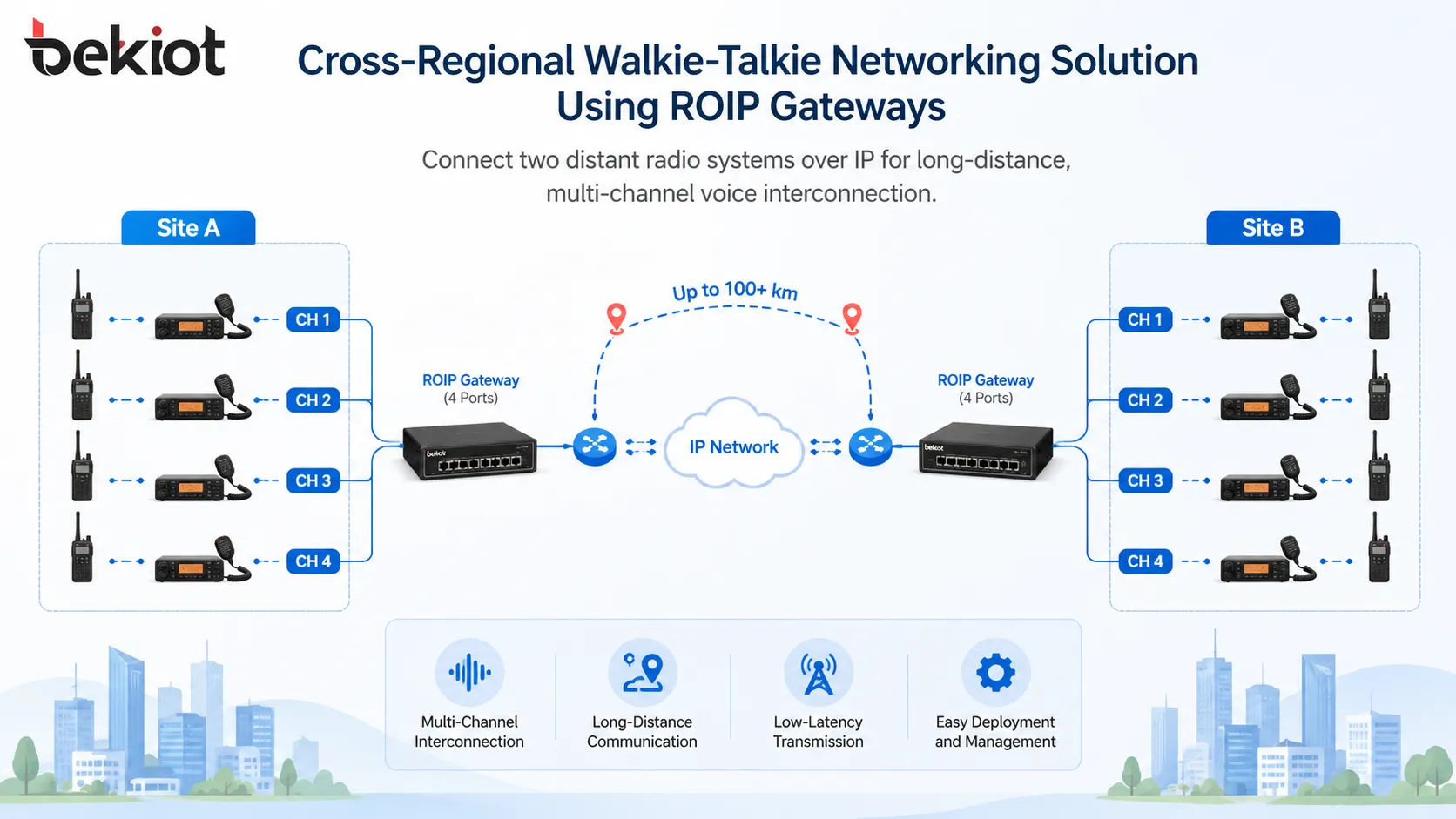
The challenge appears when teams at different locations need to communicate with each other in real time. For example, Site A and Site B may be 100 kilometers apart. Both sites have stable network connectivity, and each site has four walkie-talkie channels for different work groups. The customer wants Channel 1 at Site A to communicate with Channel 1 at Site B, Channel 2 with Channel 2, Channel 3 with Channel 3, and Channel 4 with Channel 4.
If this requirement is solved only by radio engineering, the project may need high-power repeaters, tower resources, antenna planning, intermediate relay points, frequency coordination, and professional installation. For many fixed communication scenarios, this may be more complex than necessary. When the two sites already have IP network access, ROIP gateway networking becomes a simpler and more efficient option.
How a ROIP Gateway Works in Walkie-Talkie Interconnection
A ROIP gateway works as a bridge between a traditional radio system and an IP communication network. On the radio side, it connects to walkie-talkie terminals, vehicle-mounted radios, base radios, or repeater interfaces through customized cables. On the IP side, it converts radio audio into packet-based voice communication and sends it to another ROIP gateway through a LAN, private network, VPN, or dedicated IP link.
When a walkie-talkie user speaks at Site A, the local radio terminal receives the signal. The ROIP gateway captures the audio and radio status, converts the voice into IP data, and transmits it to the gateway at Site B. The ROIP gateway at Site B then outputs the audio to the corresponding radio terminal, which broadcasts the voice into the matched walkie-talkie channel at Site B.
This process also works in the opposite direction. Users at Site B can speak through their local walkie-talkies, and their voice can be transmitted back to Site A through the same ROIP gateway link. For field users, the operation remains the same as normal walkie-talkie communication. They still press the PTT button, speak, and listen through their existing radios.
Typical Deployment: Two Sites with Four Radio Channels
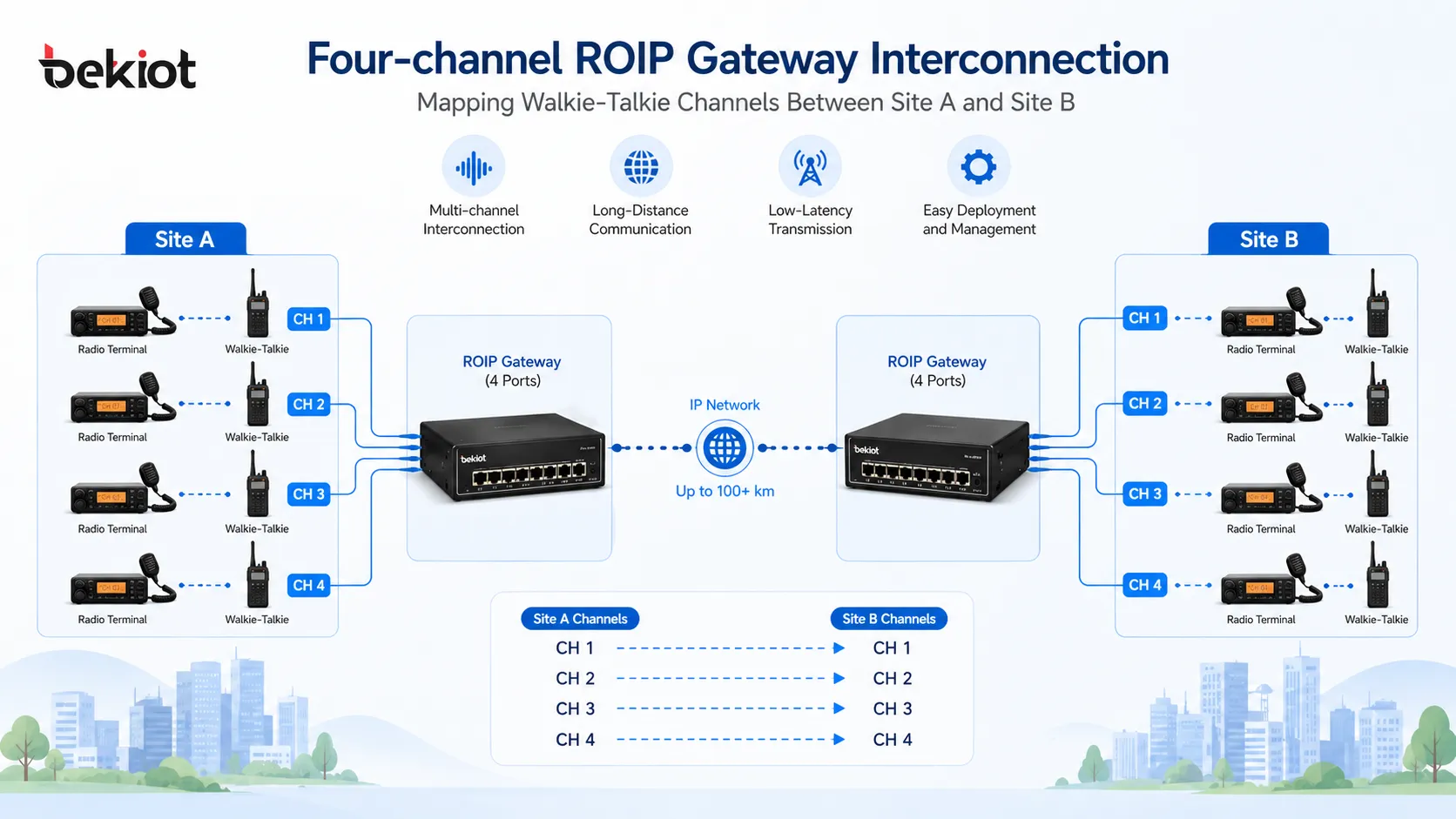
A typical cross-regional deployment can use one 4-port ROIP gateway at Site A and one 4-port ROIP gateway at Site B. At each location, four customized cables are used to connect the gateway to four radio terminals. Each radio terminal corresponds to one local walkie-talkie channel.
At Site A, Port 1 of the ROIP gateway connects to the radio terminal for Channel 1, Port 2 connects to Channel 2, Port 3 connects to Channel 3, and Port 4 connects to Channel 4. Site B uses the same structure. After both gateways are connected through the IP network, the four channels can be mapped one by one.
In this configuration, when a user on Channel 1 at Site A speaks, the voice is transmitted through the ROIP gateway and broadcast on Channel 1 at Site B. When a user on Channel 3 at Site B speaks, the voice is transmitted back and broadcast on Channel 3 at Site A. This one-to-one channel mapping keeps the communication logic simple and easy to manage.
Channel Mapping for Multi-Channel Radio Communication
Multi-channel mapping is important because different teams often use different radio channels. A security team may use one channel, a maintenance team may use another channel, and an emergency response group may use a separate channel. If all channels are mixed together, communication can become confusing.
With a multi-port ROIP gateway, each channel can be connected independently. This allows the system designer to keep the existing channel structure unchanged. Site A Channel 1 can be linked only to Site B Channel 1, while other channels remain separated. This helps avoid unnecessary interference between work groups and keeps dispatch communication clear.
For fixed business scenarios, this structure is especially practical. The customer does not need to rebuild the entire radio system or change the habits of field users. The ROIP gateway simply extends the existing radio channels over the IP network.
Low-Latency Communication with Carrier Detection
One of the key technical points in cross-regional walkie-talkie interconnection is how the gateway detects radio activity. Some interconnection systems rely mainly on voice activation. In that type of solution, the system waits until it detects voice energy before starting transmission. This may cause delay, missed first words, or unstable triggering in noisy environments.
A better solution is to use carrier detection or radio status detection. When the connected vehicle-mounted radio or base radio receives a valid carrier signal, the ROIP gateway can immediately recognize that the channel is active and activate the remote-side transmission. This allows the system to respond faster than ordinary voice-activated solutions.
For emergency dispatch, industrial coordination, security patrol, and transportation operations, low latency is very important. When users press PTT and speak, the voice should reach the remote site as quickly as possible. Carrier-based activation helps reduce response delay and makes cross-site walkie-talkie communication feel more natural.
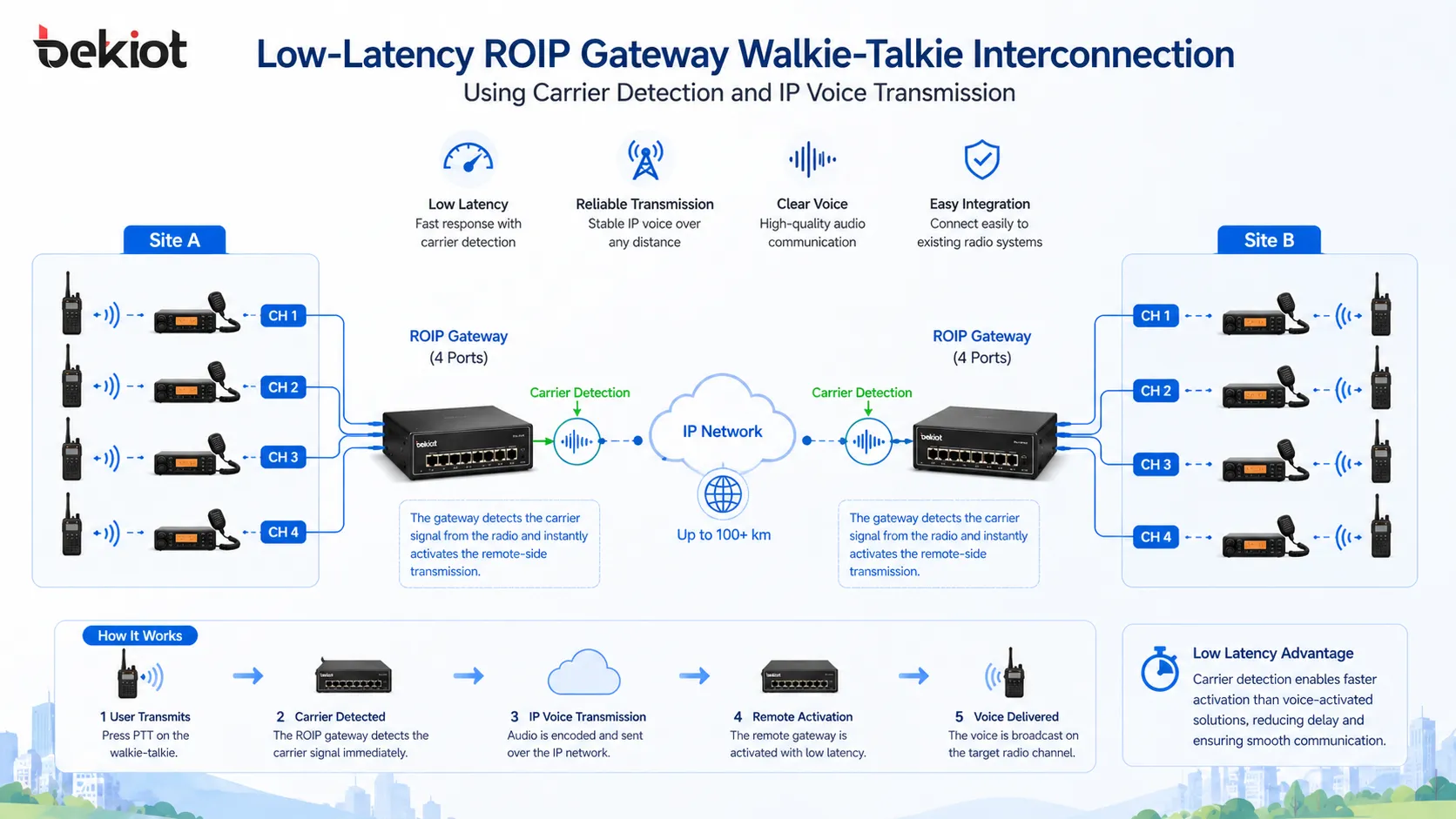
ROIP Gateway Networking Compared with Repeater-Based Extension
Repeater-Based Radio Extension
Repeater-based networking is a traditional method for extending radio coverage. It is useful when the goal is to expand radio signal coverage across a large physical area. However, for cross-regional communication over very long distances, repeater deployment may require multiple relay stations, antenna towers, power supply, site maintenance, and frequency planning.
This type of solution may be suitable for wide-area radio coverage projects, but it can be difficult to deploy quickly when the customer only needs fixed channel interconnection between two known locations.
ROIP Gateway-Based Interconnection
ROIP gateway networking is more suitable when both locations already have network connectivity and the main requirement is to connect existing walkie-talkie channels between sites. Instead of transmitting radio signals across the entire distance, the solution converts radio voice into IP data and sends it through the network.
This reduces the need for intermediate repeater sites and simplifies project implementation. It is especially suitable for two-site or multi-site communication where the channel relationship is fixed and the number of channels is limited.
Key Advantages of a ROIP Gateway Solution
Simpler Project Deployment
The solution does not require a long chain of repeaters between two distant locations. Each site only needs a ROIP gateway, radio terminals, customized cables, and IP network access. This makes the project easier to install, configure, and maintain.
Long-Distance Communication over IP
As long as the two sites have stable IP connectivity, walkie-talkie voice can be transmitted across long distances. The sites may be separated by 10 kilometers, 100 kilometers, or even longer distances, depending on the network condition and project design.
Support for Multiple Fixed Channels
A multi-port ROIP gateway can support several radio channels at the same time. For example, a 4-port gateway can connect four local radio channels and map them to four channels at another site. This is suitable for projects where different teams need independent communication channels.
Preservation of Existing Walkie-Talkie Operation
Field users do not need to change their operating habits. They still use their existing walkie-talkies and existing channels. The ROIP gateway works in the background to extend the radio communication path through the IP network.
Lower Latency with Radio Signal Detection
When the system uses carrier detection or radio status detection, it can trigger remote transmission faster than ordinary voice-activated methods. This helps improve the smoothness and reliability of cross-regional voice communication.
Comparative Advantages
| Dimension | Traditional (Phone / Push-to-Talk App) | High-Power Repeater Expansion | ROIP Gateway Interconnection |
|---|---|---|---|
| Communication Mode | One-to-one dialing, departs from radio ecosystem | Single frequency, limited talk groups | One-to-many, full group call compatibility, native PTT experience |
| Coverage | Relies on public cellular/Wi-Fi | Limited to ~100 km, dead spots remain | IP-accessible anywhere globally, unlimited reach |
| Multi-Channel Concurrency | Possible but chaotic without dedicated channels | Spectrum-constrained, easily interferred | Logical port matrix, dozens of concurrent calls without mutual interference |
| Terminal Compatibility | Requires additional smartphone | Mandates uniform radio standard, obsolesces old fleet | Retains all existing radios, zero subscriber replacement |
| Latency | Hundreds of milliseconds to seconds | Low (air interface ~100 ms) | As low as 30 ms over private network, ~100 ms over internet |
| Deployment Cost | Low (software) | Extremely high (towers, amplifiers, licensing) | Moderate (gateways + existing network), fully leverages current assets |
| Resilience | Vulnerable to public network congestion | Single point of failure at tower | Local fallback mode during WAN failure; restart interconnection when link recovers |
Suitable Application Scenarios
Industrial Parks and Remote Production Sites
Industrial companies often operate multiple production areas, warehouses, substations, maintenance points, or remote facilities. A ROIP gateway can connect local walkie-talkie systems between these sites and support real-time coordination for production, maintenance, safety, and emergency handling.
Security Patrol and Facility Management
Security teams may need to communicate across different campuses, office parks, logistics yards, or public facilities. By linking walkie-talkie channels through ROIP gateways, command centers and patrol teams in different areas can stay connected without replacing their radio systems.
Transportation, Logistics, and Port Operations
Transportation and logistics environments often involve distributed working areas. A ROIP gateway solution can connect radio users across terminals, warehouses, checkpoints, dispatch rooms, and remote operation zones through an IP network.
Emergency Response and Temporary Projects
For emergency command, temporary construction, disaster response, and event security, the communication system may need to be deployed quickly. When network access is available, ROIP gateway interconnection can provide a fast way to link radio teams across different locations.
When This Solution Is the Best Fit
A ROIP gateway-based walkie-talkie networking solution is best suited for scenarios where the number of channels is relatively small, the communication relationship is fixed, and the customer wants a simple and practical way to connect distant radio systems. A typical example is two sites with four channels each, requiring one-to-one channel interconnection.
If the project requires dynamic talk groups, centralized dispatch software, recording, GPS positioning, user permission control, radio management, emergency command workflow, or integration with a larger communication platform, a more advanced ROIP dispatch system may be required. However, for fixed channel-to-channel interconnection, a ROIP gateway provides a direct and efficient solution.
Conclusion
Cross-regional walkie-talkie communication does not have to rely only on radio coverage. When two distant sites already have IP network connectivity, ROIP gateways can connect local walkie-talkie systems and enable long-distance multi-channel interconnection.
By connecting radio terminals through customized cables, converting radio audio into IP voice transmission, mapping channels one by one, and using carrier detection for fast activation, the ROIP gateway solution provides a practical way to extend walkie-talkie communication across regions. For projects with fixed channels, clear communication needs, and limited deployment complexity, this approach can help users complete networking quickly and achieve reliable cross-site voice communication.
For similar cross-site radio interconnection projects, Becke Telcom can provide ROIP gateway solutions and practical integration support for walkie-talkie systems, SIP platforms, IP PBX systems, and dispatch communication networks.
FAQ
Can walkie-talkies communicate across long distances?
Ordinary walkie-talkies have limited communication range. For long-distance or cross-regional communication, users usually need repeaters, IP interconnection, ROIP gateways, or a wider radio communication system.
What is a ROIP gateway?
A ROIP gateway is a device that connects radio equipment to an IP network. It converts radio audio into IP-based voice transmission, allowing walkie-talkie systems in different locations to communicate through a network connection.
How does a ROIP gateway connect two walkie-talkie systems?
The gateway connects to radio terminals through customized cables. When one side receives walkie-talkie voice, the gateway converts the audio into IP data and sends it to the gateway at the remote site. The remote gateway then outputs the audio to the corresponding radio channel.
Is ROIP gateway networking suitable for four-channel systems?
Yes. A 4-port ROIP gateway can connect four radio channels at one site and map them to four channels at another site. This is suitable for fixed multi-channel walkie-talkie interconnection between two locations.
Why is carrier detection useful in ROIP gateway solutions?
Carrier detection allows the gateway to detect radio activity more quickly and accurately than ordinary voice activation. This helps reduce delay, avoid missed first words, and improve the reliability of cross-site walkie-talkie communication.