A call queue is a telephony and communication management function that places incoming calls into an organized waiting line when the intended user, department, or service team is not immediately available. Instead of allowing every new call to ring endlessly, fail randomly, or be dropped into confusion, the system holds callers in a managed sequence and connects them when an appropriate agent or endpoint becomes free. In practical terms, a call queue turns uncontrolled incoming demand into a structured service flow.
This feature is widely used in business phone systems, IP PBX platforms, SIP communication networks, customer service centers, technical support desks, reception teams, healthcare administration, hospitality communications, public service lines, and internal enterprise call handling. Wherever many calls may reach the same team or service point, a call queue helps organize access more effectively.
In modern communications, call queues matter because demand rarely arrives one call at a time in perfect sequence. Calls cluster during busy periods, shift changes, service incidents, customer campaigns, and operational peaks. Without a queue mechanism, users may encounter busy tones, repeated redirection, or missed responses. With a queue, the communication system can maintain order, visibility, and more predictable handling behavior even when demand rises.
What Is a Call Queue?
Definition and Core Meaning
A call queue is a call management structure that temporarily holds incoming callers when the destination team, department, or service resource is already occupied. Instead of rejecting the call immediately, the system places it into a waiting state and distributes it according to defined rules once an answering resource becomes available.
The core meaning of a call queue is controlled waiting. It does not remove delay, but it organizes delay so the caller remains inside the communication process rather than being forced to start over. This makes it especially useful in service-oriented voice environments where multiple callers may compete for the same limited answering capacity.
In practical terms, the queue is not just a waiting list. It is a live operational layer that links callers, agents, routing rules, wait logic, announcements, overflow paths, and service priorities into one manageable system.
A call queue does not simply make callers wait. It makes waiting structured, trackable, and easier to manage as part of a larger communication workflow.
Why Call Queues Matter
In real business environments, incoming call demand is often uneven. A department may be quiet one moment and overloaded the next. If calls are handled only through direct ringing, the results can be inconsistent. Some callers may reach staff immediately, others may hear repeated busy signals, and others may abandon the attempt entirely.
Call queues matter because they create a more controlled response model. Instead of leaving call access to chance, they provide a defined intake process. This improves fairness, visibility, and operational consistency. Even when the team is busy, the caller still remains within the managed service flow.
For organizations that rely on voice communication, this can significantly improve both user experience and internal handling discipline.
How Call Queues Work
From Incoming Call to Waiting State
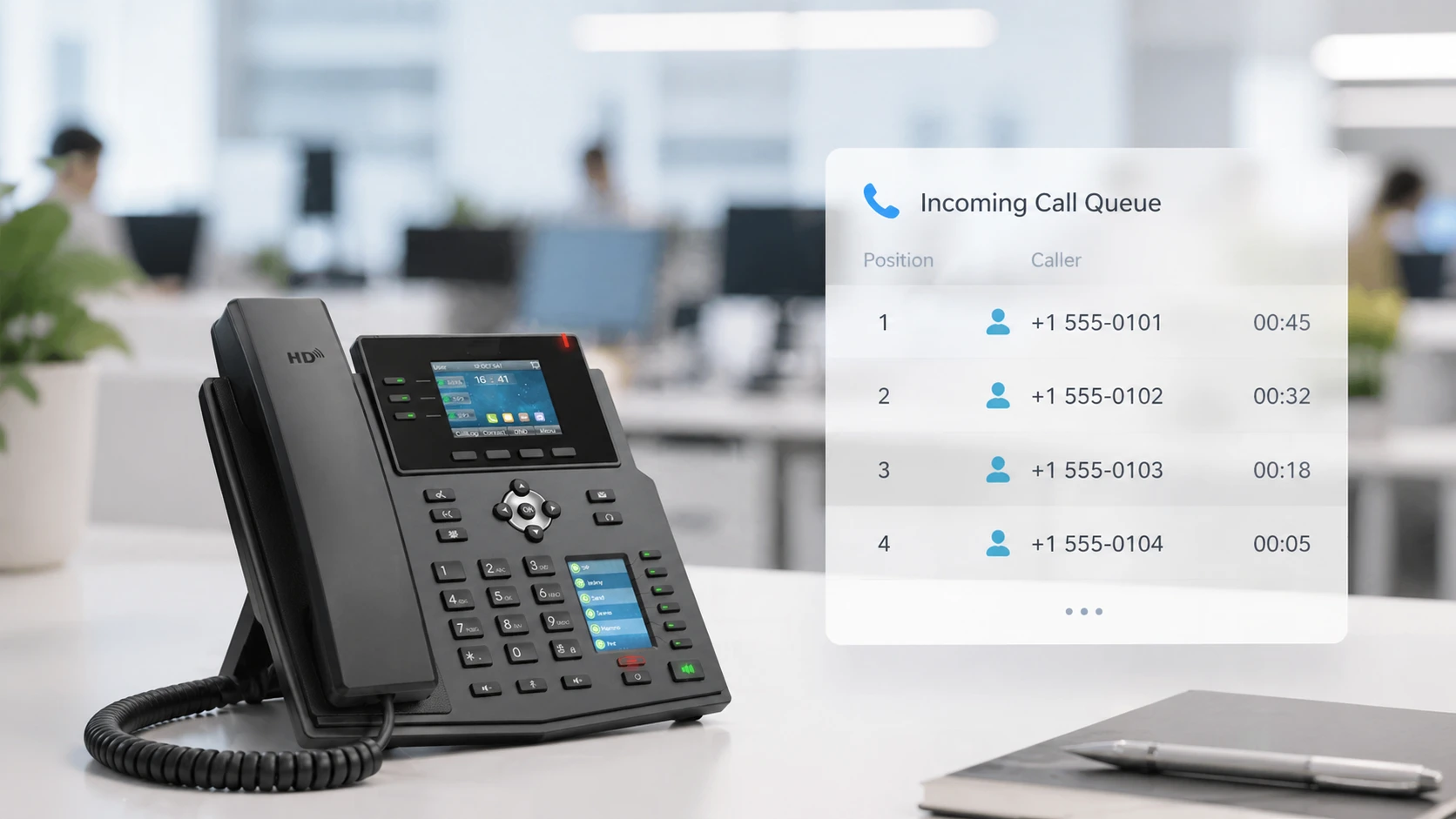
The process typically begins when a caller reaches a department number, service line, queue-enabled extension, IVR option, or ring group endpoint. If no appropriate answering resource is immediately available, the communication platform does not simply fail the call. Instead, it places the caller into a queue state.
During this state, the system may play hold music, informational announcements, estimated wait messaging, position notices, or custom service prompts. At the same time, the queue monitors agent or endpoint availability in real time. Once the routing conditions are satisfied, the next caller is distributed according to the configured logic.
This mechanism allows the system to absorb demand spikes without turning every unavailable moment into a failed communication attempt.
Distribution Logic Behind the Queue
The queue is not only a passive waiting line. It usually works together with distribution rules that determine which agent or endpoint should receive the next call. These rules may use fixed order, longest idle time, round robin, skills-based assignment, priority handling, or other policy-based methods depending on the communication platform.
This means the queue is often linked directly to workforce logic and service policy. A technical support queue may distribute by specialization, a reception queue may ring the longest idle staff member, and a multisite service queue may overflow to another branch when the primary team is saturated.
In this sense, a call queue is both a waiting structure and a live control system for how demand reaches human resources.
The real power of a call queue lies not only in holding calls, but in deciding how those calls should be released into the active service path.
Main Characteristics of Call Queues
Ordered Waiting and Controlled Distribution
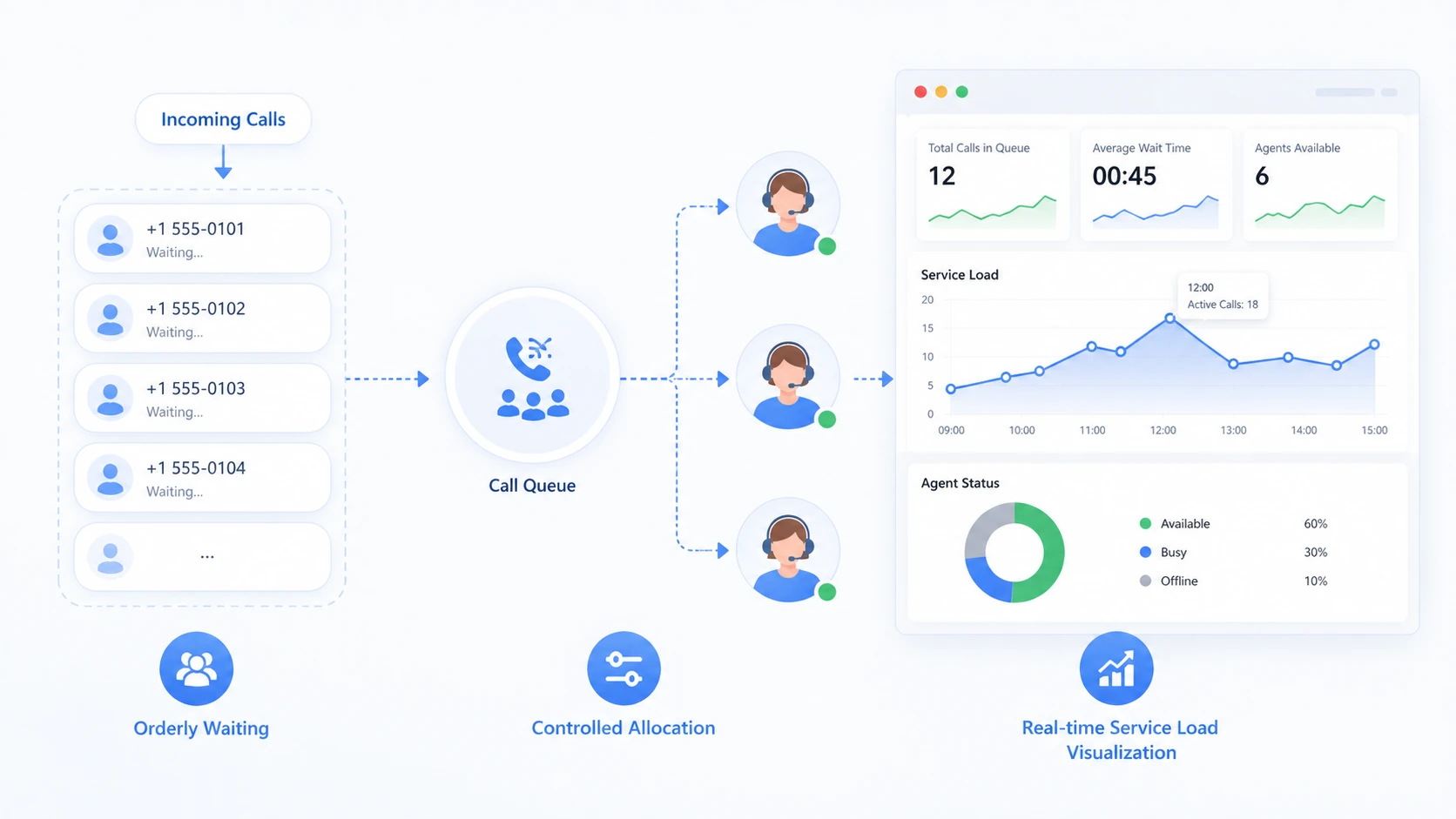
One of the most important characteristics of call queues is ordered waiting. Callers are not left in undefined ringing conditions or random retry loops. They are placed in a controlled environment where the system knows they are still present and awaiting service.
Another defining characteristic is controlled distribution. The queue does not just send calls forward blindly. It releases them according to a defined answer model. This makes communication handling more organized and helps the business control how service capacity is used.
Together, these two characteristics turn incoming call volume into something measurable and manageable rather than chaotic.
Status Visibility and Queue Awareness
Call queues often provide visibility into current queue status, including waiting callers, available agents, active service load, answer timing, and sometimes abandonment behavior. This visibility is valuable for supervisors, operators, and administrators because it helps them understand what is happening in the call environment in real time.
Visibility also supports better staffing and response decisions. If the queue grows longer than expected, supervisors may reassign staff, open overflow routes, or adjust communication priorities. Without queue visibility, those service problems may remain hidden until callers begin complaining or abandoning the line.
In practical deployment, this makes call queues important not only for callers, but also for operational monitoring.
Functional Features Commonly Found in Call Queues
Announcements, Music, and Caller Guidance
Many call queues include audio treatment features such as music on hold, recorded announcements, queue position notifications, business messages, or estimated wait prompts. These features help reassure callers that the system is still handling the call instead of leaving them uncertain about whether the line has failed.
Caller guidance is especially valuable in customer-facing environments because unmanaged silence or endless ringing often feels confusing and unprofessional. Even a simple periodic message can make the waiting experience feel more structured and intentional.
This means call queues often support both operational control and caller communication at the same time.
Overflow, Timeout, and Failover Options
Another important feature set involves overflow and timeout behavior. If the queue becomes too long, if wait time exceeds a threshold, or if the intended team remains unavailable, the system may reroute calls to voicemail, another department, a mobile duty number, an alternate site, or a backup service path.
These options are essential because no organization wants a queue to become a dead end. Good queue design includes next-step logic for when the original handling model can no longer respond acceptably.
In practical use, overflow and failover behavior often determine whether the queue remains a service tool or becomes a source of frustration.
Advantages of Call Queues
Better Organization of Incoming Demand
One of the clearest advantages of call queues is that they organize incoming demand. Instead of letting simultaneous calls collide with limited answering resources, the queue imposes structure. This makes the communication environment more predictable and easier to manage.
For service teams, this means fewer uncontrolled missed calls and less random call competition. For callers, it means the organization has a defined way to keep them inside the handling process even when immediate answer is not possible.
In real operations, that structure often makes the difference between a system that feels busy but manageable and one that feels overloaded and unreliable.
Improved Caller Retention and Service Continuity
Another major advantage is improved caller retention. Without a queue, callers who cannot reach someone immediately may hang up, redial repeatedly, or give up entirely. A queue allows the business to preserve the interaction opportunity by keeping the caller within the service flow.
This also supports service continuity. Even if the answer is delayed slightly, the communication path remains active. The caller does not need to restart from the beginning each time the team is busy. This can improve both efficiency and perceived service quality.
In practical terms, the queue helps prevent demand from disappearing simply because staff were unavailable at the exact first moment of contact.
A call queue turns temporary unavailability into managed waiting instead of communication loss.
Additional Operational Advantages
Supports Fairer Workload Distribution
Call queues can help distribute workload more fairly across staff. Instead of one agent or extension receiving all pressure while others sit idle, the queue can use distribution logic that balances call assignment more deliberately. This supports better use of personnel and may reduce answer inconsistency between team members.
In teams that handle large numbers of calls, this fairness can improve service stability and staff experience at the same time. It also gives supervisors better control over how available resources are used.
That is why call queues are often seen not just as caller tools, but also as workforce management tools.
Creates Better Visibility for Supervisors
Call queues also improve supervisory awareness. Because the queue tracks waiting calls, answer timing, and service load, managers can see when performance is healthy and when intervention is needed. This helps organizations move from reactive voice handling to more active service management.
In a busy environment, this visibility can reveal patterns such as recurring peak congestion, long wait periods, staffing mismatch, or ineffective routing. Those insights help improve not only the queue itself, but the wider communication process around it.
In practical terms, the queue becomes a source of service intelligence as well as a call-handling function.
Applications of Call Queues
Customer Service, Reception, and Help Desks
Call queues are widely used in customer service departments, reception desks, help desks, and support teams because these environments often receive multiple calls for the same limited group of people. The queue helps prevent uncontrolled congestion and keeps callers in a managed line until the next resource becomes available.
This is especially important where callers need assistance rather than simple call completion. A reception team may need to triage incoming inquiries. A support desk may need to manage technical requests. A service department may need to keep callers waiting briefly while agents finish active work. In each of these cases, a queue improves handling order and reduces missed opportunities.
That makes the queue one of the most common and valuable functions in service-oriented telephony.
Healthcare, Hospitality, and Administrative Communications
Healthcare administration, hospitality front offices, and internal administrative teams also benefit from call queues because incoming demand can be unpredictable and concentrated at certain times. A clinic may experience morning surges, a hotel may receive clustered guest requests, and an administrative department may face deadline-driven call peaks.
In these settings, the queue provides breathing space for the answering team while preserving the caller interaction. Instead of a constant busy outcome, the organization maintains a more professional and organized communication experience.
This is why call queues are useful beyond traditional contact centers. They support any voice environment where shared answering capacity matters.

Call Queues in IP PBX and SIP Environments
Role in Modern Voice Platforms
In IP PBX and SIP-based communication systems, call queues are a core live-service function. They can work across desk phones, softphones, operator consoles, remote staff endpoints, and multisite teams inside one coordinated voice environment. This gives organizations more flexibility than older isolated phone models.
In these systems, the queue may work together with IVR menus, ring groups, voicemail, presence logic, and reporting tools. The queue is therefore not a stand-alone block. It is part of a larger call management architecture that supports more intelligent service delivery.
For enterprise communications, this makes call queues highly relevant even outside dedicated contact center platforms.
Importance in Multisite and Hybrid Work Models
Call queues are also useful in multisite and hybrid work environments where answering staff may be spread across branches, offices, or remote work locations. Instead of tying service access to one physical room, the queue can treat the answering group as a service pool that may exist across different devices and places.
This flexibility is important because modern organizations often want communication systems to support distributed teams without sacrificing structure. A queue can help maintain one service entry point even when the actual answering resources are not in one fixed location.
In practical deployment, this makes call queues valuable for both traditional office communications and newer distributed work models.
Maintenance Tips and Good Design Practices
Do Not Treat the Queue as a Permanent Parking Space
One important principle is that a queue should not become a permanent parking space for callers. The goal is to manage delay, not normalize excessive waiting. If callers remain in queue too long without meaningful progress, the queue stops acting like a service tool and starts acting like a barrier.
This means businesses should review staffing, routing, announcements, overflow rules, and caller expectations regularly. A queue should support service quality, not merely hide understaffing or process weakness behind recorded messages.
In practical terms, healthy queue design focuses on movement and resolution rather than endless holding.
Monitor Real Queue Behavior and Adjust Accordingly
Another good practice is to monitor how the queue behaves in real life. How long are callers waiting? When do abandonment rates rise? Are certain periods consistently overloaded? Are the right agents receiving the right calls? These questions are essential because queue performance is highly sensitive to actual demand patterns.
Reviewing live behavior helps organizations tune announcements, staffing schedules, overflow logic, and routing priorities more effectively. Without this review, the queue may remain technically active but operationally suboptimal.
In practical service environments, the best queue design is the one that keeps evolving with actual usage instead of staying frozen at its original setup.
A good call queue is not judged only by whether it exists, but by whether it moves callers toward real service in a reasonable and predictable way.
Conclusion
Call queues are a practical communication management function that organize incoming voice demand when immediate answering is not available. Their main characteristics include ordered waiting, controlled call distribution, queue visibility, and integration with announcements, overflow logic, and service rules.
Their advantages include better organization of incoming demand, improved caller retention, fairer workload distribution, and stronger supervisory visibility. They are widely used in customer service, reception, help desks, healthcare administration, hospitality, IP PBX systems, and SIP-based enterprise voice environments.
For organizations that depend on voice communication, a call queue is not just a way to delay callers. It is a structured service mechanism that helps limited answering resources respond to real demand more effectively.
FAQ
What is a call queue in simple terms?
In simple terms, a call queue is a system that holds callers in an organized waiting line when the intended team or service point is busy. It keeps the caller in the communication process until someone becomes available.
This helps avoid immediate busy failures or random missed calls.
What are the main characteristics of call queues?
Main characteristics include ordered waiting, controlled distribution of calls, wait-state visibility, announcements or music on hold, and overflow or timeout handling. These features help create a more structured call experience.
Together, they make incoming call demand easier to manage.
Where are call queues commonly used?
Call queues are commonly used in customer service teams, reception desks, help desks, healthcare administration, hospitality front offices, office phone systems, IP PBX platforms, and SIP-based communication environments.
They are most useful wherever many callers need access to the same limited answering resources.