


Concurrent transfer refers to the practical ability of a communication system and its users to handle transfer-related actions while multiple calls or call states may exist at the same time. In a business phone environment, this may involve placing one caller on hold, consulting another extension, transferring an active call, handling a second incoming call, or moving calls between users, departments, queues, and devices without breaking the overall communication flow. It is not only about having a transfer button. It is about using transfer, hold, routing, and concurrency control together in a disciplined way.
In real deployments, concurrent transfer is especially useful for reception desks, customer service teams, help desks, dispatch positions, hospitals, hotels, administrative offices, branch organizations, and enterprise IP PBX or SIP communication systems. These environments rarely handle only one simple call at a time. Calls may arrive while another caller is already waiting, a receptionist may need to consult one department before transferring a caller to another, and support teams may need to manage several live conversations in different states.
To fully utilize the advantages of concurrent transfer, organizations must think beyond the feature itself. They need proper user permissions, enough concurrent call capacity, clear transfer rules, effective call hold behavior, queue design, operator training, and good monitoring. When these elements work together, concurrent transfer can improve responsiveness, reduce caller loss, and make high-volume voice communication much easier to manage.
What Concurrent Transfer Means in Practical Communication
Definition and Working Context
In practical communication terms, concurrent transfer describes a call-handling environment where users can manage multiple call sessions or call states while transferring calls between destinations. One call may be active, another may be held, a third may be ringing, and a transfer may be in progress. The system must be able to preserve these states correctly so the user can move callers to the right people without confusion or disconnection.
This is different from a single transfer action in isolation. A simple transfer moves one live call to another endpoint. Concurrent transfer focuses on what happens when transfer activity occurs in a busy environment with multiple calls, multiple endpoints, and multiple possible handoff paths. That is where real operational value appears.
In business communication, this capability helps users manage complexity. Instead of treating every call as a separate interruption, the system allows calls to be held, consulted, transferred, parked, queued, or redirected in an organized way.
Concurrent transfer is not just about moving one call. It is about keeping several call-handling actions under control at the same time.
Why It Matters in Busy Voice Environments
Busy voice environments depend on speed and order. If a receptionist or agent can only handle one call state at a time, callers may be dropped, left ringing, or forced to call again. When multiple calls arrive close together, a limited system or poorly trained user can quickly become a bottleneck.
Concurrent transfer matters because it gives the organization more flexibility in live call handling. A user can answer one call, place it on hold, consult another department, return to the caller, complete a transfer, and then handle the next call without losing the communication chain. This creates a more professional and resilient voice workflow.
In practical terms, the value is not simply higher call volume. The real value is controlled call movement during busy conditions.
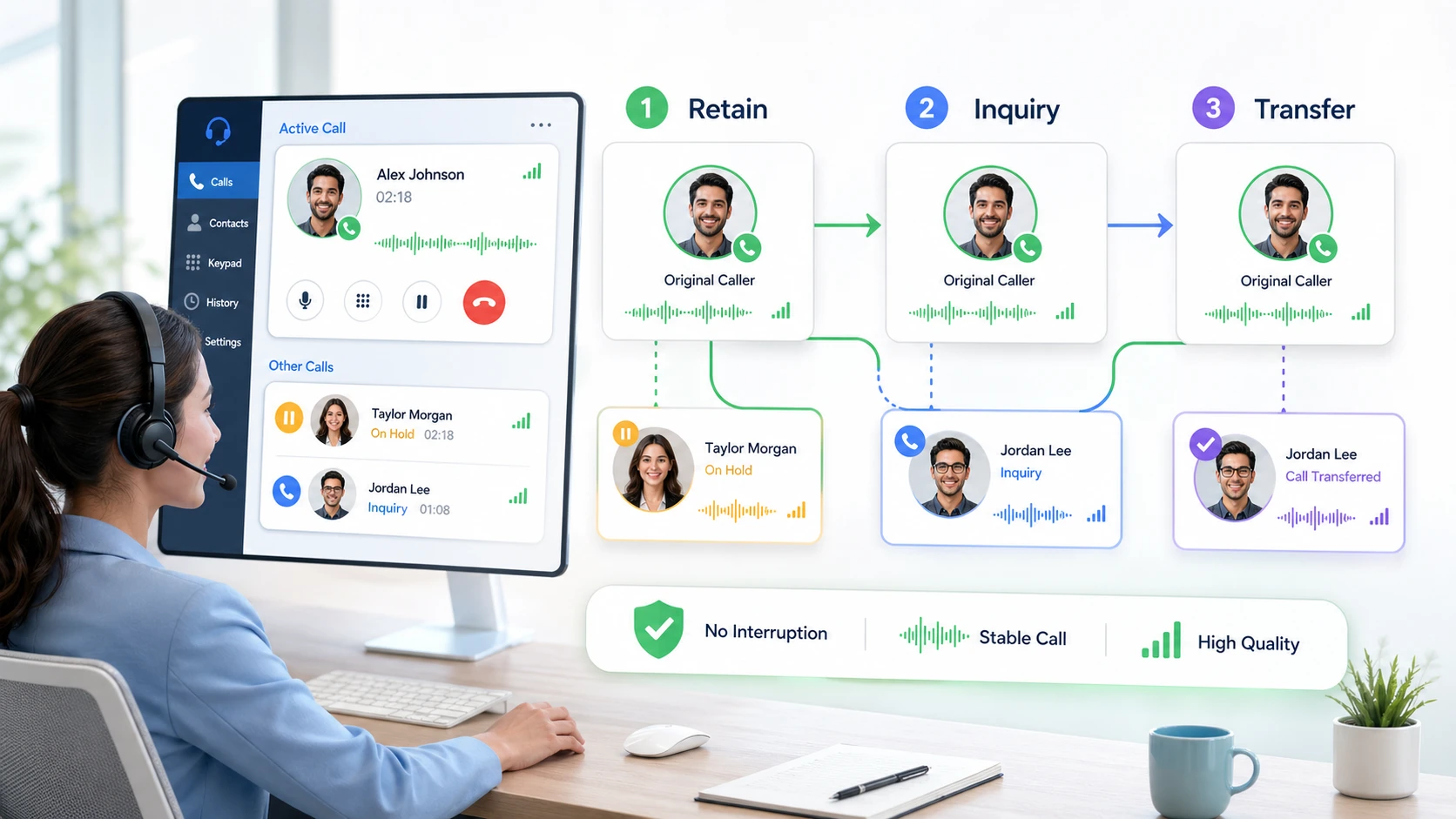
How Concurrent Transfer Works
Call Hold, Consultation, and Transfer Flow
Concurrent transfer often begins with call hold. A user may answer a caller, place that caller on hold, then call another extension or department to check availability. If the destination is correct, the user can complete the transfer. If not, the user can return to the original caller and choose another path. This is one of the most common practical examples of concurrent transfer behavior.
In attended transfer scenarios, concurrency is especially important because the transferring user may temporarily maintain more than one call leg. The original caller is waiting, the target user is being consulted, and the transfer action is not complete until the handoff is confirmed. If the system does not support enough concurrent call states, the process may fail or become awkward.
This is why concurrent transfer depends on both feature design and capacity configuration. The platform must support the number of simultaneous call legs that the workflow requires.
System Capacity and Call State Management
A communication platform must manage call states accurately for concurrent transfer to work well. Active calls, held calls, ringing calls, consultation calls, parked calls, and transferred calls should be clearly controlled by the system. If the platform loses track of these states, users may experience dropped calls, failed transfers, or unclear endpoint behavior.
Capacity also matters. If an extension, user license, trunk group, or PBX policy allows too few simultaneous call sessions, users may not be able to perform concurrent transfer smoothly during busy periods. A receptionist, operator, or support position may need more concurrent call capacity than an ordinary office user because that role is expected to manage several interactions at once.
In practical deployment, concurrent transfer should therefore be planned as a role-based communication requirement rather than assumed as a default behavior for every user.
Concurrent transfer works well only when the system can preserve call states and provide enough call capacity for the user’s actual role.
Main Advantages of Concurrent Transfer
Higher Call Handling Efficiency
One of the most obvious advantages is higher call handling efficiency. Users can manage more than one call activity without ending existing conversations or forcing callers to restart the process. This is especially useful for front desk staff, service coordinators, and agents who receive calls that often need to be redirected.
Instead of handling calls one by one in a rigid sequence, users can temporarily hold, consult, transfer, and resume calls according to the real situation. This reduces wasted time and gives the user more control over live communication flow.
In busy environments, this advantage can make the difference between an organized service desk and a constantly overloaded one.
Better Caller Experience During Handoffs
Concurrent transfer can also improve caller experience. When the system supports smooth transfer behavior, callers are less likely to be disconnected, asked to redial, or transferred blindly to the wrong destination. The user can hold the caller, consult the recipient, and then complete the transfer with better context.
This is especially valuable for customer service, healthcare, hospitality, and support environments where the caller may already be frustrated or in need of quick assistance. A controlled transfer process feels more professional and reduces the sense that the caller is being passed around randomly.
The advantage is not only technical. It directly affects how organized and reliable the organization sounds to the caller.
How to Fully Utilize Concurrent Transfer
Match Concurrent Call Capacity to User Roles
The first step is to match concurrent call capacity to actual user roles. Not every user needs the same number of simultaneous call states. A normal office user may only need basic hold and transfer. A receptionist, operator, dispatch position, or customer service agent may need more capacity because that person regularly handles multiple callers and transfer paths.
If capacity is too low, concurrent transfer becomes frustrating. The user may be unable to accept another call while holding one caller, or the system may restrict consultation calls during an active transfer. If capacity is too high without control, it may create unmanaged call stacking and poor service discipline.
The best approach is role-based design: give high-traffic positions enough concurrent capacity, but configure it with clear policy and monitoring.
Use Attended Transfer for Context-Sensitive Calls
Attended transfer is one of the best ways to take full advantage of concurrent transfer. When a call requires explanation, priority handling, or specialist support, the user can place the caller on hold, contact the target person, explain the situation, and then complete the transfer only if the recipient is ready.
This prevents callers from being sent into the wrong place without context. It also helps the receiving person understand the issue before speaking with the caller. In customer-facing environments, this often creates a much smoother and more professional handoff.
Concurrent transfer becomes more valuable when the user does not simply move calls quickly, but moves them intelligently.
Optimize the Workflow Around the Transfer
Combine Hold, Park, Queue, and Transfer Correctly
Concurrent transfer works best when it is combined with other call management tools. Hold is useful for brief pauses while the same user controls the call. Call park may be better when another team member needs to retrieve the call from a shared position. Queues are better when many callers need access to the same team in an organized order. Transfer is best when the next responsible destination is known.
These features should not be used randomly. If every caller is simply placed on hold, one user may become overloaded. If every call is transferred blindly, callers may land in the wrong place. If every busy condition is sent to a queue, urgent handoffs may become slower than necessary.
The strongest concurrent transfer strategy uses each tool for the right situation and connects them into one coherent call-handling workflow.
Define Clear Transfer Paths and Fallback Rules
To fully use concurrent transfer, the organization should define clear transfer paths. Staff should know which departments handle which call types, when attended transfer is required, when blind transfer is acceptable, and what should happen if the target does not answer.
Fallback rules are especially important. A transfer path should not become a dead end. If the recipient is unavailable, the call may return to the original user, move to a queue, go to voicemail, overflow to another team, or follow another defined route. Without fallback logic, concurrent transfer may create more confusion instead of improving service.
A good transfer system is therefore not only about the first transfer attempt. It is also about what happens when that attempt does not succeed.
Concurrent transfer reaches its full value when every handoff path has a clear next step, not only a first destination.
Training and User Behavior
Train Users to Manage Multiple Call States Calmly
Technology alone is not enough. Users need training to manage multiple call states calmly and accurately. They should understand the difference between hold, transfer, park, consultation, queue, and conference behavior. They should also know how to return to a held caller, cancel a transfer, or recover if the destination is unavailable.
Without training, concurrent transfer can become confusing. A user may lose track of which caller is waiting, transfer to the wrong destination, or leave someone on hold too long. These problems are not always caused by the platform. They often come from unclear workflow habits.
Practical training should therefore focus on real scenarios, not only button instructions.
Build Good Caller Communication Habits
Users should also communicate clearly with callers during transfer activity. Before placing someone on hold or starting an attended transfer, it is helpful to explain what will happen and why. This reduces uncertainty and makes the waiting period feel intentional rather than accidental.
For example, a user might say that they will check the right department and return if the person is unavailable. This simple explanation improves trust and makes the transfer process feel more controlled.
Concurrent transfer is most effective when the human conversation remains clear while the technical workflow happens in the background.
System Configuration Best Practices
Configure Extension and Trunk Limits Carefully
Concurrent transfer depends on proper system limits. Extension-level concurrent call permissions, outbound concurrency settings, trunk capacity, SIP session limits, and queue behavior should all be reviewed during deployment. If these settings are too restrictive, legitimate transfer workflows may fail. If they are too loose, the system may allow more call stacking than staff can manage.
The goal is balance. High-traffic users need enough capacity to do their jobs, while the system still needs safeguards against accidental overload, misuse, or unnecessary call congestion. This is especially important in SIP trunking and multisite deployments where session capacity may affect both cost and quality.
Well-designed limits help concurrent transfer remain useful without becoming uncontrolled.
Make Call State Visibility Easy to Understand
Users can only manage concurrent transfer effectively if they can see what is happening. Phone screens, softphone panels, operator consoles, BLF indicators, queue dashboards, and call status windows should make active, held, ringing, and transferring calls easy to distinguish.
If the interface is unclear, users may make mistakes even when the system technically supports the workflow. Clear visual status reduces confusion and improves confidence during busy call periods.
In practical terms, concurrent transfer requires not only back-end capacity but also front-end visibility.
Applications of Concurrent Transfer
Reception, Front Desk, and Operator Positions
Reception and front desk positions are among the most obvious applications. These users often answer general calls and then transfer them to departments, managers, service teams, or external contacts. During peak periods, they may need to place one caller on hold, answer another, consult a destination, and complete several handoffs in quick succession.
Concurrent transfer helps these positions remain efficient and organized. It allows the front desk to act as a real communication hub rather than a single-line gatekeeper. This is especially useful in offices, hotels, hospitals, campuses, and service organizations with many internal destinations.
In these scenarios, fully utilizing concurrent transfer can significantly improve the caller’s first impression of the organization.
Customer Service, Help Desk, and Technical Support
Customer service and help desk teams also benefit from concurrent transfer because many calls require escalation, consultation, or specialist handling. An agent may need to place a caller on hold, contact a technical specialist, consult a supervisor, or transfer the call to a higher-level support group.
When this process is smooth, the customer does not need to restart the conversation repeatedly. The agent can preserve context, protect the caller journey, and move the case toward the right resource more efficiently.
For support-heavy organizations, concurrent transfer helps turn call complexity into a more controlled service process.
Common Problems to Avoid
Allowing Too Many Calls Without Process Control
One common mistake is allowing users to handle too many concurrent calls without a clear process. More capacity does not automatically mean better service. If users stack too many held callers, forget who is waiting, or transfer calls without proper context, the result may be worse than a simpler system.
The right goal is not maximum concurrency. The right goal is useful concurrency. The system should support enough simultaneous call states to help users work efficiently, but not so many that the workflow becomes chaotic.
Concurrent transfer should therefore be planned around human operating limits as well as technical limits.
Using Blind Transfer When Context Is Needed
Another common problem is overusing blind transfer. Blind transfer is fast, but it can create poor caller experience when the issue requires explanation, sensitivity, or confirmation. A caller may be sent to a person who is unavailable, unprepared, or not responsible for the problem.
In those situations, attended transfer is usually better because it allows context to be shared before the caller is connected. This takes a little more time, but often saves more time later by preventing misrouting and repeated explanation.
To fully utilize concurrent transfer, users should choose the transfer method that fits the call, not simply the fastest button available.
Concurrent transfer should increase control, not create a faster way to send callers into uncertainty.
Conclusion
Concurrent transfer is most valuable when it is treated as a complete call-handling strategy rather than a single phone feature. It combines transfer, hold, consultation, queue logic, capacity control, clear call state visibility, and user training so teams can manage multiple call actions without losing control of the conversation.
To fully utilize its advantages, organizations should match concurrency limits to user roles, use attended transfer for context-sensitive calls, define fallback paths, monitor call behavior, and train staff on realistic call scenarios. When used well, concurrent transfer can improve call handling efficiency, reduce caller frustration, strengthen internal coordination, and support higher-quality service during busy periods.
In modern business communication systems, the best use of concurrent transfer is not simply handling more calls at once. It is handling multiple call movements with more clarity, confidence, and operational discipline.
FAQ
What does concurrent transfer mean in business phone systems?
In practical terms, concurrent transfer means managing transfer-related call actions while multiple calls or call states may exist at the same time. This may include active calls, held calls, consultation calls, ringing calls, or transfers in progress.
It is especially useful for reception, support, and operator roles that handle many calls.
How can a business use concurrent transfer effectively?
A business can use it effectively by matching concurrent call capacity to user roles, training staff on hold and transfer workflows, defining clear transfer paths, and using attended transfer when call context matters.
The system should also provide clear call state visibility so users do not lose track of active and held callers.
What is the main risk of concurrent transfer?
The main risk is unmanaged complexity. If users are allowed to stack too many calls without clear process control, callers may be left waiting too long or transferred without proper context.
The solution is to combine concurrency with training, routing discipline, and realistic capacity limits.







