A broadcasting system plays an essential role in emergency communication because it delivers clear voice instructions to a large number of people at the same time. In critical situations such as fire alarms, gas leaks, equipment failures, security incidents, traffic accidents, tunnel emergencies, or severe weather events, people need more than a warning signal. They need understandable instructions that tell them where to go, what to avoid, which area is affected, and how to respond safely.
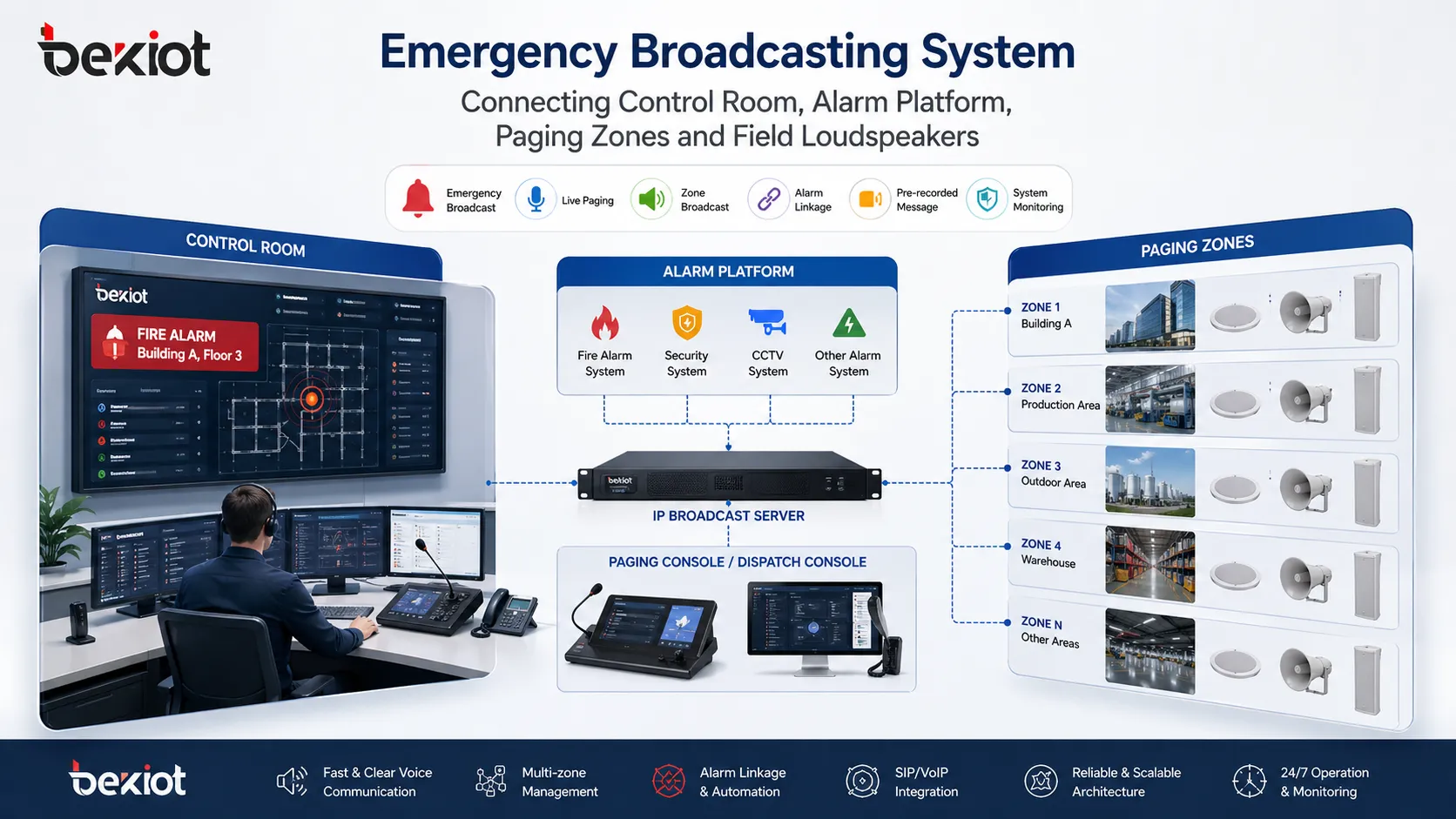
In industrial facilities, transportation networks, campuses, hospitals, public buildings, and energy sites, emergency response often depends on fast and coordinated communication. A broadcasting system can connect control rooms, dispatch centers, alarm systems, paging zones, loudspeakers, horns, amplifiers, SIP terminals, and intercom devices into one communication network. This allows operators to make live announcements, trigger pre-recorded messages, broadcast by zone, and link voice instructions with alarms or emergency events.
Why Broadcasting Systems Matter in Emergency Communication
Fast Voice Delivery During Critical Events
Emergency events often develop quickly. A delay of several seconds can affect evacuation, rescue, production shutdown, or site isolation. A broadcasting system enables authorized operators to deliver voice messages immediately across a whole building, selected floors, tunnel sections, production areas, outdoor yards, platforms, or remote field zones.
Compared with one-to-one phone calls or manual notification, broadcasting is faster and more scalable. One announcement can reach many people at once, including workers, visitors, maintenance teams, security staff, passengers, or emergency responders. This makes broadcasting especially valuable for large sites where people are distributed across different areas.
Clear Instructions Beyond Simple Alarms
Sirens, buzzers, and flashing lights can warn people that something has happened, but they cannot explain the situation. Voice broadcasting provides detailed instructions such as evacuation routes, assembly points, restricted areas, shelter-in-place guidance, shutdown notices, or emergency response procedures.
In noisy industrial environments, clear and repeated voice instructions can reduce confusion. When people understand what is happening and what action they should take, emergency communication becomes more effective and response behavior becomes more orderly.
In emergency communication, the value of a broadcasting system is not only to make sound louder, but to make critical instructions faster, clearer, and easier to follow.
Centralized Communication Across Complex Sites
Many facilities are not simple single-building environments. They may include production workshops, warehouses, tunnels, parking areas, substations, pump rooms, loading zones, control centers, security posts, outdoor roads, and hazardous areas. A centralized broadcasting system helps operators manage these different areas from one platform.
When integrated with a dispatch console or SIP communication platform, operators can select a zone, group, terminal, or emergency broadcast path according to the event location. This improves communication control and prevents unnecessary disturbance to unaffected areas.
Key Functions of an Emergency Broadcasting System
Public Address and Emergency Announcement
Public address is the basic function of a broadcasting system. Operators can use a microphone, paging console, dispatch terminal, SIP phone, or software platform to make live announcements. These announcements can be sent to all areas or to selected zones according to operational needs.
In emergency communication, public address is used for evacuation notices, incident updates, safety reminders, rescue coordination, and site-wide command delivery. The system should support high-priority emergency announcements so that urgent messages can override normal background music, routine paging, or lower-priority broadcasts.
Zone Paging and Group Broadcasting
Zone paging allows operators to broadcast messages to specific areas rather than the entire site. For example, a tunnel operator may send an evacuation message only to the affected tunnel section, while a factory control room may broadcast a shutdown notice only to one production line or hazardous zone.
Group broadcasting is useful when multiple areas need the same instruction. Operators can define broadcast groups such as workshops, office areas, outdoor yards, emergency exits, parking areas, platforms, or maintenance zones. This makes daily operation and emergency response more flexible.
Alarm Linkage with Fire, Security, and Control Systems
A modern emergency broadcasting system can be linked with fire alarm systems, security platforms, access control, CCTV, gas detection, equipment monitoring, SCADA, building management systems, or emergency dispatch platforms. When an alarm is triggered, the system can automatically play a pre-recorded message or notify the operator to make a live announcement.
Alarm linkage reduces manual response time. For example, when a fire alarm is activated in one building, the broadcasting system can automatically send evacuation instructions to the affected floor and warning messages to nearby areas. In industrial sites, gas detection alarms can trigger area-specific warnings and guide personnel away from dangerous zones.
Pre-Recorded Messages and Live Microphone Paging
Pre-recorded messages are useful for standard emergency procedures. They provide consistent wording, clear pronunciation, and repeatable instructions during stressful situations. Common messages may include fire evacuation, gas leakage warning, equipment shutdown notice, emergency assembly instruction, or restricted-area warning.
Live microphone paging is important when the situation changes quickly or when operators need to provide real-time guidance. A well-designed system should support both methods. Pre-recorded messages handle standard scenarios, while live paging gives operators the flexibility to respond to unexpected developments.
SIP and IP Network Integration
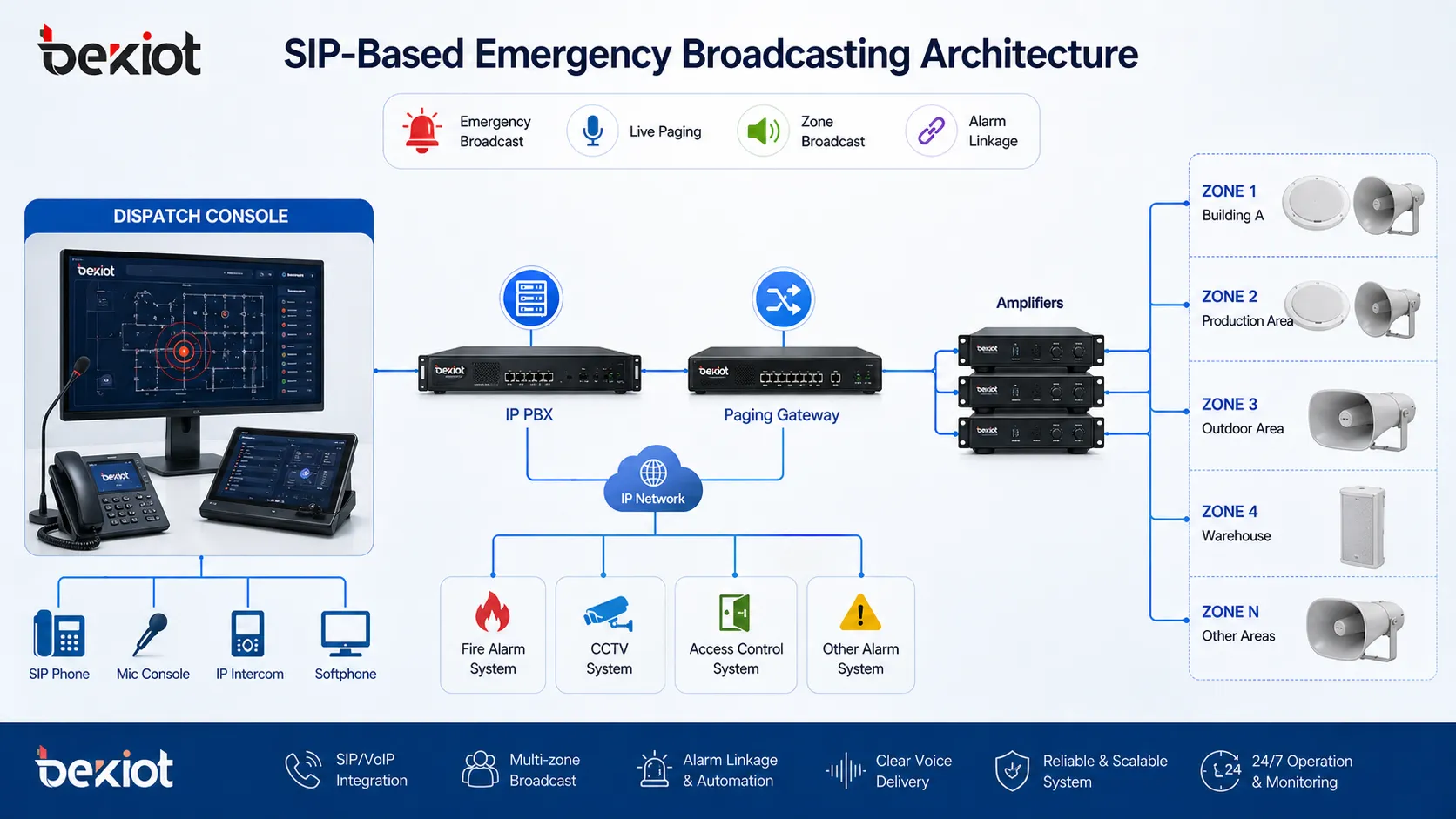
SIP-based broadcasting systems can work with IP PBX platforms, SIP servers, dispatch consoles, SIP phones, intercom terminals, paging gateways, and IP speakers. This allows broadcasting to become part of a wider unified communication architecture instead of remaining an isolated audio system.
Through SIP integration, an operator may call a paging group from a SIP phone, initiate emergency broadcast from a dispatch console, connect intercom calls with public address zones, or combine voice communication with alarm and video linkage. This is especially useful for industrial parks, transportation facilities, campuses, and mission-critical communication systems.
Benefits of Broadcasting Systems in Emergency Scenarios
Improved Response Speed
Speed is one of the most important benefits of an emergency broadcasting system. When operators can send instructions immediately, the whole response process becomes faster. Workers can evacuate sooner, security teams can move to the correct area, maintenance teams can isolate equipment, and rescue teams can receive clearer instructions.
In time-sensitive environments such as tunnels, refineries, power plants, railway stations, airports, and manufacturing facilities, faster communication can reduce operational losses and improve safety outcomes.
Reduced Communication Confusion
During emergencies, confusion often comes from incomplete information. People may hear an alarm but not understand whether they should evacuate, wait, avoid a certain exit, or report to a specific assembly point. Broadcasting helps reduce this uncertainty by delivering direct voice guidance.
A good broadcasting system can repeat important messages, broadcast in different zones, and support multilingual or pre-recorded announcements when required. This improves information consistency across large and diverse facilities.
Better Coverage for Complex Environments
Emergency communication must reach both indoor and outdoor areas. Different environments require different audio devices. Offices and corridors may use ceiling speakers or wall-mounted speakers, while tunnels, outdoor industrial yards, ports, and noisy workshops may require horn speakers, sound columns, or high-power amplifiers.
Proper speaker layout, amplifier capacity, cable or network design, and acoustic planning help ensure that messages can be heard clearly. For harsh environments, devices may also need waterproof, dustproof, corrosion-resistant, anti-vandal, or explosion-proof designs.
Stronger Coordination Between Control Rooms and Field Areas
Broadcasting systems are not only used to inform people; they also help control rooms coordinate field actions. When combined with intercom, emergency phones, CCTV, alarms, and dispatch platforms, operators can observe an event, communicate with local personnel, and broadcast instructions to nearby zones.
This coordinated workflow is useful for emergency response, routine inspection, production management, traffic control, public safety, and facility operation. It helps operators move from passive alarm receiving to active communication command.
Common Application Scenarios
Industrial Plants and Manufacturing Facilities
Industrial plants require reliable communication for production safety, equipment operation, emergency shutdown, maintenance coordination, and evacuation guidance. Broadcasting systems can cover workshops, warehouses, control rooms, loading areas, outdoor roads, and equipment zones.
In noisy production environments, the system should provide sufficient sound pressure, clear voice quality, and reliable priority control. Integration with alarms, SIP intercoms, emergency phones, and dispatch systems can improve response efficiency.
Tunnels, Railways, and Transportation Hubs
Tunnels and transportation hubs need fast public announcements during traffic incidents, fire alarms, equipment faults, passenger evacuation, or emergency rescue. Broadcasting systems can divide long tunnels, platforms, waiting halls, parking areas, and exits into different zones for accurate message delivery.
In these environments, the system should support zone paging, emergency priority, remote monitoring, backup power, and integration with CCTV, help points, and control room dispatch platforms.
Oil, Gas, Petrochemical, and Hazardous Areas
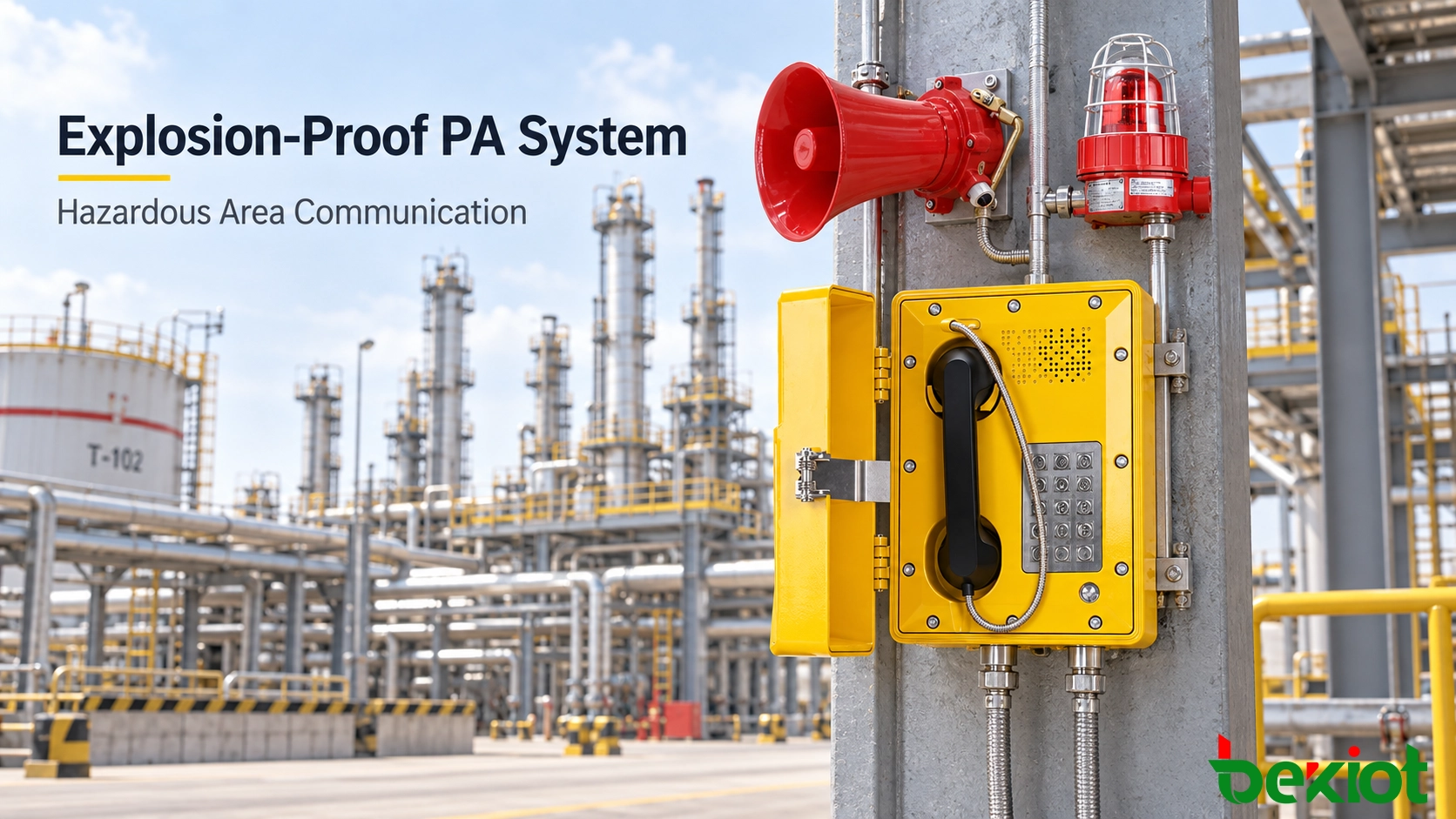
Oil, gas, petrochemical, chemical processing, and storage sites may face flammable gas, combustible dust, corrosive atmosphere, high noise, and outdoor exposure. Emergency broadcasting in these areas must consider both communication reliability and environmental safety.
Depending on the site classification, devices may require explosion-proof telephones, explosion-proof speakers, weatherproof horns, rugged amplifiers, or intrinsically safe communication terminals. The system should also support alarm linkage with gas detection, fire alarm, and emergency shutdown procedures.
Campuses, Hospitals, Parks, and Public Buildings
Public facilities use broadcasting systems for emergency announcements, daily paging, safety reminders, evacuation guidance, and security management. In hospitals, campuses, smart parks, shopping centers, and public buildings, the system must balance emergency priority with daily operational communication.
IP-based broadcasting can simplify management across multiple buildings and help administrators control different zones from a central platform. When linked with access control, CCTV, and security systems, broadcasting becomes part of a broader safety and facility management solution.
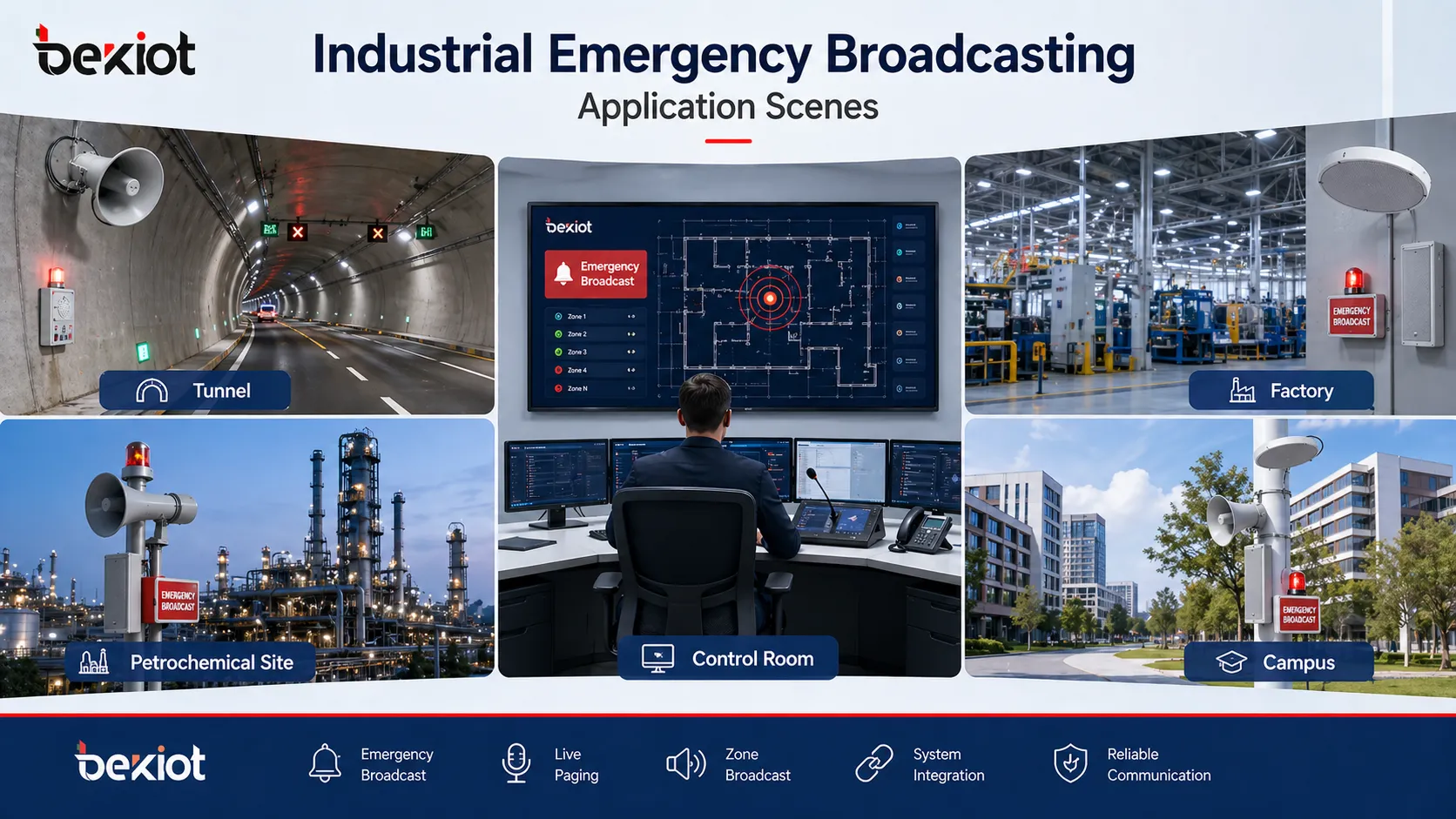
How to Select the Right Broadcasting System
Evaluate the Coverage Area and Speaker Layout
The first step is to understand where the broadcast must be heard. A small office building, a large factory, a long tunnel, and an outdoor petrochemical site have very different coverage requirements. The selection process should consider area size, building structure, background noise, ceiling height, outdoor distance, and obstacles.
Speaker layout should be designed according to real acoustic conditions. Too few speakers may create unclear coverage, while poorly placed high-power speakers may cause echo, distortion, or uneven sound distribution.
Consider Audio Clarity and Environmental Noise
Emergency messages must be intelligible, not just loud. In noisy environments, the system may need horn speakers, directional speakers, sound columns, higher amplifier power, automatic volume control, or better acoustic planning.
For critical areas, the system should support clear voice reproduction, low distortion, stable audio transmission, and reliable emergency priority. Message clarity directly affects whether people can understand and follow instructions.
Choose IP, SIP, Analog, or Hybrid Architecture
Analog broadcasting systems are often used in traditional public address projects and can be simple for fixed audio distribution. IP broadcasting systems are more flexible for multi-zone control, remote management, network transmission, and system expansion. SIP-based broadcasting is especially useful when the site already uses IP PBX, SIP phones, intercoms, or dispatch systems.
A hybrid architecture may be suitable for upgrade projects where existing speakers, amplifiers, or wiring need to be retained while new IP or SIP functions are added. The right choice depends on the existing infrastructure, budget, scalability requirements, and integration goals.
Check Reliability, Redundancy, and Power Backup
Emergency broadcasting systems must remain available when they are needed most. Important factors include equipment reliability, network stability, amplifier backup, power redundancy, line monitoring, fault reporting, and system health supervision.
For critical facilities, backup power and redundant communication paths may be necessary. The system should be designed to avoid single points of failure in key emergency communication routes.
A broadcasting system used for emergency communication should be selected as a safety communication infrastructure, not only as an audio playback system.
Confirm Alarm Linkage and Dispatch Integration
A broadcasting system becomes more powerful when it can interact with other systems. Buyers should confirm whether the system can connect with fire alarm panels, security systems, CCTV platforms, SIP servers, IP PBX systems, dispatch consoles, access control, or industrial alarm platforms.
Integration helps operators respond from one command interface. For example, when an alarm appears on the dispatch screen, the operator can view the affected area, contact a nearby intercom, open a camera view, and broadcast instructions to the related zone.
Match Devices with the Installation Environment
Indoor office areas may only need ceiling speakers or wall speakers, while outdoor industrial areas may require weatherproof horn speakers and rugged amplifiers. Tunnels may need directional sound coverage and corrosion-resistant devices. Hazardous areas may require explosion-proof communication terminals or certified field devices.
The selected devices should match the environment in terms of protection rating, temperature range, humidity resistance, impact resistance, corrosion resistance, and installation method. This is especially important for industrial, marine, energy, and petrochemical applications.
Broadcasting System Architecture for Emergency Communication
Control Room and Dispatch Center
The control room is the command center of the emergency broadcasting system. Operators can manage alarms, select zones, make live announcements, trigger pre-recorded messages, monitor device status, and coordinate field response.
In advanced systems, the dispatch center may also integrate CCTV, GIS maps, intercom, emergency phones, access control, and radio communication. This creates a visual and voice-enabled emergency command workflow.
Network, Server, and Paging Control Layer
The network and control layer may include SIP servers, IP PBX systems, paging gateways, broadcast servers, audio matrices, network switches, and management software. This layer handles communication routing, zone control, priority management, message scheduling, and system monitoring.
For SIP-based projects, the system can use SIP accounts, paging groups, multicast paging, or gateway-based broadcast control. This allows voice broadcasting to work together with enterprise telephony and industrial communication systems.
Amplifiers, Speakers, Horns, and Field Terminals
The field layer includes speakers, horn speakers, column speakers, amplifiers, emergency phones, SIP intercoms, paging terminals, microphones, and local control devices. These devices deliver the actual voice message to people in the field.
Different field devices should be selected according to the acoustic environment. For example, a ceiling speaker may be suitable for a corridor, while a high-power horn speaker may be required in a noisy outdoor industrial area.
Integration with CCTV, Fire Alarm, Intercom, and Access Control
Emergency communication is more effective when systems work together. CCTV helps operators verify the incident, fire alarm systems provide automatic triggers, intercoms allow two-way communication, and access control can support evacuation or area isolation.
Broadcasting connects these systems by delivering voice instructions to the right people at the right time. This makes it a central part of modern emergency communication and facility safety management.
Becke Telcom Emergency Broadcasting Solutions
Industrial Broadcasting for Critical Facilities
Becke Telcom provides industrial communication solutions for environments that require reliable voice delivery, emergency response, paging, intercom, and dispatch coordination. For emergency broadcasting projects, Becke Telcom can support communication designs for factories, tunnels, utility corridors, transportation sites, energy facilities, petrochemical plants, campuses, and public safety environments.
The solution can include SIP paging devices, industrial telephones, emergency intercoms, paging consoles, IP speakers, horn speakers, amplifiers, dispatch platforms, and integrated control room communication systems according to project requirements.
SIP-Based Paging and Emergency Voice Integration
SIP-based broadcasting allows emergency voice communication to connect with IP PBX systems, SIP servers, dispatch consoles, intercom terminals, and industrial communication networks. This helps users build a unified architecture instead of managing separate telephone, paging, and alarm systems independently.
For projects that require multi-system linkage, Becke Telcom solutions can help combine broadcasting, intercom, telephony, alarms, video linkage, and dispatch control into a more coordinated communication workflow.
Reliable Communication for Harsh and Hazardous Environments
Harsh environments require more than standard office-grade communication devices. Outdoor installation, dust, water, vibration, corrosion, high noise, and hazardous-area risks all affect system design. Becke Telcom can provide industrial-grade and scenario-based communication equipment to improve reliability in demanding locations.
For sites such as petrochemical plants, tunnels, mines, power facilities, and industrial parks, emergency broadcasting should be designed with device durability, system redundancy, clear voice delivery, and integration capability in mind.
Conclusion
A broadcasting system is a key part of emergency communication because it delivers fast, clear, and controlled voice instructions across large or complex sites. It helps operators reduce confusion, guide evacuation, coordinate response teams, and connect alarms with real-time communication.
When selecting a broadcasting system, users should consider coverage area, audio clarity, zone control, SIP or IP integration, alarm linkage, reliability, redundancy, and environmental protection. For industrial and mission-critical applications, the right solution should not only broadcast sound, but also support a complete emergency communication workflow.
Becke Telcom can support emergency broadcasting and industrial communication projects with SIP-based paging, intercom, dispatch, industrial telephone, and field communication solutions designed for complex facilities and demanding environments.
Frequently Asked Questions
What is a broadcasting system in emergency communication?
A broadcasting system in emergency communication is a voice announcement system used to deliver warnings, instructions, evacuation messages, and operational guidance to selected zones or entire facilities during critical events.
Why is voice broadcasting important during emergencies?
Voice broadcasting provides clear instructions that alarms alone cannot deliver. It helps people understand what happened, where to go, which area to avoid, and what action should be taken.
What is the difference between normal paging and emergency broadcasting?
Normal paging is usually used for routine announcements or daily communication. Emergency broadcasting uses higher priority, alarm linkage, pre-recorded messages, zone control, and reliable delivery to support urgent safety communication.
Can a broadcasting system connect with SIP or IP PBX platforms?
Yes. A SIP-based broadcasting system can connect with SIP servers, IP PBX platforms, SIP phones, dispatch consoles, paging gateways, intercom terminals, and IP speakers. This makes voice broadcasting part of a unified communication system.
How do I choose the right emergency broadcasting system?
You should evaluate the coverage area, environmental noise, speaker layout, system architecture, alarm linkage, redundancy, device protection rating, integration needs, and whether the project requires industrial or explosion-proof equipment.