
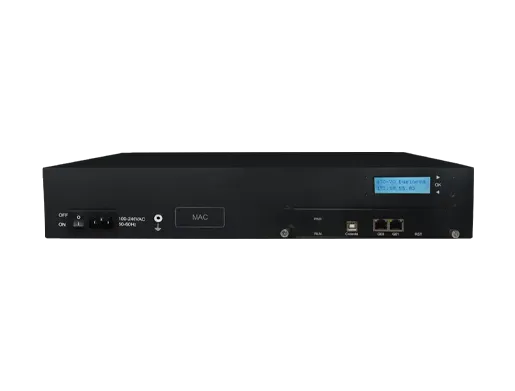

The Becke Telcom 32-Channel GOIP Gateway is designed for projects that demand higher voice capacity, stronger mobile-network flexibility, and efficient SIP integration in one business-ready platform. With 32 channels in a reliable hardware design, it supports enterprise voice traffic, SMS services, and carrier-connected communication workflows for organizations that need more than a standard gateway deployment.
Built for enterprise communication, multi-site offices, service traffic, and locations where fixed-line resources are limited, this model delivers dependable GSM, WCDMA, and LTE connectivity with support for voice, SMS, and VoLTE-ready deployment. It is well suited for mobile trunking, backup calling, landline replacement, bulk SMS services, and centralized communication projects that require higher density and more operational control.
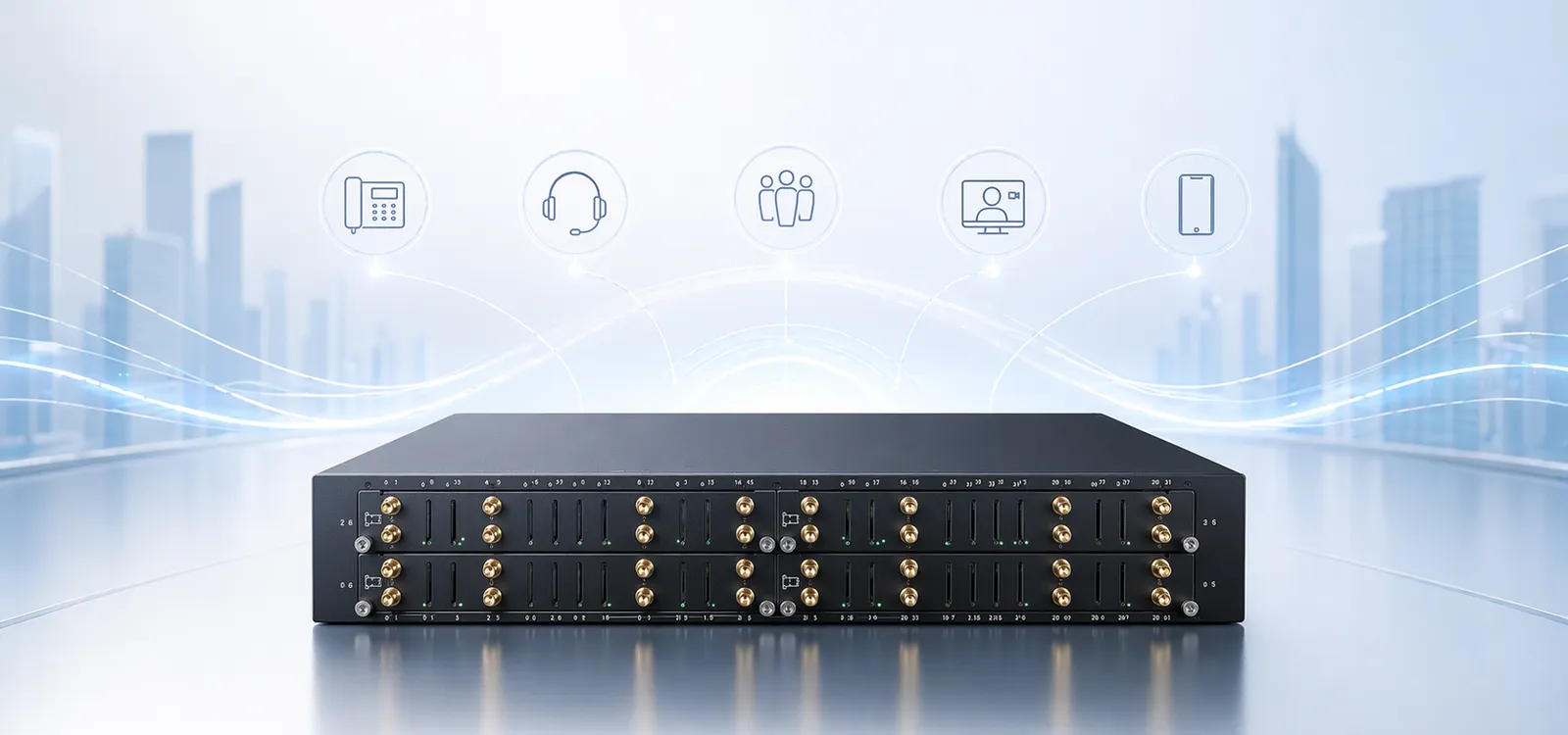
This 32-channel model is built for operations that need more concurrent mobile voice capacity, broader service coverage, and stronger routing flexibility. It gives enterprises, operators, and integrators a practical platform for handling larger call volumes while keeping deployment structured and manageable.
For multi-site organizations, customer-facing service teams, and communication-intensive projects, the higher channel count creates more room for traffic distribution, service segmentation, and future growth. It is a strong fit for deployments that need more headroom than smaller gateways can provide.
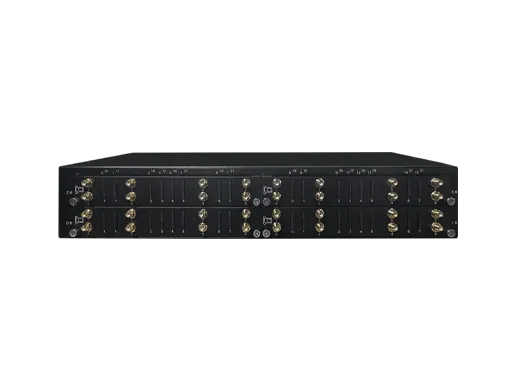
The platform is designed with 32 SIM slots and 32 antennas, helping support stable mobile-network connectivity across a larger number of active channels. This makes it suitable for projects where dedicated channel availability, flexible SIM usage, and strong network accessibility are all important to everyday communication performance.
For organizations that rely on mobile connectivity as a core part of their calling strategy, this design supports more scalable operation and more efficient resource planning.
The gateway is designed to work with mainstream VoIP platforms, supporting SIP v2.0 and RFC3261 for easier integration with IP PBX systems, SIP trunks, softswitches, and unified communication platforms. This allows businesses to extend mobile-network calling and messaging into an existing SIP environment without creating isolated infrastructure.
That makes the gateway easier to position in enterprise deployments, branch networks, and service-based communication systems where interoperability and deployment speed matter.
This model supports both voice and SMS, making it suitable for business calling, messaging services, notification workflows, and integrated communication applications. With support for SMS sending and receiving, SMS API capability, SMPP, HTTP API for SMS, SMS to Email, Email to SMS, and SMS/USSD, it can support a wide range of enterprise and operator requirements.
It is especially well suited for projects where voice traffic and messaging services need to be handled on the same platform with centralized control.
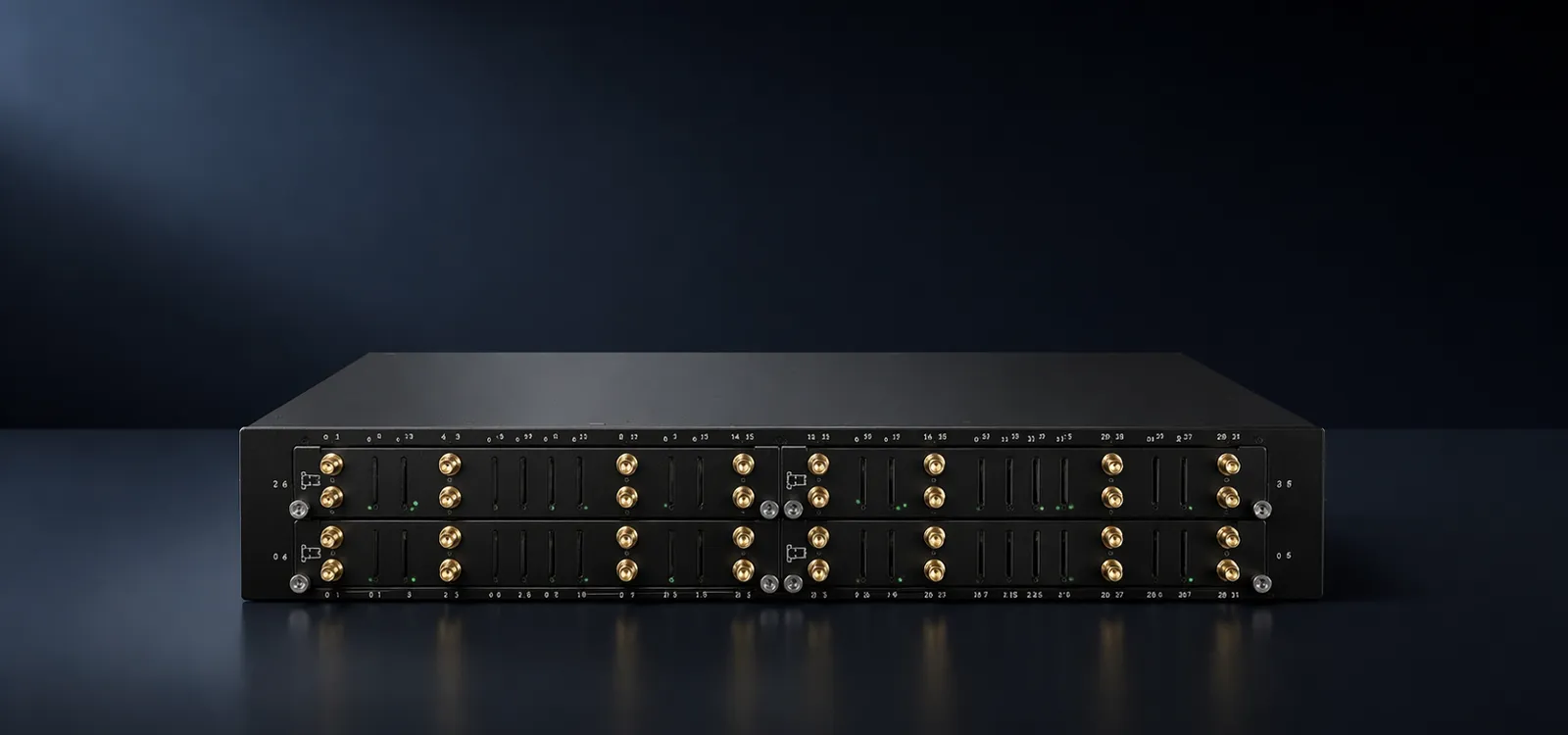
The gateway supports GSM, WCDMA, and LTE networks, with VoLTE-ready capability for mobile-network environments that require more modern voice access options. This gives businesses more flexibility when selecting carriers, planning regional deployments, and preparing for long-term communication continuity.
For organizations operating across different regions or network conditions, this multi-network support adds practical deployment value and helps reduce infrastructure limitations.
Hot-swappable SIM cards help simplify maintenance, replacement, and carrier adjustments in everyday operation. For projects that need more centralized SIM control, the gateway also supports optional remote SIM management with compatible SIMBank and SIMCloud deployment.
This flexibility is valuable for distributed offices, operator environments, and service teams that want more efficient SIM administration across multiple locations.
The platform includes a range of features that support operational control and service governance, including signaling and RTP encryption, Credit Limit management, Auto CLIP, PIN management, white and black lists, polarity reversal, call waiting, call back, call forward, caller and called number manipulation, and SIP trunk and trunk group support.
These functions help businesses manage traffic policies more effectively, maintain service quality, and support more disciplined telecom operations across larger deployments.
The gateway supports an intuitive web interface, HTTPS and HTTP web configuration, advanced debug tools, configuration backup and restore, local CDR storage, traffic statistics, and easy maintenance functions that simplify commissioning and lifecycle management.
For IT teams, system integrators, and operators, these capabilities make the platform easier to deploy, monitor, and support over time.
The Becke Telcom 32-Channel GOIP Gateway is built for larger voice loads, higher channel density, and more flexible SIP-to-mobile interconnection in real business deployments.
This gateway is a strong option for businesses that need mobile connectivity for IP phone systems and SIP-based enterprise voice platforms. It supports larger-scale mobile trunking requirements while keeping management centralized and deployment efficient.
For organizations with multiple departments, sites, or user groups, it provides a practical foundation for expanding calling reach through mobile networks.
The 32-channel design is well suited for multi-site office environments where centralized SIP infrastructure must connect with distributed users and regional mobile networks. It helps organizations improve routing flexibility, strengthen service continuity, and support communication growth across multiple locations.
This makes it especially attractive for businesses scaling across branches, project sites, and remote teams.
For locations with unstable fixed lines, limited landline access, or delayed telecom provisioning, the gateway provides a practical alternative for voice access and business continuity. It can be used for GSM/3G voice backup trunks and landline replacement scenarios where mobile networks offer the fastest or most reliable communication path.
That flexibility gives businesses more options when planning resilient communication services in underserved or hard-to-wire locations.
With high channel density and messaging support, this model is also well suited for bulk SMS services, contact center communication, and service-provider call termination projects. It supports applications where throughput, centralized messaging control, and mobile-network reach are all important to business performance.
For operators and communication service teams, that makes the gateway a versatile platform for both voice and messaging-oriented services.
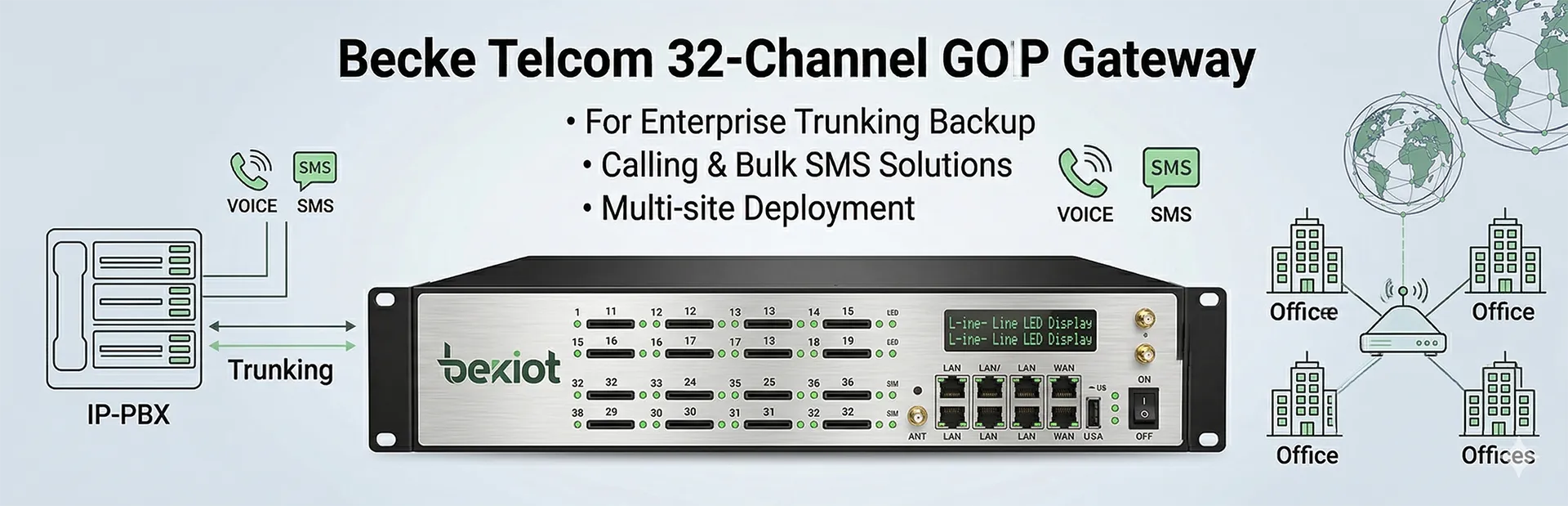
Becke Telcom focuses on business and industrial communication solutions that combine practical deployment value with flexible integration. For customers that need a higher-capacity GOIP gateway, this 32-channel model offers a strong balance of voice density, messaging capability, mobile-network flexibility, and operational control.
It is designed for projects that need dependable SIP-to-mobile interconnection, stronger communication resilience, and a platform ready for both enterprise and service-focused deployment. For organizations planning higher-volume voice and SMS applications, the Becke Telcom 32-Channel GOIP Gateway provides a reliable and scalable choice.
Yes. Its 32-channel architecture and SIP compatibility make it suitable for larger IP PBX, multi-site office, and service-oriented communication projects.
Yes. It supports voice, SMS sending and receiving, SMS API workflows, SMPP, HTTP API for SMS, and SMS-related integration scenarios.
Yes. Optional remote SIM management is supported with compatible SIMBank and SIMCloud deployment.
Yes. It is suitable for backup voice trunks and landline replacement scenarios where mobile-network communication is preferred or required.
It is well suited for enterprise mobile trunking, multi-site offices, backup communication, rural deployment, bulk SMS services, contact center communication, and service-provider traffic handling.
| Item | Specification |
|---|---|
| Mobile Channels | 32 channels |
| SIM Card Slots | 32 |
| Antenna Interface | SMA connector |
| Display | 2.3-inch graphic LCD display |
| Ethernet Ports | 2 × 10/100/1000 Base-T RJ45 ports |
| Indicators | Power indicator, Run indicator, Channel status indicators |
| Console Port | 1 × RS232 (USB-B connector) |
| Physical Buttons | Reset button, Power button |
| Communication Protocol | SIP v2.0 (RFC3261), supports SIP UDP/TCP/TLS |
| Transport Protocol | RTP/SRTP |
| Audio Codecs | G.729AB, PCMU, PCMA, G.723.1 |
| Audio Optimization | Silence suppression, Comfort Noise Generation (CNG), Voice Activity Detection (VAD), Echo cancellation, Dynamic jitter buffer |
| DTMF Format | RFC2833, SIP Info |
| Auxiliary Functions | Call progress tone generation, Programmable gain control |
| NAT Traversal | STUN, Dynamic NAT, Static NAT |
| Basic Services | SMS/USSD/PIN supported, Unicode/ASCII encoding |
| SMS Interface | HTTP API, SMPP protocol |
| Calling Features | Polarity reversal, Caller ID display / restriction, Call waiting, Call back, Call forward, Conference call |
| Automatic Functions | SMS send & receive, SMS / Email conversion, Auto SMS / call generation |
| GSM Audio Codecs | HR, FR, EFR, AMR_FR, AMR_HR |
| Power Supply | 100-240V, 50-60Hz |
| Power Consumption | 68W |
| Operating Temperature | 0℃ ~ 40℃ |
| Storage Temperature | -20℃ ~ 80℃ |
| Operating Humidity | 10% - 90% |
| Dimensions | 440×270×75mm (W×D×H) |
| Weight | 5.5kg |