Scalability is the ability of a system, platform, network, or service to handle increasing demand without suffering unacceptable drops in performance, stability, or manageability. In simple terms, a scalable system can grow when more users, more traffic, more devices, more sites, or more workloads are added. Instead of breaking under growth, it is designed to expand in a controlled and sustainable way.
This concept matters across many industries, but it is especially important in enterprise IT, cloud services, telecom infrastructure, industrial communications, and unified communications platforms. A small deployment may work well with a limited number of users or endpoints, yet struggle once the organization adds branches, remote users, more calls, more intercom devices, more paging zones, or more application traffic. Scalability is what separates a solution that works only for today from one that can continue serving tomorrow’s requirements.
For businesses and infrastructure operators, scalability is not only a technical characteristic. It is also a strategic one. A scalable system can support expansion, reduce the need for disruptive redesign, and protect long-term investment. That is why scalability is often treated as a core design principle rather than as a secondary feature.
What Is Scalability?
Definition and Core Meaning
Scalability refers to the capacity of a system to grow in volume, complexity, or workload while continuing to deliver acceptable results. Those results may include application response time, call handling performance, service availability, session stability, device coordination, or administrative efficiency depending on the environment. The core idea is that growth should not immediately create failure or chaos.
In technology and communications, scalability often describes how well a solution can support more users, more endpoints, more sessions, more transactions, or more data. In a communications system, that may mean supporting more extensions, more SIP registrations, more concurrent calls, more intercom endpoints, or more distributed sites. In a software platform, it may mean supporting higher transaction volume, additional tenants, or larger storage and processing needs.
The important point is that scalability is not only about size. It is about sustainable growth with manageable performance and operational control.
Scalability is the difference between a system that works at one size and a system that keeps working as its environment becomes larger, busier, and more complex.
Why Scalability Matters
Scalability matters because growth is normal. Organizations add staff, open new offices, connect more devices, launch more services, and integrate more workflows over time. If the underlying platform cannot grow with those changes, the business eventually faces performance bottlenecks, fragmented architecture, rising maintenance burden, or forced replacement.
In communications and infrastructure environments, the consequences can be especially visible. A platform that was adequate for one site may become unstable when it must serve headquarters, branches, remote workers, security desks, intercom devices, paging terminals, and industrial endpoints together. A system that cannot scale often creates service inconsistency just when the organization is trying to expand.
This is why scalability is closely connected to long-term planning, service continuity, and cost efficiency. It helps ensure that growth does not immediately become a technical problem.
How Scalability Works
Growth Through Capacity Expansion
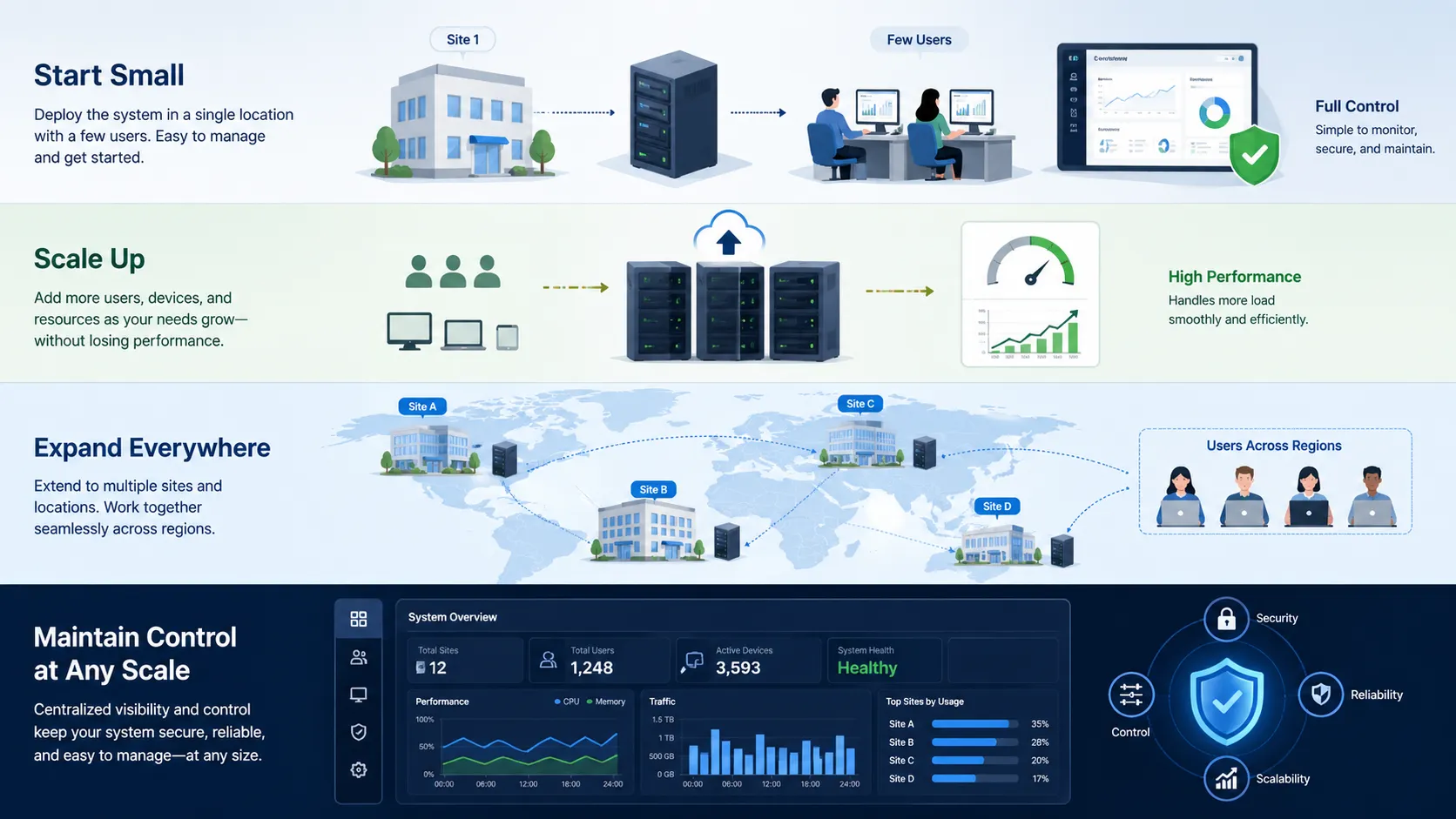
Scalability works by allowing the system to expand its effective capacity when demand increases. That capacity may involve processing power, memory, storage, bandwidth, session handling, call control resources, server instances, database performance, or endpoint management ability. The exact mechanism depends on the type of system involved, but the general principle is the same: the system must have a path for handling more load than before.
In some environments, this means increasing the size of the existing platform. In others, it means distributing the workload across additional resources. A communications server may support more users by adding compute resources, licensing capacity, or distributed nodes. A network may scale by increasing switching capacity, uplink bandwidth, or segmentation strategy. A cloud platform may scale by launching more instances or balancing traffic across multiple resources.
Scalability therefore depends on architecture. A well-designed system anticipates growth and provides structured ways to expand without full redesign each time demand rises.
Control, Coordination, and Resource Allocation
Growth alone is not enough. Scalability also requires the system to coordinate resources efficiently as it expands. If adding more users simply creates more congestion, more delay, or more administrative disorder, then the system may be larger, but it is not truly scalable. Real scalability means the platform can allocate resources, maintain control logic, and manage traffic flows in a predictable way as load rises.
This is why scalable systems usually include some combination of load distribution, modular design, efficient signaling paths, database optimization, network segmentation, or role-based administration. These mechanisms help the system remain organized instead of becoming overloaded or unmanageable.
In other words, scalability is not only about adding more. It is about adding more while keeping the platform usable and dependable.
A system becomes scalable not when it becomes bigger, but when it can become bigger without losing the qualities that made it useful in the first place.
Main Types of Scalability
Vertical Scalability
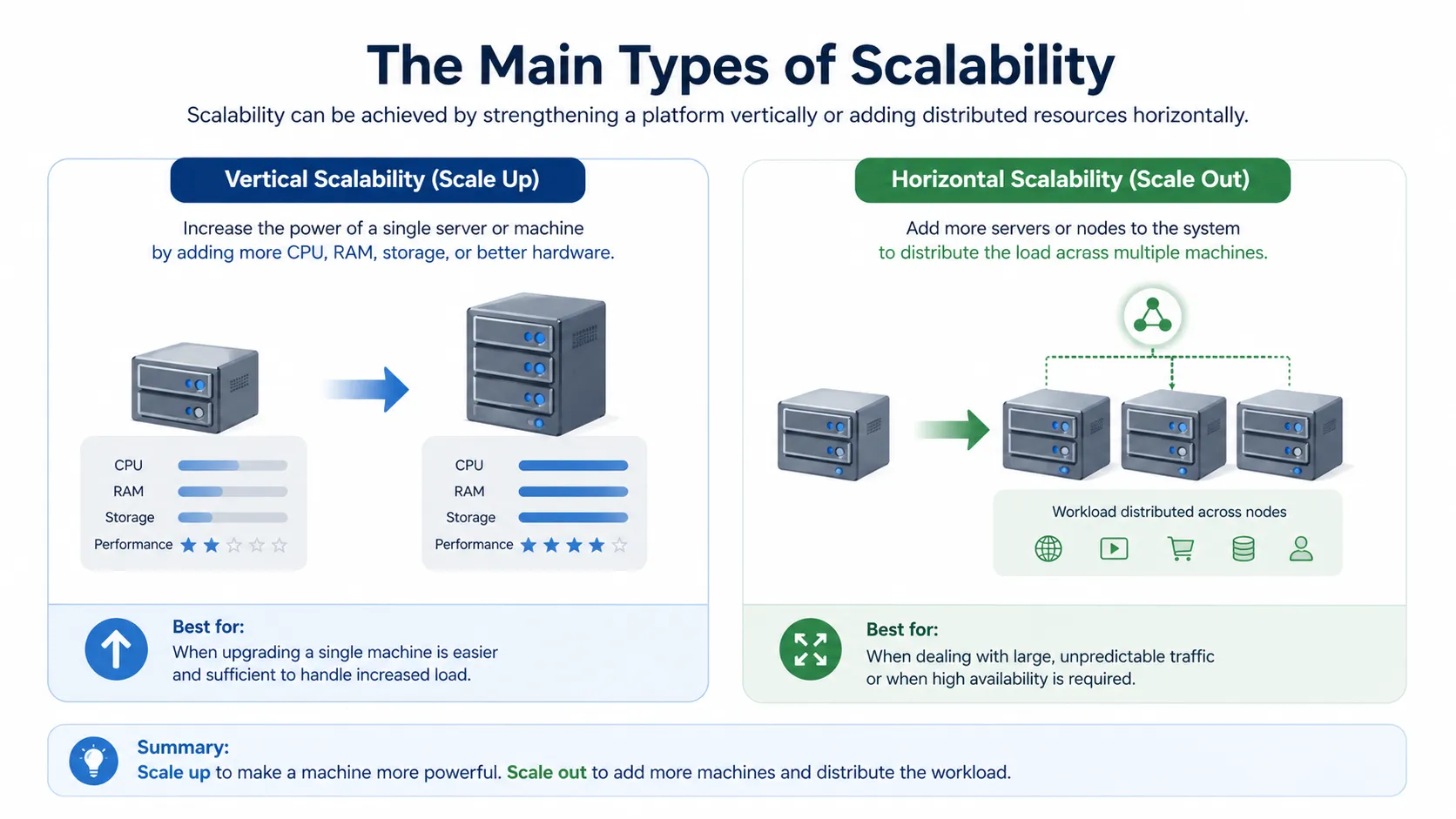
Vertical scalability usually means increasing the capacity of an existing node or system by giving it more resources. This may include more CPU, more memory, faster storage, more licensing capacity, or more powerful server hardware. In practical terms, the system grows upward by becoming stronger at a single point.
This approach can be attractive because it is often simpler to understand and deploy. Instead of redesigning a platform into multiple layers or nodes, the organization strengthens what already exists. For small and medium deployments, vertical scaling can be an efficient way to extend system life and support additional demand without immediate architectural change.
However, vertical scalability also has limits. A single node can only become so large before cost, hardware boundaries, or fault concentration become concerns. That is why it is useful, but not always sufficient for very large or highly distributed systems.
Horizontal Scalability
Horizontal scalability means growing by adding more nodes, servers, gateways, devices, or processing units rather than relying on one stronger machine alone. In this model, capacity increases by distribution. More resources are added beside the existing ones, and traffic or workload is shared across them.
This approach is especially relevant in cloud services, large applications, distributed communications systems, and multi-site enterprise environments. A horizontally scalable system can often support larger growth because it does not depend entirely on the size of one central component. It also tends to align better with distributed architectures where different sites or services may share workload responsibility.
In modern communications and business systems, horizontal scaling is often associated with better flexibility, especially when the organization expects long-term expansion across users, locations, and services.
Scalability in Communication and Network Systems
Users, Endpoints, and Concurrent Activity
In communication systems, scalability often refers to the ability to support more users, more endpoints, and more simultaneous sessions without harming call quality, response time, or operational stability. A platform that serves twenty phones may behave very differently when it must serve five hundred phones, SIP intercoms, paging devices, gateways, and remote users across multiple sites.
This means scalable communications design must consider not only endpoint count, but also concurrency. How many calls can be active at once? How many devices can register reliably? How many paging or intercom requests can the platform handle during busy periods? How well can the management layer support larger deployments without becoming confusing or slow?
In enterprise and industrial communications, these questions are central because system expansion often happens gradually. A scalable architecture allows that growth to occur without forcing the organization to rebuild the entire communications core at each stage.
Multi-Site and Hybrid Infrastructure Growth
Scalability is also critical when communication systems expand across geography. A platform that works well at one site may become more complex when it must support headquarters, branch offices, warehouses, campuses, factories, tunnels, transport facilities, or remote operator locations. A scalable design must therefore consider site distribution, bandwidth conditions, signaling coordination, remote administration, and resilience across locations.
Hybrid environments add another layer of complexity. Many organizations combine desk phones, soft clients, SIP trunks, gateways, industrial intercoms, paging devices, and cloud-connected services inside one broader communications architecture. A scalable platform must support this growth in function as well as in size.
This is one reason why enterprise communication scalability is not only about more users. It is also about supporting more roles, more devices, and more operational contexts within one manageable framework.
Benefits of Scalability
Long-Term Growth Without Constant Redesign
One of the biggest benefits of scalability is that it supports long-term growth without forcing constant replacement or architectural disruption. Organizations rarely stay the same size forever. A scalable system can continue serving the business as more users, sites, services, and workflows are added. That protects investment and reduces the need for emergency redesign when the platform becomes successful or widely adopted.
This is especially important in enterprise and industrial deployments where replacing infrastructure can be costly and disruptive. If a communications platform, network system, or application stack is scalable, the organization can usually expand in steps rather than through repeated full migrations. That makes growth more predictable and easier to budget.
In this sense, scalability reduces friction between business growth and technical capability.
Better Performance Stability Under Growth
Another key benefit is performance stability. A scalable system is designed so that increased usage does not immediately create unacceptable degradation. Users may still notice that the system is busier, but the platform continues to function within acceptable performance boundaries. Calls still connect, dashboards still load, devices still register, and operations remain manageable.
This stability is valuable because performance problems often appear first during success. A service becomes popular, a company expands, or a facility adds more endpoints, and only then does the underlying weakness become obvious. Scalability helps prevent success from turning into a performance crisis.
That is why scalable design is closely related to service confidence. It helps the platform remain dependable as adoption grows.
Scalability protects growth from becoming self-defeating by ensuring that higher demand does not automatically destroy usability.
Additional Business and Operational Benefits
More Efficient Investment Planning
Scalability also helps organizations plan investment more efficiently. A scalable system usually allows staged growth, meaning the company can add capacity when needed rather than overspending on a very large initial deployment just in case future demand appears. This can improve capital efficiency while still protecting long-term expansion potential.
In practice, this means decision-makers can align infrastructure spending with real growth milestones. Additional users, sites, licenses, modules, servers, or gateways are added as the organization evolves. This is often more practical than replacing an undersized platform entirely or buying an oversized one that remains underused for years.
Good scalability therefore supports not only technical flexibility, but also better commercial discipline.
Stronger Alignment With Business Expansion
Another benefit is better alignment with real business change. Growth is not always linear. One year may bring more branches, another year more remote users, and another year more integrated services. A scalable system can support these different growth patterns more gracefully because it is built to expand in more than one dimension.
This is especially relevant in communications and infrastructure environments, where business expansion often involves both more people and more operational complexity. The platform may need to absorb not only additional users, but also new departments, more applications, emergency workflows, or wider geographic coverage.
Scalability makes the system more adaptable to business reality instead of locking it to the assumptions of the original deployment.
Maintenance Tips for Scalable Systems
Monitor Capacity Trends Early
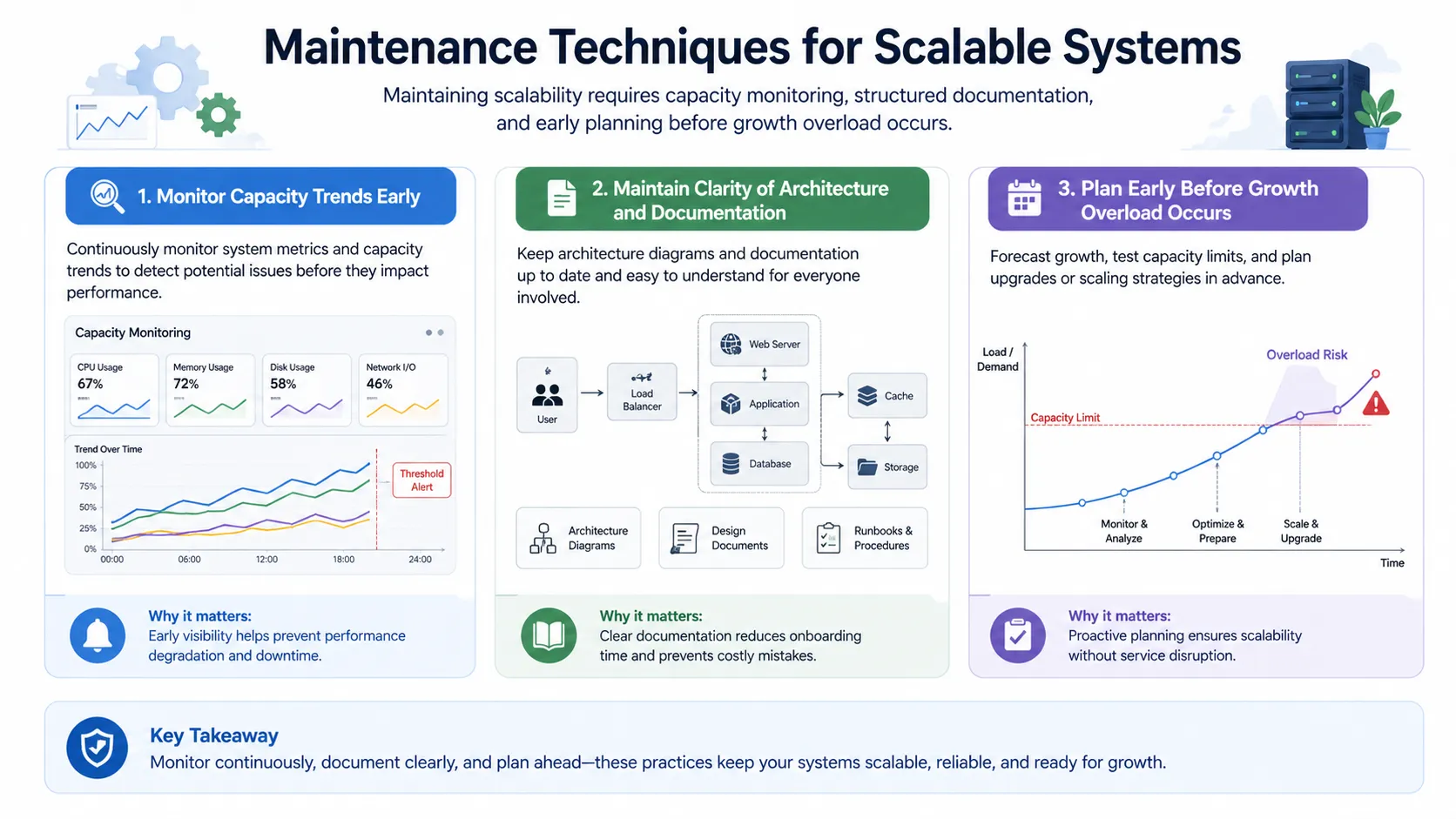
One of the most important maintenance practices is early capacity monitoring. Scalability is not useful if the organization notices growth pressure only after the system is already overloaded. Administrators should watch metrics such as session counts, CPU usage, bandwidth utilization, storage trends, endpoint registrations, alarm frequency, and response times well before service quality begins to degrade.
This is especially important in communication systems, where growth can appear gradually and then suddenly accelerate. A platform may seem comfortable for months, then experience a sharp rise in load when a new site goes live, a campaign increases call traffic, or more devices are added at once. Monitoring helps teams plan expansion instead of reacting under pressure.
In practical terms, scalability works best when it is managed as an ongoing capacity discipline, not as a one-time architectural label.
Keep Architecture and Documentation Organized
Maintenance also depends on clarity. As systems scale, architecture can become harder to understand if documentation, naming, segmentation, routing logic, and administrative boundaries are not kept organized. A platform that is technically expandable may still become operationally fragile if nobody can easily understand how it has grown.
Good maintenance therefore includes updated diagrams, device inventories, endpoint grouping, site records, version control, and capacity planning notes. In multi-site communications or industrial deployments, this documentation becomes especially important because troubleshooting and future expansion both depend on accurate visibility.
Scalable systems need scalable administration. Growth should not create confusion faster than it creates value.
Best Practices for Building Scalability
Design for Modularity
A strong scalability strategy usually begins with modularity. Systems that are divided into clearer functional layers or components are often easier to grow than systems built as one tightly bound block. Modularity allows organizations to add capacity, replace components, or expand services in more controlled steps.
In communications environments, modularity may appear through separate call control, media handling, gateway integration, intercom deployment layers, paging zones, or regional service nodes. In software and network environments, it may appear through service segmentation, node distribution, or role-based architecture.
The benefit is not only growth capacity. Modular design also tends to make troubleshooting, maintenance, and staged deployment more manageable as the system becomes larger.
Test Expansion Scenarios Before They Are Urgent
Another important practice is to test how the system behaves under larger conditions before those conditions become operationally urgent. Capacity planning should not rely only on optimistic assumptions. Organizations should ask how the platform behaves if users double, if a new site is added, if concurrent sessions spike, or if intercom and paging traffic rises during a major event.
These tests do not need to be theoretical only. Simulation, pilot expansion, staged rollout, and controlled load validation can reveal bottlenecks before they turn into production failures. This is especially important where the system supports communications, safety, or operational continuity.
A scalable platform should be proven under growth expectations, not just described that way in product language.
Scalability is strongest when it is validated in realistic growth scenarios instead of being assumed from specifications alone.
Applications of Scalability
Cloud Platforms, Enterprise Software, and IT Infrastructure
Scalability is widely applied in cloud computing, enterprise software, and IT infrastructure because these environments often experience variable growth in users, traffic, and service demand. Web platforms, databases, business applications, virtualized environments, and remote work services all depend on scalable design to remain responsive as adoption expands.
In these cases, scalability helps keep services usable even when the organization becomes larger or busier. It also supports staged investment and helps avoid constant platform replacement as digital operations become more central to the business.
This is why scalability is often treated as a basic architecture requirement for serious enterprise systems rather than an advanced optional characteristic.
Telecom, Unified Communications, and Industrial Communication Systems
Scalability is equally important in telecom and communication platforms. IP PBX systems, SIP servers, dispatch platforms, paging architectures, intercom networks, and gateway deployments all need to support growth in users, endpoints, sites, and concurrent communication activity. A system that performs well in a small office may not automatically perform well across a campus, a factory, a transport network, or a multi-branch business.
Based on the previous project experience of Becke Telcom, scalability is particularly important because enterprise and industrial communication environments often evolve over time. A platform may start with office IP telephones and then expand to branch connections, SIP intercom devices, paging terminals, analog gateway integration, remote users, or unified communication across multiple sites. An extensible architecture helps facilitate this transition without the need for continuous structural redesign.
This is particularly valuable in business parks, manufacturing sites, campuses, transportation environments, and industrial facilities where communications infrastructure often grows in both size and function.
Scalability in Modern Communication Projects
From Single Site to Multi-Site Deployment
Many communication projects begin with a focused requirement at one site, but over time the organization may want to connect headquarters, branches, control rooms, guard posts, outdoor help points, or remote facilities into one broader platform. Scalability is what allows the original system to expand into that larger structure without becoming fragmented.
In these projects, growth is not only numerical. It is architectural. More locations often mean more routing logic, more administrative layers, more user groups, and more endpoint diversity. A scalable design must support all of these changes while remaining manageable.
This is why communication scalability should be considered from the beginning, especially when the system is expected to become part of a broader enterprise or industrial network later.
Supporting More Than Basic Calling
Modern communication platforms often need to support more than voice calls alone. They may also handle intercom requests, paging broadcasts, SIP trunks, remote registrations, emergency workflows, gateway integration, alarm-linked communication, or visual dispatch coordination. Scalability in this context means supporting more functional depth as well as more size.
A platform that can scale only in user count but not in service complexity may still become a bottleneck. This is one reason why unified communication and industrial communication projects increasingly look at scalability as a multi-dimensional requirement rather than just a number of users on a product datasheet.
Real scalability means the platform can absorb more load, more sites, and more service roles at the same time when the organization grows.
Conclusion
Scalability is the ability of a system to grow in users, devices, workloads, traffic, or sites without losing acceptable performance, stability, or manageability. It is one of the most important qualities in modern business, IT, telecom, and industrial communication environments because growth is expected, and systems that cannot grow often become operational barriers.
A scalable platform works by expanding capacity in structured ways, whether through stronger existing resources, distributed new resources, or modular architecture that supports staged growth. Its benefits include better long-term investment value, improved stability under higher demand, stronger alignment with business expansion, and reduced need for constant redesign.
For organizations building communication systems, enterprise platforms, or industrial networks, scalability is not just a technical advantage. It is a practical requirement for staying usable, competitive, and reliable as the environment becomes larger and more complex.
FAQ
What is scalability in simple terms?
In simple terms, scalability means a system can grow and handle more demand without breaking down or becoming unusably slow. That demand may include more users, more devices, more traffic, or more workloads.
A scalable system is designed to remain useful as the environment around it becomes larger.
What is the difference between vertical and horizontal scalability?
Vertical scalability means increasing the power or capacity of an existing system, such as adding more CPU or memory to one server. Horizontal scalability means adding more nodes or systems so the workload can be distributed across them.
Both approaches can be useful, and many modern platforms use a combination of the two.
Why is scalability important in communication systems?
Scalability is important in communication systems because organizations often grow beyond their original deployment size. More users, more SIP endpoints, more sites, more calls, and more services can quickly stress a platform that was not designed to expand.
A scalable communication system helps support long-term growth without constant redesign or service instability.