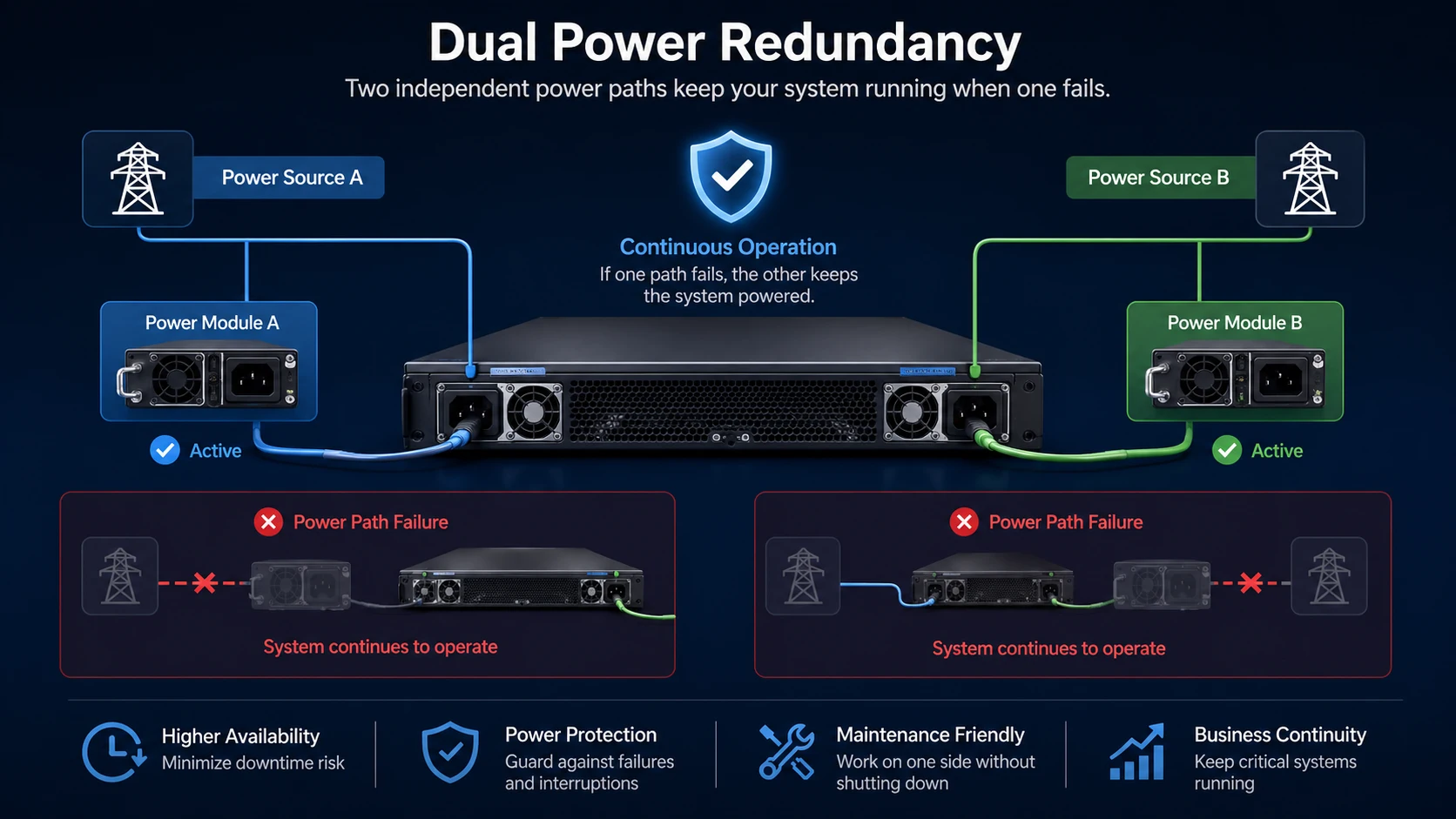
Dual power redundancy is a power protection design in which a device, system, or installation is equipped with two independent power inputs, two power modules, or two power sources so that operation can continue if one path fails or becomes unstable. In simple terms, it gives equipment a second available power route instead of depending entirely on a single feed. This helps reduce the risk of shutdown caused by power supply failure, cable faults, source interruption, or maintenance activity on one side of the power architecture.
In modern technical environments, uninterrupted power is closely linked to service continuity. A communication server, industrial controller, network switch, paging platform, intercom gateway, monitoring terminal, or emergency communication device may work correctly in every other respect, yet still become unavailable if its only power path fails. Dual power redundancy addresses that weakness by building resilience into the energy supply layer rather than leaving the equipment dependent on one electrical route.
This is why dual power redundancy is widely used in telecom systems, data centers, industrial automation, transportation infrastructure, energy facilities, security platforms, hospitals, and mission-oriented communication networks. It is not only a hardware feature. It is a reliability strategy that helps equipment stay online during faults, planned maintenance, and certain abnormal operating conditions.
What Is Dual Power Redundancy?
Definition and Core Idea
Dual power redundancy means that a device or system is designed to receive power from two separate inputs or sources so that one can support operation if the other becomes unavailable. The two paths may come from separate AC feeds, separate DC feeds, redundant power supply modules, primary and backup power systems, or combinations involving rectifiers, batteries, UPS platforms, or site power distribution architecture.
The core idea is continuity through duplication. A single power path creates a single point of failure. If that path is interrupted, the equipment may stop immediately. With dual power redundancy, the design anticipates that one path may fail and ensures that another path is already available to maintain operation. This reduces the dependence on one component, one feeder, or one supply module.
In practical engineering terms, the value of dual power redundancy lies in fault tolerance. It does not guarantee that every possible failure will be harmless, but it significantly reduces the chance that one isolated power problem will take the entire device or service offline.
Dual power redundancy is not just about adding another power connector. It is about removing a single power path as the only condition for system survival.
Why It Matters in Critical Equipment
The concept matters most where downtime has meaningful operational consequences. If a desktop accessory loses power, the inconvenience may be limited. If a communication gateway, industrial switch, hospital terminal, emergency call server, or control-room platform loses power unexpectedly, the consequences may include service interruption, alarm failure, production disruption, or delayed response to incidents.
In these environments, availability is often treated as a design requirement rather than a convenience goal. Dual power redundancy helps support that requirement by making the equipment less vulnerable to one failed power source or one maintenance operation. It also helps administrators and engineers perform service work with less risk of full interruption when the system has been designed correctly.
That is why dual power redundancy is usually associated with professional and industrial-grade equipment rather than with basic consumer devices.
How Dual Power Redundancy Works
Two Inputs, One Continuous Load
The operating principle is straightforward. The equipment is connected to two power inputs or two supply modules, but the internal load must continue receiving stable energy as one unified operating requirement. The system therefore monitors, combines, prioritizes, or switches between the available sources depending on its design. In some products, both inputs are live and the internal circuitry automatically draws from the appropriate path. In others, one source acts as the preferred feed while the other remains in standby or backup mode.
The equipment user may not notice anything during normal operation because the redundancy is meant to work in the background. If one source disappears, the remaining source continues feeding the system. In a well-designed platform, the transition happens without service interruption or with a disruption so brief that the application remains operational.
This is why redundant power design is often paired with alarms, status indicators, or management notifications. The equipment may remain online while still reporting that one power path has failed, allowing maintenance staff to fix the issue before total redundancy is lost.
Redundant Modules, Feeds, and Source Diversity
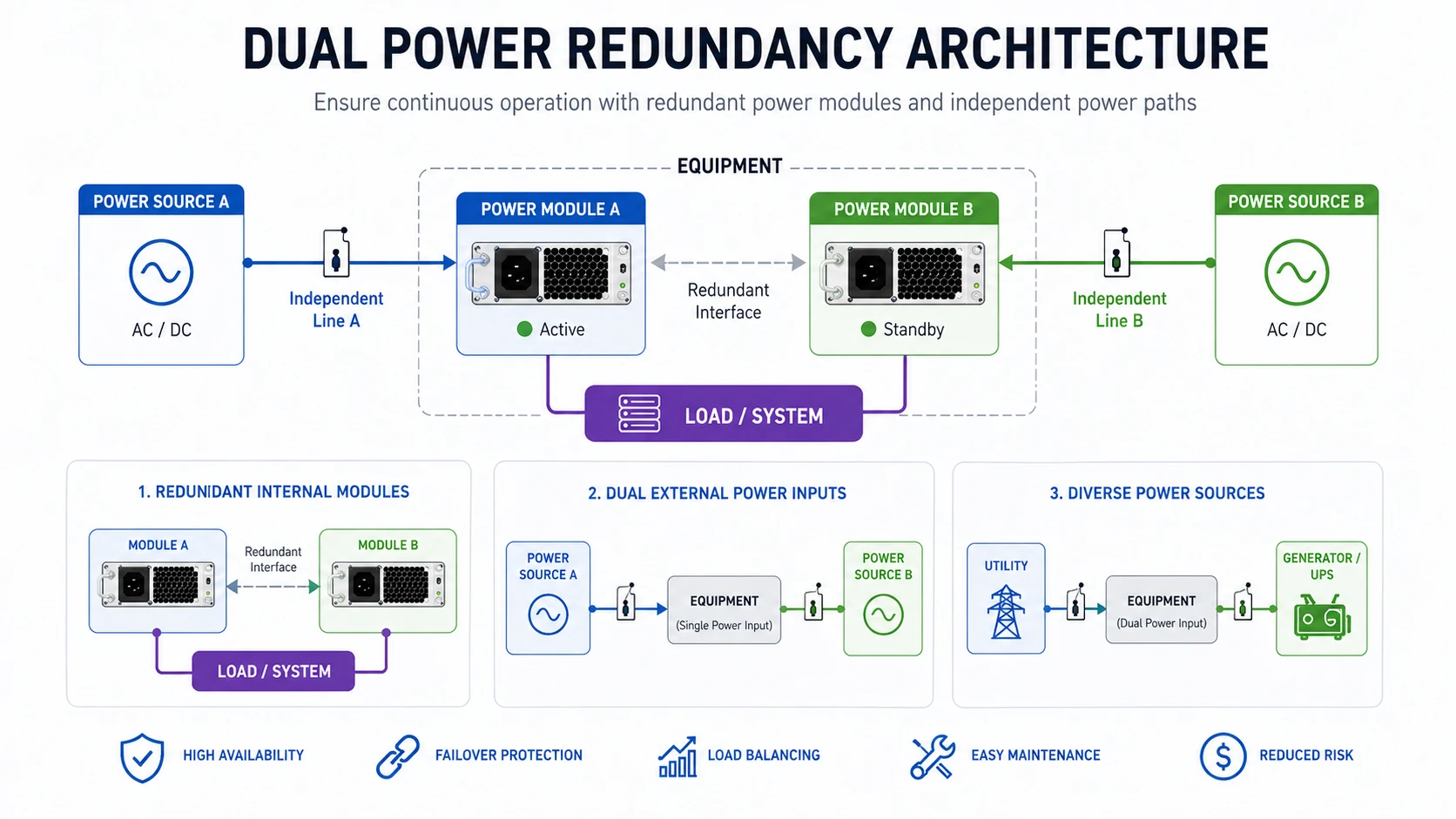
Dual power redundancy can be implemented in more than one way. Some devices use dual hot-swappable power supply modules inside the same chassis. Others offer two independent DC inputs so the equipment can be connected to separate feeds. Some systems are built around source diversity, meaning the two power paths come from different upstream infrastructure such as utility power and UPS, dual rectifier groups, or primary feed plus battery-backed distribution.
The exact architecture matters because not all redundancy is equally strong. Two connectors tied back to the same fragile upstream circuit do not provide the same resilience as two truly independent power sources. The more diverse the upstream power path is, the stronger the real redundancy usually becomes.
This is why engineers often distinguish between device-level redundancy and system-level redundancy. A device may have dual inputs, but the real benefit depends on whether the wider installation also separates the upstream risk.
Redundant power at the equipment level is valuable, but the strongest protection appears when the entire upstream power path is also designed for independence.
Main Architectures of Dual Power Redundancy
Dual Power Supply Modules Inside One Device
One common architecture uses two internal power supply modules within the same device chassis. These modules may both be active, load-sharing, or one may act as backup depending on the design. If one module fails, the other continues supporting the system. This approach is widely used in telecom equipment, enterprise switches, industrial servers, communication controllers, and rack-mounted infrastructure products.
The advantage of this model is compact integration. The redundancy is built directly into the equipment, making deployment relatively straightforward. It can also support easier field replacement when modules are hot-swappable, allowing technicians to remove a failed unit without shutting down the equipment.
However, the overall resilience still depends on the upstream feed arrangement. Dual internal modules are useful, but if both are powered from one upstream source without real diversity, the system still remains exposed to wider feed failure.
Dual External Inputs and Independent Feeds
Another common architecture uses dual external power inputs connected to separate power paths. This is especially common in industrial devices, communication terminals, field controllers, and infrastructure equipment that operate on DC feeds or mixed site power architectures. For example, a device may accept two 48V DC inputs from separate power distribution branches or separate rectifier and battery systems.
This design can be highly effective because it allows the device to benefit from upstream independence. One path may remain healthy even if the other breaker, cable, power source, or distribution segment fails. In industrial and telecom environments, this approach is often preferred because it aligns more naturally with site-level power resilience strategy.
It also supports cleaner maintenance planning, since one feed can sometimes be serviced or isolated while the device remains online through the other path.
Deployment Benefits of Dual Power Redundancy
Reduced Downtime Risk
The most obvious deployment benefit is lower downtime risk. If one power path fails, the system still has another available route to continue operating. This makes the equipment less vulnerable to isolated supply failures, maintenance mistakes, loose connectors, module faults, or feeder interruptions. In environments where even short service outages are costly, this is one of the most important reasons to deploy redundant power.
The reduction in downtime is especially valuable for communication systems, production-support systems, and infrastructure platforms that users expect to remain continuously available. A device with dual power redundancy is better positioned to remain online while the fault is diagnosed and corrected rather than failing immediately at the first power problem.
This benefit does not eliminate every outage scenario, but it removes one major class of single-point failure from the equipment design.
Better Service Continuity During Maintenance
Dual power redundancy also improves service continuity during planned maintenance. In many installations, technicians need to replace one power module, service one distribution path, or isolate one upstream branch for testing. If the device depends on only one feed, that work may require a full service interruption. If the device has correctly deployed dual power redundancy, the work may be performed with the second path maintaining operation.
This can reduce maintenance windows, simplify operational planning, and lower the pressure around routine service procedures. It is especially useful in always-on environments such as hospital communications, industrial control networks, transport communications, and critical IP systems where downtime is hard to schedule or unacceptable during active hours.
In effect, dual power redundancy supports maintainability as well as reliability. It helps the system survive faults, but it also helps it survive necessary human intervention.
Good redundancy does not only protect against unexpected failure. It also makes planned maintenance less disruptive to live services.
Additional Operational Benefits
Improved Reliability Perception and Customer Confidence
Another benefit is improved confidence in the equipment and the service built around it. Operators, engineers, and end users are more likely to trust platforms that are clearly designed with resilience in mind. In commercial and industrial environments, that confidence matters because communication and control systems are often judged not only by features, but by their ability to stay available under stress.
This is especially important for vendors and integrators deploying systems into critical infrastructure projects. A device that supports dual power redundancy sends a clear signal that the design is meant for professional deployment rather than light-duty use. That can strengthen project credibility and improve how the overall solution is evaluated.
In other words, redundant power is both a technical safeguard and a marker of serious reliability design.
Better Alignment With High-Availability Architecture
Dual power redundancy also aligns well with larger high-availability strategies. Many organizations already invest in UPS platforms, battery systems, dual network paths, redundant servers, and failover communication links. If the device itself still depends on a single power input, the wider resilience strategy remains incomplete.
By deploying equipment with dual power redundancy, organizations create a better match between device-level design and site-level availability planning. This is particularly useful in telecom rooms, data centers, industrial cabinets, dispatch platforms, and control facilities where redundancy is expected across multiple system layers.
A resilient architecture works best when no single layer quietly reintroduces a weak point that the rest of the design was supposed to eliminate.
Maintenance Tips for Dual Power Redundancy
Test Both Paths, Not Only the Primary Path
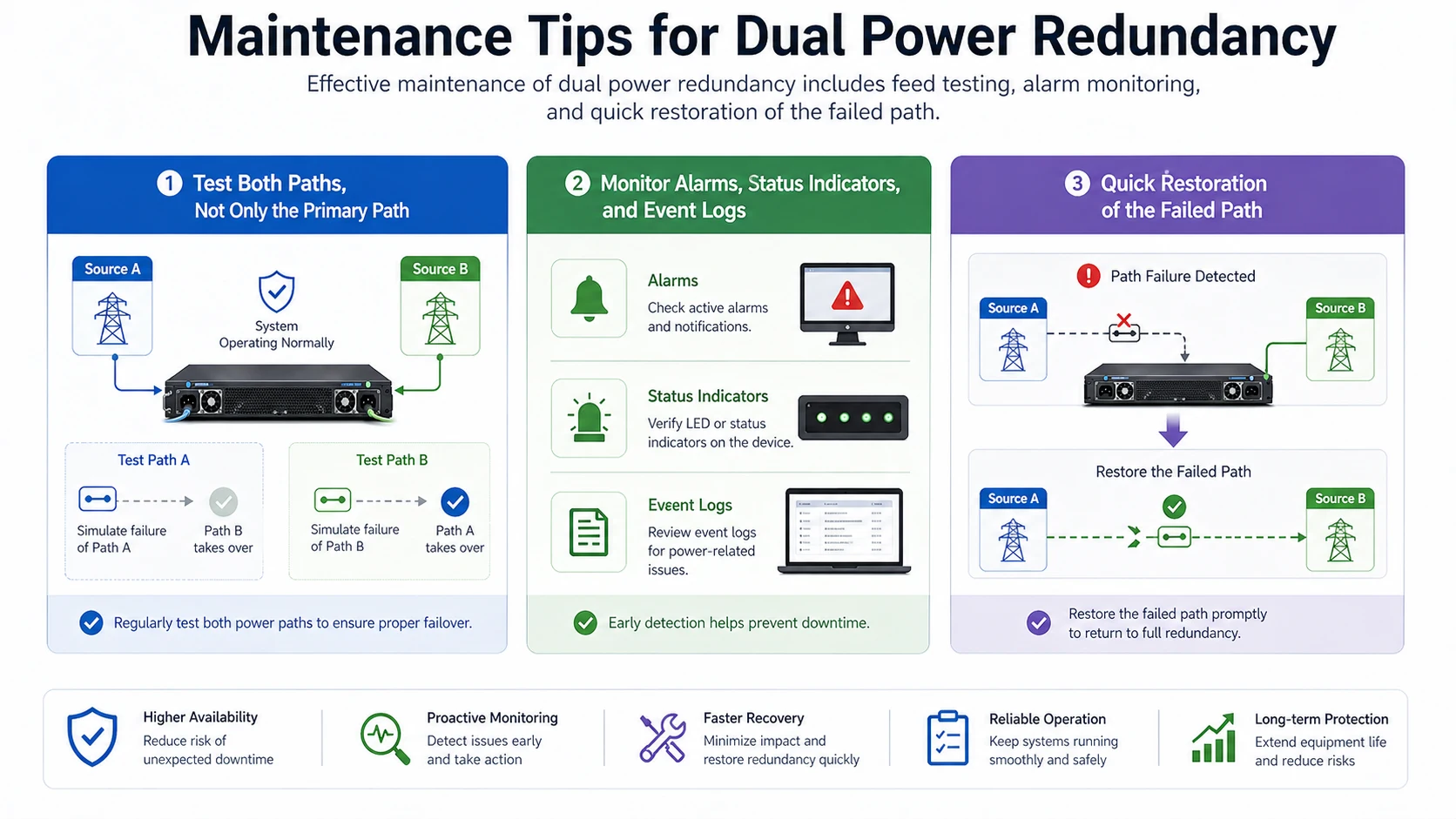
One of the most important maintenance rules is to test both power paths regularly. A redundant design offers little real protection if the secondary source has never been verified under realistic conditions. In some environments, teams assume the backup input is healthy simply because the device is online, but the device may actually be running only on one feed without anyone noticing.
Proper maintenance should therefore include controlled checks to confirm that each input, module, or source path can support the load when the other is removed or isolated. This does not mean reckless testing during critical operations. It means planned validation with appropriate change control and awareness of operational risk.
A redundancy feature is only trustworthy when both sides are known to work, not when one side is merely present on paper.
Monitor Alarms, Status Indicators, and Event Logs
Monitoring is equally important. Many redundant power devices provide LEDs, relay alarms, SNMP events, system logs, or management alerts showing the status of each power path. These signals should not be ignored. A device may remain operational on one power path for days or weeks while the second path has already failed, leaving the system in a degraded state without full redundancy.
Maintenance teams should review alarm conditions promptly and treat loss of a redundant feed as a repair priority rather than a harmless detail. The device may still be running, but the safety margin has already been reduced. The next fault could then become the one that causes real downtime.
Good maintenance practice means restoring redundancy quickly, not simply enjoying the fact that the first fault did not stop the service.
Best Practices for Long-Term Reliability
Keep Source Independence Real
A major best practice is to preserve real source independence. It is not enough to install a device with two inputs if both ultimately depend on the same vulnerable upstream circuit. Engineers should review whether the two feeds truly come from separate protected paths, separate distribution points, or separate backup-supported infrastructure when the application requires higher resilience.
This review should also include cable routing, breaker grouping, terminal condition, and site documentation. Sometimes a redundant design looks correct on the equipment faceplate but is weakened by the way it was actually wired in the cabinet or facility.
Real redundancy should exist electrically, physically, and operationally, not only in the product specification.
Replace Failed Modules and Aging Components Promptly
Another important practice is timely replacement of failed or aging power components. Redundancy can create a false sense of safety if operators allow one failed power supply module or one lost feed to remain unresolved for too long. The system may continue working, but it is no longer truly redundant.
Power modules, connectors, terminal blocks, and related components should also be reviewed for heat stress, corrosion, loosening, or aging signs during preventive maintenance. In harsh environments, these physical conditions can gradually undermine the quality of the redundant design even when no total failure has yet occurred.
Long-term reliability depends on treating redundancy as something that must be preserved continuously, not simply installed once.
Redundancy only protects the system when the backup path is healthy today, not when it was healthy six months ago.
Applications of Dual Power Redundancy
Telecom, Networking, and Data Infrastructure
Dual power redundancy is widely used in telecom and networking equipment because communications infrastructure often needs high uptime. Core switches, industrial switches, SIP servers, IP PBX platforms, gateways, dispatch systems, and communication controllers may all benefit from redundant power paths. A failure at the power layer can affect voice service, signaling, paging, alarms, and management access at the same time.
In these environments, redundant power helps align the equipment with broader high-availability expectations. Communication traffic may be business-critical or safety-relevant, so operators often want devices that can remain active through single-feed loss or power module replacement.
This is why dual power inputs and redundant supply modules are common in professional communication infrastructure rather than only in traditional server equipment.
Industrial Control, Utilities, and Critical Facilities
Industrial control systems, utilities, and critical facilities also use dual power redundancy because equipment may support production continuity, monitoring, alarm handling, or site operations. PLC-associated communications, control interfaces, remote I/O units, monitoring gateways, and field communication devices can all become important availability points in operational environments.
If these devices fail because of a single power interruption, the result may include reduced visibility, delayed response, or larger process disruption. Redundant power therefore becomes valuable not only for IT-style uptime, but for operational resilience in the field.
This is particularly true where equipment is installed in substations, plants, transport systems, tunnels, utility sites, and remote cabinets that are difficult to service quickly after a failure.
Dual Power Redundancy in Communication Projects
Role in SIP, Paging, and Emergency Communication Systems
In communication projects, dual power redundancy is especially relevant where systems must remain available for voice handling, intercom response, paging, or emergency coordination. A communication failure caused by a single lost power path can have a larger effect than ordinary device downtime because it may interrupt both routine operations and urgent response workflows.
SIP servers, dispatch platforms, network amplifiers, intercom controllers, emergency help point systems, and paging gateways may all benefit from redundant power design depending on the role they play in the architecture. In these systems, the goal is not only device survival, but continuity of the wider communications service.
In previous projects of Becke Telecom involving communication systems, industrial walkie-talkies, SIP platforms, paging infrastructure or critical site voice networks, dual power redundancy can be an effective function for important deployment of service continuity. Equipment and platforms used in industrial, tunnel, park, transportation, public utility or emergency communication environments typically benefit from resilient power design, as they operate in areas where power outages could affect operations and safety responses.
This is especially relevant when communication equipment is part of a wider high-availability architecture involving network redundancy, UPS systems, battery-backed DC power, or dual-site operational control. In such cases, dual power redundancy helps the equipment align with the resilience goals of the overall solution rather than becoming a weak point inside it.
For system planners, that means power redundancy should be considered as part of the communication design itself, not only as a general electrical detail left for later.
Challenges and Practical Considerations
Redundancy Does Not Mean Unlimited Fault Tolerance
Dual power redundancy is highly valuable, but it does not solve every availability risk. If both feeds depend on the same upstream failure point, if both modules are exposed to the same internal fault, or if the wider site loses all source power, redundancy at the device level may not be enough by itself. The design reduces certain classes of failure, but it does not make the system invulnerable.
This is why engineers should evaluate the real fault model. The question is not simply whether a device has two inputs. The question is what failures those two inputs actually protect against. Good planning means understanding the realistic limits of the redundancy design rather than assuming that “dual power” automatically means complete continuity in every scenario.
In short, redundancy improves resilience, but it still needs to be placed inside a larger availability strategy.
Improper Wiring Can Undermine the Benefit
Another practical issue is installation quality. A device may support dual power redundancy, but poor wiring, incorrect feed distribution, loose terminals, lack of labeling, or unclear maintenance procedures can undermine the benefit. In some cases, both feeds may be accidentally tied to the same circuit, or one path may never be connected correctly in the first place.
This is why deployment should include documentation, labeling, validation, and post-installation testing rather than assuming the redundant feature is automatically effective once the product is mounted. The installation quality determines whether the redundancy exists in reality or only in theory.
The more important the service, the more important it is to verify that the redundant power design was actually implemented the way the architecture intended.
Conclusion
Dual power redundancy is a power resilience design that gives equipment two independent power paths instead of one, helping reduce downtime risk and improve service continuity during faults and maintenance. Its importance is greatest in telecom, industrial, infrastructure, and mission-oriented environments where the loss of one power path should not immediately shut down the system.
The main deployment benefits include lower risk of service interruption, better support for maintenance activities, stronger alignment with high-availability architecture, and improved confidence in critical equipment. At the same time, the real value of dual power redundancy depends on good installation, real source independence, active monitoring, and timely maintenance of the failed path.
For organizations designing reliable communication and operational systems, dual power redundancy is not just a specification item. It is a practical reliability measure that helps equipment remain useful when the first power path is no longer available.
FAQ
What is dual power redundancy in simple terms?
In simple terms, dual power redundancy means a device has two power inputs or two power supply paths so it can keep running if one path fails. The second path helps reduce the chance of shutdown caused by a single power problem.
It is commonly used in professional equipment where uptime matters.
What are the main benefits of dual power redundancy?
The main benefits are reduced downtime risk, better continuity during maintenance, stronger reliability for critical systems, and better alignment with broader high-availability design.
It is especially useful in telecom, industrial, network, and emergency communication environments.
What should be maintained in a dual power redundancy system?
Maintenance should include testing both power paths, monitoring alarms and degraded status conditions, checking wiring quality, replacing failed power modules quickly, and confirming that the two feeds remain truly independent.
Redundancy is only effective when the backup path is healthy and verified, not just physically present.