A horn speaker is a type of loudspeaker that uses a horn-shaped acoustic structure to project sound more efficiently and over a longer distance than many standard speaker designs. Instead of relying only on the driver itself to push sound outward, the horn helps guide and amplify the acoustic energy so that voice messages, alarms, tones, and announcements can be heard more clearly across wider or noisier spaces. In simple terms, a horn speaker is designed to make sound travel farther and with stronger directional focus.
Horn speakers are widely used in public address systems, industrial paging systems, transport facilities, schools, outdoor warning systems, factories, ports, warehouses, tunnels, utility sites, and emergency communication networks. They are especially valuable where clear voice projection matters more than hi-fi music quality. In these environments, the main goal is often intelligibility, coverage, and durability rather than soft indoor listening comfort.
Because of this, horn speakers have become an important part of B2B communication infrastructure. They appear in traditional analog paging systems, network audio platforms, SIP-based broadcast systems, and integrated emergency communication solutions. For many organizations, the horn speaker is not simply an audio accessory. It is a practical terminal for delivering instructions, warnings, operational messages, and emergency alerts in places where ordinary speakers may not perform well enough.
What Is a Horn Speaker?
Definition and Core Meaning
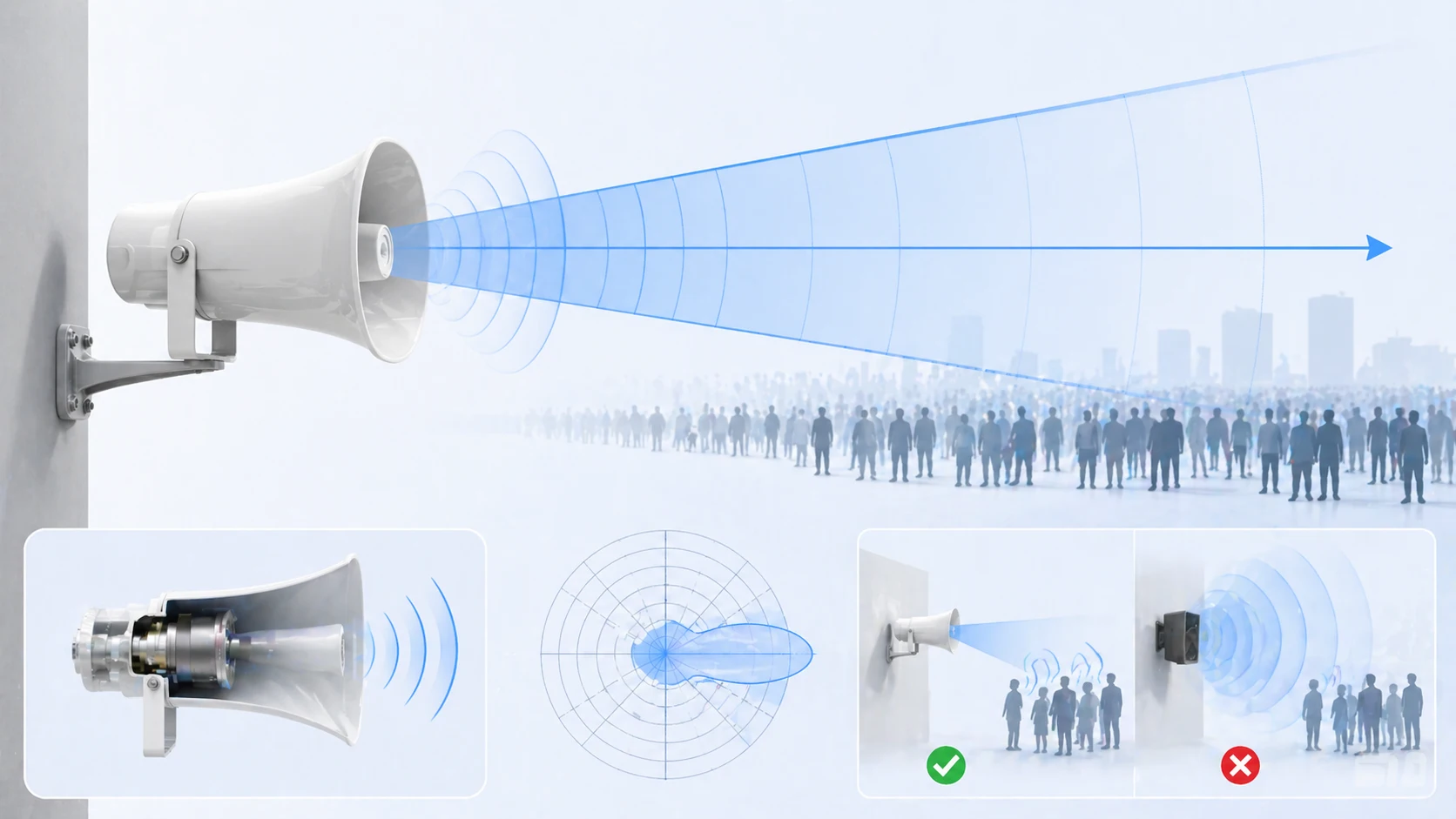
A horn speaker is a loudspeaker assembly in which the sound generated by a driver is coupled to a flared horn structure. That horn acts as an acoustic guide, helping transform the sound energy from the driver into a more directional and efficient output. As a result, the speaker can project sound over greater distances and maintain better audibility in open or challenging environments.
The core meaning of a horn speaker is acoustic efficiency with projection. A conventional speaker often disperses sound more broadly and may be better suited to balanced indoor playback. A horn speaker, by contrast, is designed to throw sound outward in a more focused way. This makes it especially useful for speech announcements, alert tones, warning signals, and command communication.
In practical installations, horn speakers are usually selected when the site requires outdoor coverage, long-distance communication, or stronger voice clarity in noisy or reverberant environments. That is why they are common in factories, school grounds, transport terminals, industrial parks, and emergency paging systems.
A horn speaker is not mainly about refined music playback. It is about projecting sound clearly and efficiently where communication needs to reach people fast.
Why It Is Different From a Standard Speaker
The main difference lies in how the sound is delivered. Standard box speakers or ceiling speakers are often used for more balanced audio reproduction in offices, stores, classrooms, or indoor public areas. Horn speakers are more purpose-driven. They emphasize projection, directionality, and intelligibility rather than broad tonal smoothness.
This makes horn speakers better suited to functional communication tasks. In an industrial site, for example, the system may need to deliver a warning across machinery noise. In a transport setting, the speaker may need to announce instructions across an open platform or roadway area. In a campus emergency system, the horn speaker may need to reach outdoor gathering points quickly and clearly.
In other words, the horn speaker is different because it is designed first for communication performance under real site conditions, not simply for general listening comfort.

How a Horn Speaker Works
The Role of the Driver and Horn Structure
A horn speaker works by combining two essential parts: the driver and the horn. The driver produces the audio energy, while the horn helps shape and project that energy into the surrounding environment. The driver may be a compression driver or another suitable transducer design, depending on the product type and intended application.
Once the driver generates the sound, the horn acts as an acoustic transformer that improves the coupling between the driver and the air. This allows the system to deliver stronger output more efficiently than the driver alone could typically achieve. The horn also helps direct the sound toward a target area rather than allowing it to spread in all directions without control.
This is why horn speakers are often associated with high sensitivity and stronger projection. The horn does not create sound by itself, but it makes the existing sound energy more useful for practical long-range communication.
Directionality, Coverage, and Intelligibility
The horn shape influences how the sound spreads. A narrower pattern can help focus audio toward a particular path or zone, while a wider pattern may be used when broader coverage is needed. In either case, the design aims to improve clarity in the intended listening area.
This directionality is especially helpful for speech. In many B2B environments, a horn speaker is used to deliver instructions, warnings, and paging announcements. The purpose is not only to make the sound louder, but to make the message more understandable at a distance. A properly selected horn speaker can help voice cut through ambient noise more effectively than a general-purpose speaker used in the same location.
The working principle therefore connects directly to the application goal: efficient sound generation, focused projection, and better message delivery where communication must be heard clearly.
A horn speaker works by making sound energy more directional and efficient, which is why it is so effective for paging, warnings, and outdoor voice projection.
Main Features of Horn Speakers
High Efficiency and Long-Range Projection
One of the most important features of a horn speaker is high acoustic efficiency. Because the horn structure helps project sound more effectively, the speaker can often deliver stronger audible coverage with a relatively practical power design. This makes horn speakers a strong choice for sites where announcements must travel across distance rather than stay within a small indoor listening zone.
Long-range projection is closely related to this efficiency. In a warehouse yard, school playground, loading area, industrial corridor, or outdoor assembly point, the speaker may need to cover a larger area than a standard indoor speaker can handle efficiently. Horn speakers are designed for this kind of task.
This is one reason they are often used in public address and industrial paging systems rather than only in general audio playback applications.
Strong Voice Intelligibility and Directional Output
Another key feature is voice intelligibility. Horn speakers are commonly optimized for speech communication, warning tones, and operational announcements. In real environments, it is often more important that people understand the message than that they experience rich musical detail. Horn speakers support that priority well.
Directional output is also valuable because it helps target the sound where it is needed. This can improve coverage efficiency and reduce unnecessary spill into unrelated areas. In practical deployment, directional behavior helps engineers and installers shape communication zones more deliberately.
Together, these features make horn speakers especially suitable for communication systems where clarity and projection matter more than full-range hi-fi audio balance.
Common Types of Horn Speakers
Traditional PA Horn Speakers
Traditional PA horn speakers are often used in analog public address systems, school broadcast systems, factory paging networks, and outdoor announcement installations. These models are typically connected to amplifiers through conventional constant-voltage audio lines such as 100V or 70V systems. Their role is straightforward: deliver voice and tones clearly across open or difficult areas.
These horn speakers remain popular because they are practical, proven, and well suited to large-area voice coverage. In many facilities, they continue to serve as reliable terminals for routine announcements and safety alerts. Their simplicity makes them a long-standing choice in conventional broadcast projects.
Even in modern systems, traditional horn speakers still have an important place, especially when existing analog infrastructure is already deployed.
IP and SIP Horn Speakers
IP and SIP horn speakers represent a more network-oriented development path. These devices connect directly to IP networks and can receive audio streams, paging commands, or SIP-based call and broadcast instructions without relying only on a traditional analog amplifier chain. This makes them attractive for modern enterprise, campus, and industrial communication systems.
In practical B2B environments, SIP horn speakers can support centralized management, flexible zoning, remote configuration, and integration with wider communication platforms. They may be used in IP paging, emergency broadcast systems, plant communications, or unified communication environments where network-based control is preferred.
Benefits of Horn Speakers
Clear Communication in Difficult Environments
One of the biggest benefits of horn speakers is their ability to support clearer communication in environments where ordinary speakers may struggle. Open outdoor areas, industrial facilities, transport platforms, loading zones, and public gathering points often present acoustic challenges such as noise, distance, weather exposure, or wide-area coverage needs. Horn speakers are well suited to these conditions because they project sound more purposefully.
This clarity can improve operational communication, routine announcements, and emergency response. A warning that is heard too weakly or too late may lose much of its value. A horn speaker helps reduce that risk by delivering stronger, more intelligible sound in the required direction.
In this sense, the benefit is not just volume. It is usable communication under real site conditions.
Practical Coverage and System Efficiency
Horn speakers can also improve practical coverage efficiency. Because they project sound more effectively, fewer devices may be needed in some outdoor or targeted installations compared with trying to force standard indoor speaker types into unsuitable roles. This can help simplify design and make communication coverage more predictable.
System efficiency is another advantage. In many B2B applications, the goal is not entertainment audio but effective voice distribution. Horn speakers match that goal well. They allow public address, industrial paging, warning, and operational voice systems to focus on what matters most: making the message heard across the correct area.
For integrators and operators, this often translates into more dependable communication performance with more appropriate equipment selection.
The real benefit of a horn speaker is not simply that it is loud. It is that it is loud in a way that is useful for operational communication.
Applications of Horn Speakers
Public Address, Paging, and Emergency Broadcast
Horn speakers are widely used in public address and paging systems because they are especially effective for announcements, alert tones, and emergency instructions. Schools, factories, industrial parks, warehouses, ports, transport facilities, and municipal sites often depend on horn speakers to deliver audio messages over large outdoor or semi-open areas.
In emergency broadcast applications, horn speakers are particularly valuable because they can help distribute urgent information quickly and across distance. Whether the message involves evacuation, warning, operational instruction, or area control, the speaker must prioritize audibility and clarity. Horn speakers fit that requirement well.
This is why they are commonly found in systems where voice communication is linked to safety, crowd guidance, or operational coordination.
Industrial, Transport, and Outdoor Communication Systems
Horn speakers are also common in industrial and transportation communication systems. A manufacturing site may use them for shift notifications, production coordination, or emergency paging. A port or logistics center may use them for operational announcements across loading or yard areas. A tunnel, highway, or railway environment may use them for warnings, instructions, or linked communication response.
In these deployments, the horn speaker often becomes part of a wider communications architecture that may include intercoms, emergency phones, control room systems, network amplifiers, and dispatch platforms. The speaker is therefore not acting alone. It is one of the output terminals in a broader communication solution.
This is one reason horn speakers are so important in industrial and infrastructure projects. They support the final delivery of messages that originate from command and communication systems elsewhere in the network.

Horn Speakers in Modern IP Communication Projects
Integration With SIP and Network Audio Platforms
In modern communication projects, horn speakers are increasingly integrated with SIP and IP-based audio systems. This allows them to work more directly with network paging platforms, IP PBX environments, broadcast servers, and integrated command systems. Instead of acting only as passive analog outputs, they can become more intelligent endpoints within a wider communication network.
This integration helps organizations build more flexible paging and broadcast architectures. Zones can be managed more dynamically, remote administration becomes easier, and audio delivery can be connected more directly to communication workflows such as emergency calling, group paging, or scheduled announcements.
For businesses and infrastructure operators moving toward network-based communications, this makes horn speakers more relevant than ever rather than less.
Becke Telcom Industrial Horn Speaker Advantage Analysis
Becke Telcom industrial horn loudspeakers are meticulously engineered to fully support a comprehensive range of applications—including industrial SIP paging, outdoor voice broadcasting, emergency communications, and IP network broadcasting—serving as the pivotal audio output terminals in enterprise and industrial communication deployments.
As a critical acoustic node within the communication chain, these loudspeakers precisely translate commands from dispatch platforms into clear, powerful voice broadcasts that reach across an entire area. They are perfectly suited for large-scale, wide-coverage operational environments such as factory floors, tunnels and utility corridors, industrial parks, transportation hubs, ports and docks, and large-scale warehouses. Leveraging Becke Telcom’s integrated communication solutions, these devices enable the seamless integration of SIP terminals, intercom systems, paging and dispatch capabilities, and IP broadcasting functions, thereby establishing a unified and highly efficient converged communication architecture.
Distinguished by their professional acoustic design and industrial-grade adaptability, Becke Telcom horn loudspeakers perform effectively even in challenging conditions—including open-air outdoor settings and high-noise industrial environments. They significantly enhance communication clarity and the efficiency of command delivery, ensuring that every dispatch notification and emergency broadcast is transmitted with unwavering stability and reliability. Ultimately, they provide industrial sites with robust, professional voice communication assurance that is both all-weather resistant and fully comprehensive in its coverage.
How to Choose the Right Horn Speaker
Match Coverage and Environment
The first rule is to match the horn speaker to the acoustic environment. Indoor corridors, open yards, transport platforms, factory buildings, coastal areas, and industrial compounds all impose different requirements. Coverage distance, background noise, mounting position, weather exposure, and required intelligibility should all influence selection.
A speaker that performs well for a small sheltered space may not be appropriate for a windy outdoor area or a site with heavy machinery noise. Likewise, a high-output model may be unnecessary in a limited area where targeted communication is sufficient. The best choice is the one that fits the actual communication task, not simply the one with the largest wattage figure.
This is why system design should begin with coverage goals and site conditions rather than with a generic product assumption.
Consider IP Network Integration and Durability
Another important factor is integration method. Some projects still require traditional analog horn speakers tied to amplifier lines. Others are better suited to IP or SIP horn speakers that can integrate directly with network audio platforms. The right choice depends on the wider system architecture, maintenance preferences, and future expansion needs.
Durability also matters greatly, especially in outdoor and industrial environments. Weather resistance, enclosure quality, mounting strength, and long-term material performance all affect whether the speaker remains dependable after installation. A horn speaker used in critical communication should be judged not only by audio output, but also by how well it survives the environment.
In practice, the right horn speaker is the one that matches the system, the site, and the communication purpose together.
Choosing a horn speaker is not only about loudness. It is about selecting the right projection, durability, and integration model for the job.
Conclusion
A horn speaker is a loudspeaker that uses a horn-shaped acoustic structure to project sound efficiently and directionally across larger or more difficult environments. It is widely used because it supports clear voice communication, practical coverage, and stronger sound projection in applications where standard speakers may not be sufficient.
Its importance is especially clear in paging, public address, industrial communications, transport facilities, outdoor announcements, and emergency broadcast systems. In modern IP and SIP-based deployments, horn speakers also play a growing role in network audio and integrated communication solutions.
For organizations building enterprise or industrial communication systems, a horn speaker is more than a simple audio terminal. It is a practical communication tool that helps instructions, alerts, and operational messages reach the people who need to hear them.
FAQ
What is a horn speaker in simple terms?
In simple terms, a horn speaker is a speaker designed to project sound farther and more clearly by using a horn-shaped structure. It is commonly used for paging, announcements, and warnings rather than high-fidelity music playback.
Its main value is strong and practical voice projection.
What is the difference between a horn speaker and a normal speaker?
A horn speaker is designed for directional projection, efficiency, and speech clarity over distance, while a normal speaker is often designed for more general audio playback and balanced listening. Horn speakers are more common in outdoor, industrial, and public address environments.
Standard speakers are usually better suited to routine indoor listening or music-oriented use.
Where are horn speakers commonly used?
Horn speakers are commonly used in public address systems, industrial paging, schools, transport facilities, warehouses, ports, factories, tunnels, campuses, and outdoor emergency communication systems.
They are especially useful where speech announcements need to be heard clearly across distance or background noise.