A die-cast aluminum enclosure is a protective housing made by forcing molten aluminum alloy into a precision metal mold under pressure. The result is a rigid, accurately shaped enclosure that can protect electronic, electrical, and communication equipment from impact, dust, water, corrosion, and general environmental stress. Because die-cast aluminum combines structural strength with relatively low weight and good corrosion resistance, it is widely used for outdoor devices, industrial terminals, junction boxes, intercom housings, network equipment, control modules, and many other field-deployed products.
In practical product design, the enclosure is not just the outer shell. It influences durability, ingress protection, heat behavior, service life, installation method, and maintenance reliability. A weak enclosure can undermine an otherwise capable device, especially in industrial, marine, transportation, utility, or exposed outdoor environments. A strong enclosure, by contrast, helps the product survive mechanical stress, weather exposure, and harsh operating conditions with better stability.
This is why die-cast aluminum enclosures are common in sectors that demand tougher equipment. They appear in industrial communications, security systems, traffic infrastructure, energy facilities, outdoor networking, emergency call stations, and harsh-environment electronics where plastic housings may not offer the same mechanical confidence or long-term environmental performance.
What Is a Die-Cast Aluminum Enclosure?
Definition and Core Meaning
A die-cast aluminum enclosure is a metal housing manufactured through the die-casting process, in which molten aluminum alloy is injected into a hardened mold cavity under pressure. After cooling and solidifying, the part is removed from the mold and may then be machined, coated, gasketed, drilled, or otherwise finished depending on the application. This process allows manufacturers to produce enclosure bodies with repeatable dimensions, integrated structural features, and relatively complex shapes.
The core meaning of the product is protective containment. The enclosure is designed to hold and protect internal components such as circuit boards, terminals, sensors, amplifiers, power units, communication modules, or control interfaces. It provides mechanical shielding and helps create the sealed boundary that determines how well the device resists dust, moisture, and physical stress.
In many applications, the enclosure also contributes to product identity and installation practicality. Mounting ears, cable entry areas, cover geometry, gasket compression surfaces, and wall thickness can all affect how the device performs in the field.
A die-cast aluminum enclosure is not only a housing material choice. It is a structural and environmental protection decision that shapes how a device survives real operating conditions.
Why Aluminum Die Casting Is Common
Aluminum die casting is common because it offers a useful balance of strength, manufacturability, dimensional consistency, and corrosion resistance. Compared with many plastic housings, die-cast aluminum often provides stronger impact resistance and greater confidence in exposed or demanding sites. Compared with heavier metal fabrication approaches, it can support more efficient production of repeatable shapes and integrated design features.
The process is also attractive for enclosure design because it can produce solid, compact housings with ribs, bosses, threaded areas, and sealing surfaces built into the casting. This helps reduce assembly complexity and supports more controlled production quality in volume manufacturing.
For outdoor or industrial communication products, these advantages are especially important. Devices such as intercom stations, industrial telephones, paging terminals, access units, and field controllers often depend on a housing that must do more than simply cover electronics. It must protect the system throughout years of environmental exposure.
How a Die-Cast Aluminum Enclosure Is Made
Die-Casting Process and Basic Production Steps
The die-casting process begins by melting an aluminum alloy and injecting it under pressure into a steel mold. Because the mold cavity has a fixed shape, the enclosure body forms with relatively consistent dimensions from part to part. Once the metal cools, the casting is removed, trimmed, and prepared for additional finishing processes.
After casting, the enclosure may go through machining steps to refine threaded holes, cable entries, mounting surfaces, or precision contact areas. It may then receive powder coating, painting, chromate treatment, or other surface finishing to improve corrosion resistance and appearance. Seals, screws, covers, windows, cable glands, and accessories are added later depending on the product design.
This sequence matters because enclosure performance depends on more than the base metal alone. Casting quality, machining precision, gasket design, and finish treatment all influence whether the final product performs well in the field.
Design Features That Affect Performance
Several design features strongly affect how a die-cast aluminum enclosure performs. Wall thickness influences strength and weight. Rib structures can improve rigidity. Cover alignment and screw placement affect gasket compression. Cable entry design affects how easily sealing can be maintained. Surface coating affects corrosion performance, especially in outdoor or coastal environments.
Internal layout is also important. The enclosure must allow enough space for components, heat movement, mounting hardware, and wiring without weakening the protective structure. If the enclosure is intended for industrial communications or outdoor electronics, the design may also need to consider vandal resistance, water shedding, condensation behavior, and maintenance access.
These details show why enclosure choice is not just about material. It is about the total protective design and how that design matches the installation environment.
The strength of a die-cast aluminum enclosure comes from both the material and the geometry that turns that material into a reliable protective structure.
Main Standards and Protection Ratings
IP Ratings and IEC 60529
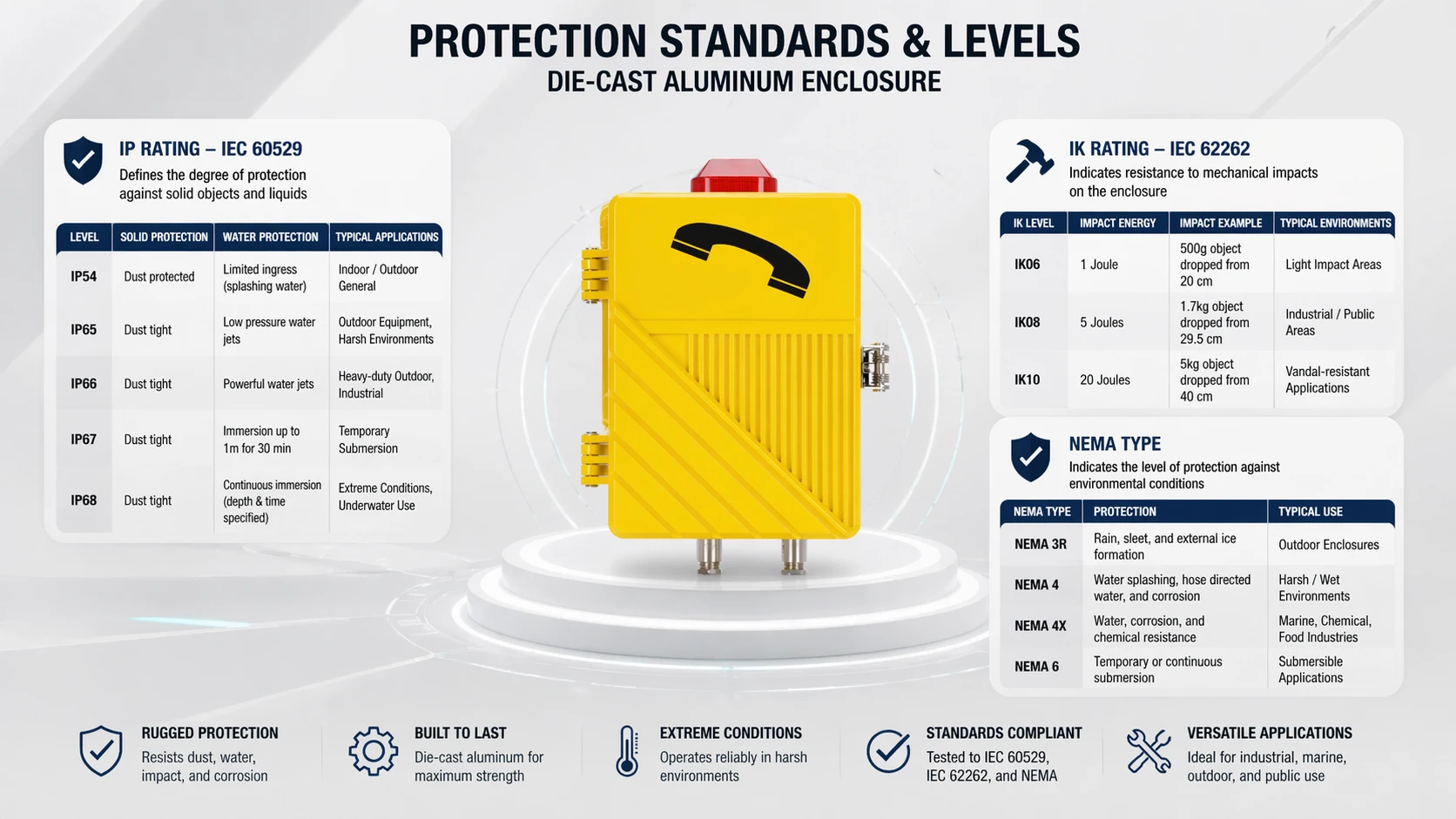
One of the most important standards associated with enclosure protection is IEC 60529, which classifies the degrees of protection provided by enclosures using the IP Code. In practical terms, this is why die-cast aluminum enclosures are often described with ratings such as IP65, IP66, or IP67.
These ratings do not mean the enclosure is made from a particular material. Instead, they describe how well the total enclosure design resists solid particle ingress and water ingress when properly tested. A die-cast aluminum body can help support high IP performance, but gasket quality, assembly precision, cable sealing, and cover design are just as important.
For buyers and engineers, the key point is that IP rating is not a marketing decoration. It is a standardized way to express environmental sealing performance, and it should be matched to the actual installation condition rather than chosen only for appearance or headline value.
IK Ratings, IEC 62262, and NEMA Type Considerations
Mechanical impact protection is commonly described using the IK Code defined by IEC 62262, which covers the degrees of protection provided by enclosures against external mechanical impacts. In practice, this is why rugged die-cast aluminum housings are often associated with IK ratings such as IK08 or IK10 when impact resistance matters.
The metal construction alone does not automatically guarantee a given IK level, but die-cast aluminum is often a strong candidate material when the application requires a more robust enclosure body than a basic plastic housing would normally provide.
In North American contexts, enclosure discussions may also reference ANSI/NEMA 250, which covers the classification and description of enclosures for electrical equipment. NEMA-type references are useful, but they should not be treated as direct one-to-one substitutes for IP codes. NEMA and IP ratings are related, but they are not fully equivalent and should be compared carefully.
Why Die-Cast Aluminum Enclosures Are Used
Strength, Rigidity, and Outdoor Durability
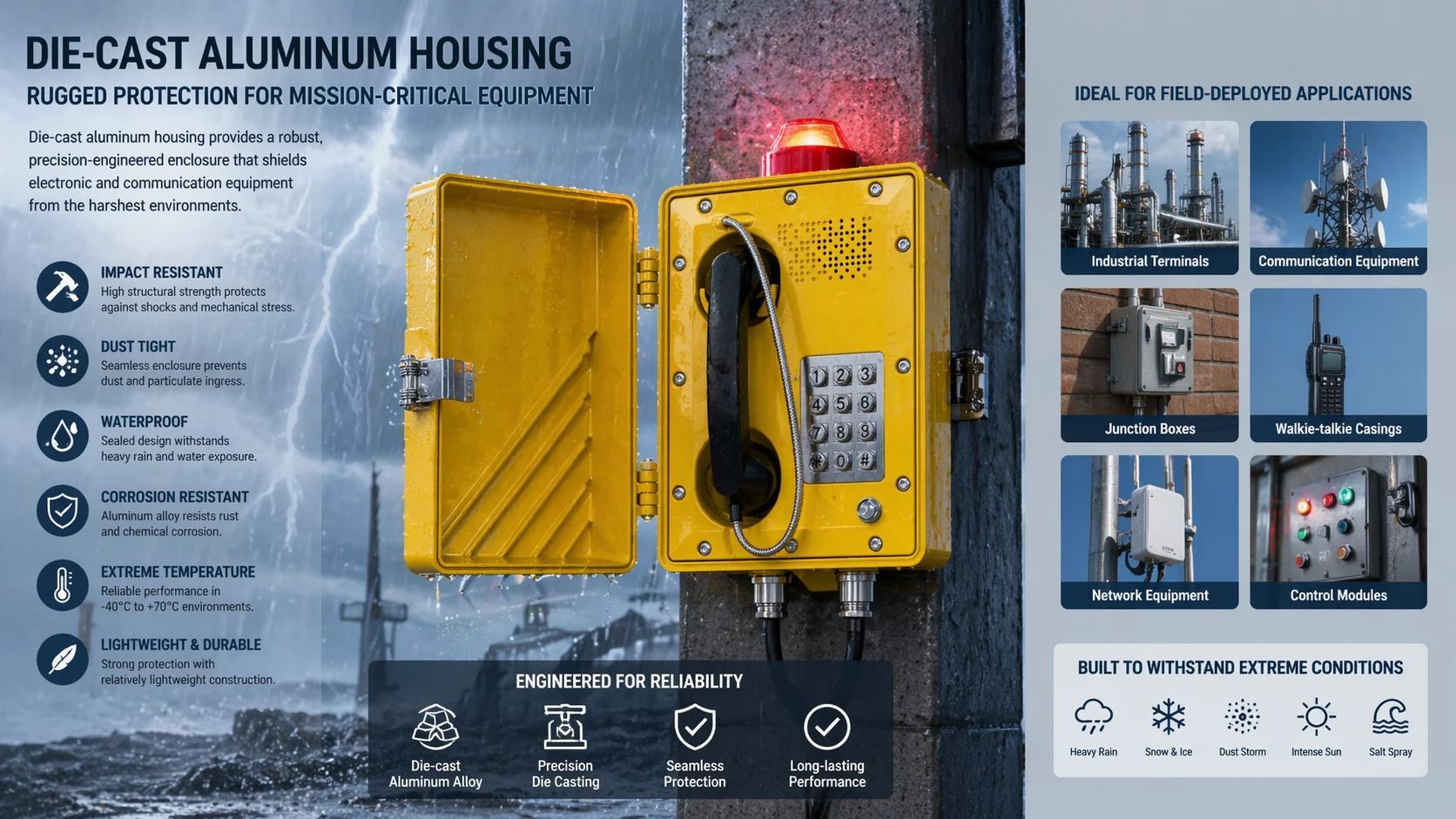
One of the main reasons manufacturers use die-cast aluminum enclosures is structural confidence. Aluminum cast housings can provide a rigid body that resists deformation, impact, and general field abuse better than many light-duty plastic alternatives. This is especially important for outdoor wall-mounted devices, exposed industrial terminals, roadside equipment, and communication devices installed in public or harsh environments.
Outdoor durability is another major reason. When properly finished and sealed, die-cast aluminum enclosures can support long-term use in environments exposed to rain, dust, sunlight, temperature variation, and airborne contaminants. The enclosure does not eliminate every environmental challenge, but it gives the product a much stronger starting point for survival under demanding conditions.
For many equipment classes, this durability directly influences service life, maintenance intervals, and field replacement frequency. That makes the enclosure a major reliability factor rather than a minor packaging detail.
Corrosion Resistance and Protective Finishing Potential
Aluminum is also attractive because of its corrosion behavior, particularly when paired with suitable surface treatment. Depending on the environment, die-cast aluminum enclosures may be powder-coated, painted, chemically treated, or otherwise finished to improve resistance to weathering, industrial atmospheres, or salt exposure.
This does not mean every aluminum enclosure performs equally well in every environment. Coastal, chemical, and high-pollution areas still demand careful material and finish selection. Even so, die-cast aluminum gives manufacturers a strong platform for building more weather-resistant and corrosion-aware products than would be practical with some lighter-duty housing materials.
In real applications, that matters for outdoor communications, plant-floor equipment, utility interfaces, marine-adjacent installations, and transport infrastructure where equipment cannot be protected by indoor conditions alone.
In harsh environments, the enclosure is often one of the first and most important lines of product defense.
Common Protection Levels in Real Products
Typical IP Ratings for Industrial and Outdoor Use
In practical product categories, die-cast aluminum enclosures are often paired with IP ratings intended for industrial or outdoor use. IP65 is commonly associated with protection against dust ingress and water jets. IP66 is chosen where stronger water-jet resistance is needed. IP67 may be selected when temporary immersion protection is relevant. The correct choice depends on the installation reality rather than on a universal “best” rating.
Engineers should be careful not to treat higher numbers as automatically better in every situation. A product installed under shelter may not need the same sealing level as one mounted on an exposed coastal wall or near washdown activity. The right rating is the one that matches environmental risk without creating unnecessary cost or design trade-offs.
This is why enclosure selection should begin with installation analysis, not only with catalog comparison.
Typical IK and Ruggedness Expectations
Where mechanical abuse is a concern, designers may also look for IK-rated enclosure performance. Public-facing help points, industrial terminals, tunnel communication devices, transport equipment, and wall-mounted outdoor electronics often face impact risk from tools, accidental contact, or deliberate vandalism.
Die-cast aluminum is often preferred in such environments because the base material and structure can support a more rugged product concept. However, impact resistance still depends on thickness, geometry, mounting, cover design, and weak points such as windows or openings. A strong housing concept is always the result of total design, not only alloy choice.
This is why product evaluation should consider the whole assembly rather than assuming that a metal body alone defines ruggedness.
Applications of Die-Cast Aluminum Enclosures
Industrial Electronics, Utilities, and Control Equipment
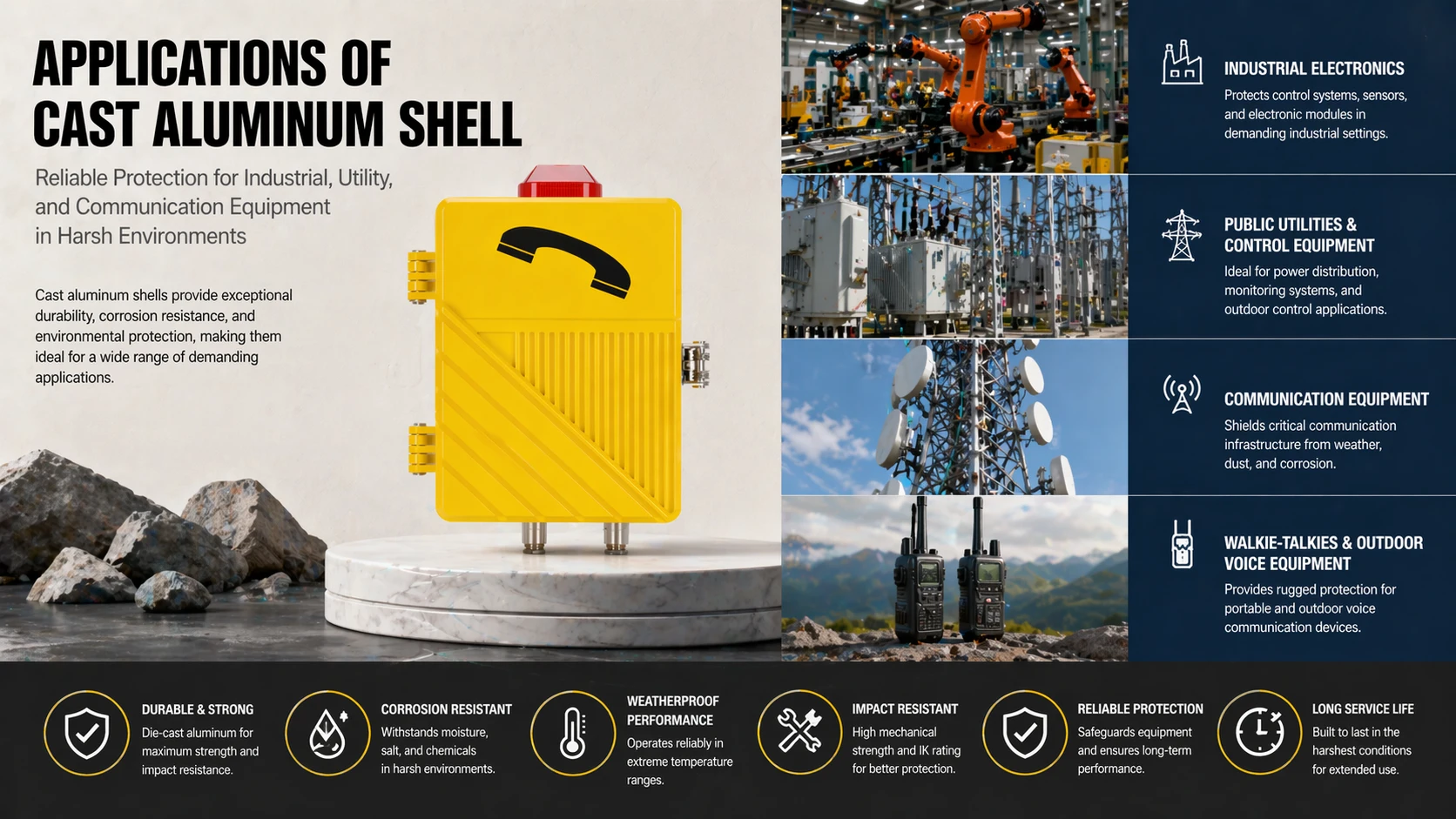
Die-cast aluminum enclosures are widely used in industrial electronics and control systems because these environments often expose equipment to dust, vibration, weather, chemical atmosphere, mechanical contact, or long unattended service periods. Junction devices, field controllers, monitoring units, sensor interfaces, utility-side terminals, and local operation boxes often benefit from a stronger enclosure structure.
Utilities and infrastructure sectors also rely on robust housings because equipment may be installed outdoors for years with limited maintenance access. In such cases, enclosure durability influences not only protection but also lifecycle cost and field reliability.
This makes die-cast aluminum a practical choice where the environment itself becomes part of the product’s operating challenge.
Communication Devices, Intercoms, and Outdoor Voice Equipment
Die-cast aluminum enclosures are also very common in communication products intended for industrial, public, or exposed environments. Outdoor intercom stations, help points, SIP paging terminals, emergency communication devices, and harsh-site telephones often require a housing that can support stronger sealing and impact resistance than standard office devices.
In this area, Becke Telcom products are a natural example of where die-cast aluminum enclosure thinking becomes relevant. Industrial SIP intercoms, outdoor communication endpoints, and harsh-environment voice devices often depend on rugged housing design to support IP protection, mechanical durability, and longer field life in demanding installations.
This is especially relevant in tunnels, campuses, transport sites, utility areas, ports, factories, and outdoor safety communication projects where enclosure integrity has a direct effect on system dependability.
How to Choose the Right Die-Cast Aluminum Enclosure
Match the Enclosure to the Environment
The first rule in enclosure selection is to match the housing to the actual environment. Indoor and outdoor installations do not face the same risks. Dry utility rooms, washdown areas, marine-adjacent sites, dusty workshops, and public corridors all impose different demands. The correct enclosure choice therefore depends on dust exposure, water exposure, mechanical abuse risk, corrosion potential, and maintenance reality.
This is where IP, IK, and sometimes NEMA-type references become useful. They help translate environmental risk into more structured enclosure requirements. The goal is not to specify the highest available rating by default, but to choose a housing that addresses the real conditions with adequate margin and credible test-backed protection.
A good enclosure selection process therefore begins with site conditions, not with catalog aesthetics.
Look Beyond Material Alone
Buyers should also look beyond the phrase “die-cast aluminum.” The material matters, but it is not the whole story. Gasket quality, cover fastening, machining precision, cable gland design, drainage concept, coating type, and mounting method all influence whether the enclosure performs well after installation.
It is also important to consider servicing needs. An enclosure that is strong but difficult to maintain may create longer downtime. One that is easy to open but poorly reseals may compromise long-term protection. The best choice balances protection, usability, installation practicality, and expected lifecycle.
In other words, the right die-cast aluminum enclosure is the one whose total design fits the equipment, the site, and the operational expectation.
Material selection starts the protection story, but sealing design, machining quality, and installation context determine how that story ends in the field.
Conclusion
A die-cast aluminum enclosure is a durable protective housing made through pressure casting of aluminum alloy into a fixed mold. It is widely used because it can support strong mechanical protection, good dimensional consistency, useful corrosion resistance, and more reliable environmental sealing when properly designed and finished.
Its practical value becomes especially clear in industrial electronics, utilities, outdoor communications, and harsh-environment equipment where the housing must protect not only against general exposure but often against dust, water, impact, and long-term weather stress.
For engineers, buyers, and project planners, the key lesson is simple: a die-cast aluminum enclosure is not just a box. It is a protective system component that strongly influences how well the product survives and performs in the real world.
FAQ
What is a die-cast aluminum enclosure used for?
A die-cast aluminum enclosure is used to protect electronic, electrical, and communication equipment from environmental exposure and mechanical stress. It is commonly used in industrial controls, outdoor electronics, intercoms, utility devices, network equipment, and harsh-environment communication terminals.
Its main value is providing a stronger and more durable housing structure than many light-duty alternatives.
Does a die-cast aluminum enclosure automatically mean high IP protection?
No. The material alone does not determine the IP rating. IP protection is determined by the total enclosure design and test performance, including sealing surfaces, gaskets, cover fit, cable entry design, and assembly quality.
Die-cast aluminum can help support a strong enclosure, but the final IP result depends on the complete product design.
Are NEMA and IP ratings the same thing?
No. NEMA and IP ratings are related in purpose but are not fully equivalent.
This is why engineers should compare them carefully instead of assuming a simple one-to-one conversion.