


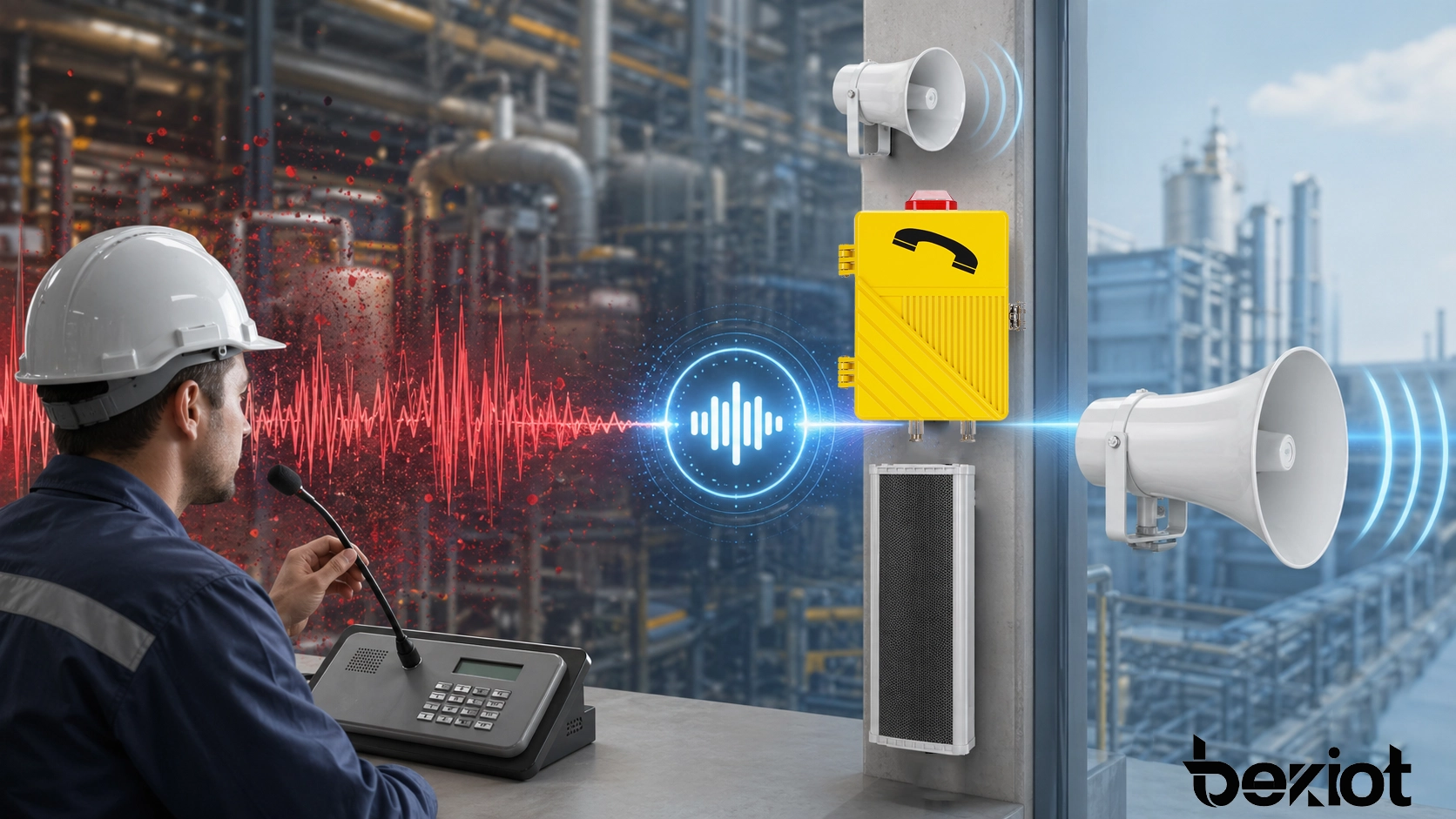
Noise Reduction (NR) is an audio processing function that reduces unwanted background noise so that speech, announcements, intercom audio, or communication signals become clearer and easier to understand. In voice communication, the purpose of NR is not to create a completely silent sound field. Its real purpose is to separate useful voice from distracting noise and make the message more intelligible in real conditions.
This function is widely used in business calls, IP phones, SIP intercoms, dispatch consoles, conference systems, public address platforms, emergency communication terminals, industrial telephones, headsets, and mobile communication devices. Background noise may come from traffic, machinery, wind, ventilation, crowds, alarms, fans, workshops, tunnels, substations, loading areas, or other active environments. Without noise reduction, the listener may hear the sound, but fail to understand the message clearly.
For enterprise and industrial communication systems, NR is especially important because voice often carries instructions, safety information, maintenance requests, emergency reports, or dispatch commands. A noisy voice path can slow response and create misunderstanding. A well-designed noise reduction function helps keep communication practical when the site itself is acoustically difficult.
What Is Noise Reduction (NR)?
Definition and Core Meaning
Noise Reduction is a set of audio processing methods used to reduce unwanted sound components from a voice or audio signal. In a communication system, the microphone captures both the speaker’s voice and the surrounding environment. NR attempts to identify which parts of the signal are likely to be noise and reduce them while keeping the useful speech as natural and understandable as possible.
The core meaning of NR is speech protection. It does not simply lower all sound. If the entire signal were reduced equally, the voice would become weak as well. Instead, NR tries to suppress background noise more than speech. This makes the voice stand out more clearly from the acoustic environment.
In practical deployment, NR may be implemented in terminal devices, audio chips, DSP modules, IP phones, SIP intercoms, dispatch consoles, mobile devices, software clients, or central audio processing systems. The exact method may vary, but the goal remains consistent: make the communication signal easier to hear and understand.
Noise Reduction is not about removing every sound. It is about protecting the useful voice from the noise that competes with it.
Noise Reduction Versus Noise Cancellation
Noise Reduction and noise cancellation are sometimes used interchangeably, but they are not always the same in practical audio design. Noise reduction usually refers to reducing background noise in a captured audio signal through filtering, adaptive processing, or digital signal analysis. Noise cancellation may refer more specifically to cancelling noise through phase-based or reference-signal methods, especially in headsets or echo-control environments.
In communication systems, the term NR is often used broadly to describe the function that makes voice clearer by suppressing background sound. The user may not care which algorithm is used, but the result matters greatly. If the listener hears less background interference and more usable speech, the NR function is doing its job.
This distinction is useful because not every noise control technology works the same way. Different environments require different processing strategies, especially when speech must remain natural and delay must remain low.
How Noise Reduction Works
Identifying Noise Patterns in the Audio Signal
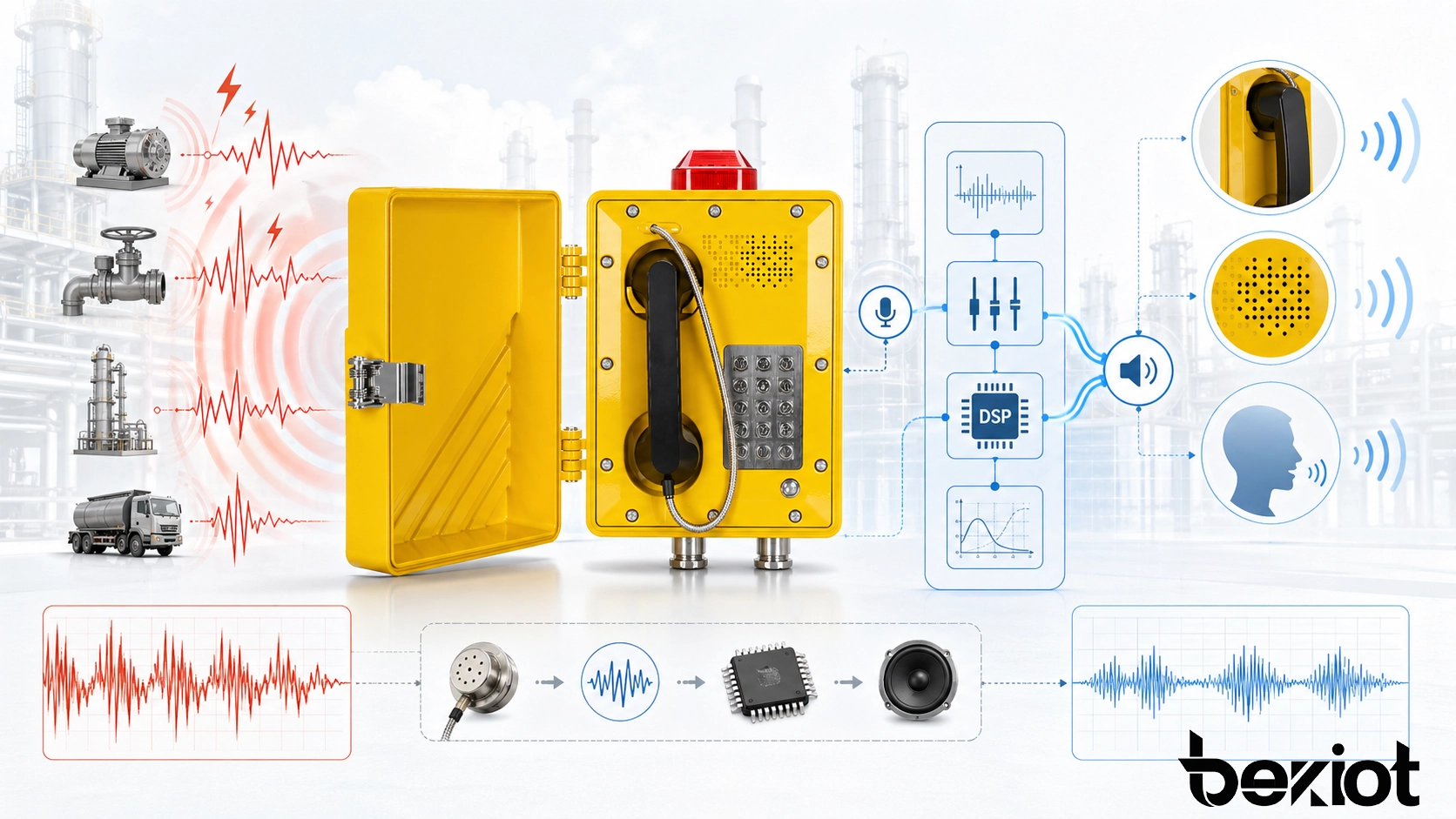
Noise reduction begins by analyzing the audio signal captured by the microphone. The system looks for patterns that are likely to represent background noise rather than speech. These may include steady fan noise, electrical hum, low-frequency rumble, wind noise, machine vibration, crowd background, or repetitive environmental sound.
Some noise is relatively predictable, such as constant ventilation or motor sound. Other noise is more complex, such as traffic, public crowd noise, or industrial machinery changing speed. The more complex the noise, the more carefully the system must process it to avoid damaging the speech signal.
A good NR system therefore needs to distinguish noise from speech in a way that is fast, stable, and suitable for real-time communication. If the processing is too slow or too aggressive, the voice may sound unnatural or delayed.
Suppressing Background Sound While Preserving Speech
Once noise patterns are identified, the system reduces those parts of the audio signal. This may involve spectral subtraction, adaptive filtering, dynamic gain control, multi-band processing, machine-learning-assisted noise suppression, or other digital signal processing methods. The exact approach depends on the device and system architecture.
The challenge is balance. If noise reduction is too weak, the background sound still interferes with understanding. If it is too strong, speech may lose detail, sound metallic, or become difficult to recognize. In communication design, the best NR result is not always the most silent result. It is the result that makes speech more intelligible and less tiring to listen to.
This is especially important in SIP communication, paging, dispatch, and intercom systems where the listener needs clear meaning, not studio-style audio effects.
Effective NR reduces noise enough to improve understanding while keeping speech natural enough to remain trustworthy.
Main Audio Benefits of Noise Reduction
Improved Speech Intelligibility
The main benefit of NR is improved speech intelligibility. When background noise is reduced, the listener can recognize words more easily, especially in environments where the speaker is not close to the microphone or the surrounding sound is high. This is critical for voice calls, intercom conversations, paging announcements, emergency reporting, and dispatch communication.
In practical communication, intelligibility often matters more than loudness. A loud but noisy signal may still be difficult to understand. NR helps increase the contrast between speech and background sound, allowing the message to be understood more accurately.
This can reduce repeated questions, missed instructions, and communication fatigue during long or high-pressure interactions.
Lower Listening Fatigue
Noise reduction can also lower listening fatigue. When background noise remains constant throughout a call or announcement, the listener’s brain must work harder to identify the useful speech. Over time, this becomes tiring, especially for operators, dispatchers, support agents, or staff who handle many conversations each day.
By reducing background interference, NR makes the listening experience cleaner and more comfortable. This can be useful in control rooms, call centers, industrial monitoring rooms, service desks, and help-point response centers where clear audio must be monitored repeatedly.
In this sense, NR improves both communication quality and operator workload.
Technical Features of Noise Reduction
Adaptive Noise Suppression
Adaptive noise suppression is one of the most important technical features of modern NR. Real environments are rarely static. A quiet room may suddenly become noisy, a vehicle may pass, machinery may start, or wind may change. Adaptive processing allows the system to adjust its suppression behavior as the acoustic situation changes.
This is valuable because fixed filtering may work well for one noise pattern but poorly for another. Adaptive NR can respond more intelligently by continuously updating its understanding of the signal. This improves performance in offices, workshops, outdoor stations, transport terminals, and industrial areas where the noise profile changes throughout the day.
In practical terms, adaptive NR helps the communication system remain usable across different sound conditions without constant manual retuning.
Multi-Band and Frequency-Based Processing
Many NR systems divide sound into frequency bands and process them separately. This is useful because speech and noise do not occupy the audio spectrum in the same way. Some noise may be low-frequency rumble, while other noise may sit in mid or high-frequency bands. By treating bands differently, the system can reduce noise more precisely.
Frequency-based processing is especially helpful when the goal is to protect speech clarity. The system can avoid cutting too much of the frequency range that carries important speech information. This helps keep consonants, word edges, and vocal detail more understandable.
Good frequency control allows NR to reduce noise without making the speaker sound distant, muffled, or artificial.
Additional Technical Considerations
Low Latency for Real-Time Communication
In real-time communication, NR must work with very low latency. If processing introduces noticeable delay, conversation becomes awkward. In intercom, dispatch, emergency communication, and live paging scenarios, delayed audio can interfere with natural response and reduce operational efficiency.
Therefore, NR design must balance processing strength with speed. A complex algorithm may suppress noise well, but if it adds too much delay, it may not be suitable for live communication. The best system is not simply the one with the most aggressive processing, but the one that improves clarity while keeping the conversation responsive.
This is particularly important in SIP intercoms, IP phones, radio-over-IP gateways, and dispatch consoles where users expect live interaction.
Integration With Echo Cancellation and Howling Suppression
NR often works together with other audio functions such as echo cancellation and howling suppression. Echo cancellation helps prevent far-end audio from being returned into the microphone path. Howling suppression helps control acoustic feedback between microphones and speakers. NR focuses on background noise that interferes with speech.
These functions are different, but in real communication systems they often work side by side. For example, an industrial intercom terminal may need noise reduction for machine noise, echo cancellation for two-way conversation, and howling suppression for nearby loudspeaker feedback. The final user experience depends on how well these functions cooperate.
When properly integrated, the result is not only cleaner sound but a more stable and professional communication path.
Applications of Noise Reduction
Business Calls, Contact Centers, and Conference Systems
NR is widely used in business calls, contact centers, softphones, headsets, conference terminals, and unified communication platforms. In these environments, background sounds such as keyboards, office conversation, air conditioning, traffic, or room echo can reduce call quality and make meetings less productive.
Noise reduction helps make the speaker’s voice easier to follow and reduces distractions for the far-end listener. This is especially valuable in hybrid work environments where users may join calls from different acoustic conditions rather than controlled meeting rooms.
In customer service and call centers, better voice clarity can also reduce handling time because agents and customers need fewer repetitions to understand each other.
Intercom, Paging, and Emergency Communication
NR is highly important in intercom, paging, and emergency communication systems because these systems often operate outside quiet office conditions. A help point may be near traffic. A gate intercom may face wind and vehicle noise. A tunnel emergency phone may be surrounded by echo and mechanical sound. A paging microphone may be used in a control room or factory floor with background activity.
In these cases, noise reduction helps preserve the spoken message. The system does not only need to carry audio; it must carry useful information. The operator must understand what the caller says, and the field user must hear the response clearly enough to act.
This makes NR a practical safety and service feature rather than only an audio enhancement.
Analysis of Noise Reduction Technology in Industrial and SIP Communication Projects
Why Industrial Sites Need Strong NR
Industrial sites often produce noise that is much more difficult than ordinary office background sound. Machines, compressors, ventilation, alarms, vehicles, pumps, engines, wind, protective enclosures, and reflective structures can all interfere with voice pickup. In these environments, the microphone may capture more of the site than the speaker’s voice.
This is why NR becomes an important part of industrial voice communication. A worker reporting a fault, requesting support, or speaking with a control room may be standing in a noisy area. If the system cannot reduce the background sound, the operator may misunderstand the message or ask for repeated clarification.
Strong NR helps industrial communication systems keep voice usable even when the acoustic environment is not friendly.
How Becke Telcom Fits the Audio Logic
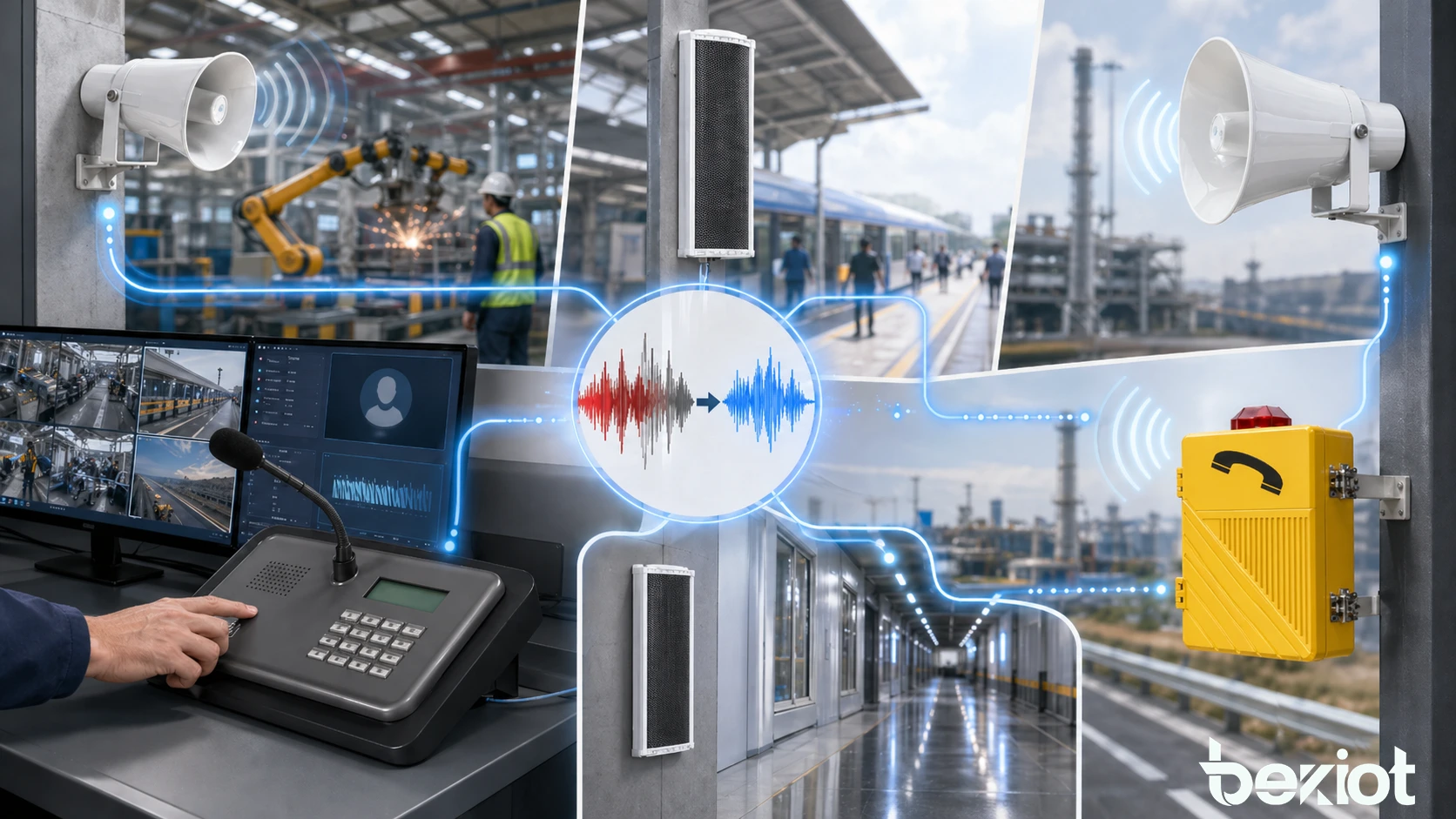
In Becke Telcom-style deployments, noise reduction is most meaningful when it is connected to the real communication chain: industrial telephones at field points, SIP intercom terminals at entrances or help stations, paging microphones in control rooms, dispatch consoles for operators, and speaker systems used for announcements. Each part of that chain may face a different noise challenge.
For example, an outdoor SOS terminal may need to reduce wind and traffic noise before the control room can understand the caller. A factory intercom may need to separate speech from machine sound. A dispatch console may need cleaner microphone pickup so a broadcast message remains clear across paging zones. In this context, Becke Telcom products are not just endpoints; they are parts of a voice path that must stay intelligible from field capture to operator response.
This is a more practical way to understand NR in communication projects. The feature matters because it supports the final goal of the solution: making sure the right message can be heard and understood in the environment where the device is actually installed.
Deployment Tips for Better Noise Reduction
Choose the Right Microphone Position and Device Type
Noise reduction works better when the microphone captures a strong voice signal in the first place. If the microphone is too far from the speaker or placed directly toward the noise source, the NR system must work much harder. Good device placement, proper microphone orientation, and suitable terminal selection can greatly improve the result.
In industrial telephones, intercom stations, paging consoles, and help points, installers should consider where the user will stand, where the noise comes from, and how the device will be used during real operation. A protected microphone design, directional pickup, or suitable mounting position may improve voice capture before digital processing even begins.
Good NR therefore starts with good acoustic input, not only software configuration.
Balance Noise Reduction Strength and Voice Naturalness
Stronger noise reduction is not always better. If the NR effect is too aggressive, the voice may sound unnatural, watery, metallic, or clipped. This can reduce trust and may even make speech harder to understand. In professional communication, natural speech quality still matters.
System tuning should therefore balance noise reduction strength with voice clarity. The best setting depends on the environment. A quiet office phone may need mild suppression, while a factory intercom or roadside terminal may require stronger processing. Testing should be performed with realistic background noise rather than in a silent room only.
The goal is not maximum suppression at any cost. The goal is useful speech under real working conditions.
Noise Reduction works best when the system reduces the environment enough for the voice to be understood, but not so much that the voice loses its natural identity.
Maintenance and Testing Recommendations
Test With Real Site Noise
NR performance should be tested with real site noise whenever possible. A device may sound excellent in a quiet office but behave differently near a road, in a tunnel, beside machinery, or in a windy outdoor area. Realistic testing helps determine whether the system actually improves speech intelligibility in the environment where it will be used.
Testing should include different speaker distances, voice levels, background conditions, and operating scenarios. For example, a help point should be tested with a person speaking naturally, not only with a technician speaking directly into the microphone. A paging console should be tested during normal room activity, not only during silent commissioning.
This helps avoid overconfidence based on laboratory-like conditions that do not match the actual deployment.
Review User Feedback and Audio Records
Maintenance teams should review user feedback and, where appropriate, audio records to understand whether NR is performing well. If operators frequently ask callers to repeat themselves, if voices sound distorted, or if background noise remains overwhelming, the settings or device placement may need adjustment.
It is also useful to identify whether the problem appears in all devices or only in specific locations. A single noisy entrance, tunnel point, machine area, or outdoor station may require different treatment from the rest of the system.
NR should be treated as part of ongoing audio quality management rather than a one-time feature enabled during installation.
Conclusion
Noise Reduction (NR) is an audio processing function that reduces background noise so that speech becomes clearer and more understandable. Its main benefits include improved speech intelligibility, reduced listening fatigue, stronger communication reliability, and better usability in noisy environments.
Its technical features may include adaptive noise suppression, frequency-based processing, low-latency operation, and integration with echo cancellation or howling suppression. It is widely used in business calls, contact centers, conference systems, SIP intercoms, industrial telephones, paging microphones, dispatch consoles, and emergency communication terminals.
In Becke Telcom-related communication scenarios, NR fits naturally into the real voice path between field users and control rooms. Whether the device is an industrial phone, SIP intercom, help point, or paging console, the value of NR is measured by one practical result: whether people can hear and understand the message clearly in the environment where the communication actually happens.
FAQ
What is Noise Reduction in simple terms?
In simple terms, Noise Reduction is a function that reduces background noise so the speaker’s voice becomes easier to hear and understand.
It is commonly used in calls, intercoms, paging systems, and communication devices used in noisy places.
What are the main benefits of NR?
The main benefits include clearer speech, less listening fatigue, fewer repeated questions, better call quality, and more reliable communication in noisy environments.
It is especially useful when speech must remain understandable despite traffic, machinery, wind, or crowd noise.
Where is Noise Reduction commonly applied?
NR is commonly applied in IP phones, SIP intercoms, dispatch consoles, conference systems, headsets, public address systems, industrial telephones, and emergency communication terminals.
It is most valuable where the microphone captures both voice and strong background noise.







