


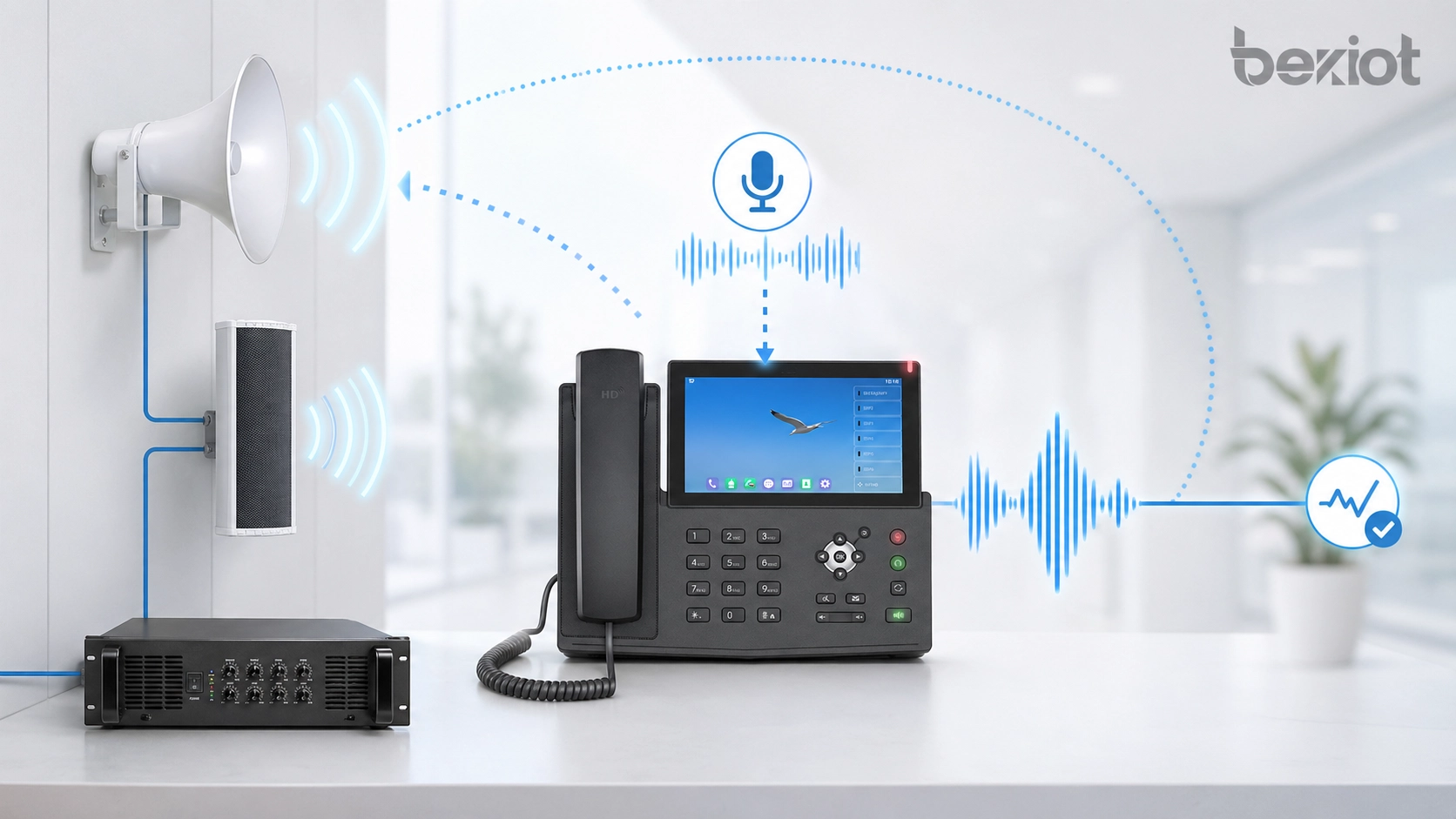
Acoustic Echo Cancellation (AEC) is an audio processing technology that reduces or removes acoustic echo during real-time voice communication. Acoustic echo happens when sound from a loudspeaker is picked up again by a microphone and sent back to the far-end talker. The far-end user then hears their own voice returning after a short delay, which can make conversations distracting, unnatural, and difficult to manage. AEC is designed to identify this returned audio and cancel it before it disrupts the communication path.
AEC is widely used in IP phones, speakerphones, SIP intercoms, conference terminals, video meeting systems, dispatch consoles, hands-free communication devices, emergency help points, paging talkback systems, and industrial communication terminals. It is especially important wherever a microphone and loudspeaker operate at the same time in the same physical space. In those situations, the device must allow two-way speech while preventing the speaker output from being treated as new microphone input.
In practical voice communication, AEC is not only an audio comfort feature. It affects conversation quality, response speed, operator confidence, and system usability. If echo remains uncontrolled, users may hesitate, talk over each other, repeat sentences, or reduce speaker volume below a useful level. A well-designed AEC function helps the communication system feel more natural, especially in hands-free and industrial environments where headset-only communication is not always realistic.
What Is Acoustic Echo Cancellation?
Definition and Core Meaning
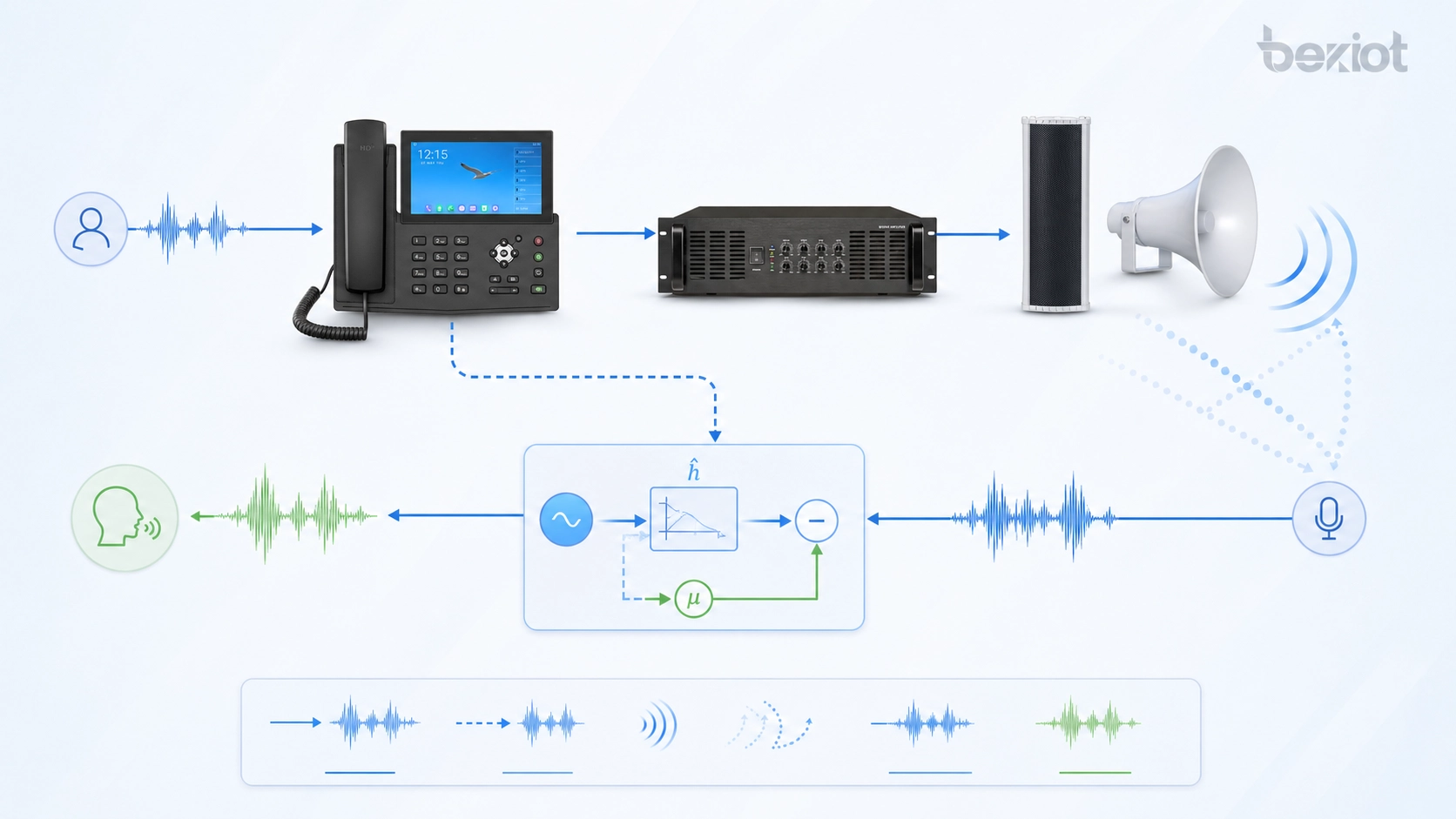
Acoustic Echo Cancellation is a digital audio processing method that estimates the echo path between a loudspeaker and a microphone, then removes the far-end audio that returns through that path. When a far-end person speaks, their voice is played through the local loudspeaker. Some of that sound may bounce around the room or device enclosure and enter the local microphone. AEC compares the loudspeaker signal with the microphone signal and subtracts the predicted echo component.
The core meaning of AEC is echo path control. It allows a device to play remote speech through a speaker while still keeping the microphone open for local speech. Without AEC, hands-free communication would often become uncomfortable because the remote user might hear their own voice coming back through the system.
In modern communication devices, AEC is usually implemented through digital signal processing. The algorithm continuously adapts because the acoustic path can change when people move, doors open, speaker volume changes, or the device is used in a different room or installation environment.
Acoustic Echo Cancellation allows loudspeakers and microphones to work together without turning the far-end voice into a repeated echo.
Acoustic Echo Versus Line Echo
Acoustic echo should not be confused with line echo. Line echo is usually related to electrical or network signal reflections in telephony circuits or hybrid interfaces. Acoustic echo, by contrast, comes from the physical sound path between speaker output and microphone pickup. In IP phones, intercoms, conference systems, and hands-free terminals, acoustic echo is often the more visible problem because the speaker and microphone share the same space.
This distinction matters because the solution is different. Acoustic echo cancellation must understand the real acoustic environment, including loudspeaker behavior, microphone sensitivity, room reflections, enclosure design, and speaker-to-microphone distance. It is not just a network setting or a wiring issue.
For hands-free voice systems, AEC is therefore part of the device audio design and real deployment performance rather than only a back-end telephony configuration.
Why AEC Matters in Voice Communication
Protecting Natural Two-Way Conversation
The main role of AEC is to protect natural two-way conversation. When echo is present, the far-end speaker hears their own voice delayed through the system. Even a short delay can be distracting because the speaker may pause, slow down, or lose the rhythm of conversation. In real-time communication, this can make a simple call feel unstable.
AEC helps prevent that problem by removing the returned far-end signal before it is transmitted back. This allows both sides to speak more naturally. It is especially valuable in full-duplex or hands-free communication, where both users may speak and listen without pressing a push-to-talk key.
In practical terms, AEC helps the communication device behave more like a natural conversation tool instead of a source of delayed audio confusion.
Improving Usability in Hands-Free Devices
Hands-free devices depend heavily on AEC because the microphone is usually active while the loudspeaker is playing. Speakerphones, conference terminals, desk consoles, SIP intercoms, emergency call stations, and industrial hands-free phones all face this challenge. The device must be loud enough for the local user to hear, but not allow that same loudspeaker output to return to the far end as echo.
Without AEC, users may try to solve the problem by lowering speaker volume, moving away from the device, or speaking only one at a time. These workarounds reduce communication efficiency. AEC allows the system to support louder, clearer, more practical hands-free audio while keeping the far-end experience clean.
This is why AEC is considered a core audio feature in many professional communication terminals.
AEC is most valuable in the exact situations where users need hands-free communication to feel natural, fast, and reliable.
How Acoustic Echo Cancellation Works
Reference Signal and Echo Path Estimation
AEC begins with a reference signal. The system knows what audio is being sent to the local loudspeaker because that signal is generated inside the device. The AEC processor uses this reference signal to predict what part of the microphone input may be echo rather than local speech.
The challenge is that the loudspeaker signal does not return to the microphone in a clean and identical form. It is changed by the speaker, device enclosure, room reflections, background noise, distance, and microphone characteristics. The AEC algorithm must estimate this echo path and build a model of how the far-end voice is returning into the microphone.
Once the estimated echo is identified, the processor subtracts it from the microphone signal. The remaining signal should contain more of the local speaker’s voice and less of the returned far-end audio.
Adaptive Filtering and Continuous Adjustment
Acoustic environments change constantly. A person may move closer to the terminal, a door may open, the speaker volume may be adjusted, or nearby surfaces may reflect sound differently. Because of this, AEC usually uses adaptive filtering. The algorithm updates itself as the echo path changes.
Adaptive filtering is important because a fixed echo model would quickly become inaccurate in real use. A conference room, outdoor help point, industrial workshop, or dispatch desk may all produce different echo paths. Even the same device can behave differently depending on installation angle and surroundings.
A strong AEC implementation keeps tracking these changes so echo remains suppressed without damaging the useful local voice signal.
Main Technical Features of AEC
Double-Talk Handling
Double-talk handling is one of the most important technical features of AEC. Double-talk occurs when the far-end user and local user speak at the same time. This is common in natural conversation, but it is difficult for echo cancellation because the microphone input contains both real local speech and returned far-end audio.
A weak AEC system may mistake local speech for echo and suppress it, causing clipped or broken audio. A better AEC system can detect double-talk conditions and adjust cancellation behavior so both sides remain understandable. This is essential for full-duplex communication where users expect to interrupt, respond quickly, or speak naturally without strict turn-taking.
Good double-talk performance is often what separates basic echo suppression from a professional hands-free voice experience.
Nonlinear Echo Control
Real loudspeakers and microphones are not always perfectly linear. At higher volume levels, speaker distortion, enclosure vibration, and device resonance can create echo components that are harder to predict. Nonlinear echo control helps manage these more complex echo behaviors.
This feature becomes important in compact terminals, outdoor call stations, industrial intercoms, and devices that must produce strong audio output from a limited enclosure. When the speaker is loud and close to the microphone, simple linear cancellation may not be enough.
In practical design, nonlinear echo control helps keep echo manageable even when the device must operate at useful field volume levels.
Additional Audio Features Related to AEC
Noise Reduction and Automatic Gain Control
AEC often works together with Noise Reduction (NR) and Automatic Gain Control (AGC). NR reduces background noise so speech becomes clearer. AGC helps adjust microphone level when the speaker talks closer or farther from the device. AEC focuses on removing the returned far-end audio from the microphone path.
These functions are different, but they are usually connected in real communication systems. If background noise is high, the AEC algorithm may have more difficulty identifying echo. If gain is poorly controlled, the echo path may become unstable. When NR, AGC, and AEC are tuned well together, the voice path becomes clearer and more stable.
This is especially important in intercom, dispatch, and emergency communication devices where sound conditions are rarely ideal.
Howling Suppression and Echo Cancellation
AEC is also related to howling suppression, but the two are not the same. AEC prevents far-end speech from being returned as echo to the remote user. Howling suppression controls acoustic feedback that produces a loud whistle or squeal between a microphone and loudspeaker. Both involve microphone-speaker interaction, but they address different problems.
In many field communication terminals, both functions may be needed. A help point or industrial telephone may require AEC for clear two-way conversation and howling suppression to prevent unstable feedback during high-volume operation. The final audio quality depends on how these functions cooperate.
This is why professional voice devices are often evaluated not by one audio feature alone, but by the overall behavior of the full audio processing chain.
AEC, NR, AGC, and howling suppression solve different parts of the same practical challenge: making voice understandable in real acoustic conditions.
Audio Benefits of Acoustic Echo Cancellation
Clearer Far-End Listening Experience
The most direct benefit of AEC is that the far-end listener no longer hears their own voice returning from the local device. This makes conversation smoother and less distracting. It also helps the far-end user speak more confidently because they are not constantly interrupted by delayed repetition.
In business calls, intercom sessions, control-room communication, and emergency assistance calls, this benefit is highly practical. The far-end operator can focus on what the local user is saying instead of being distracted by echo artifacts.
Clearer far-end listening also reduces repeated questions, conversational hesitation, and user frustration.
More Stable Hands-Free Communication
AEC makes hands-free communication more stable by allowing speaker output and microphone pickup to coexist. Users can speak naturally without lifting a handset or wearing a headset, while the system still keeps the far-end audio path clean.
This is particularly useful in places where hands-free operation is preferred or required. A control-room dispatcher may need to speak while operating a console. A visitor at a help point may use a wall-mounted intercom. A worker may need to communicate from an industrial phone while wearing gloves or carrying tools.
In these scenarios, AEC improves both audio quality and practical usability.
Applications of AEC
IP Phones, Speakerphones, and Conference Systems
AEC is widely used in IP phones, speakerphones, conference terminals, and video meeting systems. These devices often use loudspeakers and microphones at the same time, making acoustic echo a common risk. In a conference room, for example, far-end speech played through speakers may reflect from walls, tables, and screens before entering the microphone.
Without AEC, remote participants may hear their own voices echoing back through the meeting system. This creates a poor meeting experience and may cause participants to interrupt each other or mute unnecessarily. With AEC, the system can support clearer two-way or multi-party conversation.
This is why AEC is treated as a standard requirement in professional conferencing and hands-free business voice devices.
Intercom, Help Point, and Emergency Communication Terminals
AEC is highly important in intercom and emergency communication systems because these devices are often compact and hands-free. The loudspeaker and microphone may be close together inside the same housing. When the control room speaks to the field user, the terminal speaker output can easily re-enter the microphone path.
In help points, elevator emergency phones, gate intercoms, roadside call stations, tunnel communication terminals, and public assistance points, echo can make conversation harder at the exact moment clarity is needed. AEC helps ensure the operator can hear the field user without being distracted by returned speech.
In practical safety communication, this can improve response quality and reduce misunderstandings during urgent calls.
AEC in Industrial and SIP Communication Projects
Why Industrial Environments Make AEC More Difficult
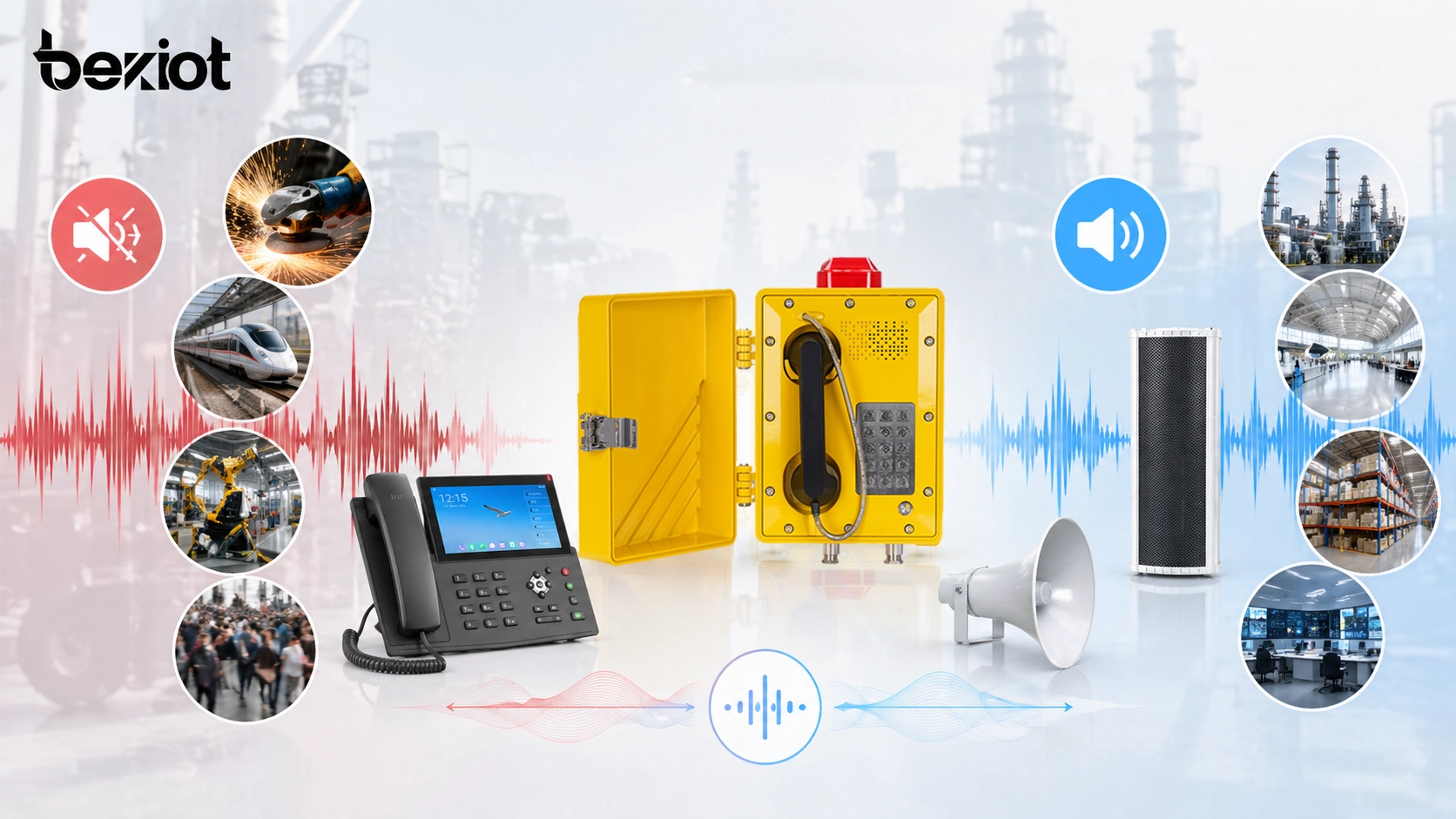
Industrial environments make AEC more challenging because sound conditions are often unstable. Machinery noise, reflective metal surfaces, outdoor wind, long corridors, large halls, protective enclosures, and high speaker volume can all affect the echo path. The system must cancel echo while still preserving local speech and dealing with background noise.
AEC in these environments must therefore be robust and practical. It cannot assume a quiet conference room or a stable desktop setup. A wall-mounted SIP intercom in a factory, an outdoor emergency call terminal, or a rugged hands-free telephone in a tunnel may face much harder audio conditions than a normal office phone.
This is why industrial voice projects should treat AEC as part of the core communication design rather than as a minor audio option.
How Becke Telcom Fits the AEC Logic
In Becke Telcom communication scenarios, AEC becomes especially relevant where hands-free voice, SIP intercom, industrial telephones, emergency terminals, paging talkback, and dispatch consoles must work together across noisy or reflective sites. The feature matters because many of these devices are used in practical field positions where users cannot always hold a handset or control the acoustic environment.
For example, a control room operator may speak through a dispatch console to a field intercom, while the field terminal must capture the local user’s response without sending the operator’s own voice back as echo. An emergency help point may need loud speaker output for audibility, but also a clean microphone return path. In these cases, Becke Telcom products can benefit from AEC as part of a broader audio chain that includes microphone design, speaker placement, NR, AGC, and feedback control.
The practical value is not simply that AEC appears as a feature name. It is that AEC helps the whole communication path feel usable in the place where the equipment is actually installed: a tunnel, plant, gate, platform, control room, utility corridor, or outdoor help station.
Deployment Tips for Better AEC Performance
Control Speaker and Microphone Placement
AEC works better when the physical design supports it. Speaker and microphone placement should reduce direct acoustic coupling where possible. If the microphone is too close to the speaker or points directly toward it, the echo path becomes stronger and harder to cancel. Device enclosure design, mounting position, speaker direction, and microphone protection all influence final performance.
In wall intercoms, industrial telephones, paging consoles, and emergency terminals, installers should consider how the user will stand near the device, where sound will reflect, and how loud the speaker must be. Good physical layout gives the AEC algorithm a cleaner problem to solve.
This is why acoustic planning and digital processing should work together rather than be treated separately.
Tune Volume, Gain, and Audio Processing as a System
AEC performance is affected by speaker volume, microphone gain, noise reduction strength, automatic gain control, and howling suppression settings. If speaker output is too loud, echo becomes stronger. If microphone gain is too high, the device may capture more speaker sound and room reflection. If processing is badly balanced, speech may become clipped or unnatural.
A good deployment tunes these parameters as one audio system. The goal is to keep the far-end voice audible locally while keeping the microphone return path clean. Testing should include realistic speech, real background noise, and normal user distance rather than only laboratory-style test conditions.
Proper tuning often determines whether AEC feels invisible and natural or noticeable and unstable.
AEC performs best when the device, installation, gain structure, and audio processing are designed as one communication path.
Maintenance and Testing Recommendations
Test Double-Talk and Real Conversation Behavior
AEC should be tested with real conversation behavior, not only one person speaking at a time. Double-talk situations are important because users naturally interrupt, respond quickly, or speak over short far-end phrases. If the system performs poorly during double-talk, the local voice may be clipped or the echo may return.
Testing should include different speaker volumes, microphone distances, background noise levels, and installation positions. For intercom and emergency communication terminals, testers should stand where real users will stand rather than speaking directly into the microphone from an ideal position.
This kind of testing gives a better picture of whether AEC will work in daily operation.
Review Echo Complaints by Location
Echo issues may not appear uniformly across a whole system. One device may perform well while another produces echo because of mounting position, nearby reflective surfaces, speaker level, enclosure condition, or local noise. Maintenance teams should review echo complaints by location instead of assuming one global setting will solve everything.
Audio logs, operator reports, and site inspections can help identify patterns. If echo appears only in one tunnel zone, entrance station, meeting room, or workshop point, local acoustic adjustment may be more effective than changing the entire system.
AEC maintenance is therefore both a software and field-deployment task.
Conclusion
Acoustic Echo Cancellation (AEC) is an audio processing technology that removes far-end loudspeaker audio from the local microphone signal so users do not hear their own voices returning as echo. Its main role is to make hands-free, full-duplex, and real-time voice communication clearer, more natural, and easier to use.
Its key technical features include reference signal processing, echo path estimation, adaptive filtering, double-talk handling, nonlinear echo control, and integration with NR, AGC, and howling suppression. It is widely used in IP phones, conference systems, SIP intercoms, emergency terminals, dispatch consoles, industrial telephones, and public assistance systems.
In Becke Telcom-related communication environments, AEC fits naturally wherever field terminals, hands-free intercoms, dispatch consoles, and control-room voice paths must operate in noisy, reflective, or high-volume conditions. When properly designed and tested, AEC helps ensure that two-way communication remains clear not only in ideal rooms, but also in the demanding places where industrial and emergency communication systems are actually used.
FAQ
What is Acoustic Echo Cancellation in simple terms?
In simple terms, Acoustic Echo Cancellation removes the sound from a loudspeaker when that sound is picked up again by the microphone. This prevents the far-end user from hearing their own voice echoed back.
It is especially useful in hands-free communication devices.
Where is AEC commonly used?
AEC is commonly used in IP phones, speakerphones, conference systems, SIP intercoms, emergency help points, dispatch consoles, industrial telephones, and video meeting devices.
It is most important where microphones and speakers operate at the same time.
Is AEC the same as noise reduction?
No. AEC removes returned loudspeaker audio from the microphone signal, while noise reduction suppresses background noise such as fans, traffic, machinery, or wind.
Many professional systems use both together to improve overall voice quality.







