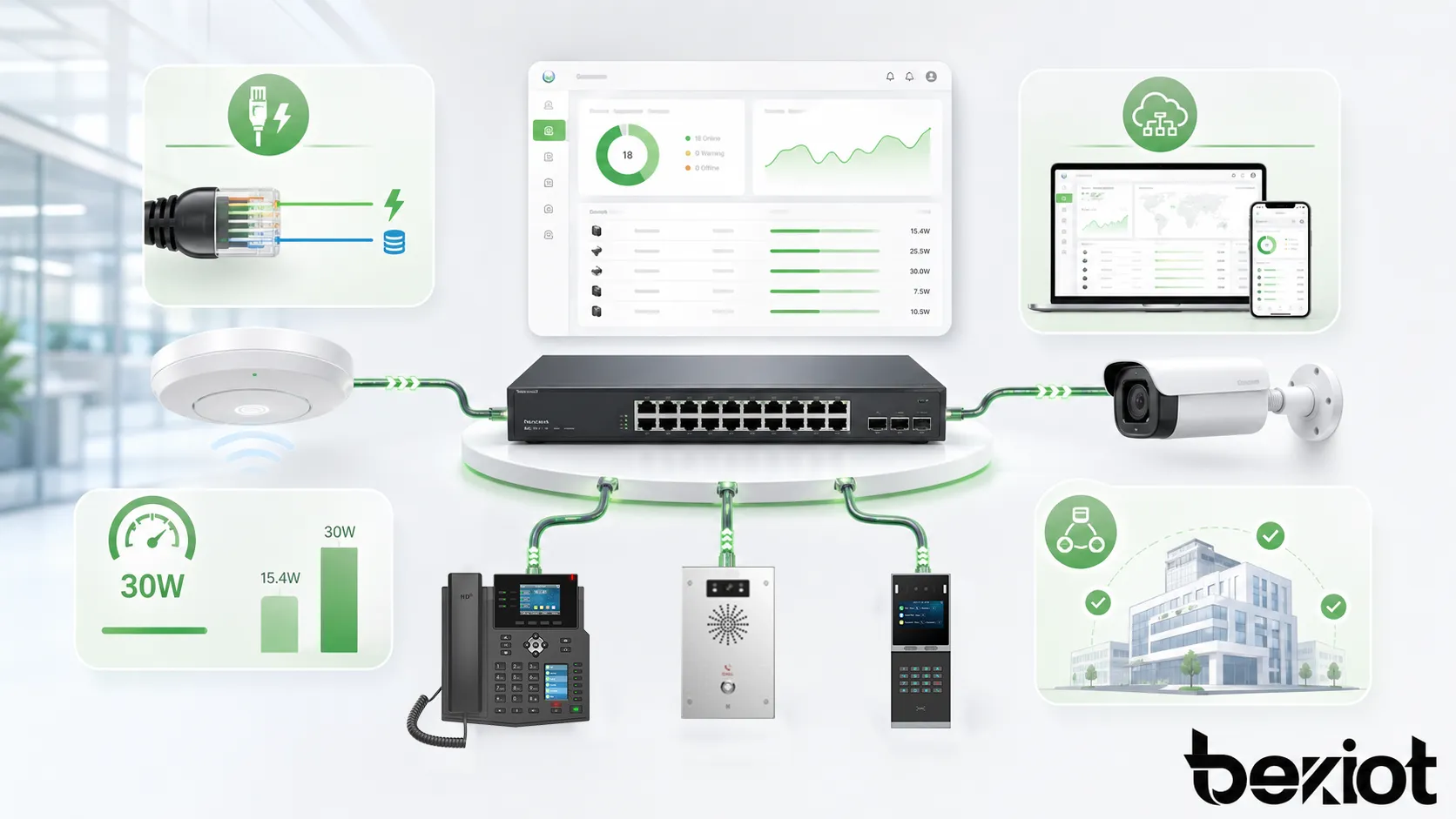
Power over Ethernet Plus, commonly called PoE+, is a network power technology that allows Ethernet cables to carry both data and electrical power to connected devices. It is based on the IEEE 802.3at standard and is also known as Type 2 PoE. Compared with standard PoE under IEEE 802.3af, PoE+ provides a higher power level, making it suitable for devices that need more energy than basic low-power network endpoints.
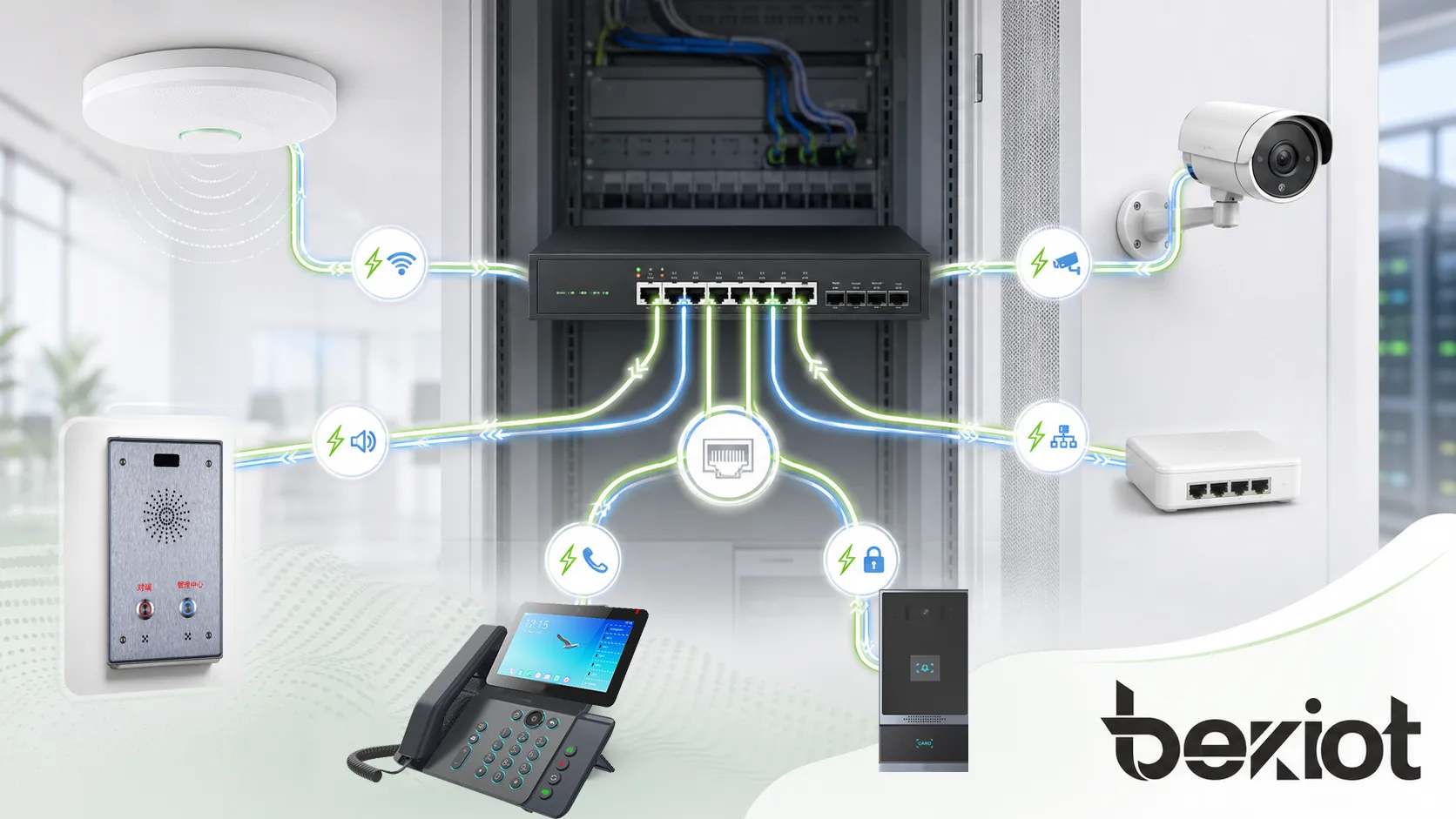
The main value of PoE+ is simple: one Ethernet cable can provide network connectivity and power at the same time. This reduces the need for a nearby AC power outlet, simplifies cabling, supports centralized power management, and makes device installation more flexible. Devices such as wireless access points, IP cameras, video intercoms, access control terminals, thin clients, small network devices, and some industrial or building automation endpoints often use PoE+ when standard PoE is not enough.
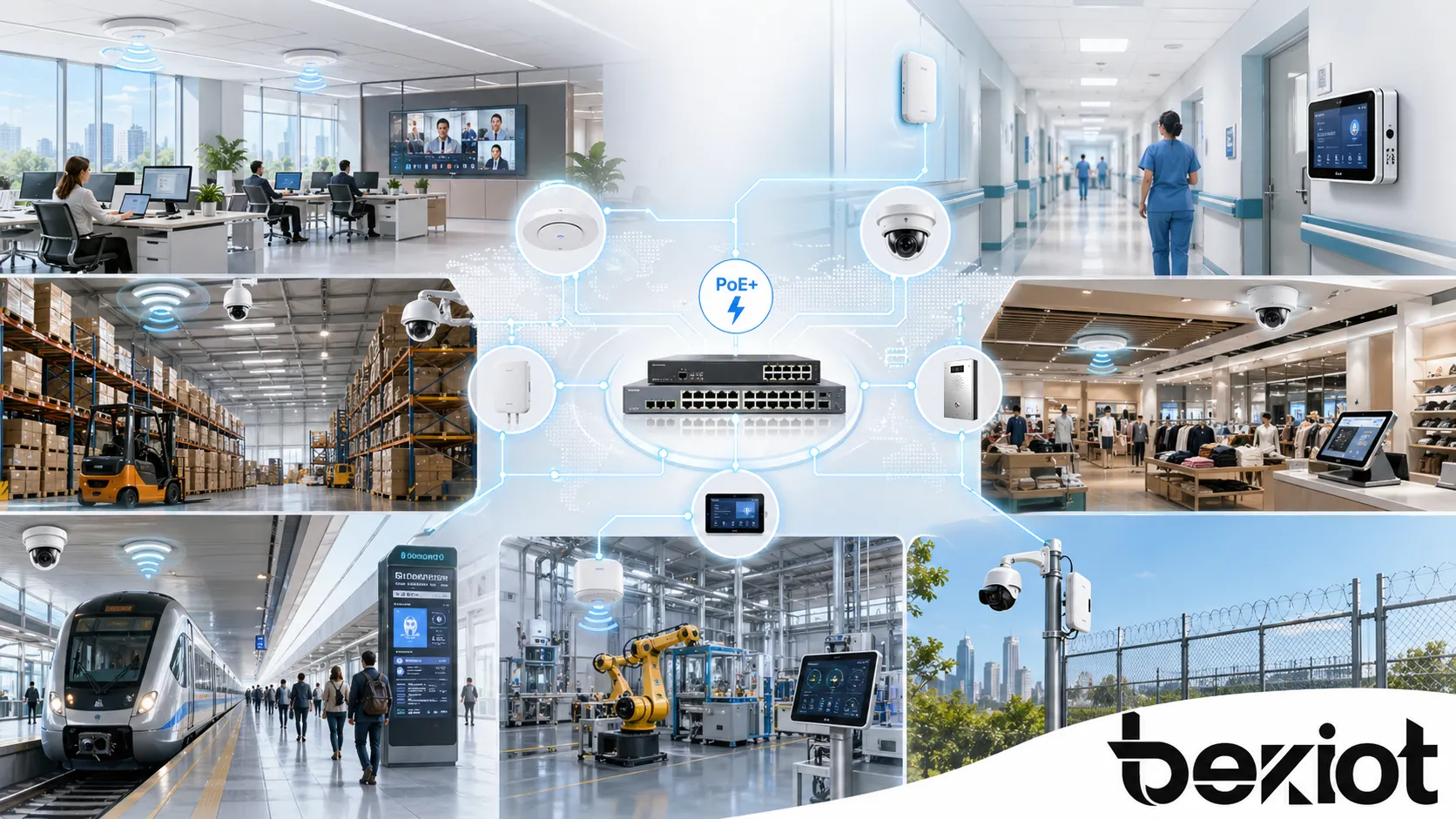
In modern networks, PoE+ is widely used in offices, campuses, hospitals, hotels, warehouses, retail sites, transportation facilities, smart buildings, security systems, and industrial environments. It is especially useful where many network devices must be installed on walls, ceilings, poles, gates, corridors, production areas, or outdoor enclosures where separate electrical wiring would be costly or inconvenient.
What Is Power over Ethernet Plus?
Definition and Core Meaning
Power over Ethernet Plus is an enhanced form of Power over Ethernet that supplies electrical power and data through the same twisted-pair Ethernet cable. It extends the power capability of earlier PoE systems so that more demanding powered devices can operate without a separate power adapter.
In a PoE+ system, the device that supplies power is called the Power Sourcing Equipment, or PSE. This may be a PoE+ switch, PoE+ injector, midspan device, or industrial PoE power source. The device that receives power is called the Powered Device, or PD. Examples include IP cameras, wireless access points, IP phones, intercom terminals, and access control devices.
PoE+ is mainly defined by higher available power compared with standard PoE. A PoE+ PSE can supply up to 30 watts at the port, while the powered device can typically receive up to 25.5 watts after cable loss is considered. This makes PoE+ suitable for devices that need more power than the original PoE level.
PoE+ is best understood as a way to deliver higher electrical power and Ethernet data through one cable to a network device.
Why PoE+ Was Developed
Standard PoE was designed for lower-power devices such as basic IP phones, simple wireless access points, and compact network terminals. As network devices became more capable, many began to require more power. Wireless access points added more radios, IP cameras added infrared lighting and pan-tilt-zoom functions, and security endpoints added screens, heaters, speakers, or multiple electronic modules.
PoE+ was developed to support this higher power demand while keeping the installation benefits of PoE. Instead of installing a separate power outlet near every device, installers can use the Ethernet cabling infrastructure to deliver both network access and power.
This made PoE+ an important technology for scalable network deployment. It helped bridge the gap between low-power PoE devices and later higher-power PoE++ systems under IEEE 802.3bt.
How PoE+ Works
Power Sourcing Equipment and Powered Devices
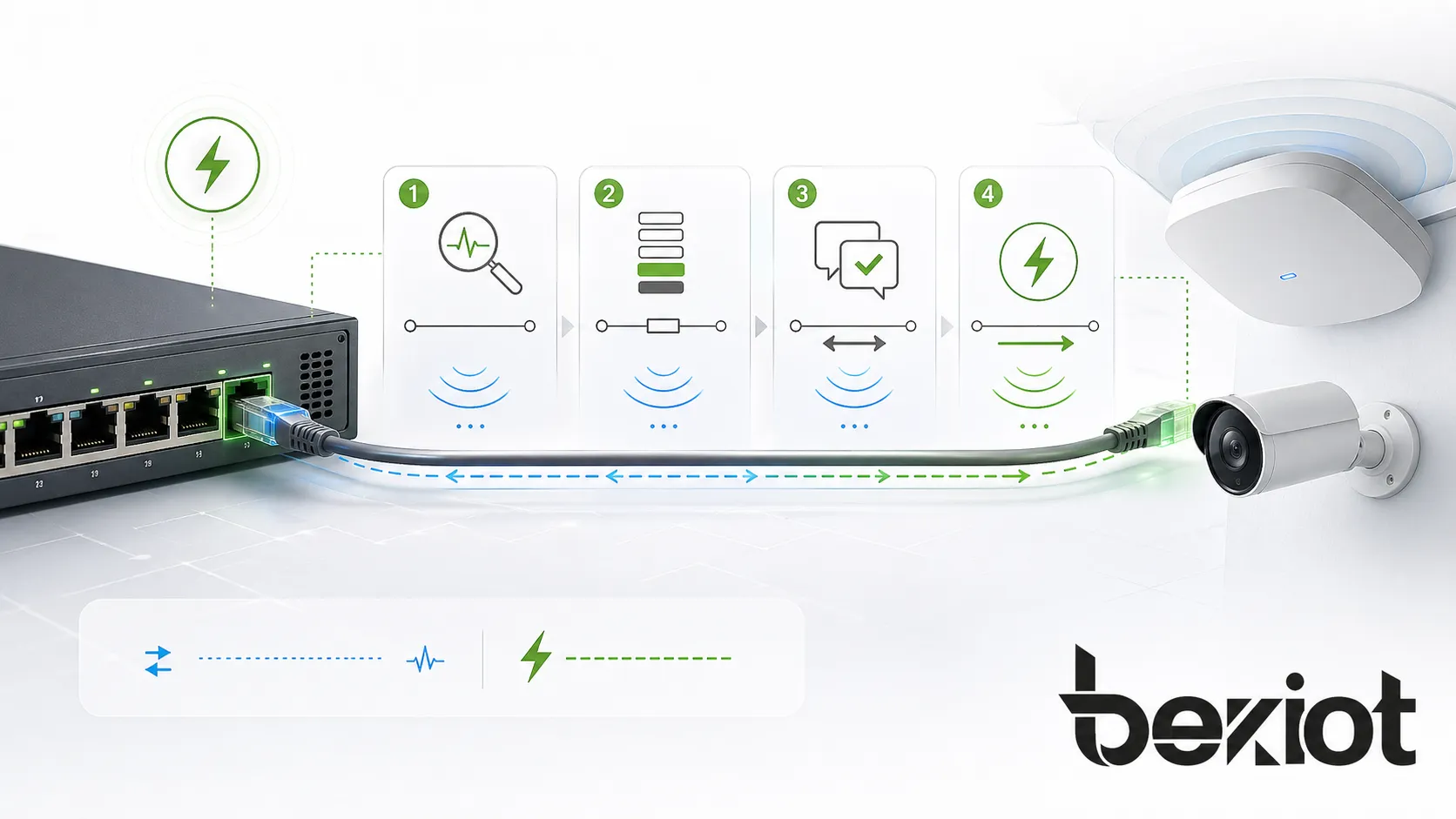
A PoE+ system begins with the Power Sourcing Equipment. The PSE detects whether the connected endpoint is a valid powered device before sending full operating power. This detection process is important because the switch should not apply power to a device that is not designed to receive it.
Once a valid powered device is detected, the PSE classifies the device and determines the required power level. The powered device communicates its power requirements through the standard PoE negotiation and classification process. After that, the PSE supplies power over the Ethernet cable while continuing to carry data traffic.
This controlled startup process helps protect both the power source and the connected endpoint. It also allows switches to manage their total power budget across many ports.
Power Delivery Over Ethernet Cable
PoE+ delivers direct current power over twisted-pair Ethernet cabling while data continues to travel over the same cable. In common deployments, PoE and PoE+ use two wire pairs for power delivery. The electrical design allows power and data to coexist without interfering with normal Ethernet communication when the equipment and cabling meet the required standards.
The maximum distance for typical Ethernet copper links is 100 meters, including patch cords, when proper cabling practices are followed. Cable quality matters because power is lost as heat along the cable. Poor cable, excessive length, bad connectors, or high cable bundle temperature can reduce reliability and increase voltage drop.
For PoE+ deployments, installers should pay attention to cable category, conductor quality, termination workmanship, switch power budget, environmental temperature, and the power requirement of each device.
Detection, Classification, and Power Management
Detection prevents power from being sent to non-PoE devices. Classification helps the PSE understand how much power the powered device may need. Power management helps the switch decide whether enough total power is available for all connected devices.
A PoE+ switch may have many ports, but the total available power budget may not be enough to run every port at full PoE+ output at the same time. For example, a switch with 24 PoE+ ports may not necessarily support 30 watts on all ports unless its total power budget is designed for that load.
This is why power budgeting is a key deployment step. Network designers must calculate the expected load of all powered devices and confirm that the switch, injector, or power system can support the actual demand.
A PoE+ port rating shows what one port can provide, but the total switch power budget determines how many devices can be powered at the same time.
PoE+ Standards and Power Levels
IEEE 802.3at Type 2
PoE+ is defined by IEEE 802.3at and is commonly described as Type 2 PoE. It was developed as an enhancement to the earlier IEEE 802.3af PoE standard. Standard PoE provides lower power, while PoE+ increases the available power for more demanding endpoints.
Under the common PoE+ model, the PSE can provide up to 30 watts at the switch or injector port, while the powered device can use up to about 25.5 watts after cable loss. This difference exists because some power is lost in the cable during transmission.
The important deployment point is that device power should be checked at the powered-device side, not only at the switch-port rating. A device that needs more than the available PD power may require IEEE 802.3bt PoE++ or a separate power supply.
PoE, PoE+, and PoE++ Comparison
PoE, PoE+, and PoE++ are related but not identical. PoE under IEEE 802.3af is commonly known as Type 1. PoE+ under IEEE 802.3at is commonly known as Type 2. PoE++ under IEEE 802.3bt includes Type 3 and Type 4 power levels for higher-power devices.
Standard PoE is suitable for lower-power endpoints. PoE+ is suitable for medium-power endpoints such as higher-performance access points, more capable cameras, and some intercom or access-control devices. PoE++ is used when even more power is needed, such as for high-power wireless access points, larger displays, thin clients, lighting systems, or devices with heaters and motors.
Choosing the right standard prevents underpowered devices, unexpected reboots, or unstable operation. The selected PSE and cabling must match the power requirement of the powered device.
Power Classes and Compatibility
PoE systems use power classes to help identify how much power a powered device may require. PoE+ includes higher power classification than standard PoE. This allows a switch to allocate power more accurately and avoid wasting power budget on devices that do not need it.
Backward compatibility is an important benefit. Many PoE+ switches can power standard PoE devices, while PoE+ devices require a PoE+ capable power source to receive their required power. If a PoE+ device is connected to a standard PoE port, it may fail to start, run in limited mode, or become unstable depending on the device design.
For best results, the power class, device datasheet, switch capability, and cable path should all be reviewed before deployment.
Main Features of PoE+
Single-Cable Power and Data
The most visible feature of PoE+ is single-cable power and data. A device can connect to the network and receive electrical power through the same Ethernet cable. This reduces cable clutter and makes installation easier in places where power outlets are not conveniently located.
Single-cable deployment is useful for ceiling-mounted access points, wall-mounted intercoms, hallway cameras, gate terminals, conference room devices, and equipment installed in high or remote positions. Installers can focus on structured cabling instead of coordinating separate electrical work for every endpoint.
This feature helps reduce installation time, simplify maintenance, and improve deployment flexibility.
Centralized Power Management
PoE+ allows power to be managed from the network switch or power source. Administrators can monitor power consumption, enable or disable ports, restart powered devices remotely, and manage power allocation. This is useful for distributed devices that are difficult to reach physically.
For example, if an IP camera or wireless access point becomes unresponsive, an administrator may be able to power-cycle the port remotely. This can reduce the need for on-site service visits and improve recovery speed.
Centralized power also makes backup power planning easier. If the PoE+ switch is connected to an uninterruptible power supply, multiple powered devices may continue operating during a short power outage.
Higher Power for More Capable Devices
PoE+ provides more power than standard PoE, which allows more capable network devices to operate through Ethernet power. This includes devices with stronger radios, infrared lighting, small speakers, screens, card readers, motors, or additional processing hardware.
The higher power level expands the number of endpoints that can be deployed without local power adapters. It also supports more flexible network design in smart buildings, security systems, communication systems, and facility automation.
However, PoE+ is not unlimited. Devices with very high power demands may still require PoE++ or an independent power supply.
Uses of PoE+
Wireless Access Points
Wireless access points are one of the most common uses of PoE+. Modern access points may support multiple radios, higher throughput, wider coverage, and advanced management functions. These features often require more power than standard PoE can provide.
PoE+ allows access points to be installed on ceilings, walls, corridors, classrooms, hotels, offices, warehouses, and public areas without needing a nearby electrical outlet. This gives network planners more freedom to place access points according to wireless coverage needs rather than power outlet locations.
In large Wi-Fi networks, PoE+ simplifies installation and makes centralized power backup more practical.
IP Cameras and Security Devices
IP cameras often use PoE+ when they include features such as infrared illumination, pan-tilt-zoom movement, heaters, microphones, speakers, or onboard analytics. These functions increase power demand beyond basic camera operation.
PoE+ makes camera deployment easier because one cable can carry both video data and power. This is useful for entrances, corridors, parking areas, warehouses, production sites, campuses, and perimeter security locations.
Security devices such as access control panels, door stations, and card reader terminals may also use PoE+ when they need more power for displays, locks, relays, audio modules, or environmental features.
IP Phones, Intercoms, and Communication Endpoints
Many basic IP phones can run on standard PoE, but more advanced communication endpoints may need PoE+. Devices with color screens, video cameras, speaker amplification, multiple interfaces, or additional control functions may require higher power.
PoE+ is also useful for intercom terminals, help points, paging adapters, and communication panels in offices, campuses, healthcare facilities, transport sites, and industrial buildings. It allows these endpoints to be powered from the network closet rather than from scattered power adapters.
In communication systems, PoE+ supports cleaner installation, easier device replacement, and centralized power planning.
IoT, Building Automation, and Smart Facilities
PoE+ is increasingly used in smart building and facility systems. Network-connected sensors, controllers, room panels, lighting controllers, occupancy devices, access terminals, and automation gateways may use PoE or PoE+ depending on power demand.
For facility managers, PoE+ can simplify device deployment because low-voltage structured cabling can deliver power and data together. This can reduce installation complexity in ceilings, equipment rooms, corridors, meeting spaces, and public areas.
In smart facilities, PoE+ helps network infrastructure become part of the building power and control layer.
Applications of PoE+
Enterprise Offices and Campuses
Enterprise offices and campuses use PoE+ to power wireless access points, IP phones, conference room devices, access control terminals, cameras, and network sensors. These environments often require many distributed endpoints across floors, departments, and buildings.
PoE+ helps IT teams deploy devices faster and manage them centrally. If devices are powered from managed switches, administrators can monitor port status, track power usage, and remotely reset devices when needed.
In multi-building campuses, PoE+ can support a consistent access infrastructure for communication, security, Wi-Fi, and operational systems.
Healthcare, Education, and Public Facilities
Hospitals, schools, universities, libraries, government buildings, and public facilities often need many network endpoints in locations where local power is inconvenient. PoE+ can support access points, cameras, help terminals, digital room devices, intercoms, and access control endpoints.
In healthcare, PoE+ may support communication terminals, wireless coverage, nurse station devices, cameras, and access points. In education, it can support classroom Wi-Fi, security cameras, intercoms, and administrative network devices.
The ability to centralize backup power can be especially valuable in facilities where communication and security devices should remain available during power interruptions.
Warehouses, Retail, and Transportation Sites
Warehouses, logistics centers, retail stores, stations, airports, and parking facilities often use PoE+ for cameras, wireless access points, access control devices, paging endpoints, and operational network terminals. These devices may be installed on ceilings, poles, walls, gates, or outdoor enclosures.
PoE+ reduces the need for local power wiring at every endpoint, which can lower installation complexity in large or high-ceiling environments. It also supports centralized power monitoring and easier device maintenance.
In transportation and logistics environments, PoE+ supports flexible installation where network coverage and security visibility are more important than the location of existing electrical outlets.
Industrial and Outdoor Networks
Industrial sites may use PoE+ for rugged access points, IP cameras, intercom terminals, sensors, controllers, and monitoring devices. Outdoor networks may use PoE+ for security cameras, wireless bridges, entry stations, and environmental monitoring devices.
These deployments require additional attention to enclosure protection, surge protection, grounding, temperature range, corrosion resistance, and cable routing. A device may be PoE+ capable but still unsuitable for a harsh environment if it lacks the required environmental protection.
For industrial and outdoor applications, PoE+ should be planned as part of the complete physical network design, not only as a power feature.
Benefits of PoE+
Simplified Installation
PoE+ simplifies installation by reducing the need for separate power cabling. Network installers can place devices where they are needed for coverage, visibility, access, or communication rather than where power outlets already exist.
This is especially useful for ceiling-mounted access points, high-mounted cameras, wall intercoms, outdoor stations, and devices installed in remote corners of a facility. It can reduce coordination between IT teams and electrical contractors for many low-voltage endpoints.
Simpler installation can reduce deployment time, improve layout flexibility, and make future device relocation easier.
Centralized Backup Power
When PoE+ switches are connected to an uninterruptible power supply or backup power system, multiple powered devices can remain active during a power interruption. This is useful for Wi-Fi coverage, IP cameras, intercoms, access control devices, and communication endpoints.
Without PoE+, each endpoint may depend on a local power adapter or nearby outlet. Keeping all of those devices backed up would be more difficult. PoE+ makes backup power more centralized and easier to manage.
For business continuity and security systems, centralized backup power is one of the strongest operational benefits of PoE+.
Remote Control and Maintenance
Managed PoE+ switches often allow administrators to control power at the port level. A port can be disabled, enabled, monitored, or power-cycled remotely. This is useful when a device becomes unresponsive and needs a restart.
Remote power control can reduce maintenance cost because technicians do not always need to visit the device location. In large buildings, warehouses, campuses, or outdoor sites, this can save significant time.
Maintenance teams should still investigate repeated device failures, but remote power cycling can be a practical recovery tool for occasional endpoint problems.
Deployment Considerations
Calculate the Power Budget
Power budget calculation is one of the most important PoE+ planning tasks. Each powered device has a maximum and typical power requirement. The switch or injector has a total available PoE power budget. The network designer must confirm that the total expected load fits within the available power.
A common mistake is assuming that a switch with many PoE+ ports can provide full PoE+ power on every port at once. Some switches support full power on all ports, while others support only a limited total budget. The datasheet should be reviewed carefully.
For reliable operation, the power budget should include margin for startup load, future expansion, environmental conditions, and device replacement.
Use Suitable Cabling
Cabling quality affects both data performance and power delivery. PoE+ deployments should use proper twisted-pair Ethernet cabling and good termination practices. Damaged cable, poor connectors, excessive length, or low-quality conductors can cause voltage drop, heat, packet errors, or unstable device behavior.
Cable bundle temperature is also important. When many PoE+ cables are bundled together, heat may accumulate. This can affect performance and long-term reliability. Installers should follow cabling standards, manufacturer guidance, and site engineering practices.
Good cabling is not just an installation detail. It is part of the power delivery system.
Check Device Compatibility
Before deployment, administrators should confirm that the powered device and the PSE support compatible PoE standards. A PoE+ device should be connected to a PoE+ capable switch or injector if it needs the full power level. A standard PoE switch may not provide enough power.
Compatibility should also include network speed, cable length, environmental rating, mounting method, and power negotiation behavior. Some devices can operate in reduced-power mode, while others may fail to boot if the correct PoE level is not available.
Checking compatibility early prevents unstable operation after installation.
A successful PoE+ deployment depends on matching device power demand, switch power budget, cable quality, and operating environment.
Common Challenges in PoE+ Deployments
Insufficient Switch Power Budget
Insufficient power budget is a common problem. A switch may have enough ports but not enough total power to support all connected PoE+ devices at their maximum demand. When this happens, some devices may fail to start, lose power, or operate unpredictably.
The solution is to calculate the total power requirement before installation. If needed, the design may use a higher-power switch, additional switches, PoE injectors, power prioritization, or a different endpoint power strategy.
Power budget should be treated as a design constraint, not an afterthought.
Cable Loss and Heat
PoE+ power is delivered through copper cable, and copper has resistance. Some power is lost as heat along the cable. Longer cable runs, smaller conductors, poor termination, high ambient temperature, and dense cable bundles can increase performance problems.
This is why powered device power is lower than the power supplied at the PSE port. The system must account for cable loss. If a device is close to the upper limit of PoE+ power, poor cabling can create instability.
Good cable planning improves safety, reliability, and device performance.
Environmental Conditions
PoE+ devices are often installed in challenging locations such as ceilings, warehouses, outdoor poles, industrial areas, parking lots, and equipment cabinets. Environmental factors can affect both devices and cabling. Heat, cold, moisture, dust, vibration, sunlight, and electrical surge can all create problems.
Outdoor and industrial PoE+ deployments may require weatherproof enclosures, shielded cable, surge protection, grounding, industrial switches, and suitable temperature ratings. The PoE+ function alone does not make a device rugged or outdoor-ready.
Environmental planning is essential when PoE+ is used outside ordinary office spaces.
Maintenance Tips for PoE+ Networks
Monitor Port Power and Device Status
Managed PoE+ switches can often show real-time port power consumption, device status, link state, and fault information. Monitoring these values helps administrators identify overloaded ports, unstable devices, unusual power draw, and possible cabling problems.
Sudden changes in power usage may indicate a device fault, environmental issue, or configuration change. Repeated disconnects may point to cable problems, insufficient power, or endpoint instability.
Regular monitoring helps keep PoE+ networks reliable after installation.
Keep Documentation Updated
PoE+ systems should be documented clearly. Documentation should include switch models, power budgets, connected devices, port assignments, cable routes, device power requirements, VLANs, UPS coverage, and installation locations.
Good documentation makes troubleshooting faster. If a device loses power, the technician can identify which switch port supplies it, what the expected power draw is, and whether the port is part of a critical system.
Documentation is especially important in large facilities where many devices are powered from multiple network closets.
Plan for Growth
PoE+ networks often expand over time. A site may add more cameras, access points, intercoms, sensors, or automation devices. If the original switch power budget has no margin, expansion may require unexpected equipment replacement.
Network designers should leave power and port capacity for future growth. They should also consider whether some future devices may require PoE++ rather than PoE+.
Planning for growth helps avoid redesign when endpoint requirements increase.
PoE+ Versus Local Power Supply
When PoE+ Is Better
PoE+ is often better when devices are distributed, mounted away from outlets, centrally managed, or part of a networked system. It simplifies installation and supports centralized backup power. It is especially useful for devices installed in ceilings, corridors, walls, poles, gates, and equipment areas.
It also improves manageability. Network teams can monitor and restart devices through managed switches. This can make PoE+ more operationally efficient than many individual wall adapters.
For many network endpoints, PoE+ provides a clean balance of power, data, and manageability.
When Local Power May Still Be Needed
Local power may still be needed when a device requires more power than PoE+ can deliver, when the cable run exceeds Ethernet distance limits, when the environment is unsuitable for PoE cabling, or when the device has special electrical requirements.
Some high-power cameras, displays, access systems, industrial devices, lighting loads, and equipment with heaters or motors may need PoE++ or a dedicated power supply. The decision should be based on the device datasheet and site conditions.
PoE+ is powerful and convenient, but it is not a replacement for every electrical power requirement.
Conclusion
Power over Ethernet Plus, or PoE+, is an enhanced Ethernet power technology based on IEEE 802.3at. It allows a network cable to carry both data and electrical power, providing more power than standard PoE for devices that need higher energy levels. A PoE+ PSE can supply up to 30 watts at the port, with up to about 25.5 watts available to the powered device after cable loss.
PoE+ works through detection, classification, power negotiation, and controlled delivery from a PoE+ switch, injector, or midspan device to a compatible powered device. Its main benefits include simplified installation, centralized power management, backup power support, remote device control, and cleaner deployment for distributed network endpoints.
Common applications include wireless access points, IP cameras, intercoms, access control devices, IP phones, sensors, building automation devices, retail systems, warehouses, healthcare facilities, campuses, transportation sites, and industrial networks. When planned with the right power budget, cabling, device compatibility, and environmental protection, PoE+ becomes a practical foundation for modern connected infrastructure.
FAQ
What is PoE+ in simple terms?
PoE+ is a technology that sends both electrical power and network data through one Ethernet cable. It provides more power than standard PoE and is used for devices that need higher power, such as advanced access points, IP cameras, and intercom terminals.
It reduces the need for separate power adapters near each device.
What standard defines PoE+?
PoE+ is defined by IEEE 802.3at and is commonly known as Type 2 PoE. It is an enhancement of standard PoE under IEEE 802.3af.
PoE+ can supply up to 30 watts from the power source, with up to about 25.5 watts available to the powered device after cable loss.
What devices commonly use PoE+?
Common PoE+ devices include wireless access points, IP cameras, video intercoms, access control terminals, IP phones with advanced features, security devices, building automation endpoints, and network sensors.
The exact requirement depends on the device’s power consumption and manufacturer specification.