
The Becke IPGA-8S FXS Gateway is designed for organizations that need to connect analog phones, fax machines, and legacy PBX resources to modern IP telephony environments in a more scalable and professionally managed way. Built with 8 FXS ports and 2 Gigabit Ethernet interfaces, it is positioned for small and medium-sized businesses, call centers, and multi-location deployments that want reliable voice connectivity, practical service flexibility, and smoother integration with SIP-based platforms. For many organizations, analog endpoints are still deeply embedded in daily workflows, whether at reception desks, administration offices, service counters, dormitories, branch offices, clinics, hospitality facilities, or legacy telephony environments. The IPGA-8S gives these users a practical way to preserve working analog assets while moving the communication core toward a more unified SIP architecture.
In real deployment projects, the challenge is rarely only about adding analog ports. More often, the requirement is to connect analog devices into a broader communication platform that supports easier management, better service continuity, more flexible call routing, and long-term migration value. The IPGA-8S is designed around that requirement. It functions as a structured analog access gateway for SIP environments, allowing enterprises and integrators to bridge legacy endpoints with IP-based voice systems without forcing a disruptive all-at-once replacement strategy. This makes the product especially relevant in staged migration projects, hybrid voice networks, and business environments where operational stability matters as much as feature availability.
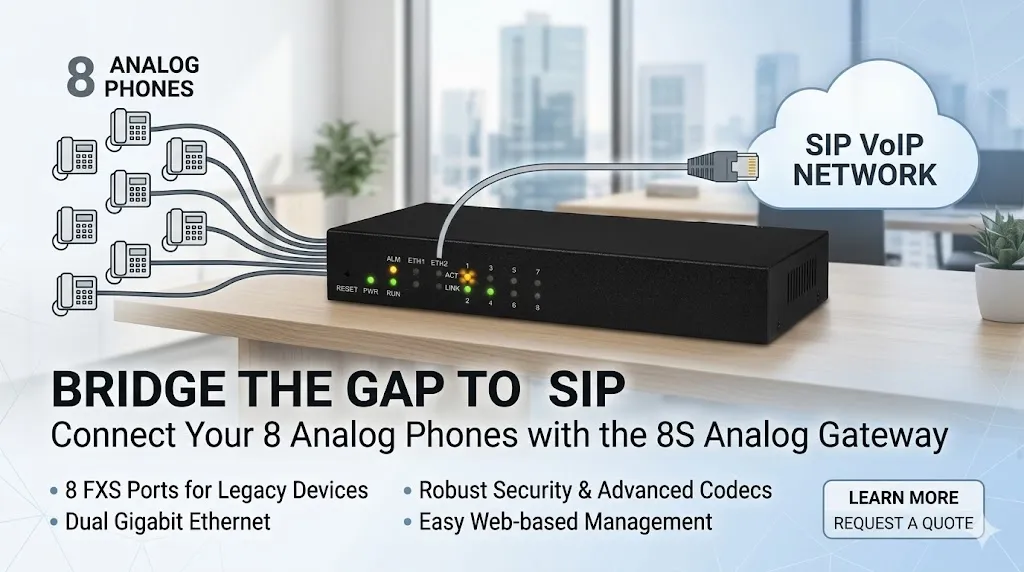
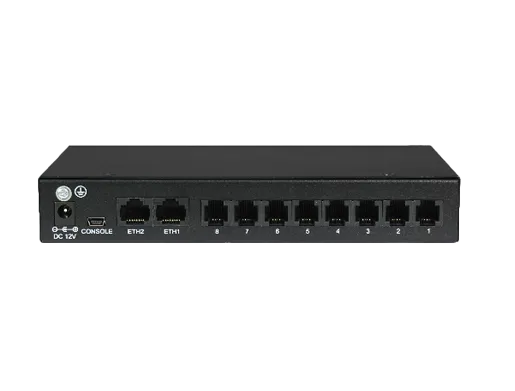
The strongest hardware advantage of the 8S model is its 8 FXS RJ11 phone ports, which make it a better fit for sites that need to connect more analog terminals without moving to a larger chassis. It can support analog telephones, fax devices, and PBX-related legacy resources in one compact gateway. This gives the product a more practical role in offices and distributed business sites where a few analog ports are no longer enough, but a higher-density chassis would add unnecessary cost, space, or deployment complexity.
In practical terms, 8 ports create a more useful midpoint for organizations that need real analog access capacity rather than a minimal adapter function. This is especially valuable in branch environments, small call handling teams, hospitality desks, public service counters, campus offices, and business departments where multiple analog devices must remain active. By combining moderate port density with a compact format, the IPGA-8S helps reduce device sprawl while supporting more orderly voice deployment inside a professional SIP network.
With 2 Gigabit Ethernet ports, described as 1 WAN and 1 LAN, the gateway is easier to place inside business networks that need reliable uplink access and practical separation between service-side and local-side connectivity. That makes it more suitable for branch offices, customer service environments, and distributed deployments than entry-level analog adapters with fewer network options. Dual Gigabit interfaces also contribute to cleaner network planning, especially in installations where administrators want better physical and logical organization around the voice gateway position.
This network design is useful for professional deployment because the gateway is not treated as a simple desktop converter. Instead, it can be integrated as a managed component inside the wider enterprise network. In structured voice projects, good interface design affects not only installation convenience but also long-term maintainability, troubleshooting efficiency, and deployment consistency across multiple sites. The IPGA-8S reflects that requirement by offering network-side flexibility beyond what is commonly seen in smaller analog adapters.
The product supports SIP and IMS and is positioned to interoperate with leading softswitches, IP PBXs, and SIP servers. This gives integrators and IT teams more flexibility when introducing analog access into mixed-vendor communication systems. Interoperability is a central requirement in enterprise voice deployments because the gateway may need to work with existing PBX platforms, hosted voice environments, softswitch-based systems, carrier-oriented infrastructure, or organization-specific telephony applications.
Strong interoperability also improves investment protection. Enterprises are more likely to keep their voice architecture flexible when analog access equipment is not tied to a narrow ecosystem. The IPGA-8S supports this broader deployment logic by aligning with mainstream SIP and IMS environments, making it a more practical option for projects where current compatibility and future adaptability both matter.
A strong 8S gateway is not just about adding analog ports. It should also make analog devices easier to manage inside a more capable SIP communications architecture.
The gateway supports T.38 and T.30 fax handling, fax pass-through, and 3-way conference, giving it practical value in real business environments where analog voice and fax still need to coexist with IP-based communications. These features help the device serve everyday operational needs rather than acting as a simple line adapter. Fax support remains particularly important in industries and office workflows where paper-based or signed document processes are still active, including healthcare administration, legal workflows, logistics, education, finance, and public service environments.
By supporting both voice and fax-oriented analog use, the IPGA-8S becomes more relevant for organizations that cannot fully abandon legacy communication methods. Instead of creating a narrow analog phone-only access layer, the gateway helps unify multiple types of endpoint requirements within the SIP environment. That makes deployment more practical for mixed business scenarios where some users rely on desk telephony while others still depend on fax-related processes.
Becke highlights flexible routing and dial plans as a core capability. The feature set also includes call waiting, blind and attended transfer, call forwarding, speed dial, do not disturb, hunting group, voice mail, music on hold, and MWI. Together, these functions make the 8S gateway suitable for business telephony workflows where usability and call handling logic matter. This means the product is not limited to basic analog extension registration but can support more structured calling behavior inside daily business operations.
Flexible routing and dial plan control are especially valuable in environments with multiple teams, branch numbers, departmental policies, or differentiated outbound rules. They help the gateway align with the real communication structure of the organization rather than forcing a simplified calling model. When analog endpoints are still part of a larger SIP system, this level of call logic support becomes an important factor in deployment quality and operational usability.
The platform supports TLS and SRTP for signaling and media security, as well as IPv4 and IPv6, QoS, and VLAN tagging. These capabilities help the gateway fit into managed enterprise or service-provider networks that require more secure and structured voice deployment. In modern IP voice projects, analog access is still expected to meet broader standards for secure transport, network segmentation, and service prioritization.
This matters because the gateway often operates inside environments where voice traffic shares infrastructure with other business services. Security and network-readiness help the device participate more appropriately in these managed conditions, supporting better service predictability and stronger policy alignment. For buyers that view analog access as part of a professional communications environment rather than an isolated legacy corner, the IPGA-8S offers a more deployment-conscious feature profile.
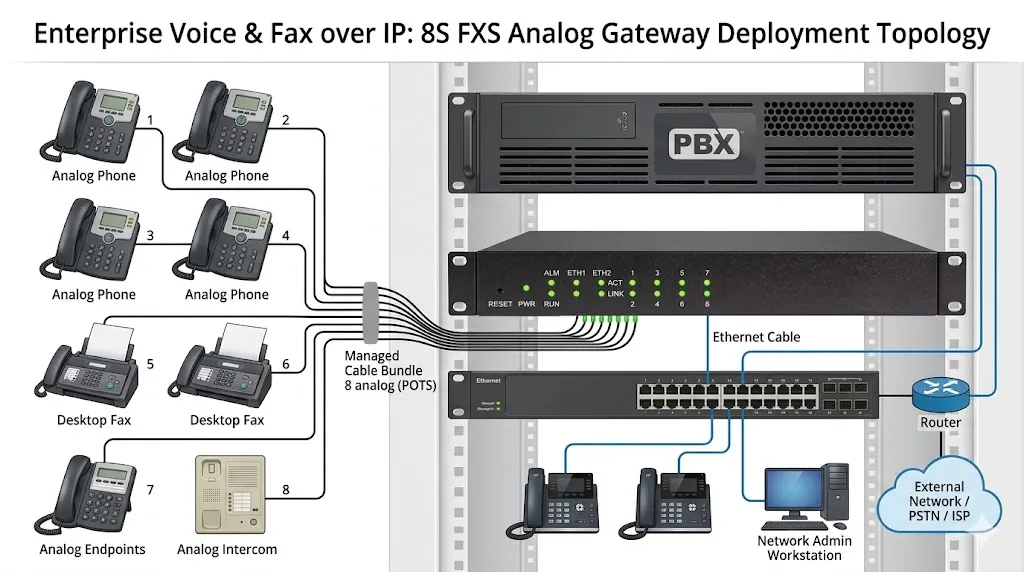
The IPGA-8S FXS Gateway includes an intuitive web interface with a quick installation guide, making setup and routine administration more efficient for installers and IT teams. It also provides debug tools in the web interface to simplify troubleshooting during deployment and maintenance. A browser-based approach is particularly useful in projects where administrators need straightforward access to provisioning, status review, adjustment, and issue diagnosis without depending on overly complex management processes.
Easier administration directly improves deployment efficiency. In environments where several gateways may be installed across different locations, a management interface that reduces learning curve and configuration time creates meaningful operational value. For resellers, integrators, and enterprise IT teams, the IPGA-8S supports a more efficient lifecycle from first installation to routine maintenance and later service adjustment.
Support for SNMP, TR-069, automated provisioning, configuration backup and restore, and the Becke Cloud Management System makes the gateway easier to manage at scale. This is especially valuable for organizations operating multiple sites or service providers supporting many customer installations. Remote management capability becomes increasingly important when analog access is distributed across branch offices, retail outlets, campus buildings, remote service points, and other geographically separated environments.
In these deployment models, centralized visibility and remote maintenance can reduce support cost, shorten response time, and improve operational consistency. Instead of treating each gateway as a standalone device that requires local attention, organizations can manage analog access more strategically across the wider SIP network. This makes the IPGA-8S better aligned with multi-site voice operations and service-provider-oriented management practices.
Becke positions the product around an embedded operating system, market-proven hardware design, carrier-grade reliability, and main or secondary SIP server failover. These points strengthen its application value in business environments where analog access is still important and service continuity matters. Stable analog access remains essential in many daily communication workflows, even when the core architecture has shifted toward IP.
Failover support and platform reliability are especially relevant when the gateway is used in customer-facing environments, administrative operations, healthcare service points, educational offices, and distributed enterprise sites. In these cases, communication interruption can affect productivity, coordination, or service responsiveness. The IPGA-8S is positioned not merely as a port expansion device, but as a stable communications component intended for ongoing operational use.
The 8S model is well suited for SMB users that need to retain analog endpoints while gaining access to SIP-based communication platforms. It offers enough port density to serve offices that have moved beyond entry-level analog requirements but do not need a large enterprise gateway. This makes it especially suitable for businesses that want a cleaner upgrade path from analog telephony toward IP communications without introducing unnecessary system scale.
For many SMB environments, analog phones are still used because they are familiar, already installed, and operationally sufficient for many roles. The IPGA-8S allows these businesses to preserve working devices while centralizing call control and integrating them into a more modern SIP framework. That balance between continuity and modernization gives the product strong practical value in the SMB segment.
Becke specifically positions this gateway for call centers. In that role, it can help connect analog devices or fax endpoints into broader voice environments where call handling, conferencing, and stable connectivity are important. Some service operations still rely on analog endpoints for desks, supporting terminals, or functional compatibility reasons while their main call platform operates over IP.
In these scenarios, the IPGA-8S is useful not only because of its port count, but because it supports the business calling features and service reliability needed in practical communication workflows. Transfer options, forwarding, holding behavior, hunting logic, and conference support all contribute to making the analog side of the environment more usable inside structured service operations.
The product is also positioned for multi-location environments that need VoIP services. Its combination of 8 FXS ports, dual Gigabit Ethernet, remote management options, and SIP interoperability makes it a practical choice for distributed sites that want centralized control with local analog connectivity. Many enterprises still operate branches where analog telephones, fax devices, or legacy extension resources remain part of daily activity.
The IPGA-8S helps these locations participate in a broader unified voice framework without requiring full endpoint replacement. That is particularly useful for organizations that want consistent management across sites while accepting that different branches may modernize at different speeds. In this context, the gateway becomes a bridge not only between analog and SIP, but also between local continuity and centralized communications policy.
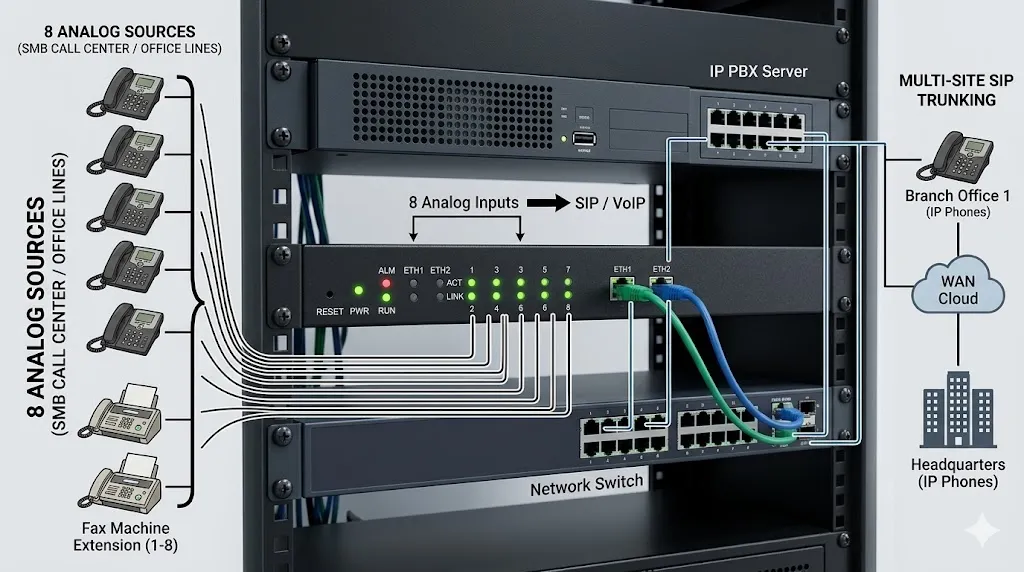
The Becke IPGA-8S FXS Gateway stands out because it balances port density, interoperability, business telephony features, security, and manageable deployment in one compact platform. For buyers who need more than a basic analog adapter, it offers a stronger combination of 8 FXS capacity, dual Gigabit connectivity, SIP/IMS support, T.38 fax, flexible routing, and scalable management. It is designed for organizations that want analog access to remain useful inside a more modern and professionally structured voice environment.
This makes the IPGA-8S particularly suitable for projects where analog preservation, SIP integration, and multi-site manageability all matter at the same time. Whether the goal is to support branch telephony, keep fax workflows operational, extend analog devices into an IP PBX platform, or create a smoother migration path away from legacy voice infrastructure, the gateway provides a deployment-oriented solution with clear business relevance.
Its main value is providing 8 FXS ports for analog phones, fax machines, and legacy analog devices while integrating them into SIP and IMS communication environments in a way that is practical, stable, and easier to manage.
It is best suited for small and medium-sized businesses, call centers, and multi-location environments that need VoIP services while still supporting analog endpoints.
Yes. It supports T.38 and T.30 fax as well as fax pass-through, making it suitable for organizations that still rely on fax workflows in business operations.
Yes. Becke states that it supports SIP and IMS and is interoperable with leading softswitches, IP PBXs, and SIP servers, making it suitable for mixed-vendor communication environments.
It includes TLS and SRTP security, along with IPv4, IPv6, QoS, and VLAN support, which makes it more suitable for managed and security-conscious voice environments.
Yes. The gateway includes a web interface, automated provisioning, SNMP, TR-069, configuration backup and restore, and cloud management support, helping simplify deployment and maintenance across multiple sites.
Its business calling features include call waiting, call transfer, call forwarding, speed dial, do not disturb, hunting group, voice mail, music on hold, and 3-way conference.
The 8S model is a better fit when a site needs more analog endpoint capacity, stronger network connectivity, easier scaling, and more practical support for structured SIP deployment without moving to a higher-capacity enterprise gateway.
| Item | Specification |
|---|---|
| Product Model | IPGA-8S FXS Gateway |
| Voice Interface | 8×FXS Ports (RJ11×8) |
| Ethernet Interface | 2×10/100Mbps RJ45 Ports |
| USB Interface | 1×Mini USB Port |
| Concurrent Calls | 8 Channels |
| Supported Protocols | SIP/IMS, DHCP, TCP/UDP, HTTP/HTTPS, TLS, ARP/RARP, DNS, NTP, TFTP, SRTP, TELNET, STUN, TR-069, SNMP |
| Audio Codecs | G.711a/u, G.723, G.729A/B, iLBC, AMR |
| DTMF Modes | In-band, RFC2833, SIP INFO |
| Echo Cancellation | Hardware AEC |
| IP Mode | IPv4/IPv6 |
| VPN | VPN Client Supported |
| Lightning Protection | Class 4 |
| Reset Button | Press and hold for 8 seconds to restore factory settings |
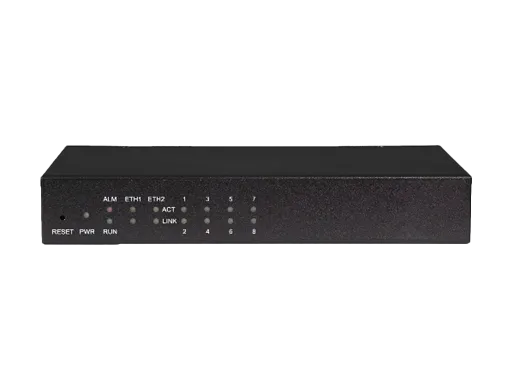
| Status Indicators | PWR (Power), RUN, ALM (Alarm), Network, FXS Channel Status |
| Product Dimensions | 186×30×108 mm |
| Net Weight | 0.55 kg |
| Operating Temperature | 0°C ~ 45°C |
| Storage Temperature | -20°C ~ 85°C |
| Operating Humidity | 8% ~ 90% Non-condensing |
| Storage Humidity | 8% ~ 90% Non-condensing |