In radio communication, one of the most important questions is simple: when should a device treat sound as useful speech? In two-way radios, walkie-talkies, PoC terminals, RoIP gateways, dispatch systems, and industrial voice networks, this question affects transmission control, channel efficiency, recording quality, hands-free operation, and communication reliability.
VOX and VAD are often mentioned together because both are related to voice detection. However, they are not the same technology. VOX is mainly a radio operation feature that can automatically start transmission when the microphone detects sound. VAD is mainly a voice processing technology that detects whether an audio signal contains human speech. Understanding the difference helps users select the right function for field radios, digital radio systems, emergency dispatch platforms, and industrial communication solutions.
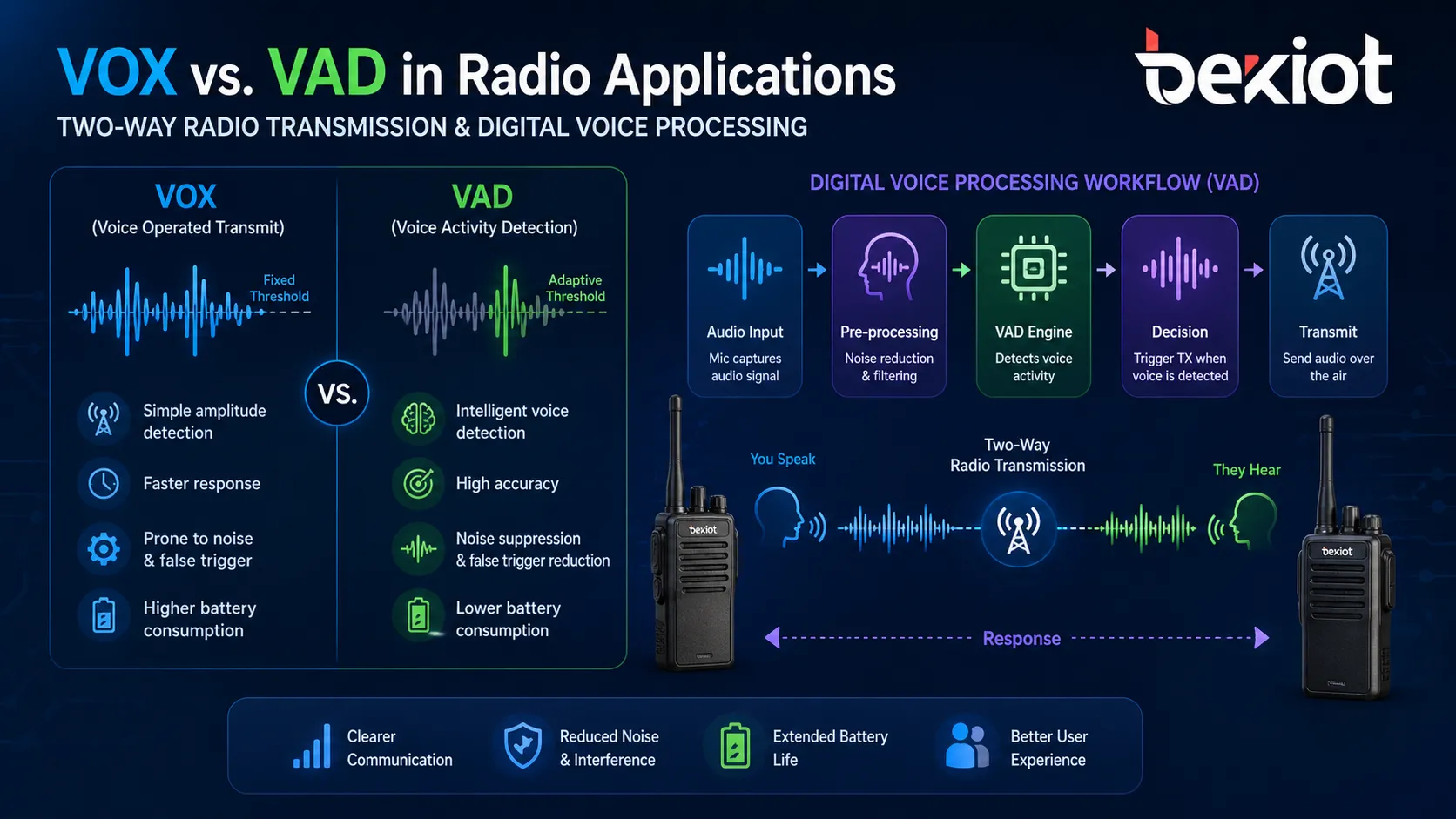
What Is VOX in Radio Communication?
VOX usually refers to voice-operated or voice-activated transmission. In radio applications, it allows a radio terminal to transmit automatically when the microphone detects sound above a preset level. Instead of pressing the PTT button, the user speaks, and the device switches from receiving mode to transmitting mode.
This function is especially useful when the user cannot easily press a button. Security guards, maintenance workers, drivers, cyclists, crane operators, warehouse workers, and emergency response teams may use VOX when their hands are occupied. In these situations, VOX improves convenience by reducing dependence on manual push-to-talk operation.
How VOX Works
VOX normally works by monitoring the microphone input. When the detected sound level reaches the configured sensitivity threshold, the radio starts transmitting. When the sound level drops and remains low for a short period, the radio stops transmitting and returns to receive mode.
Most VOX-enabled radios allow the user to adjust sensitivity. A higher sensitivity setting can detect softer speech, but it may also trigger transmission from background noise. A lower sensitivity setting can reduce false triggering, but it may fail to capture quiet speech or the first part of a sentence.
Main Benefits of VOX
The biggest benefit of VOX is hands-free communication. It allows users to speak naturally without pressing the PTT key every time. In mobile or task-intensive environments, this can improve response speed and operational convenience.
VOX can also be useful with headsets, helmet microphones, vehicle-mounted radios, and lightweight field communication devices. For short conversations in relatively quiet environments, it provides a practical way to keep communication simple and fast.
Limitations of VOX
VOX is not ideal for every radio environment. In noisy industrial sites, factories, construction areas, highways, ports, mines, or windy outdoor locations, background noise may accidentally activate transmission. This can occupy the channel, interrupt other users, or send unnecessary noise to the group.
Another limitation is the possibility of clipped speech. Because the radio needs a short moment to detect sound and open transmission, the beginning of a word may be missed if the VOX response is not fast enough. For mission-critical communication, many organizations still prefer manual PTT as a more controlled and reliable method.
VOX is best understood as a transmission control feature. It answers the question: should the radio start transmitting now?
What Is VAD in Radio and Voice Systems?
VAD stands for Voice Activity Detection. It is a signal processing method used to determine whether an audio segment contains human speech. Unlike VOX, VAD does not necessarily control radio transmission directly. Instead, it helps a system identify speech, silence, noise, and non-speech audio.
VAD is widely used in VoIP, RoIP, PoC platforms, SIP-based intercom systems, dispatch recording platforms, AI voice systems, noise suppression tools, speech recognition engines, and digital communication networks. In radio-related systems, it helps software and gateways decide when to encode, transmit, record, analyze, or ignore audio.
How VAD Works
VAD analyzes audio frames and estimates whether they contain speech. Basic VAD may use energy level, zero-crossing rate, frequency features, or background noise estimation. More advanced VAD may use statistical models or machine learning methods to improve accuracy in complex acoustic environments.
The goal is not only to detect loud sound, but to identify likely human voice activity. This is why VAD can be more suitable than simple sound-triggered logic in digital systems where the platform needs to distinguish speech from silence, noise, hum, wind, or mechanical sound.
Main Benefits of VAD
VAD helps reduce unnecessary audio processing. When no one is speaking, the system can reduce encoding, transmission, storage, or analysis. In IP-based voice communication, this can save bandwidth and processing resources. In recording systems, it can help remove long silent sections and make voice logs easier to review.
VAD is also important for intelligent communication platforms. It can support automatic recording segmentation, speech recognition, voice analytics, AI transcription, noise-aware processing, and event-based voice monitoring. For modern dispatch systems, VAD improves the efficiency of handling large amounts of voice data.
Limitations of VAD
VAD accuracy depends on the algorithm, microphone quality, acoustic environment, sampling rate, audio codec, and noise conditions. In high-noise environments, weak speech may be misclassified as noise, while sudden background sounds may be misclassified as speech.
For industrial radio applications, VAD should not be treated as a complete replacement for operational discipline or system design. It works best when combined with proper microphone placement, noise reduction, gain control, codec configuration, and well-designed dispatch workflows.
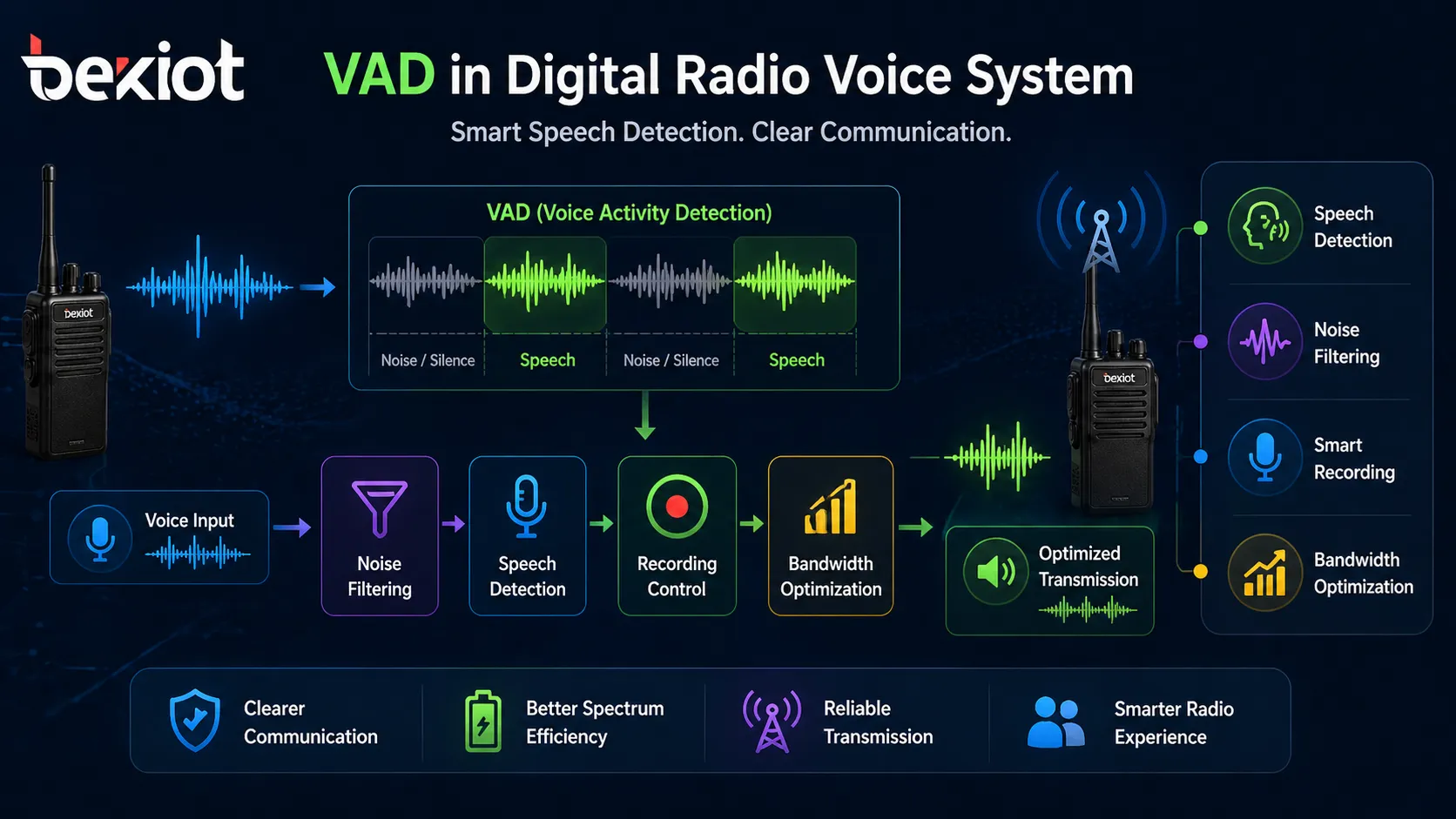
VOX vs VAD: Key Differences
The easiest way to understand the difference is this: VOX is used to trigger transmission, while VAD is used to detect speech. VOX is closer to the user-side radio operation layer. VAD is closer to the system-side audio processing layer.
| Comparison Item | VOX | VAD |
|---|---|---|
| Main Meaning | Voice-operated or voice-activated radio transmission | Voice Activity Detection |
| Main Purpose | Automatically starts radio transmission when sound is detected | Determines whether an audio signal contains human speech |
| Typical Position | Radio terminal, headset, microphone, or user device | Software platform, codec, gateway, recorder, or voice processing system |
| Core Function | Controls transmit and receive switching | Classifies audio as speech or non-speech |
| Common Applications | Walkie-talkies, two-way radios, headset communication, hands-free field operation | VoIP, RoIP, PoC, dispatch recording, speech recognition, silence suppression, voice analytics |
| Main Advantage | Convenient hands-free communication | More efficient digital voice processing |
| Main Risk | False triggering from noise or clipped speech at the beginning of a call | Incorrect speech detection under poor audio or high-noise conditions |
In simple terms, VOX decides when a radio should transmit. VAD decides whether an audio signal is likely to contain real speech. These two functions can be connected in some systems, but they are designed for different purposes.
Functions of VOX in Radio Applications
Hands-Free Transmission
VOX allows a user to talk without pressing the PTT key. This is useful in situations where manual operation is difficult, such as maintenance work, driving, climbing, operating equipment, or wearing protective gloves.
Adjustable Sensitivity
Sensitivity adjustment helps users adapt VOX behavior to different environments. A quiet office or indoor security post may use higher sensitivity, while an outdoor or semi-noisy environment may require lower sensitivity to reduce false activation.
Delay or Hang Time Control
Many VOX systems include a short delay before transmission is released. This prevents the radio from cutting off during brief pauses between words. Proper delay control makes speech sound more natural and reduces repeated switching between transmit and receive states.
Headset and Helmet Communication
VOX is often paired with headsets, throat microphones, helmet microphones, or vehicle communication accessories. For users who need mobility, this provides a practical hands-free radio experience.
Functions of VAD in Radio and Voice Systems
Speech and Silence Detection
VAD separates speech from silence or non-speech audio. This is essential for digital voice systems that need to process only useful speech segments instead of continuously handling all microphone input.
Bandwidth and Resource Optimization
In IP-based voice systems, sending silence wastes bandwidth and processing capacity. VAD can reduce unnecessary transmission by allowing the system to focus on active speech. This is especially helpful in large dispatch networks with many endpoints.
Recording and Voice Log Management
Dispatch centers and command platforms often record large volumes of audio. VAD can help identify meaningful voice segments, reduce silent recordings, and make later review more efficient. This is valuable for emergency communication, public safety, transportation, and industrial operations.
Support for AI Voice Processing
VAD is often used before speech recognition, transcription, keyword spotting, or voice analytics. By detecting speech activity first, the system can improve processing efficiency and avoid sending silent or noisy sections into downstream AI modules.
Use Cases of VOX in Radio Applications
VOX is suitable when the main requirement is hands-free talking. For example, security teams may use VOX during patrols, warehouse workers may use it while handling goods, and field technicians may use it while repairing equipment. In these situations, communication convenience is the key value.
VOX is also useful for personal outdoor activities, light-duty commercial radio systems, headset-based team communication, and vehicle-mounted communication. However, it should be used carefully in noisy or mission-critical environments where accidental transmission may create communication problems.
Use Cases of VAD in Radio and Dispatch Systems
VAD is more suitable for digital voice processing. In RoIP systems, it can help gateways detect active speech before forwarding audio over an IP network. In PoC platforms, it can support efficient voice packet handling and improve system resource usage. In dispatch recording platforms, it can help organize voice logs by active speech events.
VAD is also valuable in SIP intercom systems, control room platforms, emergency communication systems, smart city command centers, transportation dispatch, industrial alarm linkage, and AI-assisted voice monitoring. It helps the system understand whether the audio stream contains speech that should be transmitted, stored, analyzed, or displayed as an event.
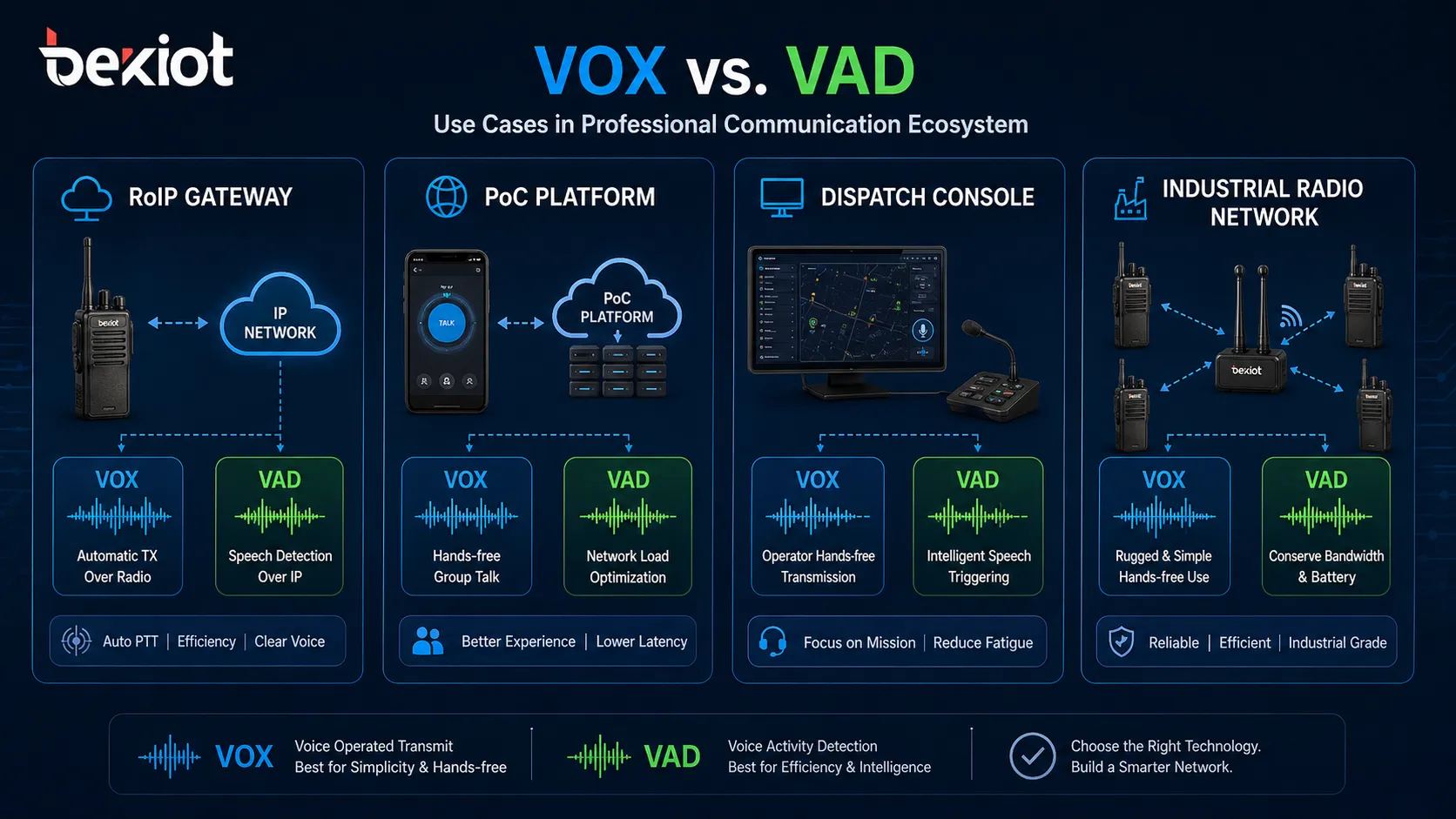
Can VOX and VAD Work Together?
Yes. In modern radio and IP voice systems, VOX and VAD can appear in the same communication chain. A field radio or headset may use VOX to start transmission when the user speaks. At the same time, a RoIP gateway, recording server, or dispatch platform may use VAD to detect speech activity in the received audio stream.
This combination is common in hybrid systems where traditional radio operation connects with IP-based dispatch, recording, analytics, or remote monitoring. VOX improves user-side convenience, while VAD improves system-side intelligence and resource efficiency.
VOX is closer to the radio user. VAD is closer to the voice processing system. In advanced radio networks, both may be used together.
Which Is Better for Radio Communication?
VOX is better when the main goal is hands-free radio transmission. It is simple, practical, and easy to understand. For users who need to talk while working with both hands, VOX can make radio operation more convenient.
VAD is better when the main goal is accurate speech detection, digital audio processing, bandwidth saving, recording management, or intelligent voice analysis. For IP-based radio systems, dispatch platforms, RoIP gateways, and PoC solutions, VAD is often more important at the system level.
The better choice depends on the application. A simple walkie-talkie user may care more about VOX. A system integrator building a dispatch platform may care more about VAD. A large industrial communication project may need both, along with PTT control, noise suppression, recording, SIP/RoIP integration, and emergency response workflows.
Selection Tips for Radio, RoIP, and Dispatch Projects
When selecting VOX or VAD functions for a radio project, the first factor is the operating environment. In quiet or controlled environments, VOX can work well. In noisy industrial areas, manual PTT or advanced audio processing may be more reliable.
The second factor is the system architecture. If the application is mainly a traditional two-way radio system, VOX may be a useful terminal function. If the system includes IP networks, dispatch software, gateways, recording servers, or AI voice modules, VAD becomes more relevant.
The third factor is communication priority. For casual or convenience-oriented communication, VOX may be acceptable. For emergency communication, railway operations, petrochemical plants, mining, public safety, and command centers, the system should prioritize reliability, controlled channel access, clear audio, and well-designed dispatch procedures.
Common Mistakes When Comparing VOX and VAD
Treating VOX and VAD as the Same Function
VOX and VAD both involve voice detection, but they are not interchangeable. VOX is usually used to control radio transmission. VAD is used to identify speech activity in audio processing.
Using VOX in Very Noisy Sites Without Testing
VOX may work poorly in environments with engine noise, sirens, wind, machinery, alarms, or loud public address systems. Before deployment, the sensitivity, microphone type, headset position, and delay settings should be tested under real conditions.
Ignoring VAD Quality in Digital Systems
Poor VAD can cause missing speech, false speech events, incomplete recordings, or inefficient bandwidth usage. For professional dispatch and RoIP systems, VAD should be evaluated as part of the whole audio chain, not as an isolated software checkbox.
Conclusion
VOX and VAD are both important in radio-related communication, but they solve different problems. VOX helps a radio transmit automatically when the user speaks, making hands-free operation easier. VAD helps a digital voice system detect whether real speech is present, improving transmission efficiency, recording management, and voice processing.
In radio applications, VOX is mainly a user-side transmission feature, while VAD is mainly a system-side speech detection technology. VOX answers whether the radio should transmit. VAD answers whether the audio contains speech. For simple radio operation, VOX can improve convenience. For RoIP, PoC, SIP dispatch, recording, and intelligent communication platforms, VAD provides deeper system value.
FAQ
Is VOX the same as VAD?
No. VOX is usually a radio feature that starts transmission automatically when sound is detected. VAD is a voice processing technology that detects whether an audio signal contains speech. They are related, but they are not the same.
Is VOX useful for two-way radios?
Yes. VOX is useful when users need hands-free communication. It is commonly used with headsets, helmet microphones, vehicle radios, and field radios. However, it should be used carefully in noisy environments.
Why is VAD important in RoIP and PoC systems?
VAD helps RoIP and PoC systems detect active speech, reduce unnecessary audio transmission, improve recording efficiency, and support speech analytics. It is especially useful when many users or channels are connected through IP networks.
Which is better for noisy industrial environments, VOX or VAD?
Neither should be selected without testing. VOX may be falsely triggered by background noise, while VAD accuracy depends on the algorithm and audio quality. In high-noise industrial environments, manual PTT, noise-reducing microphones, proper gain control, and robust system design are often necessary.
Can a radio system use both VOX and VAD?
Yes. A radio terminal may use VOX for hands-free transmission, while a gateway, recorder, or dispatch platform uses VAD for speech detection and audio processing. This is common in hybrid radio and IP dispatch systems.