A trunk gateway is a voice gateway designed to connect trunk-side telephony networks and call control platforms that use different interfaces, signaling methods, or transport technologies. In most practical deployments, it sits between an IP voice environment and a legacy or carrier-side trunk environment, allowing calls to pass between SIP-based systems and TDM-based services such as T1, E1, or ISDN PRI. Rather than serving individual analog endpoints, a trunk gateway typically serves line-side or network-side trunks that carry multiple concurrent calls.
This is why trunk gateways are common in migration projects and mixed telephony environments. An enterprise may still have a PBX with digital trunk interfaces, while the service provider offers SIP trunking. A carrier may still need to terminate TDM trunks while moving toward IP interconnection. A branch office may have legacy PRI connectivity that must be integrated into a centralized IP voice architecture. In all of these cases, the trunk gateway acts as the interworking point that keeps call traffic flowing across technology boundaries.
Understanding Trunk Gateway
Definition of a Trunk Gateway
A trunk gateway is a communications device that connects trunk interfaces used for multi-call telephony access to IP voice systems, digital carrier trunks, or other voice networks. It is usually deployed where one side of the connection uses packet-based voice signaling and media, while the other side uses traditional digital telephony framing, line coding, and circuit-oriented trunk signaling. The gateway is responsible for interpreting those different environments and enabling them to work together as one call path.
In simpler terms, a trunk gateway is not mainly about connecting a single analog telephone, fax machine, or door phone. It is about connecting a whole bundle of call capacity. That bundle may come from a SIP trunk, a PBX tie trunk, or a digital carrier interface such as T1, E1, or PRI. Because trunk links carry multiple simultaneous calls, a trunk gateway is usually designed for higher call density, stronger signaling control, and more structured routing features than a basic endpoint gateway.
Why the Term Matters
The term matters because “gateway” is broad. Some gateways are analog gateways that provide FXS or FXO interfaces. Some are media gateways focused on voice conversion. Some are session border controllers with policy and security functions. A trunk gateway is narrower in meaning. It normally refers to the class of gateway used to interconnect trunk-side services, especially digital trunks and SIP-based enterprise or carrier voice platforms.
That distinction becomes useful when planning migrations. An organization replacing analog lines may need an analog gateway. An organization replacing PRI or E1 circuits may need a trunk gateway. A service provider protecting SIP trunk edges from topology exposure and signaling attacks may need an SBC. In many real deployments, these roles can overlap in one chassis, but the engineering intent still differs.
Seen this way, a trunk gateway is best understood as the bridge between legacy trunking and IP trunking, or between one trunk technology and another, rather than as a generic voice accessory.
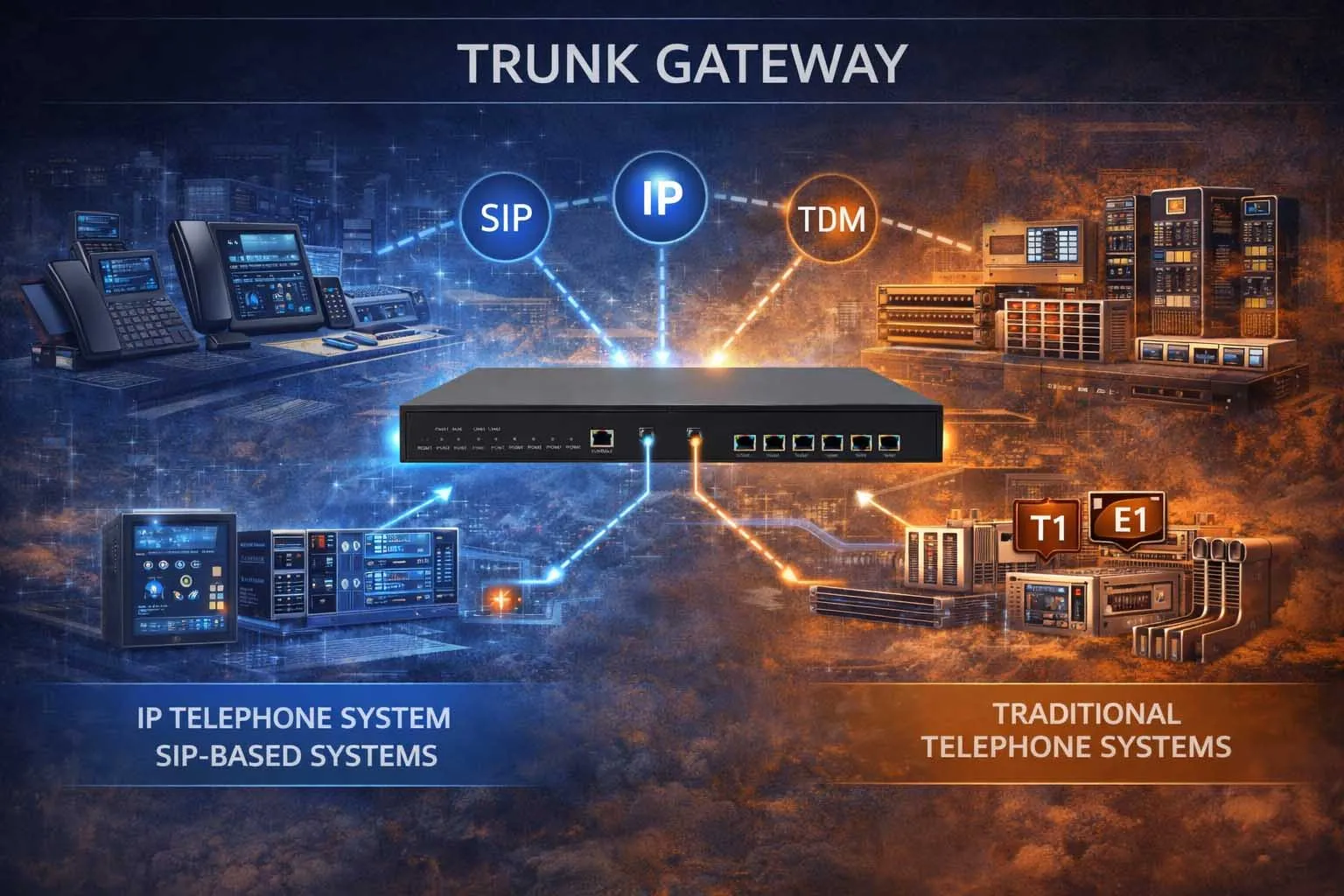
Trunk gateways are typically used to interconnect SIP-based voice systems with digital trunk interfaces such as T1, E1, and PRI.
How a Trunk Gateway Works
Call Signaling and Media Interworking
A trunk gateway works by receiving call signaling on one side, mapping it to the signaling model used on the other side, and then establishing the media path so that voice can pass correctly between networks. In a common example, the IP side uses SIP for call setup and RTP for media transport, while the trunk side uses ISDN PRI over T1 or E1. The gateway interprets the incoming signaling, allocates call resources, negotiates codecs or channel use where needed, and connects the media stream to the correct trunk channel.
This means the gateway performs more than simple forwarding. It may translate numbering formats, map cause codes, normalize calling and called party information, align dialing plans, and handle differences between IP call logic and legacy trunk expectations. Without this interworking layer, a SIP call control platform and a legacy trunk service may not understand one another well enough to complete calls reliably.
Trunk Termination and Resource Allocation
On the trunk side, the gateway terminates the physical or logical trunk interface. This may involve T1, E1, PRI, or other digital trunk resources, depending on platform and region. On the IP side, the gateway registers to or peers with a SIP server, IP PBX, softswitch, or service-provider platform. When a call arrives, the device selects an available timeslot or media resource, applies routing logic, and connects the session to the destination network.
DSP resources often play a key role in this process. Depending on deployment needs, the gateway may provide packetization, depacketization, echo control, tone handling, DTMF conversion, transcoding, and fax or modem support. Even when both sides are voice-capable, their expectations may not be identical, so the gateway ensures that signaling, channel use, and media behavior remain compatible across the interconnection.
In operational terms, the trunk gateway becomes the controlled handoff point between old and new telephony domains. That is why it is so often used in phased migration designs rather than all-at-once replacements.
A trunk gateway does not merely pass calls through. It terminates one trunk environment, interprets its signaling and media rules, and rebuilds the call in the format expected by the next network.
Core Features of a Trunk Gateway
Digital Trunk Interface Support
One of the defining features of a trunk gateway is support for digital trunk interfaces used in enterprise and carrier voice networks. Common forms include T1, E1, and ISDN PRI, along with regional variations in framing, line coding, and signaling behavior. This is what makes the device useful in environments where voice connectivity is still delivered through structured digital trunks instead of only native IP access.
This feature is especially important in migration scenarios. A company may want to move its core voice platform to SIP while continuing to use an existing PRI service for a transition period. A provider may need to keep digital trunk handoffs active while modernizing the rest of the network. A trunk gateway supports that continuity by providing a clean interconnection point.
Protocol and Signaling Interworking
Another key feature is protocol interworking. The gateway often needs to align SIP signaling on the IP side with ISDN or other trunk signaling on the TDM side. That includes call setup, teardown, caller identification, number mapping, redirect logic, digit manipulation, cause-code handling, and supplementary service behavior. In real projects, this is often more important than raw port count, because many interconnect problems come from signaling mismatches rather than physical link issues.
Good interworking support also improves interoperability with mixed-vendor deployments. Enterprises may have one PBX vendor, one SIP trunk provider, and a different trunk gateway brand. The gateway’s value lies in making those components behave consistently enough for production service.
Call Routing, Number Translation, and Survivability
Trunk gateways usually include routing logic that determines where inbound and outbound calls should go. This may involve digit analysis, prefix rules, failover paths, class-of-service handling, least-cost routing, or local breakout behavior. Number normalization is often necessary because one side may expect E.164 formatting while the other expects local dial plans or PBX-oriented numbering conventions.
Many trunk gateways also support resilience features. In branch deployments, they can preserve local PSTN access if the WAN or central IP call server becomes unavailable. In migration environments, they can provide fallback from SIP trunking to legacy trunks or the reverse. This survivability role is one reason trunk gateways remain valuable even after an organization begins moving to all-IP communications.
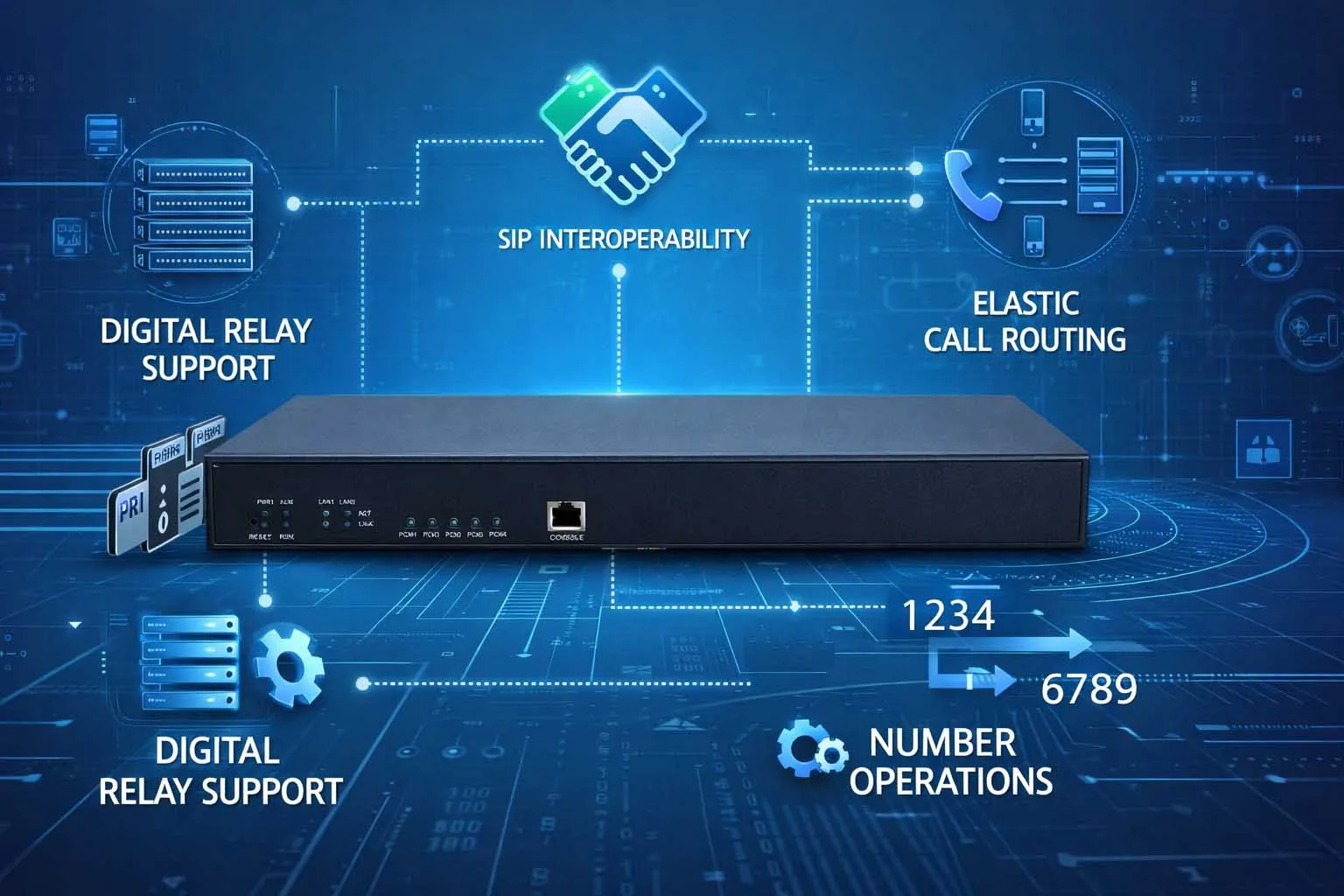
Common trunk gateway features include digital trunk support, SIP interworking, number manipulation, and resilient call routing.
Trunk Gateway vs. Other Gateway Types
Difference from an Analog Gateway
An analog gateway is usually built to connect analog endpoints or analog lines, using FXS or FXO ports. A trunk gateway, by contrast, is generally built for multi-channel trunk services rather than for single analog stations. The design focus is different: analog gateways emphasize line-side connectivity for phones, fax devices, or analog PSTN access, while trunk gateways emphasize structured trunk interconnection and multi-call capacity.
This difference matters because they solve different problems. If the goal is to preserve a group of legacy analog phones, an analog gateway is appropriate. If the goal is to preserve or convert a PRI trunk between a PBX and a SIP service, a trunk gateway is the more relevant category.
Difference from a Generic VoIP Gateway or SBC
A generic VoIP gateway is a broader term that can include analog gateways, digital gateways, and hybrid media gateways. A trunk gateway is often one subset of that larger family, specifically focused on trunk-side interconnection. The term “media gateway” also overlaps, because many trunk gateways perform media conversion and signaling interworking at the same time. In practice, vendors may describe the same product as a voice gateway, media gateway, PRI gateway, or trunk gateway depending on how they position it.
An SBC is different again. While some platforms combine gateway and SBC functions, the SBC role is more focused on SIP normalization, topology hiding, security policy, and session control at network boundaries. A trunk gateway is more directly associated with TDM-to-IP or trunk-to-trunk interworking, especially where physical digital trunk interfaces remain in service.
The easiest way to understand a trunk gateway is to see it as the gateway class built for trunks first, not for endpoints first. Its main job is interconnecting call capacity, signaling domains, and voice transport models.
Typical Network Architecture
Enterprise IP PBX to Carrier Trunk Interconnection
In a common enterprise architecture, the trunk gateway sits between an IP PBX or unified communications platform and a carrier-side digital trunk. On the IP side, the PBX sends SIP signaling and RTP media. On the carrier side, the service may arrive as PRI over T1 or E1. The gateway translates between the two, allowing the enterprise to modernize call control while keeping the existing carrier access method during transition.
This architecture is frequently used when a business wants to retain numbering, PBX logic, and user experience while changing only one side of the network at a time. It is also common where carrier modernization lags behind enterprise modernization, or vice versa.
Legacy PBX to SIP Trunk Architecture
Another common design places the trunk gateway between a legacy PBX that only understands digital trunks and a modern SIP trunk service from an ITSP. In that case, the gateway presents a familiar PRI or T1/E1 interface to the PBX while appearing as a SIP peer to the provider side. The PBX continues operating as before, but the service edge moves into the IP domain.
This architecture can extend the useful life of installed PBX equipment while enabling phased migration away from traditional carrier services. It is especially attractive in large sites where immediate full replacement would create too much cost, operational risk, or retraining burden.
Branch and Multi-Site Designs
Trunk gateways are also common in distributed voice architectures. A branch may use a local digital trunk for survivable calling while the primary call control remains centralized. In other cases, a central site may aggregate multiple trunk gateways that terminate legacy trunks from older branches and convert them into IP sessions for routing through a modern voice core.
These designs highlight the gateway’s role as an interworking and continuity tool. Rather than forcing every site to upgrade at once, the network can evolve in layers while maintaining usable service across the installed base.
Applications of Trunk Gateways
Legacy Telephony Migration
One of the most important applications of trunk gateways is legacy telephony migration. Many organizations still operate PBXs, contact centers, hotel systems, campus telephony platforms, or institutional voice systems that were built around digital trunks. Replacing everything at once is often unrealistic. A trunk gateway allows those systems to stay in place while interworking with SIP trunking, IP PBXs, or cloud-connected voice platforms.
This migration role is especially valuable in sectors with long equipment lifecycles or strict operational continuity requirements, such as healthcare, hospitality, manufacturing, transportation, government, and education.
Enterprise SIP Trunk Adoption
Trunk gateways are widely used when enterprises adopt SIP trunking but still have legacy trunk-oriented equipment on site. Instead of replacing every interface card, shelf, or switching module immediately, the organization can deploy a trunk gateway that bridges old and new. This reduces migration pressure and allows staged cutovers, testing, and rollback options.
In practical terms, that can mean lower project risk. The business can modernize service provider access while preserving existing PBX behavior until the rest of the communications environment is ready to change.
Carrier and Service Provider Interworking
Service providers also use trunk gateways where TDM and IP networks must coexist. This may include interconnecting legacy subscribers to newer softswitch platforms, aggregating digital trunks into IP cores, or supporting hybrid voice services during network transformation. In these deployments, the gateway helps keep legacy access methods operational while enabling broader IP-based transport and service control.
Although large carrier networks may also use more specialized media gateway and softswitch architectures, the underlying application is similar: the trunk gateway preserves interworking between established trunk technologies and modern packet voice infrastructure.
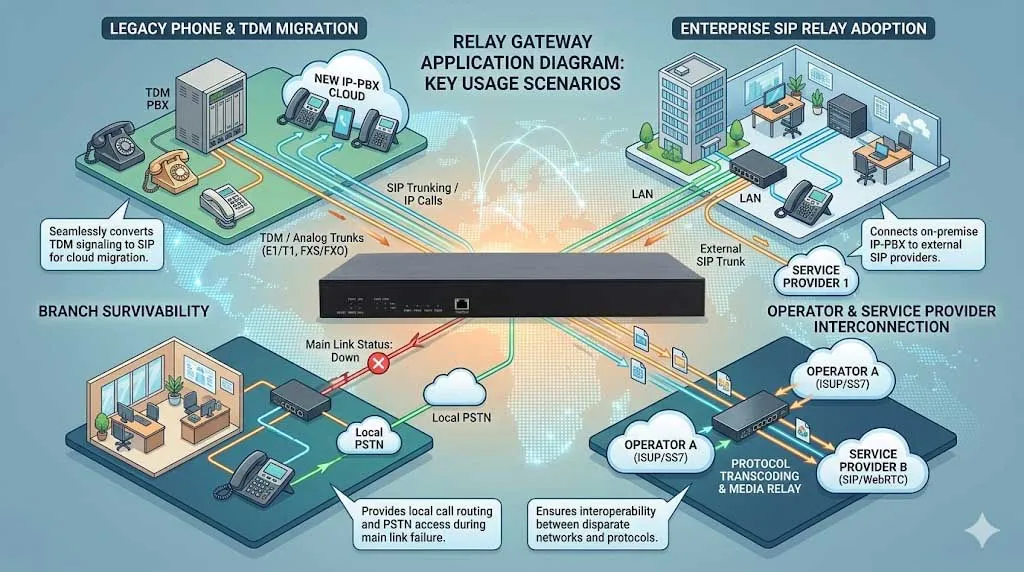
Trunk gateways are widely used for PBX migration, SIP trunk adoption, branch survivability, and hybrid carrier voice architectures.
Benefits and Operational Value
Investment Protection and Controlled Migration
The most visible value of a trunk gateway is investment protection. It allows an organization to keep using working PBXs, digital trunk interfaces, and existing dial plans while gradually moving toward SIP-based communications. That can reduce capital pressure and avoid unnecessary disruption in environments where the telephony system still supports essential operations.
Controlled migration is equally important. Voice services often touch emergency calling, front-desk operations, call centers, dispatch positions, and business-critical extensions. A trunk gateway allows those services to be modernized in phases instead of through a single disruptive replacement.
Interoperability and Service Continuity
Another major benefit is interoperability. Mixed-vendor voice networks are common, and signaling behavior is not always perfectly aligned. A trunk gateway provides a practical mediation layer between systems that would otherwise be difficult to connect directly. This is often the difference between a workable hybrid environment and a failed deployment.
Service continuity is also a core advantage. By preserving PSTN access, fallback behavior, or local breakout options, trunk gateways can help organizations maintain calling capability during WAN failures, migration windows, or provider-side changes. That continuity is especially valuable in environments where telephony remains part of daily operations and safety workflows.
Trunk gateways remain relevant because they let voice networks evolve without forcing every PBX, provider circuit, and branch site to change on the same day.
Conclusion
Why Trunk Gateways Still Matter
A trunk gateway is a voice interworking device built to connect trunk-side telephony systems across different technologies, most commonly between IP-based voice platforms and digital TDM trunks such as T1, E1, and PRI. It handles signaling translation, media interworking, call routing, number normalization, and operational continuity across networks that were never designed to speak the same language natively.
Its importance comes from real-world migration needs. Even in an era of SIP trunking and cloud communications, many enterprises, institutions, and providers still depend on legacy trunk services or trunk-oriented equipment. A trunk gateway gives them a practical way to modernize step by step while keeping service stable. That makes it one of the most useful tools in hybrid voice architecture.
FAQ
Is a trunk gateway the same as a VoIP gateway?
Not exactly. A trunk gateway is usually one type of VoIP gateway, but it is more specifically focused on trunk-side interconnection rather than on individual analog endpoints. In most cases, it is used to connect SIP-based systems with digital trunks such as T1, E1, or PRI.
So the relationship is overlapping rather than identical. “VoIP gateway” is broader, while “trunk gateway” usually points to a more specific interworking role inside the telephony architecture.
What interfaces are commonly used on a trunk gateway?
Common interfaces include T1, E1, and ISDN PRI on the trunk side, together with Ethernet-based IP connectivity for SIP signaling and RTP media on the IP side. Some platforms may also support additional digital or analog options, but the typical trunk gateway identity centers on structured multi-channel trunk interfaces.
The exact mix depends on region, carrier practice, and the installed telephony environment. North American deployments often emphasize T1/PRI, while many other regions emphasize E1/PRI.
Why would an organization still use a trunk gateway today?
Organizations still use trunk gateways because many voice environments are hybrid. A company may have a working PBX that only supports PRI. A provider may still deliver or require digital trunk handoffs in part of the network. A branch may need local PSTN survivability while the rest of the voice platform is centralized. In these cases, the trunk gateway is the bridge that allows modernization without immediate full replacement.
This is especially common where telephony supports front-desk operations, emergency calling, hospitality systems, healthcare workflows, contact centers, or other business functions that cannot tolerate abrupt transition risk.
Can a trunk gateway help with SIP trunk migration?
Yes. This is one of its most common uses. A trunk gateway can present a legacy digital trunk interface to an older PBX while connecting upstream to a SIP trunk service. That lets the enterprise adopt SIP trunking without replacing the PBX on day one.
It can also work the other way in transitional environments, preserving older carrier access or local digital trunk resources while the internal voice system migrates toward SIP-based call control.