Three-way calling is a telephony feature that allows one user to connect with two other parties in a single active call. Instead of ending one call and starting another, or relying on a separate conference platform, the user can bring a third participant into the same voice session and continue the conversation together. In practical terms, it is one of the simplest forms of conferencing and has long been used in business phones, PBX systems, analog telephone services, IP phones, and hosted voice platforms.
Although it is a basic feature when compared with large audio conferencing systems or modern unified communications platforms, three-way calling remains highly useful because it solves everyday communication needs quickly. A receptionist can connect a manager and a visitor, a field technician can bring in a supervisor during a service call, and a front desk user can add another department into a live conversation without arranging a separate meeting. Its value comes from speed, simplicity, and immediate collaboration.
Understanding Three-Way Calling
What Three-Way Calling Means
Three-way calling refers to a call control feature that lets one active caller add a second remote party to an existing call so that three people can talk together. The user typically begins with one live call, places that call on hold or in a waiting state, dials the third participant, and then merges the two call legs into a shared session. Once connected, all three parties can hear and speak with each other as part of the same conversation.
In many phone systems, three-way calling is treated as a small conference call rather than as a separate category of service. The difference is usually one of scale rather than principle. Large conference features may support more participants, host controls, and meeting management tools, while three-way calling focuses on a lightweight, immediate interaction between three people. That is why it is often built directly into desktop phones, cordless handsets, analog terminal adapters, and PBX user features.
Why It Is Still Relevant
Three-way calling remains relevant because many real conversations do not need a formal meeting room, a collaboration app, or a scheduled conference bridge. In office operations, customer handling, maintenance support, and internal coordination, users often only need to bring one more person into the call to solve a problem or confirm a decision. The feature makes that possible with very little friction.
Its continued relevance is also tied to compatibility. Three-way calling can appear across traditional telephony and IP-based voice systems, which means it works well in mixed environments where some users still rely on desk phones, PBXs, analog devices, or SIP terminals. As a result, it remains one of the most practical supplementary call features in everyday telephony.
In other words, three-way calling survives not because it is advanced, but because it is efficient. It supports quick coordination inside the normal flow of a live call.
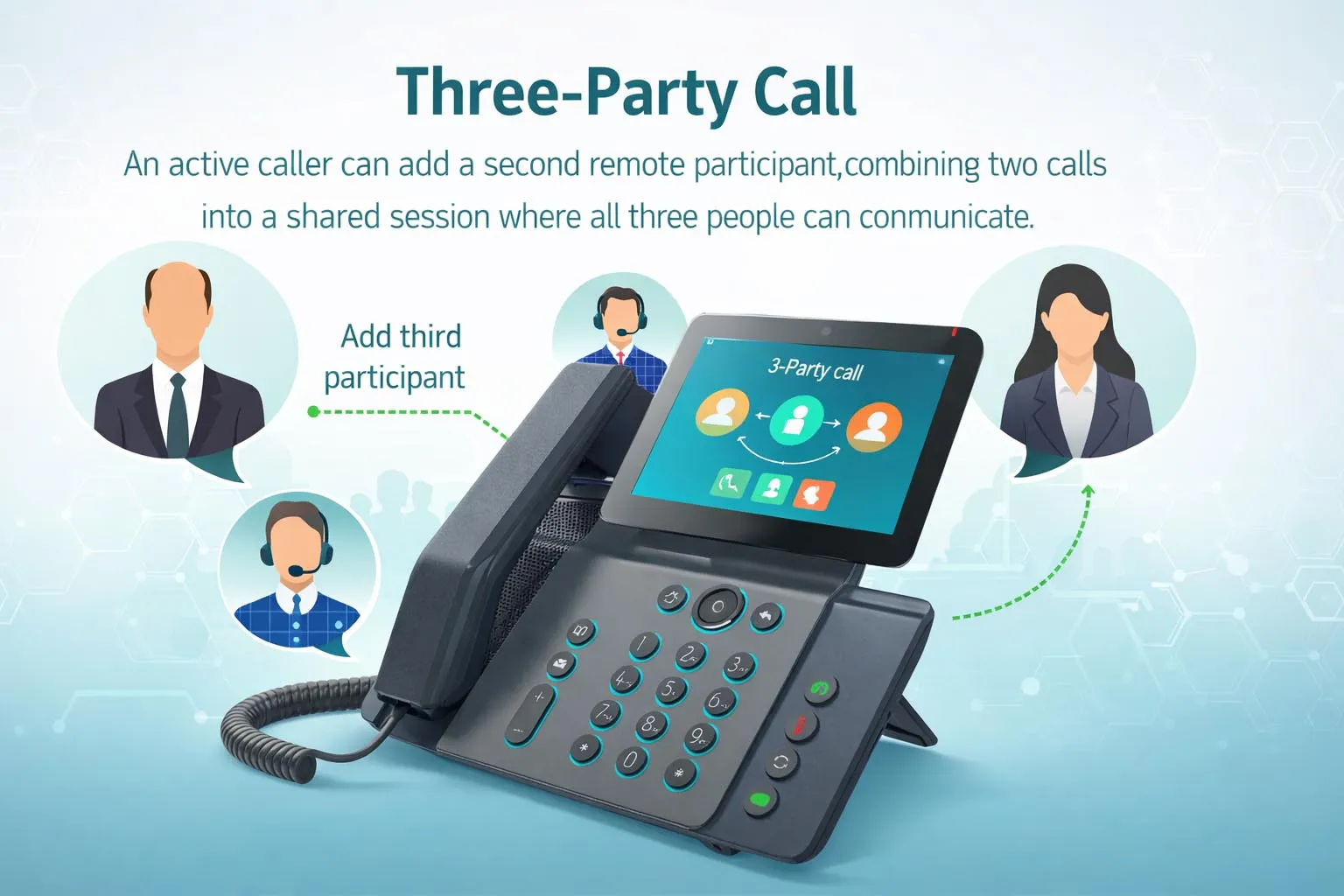
Three-way calling allows one user to bring two separate call parties into a single shared conversation.
How Three-Way Calling Works
Basic Call Flow
The usual workflow begins with an active conversation between two parties. The initiating user then activates the conference or flash function, which temporarily places the first call on hold or in a waiting state. The user dials the third person, waits for that party to answer, and then presses the relevant key or command to merge both call legs. After the merge, the three participants are bridged together into one active voice session.
The exact user experience depends on the phone type and service platform. On a business IP phone, the user may press a dedicated conference key. On an analog phone service, the action may involve pressing the hook flash key. In a PBX or hosted VoIP system, the merge may be handled by the call control server. Despite these interface differences, the communication principle is similar across implementations: one user is controlling two call legs and then combining them into a shared call.
Call Control and Media Handling
From a system perspective, three-way calling involves both signaling control and media handling. The signaling side manages call setup, hold, alerting, answer status, and the command to join the calls. The media side determines how audio is mixed so that all parties can hear one another in real time. In some systems, the endpoint itself may support part of this behavior, while in others the PBX, gateway, or hosted platform provides the conference bridge function.
This distinction matters because the user-visible feature may look simple even though the underlying implementation varies. A small office desk phone may depend on the server to create the conference. An analog adapter may rely on feature logic from the service provider. A unified communications platform may support three-way calling as part of a broader conferencing engine. The practical result is the same for the user, but the architecture behind it can differ significantly.
That is one reason the feature appears so widely. It is flexible enough to be implemented in traditional carrier services, enterprise PBXs, SIP systems, and hybrid telephony deployments.
Three-way calling is one of the clearest examples of a high-value telephony feature: simple for the user, but operationally powerful because it turns a one-to-one call into a quick decision-making conversation.
Core Features of Three-Way Calling
Fast Escalation from Private Call to Small Conference
The most important feature of three-way calling is instant escalation. A user who is already speaking with one person can bring a second person into the conversation immediately, without ending the original call or sending anyone to another system. This is especially useful when the third party is needed only briefly, such as for approval, clarification, translation, technical advice, or identity verification.
Because the escalation happens inside the current call flow, it saves time and reduces communication disruption. The original caller does not need to repeat everything in a separate call, and the added participant can contribute directly in context. For service teams and busy office users, this directness is one of the feature’s strongest advantages.
Simple User Operation on Many Phone Types
Another key feature is ease of use. Many business phones expose three-way calling through a clearly labeled conference button, a soft key, or a short hook-flash sequence. Users do not need advanced conferencing knowledge to use it. Once configured by the service provider or system administrator, the feature is usually available through a short, familiar action sequence.
This ease of use matters because telephony features only create value when ordinary users are willing to use them. A function that requires special training or a complicated workflow often stays underused. Three-way calling, by contrast, is widely understood and easy to perform, which makes it suitable for daily business use rather than only for technical staff.
Support Across PBX, VoIP, and Legacy Voice Systems
Three-way calling is also notable for its broad compatibility. It exists in analog calling services, key phone systems, PBXs, SIP desk phones, cloud calling platforms, cordless business phones, and many voice gateway environments. This gives it strong practical value in mixed or transitional networks where not every user is on the same platform generation.
For example, an organization migrating from legacy telephony to hosted VoIP may still expect three-way calling to work across desks, reception points, and departmental users. Because the feature has been preserved across generations of voice systems, it remains familiar to users and easy to justify in both legacy support and modernization projects.
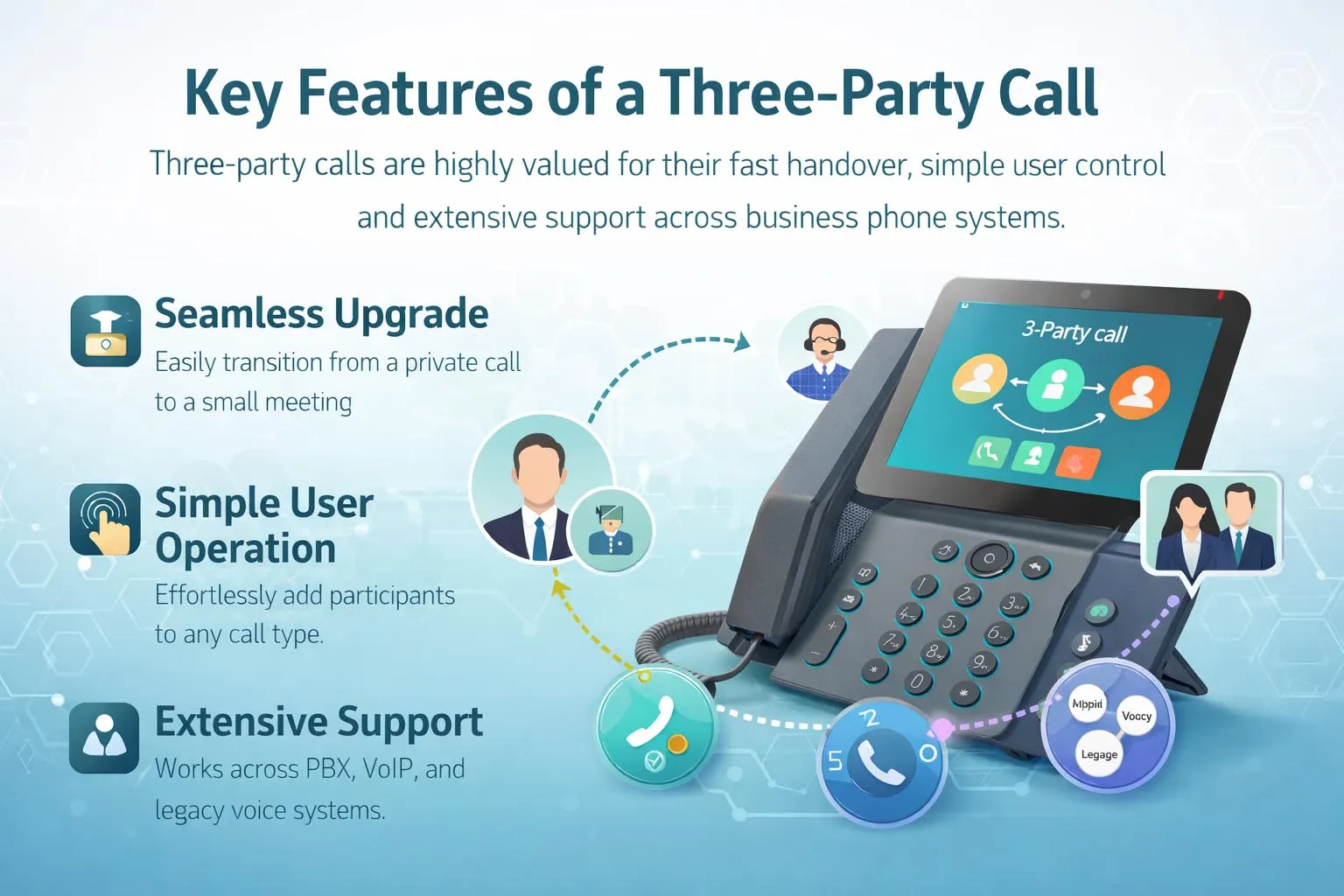
Three-way calling is valued for fast call merging, simple user control, and broad support across business phone systems.
System Value of Three-Way Calling
Faster Decision-Making and Issue Resolution
One of the clearest forms of system value is speed. When a user can add a third participant during a live call, the conversation becomes more efficient. Questions can be answered immediately, responsibility can be handed over more cleanly, and decisions can be confirmed without waiting for a later callback or a separate meeting. This reduces delays in customer service, internal escalation, and day-to-day coordination.
In practice, this means a support agent can add a supervisor, a receptionist can add a department contact, or a project user can add a technical specialist while the original caller remains on the line. Instead of breaking the communication flow, three-way calling preserves continuity. That continuity has real operational value because it reduces repetition, shortens handling time, and improves the chance of resolving an issue in one interaction.
Better Customer Handling and Internal Coordination
Three-way calling also improves how organizations handle live callers. In customer-facing roles, the feature can reduce frustration because the caller does not need to disconnect and wait while the employee tries to reach someone else. The additional participant joins the same session, which feels more direct and more professional. That is especially helpful in front desk, healthcare, hospitality, public service, and technical support environments.
Internally, the same feature supports small-group coordination without moving users away from their normal devices. For many teams, especially those that still rely heavily on desk phones or simple voice workflows, that matters more than advanced conferencing tools. A short, immediate conversation between three people is often enough to keep work moving efficiently.
From a systems perspective, this makes three-way calling a small feature with outsized business value. It improves responsiveness without requiring major behavioral change from the user base.
The real value of three-way calling is not the number three. It is the ability to resolve a live conversation at the moment it needs one more voice.
Applications of Three-Way Calling
Office Communication and Administrative Support
In office environments, three-way calling is commonly used by receptionists, assistants, managers, and department coordinators. A front desk user may receive a call and quickly add the correct internal contact. An assistant may connect an executive with a supplier and remain on the line long enough to confirm the purpose of the discussion. A manager may bring another team member into a live customer conversation for faster clarification.
These are simple use cases, but they occur frequently. That is why three-way calling remains a standard business phone feature rather than a niche option. It fits everyday communication patterns in organizations that value quick voice interaction and live human coordination.
Customer Service, Help Desk, and Technical Support
Three-way calling is especially useful in support scenarios. A service representative can speak with a customer and then add a technician, billing specialist, supervisor, or language support resource into the same call. This reduces the need for cold transfers and helps keep the original conversation intact. The customer hears the handoff directly and can stay part of the discussion instead of repeating the issue from the beginning.
In technical support, that capability can save significant time. When the first-line agent reaches the limit of what they can handle, a knowledgeable second-line user can be added immediately. The support case then moves forward inside one session instead of being broken into multiple disconnected call stages.
Healthcare, Hospitality, and Public Service Operations
Healthcare desks, hotel front offices, school administration points, and public service counters often deal with calls that require immediate coordination between more than two people. A clinic receptionist may add a nurse or scheduling desk. A hotel operator may add guest services or security. A school office may add a teacher or administrator while speaking with a parent. In these environments, the feature supports smoother human handoffs in real time.
Because these sectors often still depend heavily on practical voice workflows, three-way calling can be more valuable than more advanced meeting tools. It works on familiar devices and suits short operational conversations where speed matters more than formal collaboration features.
Industrial, Field Service, and Emergency Communication Support
In industrial sites and field operations, three-way calling can help users bring in a supervisor, control room operator, or technical specialist while an issue is unfolding. A field worker speaking with dispatch can add a maintenance engineer. A control room operator can bring in site management. A security or emergency communication point can connect a responding team member without fully transferring the session away from the original operator.
These uses highlight how the feature supports operational continuity. In environments where every extra step slows response, the ability to add another participant during a live voice exchange is practical and meaningful. Even in systems that also include paging, intercom, or dispatch functions, three-way calling remains useful because it provides a simple person-to-person coordination layer.
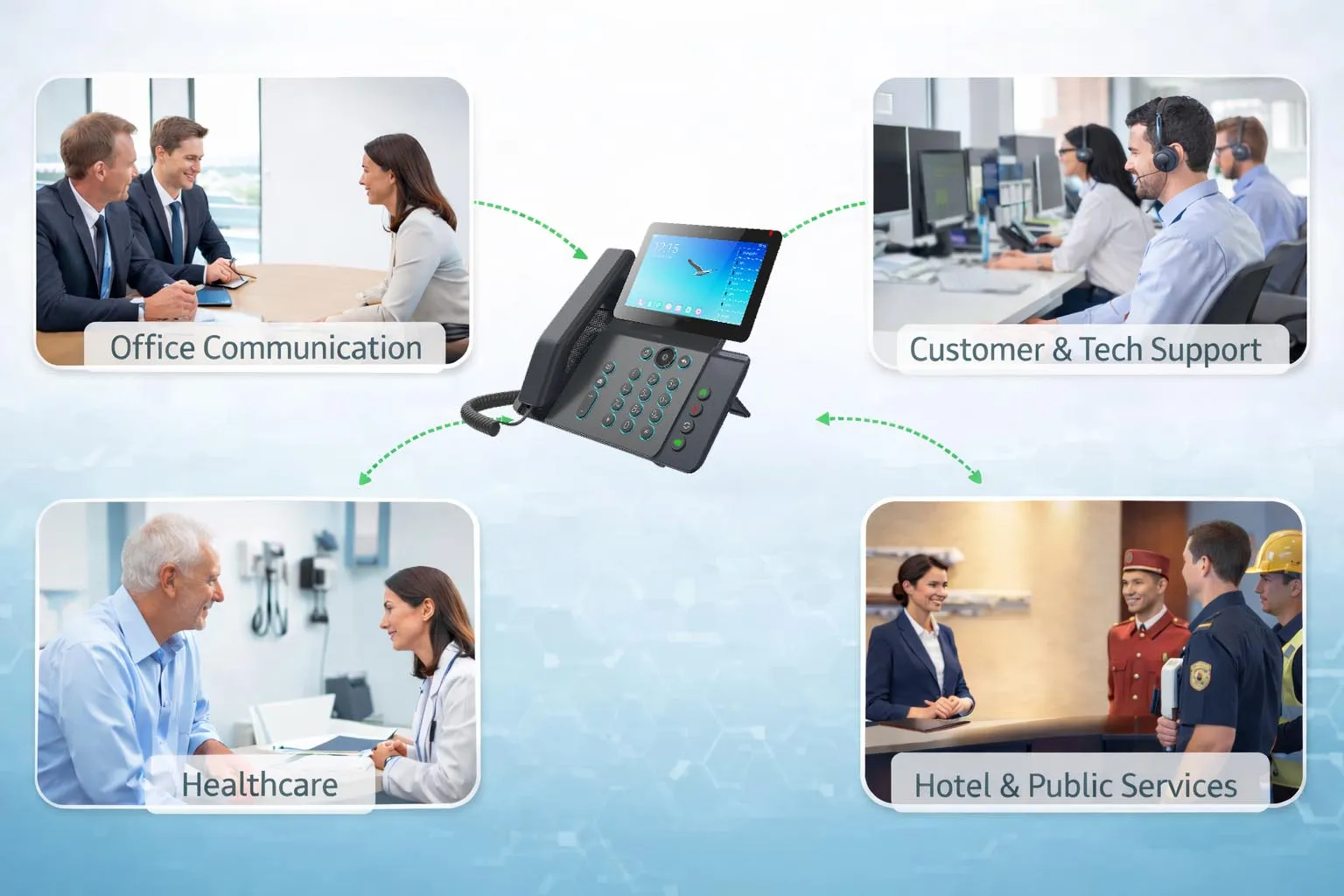
Three-way calling is widely used in administration, support desks, hospitality, healthcare, and operational coordination environments.
Three-Way Calling Compared with Other Call Features
Three-Way Calling vs. Call Transfer
Three-way calling is often confused with call transfer because both features involve another person joining the communication flow. The difference is that a transfer normally passes the caller to someone else, while three-way calling keeps the initiating user involved in the conversation. This is important when the original user needs to explain context, stay accountable, or remain available while the issue is discussed.
That is why the two features are complementary rather than interchangeable. Transfer is ideal when ownership moves completely to another person. Three-way calling is better when the original user still needs to participate, supervise, or support the handoff.
Three-Way Calling vs. Larger Conference Calling
Compared with broader conference calling, three-way calling is more limited in scale but faster in use. A larger conference system may allow many participants, host controls, mute management, participant lists, recording, or scheduled meetings. Three-way calling usually focuses on a lightweight live merge between three parties only. It is therefore less feature-rich, but much easier to trigger in the middle of an ordinary business call.
For daily communication, that simplicity is often an advantage. Not every issue requires a meeting bridge or collaboration platform. Many situations only require one extra participant, and three-way calling is optimized for exactly that need.
Implementation Considerations
Platform Support, Licensing, and User Training
Although the feature is common, organizations should still confirm how it is supported on their specific platform. Some systems provide three-way calling as a built-in user feature, while others depend on PBX configuration, carrier service permissions, endpoint capability, or hosted service plans. Administrators should verify whether the phone, analog adapter, gateway, or cloud service supports the intended conference method.
User training is also important, even for a simple feature. Staff should know whether to use a conference key, a soft key, a flash hook, or a service code, and they should understand whether they remain in the call after the merge. A short amount of user guidance often makes the difference between a feature being available and a feature being genuinely useful.
Audio Quality and Operational Policy
Because three-way calling mixes multiple participants, audio quality matters. Good handset design, echo control, codec compatibility, and stable network or carrier conditions all influence the call experience. In VoIP systems, poor network conditions can affect a three-way call more noticeably than a simple point-to-point call because more media paths or server-side mixing may be involved.
Organizations should also decide where the feature makes the most sense operationally. In some roles, three-way calling is essential and should be easy to access. In others, call transfer or escalation to a contact center queue may be more appropriate. Good telephony design matches the feature to the communication workflow rather than enabling everything without structure.
Three-way calling works best when the feature is not only available, but also aligned with real user workflows such as reception, support escalation, field coordination, and assisted service handling.
Conclusion
Why Three-Way Calling Still Matters
Three-way calling is a straightforward but valuable telephony feature that allows one user to add a third participant into an existing call. Its core strengths are simplicity, speed, and immediate collaboration. By turning an ordinary two-party call into a small live conference, it helps users resolve questions faster, coordinate more effectively, and handle callers more smoothly.
Its importance comes from practical utility rather than technical complexity. Whether used on a PBX desk phone, a hosted VoIP platform, an analog business line, or a mixed communication environment, three-way calling remains one of the most useful supplementary voice features for daily operations. It is a small function, but it supports faster human decisions where they often matter most: in the middle of a live call.
FAQ
Is three-way calling the same as conference calling?
Three-way calling is usually considered a basic form of conference calling, but it is narrower in scope. It normally supports three participants in one live call, while broader conference calling systems may support many more participants and offer extra controls such as mute management, participant lists, or scheduled meeting functions.
In everyday business use, people often treat three-way calling as a small conference feature built directly into the phone system. The main difference is scale and complexity rather than a completely different concept.
Do all business phones support three-way calling?
No. Many business phones and voice platforms support it, but actual availability depends on the endpoint model, PBX configuration, service provider settings, or hosted platform license. Some phones provide a dedicated conference button, while others rely on soft keys or hook-flash actions.
That is why organizations should confirm both device support and service-side support before assuming the feature is available to every user. In many environments it is common, but it is still a configurable telephony feature rather than an automatic guarantee.
What is the difference between three-way calling and call transfer?
With call transfer, the original user usually passes the caller to another person and may leave the conversation. With three-way calling, the original user stays in the call and joins both other parties into one shared session. This makes three-way calling more suitable when the initiating user needs to explain context, supervise the conversation, or remain involved until the issue is resolved.
Both features are useful, but they serve different communication purposes. Transfer hands the call off, while three-way calling keeps the handoff visible and collaborative.
Where is three-way calling most useful?
Three-way calling is especially useful in reception, customer service, help desk, healthcare administration, hospitality, public service counters, field coordination, and small business communication. These are environments where users often need to bring in one more person quickly during a live voice interaction.
Its value is highest when the extra participant is needed immediately for clarification, approval, technical advice, or service continuity. In those moments, three-way calling is faster and simpler than arranging a separate conference or callback.