UL certification is a third-party product conformity process used to evaluate whether a product, component, material, or system complies with specific safety and performance requirements. In practical terms, it means an independent certification body has assessed a product against applicable standards and authorized the use of a certification mark when the product meets those requirements. For manufacturers, UL certification can support market access, code acceptance, and buyer confidence. For specifiers, contractors, inspectors, and end users, it helps show that a product has been evaluated against recognized criteria rather than only the manufacturer’s own claims.
The term is often used broadly in commercial communication, but UL certification is not one single test or one universal safety label that covers everything. Different product categories are evaluated against different standards, construction rules, and intended-use conditions. Because of that, understanding UL certification requires more than simply recognizing the mark. It also requires understanding the product category, the scope of the certification, the applicable standard, and any ratings or limitations printed on the product.
Understanding UL Certification
What UL Certification Means
UL certification generally refers to a product evaluation and follow-up process in which a third-party organization reviews a product against one or more applicable standards. When the product complies, it may bear an appropriate certification mark that helps identify the nature of that certification. In many industries, the UL Mark is treated as a visible sign that the product has been independently examined for defined safety-related requirements.
This is especially important in electrical, electronic, industrial, and building-related products where authorities having jurisdiction, project engineers, or procurement teams often need evidence that equipment aligns with recognized safety expectations. In that sense, UL certification is not just a branding element. It is part of a broader compliance, inspection, and product acceptance framework.
Why UL Certification Matters in the Market
UL certification is widely referenced because product safety decisions often affect installation approval, workplace compliance, insurance expectations, and long-term operational risk. In regulated or code-driven markets, a recognized certification mark can simplify acceptance by showing that a product has already been assessed to a relevant standard instead of forcing every buyer or installer to make that determination independently.
It also matters commercially. Manufacturers use certification to improve product credibility, shorten qualification cycles, and compete in markets where third-party evidence is expected. For buyers, especially in industrial, commercial, and infrastructure projects, a certified product can reduce uncertainty when comparing equipment for critical applications.
That said, certification should never be read as a blanket promise that the product is suitable for every environment or every installation method. Certification always operates within a defined scope. The product still has to be selected, installed, and used according to its ratings, instructions, and applicable codes.
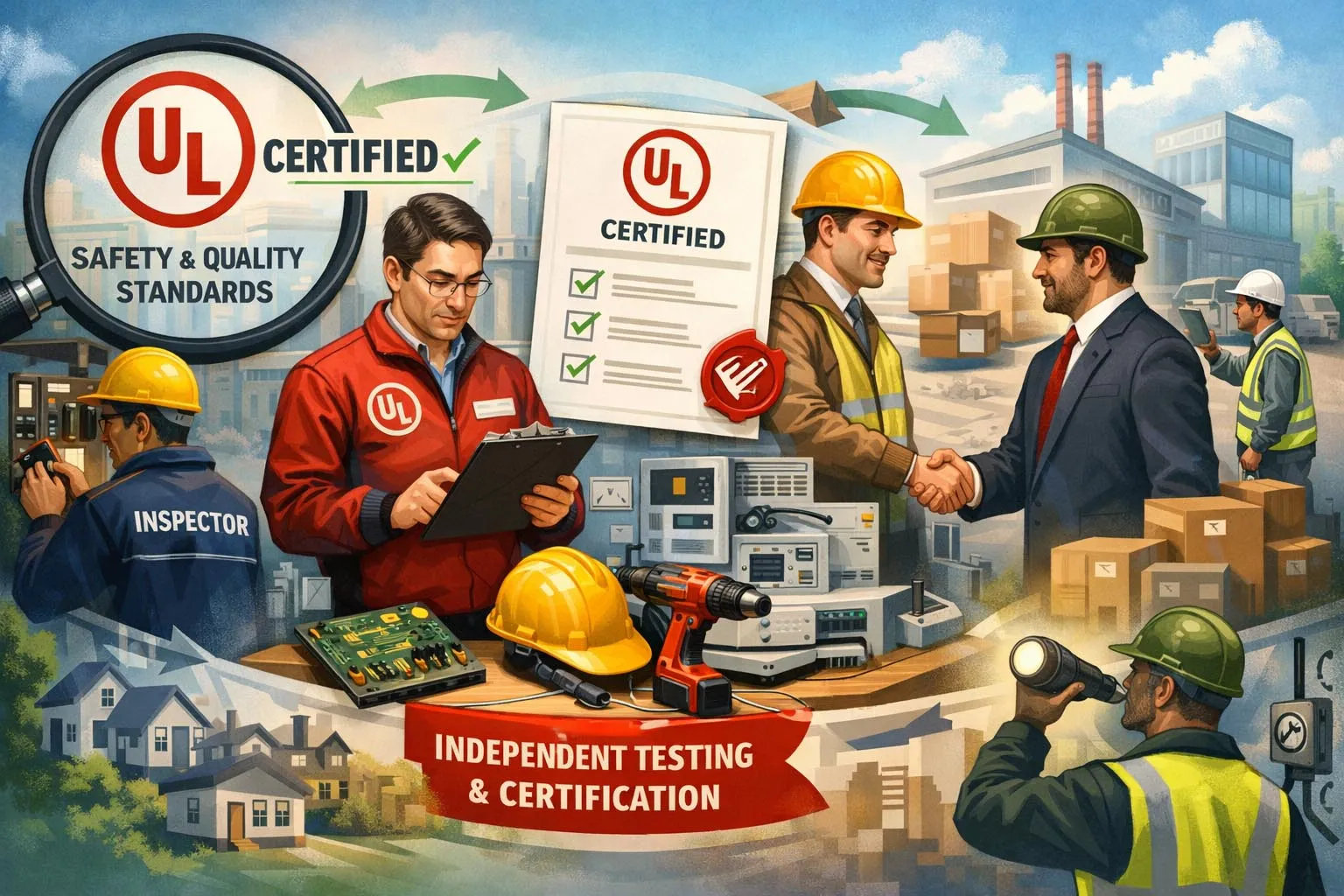
UL certification is a third-party conformity process that helps show a product has been evaluated to applicable requirements.
How the UL Certification System Works
Applicable Standards and Product Categories
One of the most important things to understand is that UL certification is standards-based. A product is not certified in the abstract. It is assessed against the requirements that apply to its category, design, intended use, and construction. For example, an industrial control panel, a power supply, a household appliance, a network device, and a plastic material may all involve different standards and different evaluation methods.
This standards-driven structure is why certification language needs to be precise. A product may be certified to one safety standard but not another. It may be suitable for indoor dry locations but not washdown areas. It may be evaluated as a component for use inside a larger assembly rather than as a complete end product. The standard and category matter because they define the real scope of the certification.
Testing, Documentation, and Ongoing Follow-Up
The certification process usually involves construction review, sample testing, document evaluation, marking requirements, and manufacturing controls. The certification body evaluates whether the submitted design meets the relevant requirements and whether the manufacturer can produce that design consistently. In many programs, certification is not limited to a one-time laboratory event. It is tied to ongoing follow-up activities intended to confirm continuing compliance of production units with the certified design.
This continuing oversight is one reason certification marks carry weight in the market. The mark does not simply mean a prototype once passed a lab test. It reflects an ongoing relationship between the manufacturer, the certified design record, and the follow-up system that supports continued conformity over time.
UL certification is best understood as a standards-based conformity framework, not as a generic safety sticker. The meaning of the mark depends on what was evaluated, to which standard, and for what intended use.
Common UL Certification Marks and Their Meanings
UL Listed, UL Recognized, and UL Classified
In practice, buyers and engineers often encounter different forms of UL certification marks. A UL Listed product is commonly a complete end product or equipment item intended for field installation or end use under the relevant code and standard conditions. A UL Recognized Component, by contrast, is generally a component intended to be used within a larger product or system, not necessarily installed on its own as a standalone end product.
UL Classified products occupy another category. A classified product is typically evaluated for specific properties, hazards, or limited conditions rather than broad end-product compliance in every respect. This is why classification details and markings matter. The mark may indicate that the product has been investigated for a particular performance attribute, fire-resistance role, or defined application rather than as a fully listed end-use device.
The Enhanced UL Certified Mark
Modern UL marking may also use enhanced certification marks that identify the product as certified and provide additional traceability and scope information. This broader marking language helps address products certified for multiple markets or multiple certification scopes. It also makes it easier for users to verify the meaning of the mark and look up supporting certification information when needed.
For project work, the practical lesson is simple: do not stop at the presence of the logo. Read the exact mark, the category description, the rating information, and the accompanying markings. Those details determine whether the certification fits the product’s intended application.
UL Standards Explained
UL Certification Is Not a Single Standard
A common misunderstanding is that “UL certified” refers to one universal standard. In reality, UL certification can involve many different standards depending on what the product is. Electrical enclosures may be evaluated under enclosure-related requirements, industrial control equipment under industrial control standards, information and communication equipment under product safety standards for that category, and plastics or insulation materials under entirely different requirements.
Because of this, engineers and purchasing teams should avoid asking only whether a product is UL certified. A more useful question is whether the product is certified to the standard relevant to the intended market and installation. That is what turns a general certification claim into a meaningful compliance statement.
For example, in the electrical and industrial space, common reference points may include enclosure standards, control panel standards, industrial control equipment standards, flammability requirements for materials, or category-specific standards tied to telecom, audio-video, laboratory, or building products. The right standard depends on the product’s design role and risk profile rather than on marketing preference.
Examples of Frequently Seen Standards
In real projects, some UL standards appear more often than others. Electrical enclosures often reference UL 50 and UL 50E considerations for enclosure construction and environmental performance. Industrial control panels commonly involve UL 508A. Many materials, plastics, and molded parts are discussed in connection with UL 94 flammability classifications. Information, communication, or laboratory-related devices may align with standards such as UL 62368-1 or UL 61010-series requirements depending on the product category.
These examples illustrate why the standard number should be treated as an important technical detail rather than fine print. Two products can both claim UL certification yet be certified under different standards for different intended uses. That difference directly affects engineering suitability, installation expectations, and downstream compliance decisions.
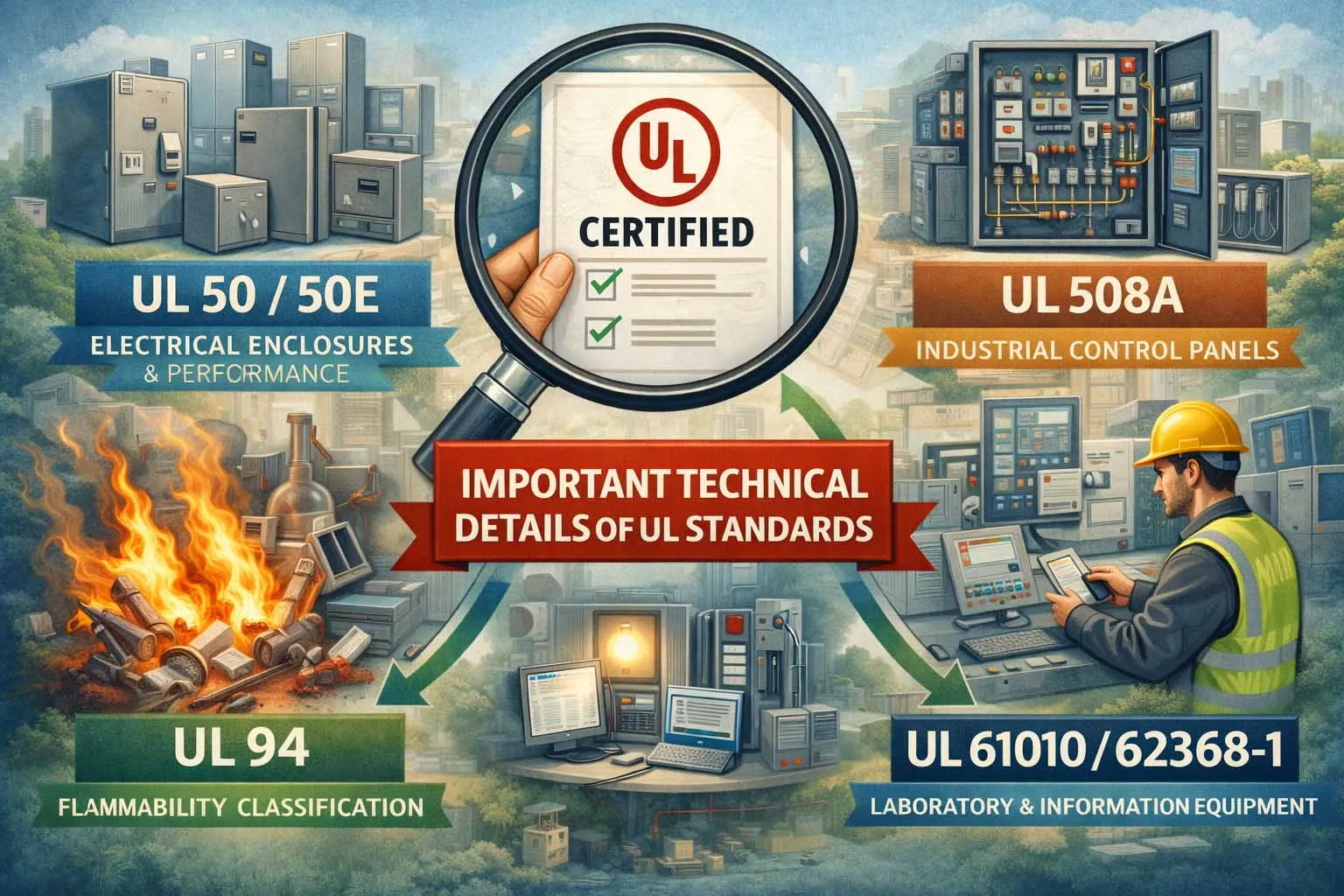
UL certification always points back to a defined standard, product category, and scope of use rather than a single universal approval.
Protection Ratings and Environmental Protection
How Protection Ratings Relate to UL Certification
Protection ratings are one of the most misunderstood parts of the certification discussion. A protection rating describes how well an enclosure or product resists environmental conditions such as dust, water, corrosion, or accidental contact. UL certification, however, is broader than protection alone. A product may be certified for electrical safety, fire behavior, construction integrity, or application suitability, while environmental protection is only one part of the overall picture.
In enclosure and industrial equipment discussions, this means people should not assume that a UL mark automatically tells them the ingress or environmental protection level. Instead, the product must be checked for the specific enclosure type marking, IP code, or related designation that applies to that design. Certification and protection ratings often work together, but they are not interchangeable terms.
UL Type Ratings and NEMA Enclosure Types
In North American practice, enclosure protection is often expressed through Type ratings that align with enclosure definitions familiar from UL and NEMA usage. Common examples include Type 1 for basic indoor protection, Type 3R for outdoor rain resistance, Type 4 for protection against splashing or hose-directed water, Type 4X for added corrosion resistance, and Type 12 or Type 13 for indoor industrial environments involving dust, drips, oil, or noncorrosive coolants.
These ratings are significant because they help determine where an enclosure can be used. An indoor control cabinet and a washdown-area stainless enclosure do not face the same environmental risks, so they should not carry the same type designation. In specification work, the marked enclosure type is often as important as the main certification claim because it helps match the product to the real operating environment.
For harsh environments, the difference between Type 4 and Type 4X can be especially important. Both indicate strong protection against water ingress in demanding conditions, but Type 4X also addresses corrosion resistance, which matters in marine, chemical, food processing, and other aggressive environments.
IP Ratings and Their Relationship to UL Requirements
Many global products also reference IP ratings, such as IP54, IP65, or IP66, based on IEC 60529. These markings describe protection against the ingress of solid objects and water under defined test conditions. IP ratings are widely used in international markets and are very common in electronic devices, industrial components, telecom equipment, and outdoor hardware.
It is important to understand that IP ratings and UL or NEMA Type ratings are not the same system. They answer related but different questions and are based on different frameworks. A product may carry an IP rating, a UL/NEMA Type rating, both, or neither, depending on its design, intended market, and certification path. Engineers should therefore compare them carefully rather than assuming a one-to-one equivalence across every condition.
A UL mark does not automatically tell you the enclosure’s environmental suitability. For that, you must read the marked Type rating, IP code, or other protection designation associated with the certified design.
Applications of UL Certification
Electrical Equipment and Industrial Panels
One of the most common application areas for UL certification is electrical equipment used in commercial, industrial, and infrastructure environments. This includes control panels, disconnect enclosures, power distribution equipment, junction boxes, terminal systems, power supplies, and machine-related electrical assemblies. In these settings, certification helps support inspection, installation approval, and safer product selection.
Industrial applications also rely heavily on correct protection ratings. A panel installed in a clean electrical room may need a very different enclosure type from one mounted outdoors, in a dusty workshop, or near corrosive process chemicals. UL certification combined with appropriate type marking helps translate product design into a more dependable field application.
Consumer, IT, and Communication Devices
UL certification also appears across consumer electronics, household devices, network equipment, chargers, adapters, communication terminals, and many other powered products. In these categories, the certification focus may involve electrical shock hazards, fire risk, abnormal operation, materials performance, or power interface safety. Even when the equipment looks simple from the outside, the certification framework behind it can be technically detailed.
For communication and electronic equipment, certification can matter in enterprise procurement, project tendering, and export sales. Buyers may look for a recognized certification mark not only for end-user trust, but also because project documentation, insurance, or customer acceptance criteria require it.
Building Products, Lighting, and Specialized Installations
Beyond electrical devices, UL certification is also relevant in building materials, fire-rated assemblies, lighting products, alarm devices, and specialized installation products. In these cases, the certification scope may focus on specific properties such as fire resistance, signaling reliability, environmental suitability, or code compliance under defined conditions.
This is why application context matters so much. The same manufacturer may offer one product that is fully listed as an end-use device, another that is recognized only as a component, and a third that is classified for a specific tested property. Understanding the application prevents costly misinterpretation during design or procurement.
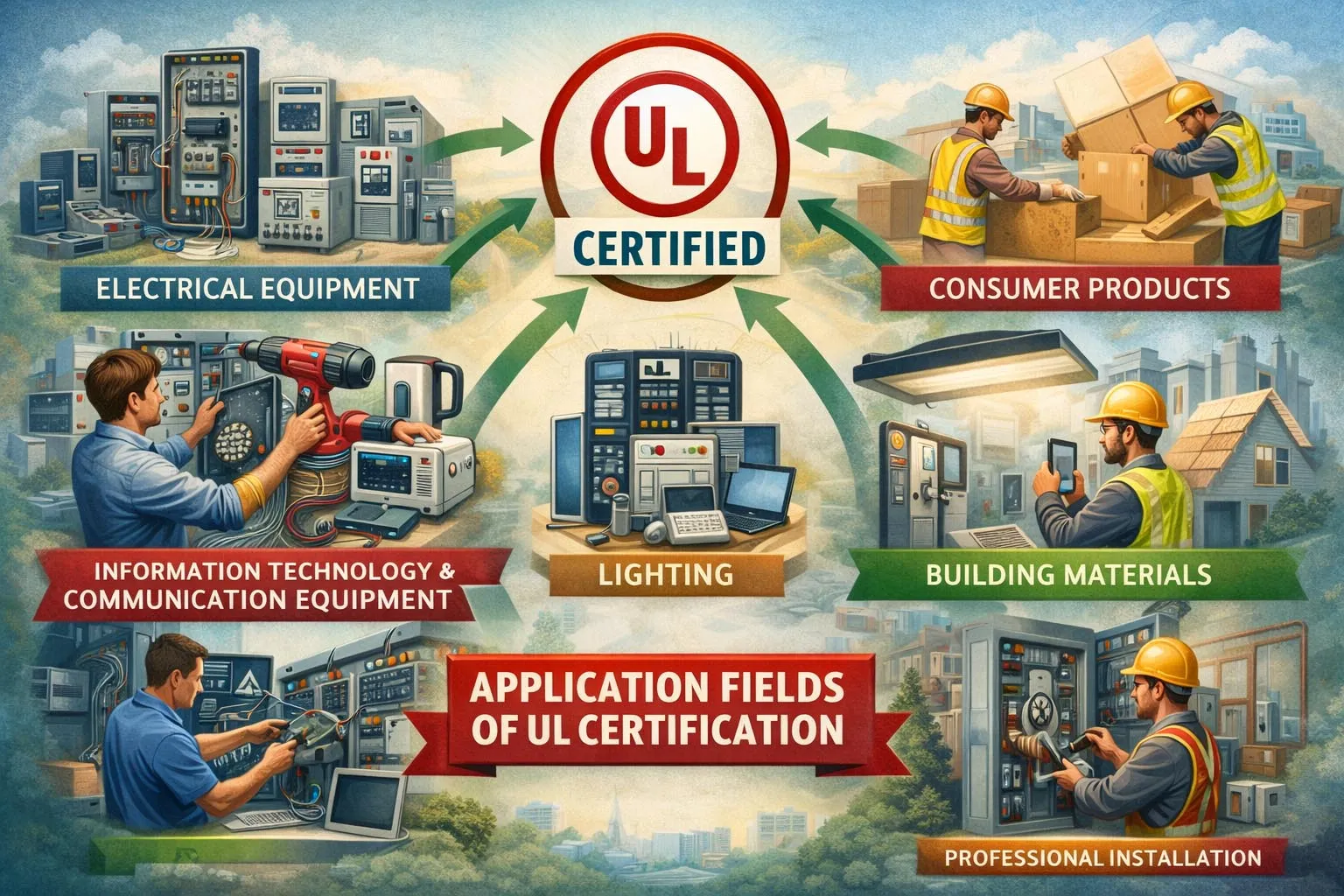
UL certification is used across electrical equipment, industrial systems, communication devices, building products, and many other regulated product categories.
How to Read a UL-Certified Product Correctly
Check the Mark, Scope, and Intended Use
When reviewing a product, the first step is to identify what kind of certification mark it carries. Is it listed, recognized, classified, or part of an enhanced certified marking system? Next, check the category description, rating data, intended environment, electrical values, and any installation limitations. Those details provide the actual engineering meaning behind the certification claim.
This matters because misreading the mark can lead to the wrong product being specified. A recognized component may be entirely appropriate inside a certified end product, but inappropriate as a standalone field-installed item. Likewise, a listed indoor enclosure may not be suitable for washdown or corrosion-prone areas even though it is genuinely UL certified.
Do Not Confuse Certification with Universal Approval
Another best practice is to avoid using “UL certified” as a shortcut for universal suitability. Certification does not cancel the need for proper design review, code compliance, installation practices, or environmental matching. It supports those decisions, but it does not replace them. The authority having jurisdiction, the project engineer, or the equipment designer may still need to confirm that the certified product is appropriate for the specific use case.
For that reason, the strongest approach is to treat UL certification as one layer of compliance evidence within a broader selection process. The certification mark is valuable, but the real technical decision depends on the standard, the ratings, the markings, and the intended application conditions.
The safest purchasing habit is not merely to ask whether a product is UL certified, but to ask what exactly is certified, to which standard, under what mark, and for which environment.
Conclusion
Why UL Certification Remains Important
UL certification remains important because it provides a structured, third-party way to evaluate products against defined safety and performance requirements. It helps connect product design, compliance expectations, installation practice, and market acceptance in a form that engineers, inspectors, buyers, and end users can understand. In many industries, it is a practical bridge between technical evaluation and real-world approval.
At the same time, the subject should be approached with precision. UL certification is not a single standard, not every UL mark means the same thing, and protection ratings such as Type or IP designations must be read separately and carefully. The most useful way to understand certification is to see it as a combination of standard, scope, marking, and intended application. When those pieces are read together, the UL mark becomes far more meaningful and far more useful in product selection.
FAQ
Is UL certification mandatory for every electrical product?
Not in every market and not in every product category. Requirements depend on local regulations, workplace rules, customer specifications, product type, and whether the installation falls under codes or acceptance practices that call for certified equipment. In many commercial and industrial situations, however, third-party certification is strongly expected and may be necessary for approval or procurement.
That is why manufacturers often pursue certification even when a law does not literally require the UL Mark on every unit. Market access, customer trust, and inspection acceptance can make certification practically very important.
What is the difference between UL Listed and UL Recognized?
UL Listed generally refers to a complete product intended for end use or field installation under its certified scope. UL Recognized usually refers to a component intended to be used as part of a larger certified product or system rather than as a standalone installed device.
This difference matters in design and procurement. A recognized relay, power supply, or subassembly may be correct inside a larger product, while the finished product itself may need listing or another certification form before it is suitable for the field.
Is a UL rating the same as an IP rating?
No. UL certification and IP ratings address different aspects of product evaluation. IP ratings describe protection against solid-object ingress and water ingress under IEC-based conditions. UL certification is a broader conformity framework that may include safety, construction, and application requirements, and in enclosure cases may also involve Type ratings.
A product can have both a UL certification mark and an IP rating, but one does not automatically replace the other. The markings should be read together when environmental protection is important.
What does Type 4X mean on a certified enclosure?
Type 4X generally indicates a high level of environmental protection for an enclosure, including protection against water exposure conditions addressed by that type designation as well as corrosion resistance. It is commonly used for demanding industrial, marine, food processing, and outdoor applications where ordinary indoor enclosures would not be appropriate.
Even so, the marked type rating should always be considered together with installation instructions, product category, and the actual exposure conditions. A higher enclosure type does not eliminate the need for proper product selection or correct installation.