In voice communication systems, CAC is most commonly understood as Call Admission Control, a mechanism that decides whether a new call or media session should be allowed onto the network based on available resources and current traffic conditions. Although the phrase “access control” can sound broader, in IP telephony and unified communications the practical meaning of CAC is usually tied to call admission and bandwidth protection. Its main purpose is simple: do not allow more voice sessions than the network can support with acceptable quality.
This matters because voice traffic is highly sensitive to delay, jitter, packet loss, and congestion. A data transfer can often tolerate short interruptions or variable delivery speed, but a live voice call cannot hide those problems well. When too many calls share the same constrained link or network segment, audio quality often drops quickly. Voices become choppy, delayed, robotic, or difficult to understand. CAC helps prevent that situation before it happens.
In practical enterprise deployment, CAC is especially valuable in IP PBX systems, SIP trunking environments, branch office WAN links, multisite unified communications platforms, contact centers, and managed VoIP networks. It acts as a gatekeeper for session quality by deciding whether the network can still support another call without harming the calls already in progress.
What CAC Means in Voice Communication
Definition and Operational Role
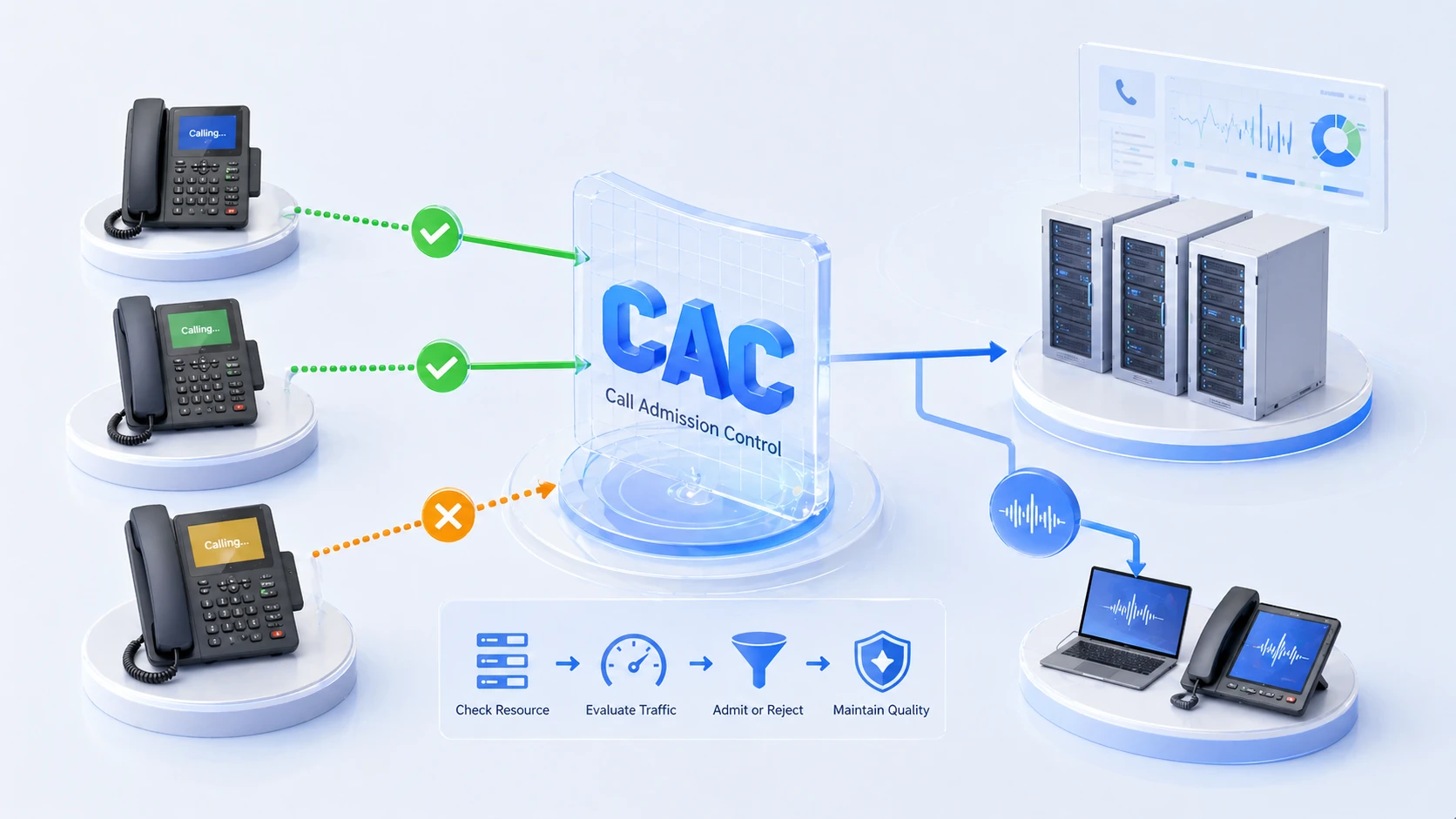
Call Admission Control is a policy-based control function that evaluates network conditions, bandwidth limits, or session thresholds before admitting a new voice call. If the required resources are available, the call proceeds. If they are not, the call may be blocked, rerouted, redirected to another path, downgraded to another service option, or handled according to the organization’s communication policy.
The operational role of CAC is not to improve audio after congestion has already damaged the call. Its role is preventive. It protects quality by limiting oversubscription. In other words, CAC works upstream of the voice problem. Instead of trying to repair broken audio after the network is overloaded, it helps stop overload from happening in the first place.
This is why CAC is often treated as a quality-protection mechanism rather than just a call-counting feature. The decision to reject or defer one more call can preserve acceptable quality for all active users already speaking.
CAC protects voice quality by refusing to pretend that a congested network can deliver unlimited clean conversations at the same time.
Why Voice Networks Need It
Voice traffic is real-time traffic. Once the moment of speech passes, it cannot be retransmitted usefully in the same way as ordinary file data. That makes voice communication particularly vulnerable when the network becomes busy. A voice packet that arrives too late is often almost as bad as a packet that never arrives at all.
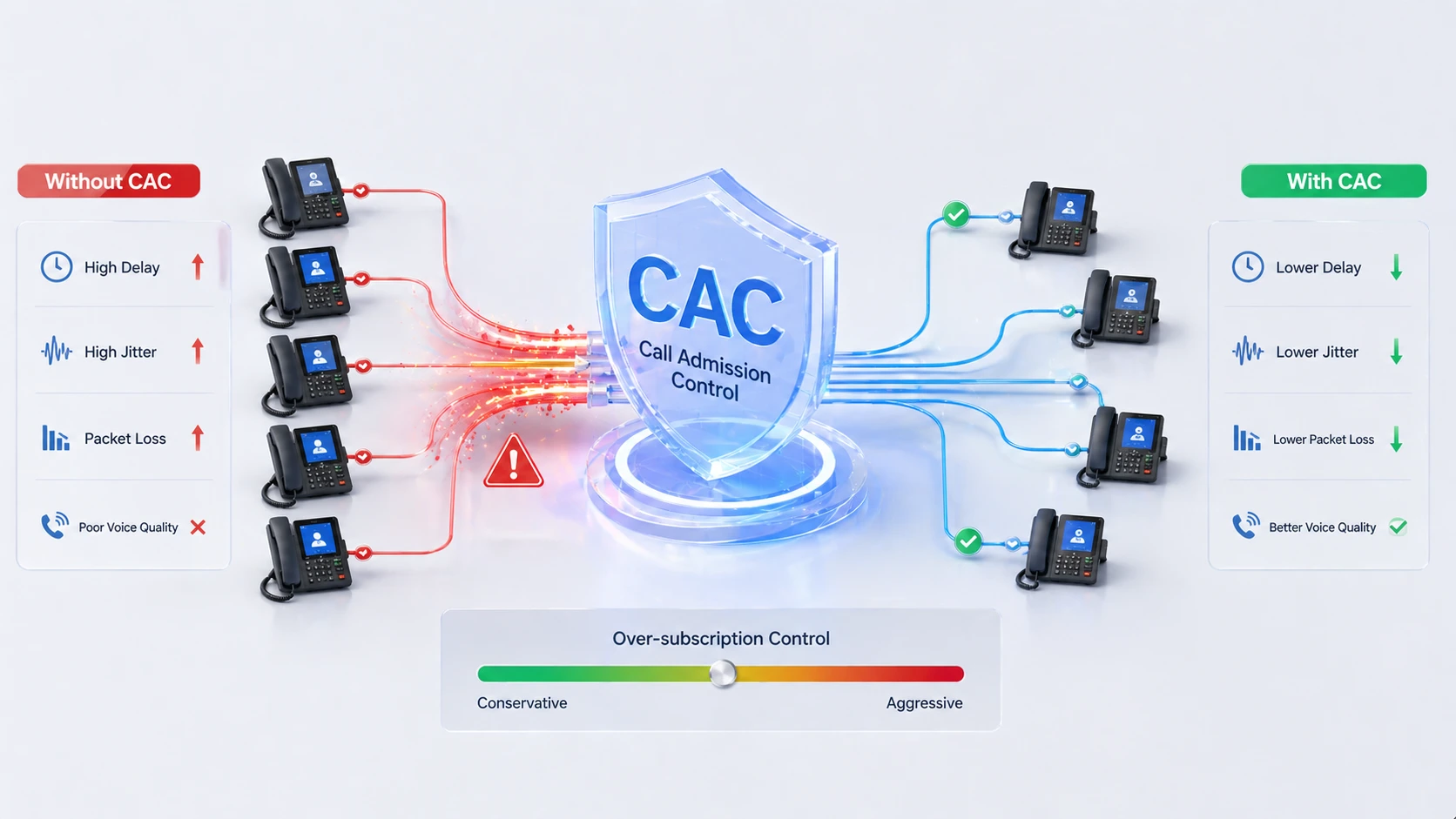
Without CAC, a branch office or constrained WAN path may continue accepting more and more calls until the link is saturated. At that point, all users may suffer rather than only the newest caller. The network technically remains connected, but the communication experience becomes poor. CAC prevents that “everyone degrades together” outcome by enforcing practical limits tied to available resources.
This is especially important in businesses where voice communication supports customer service, team coordination, supervision, or operational continuity. In those environments, preserving stable call quality is more valuable than accepting an unlimited number of low-quality sessions.
How CAC Works Step by Step
Admission Decision Before the Call Proceeds
When a new call attempt is made, the communication platform checks whether enough resources are available for that call to be carried at acceptable quality. Those resources may include available bandwidth, session capacity, codec requirements, policy limits, link utilization, site thresholds, or quality rules defined by the administrator.
If the network condition is healthy and the required capacity exists, the call is admitted. If not, the system can deny the call, route it another way, return a busy treatment, shift the user to voicemail, or apply another response defined in the deployment plan. The exact implementation depends on the platform, but the core mechanism remains the same: evaluate first, admit second.
This sequence is what makes CAC so valuable. It treats call quality as a managed resource instead of an afterthought.
Resource Awareness and Session Protection
CAC usually works by associating each call with a resource cost. For example, a call using a certain codec consumes a predictable amount of bandwidth. The platform tracks how much of the protected resource pool is already in use and how much remains. Once the threshold is reached, additional calls are no longer admitted through that protected path.
This helps ensure that active calls continue to receive the network conditions they need. Rather than allowing the newest session to dilute the quality of every existing session, the system protects the calls already underway. That trade-off is often the right one in professional communications, where stable ongoing conversation is more valuable than uncontrolled session growth.
In a multisite environment, this mechanism is especially useful on WAN links, VPN tunnels, internet uplinks, wireless backhaul, or any shared path where voice and data compete for limited capacity.
CAC is effective because it treats bandwidth and call quality as finite operational assets that must be allocated deliberately.
How CAC Protects Voice Quality Directly
Reducing Congestion on Shared Links
One of the most direct ways CAC protects voice quality is by reducing congestion. When too many calls traverse the same constrained path, the result is usually queue buildup, delay variation, and packet competition with other traffic types. Voice quality then drops for everyone using that path.
By controlling how many voice sessions are admitted, CAC helps keep the link below the point where real-time audio starts to break down. This is especially important on branch office connections, low-bandwidth sites, or hybrid environments where voice shares the same transport with business applications, file traffic, cloud access, and monitoring data.
In practical terms, CAC preserves the breathing room the network needs to deliver intelligible voice instead of pushing utilization until quality collapses.
Controlling Jitter, Delay, and Packet Loss Exposure
Voice communication quality is damaged most visibly by three issues: excessive delay, jitter, and packet loss. Congested networks create all three. Packets may wait too long in queues, arrive at uneven intervals, or be dropped entirely when buffers overflow. The result is speech that sounds clipped, robotic, delayed, or unnatural.
CAC helps reduce exposure to these problems by limiting new session entry when the network is already near its practical limit. It does not eliminate every cause of jitter or loss, but it helps avoid one of the most common ones: avoidable oversubscription. That makes the network environment more stable for active real-time traffic.
In other words, CAC protects voice by controlling the conditions that tend to damage voice first.
CAC and Other Voice Quality Mechanisms
CAC Is Not the Same as QoS
CAC is closely related to QoS, but the two are not identical. QoS prioritizes traffic and influences how packets are treated once they are already on the network. CAC decides whether a new session should be allowed onto the network in the first place. QoS manages traffic behavior during transmission, while CAC controls admission before congestion gets worse.
This distinction matters because voice quality usually benefits from both. QoS alone may not be enough if the network is accepting more calls than the protected path can reasonably support. Likewise, CAC alone may not deliver the best result if voice packets are admitted but then treated no differently from bulk data traffic. Together, they create a more disciplined real-time communication environment.
In well-designed systems, CAC and QoS work as complementary controls rather than competing ones.
Relationship With Codec Choice and Bandwidth Planning
CAC also works closely with codec policy and bandwidth planning. Different codecs consume different amounts of bandwidth and may respond differently to poor network conditions. A deployment that uses compressed codecs over constrained WAN paths may allow more calls than one using higher-bandwidth wideband codecs, but the trade-offs must still be understood clearly.
This means CAC is not just a switch that turns call limiting on or off. It depends on realistic assumptions about the media stream, packet overhead, signaling behavior, and reserved capacity. Good CAC policy therefore begins with accurate network design, not with guesswork.
When the bandwidth model is realistic, CAC becomes far more effective as a voice protection measure.
Main Benefits of CAC in Real Deployments
More Consistent Voice Quality
One of the biggest benefits of CAC is more consistent call quality across busy periods. Instead of allowing call quality to degrade unpredictably as usage rises, the system enforces practical limits. This creates a more stable communication experience for active users.
Consistency matters in business communication because users notice unstable quality quickly. A phone platform that works well in light conditions but fails during busy hours creates mistrust and weakens adoption. CAC helps avoid that by keeping performance within more controlled boundaries.
In practical deployment terms, this means fewer complaints about choppy audio, less confusion during critical conversations, and better confidence in the platform.
Better Protection for Existing Calls
CAC also protects the quality of calls already underway. Without admission control, every new call admitted onto a constrained link may increase the risk of quality degradation for everyone else. With CAC, the newest call does not automatically get to consume resources at the expense of active conversations.
This is especially useful in offices, contact centers, support teams, and multisite businesses where the continuity of an ongoing call may matter more than the convenience of allowing one more low-quality session. In other words, CAC protects the value of the communication that is already happening.
That protection is one of the strongest reasons CAC is used in professional voice environments.
CAC does not only control new calls. It protects the quality commitment made to users who are already in conversation.
Additional Operational Advantages
More Predictable Capacity Management
CAC gives administrators and planners a more predictable way to manage limited voice capacity across shared paths. Instead of relying on optimistic assumptions about how many simultaneous calls a link might survive, the organization can define controlled thresholds tied to real design values.
This improves planning discipline. Branch capacity, codec usage, WAN design, and multisite call behavior become easier to model when admission is controlled. That predictability is especially helpful in distributed businesses where communication demand varies but link constraints remain real.
In practical terms, CAC turns capacity planning from a rough estimate into an enforced operating rule.
Reduced Risk During Peak Activity
Peak activity is where voice systems often reveal their weaknesses. Shift changes, customer surges, incident response periods, and multisite coordination events can all create short-term spikes in concurrent calling. If the platform admits every new session without discipline, quality can fall just when communication is most important.
CAC reduces that risk by keeping the system from overcommitting the protected path. Even if not every new call can be admitted, the admitted calls are more likely to remain usable. In real operational environments, that is often the better outcome.
This makes CAC especially valuable in organizations that depend on stable voice during busy or time-sensitive conditions.
Applications of CAC in Voice Communication
Branch Offices and Multisite WAN Environments
One of the most common applications of CAC is in branch office WAN environments where multiple sites share limited interoffice bandwidth for voice and data. In these cases, the central challenge is simple: the link is not infinite, and voice must not be allowed to overwhelm it.
CAC helps by controlling how many calls can traverse the site-to-site path at once. This prevents branch links from being saturated by excessive concurrent sessions and helps preserve acceptable audio quality for the calls that are admitted. It is particularly useful where the WAN also carries business applications, VPN traffic, cloud access, and routine data flows.
In multisite enterprise telephony, this is one of the most practical and widely understood uses of CAC.
SIP Trunks, Unified Communications, and Managed VoIP
CAC is also relevant in SIP trunking, unified communications, and managed VoIP environments where session growth can affect service quality or infrastructure stability. Even when external bandwidth seems strong, practical quality still depends on how sessions are admitted and how resources are consumed across the full communication path.
In these deployments, CAC may help control concurrent session load, enforce branch-specific rules, protect media paths, and support service consistency under business demand. This is especially useful when communication platforms serve many users across locations with mixed traffic profiles.
The more distributed and shared the environment becomes, the more helpful disciplined admission control usually is.
Best Practices for CAC Deployment
Base Policies on Real Bandwidth, Not Optimism
One of the most important deployment principles is to build CAC policy on real measured or engineered bandwidth assumptions rather than on ideal link labels. A WAN sold as a certain capacity may not always deliver that performance under all operating conditions, and usable bandwidth for voice is rarely equal to the raw number printed in service documentation.
Administrators should account for protocol overhead, codec behavior, signaling load, competing traffic, and realistic headroom. When CAC thresholds are based on optimistic assumptions, the mechanism may appear configured correctly while still admitting more calls than the path can support comfortably.
Practical CAC begins with disciplined bandwidth understanding, not with theoretical maximums alone.
Align CAC With QoS and Real Traffic Behavior
CAC works best when it is aligned with QoS policy and observed traffic patterns. If voice traffic is admitted carefully but then not prioritized properly, quality can still suffer. If QoS is configured but CAC allows too many sessions, congestion pressure may still undermine performance.
The strongest design treats CAC and QoS as part of one coordinated strategy for real-time communication. That strategy should also be reviewed under actual usage, especially during busy periods, branch link pressure, and multisite calling events.
In practical terms, CAC is most effective when it is not deployed as a checkbox feature but as part of a realistic voice quality architecture.
CAC delivers the best results when it is engineered as part of a wider voice-quality policy, not as a standalone limit with no supporting traffic discipline.
Limitations and Trade-Offs
Protecting Quality May Mean Rejecting Calls
CAC protects quality by limiting admission, which means it sometimes says no. That is its strength, but it can also feel restrictive if not explained well. Users or managers may wonder why a network that appears available is not allowing one more call. The answer is usually that the system is protecting quality rather than pretending the call can be carried safely.
This trade-off must be understood in deployment planning. CAC does not maximize raw session acceptance. It maximizes acceptable voice performance within resource limits. In many business environments, that is the correct priority, but expectations should still be managed clearly.
In short, CAC improves communication quality by accepting that not every call should be admitted under every condition.
CAC Does Not Replace Good Network Design
Another important limitation is that CAC cannot fix a poorly designed network by itself. If latency is consistently high, links are unstable, routing is poor, or QoS is absent, CAC may still help somewhat, but it will not magically create high-quality voice from a bad transport environment.
CAC is most effective as a protective mechanism layered on top of a competent network design. It complements good architecture; it does not substitute for it. Organizations still need appropriate bandwidth, sound routing, traffic prioritization, and reliable infrastructure.
This is why CAC should be viewed as part of the answer, not the entire answer, to voice quality assurance.
Conclusion
In voice communication, CAC ensures quality by controlling whether new calls are allowed onto the network based on available resources and policy limits. Its core value lies in preventing oversubscription, reducing congestion pressure, and protecting active conversations from the packet loss, jitter, and delay that overloaded links often create.
It works best in branch office WANs, multisite VoIP deployments, SIP trunking environments, and shared real-time communication networks where voice competes with other traffic and resource limits are real. By deciding carefully before the call is admitted, CAC helps preserve a more stable and intelligible communication experience.
For enterprises that depend on professional voice quality, CAC is not simply a technical restriction. It is a practical quality-control discipline that helps the network carry conversations it can truly support instead of promising more than it can deliver.
FAQ
What does CAC mean in voice communication?
In voice communication, CAC usually means Call Admission Control. It is a mechanism that decides whether a new call should be admitted based on available network resources and defined policy rules.
Its purpose is to protect voice quality rather than allow unlimited call growth.
How does CAC improve VoIP call quality?
CAC improves VoIP quality by limiting the number of simultaneous calls on constrained paths so the network does not become overloaded. This helps reduce congestion-related packet loss, jitter, and delay.
The result is usually more stable and intelligible active calls.
Is CAC the same as QoS?
No. QoS prioritizes traffic after it is already on the network, while CAC decides whether a new call should be admitted in the first place. They are related, but they perform different roles.
In many voice deployments, the best results come from using both together.