Call routing is the process of directing a telephone call to the most appropriate destination based on predefined rules, real-time conditions, user logic, or network policy. In simple terms, it determines where a call should go and how it should get there. Instead of sending every call to one fixed endpoint, a call routing system can evaluate numbers, departments, availability, time schedules, location rules, business priorities, and communication paths before deciding how to handle the session.
This is one of the most important functions in modern business telephony, IP PBX platforms, SIP communication systems, contact centers, enterprise voice networks, and unified communications environments. Without call routing, a communication platform would behave like a basic line connection rather than an intelligent business service. Users would have fewer options for organizing calls, and organizations would struggle to control how customer inquiries, internal calls, branch communication, and service requests are distributed.
In real deployment, call routing is much more than a back-end technical process. It directly affects call efficiency, response time, user experience, business continuity, and service organization. A well-designed routing structure can reduce missed calls, distribute workload more logically, and help the communication system reflect the actual operational structure of the organization.
What Is Call Routing?
Definition and Core Meaning
Call routing refers to the logic and mechanism used to send a call from its point of origin to the correct destination or service path. The destination may be a desk phone, softphone, extension group, operator console, IVR menu, call queue, voicemail, mobile endpoint, branch office, SIP trunk, or another communication platform.
The core meaning of call routing is controlled call direction. It allows the system to decide that one call should go to a sales group, another to technical support, another to a branch office, and another to voicemail if no one is available. This controlled behavior turns telephony into a managed communication service rather than a simple ringing device model.
In business environments, this control is essential because not every call should follow the same path. Different callers, different departments, and different service conditions often require different handling logic.
Call routing is the intelligence layer that turns a phone system from a connection tool into an organized communication system.
Why Call Routing Matters
Call routing matters because communication demand is rarely uniform. Customers may call for support, billing, sales, emergencies, internal coordination, or branch contact. Employees may need to reach different teams based on schedule, responsibility, language, site, or expertise. If every call were sent the same way, the result would often be delay, confusion, and inefficient workload distribution.
Routing solves that problem by introducing structure. It helps ensure that calls reach the most relevant destination faster and with less manual intervention. In a small office, that may simply mean routing reception calls to the right extension group. In a larger enterprise or multisite network, it may involve time-based rules, least-cost routing, failover paths, SIP trunk decisions, queue logic, and policy-based service treatment.
This makes call routing one of the most practical and operationally important parts of any serious communication platform.
How Call Routing Works
Rule Evaluation and Destination Selection
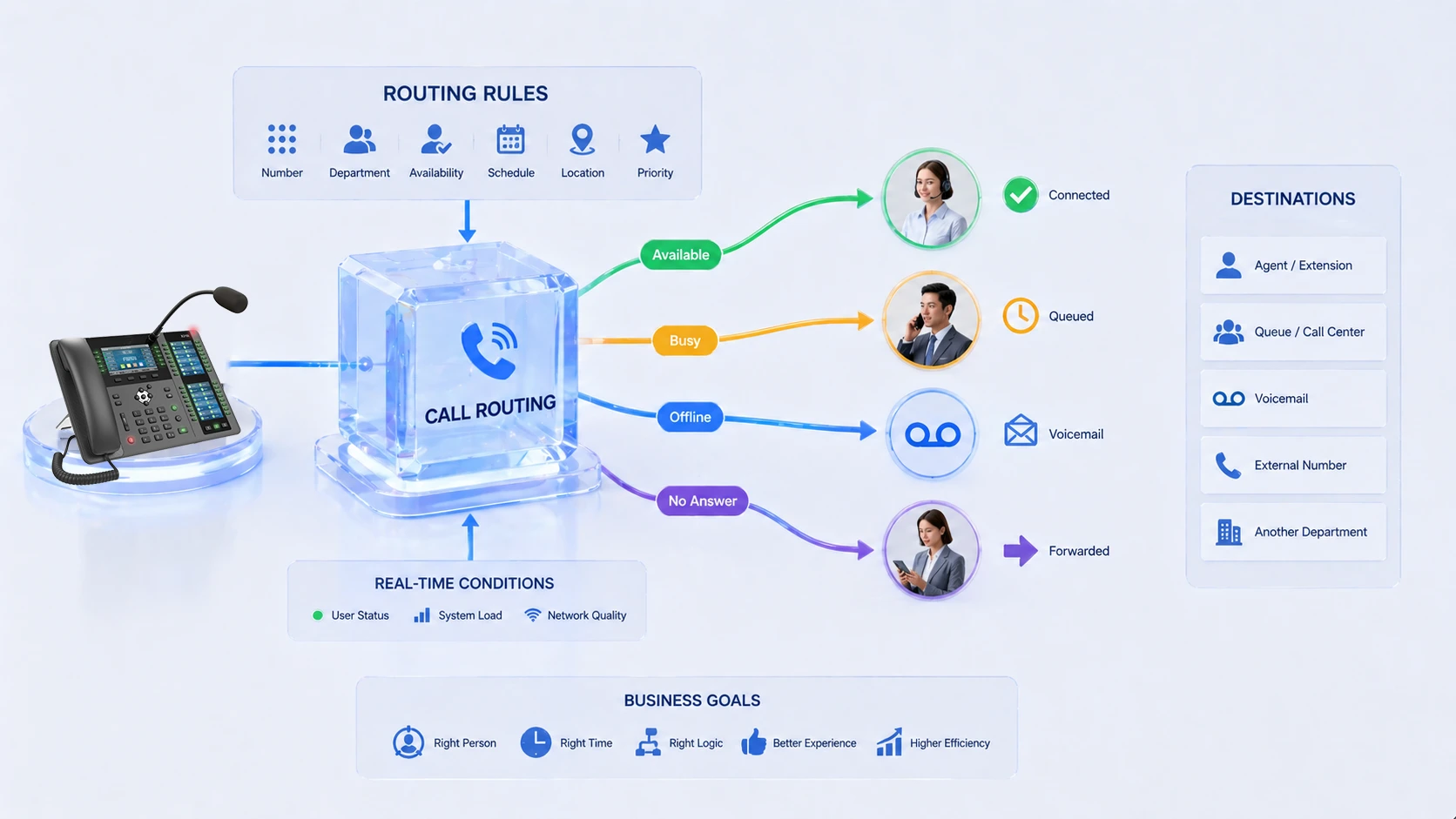
The call routing process usually begins when an incoming or outgoing call enters the communication platform. The system then evaluates routing rules that may include dialed number patterns, caller identity, extension logic, business hours, queue status, endpoint availability, site rules, or service priorities. Based on those conditions, the platform decides where the call should go next.
In a simple environment, the rule may be direct and static, such as sending all calls for a department number to one ring group. In a more advanced system, the logic can be layered and dynamic. A call may first go through an IVR menu, then be routed to a skills-based queue, then overflow to another site if the first group is unavailable, and finally be sent to voicemail if no route remains.
This step-by-step decision process is what gives call routing its flexibility. The call does not just ring randomly. It moves according to defined communication logic.
Routing Paths Across Internal and External Networks
Call routing is not limited to one local switch or office device. In IP and SIP-based systems, the route may cross internal LAN segments, WAN links, SIP trunks, cloud communication nodes, branch systems, or external carrier networks. The routing engine decides not only who should receive the call, but also which network path or signaling relationship should carry it.
This is especially important in modern enterprise telephony, where organizations often use hybrid environments that combine desk phones, soft clients, mobile integration, remote workers, branch offices, and carrier services. Routing logic must therefore align both communication intent and network reachability.
In practical terms, good call routing is both a business logic function and a network control function.
A call routing system does not only answer “who should get the call.” It also answers “how should the call reach them.”
Main Features of Call Routing
Direct Routing, Group Routing, and Queue Routing
One of the most basic features is direct routing, where calls are sent to a specific extension, device, or destination. This is useful for personal numbers, executive lines, known staff contacts, and straightforward internal communication.
Group routing is another common feature. Calls can be directed to ring groups, hunt groups, call queues, or shared response teams rather than one individual endpoint. This is especially valuable for sales desks, reception teams, support lines, and department-level numbers where multiple people may answer.
Queue routing adds even more structure by holding the caller in an ordered waiting state until the correct agent or team becomes available. This helps balance demand rather than overwhelming one endpoint or leaving calls unanswered.
Time-Based, Condition-Based, and Policy-Based Routing
Many systems also support time-based routing. Calls can be handled differently during office hours, after hours, holidays, or shift periods. For example, a daytime business number may ring a department group, while the same number routes to voicemail, a duty phone, or an on-call team after hours.
Condition-based routing extends this flexibility further. The platform may route based on endpoint availability, queue load, branch health, number patterns, or network condition. Policy-based routing can incorporate business rules such as language service, regional distribution, branch preference, emergency priority, or compliance requirements.
These features make call routing adaptable to real operational needs instead of forcing one call model onto every communication scenario.
Network Architecture of Call Routing
Core Routing Layer in PBX and SIP Systems
In most enterprise architectures, the core call routing logic sits inside an IP PBX, SIP server, unified communication platform, hosted PBX environment, or contact center control layer. This central routing engine interprets dial plans, user registrations, number mapping, service rules, and trunk relationships before deciding where each call should go.
In SIP-based environments, this may involve signaling exchanges between endpoints, proxy functions, registrar logic, session border elements, media control policies, and interconnection with upstream carriers or cloud voice services. The routing decision is therefore tied to both the user-facing dial plan and the network-facing session path.
This central role makes the routing layer one of the most strategic parts of the communication architecture. If the routing logic is well designed, the rest of the voice environment becomes easier to manage and scale.
Edge Connectivity, Trunks, and Multisite Paths
Call routing architecture also depends on edge connectivity. Internal calls may stay within the LAN or enterprise SIP domain, while external calls may be sent through SIP trunks, media gateways, analog interfaces, PRI/E1 links, or cloud carrier connections. In multisite environments, routing may decide whether a call stays local, crosses a WAN, or exits from a branch-specific trunk.
This becomes particularly important when organizations want to optimize cost, reduce latency, improve resilience, or keep branch communication aligned with local numbering and carrier behavior. Routing therefore influences not only service organization, but also network efficiency and external connectivity strategy.
In practical enterprise design, the routing architecture often sits at the intersection of user logic, numbering policy, and transport design.
Call Routing and Business Communication Logic
Aligning Telephony With Organizational Structure
One of the biggest strengths of call routing is that it allows the phone system to reflect the real structure of the organization. Instead of treating every endpoint equally, the system can map calls according to departments, branches, roles, service teams, business hours, escalation paths, and operational responsibilities.
This alignment makes communication easier to manage. Callers reach the right team more quickly, internal staff know how numbers behave, and administrators can shape call flow around actual service models rather than artificial numbering limitations.
In this sense, call routing is not just a technical control. It is a business organization tool implemented through telephony.
Supporting Customer Experience and Internal Efficiency
Routing also supports better customer experience. If calls are sent more accurately, customers spend less time waiting, transferring, or repeating the same request to multiple people. At the same time, internal efficiency improves because teams receive calls more appropriate to their role instead of becoming overloaded with misdirected inquiries.
This is one reason why routing design has direct commercial consequences. A business may invest heavily in phones, trunks, and platforms, but poor routing can still produce a weak user experience. By contrast, a well-routed system often feels faster and more professional even when the hardware itself is relatively ordinary.
In real business communication, routing quality often determines whether the platform feels organized or frustrating.
Good call routing improves service not by making calls louder or faster, but by making them smarter and more relevant from the start.
Advantages of Call Routing
Better Call Distribution and Reduced Missed Calls
One major advantage is better distribution of communication workload. Instead of overwhelming one phone or one person, the system can spread incoming traffic across a group, queue, or defined set of available users. This helps reduce missed calls and prevents unnecessary pressure on a single endpoint.
In larger environments, this distribution is essential because demand often varies by time of day, department, or service type. Routing logic helps absorb that variation more effectively than a flat call-handling model.
The result is often greater answer consistency and fewer lost communication opportunities.
Greater Flexibility and Operational Control
Call routing also gives organizations more control over how voice traffic is treated. Administrators can change routing based on schedules, campaigns, emergencies, staffing levels, site conditions, or business policy. This flexibility is extremely useful because communication demand rarely stays fixed.
With strong routing control, the organization can adapt the platform to new needs without rebuilding the entire telephony environment. Departments can grow, sites can be added, queues can be adjusted, and branch policies can change while the core communication platform remains stable.
In practical terms, routing makes the voice system more manageable over time rather than locking it into one rigid call pattern.
Applications of Call Routing
Office Systems, Customer Service, and Departmental Telephony
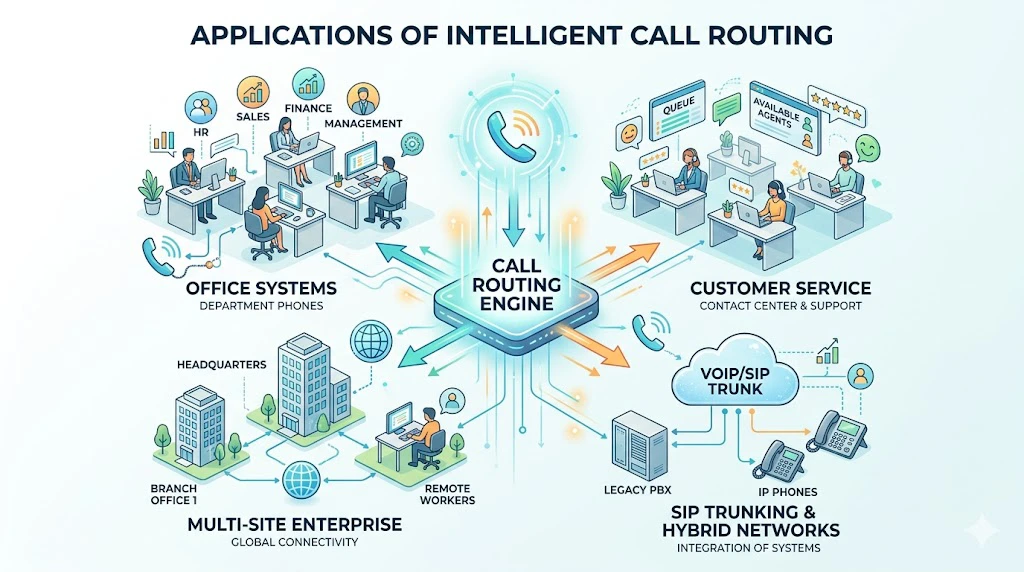
Call routing is used extensively in office communications, business phone systems, reception workflows, departmental service numbers, and customer-facing voice environments. A business may route general inquiries to reception, support calls to technical teams, sales calls to ring groups, and executive numbers to direct extensions or assistants.
This structure helps the organization present a more coherent communication model to customers and partners while making internal call handling easier to manage. Even simple businesses benefit from routing when more than one person or department is involved in call answering.
In these environments, routing often becomes one of the most frequently adjusted parts of the telephony system because it directly affects daily communication outcomes.
Multisite, SIP Trunking, and Hybrid Communication Networks
Call routing is also central in multisite and SIP-based communication deployments. Organizations may want internal calls between branches to stay on-net, local outbound calls to exit through the nearest trunk, failover calls to use an alternate route, and remote staff to remain reachable through the same numbering structure as office users.
In hybrid voice networks, routing logic becomes even more important because the environment may combine desk phones, cloud telephony, SIP trunks, media gateways, remote workers, soft clients, and legacy carrier connectivity. Routing is what keeps these different elements functioning as one usable communication platform.
This is why call routing is not only a feature for call centers. It is a core requirement for modern enterprise telephony architecture more broadly.
Maintenance Tips and Good Design Practices
Keep Routing Rules Documented and Logical
One important maintenance principle is to keep routing logic documented clearly. As systems grow, routing rules can become layered and difficult to understand if they are modified repeatedly without proper records. This can lead to unexpected call behavior, hidden loops, failed overflow paths, or administrator confusion.
Good documentation helps teams understand which numbers route where, which schedules apply, which fallback paths exist, and how special cases are handled. This is especially important in multisite, customer service, and hybrid SIP environments where routing complexity can increase quickly.
Clear routing documentation is therefore a practical operational safeguard, not just a technical convenience.
Test Failover, Overflow, and Exceptional Conditions
Another good practice is to test routing behavior beyond ordinary scenarios. Many systems behave correctly in normal daytime conditions but fail in overflow, after-hours, or outage situations because those branches of logic were never tested properly. This can create serious communication failures exactly when flexibility is needed most.
Organizations should therefore verify not only standard routing, but also alternate paths, busy conditions, failover logic, queue overflow, unavailable users, and time-based changes. This ensures the routing design works under real operational pressure rather than only in ideal conditions.
In practical terms, a routing rule is only as good as its behavior when conditions stop being simple.
The quality of a call routing design is often revealed not in ordinary office hours, but in the moments when the expected destination is no longer available.
Conclusion
Call routing is the mechanism that directs calls to the right destination through the right communication path based on rules, conditions, and business logic. Its features range from direct extension routing and queues to time-based policies, SIP path selection, and multisite call distribution. It is therefore both a user-facing service function and a network architecture function.
In enterprise and VoIP environments, call routing plays a central role in making communication organized, scalable, and efficient. It improves workload distribution, supports better customer experience, aligns telephony with business structure, and helps the communication platform behave intelligently instead of mechanically.
For organizations designing serious voice systems, call routing is not a secondary configuration detail. It is one of the core controls that determines how useful the phone system will actually be in daily operations.
FAQ
What is call routing in simple terms?
In simple terms, call routing means deciding where a call should go and how it should get there. It allows a phone system to send different calls to different users, groups, or services based on rules.
It makes the communication platform more organized and more useful.
What are the main features of call routing?
Main features include direct routing, group routing, call queues, time-based routing, condition-based routing, overflow handling, and SIP or trunk path selection. These features help the system respond to different business and network situations.
Together, they give the organization more control over call flow.
Why is call routing important in IP PBX and SIP systems?
It is important because IP PBX and SIP systems often involve multiple users, branches, devices, and network paths. Call routing ensures calls reach the right destination efficiently while aligning with business rules and network architecture.
Without good routing, even a powerful communication platform can feel disorganized and inefficient.